
 Thabo Nkosi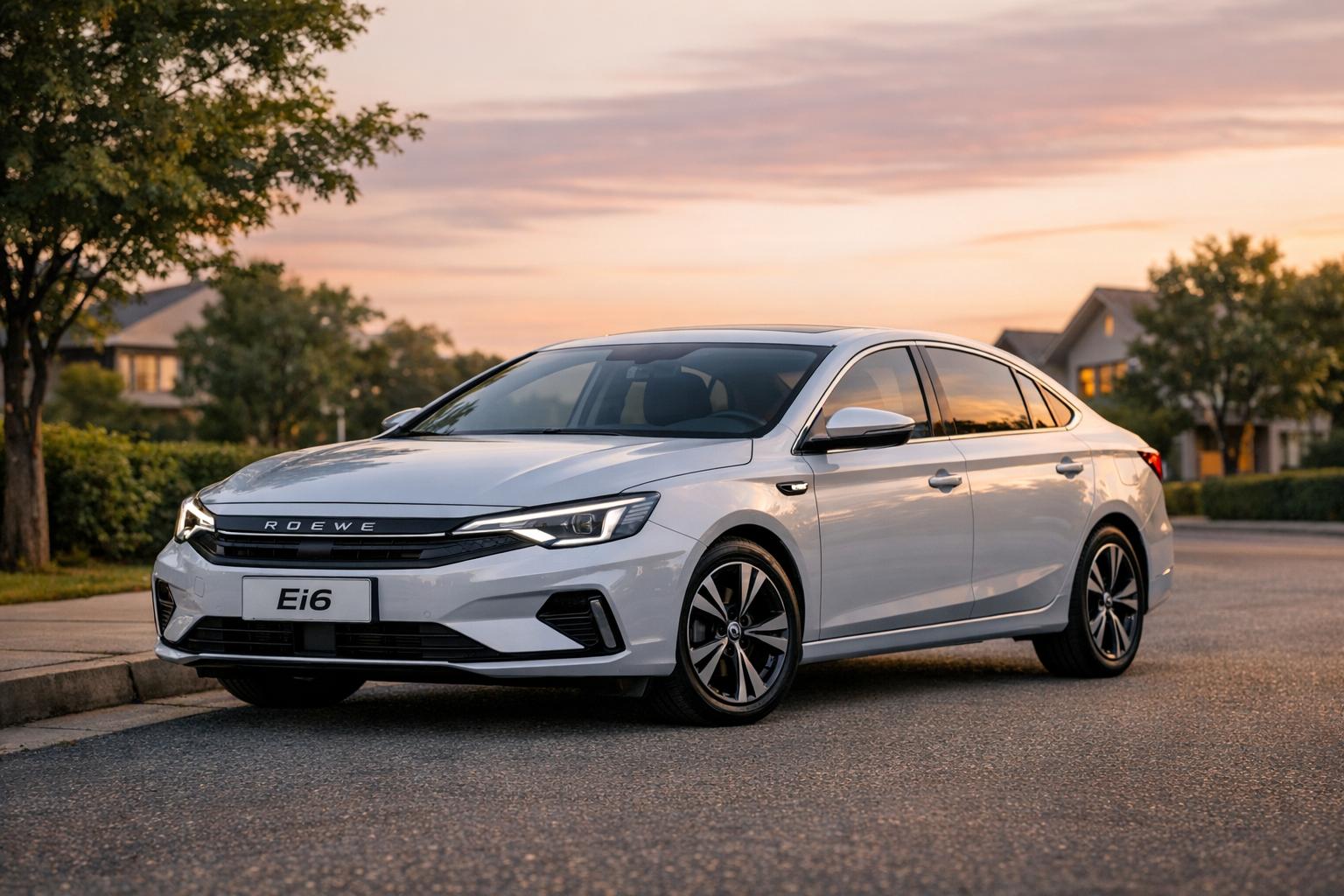
The Roewe Ei6 Plug-In Hybrid is designed for city drivers seeking fuel efficiency and electric range. With an all-electric range of 53–70 km (33–43 mi) and a combined range of up to 705 km (438 mi), it caters to urban commuters while offering a backup gasoline engine for longer trips. The MAX variant boasts impressive fuel efficiency at 1.1 L/100 km (~214 mpg) and enhanced performance with 228 horsepower and 622 Nm of torque. However, its low ground clearance (115 mm) and reliance on charging infrastructure limit its suitability for rural or rugged terrains, especially in regions with inconsistent electricity access.
Key Highlights:
- Fuel Efficiency: MAX variant achieves 1.1 L/100 km (~214 mpg); standard model offers 1.5 L/100 km (157 mpg).
- Electric Range: Covers 53–70 km (33–43 mi) on electric power alone.
- Performance: Delivers 228 hp and 622 Nm torque, with 0–62 mph in 7.9 seconds.
- Challenges: Limited ground clearance, small fuel tank, and charging infrastructure gaps in some regions.
- Price Range: Approx. $20,840–$25,210.
While ideal for city driving, the Ei6 faces hurdles in rural areas and regions with limited charging options. Buyers should weigh its urban advantages against its rural limitations.
ДОЖДАЛИСЬ! САМЫЙ ДОСТУПНЫЙ ГИБРИДНЫЙ АВТОМОБИЛЬ 2025 ГОДА (ROEWE I6)! НОВЫЕ КИТАЙСКИЕ АВТО
Fuel Economy and Performance Metrics
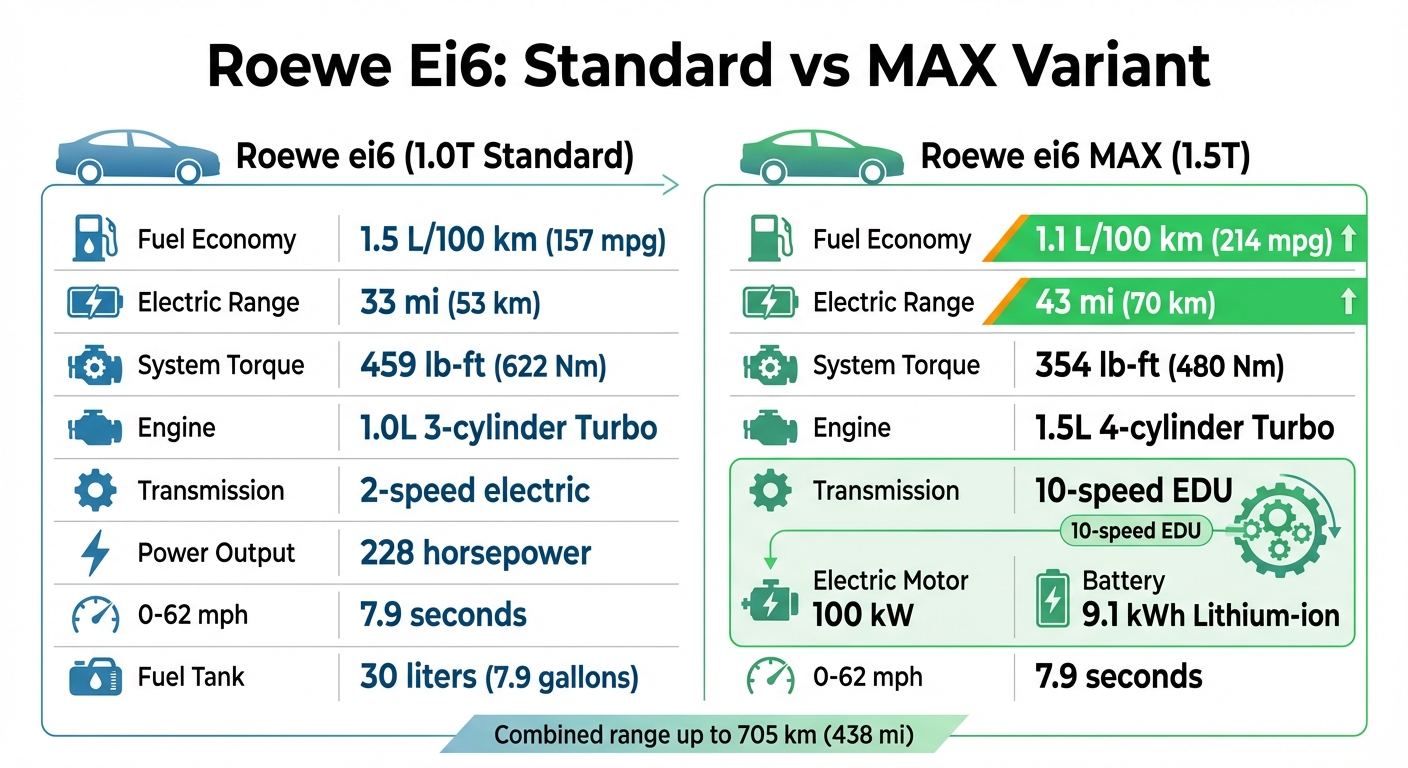
Roewe Ei6 Standard vs MAX Variant Specifications Comparison
The Roewe Ei6 stands out in the plug-in hybrid market, particularly with its MAX variant achieving an impressive fuel efficiency of 1.1 L/100 km (~214 mpg). Even the standard model holds its own in terms of efficiency. When it comes to electric-only driving, the standard model offers a range of 33 miles (53 km), while the MAX variant extends that to 43 miles (70 km).
The MAX version combines a 1.5L four-cylinder turbocharged engine delivering 178 PS (131 kW) with a 100 kW electric motor and an advanced 10-speed EDU transmission. For a clearer comparison, here’s a breakdown of key specifications:
| Specification | Roewe ei6 (1.0T) | Roewe ei6 MAX (1.5T) |
|---|---|---|
| Fuel Economy | Competitive | 1.1 L/100 km (~214 mpg) |
| Electric Range | 33 mi (53 km) | 43 mi (70 km) |
| System Torque | 459 lb-ft (622 Nm) | 354 lb-ft (480 Nm) |
| Engine | 1.0L 3-cyl Turbo | 1.5L 4-cyl Turbo |
| Transmission | 2-speed electric | 10-speed EDU |
| Battery | N/A | 9.1 kWh Lithium-ion |
The MAX variant’s enhanced battery system plays a significant role in its urban efficiency. While the standard model produces 228 horsepower and 622 Nm of torque (459 lb-ft), the MAX version generates 480 Nm (354 lb-ft). Both versions deliver quick acceleration, reaching 0-62 mph (0-100 km/h) in 7.9 seconds. The standard model is equipped with a 30-liter (7.9-gallon) fuel tank, emphasizing its design for frequent charging rather than relying solely on gasoline for extended trips.
The engineering behind the MAX variant is particularly suited for practical and demanding driving conditions. Its 10-speed EDU transmission, featuring three-chamber independent lubrication, ensures smoother power delivery and enhances durability. This is especially important for plug-in hybrids, which tend to face 80% more reliability issues compared to traditional gas-powered vehicles due to their complex systems. The Roewe Ei6’s thoughtful design addresses these challenges, making it a compelling choice for drivers seeking efficiency and performance.
Performance in African Driving Conditions
The Ei6 shines when it comes to urban efficiency, but its design encounters hurdles in Africa’s rugged and diverse driving environments. With a ground clearance of just 4.53 inches (115 mm) and a front-wheel-drive system, the car struggles on rough, uneven, or muddy roads. These conditions, often found in many parts of Africa, can lead to scraping and reduced performance on rutted or rocky terrain.
The climate also plays a significant role in how the Ei6 performs. High temperatures, common in many African regions, can impact battery efficiency. Still, recent developments suggest that electric and hybrid vehicles can handle these challenges. For instance, Burkina Faso introduced 30 electric taxis in Ouagadougou in early 2025, with plans to expand the fleet to over 100 by the end of the year, replacing older vehicles. While this shows promise, the potential for battery degradation under extreme heat remains a concern that needs close attention.
Charging infrastructure, however, presents the biggest hurdle for the Ei6 in Africa. In South Africa, frequent load shedding and the scarcity of public charging stations in rural areas force the car to rely more heavily on its gasoline engine. This reliance diminishes its advertised efficiency due to the added weight of the battery. As Charmaine Nkosi, an Impact & Sustainability Consultant, explained:
"Without a stable electricity supply, traditional grid-connected EV chargers could face disruptions, limiting their effectiveness".
This lack of charging options becomes even more problematic during long-distance travel. The Ei6’s relatively small fuel tank can be a disadvantage in areas with minimal charging infrastructure. However, there is some progress in addressing this issue. South Africa launched its first off-grid, solar-powered charging station in Wolmaransstad in March 2025, with plans to install 120 more along major highways. These stations offer a partial solution, though owners will still benefit from setting up home charging systems – preferably solar-powered – to fully leverage the hybrid system’s potential. The gasoline engine remains an essential backup, especially in regions where pure electric vehicles might falter.
sbb-itb-99e19e3
Pros and Cons
The table below highlights the key strengths and weaknesses of the Ei6, particularly in the African context. While the vehicle shines in areas like fuel efficiency and urban usability, it faces challenges when navigating rougher terrains and addressing regional infrastructure limitations.
| Strengths | Weaknesses |
|---|---|
| Impressive fuel efficiency at 1.5 L/100 km (157 mpg), offering significant cost savings in areas with high fuel prices. | Low ground clearance of 4.53 inches (115 mm), making it less suitable for unpaved roads and rural areas. |
| High torque output of 622 Nm ensures confident acceleration and load-carrying, with 0-62 mph achieved in 7.9 seconds. | Small fuel tank of 7.93 gallons requires frequent refueling, especially problematic in areas with limited charging infrastructure. |
| Electric range of 32.93 miles (53 km) covers most daily urban commutes without relying on gasoline. | Limited cargo capacity of 306 liters, constrained by battery placement, offers less storage than many compact sedans. |
| Extended total range of around 438 miles (705 km), reducing the need for frequent stops on longer trips. | Connectivity features, like Alipay integration, are not fully functional in Africa, limiting digital convenience. |
| Lower maintenance costs, aided by regenerative braking and reduced engine strain. | Dual powertrain design may lead to higher repair costs and maintenance complexity compared to traditional gas-only vehicles. |
| Modern tech features, including a 10.4-inch touchscreen, 12.3-inch digital cluster, and 4G/WiFi capabilities. | Three-cylinder engine is prone to more vibration and strain under heavy loads compared to four-cylinder options . |
The Ei6 stands out as a practical choice for urban drivers, especially in areas with reliable roads and charging options. According to SAIC Motor, the car "brings the ease and comfort of higher level vehicles to this compact car".
Conclusion
The Roewe Ei6 stands out for its efficiency and ease of use in city driving, making it a solid choice for urban commuters. Its fuel economy and smooth handling shine in heavy traffic and highway conditions, but there are compromises. The low ground clearance and a smaller fuel tank make it less suited for rural roads or areas lacking reliable charging stations.
For urban professionals with access to charging networks, the Ei6 offers appealing features like a sleek 10.4-inch touchscreen and a price range of about $20,840 to $25,210 . Its 0–62 mph acceleration in 7.9 seconds adds to its practicality for daily drives and occasional longer trips .
However, with the second-generation Roewe i6 set to launch in January 2026, potential buyers should consider its impact on parts availability and resale value for the first-generation model. Additionally, the car’s 10-speed EDU intelligent electric drive transmission requires servicing by trained technicians, so ensuring local service center support is crucial. Weighing these factors carefully will help buyers make an informed decision in a rapidly evolving automotive landscape.
FAQs
What makes the Roewe Ei6 Plug-In Hybrid a great choice for city driving?
The Roewe Ei6 Plug-In Hybrid is a smart pick for city drivers, thanks to its outstanding fuel economy, boasting an estimated 157 MPG. With a solid electric-only range, it’s perfect for handling daily commutes without dipping into the gas tank, which means lower emissions and savings at the pump.
Its compact build makes weaving through busy streets a breeze, and its price point keeps it within reach for those looking for a practical, eco-conscious ride. Plus, the hybrid system delivers smooth and consistent performance, even in stop-and-go traffic, making it a dependable companion for urban living.
How well does the Roewe Ei6 handle rural or uneven roads?
The Roewe Ei6 Plug-In Hybrid is built with a lightweight design and a front-wheel-drive system, making it a solid choice for typical rural roads. Its electric motor shines when it comes to low-speed torque, allowing it to handle modest hills, gravel paths, and mixed surfaces without breaking a sweat. Plus, its efficient powertrain offers an impressive combined range of around 438 miles, meaning fewer stops for fuel on longer trips.
However, it’s important to remember that the Ei6 is a sedan, not an SUV or an off-roader. Its lower ground clearance and absence of all-wheel drive mean it’s not equipped to tackle very rugged or extreme off-road conditions. For everyday rural driving, it’s a smart and efficient option, but it’s wise to steer clear of terrains that demand higher clearance or four-wheel traction.
What should I know about maintaining the Roewe Ei6’s hybrid system?
While specific maintenance tips for the Roewe Ei6 plug-in hybrid system aren’t outlined, there are some general practices that apply to most hybrid vehicles. Regular servicing is key – this includes keeping the hybrid battery charged within the recommended range and ensuring the cooling system is in good working order. Staying current with software updates and strictly following the manufacturer’s maintenance schedule can also contribute to better performance and a longer lifespan for your vehicle.
For detailed instructions tailored to the Roewe Ei6, it’s best to check the owner’s manual or reach out to an authorized service center. They’ll provide guidance to ensure your car is maintained to the manufacturer’s standards.