
 Thabo Nkosi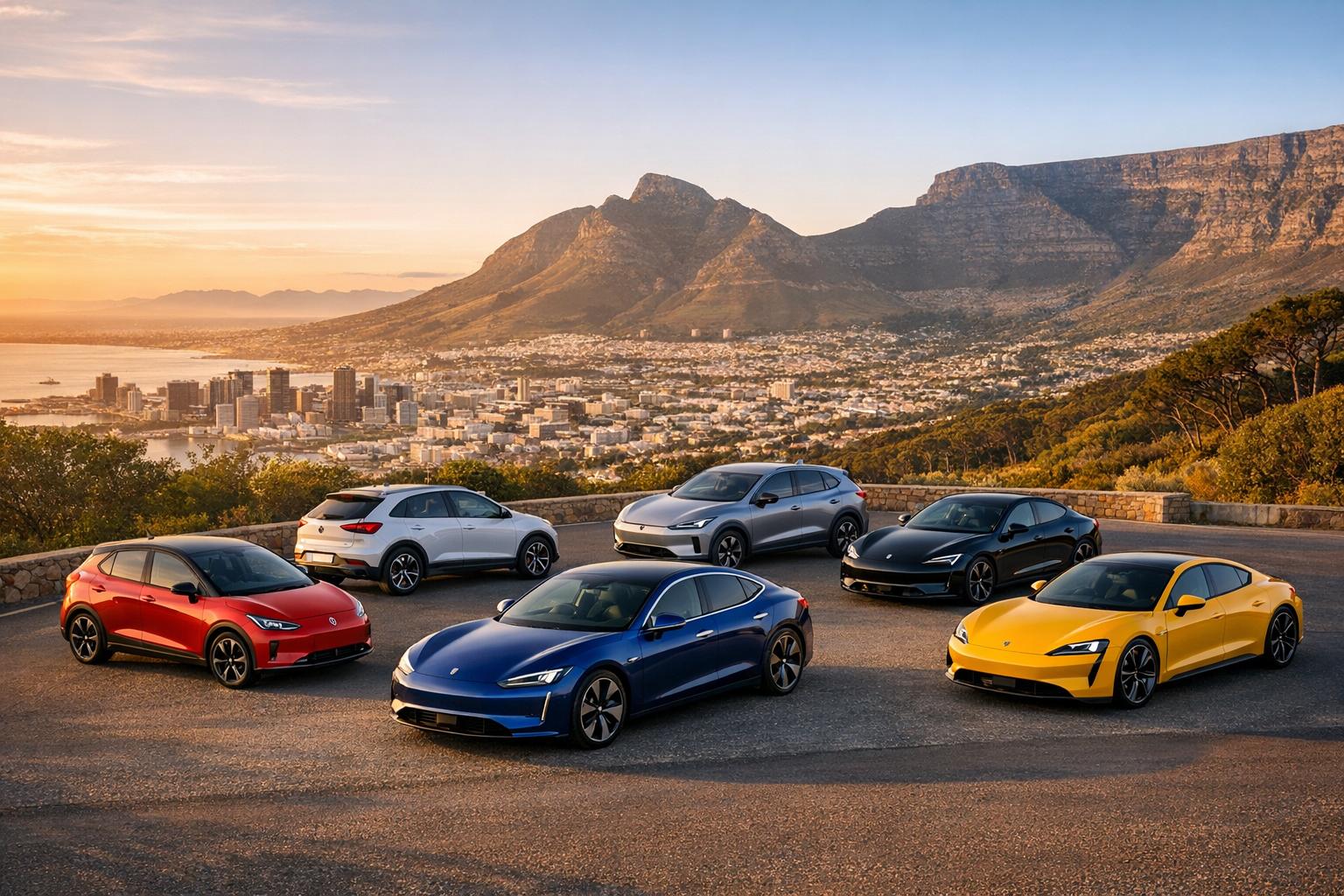
South Africa’s electric vehicle (EV) market is growing, with 2024 seeing a 35% increase in EV sales compared to 2023. Although EVs still account for only 0.24% of new car sales, the variety of models has expanded significantly – from 17 in 2022 to over 61 by 2024. Chinese manufacturers are leading the charge with affordable options, while government incentives starting in March 2026 aim to boost local EV production.
Here are six EVs that South Africans are gravitating toward:
- Dayun Yuehu S5: Budget-friendly city SUV, priced from $21,900, with a 205-mile range.
- BYD Dolphin Surf: South Africa’s cheapest EV at $18,600, offering up to 183 miles of range.
- Dongfeng Box: Compact hatchback with a range of up to 267 miles, priced from $25,200.
- Volvo XC40 Recharge: Premium SUV starting at $60,600, with a highway-tested range of 190 miles.
- Mini Countryman SE All4: Stylish all-wheel-drive EV with a 245–269-mile range, priced from $59,400.
- Porsche Taycan: Luxury performance EV starting at $159,200, offering up to 421 miles of range.
Each model caters to different needs, from affordable urban commuting to high-performance luxury. With more options and upcoming incentives, EV adoption in South Africa is set to grow.
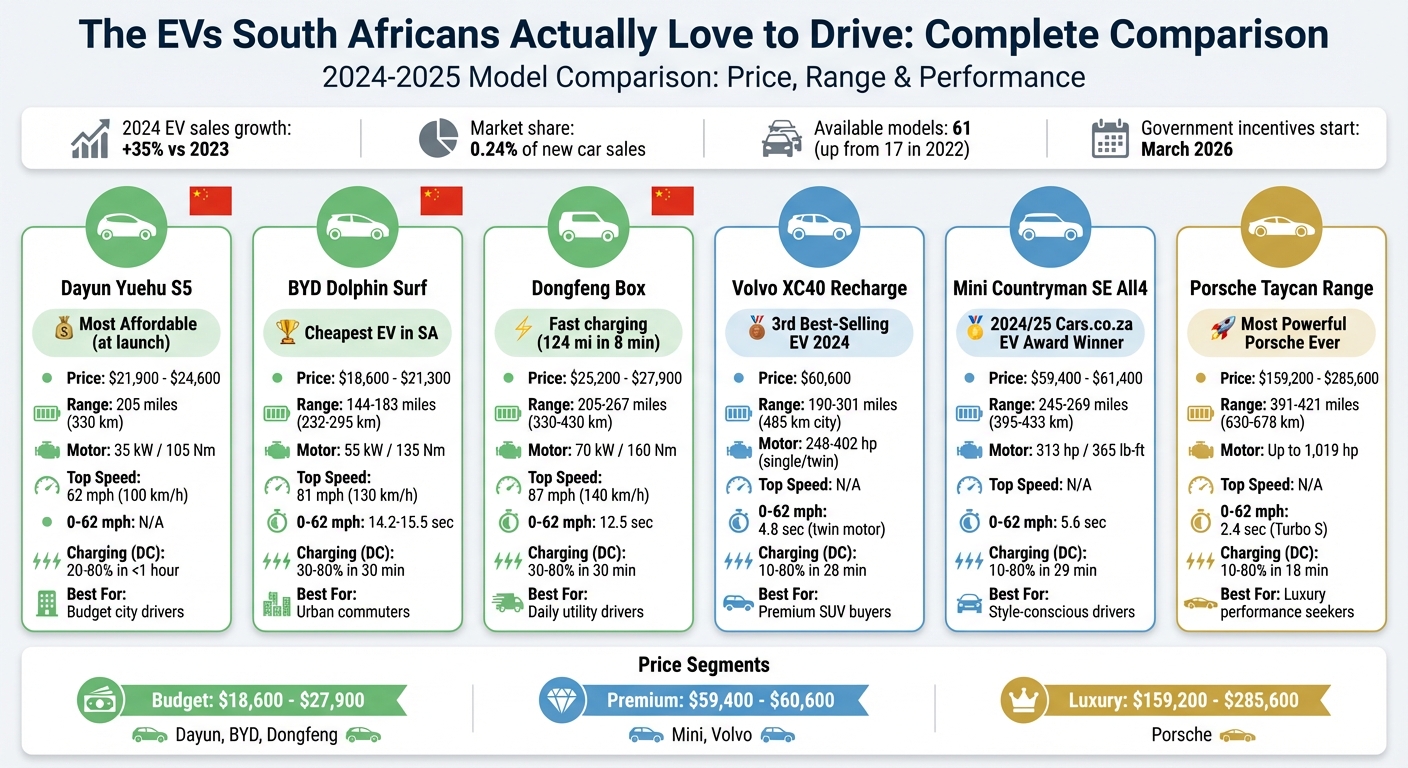
South Africa’s Top 6 Electric Vehicles: Price, Range & Performance Comparison 2024-2025
Electric Cars In South Africa 2024 | Cost of Ownership | Affordability | Sustainability
1. Dayun Yuehu S5
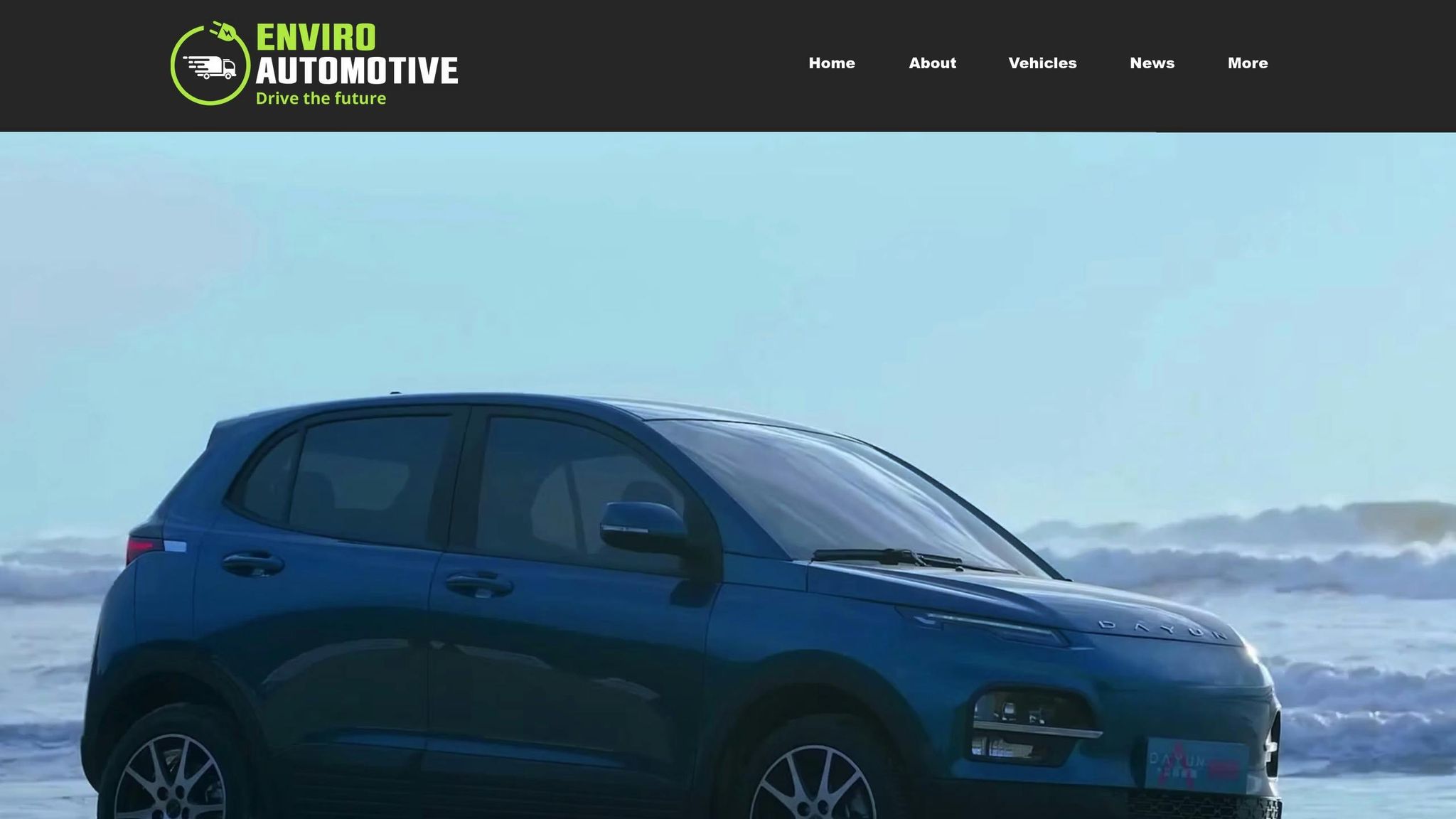
Introduced in July 2024, the Dayun Yuehu S5 quickly earned its spot as South Africa’s most affordable electric vehicle (EV) at the time. Distributed by Enviro Automotive, this compact electric SUV starts at $21,900 (R399,900) for the Standard trim and $24,600 (R449,900) for the VIP model. While the BYD Dolphin Surf later took the crown as the cheapest EV at $18,600 (R339,900), the Yuehu S5 remains a favorite for budget-conscious urban drivers. Let’s dive into what makes this EV a practical choice for city life.
Pricing Details
Both versions of the Yuehu S5 come with a 3-year/60,000 km warranty and service plan, along with a 5-year/120,000 km battery warranty (about 37,000 and 75,000 miles, respectively). The VIP trim sweetens the deal with added perks like 16-inch alloy wheels, LED daytime running lights, parking sensors, and the SmartLink app, which allows remote control of locks, windows, and climate settings.
Range
The Yuehu S5 is powered by a 31.7 kWh battery pack that delivers a claimed range of 205 miles (330 km). Real-world tests in Gauteng give a clearer picture of its performance: during a 15.5-mile (25 km) urban trip, it used only about 11 miles (18 km) of its range, while a 25-mile (40 km) highway drive consumed roughly 22 miles (36 km) of the indicated range.
Charging is straightforward: DC fast charging can boost the battery from 20% to 80% in under an hour, and a full charge at home costs around $4.16 (R76). These numbers highlight why this EV is ideal for city commutes.
Performance
Equipped with a 35 kW motor generating 105 Nm of torque, the Yuehu S5 is designed with urban driving in mind. Its top speed of 62 mph (100 km/h) makes it less suited for highways with 75 mph speed limits. Automotive journalist Nafisa Akabor shared her experience, noting:
"The 35kW motor underperforms on highways, with vehicles behind flashing us because of our slow speed, which at the time was around 80km/h".
This motor setup clearly prioritizes city driving over long-haul or high-speed trips.
Practicality
With a compact length of 12 feet (3,695 mm), the Yuehu S5 is built for navigating crowded streets and squeezing into tight parking spots. Its 5-door, 5-seater layout and 7.9-inch (201 mm) ground clearance make it a versatile option for daily commutes, school runs, and small business deliveries. As Gideon Wolvaardt, Managing Director of Enviro Automotive, explains:
"At just 3.65 metres long, the Dayun Yuehu S5 is perfect for daily urban commutes, navigating congested city streets, and fitting into tight parking spots".
The Yuehu S5’s design and features make it a practical and budget-friendly choice for urban dwellers looking to transition to electric mobility.
2. BYD Dolphin
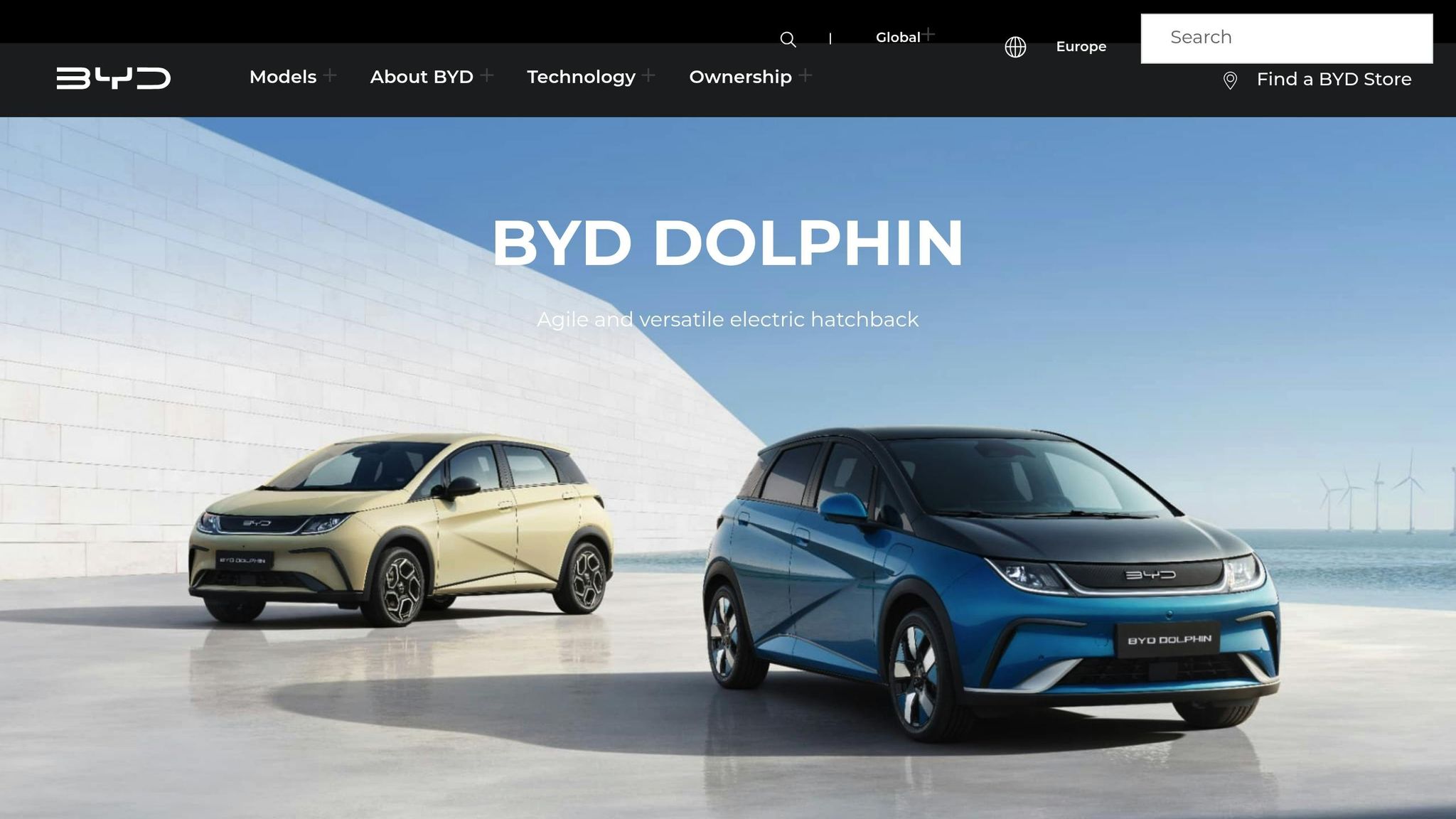
When BYD introduced the Dolphin Surf in South Africa, it made waves as the most affordable electric vehicle (EV) in the country. The Comfort model starts at $18,600 (R339,900), while the Dynamic version begins at $21,300 (R389,900), undercutting the Dayun Yuehu S5 by nearly $3,300 (R60,000). Both trims come with a 7 kW home wallbox charger, a 3-year/100,000 km warranty, and an 8-year/200,000 km battery warranty. Auto magazine journalist Michele Lupini captured the excitement in his review:
"South Africa’s cheapest EV is actually a little gem."
Range
The Dolphin Surf offers two battery options tailored for urban commuters. The Comfort model is equipped with a 30.08 kWh battery, delivering a claimed range of 144 miles (232 km). The Dynamic version steps up with a 38.88 kWh battery, offering 183 miles (295 km) based on the WLTP cycle. Impressively, real-world tests show these ranges hold true in city driving, a rare feat for many EVs. For quick recharges, DC fast charging can bring the battery from 30% to 80% in about 30 minutes. The Comfort supports 30 kW charging, while the Dynamic handles 40 kW. This balance of range and charging speed makes it a practical choice for daily urban use.
Performance
The Dolphin Surf prioritizes efficiency over speed. Both models feature a 55 kW motor producing 135 Nm of torque. The Comfort version accelerates from 0 to 62 mph (0–100 km/h) in 14.2 seconds, while the Dynamic takes 15.5 seconds. The top speed is limited to 81 mph (130 km/h). A standout feature for South African drivers is the Vehicle-to-Load (V2L) functionality, enabling the car to power small appliances during load shedding. Adding to its appeal, the Dolphin Surf has earned a five-star Euro NCAP safety rating.
Practicality
Compact yet functional, the Dolphin Surf measures about 12.9 feet (3,925 mm) in length, comparable to a MINI Cooper. It offers 230 liters of trunk space, expandable to 930 liters with the rear seats folded. Inside, the cabin is equipped with a rotating 10.1-inch infotainment touchscreen, voice activation, and smartphone integration. Ferdi de Vos from Driven Magazine highlighted its impact:
"BYD Dolphin Surf brings a new dimension to electric mobility in South Africa, making EV ownership a viable and attractive option for everyday South Africans."
While the Dolphin Surf excels in city driving, experts caution that its range decreases significantly at highway speeds. To maximize convenience, they recommend using the included home charger for overnight recharging.
3. Dongfeng Box
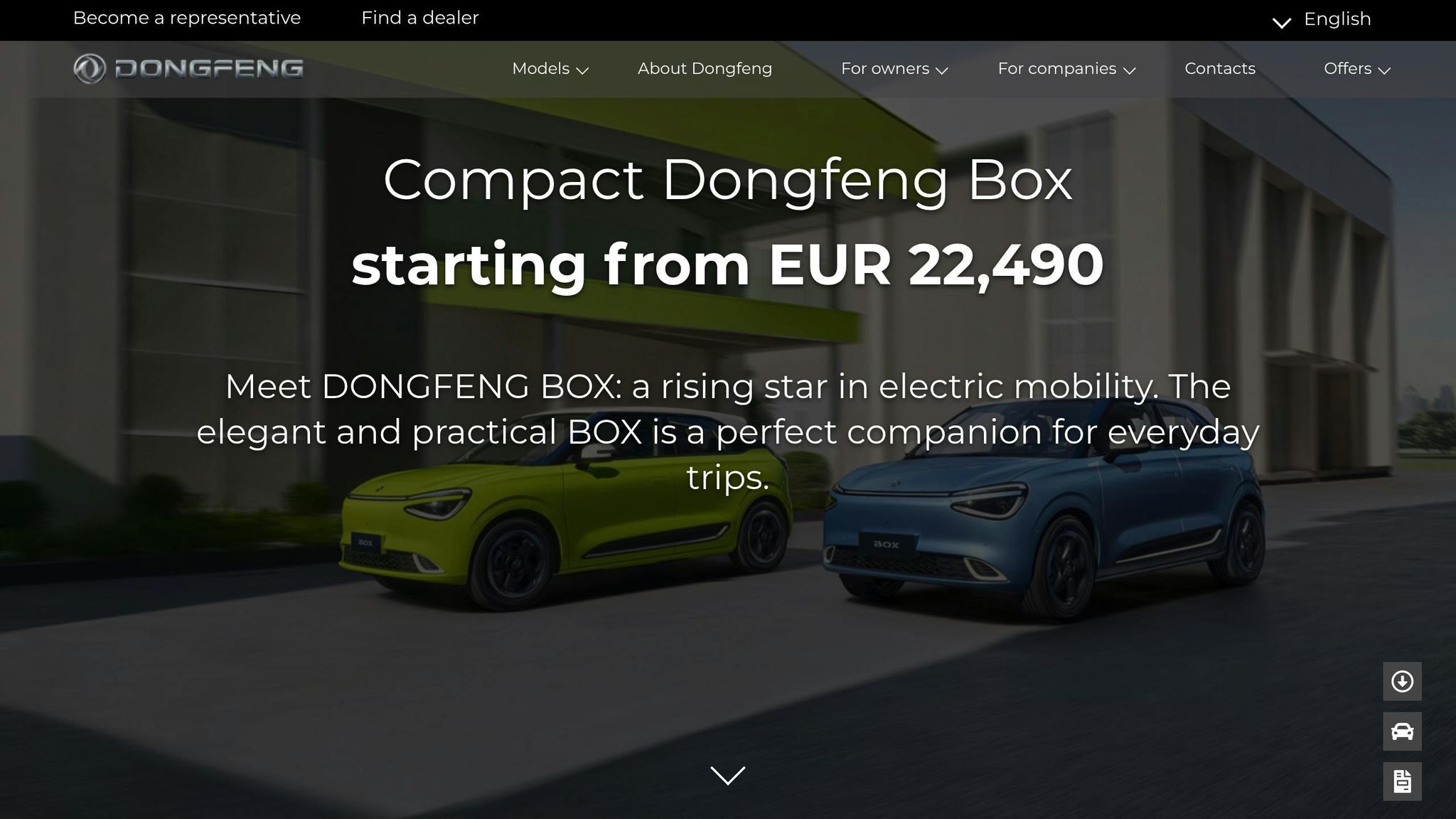
The Dongfeng Box hit the market in early 2025 as a compact electric hatchback from one of China’s major state-owned automakers. With a price range of $25,200 to $27,900 (R460,000–R510,000), it offers an attractive option among local EVs. This vehicle is part of Dongfeng’s "Nammi" sub-brand and benefits from a $5 million (roughly R89 million) investment by E Auto Motor SA to establish service centers and parts hubs in key South African cities. These efforts aim to ensure reliable support for the car’s promising range and performance.
Range
The Dongfeng Box addresses range anxiety with its two battery options. The standard 42.3 kWh battery delivers an estimated range of 267 miles (430 km), while the optional 31.45 kWh battery offers up to 205 miles (330 km). This range makes it suitable for inter-city travel, especially when DC fast-charging infrastructure is available. Using DC fast charging, the battery can go from 30% to 80% in just 30 minutes, and high-speed chargers can add 124 miles (200 km) in only 8 minutes. For home charging, a 6.6 kW AC wallbox takes approximately seven hours to fully charge the battery.
Performance
The Dongfeng Box pairs its range capabilities with practical performance. Its front-mounted motor produces 70 kW and 160 Nm, allowing it to accelerate from 0 to 62 mph (0–100 km/h) in 12.5 seconds and reach a top speed of 87 mph (140 km/h). While these numbers won’t thrill speed enthusiasts, they are well-suited for everyday urban commutes and highway cruising, prioritizing efficiency over raw power.
Practicality
At 13.2 feet (4,020 mm) long and with an 8.7-foot (2,660 mm) wheelbase, the Dongfeng Box sits between the Volkswagen Polo and Polo Vivo in size. Inside, it offers clever features like a drawer-style storage box that doubles as a table and front seats that can fully recline into a lounge-like setup. The cabin provides 326 liters of cargo space and includes modern amenities like a 12.8-inch infotainment screen, wireless charging, and advanced safety features such as adaptive cruise control and lane-keep assist. Buyers can choose from colors like Rain Blue, Fantasy Purple, Stone White, and Fruit Green, while design touches like frameless doors and flush-fit handles add to its sleek, modern appeal.
4. Volvo XC40 Recharge
The Volvo XC40 Recharge secured its spot as South Africa’s third best-selling EV in 2024, with 103 units sold. Priced at $60,600 (R1,108,000), it sits between the more affordable EX30 at $43,300 (R791,900) and the pricier C40 Recharge at $70,200 (R1,285,000). Let’s dive into its range, performance, and practical features.
Range
Local testing reveals the XC40 Recharge can achieve a range of up to 301 miles (485 km). On highways, the single-motor version managed 190 miles at 75 mph, while EPA estimates range from 254 to 293 miles, depending on the configuration. Thanks to DC fast charging, the battery can go from 10% to 80% in about 28 minutes. Buyers also benefit from a home wallbox charger and two years of free public charging.
Performance
The twin-motor all-wheel-drive model delivers impressive acceleration, reaching 0 to 62 mph in just 4.8 seconds with 402 horsepower. Meanwhile, the single-motor rear-wheel-drive version offers a solid 248 horsepower. The XC40 Recharge includes one-pedal driving with regenerative braking, though some drivers feel the braking response is more abrupt compared to other EVs. Additionally, it features a convenient "sit-and-drive" system, eliminating the need for a start button.
Practicality
With 419 liters of rear cargo space, the XC40 Recharge offers plenty of room for everyday needs. A front trunk (frunk) provides a dedicated spot for charging cables, keeping the rear area clear for luggage. The twin-motor version also boasts a towing capacity of up to 1,800 kg (3,968 pounds). Onboard tech is powered by Google Automotive Services, integrating Google Maps, Google Assistant, and Google Play. However, the touchscreen controls for climate settings can feel awkward to use. The vehicle comes with an 8-year or 99,419-mile (160,000 km) battery warranty, and its sealed electric motors reduce maintenance demands compared to traditional engines.
sbb-itb-99e19e3
5. Mini Countryman SE All4
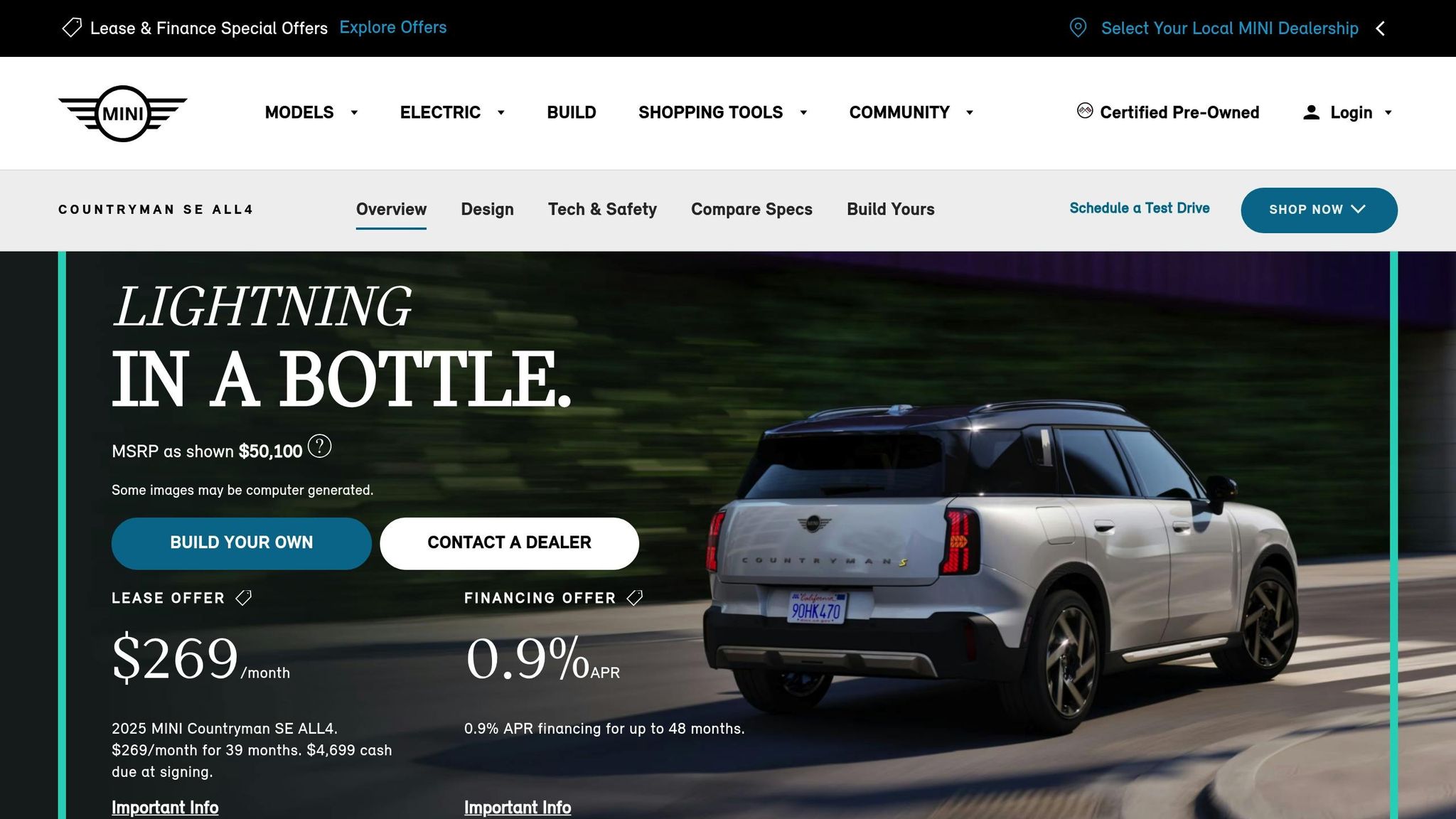
As we continue diving into electric vehicles suited for South African roads, the Mini Countryman SE All4 makes an impression with its mix of performance and practicality. This model recently earned the 2024/25 Cars.co.za Consumer Award for Electric Vehicle, narrowly beating the BMW iX1 with a score of 78.6% compared to 77.5%. Starting at $59,400 (R1,086,000) for the base model and $61,400 (R1,122,000) for the Favoured trim, it comes in at about $6,600 (R120,000) less than the BMW iX1, even though both share the same platform. Let’s take a closer look at what makes this award-winning EV stand out.
Range
The Countryman SE All4 offers a WLTP range of 245 to 269 miles (395 to 433 km). Real-world tests show energy consumption around 18 kWh per 100 km, slightly higher than the manufacturer’s claim. Its 64.6 kWh battery supports quick charging, going from 10% to 80% in just 29 minutes with a 130 kW DC fast charger. A brief 10-minute charge gives you an extra 76 miles (122 km) of range. For home charging, a 22 kW AC source can fully recharge the battery in about 3 hours and 45 minutes.
Performance
Equipped with a dual-motor all-wheel-drive system, the Countryman SE All4 delivers 313 horsepower and 365 lb-ft of torque. This setup allows the car to accelerate from 0 to 62 mph in just 5.6 seconds. It even outpaces its gas-powered equivalent, which starts at $52,800 (R965,768). The ALL4 system is designed to adapt, typically splitting torque 50/50 but capable of sending all the power to the front wheels when needed. For an extra thrill, the "Go-Kart" mode sharpens acceleration and reconfigures the instrument cluster for a sportier experience.
Practicality
With 16.2 cubic feet (460 liters) of cargo space that expands to 49.1 cubic feet (1,390 liters) when the rear seats are folded, the Countryman is more than ready for daily errands or weekend getaways. Its 6.5-inch (165 mm) ground clearance makes it well-suited for handling pothole-heavy roads. Motoring editor Brenwin Naidu captured the car’s essence perfectly, saying it
"feels like a happy car, in that traditional Mini way, more soulful than the Bavarian relation".
The vehicle also comes with peace of mind through its 8-year or 62,137-mile (100,000 km) battery warranty and a 5-year or 62,137-mile (100,000 km) maintenance plan.
6. Porsche Taycan Range
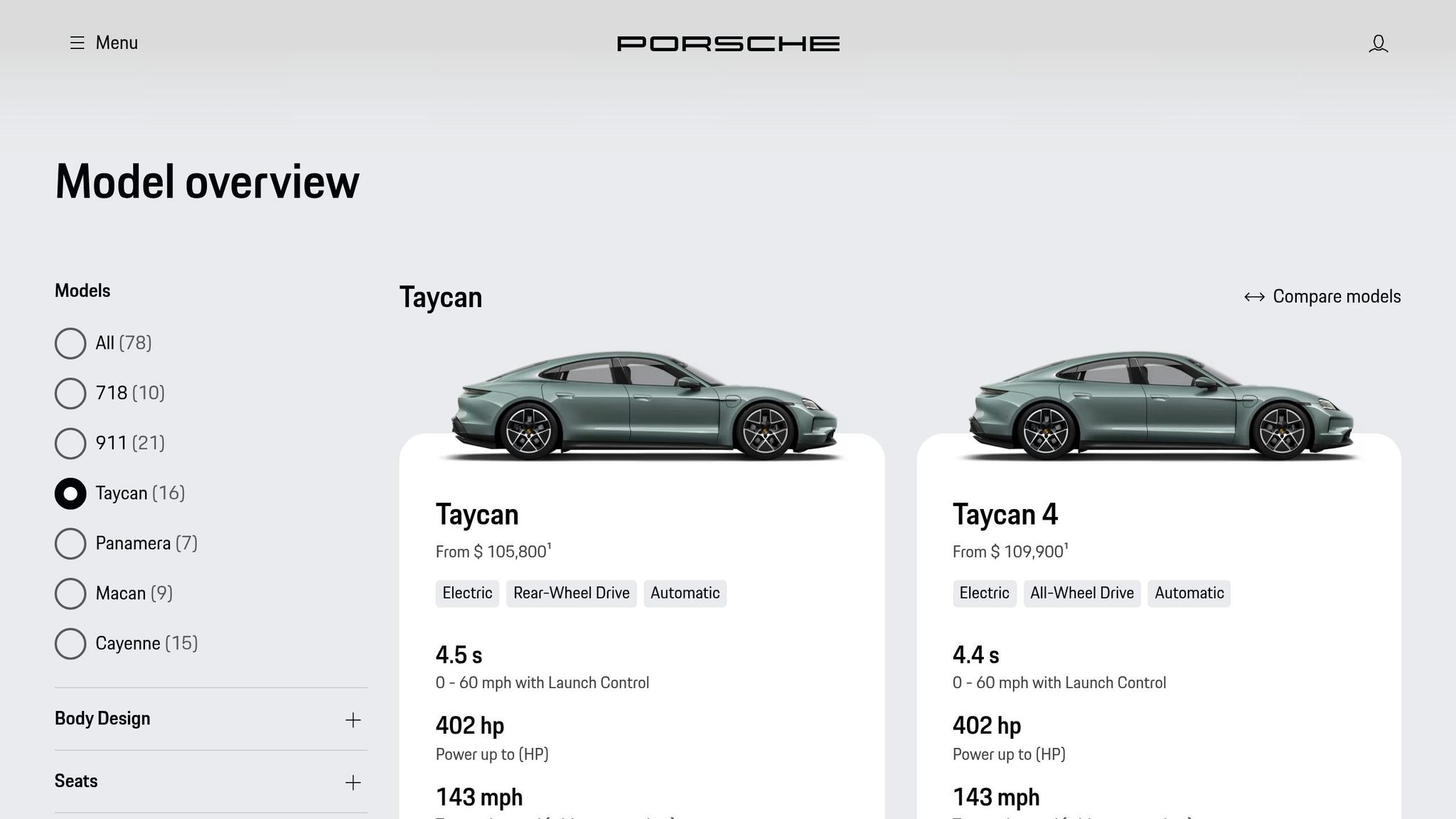
The Porsche Taycan lineup represents the pinnacle of electric luxury. With three distinct body styles – the sedan, Sport Turismo, and Cross Turismo estate – it offers a range of options to suit different tastes. Pricing starts at $159,200 (R2,912,000) for the base model and goes up to $285,600 (R5,225,000) for the high-performance Turbo S. Designed to handle South Africa’s unique driving conditions, the Taycan shines in both city streets and long-distance travel.
Kevin Giek, Porsche’s Head of Model Line, summed up its appeal:
"The model line has reached new heights in terms of performance, with exceptional driving dynamics and driving pleasure. At the same time, we were able to significantly improve efficiency, range, day-to-day usability and comfort."
Range
The 2024 facelift brings a 35% improvement in range, making the Taycan even more competitive. The base model can now cover up to 421 miles (678 km), while the Turbo S achieves 391 miles (630 km) on a single charge. Its 105 kWh battery features an advanced 800-volt system, enabling ultra-fast DC charging at speeds up to 320 kW. This means you can go from 10% to 80% charge in just 18 minutes.
Performance
Boasting 1,019 horsepower and a blistering 0-to-62 mph time of just 2.4 seconds, the Taycan is Porsche’s most powerful production car to date. All-wheel-drive models include adaptive air suspension as standard, enhancing ride quality and handling. Opting for the Sport Chrono package adds a "push-to-pass" button, delivering an extra 70 kW boost for 10 seconds – perfect for overtaking. Despite its hefty 2.4-ton weight, the Taycan retains the agile, sporty feel Porsche is known for, thanks to its low-slung battery placement.
Practicality
The Taycan balances performance with usability, offering 446 liters of total cargo space. This includes a 366-liter rear trunk and an 80-liter front compartment. For those seeking a more rugged option, the Cross Turismo models feature a crossover-inspired design, ideal for South Africa’s diverse roads. Standard models comfortably seat four adults, but the Turbo GT Weissach edition, designed for the track, removes the rear seats to reduce weight. This combination of practicality and high performance ensures the Taycan remains a standout choice for a variety of driving needs.
Pros and Cons
After diving into the details of each electric vehicle (EV), here’s a quick breakdown of their strengths and trade-offs. Each model offers a unique mix of features and limitations, catering to a variety of driving needs. It’s worth noting that real-world tests in South Africa highlight differences in range compared to manufacturer claims, especially under local conditions.
Affordability spans a wide spectrum. Entry-level options like the Dayun Yuehu S5 and BYD Dolphin are aimed at first-time EV buyers who stick to city roads. Mid-range models, such as the Dongfeng Box and Mini Countryman SE All4, balance features and cost effectively. At the premium end, the Volvo XC40 Recharge comes in around $60,600 (R1,108,000), while the Porsche Taycan lineup ranges from $159,200 (R2,912,000) for the base model to as much as $285,600 (R5,225,000) for high-performance versions. These higher-end models cater to those looking for cutting-edge technology and luxury. However, highway speeds can significantly reduce range, which may affect operating costs.
Performance and practicality vary widely. The Porsche Taycan stands out with its sports car-level acceleration and luxury, but even the base model’s price tag makes it inaccessible for many. The Volvo XC40 Recharge offers the versatility of an SUV and solid performance, but its highway range (just 133 miles at 75 mph) requires careful planning for longer trips. Budget-friendly models, while great for daily commutes, often lack the range needed for extended drives.
Here’s a summary table highlighting the key strengths, drawbacks, and ideal use cases for each model:
| Model | Key Strengths | Main Drawbacks | Best For |
|---|---|---|---|
| Dayun Yuehu S5 | Lowest-cost EV option | Short range and basic features | Cost-conscious city drivers |
| BYD Dolphin | Great value with modern tech | Limited range on highways | Urban commuters seeking affordability |
| Dongfeng Box | Practical design at a competitive price | Limited brand recognition and support | Drivers prioritizing utility for daily use |
| Volvo XC40 Recharge | Comfortable premium SUV with strong safety features | Significant range drop at highway speeds | Families with home charging setups |
| Mini Countryman SE All4 | Fun to drive with a stylish design | Pricey for its limited electric range | Style-conscious drivers with shorter commutes |
| Porsche Taycan Range | Incredible performance and fast-charging capability* | High price ($159,200–$285,600) | Luxury buyers focused on performance |
*The Porsche Taycan’s 800-volt system allows it to charge from 10% to 80% in just 18 minutes.
These insights reflect broader trends in the EV market, where local conditions play a big role in shaping performance and practicality.
Conclusion
After examining the options, it’s clear that each EV brings something unique to the table, catering to South Africa’s specific driving conditions. Choosing the right EV comes down to aligning your budget with your lifestyle and driving needs.
For city dwellers looking for affordable and efficient mobility, models like the BYD Dolphin Surf and Dayun Yuehu S5 are smart choices. Families or drivers seeking more versatility might lean toward mid-range options such as the Dongfeng Box, or even splurge on premium picks like the Volvo XC40 Recharge or Mini Countryman SE All4. And for those chasing performance, the Porsche Taycan Turbo S offers sports car-level thrills – albeit at a higher price point.
The market now boasts a variety of EVs, from budget-friendly urban rides to high-performance luxury models, reflecting local needs and preferences. With Chinese manufacturers leading the charge in the affordable segment and government tax incentives set to roll out in March 2026, the EV landscape in South Africa is evolving rapidly. Thanks to these developments, there’s now an electric vehicle to suit nearly every South African driver.
FAQs
What incentives is the South African government offering to encourage EV adoption?
The South African government is stepping up efforts to encourage the adoption and production of electric vehicles (EVs). From 2026, companies manufacturing EVs and hydrogen-powered vehicles will benefit from a 150% tax deduction, significantly cutting production expenses. On top of that, EVs will be exempt from carbon tax, making them a more budget-friendly option for consumers.
To further promote EVs, the government has introduced reduced import duties on both vehicles and their components. Other perks include priority parking for electric cars and incentives for businesses installing charging stations, such as special electricity rates and possible rebates. These measures are designed to make EVs more accessible, stimulate local manufacturing, and expand the charging network – paving the way for broader EV adoption throughout South Africa.
How do these popular EVs perform in real-world driving conditions?
Electric vehicles (EVs) in South Africa often show a noticeable gap between their official range estimates and how they perform on the road. Things like driving at high speeds, hot weather, or even personal driving habits can cut the advertised range by 10–30%. For instance, compact EVs like the BYD Seagull and GWM Ora 03 usually deliver around 180–250 miles in mixed city driving conditions. On the other hand, mid-range crossovers such as the BYD Atto 3 and Volvo EX30 tend to reach closer to 250–300 miles per charge.
When it comes to premium models like the Tesla Model S Plaid, they boast some of the highest ranges available. However, even these high-performing vehicles can see reduced range when faced with challenging conditions. Being aware of these real-world variations can help drivers pick an EV that aligns with their daily driving needs and charging routines.
What is driving the growth of electric vehicles in South Africa?
The rise of electric vehicles (EVs) in South Africa is being driven by a mix of affordability, practicality, and growing awareness about sustainability. Newer, budget-friendly models like the BYD Dolphin Surf (priced at roughly $18,500) and the GWM Ora 03 are making EVs accessible to more people. Thanks to reduced import duties and competitive pricing – particularly from Chinese manufacturers – these vehicles are becoming easier on the wallet. Plus, the expanding range of models means there’s something to suit various budgets and tastes.
Beyond affordability, owning an EV comes with practical perks. They’re cheaper to run and maintain compared to traditional gas-powered cars, with electricity costs per mile coming in well below fuel expenses. Government policies, including tax breaks and duty exemptions, make the decision to switch even more attractive. On top of that, the growing network of charging stations, especially in cities, is helping ease concerns about range. While challenges like power outages remain, stricter emissions rules and a push toward sustainability are motivating more buyers to make the switch to electric.