
 Thabo Nkosi
Africa is gearing up for the electric vehicle (EV) revolution, but challenges loom large. With vehicle numbers projected to more than double by 2040, the continent faces critical decisions about transitioning from polluting internal combustion engine (ICE) vehicles to cleaner EVs. However, the current state of Africa’s power grid presents significant obstacles:
- Electricity Access: 600 million people lack electricity, hindering EV adoption in rural areas.
- Grid Reliability: Frequent outages and electricity losses strain infrastructure.
- Charging Infrastructure: Only 17% of African countries have 10+ public charging stations, far below what’s needed.
Efforts to modernize grids, integrate renewables, and build charging networks are underway. Countries like South Africa and Kenya are leading with policies and projects, while solar-powered charging stations and battery storage systems offer promising solutions. Platforms like EV24.africa are also making EVs more accessible with financing options and charging education. Africa’s electric future depends on upgrading its energy systems to support the growing demand for EVs.
BYD Expands Into South Africa With Major Solar Powered EV Investment

Current Power Grid Challenges for EV Adoption
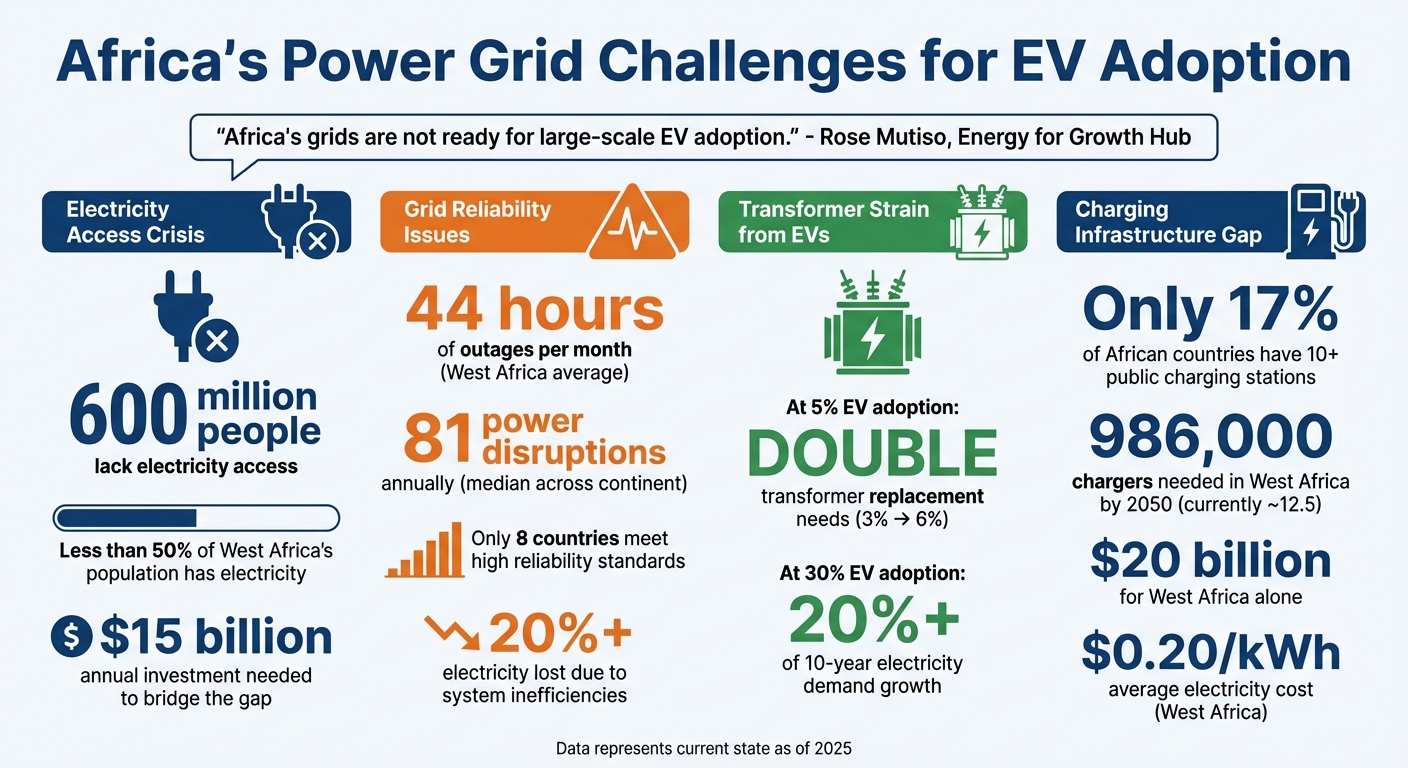
Africa’s EV Infrastructure Challenges: Key Statistics and Investment Needs
Before Africa can fully transition to electric mobility, the continent faces three major power grid obstacles that could hinder widespread EV adoption.
Limited Electricity Access
Around 600 million people in Africa currently live without electricity. This staggering figure highlights a critical barrier to making EVs practical. In West Africa, fewer than half of the population has access to electricity, making home charging an unattainable luxury for many. Bridging this gap would require a massive investment – about $15 billion annually – a daunting task given the competing priorities for development funding.
For now, EVs are likely to be concentrated in wealthier urban areas with dependable power access, leaving rural communities behind. This divide could result in a two-tier transportation system, where the cleaner, cheaper benefits of electric vehicles bypass the very regions that could benefit the most.
Grid Reliability and Capacity Issues
Even in areas with electricity, reliability is a persistent problem. In West Africa, consumers experience an average of 44 hours of outages each month, amounting to nearly two full days without power. Across the continent, utilities report a median of 81 power disruptions annually, making consistent EV charging a challenge without costly backup systems. At present, only eight African countries meet high standards for grid reliability.
Capacity is another pressing issue. African utilities lose over 20% of generated electricity due to inefficiencies in the system. Rose Mutiso, Science Advisor at Energy for Growth Hub, put it plainly:
"Africa’s grids are not ready for large-scale EV adoption."
A study conducted in Nairobi by researchers June Lukuyu, Rebekah Shirley, and Jay Taneja in January 2025 found that even modest EV adoption could strain infrastructure. If just 5% of vehicles transitioned to EVs, the proportion of transformers needing replacement would double within five years – from 3% to 6%. A more ambitious shift, with 30% of road transport electrified, would force most African countries to divert over 20% of their projected electricity demand growth over the next decade to support EVs.
Lack of Charging Infrastructure
The gap in charging infrastructure is striking: only 17% of African countries have 10 or more public charging stations. In West Africa, there are currently about 12.5 public chargers, but nearly 986,000 will be needed to support an estimated 9.9 million EVs by 2050. Addressing this shortfall goes beyond installing chargers – it requires an estimated $20 billion investment in generation and grid infrastructure for West Africa alone, not including the cost of the charging stations themselves.
High electricity prices, averaging $0.20 per kilowatt-hour in West Africa, further erode the financial appeal of switching from gasoline to EVs. Joel Nana, Project Manager at Sustainable Energy Africa, highlighted the scale of the challenge:
"Deploying a charging infrastructure of this scale will require significant investments, which in turn necessitates enabling policies, tax incentives and subsidies."
Without affordable and reliable charging options, public charging networks remain economically unfeasible. This creates a frustrating cycle: EVs won’t gain traction without sufficient infrastructure, but investors are reluctant to build that infrastructure without a critical mass of vehicles. These interconnected challenges emphasize the urgent need for grid improvements and smarter energy management solutions.
Infrastructure Upgrades and Renewable Energy Integration
African nations are steadily upgrading their power grids and incorporating renewable energy sources to support the growth of electric vehicles (EVs). These efforts focus on meeting the immediate need for reliable charging infrastructure while paving the way for a more sustainable transportation future.
Grid Modernization Projects
One of the key advancements in grid technology is the adoption of High-Voltage Direct Current (HVDC) systems, which enable efficient cross-border power sharing. A prime example is the Ethiopia-Kenya electricity highway, a 649-mile transmission line connecting Wolayta-Sodo in Ethiopia with Suswa in Kenya. This $1.26 billion project, capable of transmitting 2,000 MW of power, showcases the benefits of HVDC technology. John Mativo, Managing Director of Ketraco, highlighted the importance of regional cooperation:
"Around 2010, countries in East Africa, as an energy pool, decided that it was essential to have an interconnected hub so that everyone could use and exploit energy and support each other."
HVDC systems are instrumental in reducing energy wastage, minimizing power losses, and improving grid stability – factors that are essential for building reliable EV infrastructure. Beyond HVDC, smart grid technology is also gaining momentum. For instance, the South African National Energy Development Institute (SANEDI) has implemented 10 pilot projects across various municipalities. One of these projects successfully reduced electricity losses from 23% to just 6% using Advanced Metering Infrastructure (AMI). This is a critical improvement, considering that transmission and distribution losses in Africa can reach as high as 48%. Additionally, smart charging strategies are proving to be cost-effective, potentially reducing transformer replacement expenses by up to 40%.
These grid upgrades are laying the groundwork for renewable energy integration, which is becoming a cornerstone of EV infrastructure development.
Renewable Energy for EV Charging
In tandem with grid modernization, renewable energy projects are being integrated to power EV charging networks. Thirteen African nations already generate over two-thirds of their electricity from clean energy sources, and this trend is accelerating as countries recognize the dual advantages of renewable energy: supporting EV charging while cutting reliance on costly fossil fuel imports. Ethiopia, for example, has utilized its growing hydroelectric capacity to enforce a nationwide ban on internal combustion engine vehicle imports.
In West Africa, the additional energy demand from EVs is projected to require a $20 billion investment in power generation and grid infrastructure by 2050. To address this, countries are embedding EV charging needs into regional power pool strategies, such as the West African Power Pool (WAPP) Master Plan, ensuring coordinated development. Meanwhile, Kenya, Rwanda, and Uganda are emerging as leaders in electric two- and three-wheelers, supported by preferential electricity tariffs that make renewable-powered charging more affordable.
Solar-Powered Charging Stations
To address limitations in the existing grid, solar-powered charging stations are stepping in as a practical solution. In May 2025, Zero Carbon Charge (CHARGE) in South Africa secured $6.5 million from the Development Bank of Southern Africa to expand its network. Under the leadership of CEO Larissa Venter, the project started work on two sites along the N3 highway between Johannesburg and Durban. By December 2027, the plan is to complete 120 passenger and 138 truck charging stations. Venter highlighted the project’s independence from the national grid:
"The CHARGE network is designed to operate independently from the national electricity grid, using a fully integrated micro-grid model powered by photovoltaic solar and battery storage."
Similarly, in March 2025, ChargePoint and Africa GreenTec collaborated on a renewable energy initiative in Keur Niangane, Senegal. This project replaced diesel generators with a "Solartainer" mobile solar power plant, providing clean energy for EV charging and community use. The installation included 55 solar-powered streetlights and approximately 3 miles of cabling, benefiting over 1,000 residents.
Côte d’Ivoire is also making strides, with Pétro Ivoire deploying around 30 public solar-powered charging stations in cities like Abidjan and Bouaké. These stations are primarily designed for corporate fleets and electric two-wheelers. By bypassing the need for extensive grid improvements, solar-powered solutions are helping accelerate EV adoption across the continent.
Energy Storage and Demand Management Solutions
As electric vehicles (EVs) gain traction across Africa, the challenge of managing the additional energy demand becomes increasingly urgent. To maintain grid stability and support renewable energy adoption, solutions like battery energy storage systems (BESS), vehicle-to-grid (V2G) technology, and smart charging systems are coming into focus.
Battery Energy Storage Systems
Utility-scale battery systems are tackling one of Africa’s biggest energy challenges: the inconsistent nature of renewable energy sources. These batteries store excess energy produced during periods of high solar or wind activity and release it when demand spikes, helping to mitigate the frequent power disruptions that many African countries face. For instance, South Africa experienced over 8 terawatt-hours (TWh) of unmet electricity demand in 2022 due to load shedding, highlighting the pressing need for reliable storage solutions.
In November 2023, South Africa took a significant step by naming preferred bidders for its first Battery Energy Storage IPP Procurement Program. This initiative will add 360 megawatts (MW) of firm battery storage capacity to the national grid. The program is part of a larger strategy to reduce load shedding and integrate renewable energy, supported by power purchase agreements with Eskom, the state utility. Norton Rose Fulbright emphasized the importance of these systems:
"BESS projects can play a crucial role in enhancing the resilience and stability of electrical grids by: 1. responding quickly to fluctuations in demand and supply, 2. maintaining power continuity, and 3. preventing service disruptions".
Further advancements are on the horizon. In 2024, the World Bank and African Development Bank approved around $500 million in funding for a hybrid project under the Eskom Just Energy Transition Partnership. This project involves retiring one of South Africa’s oldest coal-fired power plants and replacing it with 220 MW of solar and wind power, backed by 150 MW of battery storage for grid stability. By combining renewable energy with battery systems, this initiative not only supports the transition away from fossil fuels but also ensures the grid can meet the growing energy demands of EV charging. Beyond storage, the flexibility of EVs themselves offers another promising solution.
Vehicle-to-Grid (V2G) Technology
V2G technology allows EVs to act as mobile energy resources, capable of returning electricity to the grid during peak demand or outages. This feature is particularly valuable in Africa, where grid reliability remains a major issue. For example, only eight African countries meet high grid reliability standards, and in West Africa, households with grid access still endure an average of 44 hours of outages per month. According to the International Energy Agency (IEA):
"electric mobility offers a key opportunity to increase variable renewable integration".
Although V2G technology is still in its infancy across the continent, utility-scale battery projects are laying the groundwork by developing the necessary technical and regulatory frameworks. The potential here is immense. By synchronizing EV charging and discharging with renewable energy production, V2G can help manage the surge in electricity demand expected from the shift to electric transportation. To put it into perspective, most African nations would need to allocate over 20% of their projected ten-year electricity demand growth to support a 30% shift to EVs in road transport. This highlights the synergy between EV adoption and renewable energy integration.
Smart Charging Systems
Smart charging systems are another crucial piece of the puzzle, optimizing when EVs draw power from the grid to prevent overloading. A simple yet effective approach is time-of-use pricing, which encourages off-peak charging. Countries like Kenya, Rwanda, and Uganda have already implemented preferential electricity tariffs to promote charging during early morning hours (1:00 AM to 6:00 AM) instead of evening peak times (6:00 PM to 10:00 PM). This strategy helps balance the grid’s load.
Research from Nairobi underscores the cost-saving potential of smart charging. If unmanaged, EV charging at 30% market penetration could lead to daily overloading of about 5% of distribution transformers for an average of 8.5 hours. However, smart charging could reduce transformer replacement costs by up to 40%. For instance, coordinating just 20% of EV charging in Nairobi is equivalent to a 10 MW storage upgrade, which would cost $11 million. This makes smart charging an affordable and effective alternative.
Electric paratransit vehicles, such as e-buses and matatus, also align well with smart charging practices. These vehicles typically recharge during daytime off-peak hours, helping to ease the strain on evening grid demand.
sbb-itb-99e19e3
Country-Specific Programs and Regional Partnerships
National-Level Programs
Countries across Africa are taking steps to modernize their grids and expand electric vehicle (EV) infrastructure, each tailoring their approach to local needs and opportunities.
South Africa is leveraging its well-established automotive industry to advance EV manufacturing. In January 2025, the country introduced a 150% tax deduction for investments in EV and hydrogen facilities, alongside a $54.2 million fund to support the local production of new-energy vehicles and batteries. This manufacturing-first approach aligns with South Africa’s 2023 Electric Vehicles White Paper, which envisions a fleet combining electric and internal combustion vehicles by 2035.
Kenya is focusing on utility-driven upgrades to its grid. Kenya Power committed $1.9 million in 2024 to develop charging stations over three years, while a new National Building Code mandates that 5% of commercial parking spaces be set aside for EV charging. The government has also halved the excise duty on EV imports, reducing it from 20% to 10%. With a focus on two- and three-wheelers, Kenya is making strides in affordable electric transport. For example, in July 2024, Afrigreen Automobile partnered with Chinese manufacturer Chery in a $20 million deal to establish a plant capable of producing 5,000 to 6,000 EVs annually.
Ethiopia has taken bold action by banning internal combustion engine vehicle imports as of June 2025. This move underscores its commitment to transitioning to electric mobility, even as the country contends with relatively low vehicle ownership rates. Meanwhile, Nigeria is focusing on regional deployment. In March 2025, the Federal Executive Council approved contracts worth $100 million to introduce electric buses and 10,000 electric tricycles in the North-East region, along with the necessary charging infrastructure. Local firms, such as Bluecrest Integrated Concept Ltd., are playing a key role, highlighting how government contracts can stimulate domestic industry growth.
These national strategies are paving the way for broader regional collaboration.
Cross-Border Partnerships
Recognizing that many African grids aren’t equipped to handle widespread EV adoption, regional partnerships are stepping in to fill the gap. The African Continental Power Systems Masterplan (CMP), ratified in September 2023, aims to develop a continent-wide interconnected power network, serving over 2 billion people across 55 countries. Energy ministers are also exploring the creation of a Single Electricity Market for Africa (AfSEM) to unify power systems and ensure the reliability needed for EV charging infrastructure.
Regional organizations, including power pools, the AU Development Agency, and the African Development Bank, are working to map out infrastructure for cross-border energy flow. East Africa has emerged as a hub of e-mobility innovation, with Kenya, Rwanda, and Uganda collaborating on shared policy frameworks and business models. These efforts focus on two- and three-wheeler EVs and include initiatives like digital lending and battery swapping systems. As Rose Mutiso, a Science Advisor at Energy for Growth Hub, noted:
"Investing in grid infrastructure is especially valuable, as it supports broader economic growth beyond just EVs".
Government and Private Sector Roles
While governments are setting the stage with policy frameworks, private companies are driving much of the on-the-ground progress. Currently, only 28% of African countries have implemented at least one national EV target, and just 39% have legally binding EV incentives. This policy gap has opened the door for private sector leadership. In East Africa, startups raised over $25 million in publicly announced funding in 2021 to support electric two- and three-wheeler solutions. Companies like Ampersand in Rwanda have developed battery-swapping networks that allow drivers to replace depleted batteries with charged ones in minutes.
Affordability remains a challenge, but private fintech firms are stepping in with innovative solutions. In Kenya, companies like M-KOPA and Watu Credit are taking advantage of the country’s high financial inclusion rates – 40% of the population uses mobile money – to offer digital loans for electric two-wheelers. Meanwhile, firms like Zero Carbon Charge are addressing grid reliability issues. In January 2025, the company launched South Africa’s first fully off-grid EV charging station, part of a planned network of 120 stations along major routes.
Research shows that for most African countries, supporting a 30% conversion of road transportation to EVs would require diverting more than 20% of their ten-year electricity demand growth. The collaboration between forward-thinking policies and private sector innovation will be key to scaling EV infrastructure across the continent.
How EV24.africa Supports Grid-Ready EV Deployment

As Africa works to modernize its power grid, EV24.africa is stepping in to make electric vehicles (EVs) more accessible through a combination of vehicle options, financing solutions, and charging education.
Diverse Range of EVs
EV24.africa offers a centralized marketplace featuring EVs from leading brands like Tesla, BYD, Hyundai, and Toyota. This approach challenges the widespread reliance on importing used internal combustion engine (ICE) vehicles – currently, about 85% of four-wheel vehicle sales in most sub-Saharan African countries involve used vehicles. By providing both new EVs and certified pre-owned options with transparent pricing and detailed specifications, the platform supports a shift toward cleaner, more sustainable transportation across the continent.
Financing and Delivery Across Africa
Beyond its extensive vehicle selection, EV24.africa addresses key barriers to EV adoption. The platform delivers vehicles to all 54 African countries, eliminating logistical challenges tied to geography. High upfront costs are a significant hurdle, with more than 90% of EV owners in Nigeria and Kenya identifying this as a major issue. To tackle this, EV24.africa offers financing options that reduce initial costs, making EVs more attainable. This is especially impactful for two-wheelers, which have consistently proven to be more economical in terms of total ownership costs over time.
Charging Education for Grid Compatibility
To ensure EV adoption aligns with Africa’s evolving grid infrastructure, EV24.africa provides guidance on charging practices. The platform educates users on three key charging levels:
- Level 1 Charging: Utilizes standard home outlets, adding 3–5 miles of range per hour.
- Level 2 Charging: Requires specialized equipment, providing 12–80 miles of range per hour.
- Level 3 Charging: Offers DC fast charging, delivering 3–20 miles of range per minute.
For personal vehicle owners who park overnight, EV24.africa emphasizes Level 1 and Level 2 charging, as these methods are more compatible with current residential grid capacities. By pointing out that most daily driving in urban areas – less than 62 miles – fits comfortably within modern EV ranges, the platform helps alleviate range anxiety. This guidance not only encourages sustainable charging habits but also ensures that EV adoption progresses in harmony with ongoing grid upgrades, creating a smoother transition to electric mobility across Africa.
Conclusion: Building Africa’s Electric Future
Africa’s journey toward electric mobility depends on modernizing power grids, integrating renewable energy, and implementing smart charging systems. However, the road ahead is steep – most countries would need to dedicate over 20% of their ten-year electricity demand growth just to support a 30% shift to electric vehicles (EVs) on their roads.
There are encouraging signs of progress. The Scaling Up Renewables in Africa (SURA) Campaign wrapped up in November 2025 with commitments to deliver 26.8 gigawatts of renewable energy and expand electricity access to 17.5 million homes by 2030. This initiative, supported by €15.1 billion in funding from the European Union, highlights the growing investment in clean energy solutions. Such efforts are crucial for ensuring a smooth transition to electric mobility.
The benefits of EV adoption are clear: cleaner urban air and reduced reliance on expensive fossil fuel imports. In line with this vision, Pele Energy Group announced plans in September 2025 to deploy 10 gigawatts of renewable energy over the next decade, aiming to power 6.25 million households across 11 African nations.
To handle the increased demand from EVs, smart infrastructure will play a key role. This includes technologies like battery energy storage systems, vehicle-to-grid solutions, and managed charging practices, which are essential for balancing the load on power grids.
Platforms like EV24.africa are helping accelerate EV adoption by making grid-ready vehicles more accessible. They provide transparent pricing on new and certified pre-owned EVs, deliver to all 54 African countries, and offer flexible financing options. This is particularly important in a region where used internal combustion engine vehicles still dominate, accounting for about 85% of four-wheel vehicle sales in many sub-Saharan nations. Alongside infrastructure upgrades, EV24.africa also educates consumers on charging practices, encouraging the use of Level 1 and Level 2 chargers for personal vehicles to ease grid strain.
But Africa’s electric future isn’t just about vehicles – it’s about creating sustainable energy systems that fuel economic growth across industries. With strategic investments in grid upgrades, renewable energy, and accessible EV marketplaces, the continent has a chance to leap ahead of outdated automotive trends and position itself as a global leader in clean mobility.
FAQs
How can Africa address limited electricity access to support electric vehicles?
Africa faces a significant hurdle when it comes to electric vehicle (EV) adoption: limited access to electricity. With an estimated 600 million people on the continent lacking reliable power, addressing this issue is critical. To make EVs a viable option, Africa must focus on improving and expanding its energy infrastructure. Experts estimate that achieving universal electricity access and supporting EV infrastructure will require an annual investment of about $15 billion.
Here are three strategies that could help tackle this challenge:
- Upgrading the grid: Modernizing transmission lines, integrating large-scale energy storage systems, and adopting digital control technologies can make power grids more efficient and better equipped to handle renewable energy sources.
- Decentralized charging solutions: Solar-powered charging stations and mini-grids that operate independently of the central grid are already proving effective in countries like Kenya and Rwanda. These setups can bring reliable power to remote areas while supporting EV charging.
- Regional partnerships and funding: Cross-border collaboration, combined with public and private investments, can help secure the capital needed for EV infrastructure. Creating dedicated funds for EV projects could also attract more financial backing.
By focusing on these areas, Africa can not only expand electricity access but also create a solid framework for the growth of electric mobility, reducing range anxiety and paving the way for a more sustainable future.
How are renewable energy and grid upgrades helping Africa support electric vehicles?
Renewable energy plays a key role in powering Africa’s electric vehicle (EV) infrastructure. By tapping into solar and wind energy, charging stations can operate without relying on expensive diesel generators, keeping EVs aligned with low-carbon goals. Countries like Kenya, Ethiopia, and Rwanda are already taking steps to integrate solar panels and battery storage at charging stations. This setup ensures reliable, off-grid power for both public and private EVs. The strategy not only takes advantage of Africa’s abundant clean energy resources but also helps lower charging costs, making EVs more accessible and environmentally friendly.
Modernizing the grid is equally important to ensure renewable energy can meet the growing demand for EVs. Upgraded grids equipped with digital controls, energy storage systems, and bi-directional energy flows can manage the variable output of solar and wind power while handling the increased load from EV charging. For instance, research in Nairobi highlights how smart charging strategies and enhanced substations can cut costs and avoid grid overloads. By combining renewable energy with advanced grid infrastructure, Africa is creating a resilient and sustainable platform for the future of electric mobility.
How are African countries improving EV charging infrastructure?
African countries are tackling the challenge of limited EV charging infrastructure with a mix of investments, partnerships, and creative technologies. Governments and private companies are working together to set up charging stations in key locations like highways, urban centers, and transportation hubs. At the same time, local entrepreneurs are stepping up with smaller, community-based charging solutions.
To enhance reliability, many of these stations are powered by renewable energy sources, especially solar. For instance, Kenya’s solar-powered carports highlight how clean energy can directly fuel the growth of electric vehicles. Additionally, smart-charging systems and energy management tools are being introduced to optimize power use and keep costs in check.
Policy measures are also playing a crucial role. Tax incentives and subsidies for EV owners are encouraging adoption, while governments are pushing for fast-charging networks and integrating energy storage solutions. Together, these efforts are gradually bridging the gap in EV charging infrastructure across the continent.