
 Thabo Nkosi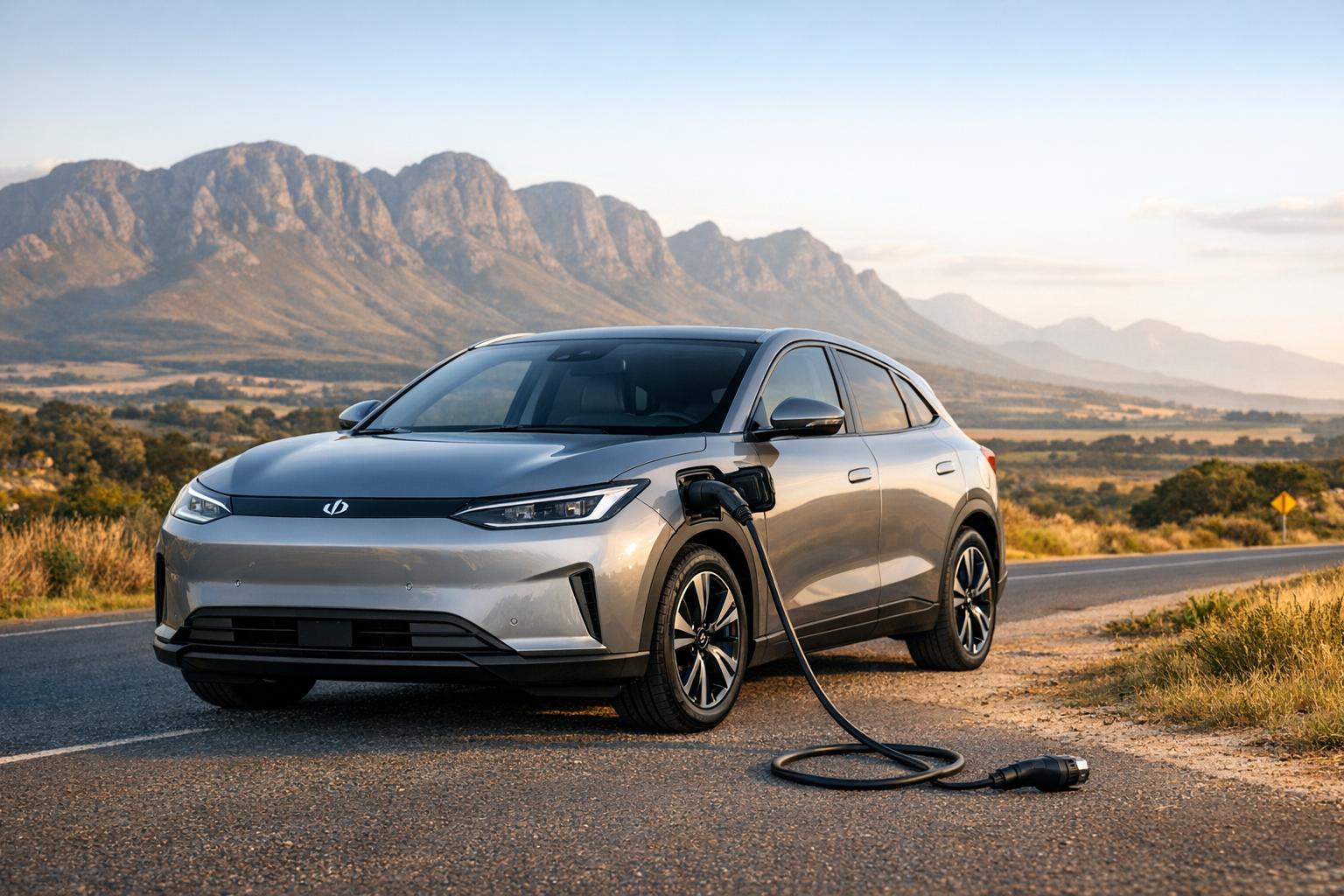
Leapmotor’s entry into South Africa could reshape the country’s electric vehicle (EV) market by addressing key barriers like high costs, limited charging networks, and an unstable power grid. The Leapmotor C10 REEV combines electric driving with a petrol generator for extended range, offering a practical solution for South African drivers hesitant to adopt fully electric vehicles. Here’s why this matters:
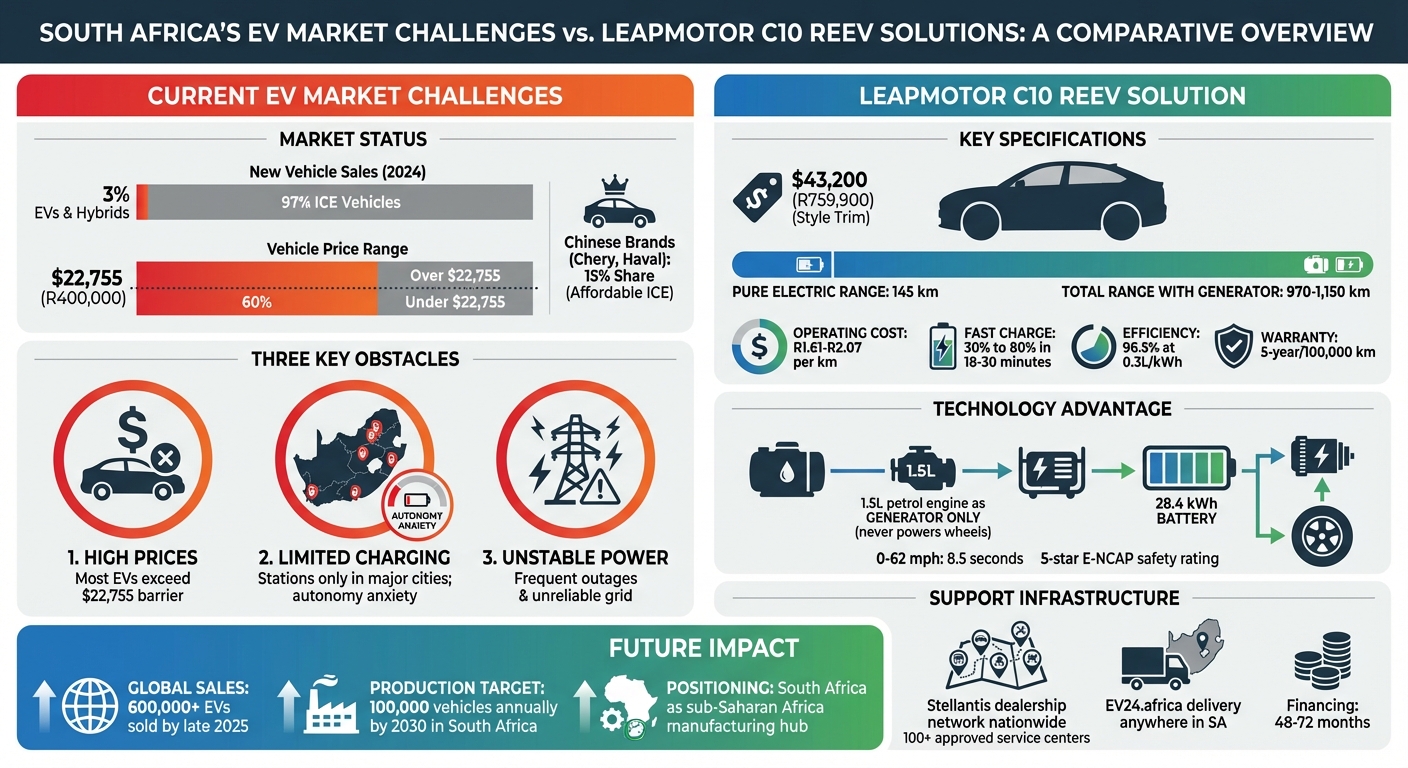
- EV adoption is low: In 2024, EVs and hybrids made up just 3% of new vehicle sales, with most being hybrids.
- Key obstacles: High EV prices (most over $22,755), sparse charging stations, and frequent power outages discourage buyers.
- Leapmotor’s approach: The C10 REEV offers 145 km of electric range, extended to 1,150 km using a petrol generator, reducing reliance on charging infrastructure.
- Cost and accessibility: Starting at $43,200, it’s pricier than most South African cars but still among the more affordable EVs. Stellantis’ dealership network and EV24.africa’s delivery services make it easier to buy and maintain.
Leapmotor C10 REEV vs South Africa’s EV Market Challenges
Leapmotor electric vehicles officially launch in SA
Current Barriers to EV Adoption in South Africa
Electric vehicles (EVs) face some tough challenges in South Africa. High costs, limited charging options, and unreliable electricity make it hard for EVs to gain traction. These hurdles have opened the door for alternatives like Leapmotor’s REEV technology, which aims to address some of these issues.
High Purchase Prices
Affordability is a major obstacle. In South Africa, over 60% of vehicles are sold for less than $22,755 (R400,000). By comparison, the Leapmotor C10 REEV comes with a hefty price tag of $43,200 (R759,900). That’s nearly double the budget of most buyers, making EVs a luxury that many can’t afford.
Interestingly, Chinese brands like Chery and Haval have found success by offering feature-packed internal combustion engine vehicles at competitive prices. They’ve captured 15% of the market share, proving that South African consumers are open to new brands – if the price is right. For EVs to compete, they’ll need to hit similar price points. Until then, they’ll remain out of reach for the average driver.
But price isn’t the only hurdle. The lack of charging infrastructure makes owning an EV even more challenging.
Insufficient Charging Networks
Charging stations in South Africa are mostly concentrated in major cities, leaving rural areas and long-distance travel routes underserved. This uneven distribution fuels what’s often called "autonomy anxiety" – the fear of running out of battery power with no charging station in sight.
For businesses like farms or logistics companies, this scarcity can lead to longer downtimes compared to traditional vehicles. Even well-off consumers who can afford an EV may hesitate, knowing that venturing beyond urban areas could turn into a logistical headache. The slow pace of building a reliable charging network is a key bottleneck in the EV market’s growth.
And if the lack of charging stations wasn’t enough, South Africa’s unstable power grid adds another layer of uncertainty.
Unreliable Power Supply
Frequent power outages and an unstable grid make EV ownership feel risky.
"In South Africa, where energy challenges and limited charging infrastructure slow EV adoption, REEV offers a practical solution… the technology ensures reliability across both urban and rural conditions." – Stellantis South Africa
These energy issues affect both home charging setups and public charging stations, leaving potential buyers questioning whether they can depend on an EV. For many, the well-established refueling network of traditional vehicles feels like a safer bet. In a country already hesitant to embrace new technologies, the unpredictability of the power supply only deepens the reliance on conventional cars.
How Leapmotor Addresses South Africa’s EV Challenges
Leapmotor has tailored its vehicles to navigate the unique challenges posed by South Africa’s infrastructure. By combining smart technology with a competitive pricing approach, the brand aims to make electric mobility a feasible option for South African drivers.
Range-Extended Electric Vehicle (REEV) Technology
At the heart of Leapmotor’s strategy is its Range-Extended Electric Vehicle (REEV) system. The C10 REEV includes a 1.5-liter petrol engine that functions solely as a generator. This setup ensures a fully electric driving experience by using the engine only to recharge the 28.4 kWh battery when needed, never to directly power the wheels.
"The system includes a small combustion engine used solely to recharge the battery, without directly powering the wheels. This provides a 100% electric driving experience while addressing one of the main concerns around EV ownership in South Africa, limited driving range." – Mike Whitfield, Managing Director, Stellantis South Africa
The C10 REEV offers 145 km of pure electric range, ideal for daily commutes. When the battery depletes, the generator extends the total range to an impressive 970 km. This flexibility is particularly useful during load shedding or longer journeys, as drivers can switch to modes that conserve battery power. With an efficiency rating of 96.5% at 0.3L/kWh and the ability to fast-charge from 30% to 80% in just 18–30 minutes, the system caters to a variety of driving needs.
But Leapmotor’s approach isn’t just about technology – it’s also about making EV ownership more affordable.
Affordable Pricing
Leapmotor’s vertical integration strategy significantly reduces production costs. As a result, the C10 REEV starts at $43,200 (R759,900) for the Style trim and $45,500 (R799,900) for the Design trim. These prices make it one of the more accessible EV options on the market. Both trims come with a 5-year/100,000 km warranty and service plan, adding extra value.
Additionally, Leapmotor has teamed up with Stellantis, leveraging its established dealership network across South Africa, which includes brands like Citroën, Peugeot, and Jeep. This partnership eliminates the need for Leapmotor to invest heavily in new infrastructure, helping to keep costs down and pass those savings on to customers.
Coupled with its pricing strategy, Leapmotor’s design philosophy addresses South Africa’s infrastructure challenges head-on.
Built for Infrastructure Constraints
Leapmotor’s "Leap 3.0" architecture, featuring Cell-to-Chassis technology, reduces both weight and complexity while achieving a 5-star E-NCAP safety rating. This design ensures the vehicle performs reliably, even in areas with limited charging stations or an unstable power grid.
The REEV system is particularly suited to these conditions. Drivers can rely on electricity for urban trips and switch to the petrol generator during extended rural drives or power outages. With operating costs ranging between R1.61 and R2.07 per kilometer, the C10 REEV is cheaper to run than most conventional vehicles. Leapmotor’s success in selling over 600,000 electric vehicles globally by late 2025 underscores the effectiveness of its technology in markets with similar challenges.
sbb-itb-99e19e3
How EV24.africa Makes Leapmotor More Accessible
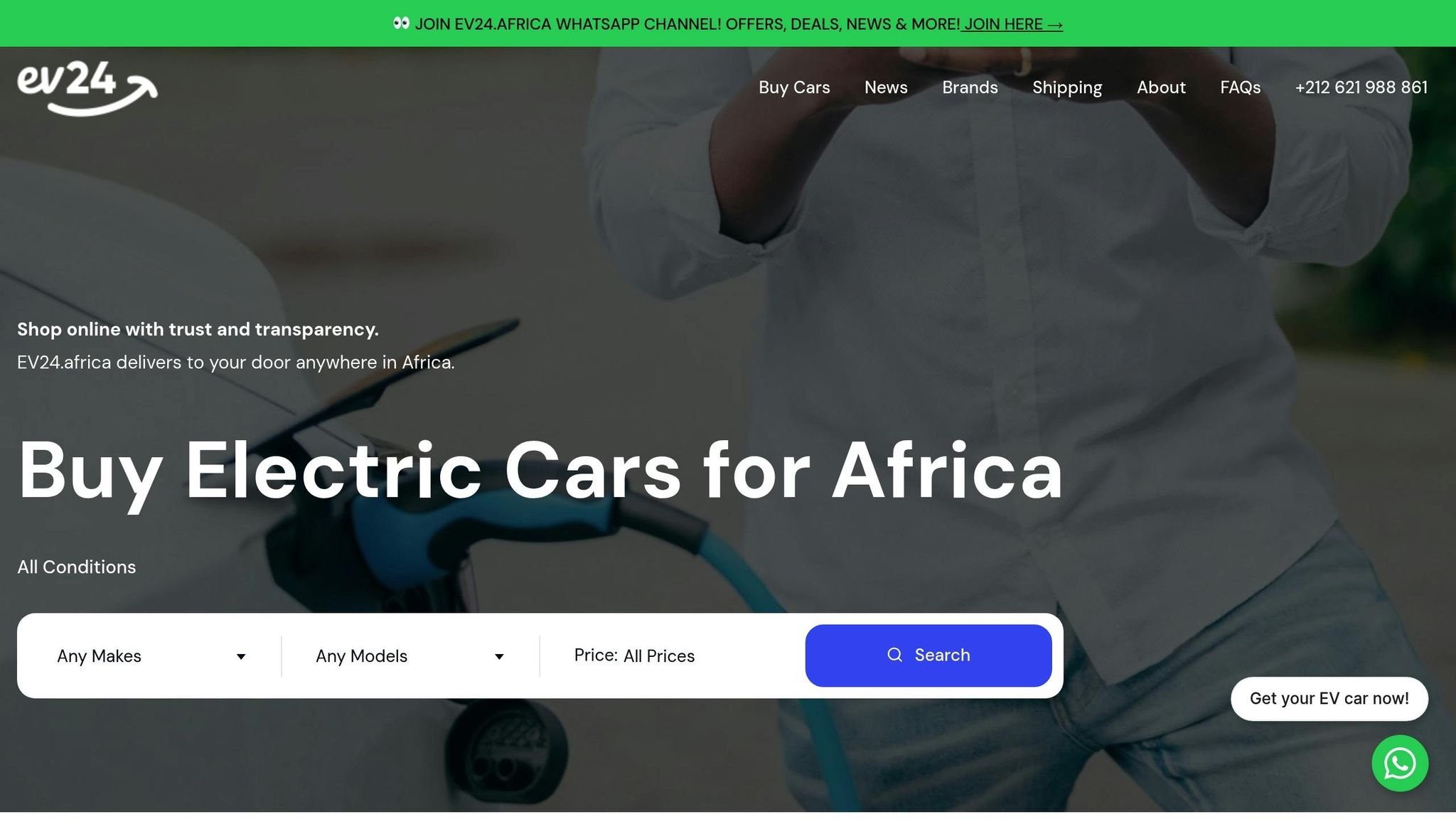
EV24.africa is the exclusive digital retail partner for Leapmotor in South Africa, streamlining the ownership experience for this electric vehicle brand. From upfront pricing to delivery anywhere in the country, the platform simplifies the process of owning a Leapmotor for South Africans.
Financing Options and Transparent Pricing
Buying an electric vehicle can feel complicated, but EV24.africa makes it straightforward by breaking down all costs upfront. The platform clearly lists the total cost of ownership, including the vehicle price, VAT, registration fees, on-road costs, and delivery charges. For instance, the Leapmotor C10 REEV Style is priced at $43,200 (R759,900). This transparency ensures buyers can budget confidently without worrying about hidden fees.
Financing is also made accessible with flexible payment plans ranging from 48 to 72 months. These plans are designed to keep monthly payments comparable to those of similar internal combustion engine SUVs. Additionally, the platform offers trade-in options and balloon payment structures to reduce the initial cash burden. With operating costs for the C10 REEV estimated at $0.09–$0.12 per kilometer (R1.61–R2.07/km), EV24.africa helps make the transition to electric mobility more affordable.
Nationwide Delivery Services
One of the biggest challenges for EV buyers outside major cities is access – but EV24.africa has that covered. The platform delivers Leapmotor vehicles anywhere in South Africa, ensuring that even those in remote areas can own one. Whether buyers choose port-to-port or full door-to-door logistics, EV24.africa takes care of everything, including customs clearance, local registration, pre-delivery inspections, and software updates.
To further support customers, the company has partnered with over 100 Stellantis-approved service centers across the country. These centers provide ongoing maintenance and support, even in smaller towns and cities. By handling roadworthy checks, licensing, and more, EV24.africa ensures that Leapmotor vehicles are ready to hit the road as soon as they arrive.
Customer Support and Warranty Coverage
EV24.africa’s customer support is tailored to meet the unique challenges South African drivers face, such as load-shedding and long-distance travel. Support is available through WhatsApp, email, and phone, with knowledgeable staff ready to assist.
The C10 REEV comes with a 5‑year/100,000 km warranty and service plan, covering both the vehicle and its range-extending electric vehicle (REEV) system. Support teams also provide guidance on using the 1.5‑liter petrol generator, maximizing the 145 km pure-electric range, and planning routes in areas with limited charging infrastructure.
To further enhance the ownership experience, Leapmotor vehicles benefit from remote diagnostics and over-the-air software updates. These updates improve range, infotainment, and safety features without requiring a visit to a service center. This proactive approach minimizes downtime and builds confidence in EV technology, especially for first-time buyers.
Leapmotor’s Potential Impact on South Africa’s EV Market
REEV as a Transition Solution
Leapmotor’s range-extended electric vehicle (REEV) technology presents South Africans with a practical approach to cutting fuel consumption while easing concerns about running out of charge. The C10 REEV uses a 1.5-liter petrol engine purely as a generator to recharge the battery, ensuring that the vehicle operates entirely on electric power. This setup is particularly reassuring in a country where load-shedding and long intercity travel can make fully electric vehicles less appealing. Stellantis South Africa Managing Director Mike Whitfield has described this launch as "an important step in offering innovative new energy vehicle options", highlighting the importance of partnerships in advancing cleaner mobility. For drivers who enjoy the quietness and instant torque of electric vehicles (0–62 mph in just 8.5 seconds) but worry about limited charging infrastructure, the REEV strikes a balance between convenience and innovation. This combination of technology and performance not only meets daily commuting needs but also offers tangible financial advantages.
Cost Savings and Emissions Reduction
The C10 REEV makes a strong financial case for itself. Compared to traditional petrol-powered SUVs, owners can anticipate substantial savings – especially as fuel prices continue to climb. The electric drivetrain also reduces maintenance costs and significantly cuts tailpipe emissions, aligning with South Africa’s Just Energy Transition goals. With a starting price of $43,200 (R759,900), the C10 REEV aims to attract middle- and upper-middle-income buyers who may have previously found electric vehicles either too expensive or impractical. If widely embraced, this cleaner technology could help lower national fuel consumption and reduce overall vehicle emissions, delivering economic and environmental benefits on a broader scale.
Opportunities for Broader African Market Growth
Leapmotor’s potential success in South Africa could serve as a stepping stone for broader expansion across Africa. Stellantis has plans to establish local production with a capacity of up to 100,000 vehicles annually by 2030, positioning South Africa as a manufacturing and export hub for sub-Saharan Africa. Globally, Leapmotor has already sold over 600,000 fully electric vehicles and is targeting 500,000 annual sales by 2025, showcasing the brand’s ability to scale. Leveraging EV24.africa’s distribution network and Stellantis’s established dealership infrastructure, Leapmotor is well-positioned to enter other African markets where limited charging stations, long travel distances, and unreliable power grids pose challenges. The C10 REEV’s debut at SA Auto Week in October 2025 received strong praise for delivering an electric vehicle experience without the worry of range limitations. By using South Africa as a proving ground for REEV technology, Leapmotor could help redefine electric mobility across the continent.
Conclusion
Leapmotor’s entry into South Africa signals a meaningful change in the country’s EV market, tackling challenges where traditional electric vehicles have often fallen short. With its competitive pricing and extended range, the C10 REEV addresses two major hurdles for South African buyers: affordability and limited charging infrastructure. These features position Leapmotor as a potential game-changer in overcoming long-standing obstacles in the market.
The REEV design incorporates a petrol generator used exclusively to recharge the battery, easing concerns about range limitations while aligning with clean energy goals. For daily commutes, drivers can rely entirely on electricity, while the generator ensures extended travel is still an option. Coupled with operating costs that are projected to be lower than those of conventional vehicles, the financial argument for making the switch becomes hard to ignore, even in areas with sparse charging networks.
Leapmotor also strengthens its position through strategic partnerships, enhancing its ability to make a lasting impact. By entering the market at the right time, the company takes advantage of established trends and benefits from Stellantis’ nationwide support network. The combination of affordable pricing, REEV technology that mitigates range anxiety, and a trusted dealership infrastructure creates a solid foundation for success.
Looking beyond individual car sales, Stellantis’ ambitious plan to produce 100,000 vehicles annually by 2030 could establish South Africa as a key player in electric mobility across sub-Saharan Africa. If this vision materializes, it could bring cleaner, more accessible transportation to millions who have previously seen EVs as unattainable. Leapmotor’s approach has the potential to drive a significant shift in making electric mobility a practical reality for the region.
FAQs
How does Leapmotor’s REEV technology help with South Africa’s power grid challenges?
Leapmotor’s REEV (Range-Extended Electric Vehicle) technology provides a smart way to tackle South Africa’s power grid issues. It blends the benefits of fully electric driving with a compact gasoline generator that boosts the vehicle’s range. This means drivers can go farther without constantly worrying about finding a charging station – perfect for areas where charging infrastructure is scarce or the power grid is unreliable.
By easing range anxiety and giving drivers more flexibility, Leapmotor’s REEV technology makes the shift to electric vehicles much easier, even in places where dependable charging options are hard to come by.
Why is the Leapmotor C10 REEV a more affordable choice for South Africa’s EV market?
The Leapmotor C10 REEV is a smart choice for those seeking an economical yet efficient vehicle. It pairs a 28.4 kWh lithium-iron-phosphate battery with a 1.5-liter gas engine that acts as a generator, providing an impressive range of up to 715 miles (1,150 km). This clever combination minimizes dependence on costly charging stations while ensuring you can tackle long journeys with ease.
Priced between $39,500 and $41,600, the C10 REEV caters to local market demands by offering an affordable energy solution without compromising on key features like quick charging. Its emphasis on practicality and efficiency makes it an attractive option for South African drivers transitioning to electric vehicles.
How is Leapmotor planning to grow its presence in Africa’s EV market?
Leapmotor is setting its sights on expanding in Africa by forging key partnerships and rolling out vehicles tailored for the region. Through its collaboration with Stellantis, the company plans to tap into established infrastructure, distribution channels, and local manufacturing facilities, making their electric vehicles (EVs) more accessible to buyers.
Their lineup features models like the C10, B10, and T03, which are designed with affordability in mind. These vehicles also include innovative technologies, such as range-extended electric vehicle (REEV) systems, to enhance usability. By incorporating local assembly into their strategy, Leapmotor can cut costs, making their EVs a more practical option for African consumers while addressing hurdles like high prices and limited charging infrastructure.