
 Thabo Nkosi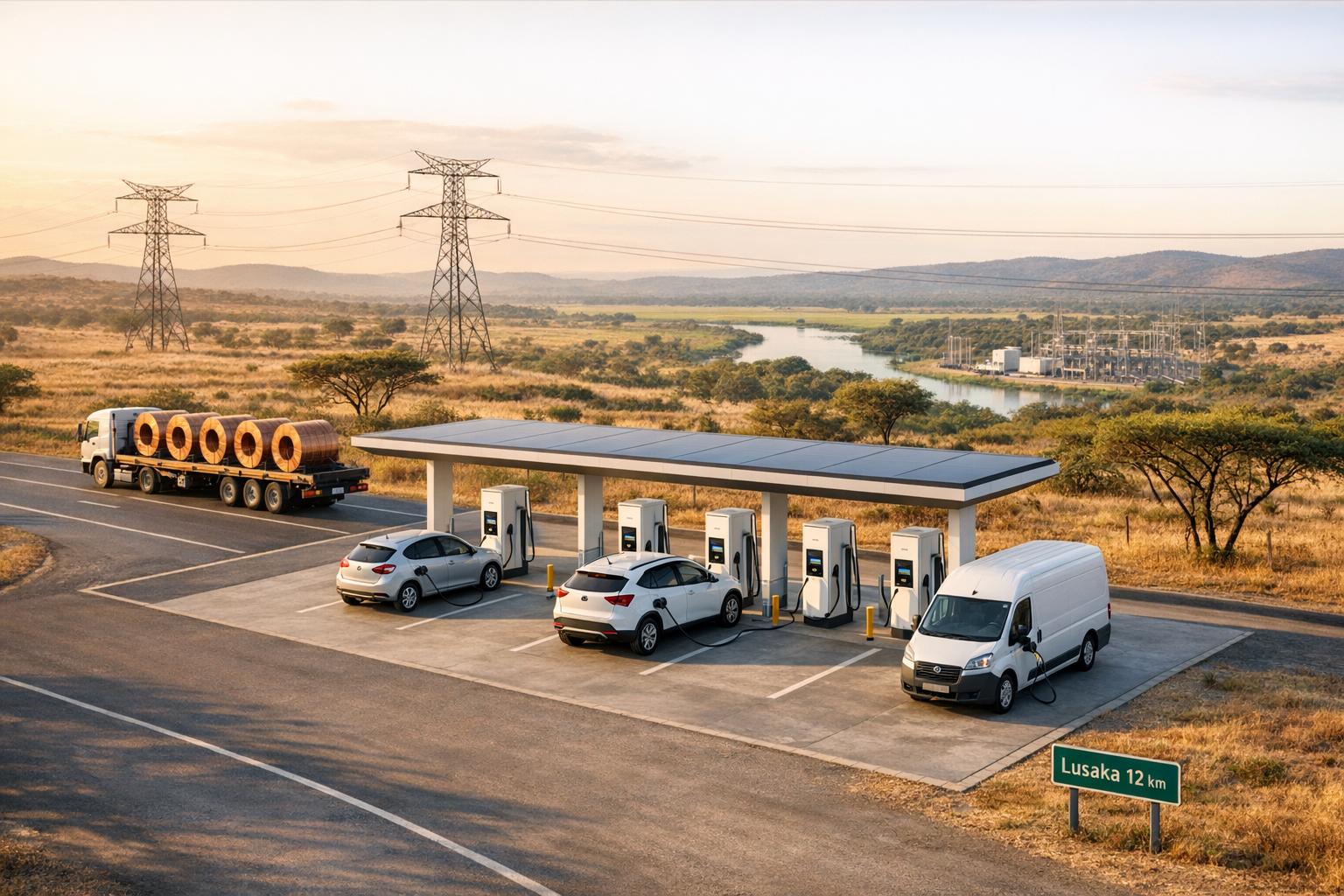
Zambia is positioning itself as a key player in Africa’s electric vehicle (EV) industry. Here’s why:
- Abundant Copper Reserves: With over 2.1 billion metric tons of copper, Zambia is Africa’s second-largest copper producer. Copper is essential for EV motors, batteries, and wiring.
- Government Initiatives: Zambia is shifting from exporting raw copper to manufacturing EV components locally. Policies like removing customs duties on EVs and charging equipment have driven a 334% increase in EV registrations between 2023 and 2025.
- Global Investments: Companies like KoBold Metals and BYD are investing billions in Zambia’s copper and EV sectors.
- Renewable Energy for Charging: Zambia generates 87% of its electricity from renewable sources, mainly hydropower, making it ideal for clean EV charging.
- Infrastructure Upgrades: Partnerships with the DRC and new railway projects have reduced export times, strengthening Zambia’s role in the EV supply chain.
- Workforce Training: Efforts are underway to train technicians in EV maintenance, ensuring the country has the skills to support its growing EV industry.
Zambia’s combination of natural resources, supportive policies, and international partnerships makes it well-suited to play a major role in the global EV market.
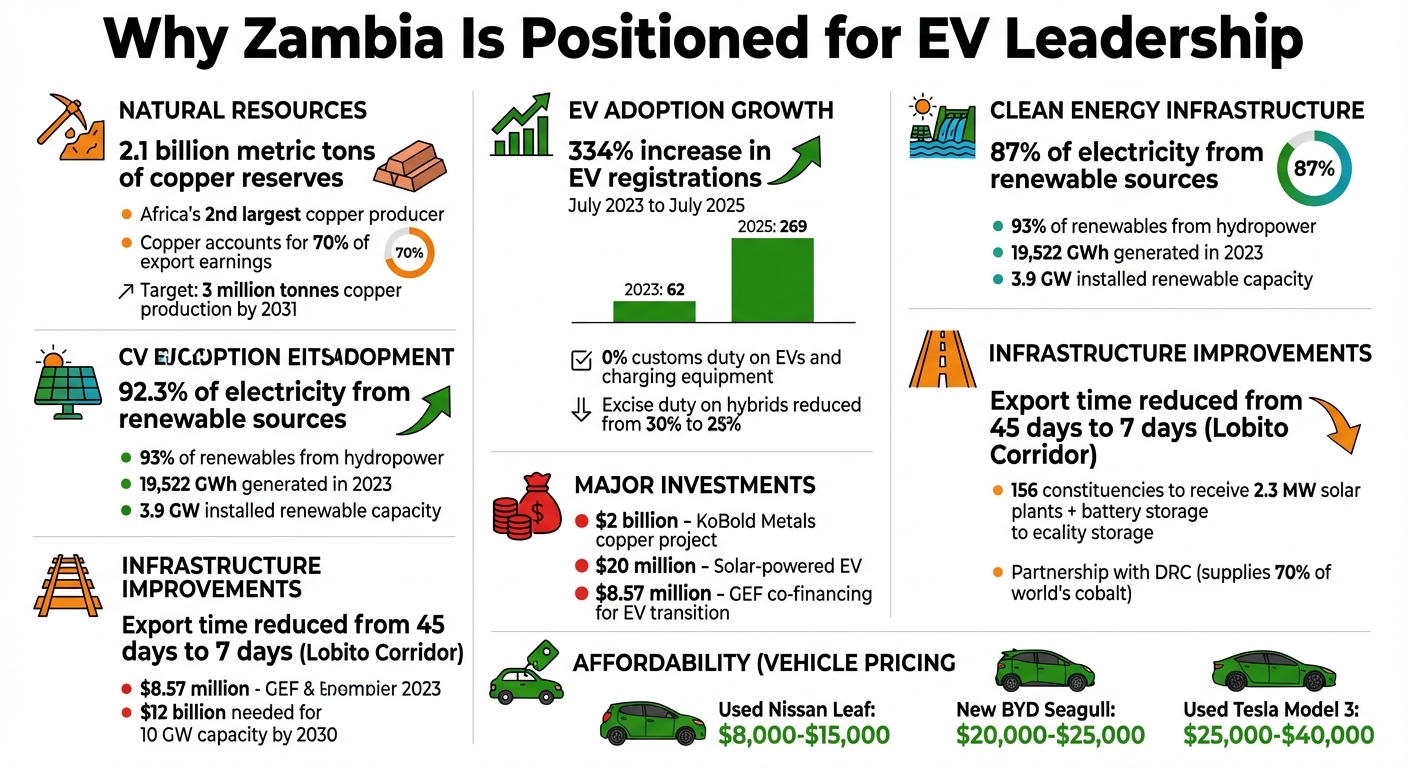
Zambia’s EV Industry Advantages: Key Statistics and Resources
ZAMBIA TARGETS REGIONAL E-MOBILITY HUB AS GOVERNMENT PRIORITIZES ELECTRIC VEHICLES
sbb-itb-99e19e3
Zambia’s Copper Resources and EV Battery Production
Copper is at the heart of every electric vehicle. It powers vital components like motors, batteries, and internal wiring, while also supporting the broader EV infrastructure, including solar charging stations and energy storage systems. With its rich copper reserves, Zambia is positioned to play a crucial role in advancing domestic EV component production, making it a valuable player in the global shift toward electrification. This abundance of resources offers a strong foundation for increasing local value creation.
Right now, only about 20% of Zambia’s copper undergoes refining or processing within the country. The rest is mostly exported, with China being a primary destination. To change this, the Zambian government is working to attract international manufacturers to establish EV component plants close to its copper mines. This strategy aims to shift from exporting raw materials to producing battery components locally. Finance Minister Situmbeko Musokotwane highlighted this vision during discussions in Germany in June 2025:
"Those components can then be shipped to your factories in South Africa which now exports to the rest of the world. That is a powerful way of value addition."
These efforts are already drawing global attention and investment. For instance, in June 2024, KoBold Metals – supported by Bill Gates and Jeff Bezos – announced a $2 billion investment to develop a copper deposit near Chingola. The company plans to start commercial mining by 2026, exporting 300,000 tons of copper annually via the upgraded Lobito Corridor railway. Similarly, BYD, the largest EV manufacturer in the world, expanded its footprint in Zambia in 2024 through a partnership with Pilatus Electric Mobility Zambia Limited, leveraging Zambia’s local supply chain.
The International Energy Agency has sounded the alarm about a potential 30% global copper shortage by 2035, as demand for clean energy technologies surges beyond supply. Zambia’s ambitious goal to boost copper production to 3 million tons per year by 2031 – up from current levels, with copper already making up 70% of its export earnings – positions the country to capture a larger share of the EV component market.
Zambia is also collaborating with the Democratic Republic of Congo (DRC) through the Transboundary Battery and Electric Vehicle Industry Special Economic Zone. The DRC supplies 70% of the world’s cobalt, while Zambia and the DRC together account for 11% of global copper production. This partnership aims to establish a secure and integrated supply chain for critical EV materials, supporting local battery production and enhancing their role in the global EV market.
Government Policies Supporting Electric Vehicles
Zambia has taken bold steps to make electric vehicles (EVs) more accessible by eliminating customs duties on EVs and related accessories. This includes electric motorcycles, cars, buses, trucks, and charging equipment. By removing these financial barriers, EVs are now within reach for many Zambians, with prices comparable to popular gasoline or diesel vehicles. This policy shift marks a significant step toward expanding the EV market in the country.
Between July 2023 and July 2025, registered EVs in Zambia increased by an impressive 334%, jumping from 62 to 269 vehicles. This surge highlights how financial incentives can drive adoption, particularly in the used car market, where most Zambians prefer to shop. For instance, a used Nissan Leaf now costs between $8,000 and $15,000.
Additionally, the government has reduced excise duty on hybrid passenger vehicles from 30% to 25%. While buyers still face Value Added Tax (VAT) and clearing fees, these reductions make EVs and hybrids more appealing to middle-class consumers.
How Duty Removal Affects EV Imports
By applying the zero-duty policy to both new and used EVs, Zambia has transformed its automotive market. Previously considered luxury items affordable only to the wealthy, EVs like the Nissan Leaf (40 kWh and 62 kWh models) are now priced competitively with conventional used cars.
| Policy Measure | Target Vehicle/Equipment | Tax Change |
|---|---|---|
| Customs Duty Removal | Electric motorcycles, cars, buses, trucks, and chargers | Reduced to 0% |
| Excise Duty Reduction | Hybrid passenger vehicles | Reduced from 30% to 25% |
This policy aligns with Zambia’s broader economic goals of shifting from exporting raw materials to producing value-added EV components. In 2023, out of 122,775 motor vehicles imported, only a small fraction were electric. However, with these incentives, EV imports are rising. Buyers can now find models like the BMW i3 for $15,000 to $22,000 or even a Tesla Model 3 for $25,000 to $40,000.
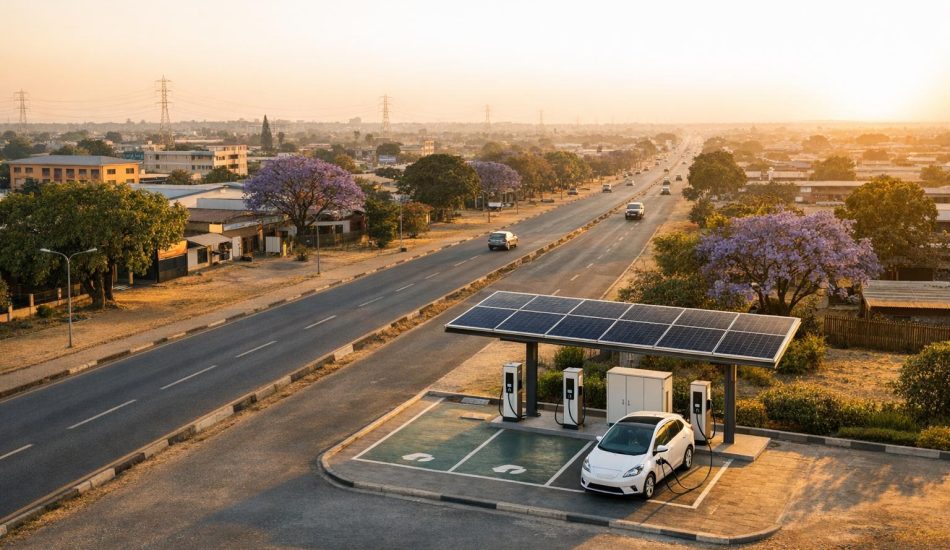
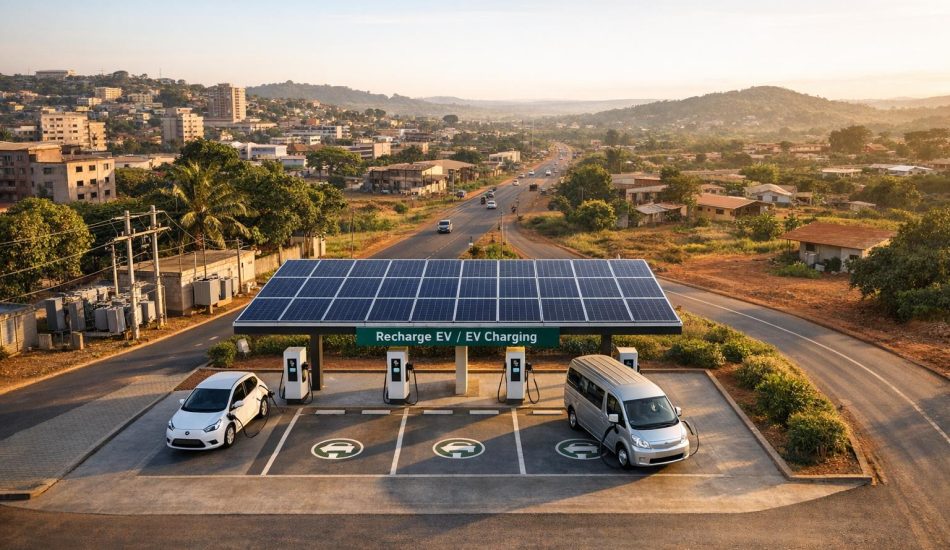
The government is also addressing infrastructure challenges. Through a $20 million agreement between the Ministry of Green Economy and Environment and EVC Investments, solar-powered charging stations are being installed in major cities. This is a game-changer for potential buyers concerned about charging availability. Combined with other incentives, these developments are creating a more EV-friendly environment.
Additional Policies That Could Accelerate EV Growth
To further drive EV adoption, Zambia could introduce consumer tax credits or purchase subsidies. These measures would make EVs, such as BYD’s Seagull model (priced at $20,000 to $25,000), more accessible to first-time buyers.
Other countries, like Ethiopia, have taken more aggressive steps, such as banning imports of internal combustion engine (ICE) vehicles. While Zambia hasn’t adopted such a policy, doing so could accelerate the transition to electric mobility and attract investors interested in local manufacturing.
Standardizing charging systems across the country would also encourage private investments in charging networks. Another idea is to offer green financing programs, such as low-interest loans for EV purchases, which would help buyers manage monthly payments.
In December 2024, the Global Environment Facility (GEF) approved $8,571,104 in co-financing to support Zambia’s transition to electric mobility. Managed by the Zambian Environmental Management Agency (ZEMA), this funding will help establish formal regulations for EV waste management and battery recycling. As the EV fleet grows, such infrastructure will be critical.
The government is also courting international manufacturers to set up EV component plants near Zambia’s copper mines, aiming to move from raw material exports to value-added production. Workforce development programs to train EV technicians are another key part of this strategy, ensuring the country has the skills to support its growing EV industry.
Renewable Energy Infrastructure for EV Charging
Zambia’s electricity grid stands out globally, with 87% of its energy already coming from renewable sources. Hydropower dominates this mix, contributing 93% of the renewable total. In 2023 alone, renewables accounted for 89% of the 19,522 GWh generated nationwide, backed by an installed renewable capacity of about 3.9 GW. This makes Zambia a prime location for clean EV charging. However, heavy reliance on hydropower poses challenges during dry seasons, pushing the government to diversify energy sources with solar projects and battery storage systems.
Solar and Hydropower for EV Charging Stations
In late 2025, the Zambia National Energy Corporation Limited (ZNEC) introduced the Presidential Constituency Energy Initiative (PCEI). This program aims to install a 2.3 MW solar PV plant paired with a 4.16 MWh Battery Energy Storage System (BESS) in each of the country’s 156 constituencies. Redirecting Constituency Development Fund resources, the initiative targets a total of 359 MWp in solar capacity and 648.96 MWh of battery storage nationwide. By integrating these solar plants into nearby 11 kV or 33 kV substations (within a 5 km range), the program minimizes connection and integration costs.
In September 2025, the Ministry of Green Economy and Environment partnered with EVC Investments on a $20 million project to establish solar-powered EV charging stations in major cities like Lusaka, Kitwe, and Ndola. These charging hubs operate independently of the main grid, ensuring consistent service even during load-shedding events – a critical step in reducing range anxiety for EV users.
The Copperbelt region is also seeing significant investment. The Copperbelt Energy Corporation (CEC) is developing over 250 MW of renewable energy projects to support the mining sector’s ambitious goal of producing three million metric tonnes of copper annually by 2031. Owen Silavwe, Managing Director of CEC, emphasized:
"The expansion of the mining sector and the country’s wider economic growth are closely linked to the availability of a reliable, scalable, and diversified power supply."
Policy reforms are further driving progress. The government’s "open access" policy allows private companies to use existing transmission infrastructure, speeding up the deployment of EV charging networks.
While these initiatives signal major advancements, challenges in grid development and investment remain.
Infrastructure Challenges and Solutions
To meet its energy goals, Zambia needs approximately $12 billion to add 10 GW of new power generation capacity by 2030. This investment is essential not only for the mining industry but also for sustaining the growing EV market.
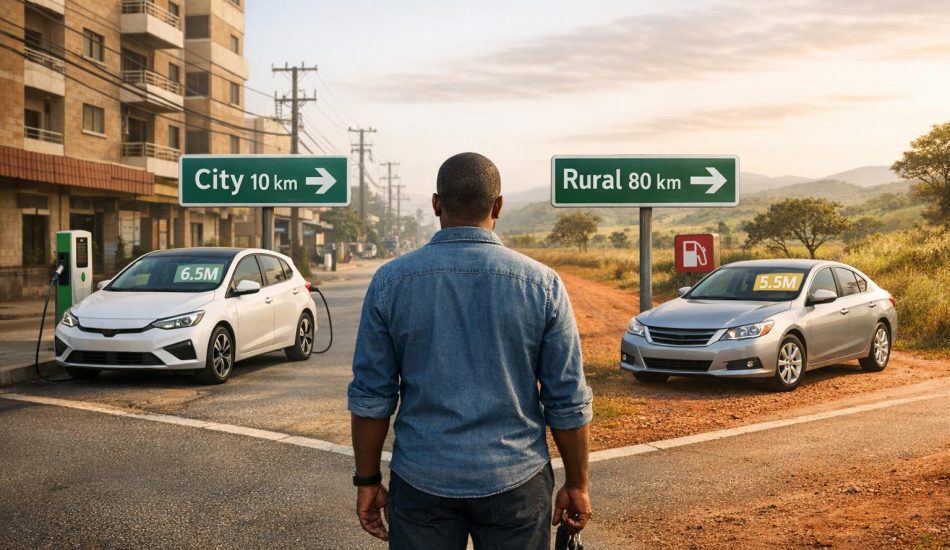
Grid coverage gaps are another hurdle. While urban areas like Lusaka and Kitwe benefit from new solar-powered charging stations, rural regions and highways often lack sufficient infrastructure. This can complicate long-distance EV travel, though apps like PlugShare are helping drivers navigate the emerging network.
The PCEI’s approach offers a practical workaround. By deploying 2.3 MW solar plants with battery storage across all constituencies, the program creates localized energy hubs without needing costly upgrades to the national grid. Battery storage ensures that charging stations can operate 24/7, regardless of weather conditions.
For EV owners, charging during off-peak hours – such as overnight – can help balance grid demand and potentially lower costs. Additionally, in Zambia’s warm climate, maintaining a battery charge between 20% and 80% can extend battery life.
With its abundant hydropower, growing solar infrastructure, and advanced battery systems, Zambia is well-positioned to establish a reliable and clean EV charging network. These developments not only support the adoption of EVs but also contribute to the country’s broader industrial and economic growth.
Training EV Technicians and Maintenance Workers
Zambia’s transition to electric vehicles (EVs) calls for a workforce skilled in high-voltage systems, battery diagnostics, and charging infrastructure. With EVs having roughly 90% fewer moving parts than traditional vehicles, maintenance shifts away from mechanical repairs to focus on electrical systems. This shift requires technicians to master specialized skills, such as lithium-ion battery wiring and AC/DC power conversion through inverters.
The global demand for EV technicians highlights a significant skills gap. For example, the U.S. alone is expected to face a shortage of 35,000 electric vehicle technicians by 2028, reflecting a broader global challenge. In Zambia, this means local technicians must develop expertise in high-voltage electrical safety, using tools like multimeters for diagnostics, and wearing high-voltage personal protective equipment (PPE). Additionally, digital literacy is crucial for working with real-time vehicle data to monitor battery performance and troubleshoot system issues. To address this gap, educational institutions and industry partnerships are adapting their training programs.
EV Technician Training Programs
In Zambia, technical and vocational colleges are stepping up to meet the demand for EV-specific skills. For instance, institutions in cities like Kitwe already offer Diploma in Automotive Electrical programs that teach foundational automotive electrical skills essential for EV maintenance. These programs can be expanded to include advanced training on high-voltage systems and battery management. Such initiatives are key to Zambia’s vision of transforming from a raw materials exporter into a hub for EV component manufacturing.
In 2026, EV24.africa and the Zambia Electric Mobility Initiative Association (ZEMIA) joined forces to create a comprehensive electric mobility framework. Kabayo Muhau, President of ZEMIA, explained:
"By merging EV24’s sourcing capabilities with our leadership within the local ecosystem, we aim to drive faster adoption and establish a solid foundation for the country’s electric mobility future".
This partnership emphasizes ecosystem development, including building charging infrastructure and fleet services – both of which require skilled maintenance workers.
Special Economic Zones (SEZs) focused on EV and battery production offer hands-on training opportunities. These "factory-to-school" programs allow technicians to start with low-voltage systems and progress to high-voltage components. In June 2025, the Chinese firm Juncheng Design began studying the feasibility of an EV assembly plant in Zambia, targeting electric motorcycles and bicycles. This project aims to enhance local skills while aligning with Zambia’s industrial ambitions.
Collaborations with Global EV Manufacturers
Partnerships with global EV manufacturers are playing a pivotal role in workforce development. Pilatus Electric Mobility Zambia Limited (PEM), a local partner of BYD, the world’s largest EV manufacturer, provides access to OEM-supported training programs. These programs ensure that technicians gain practical knowledge directly from manufacturers, including brand-specific diagnostics and repair techniques.
The expansion of EV charging infrastructure is another area ripe for job creation. Research predicts that by 2032, global infrastructure growth could generate over 160,000 jobs, with nearly half in electrical installation, maintenance, and repair. Companies like InCharge Energy are actively seeking partners to develop the workforce, stating:
"The role of technicians will only grow more essential… We invite workforce development organizations to connect with us about bringing this training to their own workforce".
Building a skilled workforce is essential for Zambia to solidify its reputation as an emerging leader in electric mobility.
How EV24.africa Supports Zambia’s EV Market
EV24.africa stands out as Africa’s first dedicated online marketplace for electric vehicles (EVs), simplifying the entire process of sourcing, shipping, and customs clearance. By managing these steps – from international markets like Japan, the UK, and South Africa, through Zambia Revenue Authority (ZRA) procedures, to final delivery – it plays a key role in accelerating EV adoption across Zambia.
Making EVs Accessible Through Online Sales
The platform offers a wide selection of new and used EVs, complete with detailed specifications and tailored recommendations for different driving needs. For example:
- Used Nissan Leaf: Ranges from $8,000 to $15,000
- New BYD Seagull: Priced between $20,000 and $25,000
- Used Tesla Model 3: Costs $25,000 to $40,000
These vehicles are listed with clear pricing that reflects Zambia’s 0% customs duty, making them more affordable and suited for local road conditions.
EV24.africa also provides direct access to EV experts via a dedicated WhatsApp channel. This real-time support covers vehicle sourcing, import logistics, and financing advice – crucial in a market where vehicle loan interest rates typically range from 25% to 45%. Additionally, resources like the "Zambia EV Import Guide 2025" help buyers navigate tariff structures, VAT, and registration processes. The guide includes practical tips such as obtaining itemized quotes from clearing agents, verifying vehicle condition through live video walk-arounds, and reviewing auction grade sheets for Japanese imports.
Connecting Buyers, Sellers, and Service Providers
EV24.africa goes beyond just sales by creating a network that links global suppliers with local service providers. A notable partnership with the Zambia Electric Mobility Initiative Association (ZEMIA), announced in 2026, underscores this effort. Business Development Manager Younes Rabeh highlights the importance of this collaboration:
"Our partnership with ZEMIA enables us to fast track our entry with a trusted local institutional partner and provide comprehensive electric mobility solutions for both fleets and individual consumers."
This partnership supports not only individual buyers but also ride-hailing companies, logistics providers, corporate fleets, and public institutions making the shift to sustainable transportation. By connecting these users with international dealers, clearing agents, and financing experts, EV24.africa strengthens the infrastructure needed to meet Zambia’s electric mobility goals.
Axel Peyriere, CEO and Co-Founder of AUTO24.africa and EV24.africa, underscores the platform’s broader mission:
"Through EV24, we are establishing the supply chains, partnerships, and operational frameworks required to make electric vehicles accessible and affordable continent wide."
Conclusion
Zambia stands at a crucial point in Africa’s electric vehicle (EV) journey. With over 2.1 billion metric tons of copper reserves – accounting for 70% of its export earnings – the country has the resources to significantly boost production, aiming for 3 million tonnes by 2031. This positions Zambia as a key player in supporting the EV industry’s rapid expansion.
Transitioning from a raw material exporter to a manufacturer is a game-changing opportunity. Finance Minister Musokotwane has called on global manufacturers to establish local production facilities for EV components, signaling a clear commitment to this shift. At the same time, Zambia is benefiting from increased mining investments and improved infrastructure. For instance, the Lobito Corridor has drastically reduced mineral export times from 45 days to just 7 days. Partnerships like the trilateral agreement with the DRC and the United States further integrate Zambia into the global EV battery supply chain. Major investments reinforce this momentum: KoBold Metals plans to invest $2 billion in a copper project near Chingola by 2025, while BYD expanded its footprint in 2024 through Pilatus Electric Mobility Zambia Limited.
However, a critical challenge remains – capturing more value domestically. Currently, only 20% of Zambia’s copper is processed within the country. Ashu Sagar, President of the Zambia Association of Manufacturers, highlighted the risks:
"If these transport corridors are used solely to export raw copper, we risk losing out on the full economic potential that comes with value-added products."
Tackling this issue requires a concerted effort, including workforce training, local manufacturing initiatives, and policies that encourage domestic processing.
For stakeholders, collaboration and deeper engagement will be key. With its resources, infrastructure advancements, and international partnerships, Zambia has the ingredients to grow into an EV-friendly nation. Efforts like those of EV24.africa, which connects buyers with affordable EVs and strengthens local sustainable transportation networks, play a vital role in shaping this ecosystem and realizing Zambia’s potential.
FAQs
Will Zambia have enough reliable electricity for EV charging year-round?
Zambia’s wealth of renewable energy, especially hydroelectric power, makes it well-equipped to supply reliable electricity for EV charging throughout the year. With ongoing growth in renewable energy infrastructure, the stability and availability of power for EVs are set to become even better.
How soon could Zambia start making EV parts instead of exporting raw copper?
Zambia is positioning itself to become a hub for electric vehicle (EV) component production in the near future. The country is exploring opportunities to set up local manufacturing facilities close to its copper mines. Talks are already underway with global carmakers to establish these plants. If infrastructure development, investments, and regulatory processes stay on track, Zambia could begin producing EV parts by 2027. This initiative aims to capitalize on the country’s abundant copper reserves and forge strategic partnerships to support the growing EV market.
What will EV charging look like outside major cities and on highways?
The availability of EV charging stations in Zambia is still growing, especially outside major cities and along highways. Rural areas and long-distance routes currently have limited options. However, the government is taking steps to expand green energy projects and create EV manufacturing zones near copper mines. These efforts could help improve charging networks, making highway travel for EVs easier and more practical in the years ahead.