
 Thabo Nkosi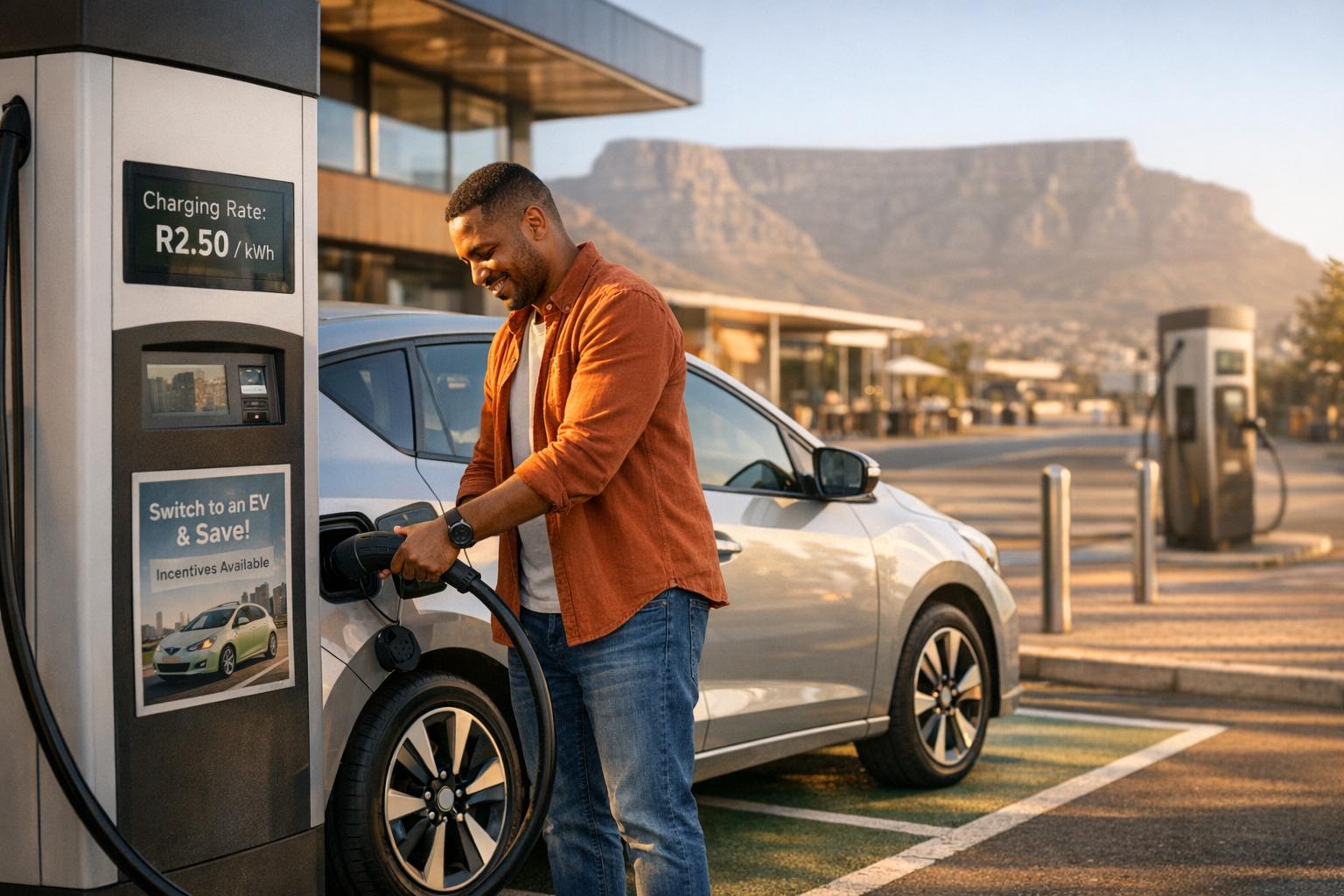
Electric cars (EVs) in South Africa are becoming more appealing thanks to lower prices, expanded charging networks, and new government incentives. While EVs still face challenges like high upfront costs and reliance on coal-powered electricity, 2025 marks a turning point for potential buyers. Here’s what you need to know:
- Lower Prices: Affordable models like the BYD Dolphin Surf (R339,900) and Dayun S5 (R399,900) make EVs more accessible to middle-income buyers.
- Government Incentives: Tax breaks and R1 billion in funding are boosting local EV production and infrastructure.
- Improved Charging: Over 350 charging stations now exist, with solar-powered options reducing reliance on the coal-heavy grid.
- Cost Savings: EVs offer up to 61% lower fuel costs and significantly lower maintenance expenses compared to gas cars.
For urban drivers with access to home charging, EVs are now a practical option. However, long-distance travelers or those without reliable charging access might still face hurdles.
TCS | We test drive South Africa’s cheapest electric car
sbb-itb-99e19e3
Why Electric Cars Have Struggled in South Africa
While electric vehicles (EVs) are gaining traction globally, South Africa faces unique obstacles that slow their adoption. In 2023, EV sales grew by an impressive 85.4%, yet they still made up just 0.17% of the 532,098 new vehicles sold – only about 931 units. Let’s break down the key challenges.
High Purchase Prices
Cost remains the biggest barrier. On average, EVs in South Africa are about 33% more expensive than traditional gas or diesel cars. Most South African buyers tend to choose vehicles priced under R500,000 (roughly $27,800), but the majority of EVs have historically been priced above R900,000 (around $50,000).
This price gap stems from a combination of expensive batteries and high import duties on EV components from countries like China. Shivani Singh from Naamsa highlights the affordability issue:
"These fully battery electric vehicles are still sitting at over R900,000 per unit. Our chief economist tells us that for quarter one 2025, 74% of new cars that were sold were under R500,000 in value. So South Africans have an affordability challenge."
Adding to the hesitation is uncertainty around resale values. With a limited secondhand EV market, potential buyers are understandably cautious.
Limited Charging Station Network
Keeping an EV charged is another significant challenge. South Africa’s electricity grid has long suffered from underinvestment and frequent power outages. While charging stations are becoming more common along major highways, many potential EV owners still struggle to find reliable information on charger locations, costs, and availability.
Charging costs also raise concerns. Public DC fast charging costs between R7.00 and R7.35 per kWh (about $0.39 to $0.41), while AC charging averages R5.88 per kWh (around $0.33). Hilton Musk, Head of E-mobility at Rubicon, sums it up:
"It’s not just about electricity; it’s about infrastructure, access, and convenience."
Beyond the logistics of charging, the source of South Africa’s electricity adds another layer of complexity.
Coal-Powered Electricity Grid
About 80% of South Africa’s electricity comes from coal. This reliance on one of the dirtiest energy sources complicates the environmental benefits of EVs. While EVs produce zero emissions at the tailpipe, the electricity powering them often comes from coal-fired plants.
Denis Droppa, Group Motoring Editor at TimesLIVE, points out this contradiction:
"EVs… don’t satisfy a green conscience as long as the country’s Eskom supply is mostly delivered by dirty coal."
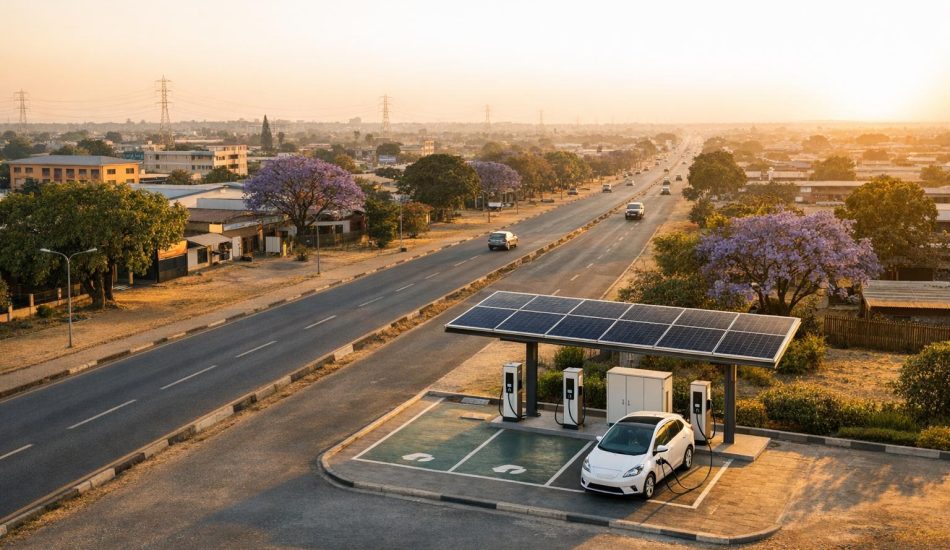
Efforts to address this include companies like Zero Carbon Charge, which are introducing solar-powered charging stations to bypass the coal-heavy grid. However, these renewable solutions are still in the early stages of development.
What’s Changed in 2025
The electric vehicle (EV) scene in South Africa has taken a major leap forward in 2025. Key developments are addressing the long-standing challenges of cost, infrastructure, and affordability, making EV ownership a more realistic option for many South Africans. These changes directly tackle barriers like high prices and sparse charging networks, which previously discouraged buyers.
New Government Support Programs
The government has rolled out substantial incentives to boost the EV sector. A 150% manufacturing tax incentive now allows manufacturers to deduct the costs of building and machinery for electric and hydrogen-powered vehicles. On top of that, the National Treasury has allocated R1 billion in the 2025 budget to support the production of EVs, batteries, and associated infrastructure.
BMW Group South Africa is already taking advantage of these initiatives, with a R4.2 billion investment into its Rosslyn facility. This funding is set to ramp up production for plug-in hybrids and eventually fully electric vehicles.
Expanded Charging Networks
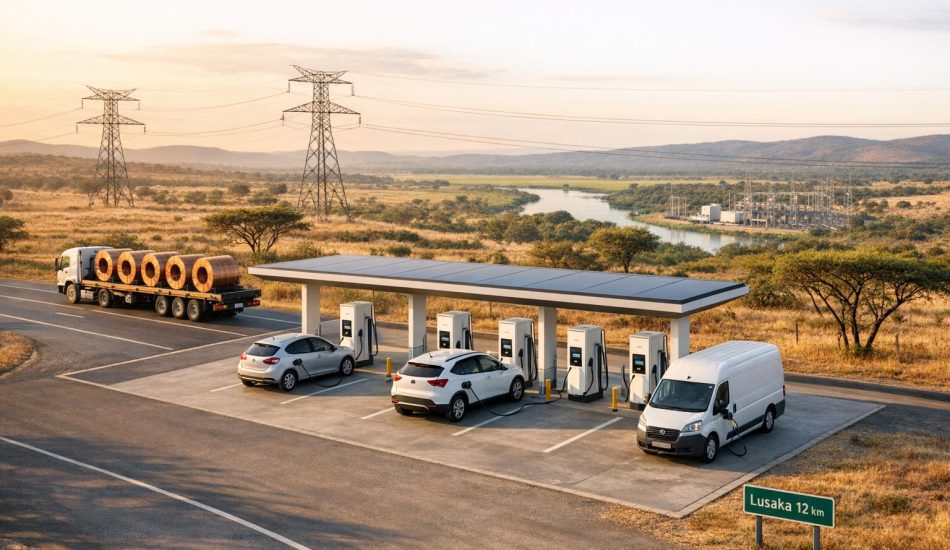
Charging infrastructure has grown significantly. The GridCars network now spans over 350 charging stations across the country, while the CHARGE initiative is in the process of installing 120 solar-powered EV charging points throughout 2025. To ease range anxiety, charging stations are strategically placed every 150 km along major travel routes.
Off-grid, solar-powered charging is also gaining traction. The first of its kind, located in the North West province, includes six DC fast-charging points and two AC chargers that operate independently of the national grid. This setup not only enhances reliability but also reduces reliance on coal-powered electricity.
DC fast chargers now deliver enough range in about 25 minutes, and many stations are equipped with amenities like farm stalls and shops, offering drivers a comfortable place to wait.
George Mienie, CEO of AutoTrader, summed up the progress:
"South Africa is at a pivotal moment in the journey toward widespread electric vehicle adoption. As more affordable EV models enter the market and charging networks expand, the barriers to EV ownership will steadily be dismantled."
Lower-Priced EV Models Now Available
The introduction of affordable EVs is another game-changer. Chinese carmakers have entered the market with lower-cost options, making EVs accessible to a broader audience. The BYD Dolphin Surf, launched in early 2025, starts at R339,900 (about $18,900), making it the cheapest EV in South Africa. Later in the year, the Dayun S5 was introduced at R399,900 (around $22,200), followed by the Dongfeng Box E1 330 in November at R459,000 (roughly $25,500).
Cost Comparison: Electric vs. Gasoline and Hybrid Vehicles
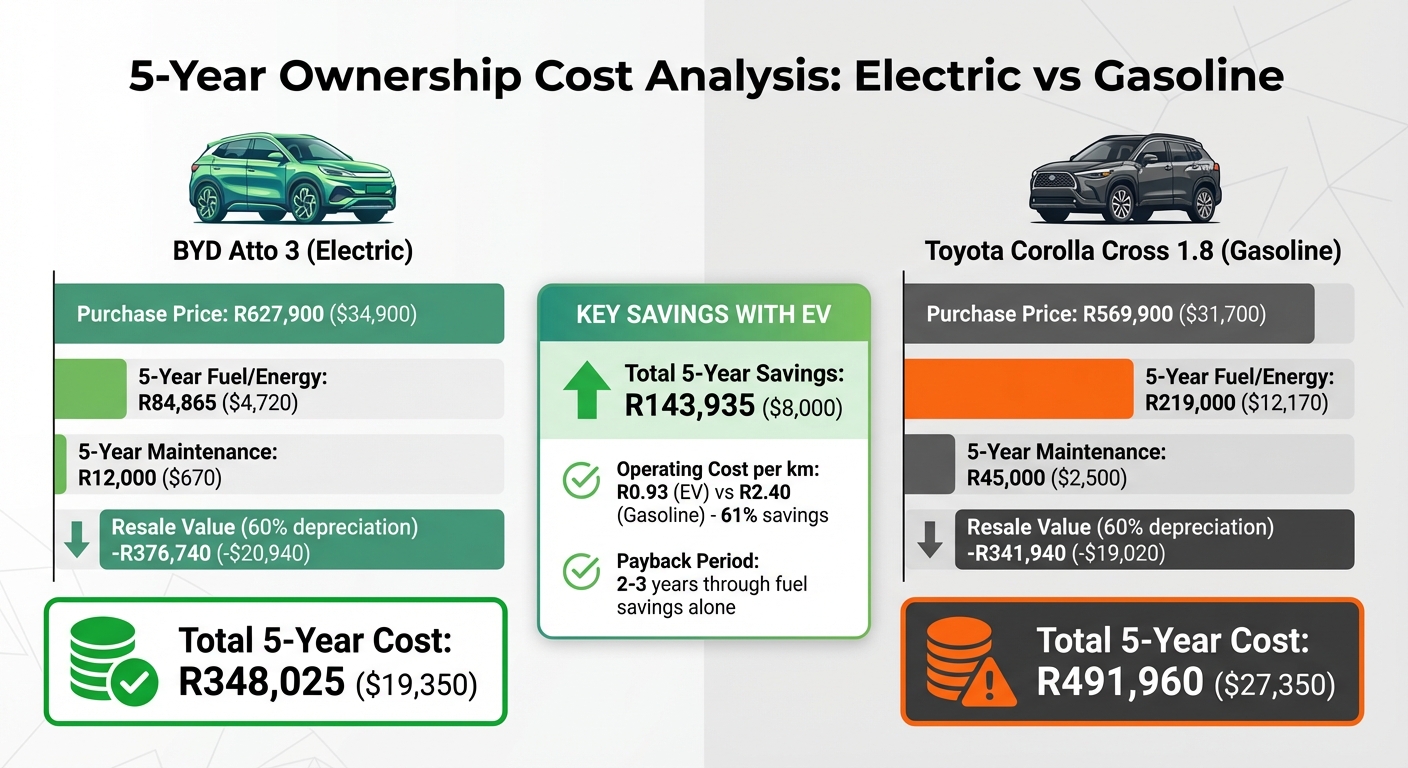
5-Year Cost Comparison: Electric vs Gasoline Cars in South Africa
Electric vehicles (EVs) tend to cost about 10–15% more upfront than their gasoline or hybrid counterparts. Take the BYD Atto 3, priced at R627,900 ($34,900), compared to the Toyota Corolla Cross 1.8 at R569,900 ($31,700). That’s a difference of R58,000 ($3,200). But the story doesn’t end there. When you factor in long-term fuel and maintenance costs, the financial picture shifts significantly.
EVs offer much lower operating costs – averaging R0.93 per kilometer compared to R2.40 per kilometer for gasoline vehicles. That’s a massive 61% savings on energy costs. For someone commuting 50 kilometers (31 miles) daily, this translates to annual fuel savings of around R26,827 ($1,490). Charging a 60 kWh EV battery costs roughly R309 ($17) at Cape Town’s electricity rate of R5.15 per kWh, giving you a range of 400 kilometers (249 miles). In contrast, filling a 50-liter (13.2-gallon) gasoline tank costs approximately R1,200 ($67) for a 500-kilometer (311-mile) range.
Maintenance costs also tilt in favor of EVs, thanks to fewer moving parts and the use of regenerative braking. Over five years, maintaining the BYD Atto 3 costs about R12,000 ($670), compared to R45,000 ($2,500) for the Corolla Cross. That’s a savings of R33,000 ($1,830) just on upkeep.
5-Year Ownership Cost Analysis
When you combine fuel and maintenance savings, the numbers show that EVs quickly offset their higher purchase price. Here’s how the five-year ownership costs compare:
| Cost Component | BYD Atto 3 (Electric) | Toyota Corolla Cross 1.8 (Gasoline) |
|---|---|---|
| Purchase Price | R627,900 ($34,900) | R569,900 ($31,700) |
| 5-Year Fuel/Energy | R84,865 ($4,720) | R219,000 ($12,170) |
| 5-Year Maintenance | R12,000 ($670) | R45,000 ($2,500) |
| Resale Value (60% depreciation) | -R376,740 (-$20,940) | -R341,940 (-$19,020) |
| Total 5-Year Cost | R348,025 ($19,350) | R491,960 ($27,350) |
Over five years, the BYD Atto 3 saves you approximately R143,935 ($8,000) in total ownership costs compared to the Corolla Cross. Even better, the initial price premium is recouped in just 2–3 years through fuel savings alone. If gasoline prices rise further – say, to R27 per liter – the cost gap widens even more, making EVs up to 66% cheaper to operate per kilometer. For those who rack up significant mileage, the economic case for EVs becomes even more compelling.
Best Electric Vehicles for South Africa in 2025
With improvements in infrastructure and affordability, the electric vehicle (EV) market in South Africa is evolving to meet practical local needs. By 2025, affordable Chinese EVs will dominate, with models priced under R340,000 ($18,900) and compact hatchbacks accounting for 67% of sales – ideal for the growing network of urban charging hubs.
When selecting an EV for South African conditions, three factors are key: price, range, and compatibility with local charging networks. Here are three models that cater to different needs, from budget-conscious city drivers to families seeking flexibility.
BYD Sealion
The BYD Sealion 6 is a plug-in hybrid electric vehicle (PHEV) designed to address South Africa’s infrastructure challenges. Its hybrid system combines electric efficiency for daily commutes with a gasoline engine for extended trips, making it a versatile option for families or long-distance travel.
BYD plans to install 200–300 "Flash Charging" stations nationwide by 2026, which will significantly enhance the feasibility of long-distance EV travel. For now, the Sealion offers the perfect balance of electric savings and gasoline reliability, easing range anxiety.
Leapmotor T03
Compact and city-friendly, the Leapmotor T03 is a great option for navigating urban areas like Cape Town or Johannesburg. Its range is tailored to city driving, where charging infrastructure is most concentrated.
The T03’s affordability makes it an excellent choice for first-time EV buyers. It’s also well-suited for solar off-grid (SOG) charging systems, allowing owners to use solar panels for home charging – an effective solution for avoiding issues tied to national grid instability.
Dayun S5
The Dayun S5 is a budget-friendly compact hatchback, making it a smart pick for those entering the EV market. Its design aligns with the growing demand for hatchbacks, which dominate the market with a 67% share.
Equipped with smart charging features and local charge controllers, the Dayun S5 supports efficient home charging, reducing electricity costs and charging times. This makes it an ideal choice for daily urban commutes and cost-conscious buyers.
Should You Buy an Electric Vehicle in South Africa in 2025?
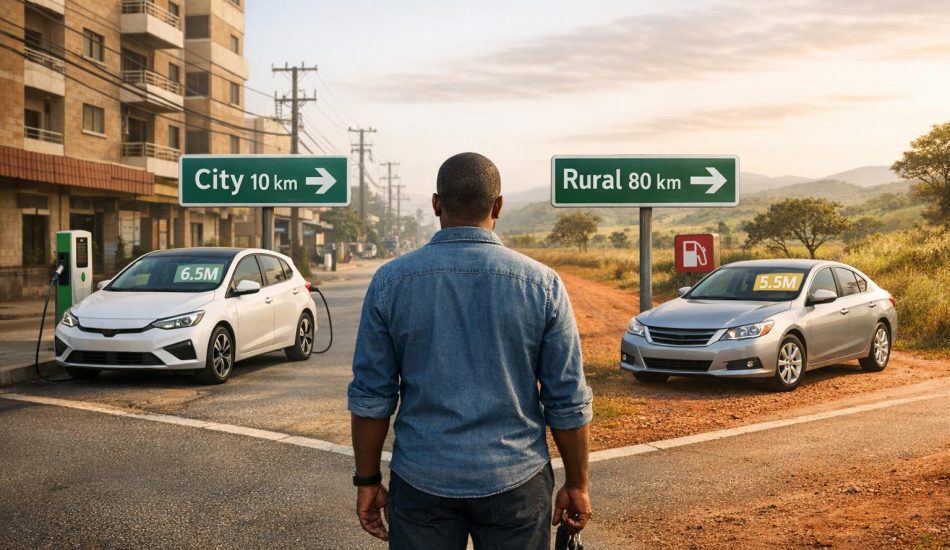
Deciding whether to invest in an electric vehicle (EV) in South Africa largely depends on your daily driving habits and access to charging. For urban commuters with reliable home charging, EVs can be a cost-effective option, especially with the improvements in infrastructure and government incentives introduced earlier. With operating costs about 33% lower than gasoline cars, and entry-level models like the BYD Dolphin Surf priced at around R339,900 (roughly $18,900), EVs are becoming more accessible. Below, we’ll break down the benefits and challenges to help you decide.
Advantages and Drawbacks
For the right buyer, EVs offer several advantages. Charging at home costs between R3.00 and R3.50 per kWh, which means driving a BMW iX3 for about 1,600 km (994 miles) would cost roughly R900–R1,000 ($50–$56). In comparison, a diesel vehicle covering the same distance would cost around R2,000 ($111). South Africa also boasts an impressive ratio of charging points, with one station for every six EVs – one of the highest globally. Other perks include quiet operation, instant torque, and the convenience of overnight home charging.
However, there are challenges to consider. EVs still cost about 33% more upfront than their gasoline counterparts. Charging is slower than refueling, and South Africa’s reliance on coal for electricity (about 80%) limits the environmental benefits. Public charging is also more expensive than home charging, which can reduce the overall savings.
Who Should Buy an EV Now
These factors highlight which drivers are best suited for EV ownership in 2025. Urban drivers with predictable daily commutes and access to home or solar charging setups stand to benefit the most. As Winstone Jordaan, Director at GridCars, explains:
"80% of all charging is done at home and the overall average of running an EV is about two-thirds of the price of fuel."
On the other hand, long-distance travelers and those without home charging access might want to hold off. For individuals frequently traveling between cities with limited charging infrastructure, a plug-in hybrid like the BYD Sealion 6 could be a more practical choice. Additionally, budget-conscious buyers might explore affordable Chinese EV models priced under R400,000 (around $22,200).
FAQs
What are the benefits of owning an electric car in South Africa in 2025?
Owning an electric car in South Africa by 2025 comes with practical perks and financial benefits. One of the standout advantages is the lower running costs. Charging an electric vehicle (EV) is often cheaper than filling up a gas or diesel car, even with rising electricity rates. Plus, EVs are simpler machines – they have fewer moving parts than traditional internal combustion engine (ICE) vehicles, which means less maintenance and fewer repair bills over time.
The charging infrastructure in cities like Cape Town and Johannesburg is steadily expanding, making EV ownership more convenient. On top of that, a growing variety of models is becoming available, whether you’re looking for something compact for city commutes or a vehicle suited for longer road trips. Potential government initiatives, such as tax breaks or subsidies, could also make EVs more affordable upfront while encouraging local manufacturing.
And let’s not overlook the environmental benefits. EVs produce fewer carbon emissions, helping to tackle air pollution and climate change. With more choices, better technology, and improving affordability, switching to an electric car in 2025 is not just a wise financial move – it’s also a step toward a cleaner, healthier future.
How does the cost of owning an electric car compare to a gas-powered car over five years?
Over a five-year period, owning an electric vehicle (EV) often turns out to be more budget-friendly than sticking with a gas-powered car, despite the higher upfront price tag of EVs. The key reason? Lower operating and maintenance costs.
For instance, EVs cost approximately $0.05 per mile to run, while gas-powered vehicles average around $0.13 per mile. That difference adds up quickly, leading to notable savings on fuel alone.
Although EVs are typically about 30% pricier to buy initially, their minimal maintenance requirements and lower energy expenses make them a smarter financial choice over time. On top of that, with improvements in EV technology and the increasing number of charging stations, owning an electric car is becoming more convenient and affordable than ever.
What are the main challenges of charging an electric car in South Africa?
One of the toughest hurdles for electric car owners in South Africa is the limited availability and uneven distribution of charging stations. While cities like Cape Town and Johannesburg are working to expand their networks, large parts of the country still don’t have enough charging points. This creates "range anxiety" – that constant worry about running out of charge before reaching the next station. On top of that, some stations are either unreliable or situated in inconvenient locations, making long-distance travel a real challenge.
Another major concern is the time it takes to charge an EV. Charging can take longer than expected, especially when chargers are either occupied or operate at slower speeds. While home charging offers an alternative, many South Africans don’t have the right setup, such as solar panels or large batteries, to make overnight charging efficient. Adding this infrastructure can also come with a hefty price tag. For EV ownership to become more practical in South Africa, charging options need to be more accessible, dependable, and quicker.