
 Thabo Nkosi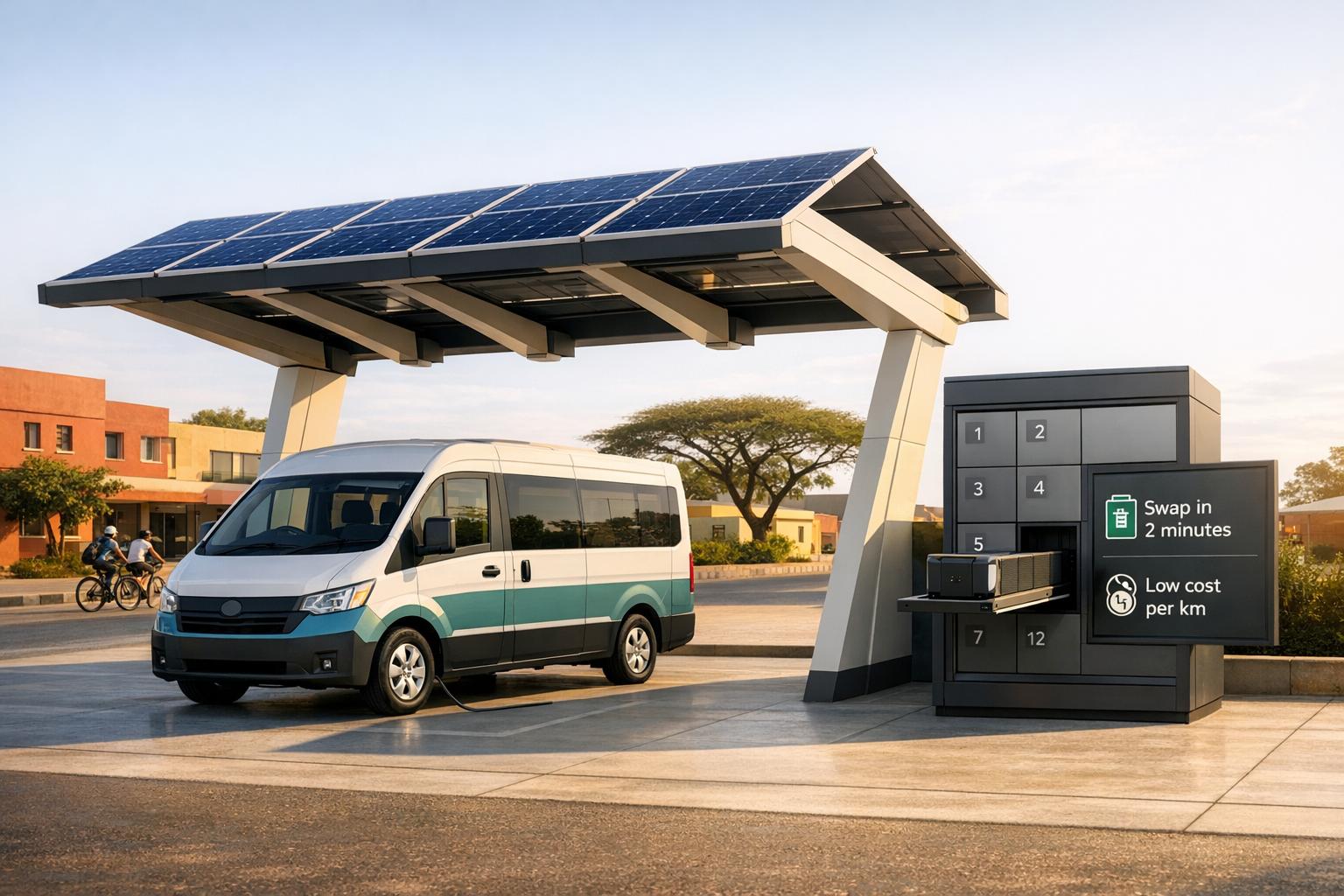
Electric vehicles (EVs) in Africa face challenges like high costs, limited charging infrastructure, unreliable electricity, and concerns about durability on rugged roads. However, these issues are often overstated or solvable with available solutions. Here’s the reality:
- Cost: While EVs are expensive upfront, lower fuel and maintenance costs make them cheaper over time. Solar charging systems further reduce costs.
- Range: Modern EVs can travel over 200 miles per charge, enough for most daily commutes. Strategic charging solutions, like solar off-grid systems, address range concerns.
- Charging Infrastructure: Though limited, networks are growing rapidly with battery-swapping stations, home chargers, and private investment.
- Durability: EVs are designed for harsh conditions, with advanced cooling systems and fewer parts prone to failure.
EV adoption is increasing, with countries like Kenya, Rwanda, and Ethiopia leading the way. EVs are already proving to be a practical, cost-effective, and cleaner alternative to traditional vehicles in Africa.
Common EV misconceptions debunked
Objection 1: EVs Can’t Handle Long Distances
There’s a lingering belief that electric vehicles (EVs) aren’t suitable for long trips. However, this view doesn’t align with the capabilities of today’s EVs, which offer impressive ranges that easily meet the daily driving needs of many users. Let’s dive into the actual data and practical strategies that address these concerns head-on.
Actual Range Data for EVs in Africa
Modern EVs are far from limited when it comes to range. Many models now surpass 200 miles (322 km) per charge, with some high-end options pushing even further. For instance:
- Lucid Air Grand Touring: 410 miles (660 km)
- Chevrolet Silverado EV and Mercedes EQS 450+: Around 400 miles (644 km)
- Hyundai Ioniq 6: Nearly 300 miles (483 km)
When you consider that urban trips in many African cities average just 20–31 miles per day, these vehicles can often handle a full week’s worth of driving on a single charge.
Real-world tests back up these claims. In April 2024, James Attwood from Autocar tested a Skoda Enyaq Coupé 85x on a challenging route from Marrakesh to the Sahara’s edge. The EV outperformed its official efficiency rating, achieving 4.5 miles per kilowatt-hour (mpkWh) compared to the advertised 3.9 mpkWh. Even on steep mountain roads, the instant torque of the electric motor proved more effective than traditional diesel engines. Clearly, EVs are more than capable of handling demanding conditions.
How to Overcome Range Limitations
For vehicles like paratransit matatus, which typically cover 75–137 miles (120–220 km) daily, strategic charging stops at key locations – such as termini and commercial hubs – can ensure smooth operations. In areas where the electrical grid is unreliable, solar off-grid (SOG) charging systems offer a practical alternative. For example, a SOG system designed for a vehicle traveling roughly 31 miles (50 km) daily costs about $2,700. Such systems can meet 90% of the vehicle’s annual energy needs with 90% reliability.
Commercial fleets are already proving how effective these solutions can be. By May 2025, BasiGo had deployed 100 electric buses across Kenya and Rwanda, serving thousands of passengers daily. Their success attracted $42 million in funding to scale operations to 1,000 buses. Similarly, Moove has introduced EV ride-hailing fleets in Nigeria, South Africa, and Ghana, showing that even in regions with variable grid reliability, high-utilization EVs can thrive.
The financial benefits are just as compelling. In Kenya, driving an EV for 62 miles (100 km) costs between $0.62 and $0.92, compared to $6.62 for gasoline – a savings of 47% to 83%. With advances in battery technology and the rapid growth of charging infrastructure, it’s clear that range anxiety is becoming a thing of the past in Africa.
Objection 2: Africa Lacks Charging Stations
The notion that Africa has insufficient charging infrastructure can deter potential EV buyers. While it’s true that charging networks aren’t yet as widespread as gas stations, progress is happening fast, and practical solutions are already taking shape across the continent. Here’s how the landscape is evolving.
Charging Networks Are Expanding Across Africa
Charging infrastructure in Africa is developing through several distinct approaches. In countries like South Africa and Morocco, public charging networks similar to those in Western nations are beginning to take root. Meanwhile, Kenya and Rwanda are leading the way with innovative options like battery-swapping stations and electric two-wheelers, which align better with local transportation needs.
In Kenya, companies such as M-KOPA and Watu Credit are providing digital loans for electric motorcycles, making EVs more accessible. At the same time, businesses like Ampersand and Powerhive are introducing battery-swapping systems, allowing riders to replace depleted batteries quickly and efficiently. Even in Nigeria, where the power grid is often unreliable, startups like MAX are working to expand electric mobility solutions.
For many African drivers, home charging is a practical alternative. Most drivers on the continent travel less than 62 miles (100 km) daily, making home charging a feasible option. Installing a Level 2 home charger – which costs between $200 and $1,000 – can provide 12 to 80 miles (20 to 130 km) of range per hour, depending on the system.
As of now, 12 African countries – including Seychelles, Morocco, Mauritius, South Africa, Tunisia, Egypt, Rwanda, Cabo Verde, Ethiopia, Kenya, Ghana, and Namibia – have reached "High EV Readiness" status. This designation reflects advancements in policy frameworks, grid reliability, and charging infrastructure. While only 17% of African nations currently have 10 or more public charging stations, private sector investments are quickly working to close this gap.
These growing networks aren’t just about convenience – they also make economic sense.
Charging Costs vs. Gas Refueling Costs
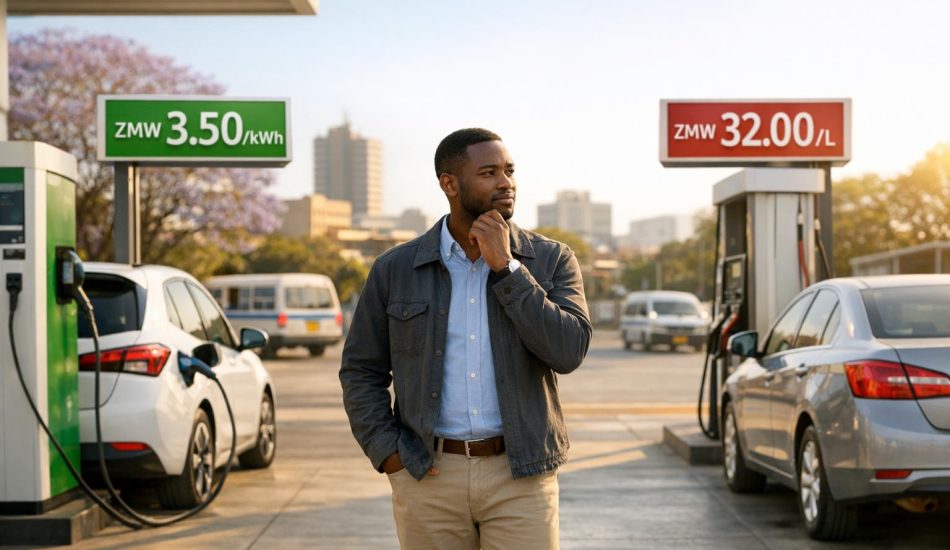
Charging an EV doesn’t just reduce emissions – it’s also more affordable. For EVs powered by solar off-grid systems, charging costs account for less than 4% of the total cost of ownership. In contrast, fuel costs remain a significant financial burden for gas-powered vehicles. Moreover, in many African countries, gasoline is heavily taxed, making it more expensive than global averages. This further strengthens the case for electric vehicles.
| Charging Method | Cost Impact | Reliability |
|---|---|---|
| Public Grid | Varies by local electricity tariffs | Low (Only 8 countries have stable grids) |
| Solar Off-Grid (SOG) | <4% of Total Ownership Cost | High (Independent of national grids) |
| Gasoline Refueling | High (Due to heavy taxation) | High (Well-established infrastructure) |
"Charging using SOG systems adds minimally to the total cost of BEV-SOG ownership while also circumventing the need for expensive grid upgrades." – Nature
Africa’s charging infrastructure may still be developing, but the combination of innovative solutions, private investment, and cost advantages is paving the way for a more electrified future.
sbb-itb-99e19e3
Objection 3: EVs Cost Too Much
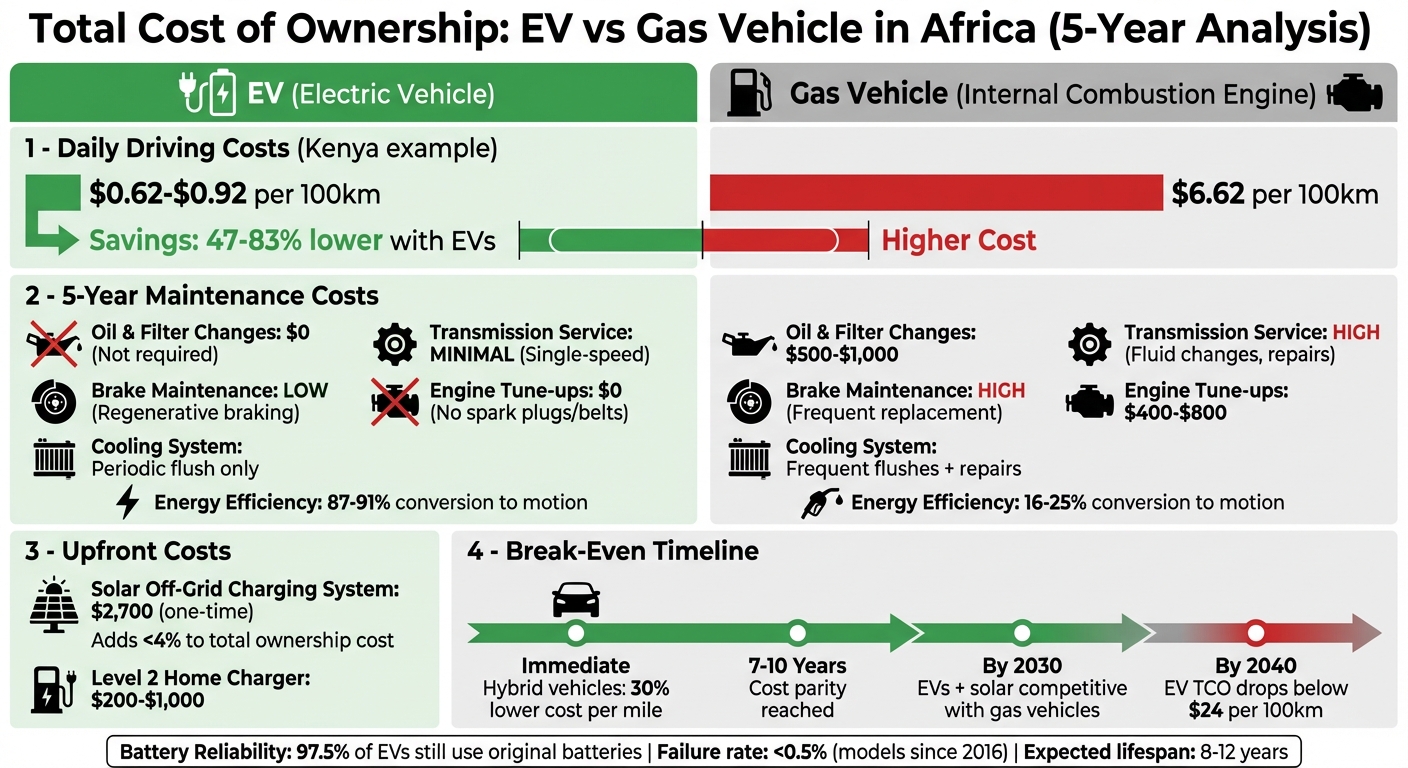
EV vs Gas Vehicle Cost Comparison in Africa: 5-Year Ownership Analysis
It’s true that electric vehicles (EVs) generally have higher sticker prices than gas-powered cars. However, when you factor in fuel savings, reduced maintenance costs, and favorable financing options, the long-term financial picture often tilts in favor of EVs.
Total Ownership Costs Favor EVs
The Total Cost of Ownership (TCO) includes more than just the purchase price – it accounts for fuel, maintenance, insurance, and financing. And in these areas, EVs tend to shine.
For starters, charging an EV is significantly cheaper than refueling a gas-powered car. For instance, using a solar off-grid system to charge a small four-wheeler driving about 31 miles per day costs less than 4% of the total ownership cost. These systems typically cost around $2,700 to install, making them an economical choice over time. Maintenance is another area where EVs come out ahead. With fewer moving parts, they require far less upkeep than traditional vehicles.
While the upfront cost of an EV may seem steep, most drivers reach cost parity with gas-powered vehicles within 7 to 10 years. In some cases, hybrid vehicles are already delivering immediate savings, with costs per mile up to 30% lower than those of traditional petrol cars.
Financing, however, remains a challenge, particularly in regions like Africa, where high interest rates can double the cost of a vehicle. This is where platforms like EV24.africa step in. By offering transparent pricing and connecting buyers with financing solutions, EV24.africa simplifies the process of purchasing an EV. Whether you’re considering new options from brands like Tesla, BYD, or Leapmotor, or exploring the used market, these platforms help buyers understand the true cost of ownership.
"Financing is identified as the key action point for governments and global financial institutions to accelerate Africa’s transition to battery electric vehicles…" – Nature
Looking ahead, EVs are expected to become even more cost-competitive. By 2030, battery electric vehicles paired with solar off-grid charging systems could rival fossil-fuel vehicles in most African markets. By 2040, the total cost of ownership for EVs is projected to drop below $24 per 100 km (about 62 miles), thanks to falling battery prices.
These cost advantages also extend to battery durability and resale value.
Battery Life and Resale Prices
One of the standout features of EVs is their battery reliability. Studies show that battery failures are extremely rare. Among 15,000 vehicles analyzed, EVs manufactured since 2016 had a failure rate of less than 0.5%. Even more striking, 97.5% of EVs on the road today are still running on their original batteries.
"Electric vehicle battery replacements due to failures are uncommon… drivetrain batteries are designed to last the lifetime of the vehicle." – U.S. Environmental Protection Agency (EPA)
Battery technology is advancing rapidly. In 2024 alone, global battery pack prices dropped by over 25% compared to the previous year. While some regions, such as parts of Africa, face challenges like a shortage of EV maintenance expertise and limited spare parts, these issues are expected to diminish as the market grows and infrastructure improves.
With long-lasting batteries, lower operating costs, and a maturing support network, EVs are proving to be a solid long-term investment.
Objection 4: EVs Can’t Handle African Heat and Roads
Some argue that electric vehicles (EVs) aren’t built to withstand Africa’s intense heat and rugged roads. However, advancements in EV technology prove otherwise. Modern EVs are designed to excel in these conditions, and pilot programs have shown they can match – or even surpass – the performance of traditional gas-powered vehicles.
Cooling Systems in Modern EVs
Modern EVs use active thermal management systems to regulate temperature effectively. These systems circulate coolant around critical components like the battery pack, electric motors, and power electronics. A Battery Management System (BMS) ensures that overheating is avoided. Many EVs also integrate their air-conditioning system with the battery cooling loop, using evaporators to provide chilled coolant during extreme heat. This setup keeps the battery within its optimal temperature range (60°F to 95°F), ensuring peak efficiency. As a result, high temperatures have minimal impact on EV range.
Additionally, pre-conditioning technology allows drivers to cool both the battery and cabin while the vehicle is still plugged in. This feature not only enhances comfort but also conserves energy for driving.
Real-world examples back up these claims. A 2021 pilot in East Africa, involving 40 drivers, revealed that over 90% found their EVs outperformed gas vehicles on rough terrain. Kenyan startup Roam (formerly Opibus) is manufacturing electric motorcycles tailored for "boda boda" drivers, who often cover up to 80 miles daily on challenging roads. Similarly, Rwanda-based Ampersand has introduced battery-swapping stations, enabling commercial drivers to quickly exchange depleted batteries and continue their journeys. These innovations ensure EVs remain reliable even in areas with limited infrastructure.
These advanced cooling and operational strategies make EVs well-suited for Africa’s heat and diverse terrains.
5-Year Maintenance Cost Comparison
The simpler mechanical design of EVs translates into significant maintenance savings over time. Here’s how EVs compare to gas-powered vehicles in terms of upkeep:
| Maintenance Item | Electric Vehicle (EV) | Gas Vehicle (ICE) |
|---|---|---|
| Oil & Filter Changes | $0 (Not required) | $500–$1,000 |
| Brake Maintenance | Low (Regenerative braking) | High (Frequent pad/rotor replacement) |
| Cooling System | Periodic coolant flush | Frequent flushes, belt/pump repairs |
| Transmission Service | Minimal (Single-speed gearbox) | High (Fluid changes, clutch/gear repairs) |
| Engine Tune-ups | $0 (No spark plugs or belts) | $400–$800 |
EVs not only save money on maintenance but also operate more efficiently. They convert 87%–91% of their energy into motion, compared to just 16%–25% for gasoline vehicles. This efficiency means less wasted heat and fewer components prone to failure. Furthermore, modern EV batteries are built to last, with an expected lifespan of 8 to 12 years and a failure rate below 0.5% for models produced since 2016.
These features make EVs a practical and cost-effective option, even in harsh environments like Africa.
Why EVs Make Sense for Africa
Concerns about range, charging infrastructure, costs, and durability don’t hold up when you dig deeper. EVs bring cleaner air, lower expenses, and energy independence to the table. Transportation is responsible for 24% of direct global CO₂ emissions, and vehicle exhaust contributes to more than 4 million deaths annually due to particulate air pollution. By adopting EVs, African cities can tackle these health challenges while reducing reliance on costly imported fossil fuels.
The financial benefits are hard to ignore. EVs paired with solar charging are expected to become more affordable than traditional gas-powered vehicles across much of Africa well before 2040. In Kenya, for example, driving costs are already 47% to 83% lower with EVs. Electric motorcycles, in particular, are 25% cheaper over a five-year lifecycle. EVs also shine in terms of emissions, with life-cycle emissions being 65% to 85% lower compared to conventional vehicles. In some cases, the transition to EVs even results in a net financial saving over time.
"Battery electric vehicles with solar off‑grid chargers will have lower costs and negative greenhouse gas abatement costs well before 2040 in most countries and segments." – Nature Energy
Momentum is building fast. By May 2025, Africa had over 30,000 active EVs, with electric two- and three-wheelers growing 38% year-over-year and electric buses seeing a 44% surge. In December 2023, Dakar introduced sub-Saharan Africa’s first all-electric Bus Rapid Transit system, featuring 23 stations and 155 e-buses to combat urban congestion and pollution. Companies like BasiGo are also stepping up, securing $42 million in funding to roll out 1,000 electric buses across Kenya and Rwanda using a "Pay-As-You-Drive" battery leasing model. Ethiopia made headlines in 2024 by becoming the first country to ban the import of internal combustion engine vehicles. These developments highlight how EVs are no longer just a concept – they’re becoming a practical, everyday solution.
How EV24.africa Makes EV Ownership Easier
EV24.africa takes the hassle out of EV ownership by managing global sourcing, shipping, customs clearance, and local registration across all 54 African countries. Delivery takes 4 to 8 weeks, and buyers can track their vehicle’s journey in real time, from supplier to doorstep.
The platform offers a range of options, including battery electric vehicles, plug-in hybrids, and light commercial EVs from trusted brands like Tesla, BYD, Leapmotor, Geely, and Hyundai. Whether you’re looking for a budget-friendly city car like the Geely Panda Mini starting at $5,880 or a performance-oriented model like the MG4 Electric at $28,000, EV24.africa provides transparent pricing and detailed specs for every vehicle. Both new and certified pre-owned vehicles come with warranties.
Financing is available through partner institutions, offering leasing and loan packages to help offset higher upfront costs. The platform also guides users on installing Level 2 home chargers and pairing them with solar panels, making it easier to navigate unreliable grid power. By streamlining these processes, EV24.africa makes transitioning to EVs much simpler.
Getting Started with EVs in Africa
Switching to an EV starts with assessing your daily mileage to find the right fit. Most urban drivers in Africa cover less than 31 miles per day, which is well within the range of even entry-level EVs. Use the EV24.africa website to filter vehicles based on your budget, charging needs, and intended use, whether for personal commuting or a business fleet.
Look into local incentives. For instance, Rwanda has removed VAT, import, and excise duties on EVs, significantly lowering ownership costs. If you’re considering a pre-owned EV, check the battery health percentage to gauge the remaining range. Modern EV batteries are built to last 8 to 15 years, so even used models can still have plenty of life left.
For areas with unreliable electricity, investing in a solar charging setup is a smart move. A solar off-grid system for a small EV costs around $2,700 and adds less than 4% to your total ownership costs. This setup eliminates range anxiety and reduces dependence on the grid. High-mileage drivers – those traveling over 31 to 62 miles daily – will see the quickest return on investment thanks to fuel savings.
FAQs
Why are EVs actually more affordable in the long run, even if they cost more upfront?
While electric vehicles (EVs) might cost more upfront compared to gas-powered cars, they often save you money in the long run. Why? Lower operating costs. Charging an EV at home usually costs less than a tank of gas, and since EVs have fewer moving parts, you can skip pricey maintenance like oil changes or engine repairs.
On top of that, government tax credits, rebates, and lower electricity rates in some areas can cut costs even further. And as battery technology improves and production ramps up, EV prices are steadily becoming more competitive. Over time, the savings on fuel and maintenance can make EVs a more budget-friendly option for many drivers.
How can EVs be charged in areas with unreliable electricity in Africa?
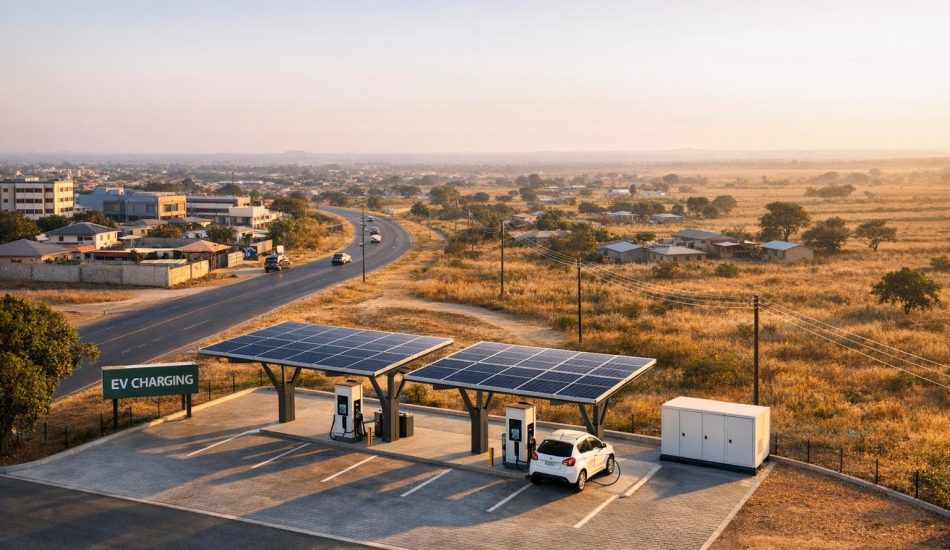
One promising way to charge EVs in areas with unreliable electricity in Africa is by using solar-powered charging stations. These stations take advantage of the region’s abundant sunlight to produce clean and steady energy. This makes them a great fit for places where access to the power grid is inconsistent or where blackouts are common. They’re especially useful in rural areas where traditional electrical infrastructure is often lacking.
Another practical solution includes mobile chargers and battery swap systems. These options let EV users either charge their vehicles or swap out depleted batteries without needing a fixed charging station. By addressing local energy limitations, these adaptable methods make it easier for people in underserved areas to embrace EV technology.
Can electric vehicles handle Africa’s tough roads and hot climate?
Modern electric vehicles (EVs) are designed to handle tough conditions, making them a great fit for Africa’s unique roads and climate. Many models now feature reinforced suspensions, high ground clearance, and sealed battery compartments – perfect for navigating unpaved roads, potholes, and rough terrains. These upgrades not only improve durability but also help cut down on maintenance costs.
To combat extreme heat, manufacturers incorporate heat-resistant materials and advanced cooling systems that keep the battery protected and running smoothly, even in temperatures over 104°F. Some EVs even offer solar charging capabilities, a practical solution for regions with inconsistent or limited electricity access. These advancements ensure that modern EVs are reliable and efficient, ready to take on the challenges Africa presents.