
 Thabo Nkosi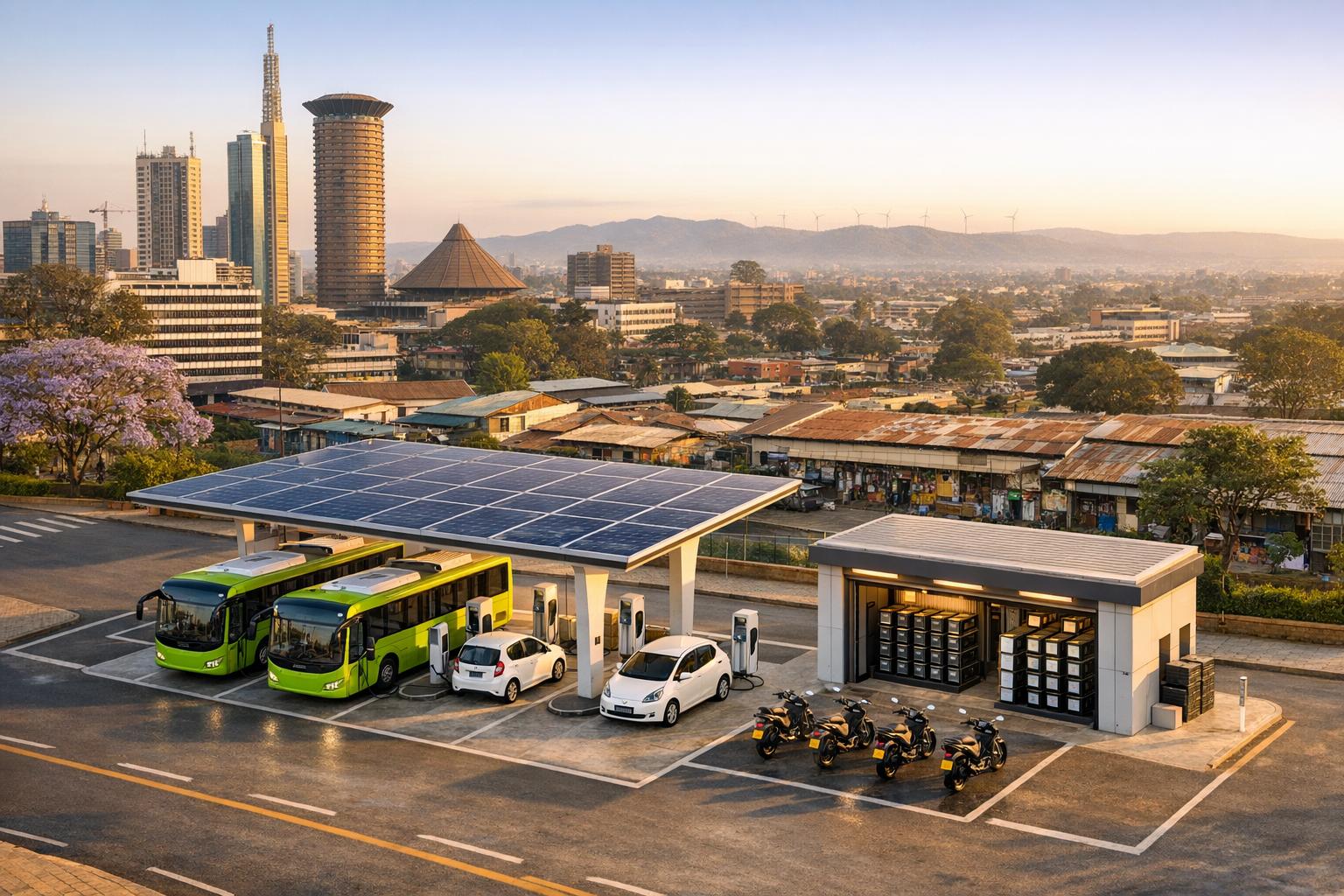
Kenya is emerging as East Africa’s leader in electric vehicle (EV) adoption due to its renewable energy infrastructure, supportive policies, and cost benefits. By February 2026, the country had 24,754 EVs – a 2,700% increase since 2022. Key drivers include:
- Renewable Energy: 90% of Kenya’s electricity comes from clean sources like geothermal, wind, and hydro, reducing EV charging costs and emissions.
- Economic Impact: EVs save on fuel costs – $0.62 for 62 miles vs. $6.62 for gasoline – and reduce Kenya’s $4.8 billion annual petroleum import bill.
- Government Policies: Zero VAT on EVs, battery-swapping networks, and local assembly plants are accelerating adoption.
- Motorcycle Sector Growth: Electric motorcycles dominate, making up 90% of EVs, driven by tax cuts and lower operating costs.
Kenya’s renewable energy, cost-efficient EV use, and government support position it as a testing ground for EV technology in Africa.
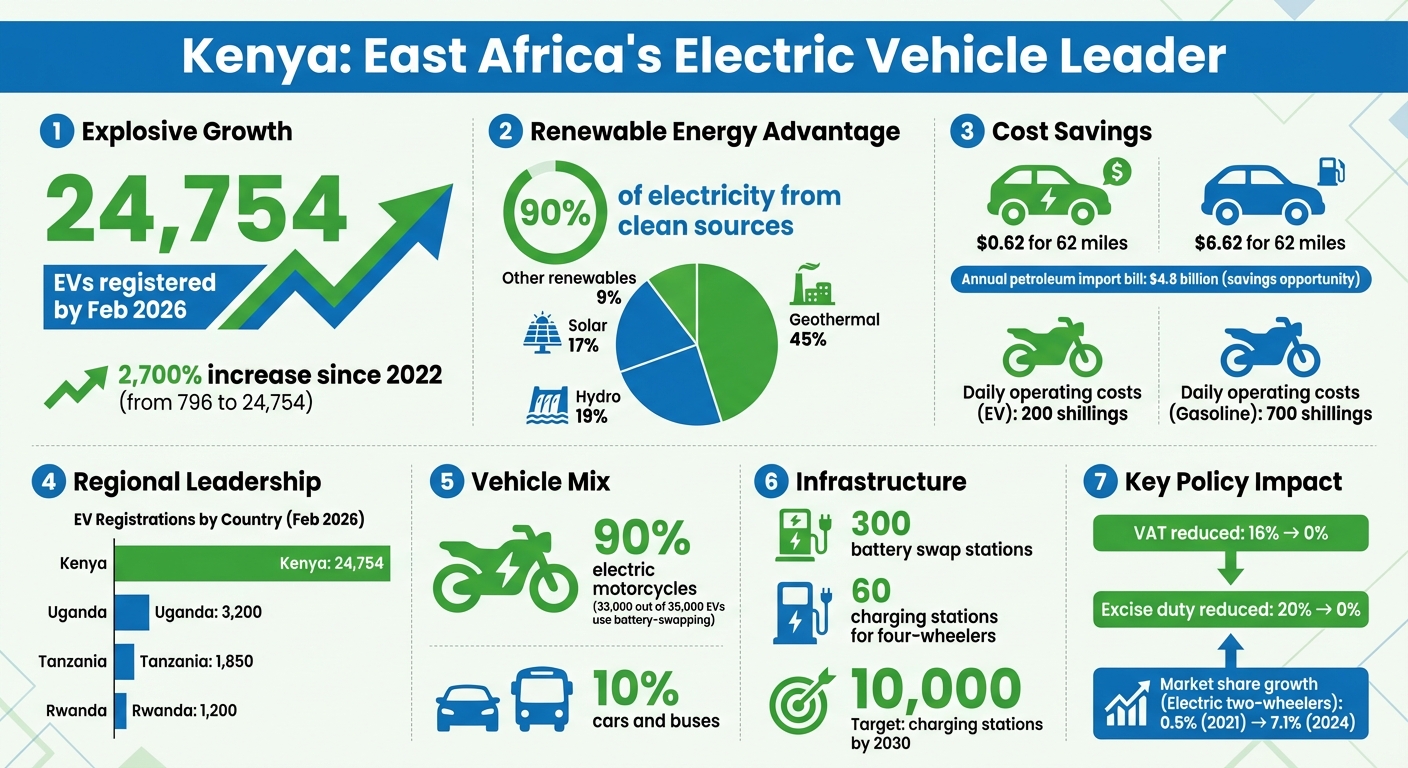
Kenya’s EV Growth: Key Statistics and Regional Leadership in East Africa 2022-2026
Kenya’s EV Economy Ready For Lift Off!
sbb-itb-99e19e3
Government Policies Driving EV Growth
Kenya’s government has shifted electric vehicle (EV) efforts from small-scale trials to a unified national movement through deliberate policy changes. By eliminating fiscal hurdles and standardizing regulations, the country has laid the groundwork for a large-scale transition to electric mobility.
National E-Mobility Policy
Introduced in February 2026 at the Kenyatta International Convention Centre, the National E-Mobility Policy created a roadmap for scaling up EV adoption. During the launch, Cabinet Secretary Davis Chirchir unveiled green reflective plates for fully electric vehicles, symbolizing Kenya’s commitment to tracking and encouraging EV growth.
This policy focuses on five main areas: setting standards, expanding charging infrastructure, promoting local manufacturing, developing skills, and offering fiscal incentives. The Energy and Petroleum Regulatory Authority (EPRA) has issued guidelines for charging and battery-swapping stations, while the Kenya Bureau of Standards (KEBS) now bans the import of used EVs with battery health below 80%, ensuring better consumer protection.
"Electric mobility is no longer optional, but a strategic necessity for Kenya’s economic resilience and environmental sustainability." – Davis Chirchir, Cabinet Secretary for Transport
The policy also addresses Kenya’s $5 billion annual petroleum import bill and aims to utilize over 1,300 MWh of off-peak energy for EV charging. These broader measures are reinforced by specific fiscal incentives, especially in the motorcycle sector.
Incentives for Electric Motorcycles
The Finance Bill 2025 introduced tax exemptions on electric motorcycles, bicycles, and lithium-ion batteries, reducing VAT and excise duty from 16% and 20% to 0%. This has led to electric motorcycles making up nearly 90% of Kenya’s EV fleet.
These incentives are particularly impactful in the "boda boda" (motorcycle taxi) sector. Riders benefit from significant savings, with daily energy costs dropping from about 700 shillings for gasoline to just 200 shillings for electricity. These savings not only support individual riders but also help reduce Kenya’s reliance on petroleum imports and stimulate local production. The market share for electric two-wheelers jumped from 0.5% in 2021 to 7.1% in 2024.
Manufacturers have also capitalized on these incentives. For example, MojaEV expanded production at its Mombasa assembly plant in 2025, aiming to produce 300 vehicles per month. Similarly, Rideence signed a 320 million shillings deal with Associated Vehicle Assemblers (AVA) in February 2026 to locally assemble low-cost EVs for public transport. By prioritizing local assembly and parts production, these measures are boosting domestic industries and creating jobs.
| Incentive Type | Previous Rate | Current Rate (2025/2026) | Target Category |
|---|---|---|---|
| Value Added Tax (VAT) | 16% | 0% | E-bikes, buses, batteries |
| Excise Duty | 20% | 0% | Electric motorcycles & parts |
| Battery Health Standard | None | Minimum 80% | Used EV imports |
Kenya’s Renewable Energy Advantage
Kenya’s electricity grid, powered by 90% renewable energy, offers a solid foundation for the adoption of electric vehicles (EVs). This infrastructure not only supports the economic feasibility of EVs but also aligns with environmental goals.
Clean Energy for Charging Infrastructure
Kenya generates 45% of its electricity from geothermal energy. Unlike solar or wind, geothermal provides a steady, 24/7 energy supply by tapping into the volcanic heat of the Rift Valley. This ensures EVs can be charged with low-carbon energy at any time, not just during sunny or windy conditions.
Hydropower contributes another 19%, while solar energy accounts for 17% of the grid. The Lake Turkana Wind Power Project alone generates about 15% of the country’s electricity, cutting carbon emissions by 700,000 tons annually. With over 90% of its electricity coming from renewable sources that produce minimal emissions, Kenya is directly translating its clean energy mix into cleaner transportation.
The shift to e-mobility is gaining momentum. Kenya Power reported a 188% increase in electricity consumption for EVs in 2025, reaching 8.4 million kilowatt-hours. To accommodate this growth, the utility has installed five chargers at its Nairobi offices and operates a fleet of 11 electric vehicles and 30 electric bikes.
"A developing country having close to 90 percent of renewable energy power generation is quite unique." – Tobias Rasmussen, IMF Resident Representative in Kenya
Kenya’s grid also faces an interesting challenge: it wastes over 1,300 megawatt-hours of renewable energy every night due to reduced demand. While peak capacity reaches 1,944 MW, off-peak demand drops to just 1,200 MW – leaving enough unused capacity to charge up to 2 million motorcycles and 50,000 buses. To address this, the government introduced a special e-mobility tariff: $0.12 per kWh during peak hours and just $0.06 per kWh overnight. This pricing structure makes overnight charging both affordable and efficient, utilizing renewable energy that might otherwise go unused. Kenya’s renewable energy base not only reduces emissions but also supports a reliable and cost-effective charging network.
Energy Reliability and Regional Comparison
Kenya ranks 3rd in Africa on the World Economic Forum’s Energy Transition Index, following Morocco and Namibia. This ranking reflects not just its renewable capacity but also its grid reliability, a key factor for EV adoption and commercial expansion.
The state utility KETRACO is working to improve this reliability by adding 2,858 miles (4,600 km) of new transmission lines, aiming for 99.7% grid reliability. While technical losses currently stand at around 23%, Kenya’s geothermal energy provides a stable baseload, outperforming neighboring countries that rely on rain-dependent hydropower or diesel generators.
The regional differences are striking. As of February 2026, Kenya led East Africa with 24,754 registered EVs, far ahead of Uganda (3,200), Tanzania (1,850), and Rwanda (1,200). Kenya’s electricity costs also remain competitive, with household rates averaging $0.21 per kWh in 2021 – lower than Rwanda’s $0.25 per kWh. Its nearly 1,000 MW of installed geothermal capacity ensures low-cost, stable power, making large-scale EV adoption feasible.
| Country | Registered EVs (Feb 2026) | Primary Energy Sources | Grid Reliability |
|---|---|---|---|
| Kenya | 24,754 | Geothermal (45%), Hydro (19%), Solar (17%) | 99.7% target (expanding) |
| Uganda | 3,200 | Hydro-dependent, thermal backup | Lower consistency |
| Tanzania | 1,850 | Natural gas, hydro, thermal | Variable |
| Rwanda | 1,200 | Hydro, diesel, imports | Import-dependent |
Kenya’s dependable renewable energy supply, competitive electricity pricing, and improving grid reliability position it as a regional leader in EV adoption. Few other African nations can match these conditions, making Kenya an ideal testing ground for advancing EV technology and infrastructure.
Charging and Battery Infrastructure Solutions
Kenya is making strides in scaling its EV charging and battery systems, supported by strong government policies and renewable energy. The country has adopted a dual approach: battery-swapping networks for motorcycles and fixed charging stations for cars and buses. As of early 2026, Kenya boasts around 300 battery swap stations and 60 charging stations for four-wheel vehicles. This strategy addresses the needs of various vehicle types while working within the limitations of the current grid, aiming to integrate EVs across both urban and rural areas.
Battery-Swapping Technology
Battery-swapping is a game-changer for Kenya’s electric motorcycle market. Out of 35,000 registered EVs, 33,000 rely on battery-swapping. Companies like ARC Ride and Spiro use a Battery-as-a-Service (BaaS) model, which allows riders to rent batteries, significantly reducing upfront costs.
In October 2024, ARC Ride, in partnership with OLA Energy and Watu Credit, opened its 100th battery swap station in Nairobi. Riders can swap batteries in under two minutes at key locations for about 350 Kenyan shillings daily (approximately $2.70). Spiro, on the other hand, operates over 300 battery-swap stations across Kenya, supporting more than 3,000 electric motorcycles in cities like Nairobi, Mombasa, Eldoret, and Kisumu as of February 2026. That same month, climate finance firm Nithio provided Spiro with a $7 million senior debt facility to support its expansion.
Spiro has deployed over 80,000 electric motorcycles and 2,500 battery-swapping stations across Africa, helping riders cut fuel and maintenance costs by up to 40%. The Kenyan government and Spiro are also working together to roll out over one million electric motorcycles and 3,000 battery-swap stations nationwide. Additionally, in October 2025, French investor Mirova extended a $10 million loan to ARC Ride to establish 600 battery exchange stations in Nairobi.
"This partnership with Mirova marks a major milestone in our mission to make electric mobility accessible, affordable, and sustainable across Africa." – Joseph Hurst-Croft, ARC Ride founder
"The battery is the bus. Everything else is just a shell." – George Githinji, CEO, Outer Ring Matatu Association
Battery-swapping also helps balance grid demand. Operators can charge batteries during off-peak hours when electricity costs just $0.06 per kWh, compared to $0.12 per kWh during peak times. For electric tuk-tuks, daily battery-swap costs are around 650 Kenyan shillings (roughly $5), which is lower than the 850 shillings spent on diesel.
Charging Station Expansion
While battery-swapping dominates for motorcycles and tuk-tuks, fixed charging stations are essential for cars and buses.
Kenya Power is leading efforts to expand fixed charging infrastructure. The utility has already installed five chargers at its Nairobi offices. In July 2025, Kenya Power announced plans to set up 45 public EV chargers across seven counties – including Nairobi, Nyeri, Kisumu, Eldoret, Nakuru, Mombasa, and Taita-Taveta – within a year.
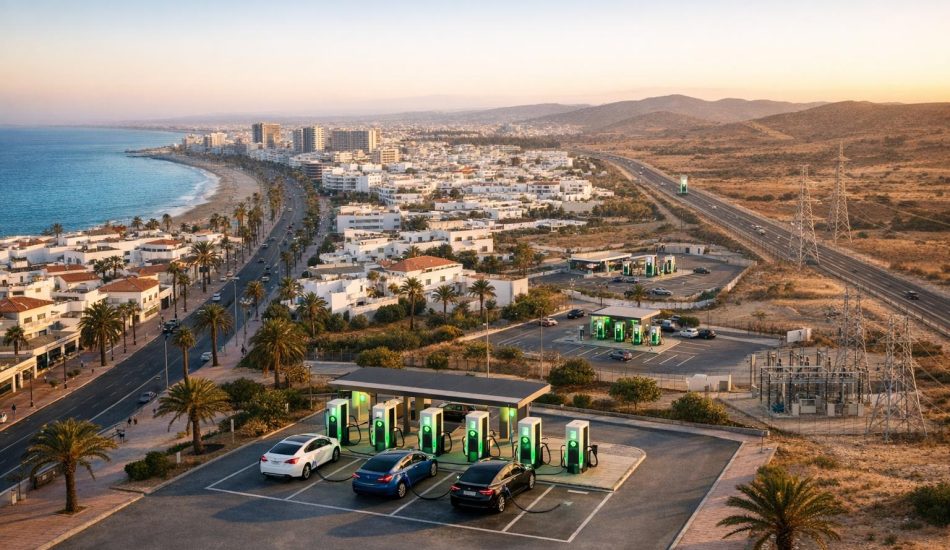
The government’s National Energy Compact 2025–2030 aims to install 10,000 EV charging stations across the country by 2030, with an estimated investment of $47.26 million. The rollout is divided into three phases: Phase 1 will establish 17 stations along major highways like the Mombasa–Busia corridor and in towns such as Voi and Naivasha; Phase 2 will add 23 stations in towns like Machakos and Garissa; and Phase 3 will extend coverage to county headquarters and satellite towns.
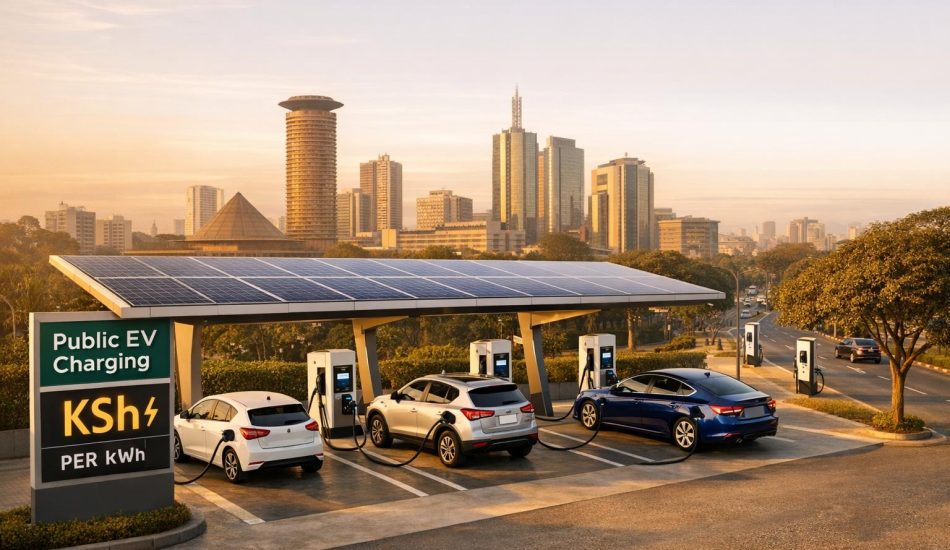
To ease range anxiety, energy regulators have mandated charging stations every 15.5 miles (25 kilometers) along highways. Additionally, the National Building Code now requires that 5% of parking spaces in commercial buildings be EV-ready with pre-installed outlets.
Private companies are also stepping up. In 2023, BasiGo built a six-bus charging station in Buruburu, Nairobi, powered entirely by renewable energy to support its fleet of nearly 20 electric buses. By owning and operating their charging infrastructure, EV assemblers like BasiGo can bypass gaps in public networks, ensuring reliable service for their customers.
Kenya Power’s EV charging services generated 125.9 million Kenyan shillings (about $976,803) in 2025.
"E-mobility is one of the key areas the company is focused on under our green agenda, which seeks to power livelihoods and support our communities with solutions that reduce carbon emissions." – Joseph Siror, Kenya Power’s Managing Director
Kenya’s Startup Ecosystem and Local Manufacturing
Kenya’s push towards electric vehicles (EVs) is being fueled by a wave of local startups and manufacturers shifting from imported vehicles to assembling them domestically. This change is helping lower costs, create jobs, and position Kenya as a leader in EV development within the region.
Startup Activity in EV Technology
Startups like TAD Motors and Rideence Africa Limited are leading the charge in EV assembly. TAD Motors has invested $10 million to establish a manufacturing facility in the Naivasha Special Economic Zone. By January 2026, the company rolled out its first five locally assembled EV models – Dhahabu, Amani, Taji, Makena, and Fahari – priced between $10,077 and $20,154. Their goal? To produce 3,000 vehicles annually and source 80% of components locally by September 2026.
"Our idea is to make EVs affordable to ‘normal’ people." – Tadesse Tessema, Founder & CEO, TAD Motors
Meanwhile, Rideence Africa Limited is focusing on ride-hailing and public transport. Partnering with Associated Vehicle Assemblers in Mombasa, the company invested $2.5 million (320 million Kenyan shillings) to establish Kenya’s first dedicated EV assembly line. Their initial rollout includes assembling 152 vehicles – 132 Henrey taxis and 20 Joylong minibuses – from completely knocked-down kits. This effort is set to create over 3,000 jobs and increase local parts sourcing to 25% by the end of 2026.
"Our vision is to become a leading new energy mobility enterprise ‘Born in Kenya, Serving Africa’." – Minnan Yu, Managing Director, Rideence Africa Limited
Other players, like BasiGo, continue to focus on electric buses, assembling them in partnership with Kenya Vehicle Manufacturers in Thika. Additionally, Spiro has made strides by setting up over 300 battery swap stations across the country.
These startups are not only innovating but also driving broader local assembly efforts, reducing costs, and spurring industry growth.
Local Assembly and Manufacturing
Local assembly has reshaped Kenya’s manufacturing landscape. By assembling vehicles locally through completely knocked-down (CKD) and semi-knocked-down (SKD) kits, manufacturers can sidestep a 35% import duty on fully built vehicles. This approach cuts retail prices by up to 25% and provides tax benefits, including a reduced excise duty of 10% (down from 20%), and lower fees for Import Declaration (2.5%) and Railway Development Levy (1.5%).
The financial benefits extend to consumers too. For instance, Rideence’s lease-to-drive model charges taxi drivers 2,400 Kenyan shillings daily, with charging costs as low as 400 Kenyan shillings for a 200-kilometer range. This is a significant savings compared to over 2,000 Kenyan shillings for petrol. Similarly, TAD Motors is pricing its vehicles around $10,000 to compete directly with second-hand internal combustion engine cars, which currently dominate 90% of the market.
"This partnership delivers Kenya’s first dedicated electric vehicle assembly line, demonstrating clearly that the country has the capacity and capability to assemble EVs locally at scale." – Matt Lloyd, Managing Director, Associated Vehicle Assemblers
Key manufacturing hubs are emerging in places like Mombasa, Thika, and the Naivasha Special Economic Zone. Beyond assembling vehicles, these hubs are working with institutions like the University of Nairobi to build technical expertise and advance EV technologies.
Consumer Adoption Trends and Regional Integration
Adoption Numbers and Barriers
Kenya’s electric vehicle (EV) registrations jumped from 796 in 2022 to an impressive 35,000 by the end of 2025. Despite this growth, the market is still in its early stages. Interestingly, electric two-wheelers – like motorcycles and e-bikes – dominate the scene, making up nearly 90% of all registered EVs. On the other hand, electric cars made up just 0.18% of all cars registered in 2024.
The cost of operation plays a big role in this trend. Electric motorcycles save operators up to 40% on fuel and maintenance compared to their gasoline-powered counterparts. For tuk-tuk operators, swapping a battery daily costs around 650 Kenyan shillings ($4.85), while diesel expenses are about 850 shillings ($6.35). Charging an EV costs roughly $3 per 200 kilometers (124 miles), compared to over $15 for the same distance in a petrol vehicle. These savings make EVs an attractive option for commercial operators who rack up high mileage, though private car buyers may face different financial hurdles.
Infrastructure, however, remains a significant challenge. Kenya currently has about 60 charging stations for four-wheelers and around 300 battery swap stations. While EV registrations grew by 126% between 2023 and 2024, the development of charging infrastructure hasn’t kept pace. For instance, in early 2026, the Outer Ring Matatu Association, under CEO George Githinji, ordered 68 electric buses from BasiGo but received fewer than 30. The delay wasn’t due to bus production but rather the slower rollout of charging infrastructure.
Most public chargers are located in high-income urban areas, leaving key commuter routes underserved. This lack of access creates a "charging wall", discouraging fleet operators from investing in EVs. The government’s ambitious plan to establish 10,000 charging stations by 2030 is promising, but the speed of implementation will determine whether it can sustain the momentum in EV adoption.
As Kenya’s domestic market strengthens, aligning with regional standards becomes essential to unlock cross-border opportunities.
Cross-Border Standardization
Kenya’s ambitions extend beyond its borders, aiming to become East Africa’s hub for EV manufacturing. Vehicles assembled locally are already being exported to neighboring countries like Uganda, Tanzania, Rwanda, and Ethiopia. However, achieving seamless regional integration requires unified technical standards.
Currently, Kenya’s charging infrastructure is fragmented, with three main standards in use: CCS2 and CHAdeMO (from UK and Japanese imports) and GB/T (from Chinese imports). This lack of standardization limits flexibility for local users and complicates regional EV operations. A unified approach is critical for supporting cross-border trade and mobility.
To address this, Kenya introduced the National e-Mobility Policy in February 2026, spearheaded by Cabinet Secretary for Transport Davis Chirchir. This policy established multi-sectoral working groups to align standards and regulations. The Energy and Petroleum Regulatory Authority (EPRA) has also issued guidelines for licensing, safety, and grid connectivity for charging stations and battery-swapping facilities. Meanwhile, the Kenya Bureau of Standards (KEBS) enforces quality checks, including a rule that imported used EVs must have at least 80% battery life to ensure reliability across the region.
"By reducing our dependence on imported fossil fuels, we can save foreign exchange and strengthen our economy." – Davis Chirchir, Cabinet Secretary for Transport, Government of Kenya
The Draft National Automotive Bill is another critical step, aiming to formalize electric mobility and establish a stable regulatory framework for cross-border trade. With interoperable charging standards and consistent vehicle specifications, Kenya has the potential to not only lead by example but also set the stage for regional EV integration.
Kenya’s Role in Shaping Africa’s EV Future
Kenya is paving the way for electric vehicles (EVs) in Africa, thanks to its reliance on over 90% renewable energy and ambitious growth in EV adoption. The leap from just 1,378 EVs in 2022 to a projected 39,000 by the end of 2025 is setting a powerful example for the continent. With targeted fiscal policies and a growing local manufacturing sector, Kenya is showing that African nations can bypass traditional automotive development paths. This transformation has implications that go far beyond Kenya’s borders, influencing regional economic and industrial dynamics.
By transitioning from importing vehicles to assembling them locally, Kenya is cutting costs, creating jobs, and conserving foreign exchange. A standout example is the $2.46 million partnership between Rideence Africa and Associated Vehicle Assemblers in February 2026. This shift is particularly significant given that Kenya spends roughly $5 billion annually on petroleum imports. Locally assembled vehicles are already being exported to countries like Uganda, Tanzania, Rwanda, and Ethiopia, solidifying Kenya’s position as a regional manufacturing hub.
"If we do this well, Kenya will not only adopt electric mobility, we will build an industry, create jobs, and strengthen our currency position." – Davis Chirchir, Cabinet Secretary for Roads and Transport
Kenya’s approach to vertical integration is another key factor in its success. Companies like BasiGo and Spiro are not just selling vehicles – they’re bundling them with charging infrastructure and maintenance services. This model offers a practical solution for cities dealing with grid limitations. The African Development Bank‘s approval of $150 million for regional EV infrastructure in June 2025, with Kenya receiving 40% of the funds, highlights the country’s leadership in this space. Kenya’s strategic approach is clearly influencing electric mobility projects across Africa.
Beyond technical and infrastructural achievements, Kenya is also shaping regulatory frameworks in the region. The country’s National E-Mobility Policy includes standardized safety guidelines and consumer protections, providing a governance model that other East African nations can follow. As the East African Community works toward harmonized EV standards, Kenya’s early adoption of battery-swapping technology, charging networks, and commercial fleet electrification offers critical insights. These experiences are helping to accelerate the transition to electric mobility across the continent.
FAQs
How much does it cost to charge an EV in Kenya?
Charging an EV in Kenya costs approximately $0.06 per kWh during off-peak hours and $0.12 per kWh during peak hours. These rates reflect Kenya Power’s E-Mobility tariffs as of 2026. Actual costs can differ based on your charging habits and the specific location where you charge your vehicle.
Where can I find charging or battery-swap stations in Kenya?
Charging and battery-swap stations are now accessible in over 200 locations throughout Kenya. This network spans cities like Nairobi, Nyeri, Kisumu, Eldoret, Nakuru, Mombasa, and Taita-Taveta. The infrastructure includes public chargers provided by Kenya Power, alongside services from private operators such as Moja EV Kenya, Electric Avenue, EVChaja, and TotalEnergies. Adding to these options, Roam Motors has introduced mobile chargers capable of recharging an 80-kilometer battery in approximately 20 minutes, offering a flexible and efficient solution for EV users.
Which EV charging plug standard should I look for in Kenya?
Look for charging stations that support the CCS (Combined Charging System) standard. This system works with both AC and DC charging, making it increasingly popular across Africa, including Kenya. Choosing CCS-compatible stations ensures your EV can charge seamlessly and keeps your options open as the technology evolves.