
 Thabo Nkosi
Electric vehicles (EVs) are gaining traction in Africa, but their adoption varies widely across the continent. The readiness of each country depends on factors like electricity reliability, government policies, charging infrastructure, and economic conditions. Here’s a quick breakdown:
- Countries leading EV adoption: Ghana, Morocco, and Rwanda are making progress with clear policies, investments in infrastructure, and incentives. For example:
- Ghana introduced EV charging regulations and aims for 32% EV sales by 2050.
- Morocco is emerging as an EV manufacturing hub with a $5.6 billion battery factory.
- Rwanda eliminated import duties on EVs and transitioned to electric motorcycles in Kigali.
- Countries with mixed conditions: Kenya, South Africa, and Egypt show potential but face hurdles like grid instability and affordability issues. For instance:
- Kenya focuses on electric motorcycles but struggles with frequent power outages.
- South Africa has a developed charging network but high EV import taxes and unreliable electricity.
- Egypt plans to introduce electric buses but relies heavily on used cars.
- Countries still building capacity: Tanzania and Ethiopia are in the early stages. Ethiopia banned fuel-powered car imports in 2024 but lacks sufficient grid infrastructure, while Tanzania is expanding its limited charging network.
EV adoption in Africa is advancing fastest in two- and three-wheelers, which are more affordable and suited to local conditions. However, challenges like unreliable electricity, high costs, and infrastructure gaps mean that progress depends on tailored solutions for each country.
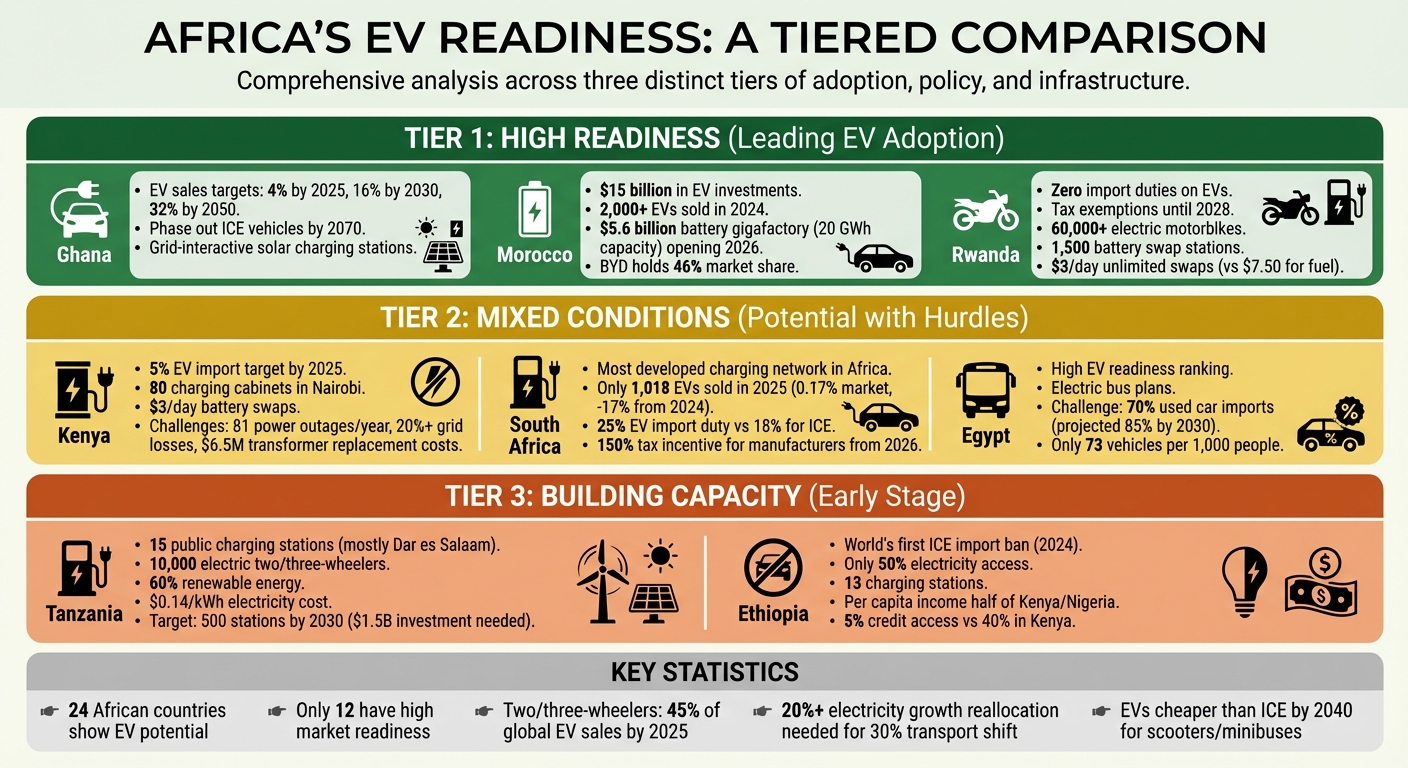
EV Readiness Across African Countries: Infrastructure, Policy, and Adoption Status
Africa’s EV Revolution & Urban Mobility Solutions | Anazi Zote-Piper
sbb-itb-99e19e3
1. Countries Where EVs Are Most Practical (Ghana, Morocco, Rwanda)
Three African nations – Ghana, Morocco, and Rwanda – are making notable strides in electric vehicle (EV) adoption, despite the challenges posed by infrastructure limitations. Each country has adopted unique strategies, moving beyond small-scale initiatives to implement nationwide policies that promote EV growth. Their efforts highlight the diverse paths to EV readiness across Africa.
Ghana has taken a regulation-focused approach to EV adoption. In February 2026, the Energy Commission of Ghana introduced the "Electric Vehicle Charging Infrastructure and Battery Swap Systems Regulations", which set safety and technical standards for EV infrastructure.
Professor John Gartchie Gatsi, Board Chairman of the Energy Commission, explained that these regulations will "empower the Energy Commission to effectively regulate and license all aspects of the EV infrastructure value chain, including the manufacturing, assembly, importation, installation, and operation of charging equipment and battery swap systems".
Ghana has ambitious EV adoption targets, aiming for EVs to account for 4% of new vehicle sales by 2025, 16% by 2030, and 32% by 2050. The country plans to phase out internal combustion engine vehicles entirely by 2070. To support this transition, Ghana is introducing grid-interactive solar-powered charging stations with battery storage, easing the load on the national grid.
Morocco, on the other hand, is leveraging its manufacturing capabilities to position itself as Africa’s EV production hub. The country has attracted around $15 billion in EV and battery-related investments. By 2024, over 2,000 new EVs had been sold, with Chinese automaker BYD capturing 46% of the hybrid and electric vehicle market. Starting in 2026, Gotion High-Tech will operate Africa’s first battery gigafactory – a $5.6 billion facility capable of producing 20 gigawatt-hours of batteries annually, enough to power hundreds of thousands of vehicles. Automakers like Renault and BYD have also established local production facilities, with Renault‘s plant near the Nador West Med port aiming for €3 billion in local sourcing and 80% supply chain integration.
Rwanda has become a testing ground for progressive EV policies, using financial incentives to accelerate adoption. The government has eliminated import duties on EVs and extended tax exemptions on EVs, batteries, and charging equipment until 2028. In 2025, Rwanda banned new registrations of internal combustion engine motorcycles in Kigali, effectively transitioning the market to electric bikes. Dubai-based Spiro has introduced over 60,000 electric motorbikes supported by 1,500 battery swap stations. Riders pay approximately $3.00 per day for unlimited battery swaps, a cost that is less than half of what traditional fuel-powered bikes require.
These long-term, clearly defined policies inspire confidence in the market.
Rose Mutiso, Science Advisor at Energy for Growth Hub, remarked, "Policy certainty turns one-off deployments into sustainable industry growth rather than short lived adoption".
While many African nations are still exploring EV adoption through smaller initiatives, Ghana, Morocco, and Rwanda have committed to comprehensive regulatory frameworks. These policies not only encourage current EV adoption but also set a standard for evaluating future EV readiness across the continent. Their efforts serve as a model for how focused strategies can drive meaningful progress in the EV sector.
2. Countries With Mixed Conditions (Kenya, Egypt, South Africa)
Not all nations have a clear path to EV adoption. In some places, economic realities and infrastructure challenges shape how electric vehicles are introduced. Let’s look at three countries navigating these mixed conditions: Kenya, South Africa, and Egypt.
Kenya is focusing its EV efforts on electric motorcycles and three-wheelers. The government has set a goal for at least 5% of all imported vehicles to be electric by 2025. In Nairobi, startups like ARC Ride are making battery swapping accessible, with around 80 charging cabinets spread across the city. These stations are strategically placed to keep riders within 1.2 miles (2 kilometers) of a swap point. Riders pay 400 Kenyan shillings ($3.00) daily for unlimited battery swaps, which is less than half the cost of traditional fuel at 1,000 shillings ($7.50). However, the country’s power grid faces serious challenges. Research indicates that unmanaged private EV charging in Nairobi could increase peak loads, accelerate transformer wear, and result in $6.5 million in replacement costs over five years. Additionally, Kenya’s utilities suffer from frequent power disruptions, with a median of 81 outages per year and system losses exceeding 20%. While Kenya is making strides with two- and three-wheelers, its energy infrastructure remains a key obstacle.
South Africa has the most developed EV charging network in Africa, but it struggles with adoption. In 2025, only 1,018 battery-electric vehicles were sold, a 17% drop from 2024’s 1,231 units, making up just 0.17% of the 596,818 vehicles sold that year. High import duties – 25% for EVs compared to 18% for internal combustion vehicles – make EVs less appealing to consumers. On top of that, frequent power cuts further erode confidence in EV reliability. Starting in 2026, automakers can claim a 150% tax incentive for investments in EV manufacturing facilities, but consumer adoption remains a challenge.
Joubert Roux, Co-Founder and Chair of Zero Carbon Charge (CHARGE), highlighted the issue: "You cannot incentivise EV production on one hand and penalise EV adoption on the other. Without urgent tax reform and infrastructure funding, South Africa risks constraining domestic EV demand at precisely the moment it is trying to attract EV investment".
Egypt is considered one of 12 African countries with "high EV readiness", thanks to its automotive industry connections and government initiatives. The government plans to introduce electric buses in major cities to combat urban air pollution. However, Egypt faces a significant challenge with its used-car market, which accounts for 70% of imports and is projected to hit 85% by 2030. With only 73 vehicles per 1,000 people across Africa, low incomes make it difficult for most consumers to transition from affordable used cars to new EVs.
These examples highlight the complexities of EV adoption in countries with mixed conditions. While infrastructure is growing, economic hurdles and grid limitations continue to slow progress in Kenya, South Africa, and Egypt.
3. Countries Still Building Capacity (Tanzania, Ethiopia)
Tanzania and Ethiopia are just beginning their journey toward electric vehicle (EV) adoption, each with its own set of challenges.
In Tanzania, as of 2025, there are only about 15 public charging stations, mostly clustered in Dar es Salaam. This limited infrastructure contributes to range anxiety for longer trips. The country does have a 60% renewable energy mix – mainly from hydropower and solar – but high electricity costs, averaging $0.14 per kilowatt-hour, make EV adoption less appealing. The government has outlined plans in its draft E-mobility Framework to expand the charging network to 500 stations by 2030, but achieving this will require an estimated $1.5 billion investment to upgrade the grid. Interestingly, Tanzania leads East Africa with approximately 10,000 electric two- and three-wheelers, though most rely on lead-acid batteries.
"Lack of finalized standards for charging infrastructure, such as connector types (e.g., CCS2, CHAdeMO) or interoperability protocols like OCPP, creates uncertainty for investors", says Anari Energy.
On the other hand, Ethiopia faces more fundamental hurdles. Unlike Tanzania’s gradual expansion, Ethiopia has taken a bold policy-driven approach. In early 2024, the country introduced the world’s first ban on internal combustion engine (ICE) imports to encourage local EV manufacturing. However, with only 50% of the population having access to electricity, the transition to EVs is far from straightforward. Research Director Rose Mutiso from Energy for Growth Hub commented:
"Ethiopia’s abrupt pivot – including the world’s first internal combustion engine (ICE) ban and a strong push for local manufacturing – raises critical concerns about implementation, grid readiness, and affordability".
Ethiopia currently has just 13 charging stations, and financial barriers further complicate the situation. With a per capita income roughly half that of Kenya or Nigeria and only 5% of the population having access to credit (compared to 40% in Kenya), buying EVs remains out of reach for most people.
These cases underscore the reality that ambitious EV goals demand more than just policies – they require substantial investments in infrastructure, reliable power access, and financial solutions. Without addressing these foundational issues, widespread EV adoption will remain a distant goal.
Advantages and Disadvantages by Region
Electric vehicle (EV) adoption across Africa depends heavily on three key factors: affordability, infrastructure readiness, and policy support. These factors vary widely, shaping unique regional scenarios.
In countries with high readiness – such as Morocco, Ghana, and Rwanda – stronger grid reliability and supportive government policies provide a solid foundation. Morocco, for instance, is set to host a massive $5.6 billion Gotion High-Tech battery gigafactory starting in 2026. Similarly, Rwanda’s bold move to ban new registrations of gas-powered commercial motorbikes in Kigali by 2025 has accelerated the adoption of electric two-wheelers. However, affordability barriers limit the uptake of private passenger EVs, making smaller vehicles like two- and three-wheelers more practical.
Countries with mixed readiness – like Kenya, South Africa, and Egypt – display promising potential but face hurdles, particularly with grid infrastructure. For example, many African nations would need to reallocate over 20% of their projected electricity growth over the next decade to support a 30% shift in transportation. In South Africa, the growing presence of BYD dealerships (with plans for 70 locations by 2026) highlights rising market interest. However, persistent grid instability remains a significant challenge. These issues are even more pronounced in nations where basic energy infrastructure is still underdeveloped.
For capacity-building nations like Ethiopia and Tanzania, the challenges are even steeper. Ethiopia’s decision to ban internal combustion engine imports in 2024 came before adequate charging infrastructure was in place, despite commissioning a 5-gigawatt hydropower dam in September 2025. As Rose Mutiso notes, addressing these gaps will require substantial grid improvements.
The contrast is striking: while 24 African countries show strong potential for EV adoption, only 12 currently demonstrate high market readiness. This gap between potential and readiness underscores the urgent need for targeted policy measures and infrastructure investments, setting the stage for further discussion in the conclusion.
Conclusion
Africa’s shift toward electric vehicles (EVs) requires solutions that align with each nation’s unique challenges – grid capacity, economic conditions, policies, and infrastructure. Countries like Morocco and Rwanda show how tailored approaches, including strategic policies and local manufacturing investments, can speed up this transition. These examples highlight the need for customized strategies, as earlier discussions on varying levels of readiness emphasized.
With regional differences in mind, the next step is to focus on targeted strategies to drive meaningful progress. While 24 African nations show strong potential for EV adoption, only 12 are currently well-positioned to support a thriving EV market. Creative solutions, such as battery swapping, offer ways to address infrastructure gaps and reduce costs, especially in areas where grid instability remains a challenge.
"Africa’s electric vehicle future can’t be built on guesswork." – Rose Mutiso, Hamna Tariq, and Daniel Johansson, Energy for Growth Hub
This statement underscores the importance of innovation in the sector. Two- and three-wheelers, in particular, hold significant promise, with projections showing they will account for 45% of global EV sales by 2025, compared to just 25% for cars and trucks. Their affordability and ability to handle poor road conditions make them an ideal starting point for electrification efforts. By 2040, owning EVs such as scooters and minibuses is expected to be cheaper than maintaining gas-powered vehicles.
For nations still building their capacity, the key takeaway is clear: infrastructure must come first. Ethiopia’s ban on internal combustion engine imports serves as a cautionary tale, as the country lacks sufficient charging infrastructure despite its vast hydropower potential. By prioritizing grid improvements, adopting battery-as-a-service models, and focusing on impactful vehicle segments, even less developed markets can bypass traditional automotive development and create cleaner, more efficient transportation systems.
FAQs
How can I tell if my country is ready for electric cars?
To figure out if your country is prepared for electric cars, take a closer look at a few key areas: government policies, electricity grid reliability, market potential, and affordability.
Countries that actively support EVs with strong policies, have a dependable power grid, and show a growing interest in electric vehicles are generally in a better position for EV adoption. However, if charging stations are scarce or the electricity supply is unreliable, it might be a sign that widespread EV use is still a challenge.
Are electric motorcycles a better starting point than electric cars in Africa?
Electric motorcycles present a practical entry point for Africa’s transition to electric mobility. Their lower costs make them more accessible, and they’re ideal for short-distance travel, which aligns with the daily needs of many urban commuters. Unlike electric cars, motorcycles face fewer challenges, such as range limitations, making them a more adaptable option for the continent’s infrastructure.
Motorcycles already dominate the transport sector in many African cities, so shifting to electric versions could bring notable benefits. They cater well to urban mobility demands while offering the added advantage of reducing emissions. Additionally, given the limited charging infrastructure and ongoing issues with energy grids, electric motorcycles are a more scalable and feasible choice compared to electric cars.
What matters more for EV adoption: charging stations or a reliable power grid?
A dependable power grid plays a crucial role in the adoption of electric vehicles (EVs), particularly in African countries where challenges like frequent outages and limited access in rural areas are widespread. Without consistent electricity, charging stations simply can’t operate efficiently. On top of that, the added demand from EVs could put even more pressure on already fragile grids. Strengthening these grids is an essential step to ensure the successful integration of EVs in these regions.