
 Thabo Nkosi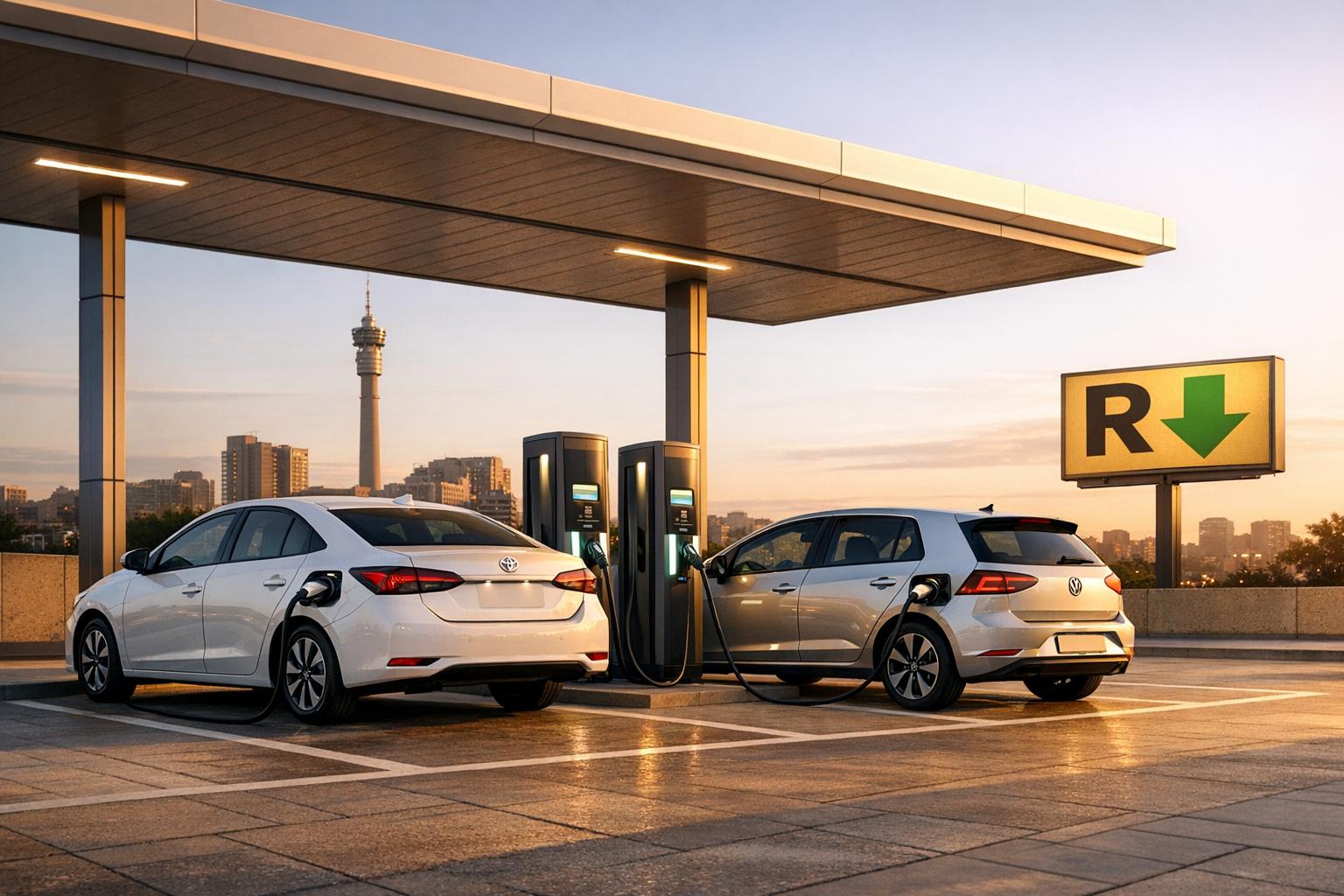
South Africa’s EV market is set for a shake-up in 2026. Toyota and Volkswagen are launching electric vehicles (EVs) with pricing strategies aimed at overcoming high import duties. Here’s what you need to know:
- Toyota plans to use local Production Rebate Certificates (PRCs) to cut import duties, reducing prices by up to $2,700 (R150,000). The Toyota bZ4X is expected to cost under $39,500 (R700,000).
- Volkswagen will introduce the ID.4 SUV in 2026, followed by a budget-friendly model in 2027, priced around $21,800 (R386,000).
- Both brands face challenges like limited charging stations and load shedding but may benefit from a 150% tax deduction on EV production investments starting in March 2026.
Toyota’s bZ4X offers rugged features like AWD and a 516km range, while Volkswagen’s T-Roc EV focuses on premium design and advanced features. The competition with Chinese brands like BYD and GWM will further shape South Africa’s EV landscape.
1. Toyota bZ4X
Specifications and Features
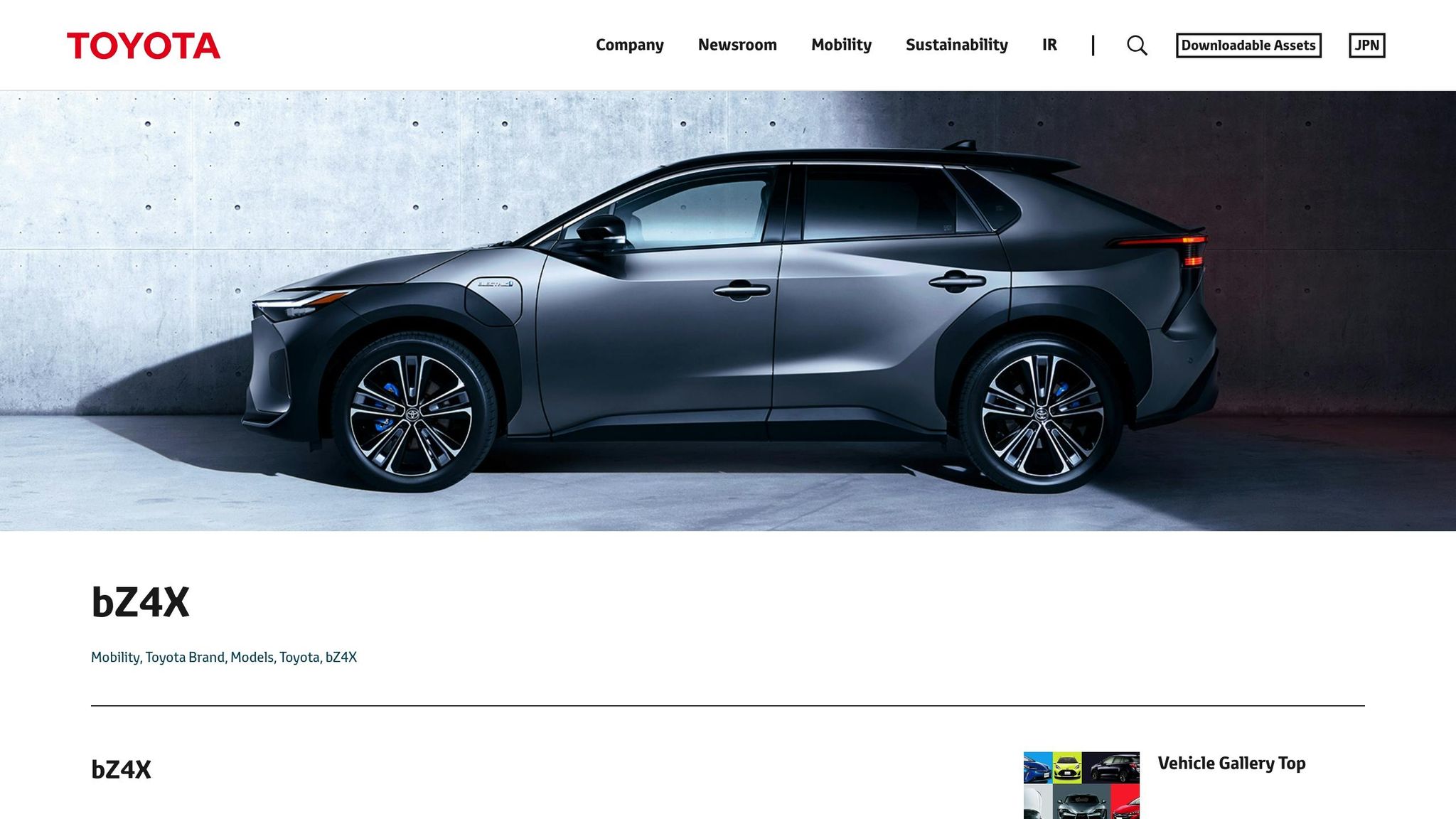
The Toyota bZ4X marks the company’s first fully electric vehicle in South Africa, built on the specialized eTNGA platform. This platform integrates a 71.4kWh lithium-ion battery directly into the chassis, resulting in a low center of gravity and improved handling for various terrains.
Two drivetrain options will be available: front-wheel drive (FWD) and all-wheel drive (AWD). The FWD version generates 150kW and 265Nm of torque, offering a range of 516km (320 miles). Meanwhile, the AWD model delivers 160kW and 337Nm of torque, with a slightly shorter range of 470km (292 miles). The AWD variant also includes Subaru’s "X-MODE" technology, designed to enhance traction on rough surfaces, and boasts a wading depth of 500mm (19.7 inches), making it well-suited for South African road conditions.
Charging options include DC fast charging, which can take the battery from 10% to 80% in about 30 minutes, and an 11kW onboard charger for quicker home charging. Inside, the bZ4X features a 12-inch infotainment screen, eco-conscious dashboard materials, and a towing capacity of 750kg (1,650 pounds), adding both functionality and comfort.
Pricing and Affordability
Toyota is planning a competitive pricing strategy for the bZ4X. While the official price for South Africa hasn’t been revealed yet, the company intends to use local rebate certificates to help offset the 25% import duty, which could make the vehicle more accessible to buyers.
Market Position and Challenges
The bZ4X enters a competitive market where affordability plays a crucial role. Models like the BYD Dolphin, priced at $30,500 (R539,990), highlight the importance of Toyota’s pricing decisions and market strategy to ensure the bZ4X appeals to South African consumers.
sbb-itb-99e19e3
2. Volkswagen T-Roc EV
Specifications and Features
Volkswagen, like Toyota, is taking advantage of local production incentives to navigate high import duties and promote EV adoption in South Africa.
The T-Roc EV will be manufactured at Volkswagen’s Wolfsburg facility, built on the new SSP platform. While it retains the familiar SUV look of the T-Roc, the EV version will feature a sleeker, more streamlined design.
Details about the battery and range are still under wraps. However, the internal combustion engine (ICE) version starts at approximately $35,600 (R648,900). Volkswagen plans to equip the T-Roc EV with advanced driver assistance systems and a modern design, aligning with its strategy to offer competitive pricing and appeal.
Pricing and Affordability
Volkswagen is using local incentives to make the T-Roc EV more affordable. By leveraging South Africa’s Production Rebate Certificates (PRCs), the company can potentially reduce the EV’s price by as much as R150,000 (around $8,200). This approach helps counteract the 25% import duty on EVs. Globally, Volkswagen is also aiming for an entry-level EV price of around €20,000 (approximately $21,200 or R386,062) for its electric lineup.
"The ID. Family offers driving solutions at the price point of a comparable car with a combustion engine – because no game-changing idea is for the better, unless everyone can become a part of it."
– Volkswagen South Africa
This pricing strategy positions the T-Roc EV as a strong contender in a market heavily influenced by import costs.
Market Position and Challenges
Despite its promising features, the T-Roc EV will face several challenges in South Africa. These include the country’s limited charging infrastructure and persistent load shedding issues. Additionally, Volkswagen will compete with Chinese automakers offering comparable vehicles, such as the GWM ORA, which starts at roughly $37,700 (R686,950).
On the bright side, a new 150% tax deduction for companies investing in EV production equipment, beginning in March 2026, may support Volkswagen’s local strategy. However, the absence of strong consumer-focused government incentives remains a significant obstacle.
Thomas Schäfer, CEO of Volkswagen Passenger Cars, expressed optimism about the company’s ambitious plans:
"With the conclusion of negotiations in December, we set the largest plan in Volkswagen’s history in motion."
Let’s Talk Electric Episode 4: SA’s new energy vehicle revolution – what 2025 taught us
Pros and Cons
Toyota bZ4X vs Volkswagen T-Roc EV: South Africa Comparison 2026-2027
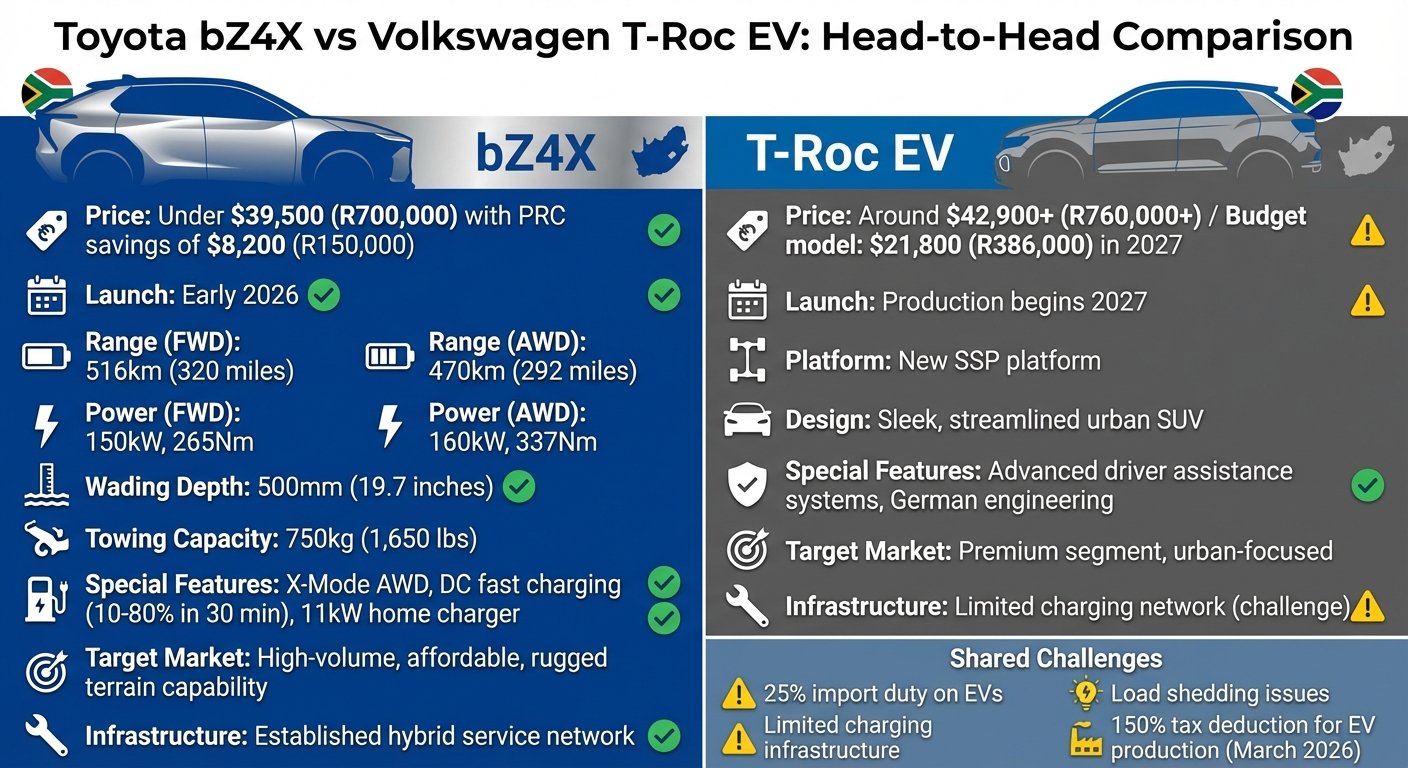
Here’s a quick comparison of the Toyota bZ4X and Volkswagen T-Roc EV across key aspects:
| Aspect | Toyota bZ4X | Volkswagen T-Roc EV |
|---|---|---|
| Pricing Strategy | Aggressive use of Production Rebate Certificates (PRCs) could lower costs by $8,200 (R150,000), potentially pricing models under $39,500 (R700,000). | Utilizes local production incentives but is likely to be priced near or above $42,900 (R760,000). |
| Launch Timeline | Expected in early 2026. | Production begins in 2027. |
| Terrain Capability | Offers a 19.7-inch (500mm) wading depth, 1,650-pound (750kg) towing capacity, and X-Mode AWD for off-road performance. | Primarily urban-focused, with no off-road enhancements disclosed. |
| Market Positioning | Aimed at competing with affordable Chinese EVs, focusing on high-volume sales. | Targets the premium market with an emphasis on German engineering and quality. |
| Infrastructure Readiness | Supported by an established hybrid service network across South Africa. | Faces challenges with limited charging infrastructure. |
Key Highlights
The Toyota bZ4X stands out for its rugged features, designed to handle South Africa’s challenging road conditions. Its 19.7-inch (500mm) wading depth and waterproof battery housing make it a practical choice for areas prone to flooding and heavy rains. Motoring journalist Willem van de Putte noted:
For an EV, a wading depth of 500mm, thanks to a waterproof battery housing, is impressive… it gives some peace of mind [considering SA rains].
Additionally, its 1,650-pound (750kg) towing capacity aligns well with the preferences of local consumers.
On the other hand, the Volkswagen T-Roc EV targets a higher-end market, leveraging its reputation for German engineering. However, its later production timeline – starting in 2027 – could leave a gap for Toyota to capture early adopters.
Both vehicles face a shared challenge: South Africa’s limited charging infrastructure, further complicated by ongoing load shedding. While the government’s upcoming 150% tax deduction for EV production equipment (effective March 2026) may lower manufacturing costs, the lack of consumer-focused incentives remains a barrier. These factors will play a pivotal role in determining which model gains traction in South Africa’s growing EV market.
Conclusion
Toyota and Volkswagen are making waves in South Africa’s EV market by focusing on pricing strategies and local production benefits. Toyota, with its commanding 67% share of the hybrid market, plans to use Production Rebate Certificates (PRCs) to align EV prices with local affordability. This could bring their vehicles closer to a price point of $39,500 (R700,000). Meanwhile, Volkswagen is positioning its upcoming T-Roc EV as a luxury option, appealing to buyers drawn to German craftsmanship and urban style.
For budget-conscious consumers, Toyota’s approach may stand out, especially if PRC savings – estimated at $8,200 (R150,000) – materialize. On the other hand, those who value European design and cutting-edge technology might lean toward the T-Roc EV, even with its higher price tag and later availability. However, both brands must navigate hurdles like South Africa’s limited charging infrastructure and ongoing load shedding issues.
Andrew Kirby, CEO of Toyota South Africa, emphasized the importance of adapting to these challenges:
It’s a strategic concern for us and we need to make sure we respond in the right way.
As competition heats up and government incentives come into play, these factors could push prices lower and speed up the shift to electric vehicles. Together, these efforts mark a step forward for South Africa’s EV landscape.
FAQs
How could Toyota and Volkswagen’s pricing strategies make EVs more affordable in South Africa?
Toyota and Volkswagen are making moves to bring more affordable electric vehicles (EVs) to South Africa. They’re tapping into local production incentives and easing import duties to make this happen. For instance, Toyota is planning to use local rebate programs to cut import taxes. This could slash EV prices by up to $7,800, potentially making models like the electric Urban Cruiser within reach for more South African buyers.
Volkswagen isn’t far behind. They’re gearing up to introduce models like the ID.4 SUV and a compact EV, focusing on competitive pricing to appeal to a wider audience.
By combining local incentives with smart pricing strategies, both automakers are tackling the high costs that have held back EV adoption in South Africa. These efforts could open the door for more people to embrace electric mobility in the region.
What challenges do Toyota and Volkswagen face in bringing EVs to South Africa?
Toyota and Volkswagen are navigating a tough road as they work to introduce electric vehicles (EVs) in South Africa. One of the biggest obstacles? The lack of EV infrastructure. With too few charging stations and an unreliable power grid, it’s not exactly easy for consumers to make the switch to EVs. These gaps make it hard to encourage widespread EV adoption.
On top of that, high import duties and production costs are driving up EV prices. Even with incentives and discussions around local manufacturing, affordability remains a big hurdle. Add frequent power outages and logistical hiccups to the mix, and it becomes clear why scaling EV operations is such a challenge.
For EVs to truly take off in South Africa, the local ecosystem needs a serious upgrade. More charging stations and a stable electricity supply are key to making EVs accessible and driving market growth. Until then, adoption is likely to remain limited.
What are the key differences between Toyota’s bZ4X and Volkswagen’s T-Roc EV in terms of features and target market?
Toyota’s bZ4X and Volkswagen’s T-Roc EV are designed for two distinct audiences in South Africa’s growing EV market. The bZ4X, a mid-size SUV, is fully electric and tailored for those looking for a higher-end driving experience. With trims like the base XLE and the more advanced Limited, its starting price is approximately $43,070. This model reflects Toyota’s efforts to expand its EV range and reduce emissions, with a launch planned for early 2026.
On the other hand, Volkswagen’s T-Roc EV (or a comparable compact EV) is aimed at buyers who prioritize affordability. Scheduled for release in 2027, this vehicle is designed to make EV ownership more accessible in South Africa. While details on its features are still emerging, VW’s focus is on delivering an entry-level EV that balances cost and functionality.
The bZ4X appeals to those seeking a premium, feature-packed option, whereas the T-Roc EV is positioned as a more budget-friendly choice to encourage wider EV adoption.