
 Thabo Nkosi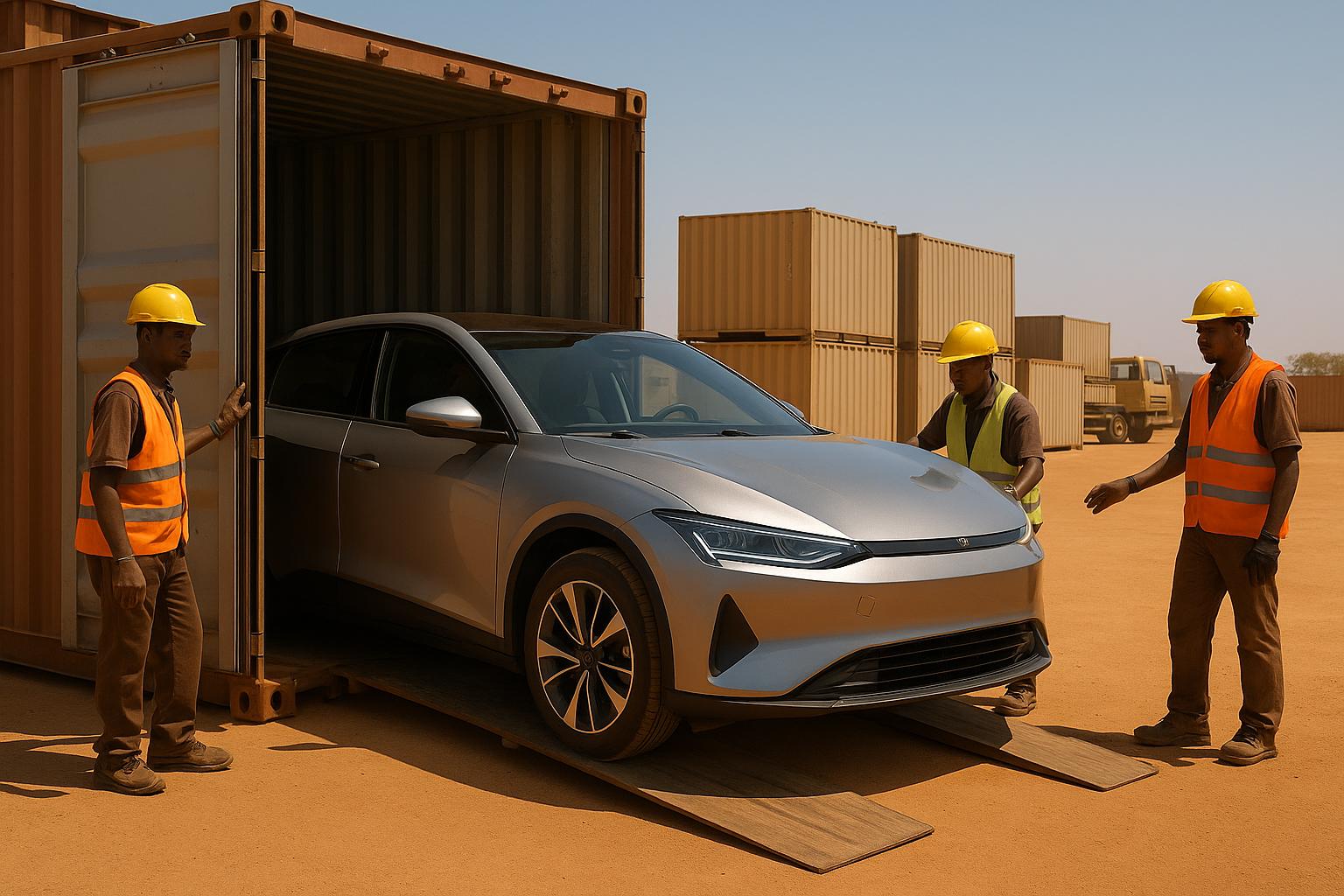
Importing electric vehicles (EVs) from China to Burkina Faso in 2025 involves navigating regulations, selecting the right vehicle, and managing shipping logistics. Here’s what you need to know:
- Regulations: EVs must meet Burkina Faso’s safety standards. Key documents include a Bill of Lading, Commercial Invoice, and Electronic Cargo Tracking Note. Import taxes can add up to 53.22% of the CIF value.
- Vehicle Selection: Choose EVs designed for extreme heat and rough roads. Look for models with LFP batteries, liquid cooling, and a range of 180–250 miles.
- Shipping: Vehicles are shipped via ports like Tema (Ghana) or Lomé (Togo), followed by overland transport. Special handling is required for lithium-ion batteries.
- Costs: Total import costs include factory price, shipping, taxes, and local fees. A $20,000 EV could cost up to $32,000 delivered.
Partnering with experienced freight forwarders, brokers, or platforms like EV24.africa can simplify the process. With proper planning, importing an EV is achievable and aligns with Burkina Faso’s growing interest in electric mobility.
Import Regulations and Customs Requirements in Burkina Faso
EV Import Rules for 2025
Burkina Faso adheres to the WAEMU Common External Tariff, which governs import requirements for electric vehicles (EVs). To comply, EVs must meet safety and roadworthiness standards set by the Ministry of Transport. These include ensuring that critical components – such as lighting, brakes, and tires – are in proper working order.
Additionally, lithium-ion batteries must align with international shipping safety standards. Importers should provide documentation detailing the battery’s capacity and type to ensure accurate classification.
Now, let’s cover the essential paperwork needed to meet these requirements.
Required Documents and Compliance Steps
To successfully import an electric vehicle, the following documents are essential:
- Bill of Lading: Confirms ownership and facilitates customs clearance.
- Commercial Invoice: Lists key vehicle details, including make, model, year, VIN, battery capacity, and purchase price.
- Combined Certificate of Value and Origin (CCVO): Verifies the vehicle’s origin and declared value.
- Electronic Cargo Tracking Note (ECTN): Monitors the shipment from departure to destination. This must be secured before shipping to avoid penalties or delays.
In addition to these, importers should have certificates of conformity or inspection reports, proof of payment, and valid identification. For businesses, company registration documents and tax identification numbers are typically required.
Import Taxes, Duties, and Fees
When importing an electric vehicle, several taxes and duties apply beyond its purchase price. Under the WAEMU Common External Tariff, customs duties are calculated based on the vehicle’s CIF (Cost, Insurance, and Freight) value. Additional charges, such as value-added tax (VAT) and other fees, may also be applicable.
Importers should consult local customs authorities for the latest rates, as fees can vary depending on the vehicle’s classification, exchange rates, and current regulations. Payments are usually made in stages – before shipment and during customs clearance. Keeping detailed payment records will help ensure a smooth process.
Choosing an EV and Chinese Supplier
Selecting EVs for West African Climate and Roads
When choosing an EV for Burkina Faso, it’s crucial to consider the region’s extreme heat and challenging road conditions. With temperatures often surpassing 95°F (35°C), batteries can degrade faster, reducing the vehicle’s range. Poor thermal management systems can even pose safety risks. To address this, focus on EVs equipped with LFP batteries and liquid-cooled systems, which are better suited for high temperatures. Many Chinese manufacturers already integrate these technologies into their export models, making them a practical choice for the West African climate.
Road conditions outside urban areas can be harsh, with unpaved roads, potholes, and uneven terrain. Look for EVs with adequate ground clearance, reinforced suspension systems, and durable underbody protection. Compact city EVs may not hold up well in these conditions, as they tend to wear out faster on rough roads.
Real-world factors like running the AC in 100°F+ heat and navigating uneven terrain can reduce the manufacturer’s stated range by 20–30%. To ensure reliability, aim for a practical range of 180–250 miles (290–400 km), especially given the limited availability of public charging infrastructure.
Charging compatibility is another critical factor. Burkina Faso’s electrical grid operates mainly on 220–240V single-phase power, with some three-phase systems available. Choose an EV that supports flexible charging options, such as home AC charging, solar power integration, and, when possible, DC fast charging.
Finally, think about the vehicle type that best fits your needs. For personal urban use, compact hatchbacks or sedans are ideal for their efficiency and maneuverability. For commercial use, such as taxis or ride-hailing services, durable compact designs are advantageous. For mixed urban-rural or commercial applications, crossovers or pickups – like the Itaoua Land Elder – offer better cargo space and off-road capability. For example, the Itaoua electric taxi fleet in Ouagadougou already includes 30 vehicles, with plans to expand to over 100, demonstrating the practicality of these vehicles in urban settings.
The next step is to ensure that your chosen supplier meets these high standards.
Verifying Chinese EV Manufacturers
Not all Chinese EV manufacturers are equally equipped for export or reliable in delivering quality vehicles. A thorough verification process is essential to avoid subpar products, compliance issues, or poor after-sales support.
First, confirm the manufacturer’s legal standing and export experience. Request documentation such as business registration papers, export licenses, and a list of countries where their vehicles are already in use. Manufacturers with a proven track record in African or similar markets should be prioritized. For example, Burkina Faso’s Itaoua assembly plant benefits from technical support from Chinese partners, with local engineers trained at Chinese factories – this is a strong example of a dependable collaboration.
Quality and safety certifications are equally important. Check for ISO 9001 (quality management) and ISO 14001 (environmental management) certifications, as they reflect structured manufacturing practices. Also, ensure compliance with UN ECE safety standards or equivalent, particularly for high-voltage systems and battery safety.
Battery safety is critical. Manufacturers should provide a Material Safety Data Sheet (MSDS) for the traction battery and demonstrate compliance with IMO dangerous goods regulations. A refusal to share these documents is a serious red flag.
After-sales support is another key consideration. Ask about the availability of spare parts in West Africa, remote diagnostic capabilities, training programs for local technicians, and partnerships with African service centers. The Chinese partners supporting Itaoua’s assembly plant, for instance, have invested in building local technical expertise instead of merely exporting vehicles – this sets a high benchmark.
Finally, seek independent verification. Request references from African fleet operators or inspection reports from recognized testing agencies. Be cautious of suppliers who withhold company information, quote unrealistically low prices without explanation, or suggest bypassing customs procedures.
Once you’ve identified a reliable manufacturer, the next step is calculating the full cost of importing the vehicle.
Calculating Total Import Costs
Understanding all the costs involved in importing an EV is essential for accurate budgeting and comparing suppliers fairly.
Start with the factory price (either ex-works or FOB China). This includes the base vehicle and any necessary upgrades for local conditions, such as reinforced suspension or enhanced cooling systems.
Next, account for international freight and insurance. Shipping a car to Burkina Faso typically starts at around $1,500 to Ouagadougou, though costs vary depending on the vehicle size, shipping method (container versus roll-on/roll-off), and route. Since EVs require special handling due to battery safety regulations, additional logistical fees should be expected. Don’t forget to include inland transport costs from coastal entry points – such as Togo, Benin, or Côte d’Ivoire – since Burkina Faso is landlocked.
Customs duties in Burkina Faso are calculated based on the CIF value (cost, insurance, and freight). Import duties and VAT can add up to around 53.22% of the CIF value. In some cases, vehicles may face a 10% import duty and 12.5% VAT, depending on the import route. Temporary vehicle imports, on the other hand, might incur taxes of approximately 6% of the CIF value. Note that Burkina Faso restricts the import of vehicles older than 10 years.
Additional expenses – such as port and terminal fees, customs broker charges, inspection costs, and local registration fees – should also be included in your budget.
For buyers new to importing or without established contacts in China, bundled solutions like those offered by EV24.africa can be a convenient alternative. They handle sourcing, shipping, customs clearance, and local registration, simplifying the process and reducing the risk of unexpected costs.
To make an informed decision, prepare a detailed cost comparison spreadsheet. Include every expense category – factory price, freight, insurance, inland transport, duties, VAT, and other fees – for each vehicle option. This approach ensures you identify the best overall value, not just the cheapest upfront price.
Shipping and Logistics from China to Burkina Faso
Shipping Routes and Land Transport
Given Burkina Faso’s landlocked geography, importing electric vehicles (EVs) from China involves a two-step journey: sea transport to a West African port, followed by overland delivery to the final destination. Each stage affects both cost and delivery time.
The journey typically begins at major Chinese ports like Shanghai, Ningbo, or Guangzhou, where many EV manufacturers are based. From there, vehicles are shipped via cargo vessels to West African ports such as Tema (Ghana), Lomé (Togo), Cotonou (Benin), or Abidjan (Ivory Coast). Tema and Lomé are often preferred due to their proximity to Burkina Faso and relatively efficient customs processes.
The ocean voyage usually takes 25–35 days, but factors like weather, port congestion, and seasonal demand can prolong transit times. Once the shipment reaches the port, the overland leg begins. For example, the distance from Tema to Ouagadougou is roughly 600 miles (965 km), taking 2 to 4 days by truck under normal conditions. The Lomé route is slightly shorter at about 550 miles (885 km). While major highways connect these routes, road quality varies, especially during the rainy season (June to September), which can slow down transport.
Border crossings add another layer of complexity, with delays ranging from a few hours to a full day for document checks and vehicle inspections. Having all required paperwork – such as the bill of lading, customs clearance certificate, and vehicle registration documents – ready can help minimize these delays.
Freight forwarders typically handle inland transport, either using their own fleet or contracting local haulage companies. For EVs, enclosed carriers are recommended over open flatbeds to protect vehicles from dust, debris, and weather exposure during the journey.
EV Shipping Safety and Regulations
Shipping EVs comes with unique challenges, primarily due to the lithium-ion batteries they contain. Classified as Class 9 dangerous goods under the IMDG Code, these batteries require special handling, documentation, and packaging.
Before shipping, ensure you have a Dangerous Goods Declaration and Material Safety Data Sheet (MSDS) for the battery. These documents outline the battery’s chemical composition, potential hazards, and safe handling procedures, and they are essential for avoiding shipment delays or refusals.
Most shipping lines mandate that EV batteries remain at a 30% to 50% state of charge (SOC) to reduce fire risks while keeping enough power for loading and unloading. Some carriers may also require additional safety measures, such as disconnecting the high-voltage system or installing a physical disconnect switch. It’s crucial to confirm the specific requirements of your chosen shipping line in advance.
Container shipping offers better protection against damage and fire risks but comes at a higher cost. In contrast, RoRo (roll-on/roll-off) shipping is faster and cheaper but exposes vehicles to more handling and potential damage. If choosing RoRo, inquire about the vessel’s safety equipment and compliance with International Maritime Organization (IMO) standards for transporting dangerous goods.
Insurance is a must when shipping EVs. Standard marine cargo insurance may not fully cover risks associated with lithium-ion batteries. Opt for an all-risk marine insurance policy that explicitly includes coverage for battery-related risks, fire damage, and total loss. Review exclusions and claim procedures carefully.
Finally, extended transit times, especially in hot climates, can affect battery health. While modern EVs are equipped with thermal management systems, shorter shipping times can help reduce battery stress. If possible, prioritize faster shipping routes, even if they come at a slightly higher cost.
Working with Freight Forwarders and Customs Brokers
Coordinating with experienced freight forwarders and customs brokers is essential for smooth logistics and compliance when importing EVs. These professionals manage the complex paperwork, liaise with shipping lines, and ensure adherence to regulations in both China and Burkina Faso.
In China, freight forwarders handle tasks like picking up the vehicle from the manufacturer, managing export documentation, booking cargo space, and overseeing loading at the port. Choose a forwarder with proven expertise in shipping EVs and handling dangerous goods. Ask about their IATA/IMDG certification, relationships with major shipping lines, and references from clients who have shipped EVs to West Africa.
On the Burkina Faso side, customs brokers manage import clearance at the coastal port and coordinate inland transport. Their responsibilities include customs declarations, duty calculations, vehicle inspections, and liaising with government agencies. It’s advantageous to work with a broker who operates both at the port and in Ouagadougou, understands local import regulations, and has strong connections with customs officials. Clarify their fee structure – some charge a flat rate, while others work on a percentage basis.
Clear communication between your freight forwarder and customs broker is vital to avoid delays and unexpected costs. Platforms like EV24.africa can simplify the process by offering end-to-end logistics management. These services coordinate with vetted partners, handle all documentation, and provide a single point of contact, reducing complexity and risk.
Freight forwarding and customs brokerage fees vary based on factors like shipping routes, methods, and vehicle specifications. Always request detailed quotes that outline all charges, including port fees, handling costs, and inland transport expenses, to make informed comparisons.
Throughout the process, keep copies of all documentation – both physical and digital – for customs clearance, vehicle registration, and potential warranty claims. Storing these records securely ensures they’re readily accessible when needed.
sbb-itb-99e19e3
Step-by-Step Import Process
Planning and Vehicle Selection
Start by setting a budget that includes the vehicle’s price, shipping costs, duties, taxes, brokerage fees, inland transport, registration, and insurance. To be safe, add an extra 10–15% to cover any unexpected expenses.
Make sure the electric vehicle (EV) you’re considering is suitable for local roads and climate conditions. Check that it meets Burkina Faso’s import regulations and confirm that the manufacturer can provide all necessary paperwork, such as certificates of origin and compliance documents. It’s also a good idea to research the availability of spare parts and after-sales support in your area.
When looking for your EV, use trusted platforms that offer direct listings with clear pricing. Once you’ve selected your vehicle and finalized your budget, move forward by formalizing an agreement.
Contract Terms and Payment
Draft a clear sales contract that specifies the vehicle’s model, features, and specifications. Include Incoterms in the agreement, such as FOB (Free on Board) if you want control over shipping or DDP (Delivered Duty Paid) if you prefer the seller to handle logistics. Ensure the contract aligns with Burkina Faso’s documentation requirements.
Payment terms should also be outlined in the contract. Many suppliers require a deposit – typically between 30% and 50% – with the remaining balance due before shipment. To protect both parties, consider using a bank instrument like a letter of credit, which ensures payment is only released once agreed conditions are met. Avoid paying the full amount by wire transfer until you have shipment confirmation, such as a bill of lading. Be sure to include warranty details and delivery timelines, accounting for potential delays.
Once the contract and payments are finalized, the focus shifts to shipping and customs clearance.
Shipping, Customs Clearance, and Vehicle Registration
After payment, the freight forwarder will collect the vehicle and transport it to the departure port in China. A bill of lading will confirm the shipment. Only proceed with shipping after obtaining all necessary import authorizations. You can track the shipment as it makes its way to the Port of Tema in Ghana.
Before the vehicle arrives, secure an import authorization from Burkina Faso’s Ministry of Commerce, Industry, and Handicrafts. This document, valid for six months, is crucial for a smooth customs process. Additionally, if the value of the import exceeds FCFA 1,000,000 (around $1,565), a pre-shipment inspection by COTECNA is required. The resulting inspection report will be necessary for customs clearance.
Once the vehicle reaches Tema, your customs broker will handle the clearance process using your import authorization and the COTECNA report. After clearance, the vehicle will be transported overland to Burkina Faso.
Finally, complete the vehicle registration with the local registration authority. Companies like EV24.africa can manage the entire process for you, including customs clearance and registration, ensuring everything complies with local regulations. Be sure to keep copies of all documents for future reference.
How to Import Electric Cars from China?
Conclusion
This guide breaks down the essential steps for successfully importing an electric vehicle (EV) from China to Burkina Faso in 2025. From preparation and compliance to cost calculation and post-arrival registration, every stage requires attention to detail.
Accurate documentation is a top priority. Ensure all necessary paperwork – such as the bill of lading, invoice, certificate of origin, customs forms, and battery safety data – is complete to avoid delays or fines. Be meticulous in declaring your EV as fully electric or hybrid, and verify that all customs fees are paid.
Budgeting is equally important. Additional costs like shipping, inland transport, port handling, customs clearance, and registration can increase the factory price by 40–60%. For instance, a $20,000 EV could end up costing up to $32,000 delivered. To avoid surprises, always request detailed quotes from freight forwarders, customs brokers, and insurers, and set aside a 10–15% buffer for currency fluctuations or unforeseen expenses.
Experienced partners can make the process smoother. Platforms like EV24.africa help Burkinabé buyers connect with trusted Chinese manufacturers, stay updated on 2025 import reforms, and calculate total landed costs while exploring financing options. Freight forwarders ensure compliance with IMO battery safety regulations, and local customs brokers handle EV classification and declarations to expedite clearance. With the right team and precise cost planning, your import process can run efficiently.
Burkina Faso’s commitment to electric mobility is growing stronger. Local EV production is already underway – Itaoua models, developed with Chinese technical support, began production in January 2025. By mid-2025, around 30 Itaoua electric taxis were operating in Ouagadougou, with plans to expand the fleet to over 100 vehicles. According to Mordor Intelligence, the EV market in Burkina Faso and other African nations could grow from $15.8 billion today to $25.4 billion by 2029.
To simplify your import journey, consider creating a step-by-step checklist and maintaining a well-organized folder (digital and physical) for all contracts, invoices, and shipping documents. Regularly review policies and incentives, as they may change over time. Individual buyers might start with a single EV and rely on a turnkey partner, while businesses or fleet operators could pilot a small batch of vehicles before scaling up, ensuring they meet local performance and cost expectations.
"At EV24.africa, we simplify the process of importing and buying electric vehicles in Africa. Our expertise ensures a seamless, transparent, and stress-free experience, so you can focus on driving the future of mobility." – EV24.africa
With proper planning, thorough documentation, and reliable support, importing an EV from China to Burkina Faso in 2025 is not only achievable but also fits well with the country’s expanding electric mobility landscape.
FAQs
What safety and roadworthiness standards must electric vehicles meet to be imported into Burkina Faso?
Electric vehicles (EVs) brought into Burkina Faso need to adhere to Euro IV emissions standards – a requirement that most modern EVs already fulfill. Although there’s no need for pre-import inspections, you’ll need to present a certificate of conformity to verify that the vehicle complies with local safety and technical regulations, including standards for battery safety.
It’s worth noting that vehicles over 10 years old might be subject to additional taxes, so be sure to account for this when planning your import.
How can I make sure the electric car I import is suitable for Burkina Faso’s climate and roads?
To make sure an electric vehicle works well in Burkina Faso’s hot climate and on its diverse roads, focus on models designed for high temperatures and challenging terrain. Look for features like effective thermal management systems, sturdy batteries, and high ground clearance to handle unpaved roads with ease.
Stick to vehicles that are less than 10 years old to meet import regulations and benefit from newer cooling systems and improved battery safety. It’s also wise to choose a model with a range of at least 250 miles, which is essential for rural travel and the limited availability of charging stations. These considerations will help the vehicle perform reliably and last longer in Burkina Faso’s demanding conditions.
How can I confirm that a Chinese electric vehicle manufacturer is reliable and prepared for exports before making a purchase?
When evaluating a manufacturer’s reliability, start by digging into their reputation. Check independent reviews, industry reports, and feedback from past customers. This will give you insight into how they operate and whether they meet expectations. Make sure they’re ready for export by confirming they comply with local import regulations, hold international certifications, and meet quality standards. It’s also worth examining their history in exporting, their manufacturing capacity, and how they handle after-sales support.
Credibility matters, too. Look for signs like participation in international trade shows or partnerships with well-known local distributors. These details can help you make a smarter choice and steer clear of unnecessary risks.