
 Thabo Nkosi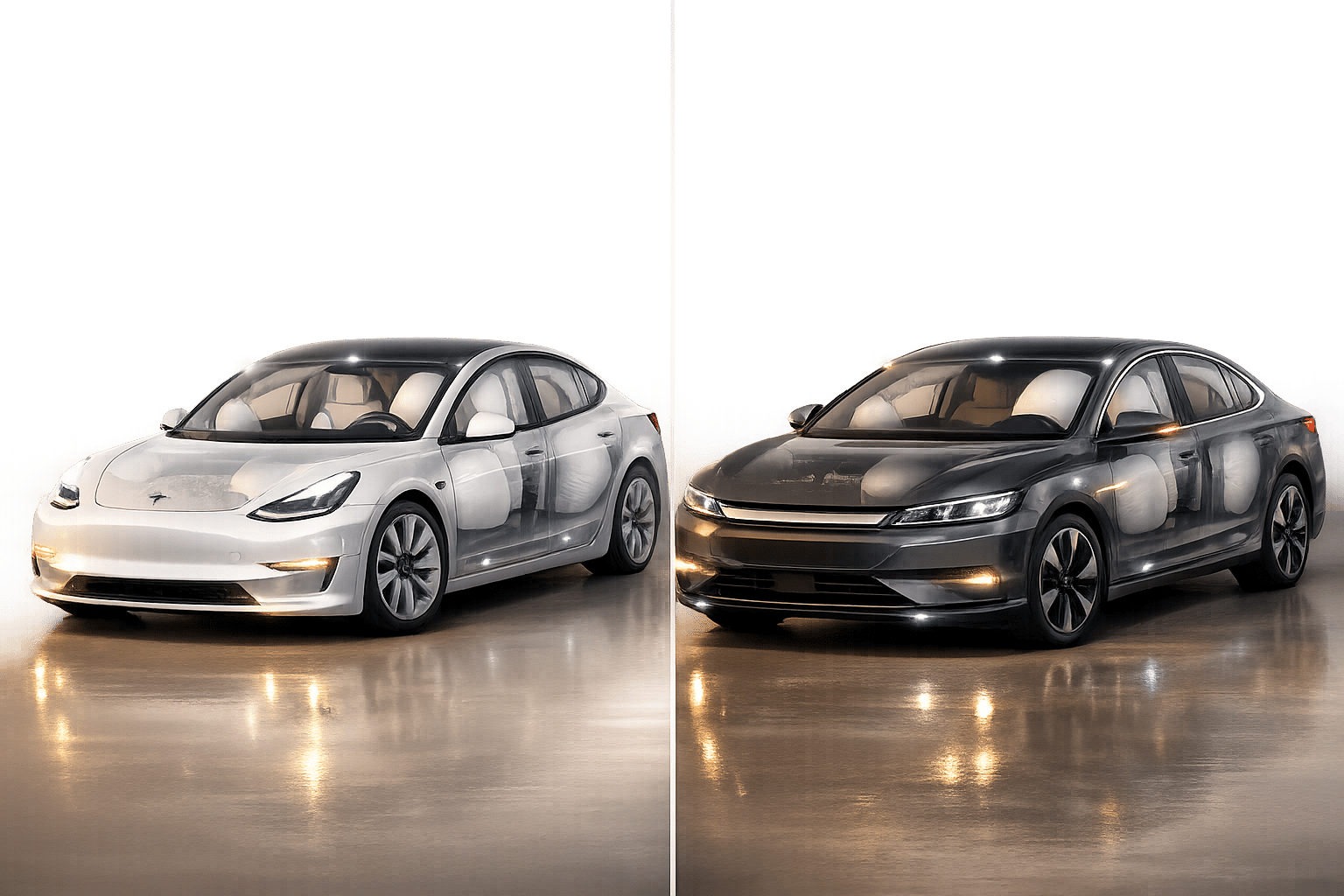
Tesla and BYD dominate the EV market but differ in their safety approaches. Tesla excels in driver assistance technology and collision prevention, with high Safety Assist scores (Model Y: 92%). BYD prioritizes occupant protection, achieving a 92% Adult Occupant score with its Seal 6 model. Both brands earned 5-star Euro NCAP ratings, but Tesla’s camera-based system contrasts with BYD’s multi-sensor setup, including lidar. Here’s a quick overview:
- Tesla Strengths: Advanced driver assistance, high Safety Assist scores, and strong pedestrian protection.
- BYD Strengths: Superior adult crash protection, affordable safety features, and advanced sensor integration.
Quick Comparison
| Feature | Tesla | BYD |
|---|---|---|
| Safety Assist Score | 92% (Model Y) | 85% (Seal 6), 74% (Atto 3) |
| Adult Occupant Score | 91% (Model Y), 90% (Model 3) | 92% (Seal 6), 91% (Atto 3) |
| Pedestrian Protection | 89% (Model 3) | 84% (Seal 6), 69% (Atto 3) |
| Driver Assistance | Tesla Vision (camera-only) | Multi-sensor (cameras, lidar) |
| Standard Features | Child presence detection, Dynamic Brake Lights | Center airbags, cross-traffic alerts |
Tesla leads in technology and Safety Assist, while BYD offers strong crash protection and value-based features. Both brands cater to different priorities, making them stand out in the EV market.
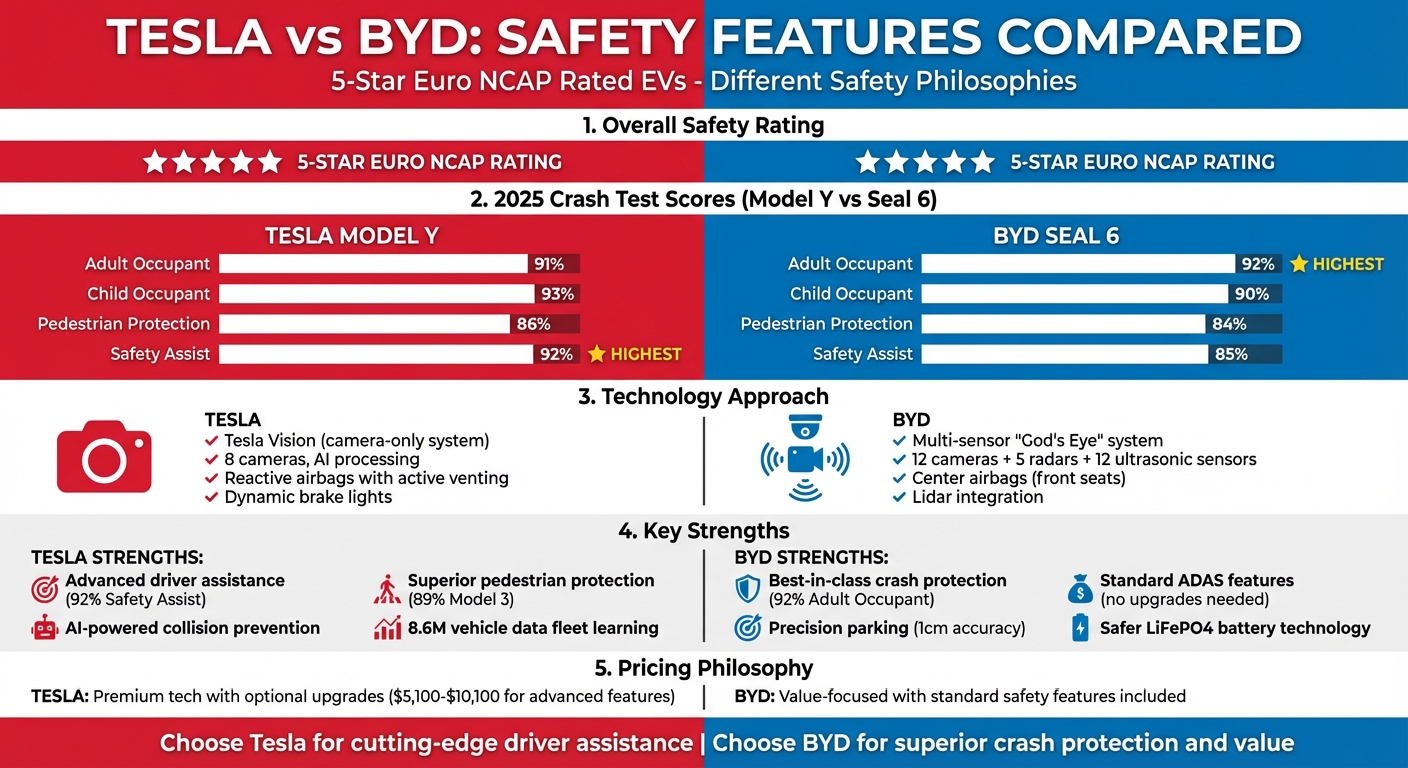
Tesla vs BYD Safety Features Comparison: Crash Test Scores and Key Safety Technologies
2026 Tesla v BYD Crash Tests: Which is REALLY Safe?
Crash Test Ratings: Tesla vs. BYD Performance
Tesla and BYD both achieved five-star ratings from Euro NCAP and ANCAP. However, a closer look at detailed crash test results reveals differences in how each brand performs in occupant and pedestrian safety. Recent 2025 tests show that while BYD has made progress in some areas, Tesla still leads in others. Here’s a breakdown of how each model performed.
Tesla Model 3 and Model Y Crash Test Results
In the 2025 Euro NCAP tests, the Tesla Model Y demonstrated strong results across multiple categories. It scored:
- 91% for Adult Occupant protection
- 93% for Child Occupant protection
- 86% for Vulnerable Road User (VRU) protection
- 92% for Safety Assist, marking the highest score under the 2023–25 protocols.
The Model Y’s passenger compartment remained stable during frontal offset tests, effectively protecting knees and femurs for both driver and passenger. However, chest protection during side pole impact tests was rated "marginal" due to rib compression readings.
The Tesla Model 3 also performed well in 2025 testing, achieving:
- 90% for Adult Occupant protection
- 93% for Child Occupant protection
- 89% for VRU protection
- 87% for Safety Assist.
Both the Model Y and Model 3 include a child presence detection system that warns if a child is left in the car. Additionally, Tesla models produced after April 2025 earned IIHS "Top Safety Pick" awards, receiving top ratings in all major crashworthiness categories.
BYD Seal and Atto 3 Crash Test Results
The BYD Seal 6 delivered a strong performance in 2025, slightly outperforming the Model Y in Adult Occupant protection with a score of 92%. Its scores in other categories included:
- 90% for Child Occupant protection
- 84% for VRU protection
- 85% for Safety Assist
Meanwhile, the BYD Atto 3, tested in 2022, earned:
- 91% for Adult Occupant protection
- 89% for Child Occupant protection
The Atto 3 excelled in child dummy protection during frontal offset and side barrier impacts, earning maximum points in these areas. However, it struggled in VRU protection, scoring just 69%, with particularly poor ratings for pedestrian pelvis protection. Its Safety Assist score of 74% also fell short compared to Tesla models. On the plus side, the Atto 3 includes a center airbag to reduce the risk of front-seat occupant collisions during side impacts.
Comparison Table
The table below summarizes the crash test results for each model:
| Vehicle Model | Test Year | Adult Occupant | Child Occupant | VRU Protection | Safety Assist |
|---|---|---|---|---|---|
| Tesla Model Y | 2025 | 91% | 93% | 86% | 92% |
| Tesla Model 3 | 2025 | 90% | 93% | 89% | 87% |
| BYD Seal 6 | 2025 | 92% | 90% | 84% | 85% |
| BYD Atto 3 | 2022 | 91% | 89% | 69% | 74% |
Standard Safety Features: Airbags, ABS, and Stability Control
After looking at crash test ratings, it’s time to dive into how each brand’s standard safety features work to protect passengers in real-world scenarios.
While crash tests provide a snapshot of safety performance, the everyday safety systems in a car are what truly safeguard occupants. Both Tesla and BYD offer anti-lock braking systems (ABS) and electronic stability control (ESC) as standard. However, their approaches to airbag technology and system integration differ in ways that complement their crash test results.
Tesla Safety Equipment
Tesla takes a tech-driven approach with its "One System", which seamlessly integrates hardware and software. One standout feature is its Reactive Airbags, which adjust deployment based on crash type and the size of the occupant. These airbags also use active venting to fine-tune cushion pressure depending on the severity of the impact. Tesla adds extra protection with far-side airbags, positioned between front-row seats to reduce head-to-head contact during side collisions.
Tesla’s safety tech doesn’t stop there. Front cameras monitor passengers to optimize seat belt tension and airbag deployment. Another clever feature is Dynamic Brake Lights, which flash rapidly during emergency braking at speeds over 31 mph to warn drivers behind you. Tesla’s global fleet of 8.6 million vehicles provides valuable data to continuously refine these systems. Post-crash, Tesla vehicles automatically unlock doors, activate hazard lights, contact emergency services, and even disconnect the high-voltage battery for added safety.
BYD Safety Equipment
BYD focuses on delivering robust safety features across all its models, even entry-level ones. For example, the Dolphin comes equipped with a full set of airbags, including side and curtain versions. Meanwhile, the Atto 3 takes it a step further by featuring a center airbag to reduce the risk of front-seat passengers colliding during side impacts.
BYD also includes helpful tech like front and rear cross-traffic alerts as standard on the Dolphin. In comparison, this feature is optional on Tesla’s Model 3. This emphasis on comprehensive safety equipment ensures BYD provides solid protection, even at lower price points.
Driver Assistance Systems: Tesla Autopilot vs BYD ADAS
Driver assistance technology sets Tesla and BYD apart in unique ways. Tesla relies entirely on cameras and artificial intelligence through its Tesla Vision system, while BYD employs a multi-sensor approach, combining cameras, lidar, millimeter-wave radar, and ultrasonic sensors. These systems go beyond static crash tests and basic safety features by actively working to prevent accidents, enhancing overall safety. Below is a closer look at how each brand’s system performs, from lane-keeping to object detection.
Tesla Autopilot Capabilities
Tesla’s Autopilot comes standard on all models, offering adaptive cruise control, lane-keeping assist, and automatic emergency braking. The system uses eight cameras to create a 360-degree view around the vehicle, with AI processing the visual data. In highway tests conducted in July 2025, Tesla vehicles successfully navigated five out of six high-risk scenarios.
Wang Yao, deputy chief engineer at the China Association of Automobile Manufacturers, stated: "Domestic brands should face up to the gap with Tesla in autonomous driving".
Tesla’s lane-keeping system stands out for its precision but can sometimes trigger false alerts, known as phantom braking. The Model 3 achieved a 94% safety assist score under the 2019 ANCAP protocols, while the Model Y earned a 92% rating in Euro NCAP assessments. For those seeking more advanced features, Tesla offers Enhanced Autopilot for approximately $5,100 and Full Self-Driving for around $10,100.
BYD ADAS Capabilities
BYD’s ADAS takes a different approach, integrating a wide range of sensors into its vehicles. Standard Level 2 features are included across models like the Atto 3 and Seal, without requiring costly upgrades. Its "God’s Eye" system combines 12 cameras, 5 millimeter-wave radars, and 12 ultrasonic sensors, even on entry-level configurations. The system’s front radar can detect objects up to 984 feet away, while its parking sensors boast an impressive accuracy of about 0.8 inches.
However, BYD’s systems have faced scrutiny for their real-world performance. For instance, the Seal’s lane-keeping assist has been criticized for being overly sensitive, occasionally steering unnecessarily away from oncoming traffic. In the same July 2025 tests, BYD’s Denza Z9GT struggled, failing three of six high-risk scenarios. Euro NCAP ratings highlight these challenges further: while the BYD Seal 6 scored 85% for safety assist, the Sealion 7 and Dolphin Surf scored 79% and 77%, respectively – falling short of Tesla’s results. The Atto 3 performed particularly poorly, receiving a "not recommended" rating in October 2024 after scoring zero for driver monitoring and failing key collision avoidance tests, particularly at speeds above 56 mph.
Despite these performance issues, BYD offers a strong value proposition. By including advanced driver assistance features as standard, it makes safety technology more accessible without additional costs, appealing to budget-conscious buyers.
sbb-itb-99e19e3
Parking Aids and Sensor Technology
When it comes to parking assistance, Tesla and BYD take very different paths, reflecting their contrasting design philosophies. Tesla has moved away from ultrasonic sensors and radar, relying entirely on its camera-only system, Tesla Vision. On the other hand, BYD employs a comprehensive "God’s Eye" system, combining 12 cameras, 5 millimeter-wave radars, and 12 ultrasonic sensors – even in its entry-level models. These distinct hardware choices influence how each brand handles tight parking spaces and obstacle detection. Let’s delve into how these systems perform in practice.
Tesla Parking and Sensor Systems
Tesla’s camera-only system delivers a 360-degree view, processing over one million pixels every millisecond. Using artificial intelligence, the system estimates distances and identifies obstacles based solely on visual input. Standard across Tesla’s lineup is blind-spot monitoring, while the Autopark feature assists with parking maneuvers. However, this operates at Level 2 autonomy, requiring the driver to supervise at all times [22].
BYD Parking and Sensor Systems
BYD’s multi-sensor approach offers a level of precision that stands out. Its ultrasonic sensors, for example, provide accuracy down to 1 centimeter, enabling vehicles to park within 0.8 inches of obstacles. The system also excels at detecting objects above the roofline, thanks to its advanced three-dimensional sensor mapping.
One of BYD’s standout features is its Level 4 autonomous parking. This allows vehicles to navigate parking lots and choose spaces without requiring pre-mapped guidance. Additionally, BYD offers a liability guarantee, covering any damages that might occur if the system fails during an unattended parking maneuver. As of early 2026, over 1 million BYD vehicles in China had received the God’s Eye update.
"BYD’s confidence stems from a sophisticated sensor architecture… unlike Tesla’s problematic camera-only approach", commented journalist Jesus Diaz.
For even greater precision, BYD’s premium God’s Eye A variant includes three lidar sensors. In the Yangwang U9 model, the system can even detect and navigate around potholes. This layered sensor strategy contrasts with Tesla’s minimalist hardware approach, though Tesla’s software calibration for general driving remains highly polished in many driving scenarios. These advanced parking aids, combined with BYD’s broader safety systems, enhance its reputation for precision and reliability in tight spaces.
Safety Features Comparison Table
The following table outlines the main safety feature differences between Tesla and BYD, based on their respective models. Both brands have achieved 5-star ratings from Euro NCAP and ANCAP, but there are notable distinctions in occupant protection and driver assistance categories. Tesla generally excels in areas like Safety Assist and Child Occupant protection, with the Model Y earning a 92% Safety Assist score, compared to the BYD Atto 3’s 74%. On the other hand, BYD’s 2025 Seal 6 scored 92% for Adult Occupant protection and 85% for Safety Assist.
Tesla’s Model 3 comes equipped with frontal, side curtain, and side (torso/pelvis) airbags, while BYD adds a center airbag but does not include a knee airbag. Both brands provide ISOFIX/LATCH compatibility as standard, ensuring secure child seat installation.
When it comes to active safety systems, both brands include Automatic Emergency Braking (AEB) as standard. Tesla’s AEB earned a "Good" rating from the IIHS for preventing collisions at speeds up to 43 mph, while BYD’s AEB activates at speeds as low as 2.5 mph and also detects pedestrians, cyclists, and reversing hazards. Additional safety features like lane-keeping assist, blind-spot monitoring, and electronic stability control are standard across both manufacturers.
| Feature | Tesla Model 3/Y | BYD Seal / Atto 3 |
|---|---|---|
| Euro NCAP Rating | 5 Stars | 5 Stars |
| Adult Occupant | 89% (Model 3, 2025) | 92% (Seal 6, 2025) |
| Safety Assist | 92% (Model Y) | 74% (Atto 3) |
| Airbag Count | Front, Side, Curtain | Front, Side, Curtain, Center (No Knee) |
| AEB | Standard (Vehicle, Pedestrian) | Standard (Vehicle, Pedestrian, Cyclist) |
| Adaptive Cruise Control | Standard | Standard |
| Lane‑Keeping Assist | Standard | LKA & Emergency Lane Keeping |
| Blind‑Spot Monitoring | Standard | Standard |
| 360° Camera | Camera‑only (Tesla Vision) [23] | 12 Cameras (God’s Eye) |
| ISOFIX/LATCH | Rear Outboard | Front Passenger & Rear Outboard |
| ESC / Traction Control | Standard | Standard |
Tesla’s Model 3 also received an "Acceptable" rating from the IIHS for its LED projector headlights, which include high-beam assist and curve-adaptive features. For pedestrian safety, the 2025 Model 3 scored 89% for Vulnerable Road User protection, outperforming the BYD Atto 3’s 69% from 2022. BYD, however, offers additional features like a Multi-Collision Brake system, which engages the brakes after an initial impact to reduce secondary collisions, and an ISO-compliant advanced eCall system for automatic emergency service alerts.
This table provides a clear overview of the key safety distinctions between Tesla and BYD, showcasing their respective strengths and unique features.
Conclusion: Tesla vs BYD Safety Verdict
Both Tesla and BYD have earned 5-star Euro NCAP ratings across their primary models, showcasing their commitment to safety. Tesla stands out in Safety Assist technology, with the Model Y achieving an impressive 92% score in 2025 tests, surpassing BYD’s Seal 6 at 85% and Sealion 7 at 79%. This highlights Tesla’s advanced Autopilot system and cutting-edge collision-avoidance features, though many of these capabilities come as optional upgrades.
On the other hand, BYD focuses on occupant protection, offering stronger Adult Occupant safety. In 2025 testing, the BYD Seal 6 scored 92%, edging out Tesla’s Model Y at 91% and Model 3 at 90%. BYD also provides Level 2 ADAS as a standard feature, avoiding additional costs. Its use of Lithium Iron Phosphate (LiFePO4) batteries enhances thermal safety, reducing the risk of battery fires compared to traditional chemistries [25].
For families prioritizing child safety, both brands perform equally well. The Tesla Model Y and Model 3, along with BYD’s Sealion 7, all achieved 93% Child Occupant protection scores [26]. BYD offers added features like center airbags and Child Presence Detection systems, while Tesla excels in protecting vulnerable road users, with the Model 3 scoring 89% compared to the Seal 6’s 84%. These distinctions underline each automaker’s unique safety priorities.
The takeaway: Tesla leads in advanced driver assistance and collision prevention, reflected in its high Safety Assist scores. Meanwhile, BYD offers stronger adult crash protection, standard safety features, and the added benefit of safer battery technology – all at more competitive prices. Visit EV24.africa to explore detailed specs, safety ratings, and availability for both brands’ latest models in Africa’s growing EV market.
FAQs
How do Tesla and BYD compare in terms of safety features?
Tesla and BYD both emphasize safety, but their methods differ. Tesla leans heavily on its Autopilot system, which provides advanced semi-autonomous driving capabilities. On the other hand, BYD integrates Level 2 driver-assistance systems (ADAS) across many of its vehicles, often without extra charges.
Both brands have earned 5-star safety ratings in crash tests for models like Tesla’s Model 3 and Model Y, as well as BYD’s Atto 3 and Seal, showcasing excellent crash protection. Tesla’s vehicles often stand out in safety evaluations, with some models considered among the safest ever made. Meanwhile, BYD’s newer models prove they are no slouch in delivering strong safety performance.
Tesla pushes the envelope with advanced driver-assist tech, while BYD prioritizes accessible, dependable safety features, making both brands appealing choices for safety-conscious drivers.
How do Tesla and BYD’s driver assistance systems perform in real-world driving?
Tesla and BYD both provide advanced driver assistance systems, but their performance on the road shows some noteworthy differences. Tesla’s Autopilot and Full Self-Driving (FSD) systems are particularly known for excelling in complex highway scenarios. These systems have consistently performed well in driving tests and are often praised for their ability to handle challenging situations with a high degree of reliability.
BYD’s God’s Eye system brings its own strengths to the table, offering features like remote parking and highway navigation, even on models that are more budget-friendly. While BYD has made impressive progress, its system is still working to match Tesla’s level of performance in managing intricate driving conditions and ensuring overall safety in real-world scenarios.
At this point, Tesla’s systems are seen as more polished and thoroughly tested. However, BYD is steadily narrowing the gap by delivering advanced technology at a price that appeals to a broader range of buyers.
Which brand provides better safety for adults in crash tests?
Tesla excels in adult occupant protection during crash tests, earning an impressive 90% rating from Euro NCAP in this category. In comparison, BYD, though equipped with solid safety features, has received lower scores in similar assessments.
Tesla’s strong performance is attributed to its advanced safety technology and durable design, positioning it as a leading option for anyone prioritizing crash safety.