
 Thabo Nkosi
Tesla officially launched in Africa in May 2025, starting operations in Morocco. Here’s what you need to know:
- Why Morocco? Tesla chose Morocco for its strong EV infrastructure, tax exemptions (0% VAT and no customs duties on EV imports), and a growing automotive industry producing up to 50,000 EVs annually.
- Models Available: Tesla offers the Model 3 ($44,130–$56,630) and Cybertruck (price TBD) through its Moroccan subsidiary.
- Charging Network: Morocco leads Africa with 1,000 public EV charging points, supported by Tesla’s Superchargers in key cities like Casablanca, Marrakesh, and Tangier.
- Future Plans: Tesla is investing $5 billion in a manufacturing facility near Kenitra, Morocco, set to produce 400,000 vehicles annually by 2027, including a $25,000 compact EV for emerging markets.
For now, Morocco is Tesla’s main hub in Africa, but the company plans to expand into Egypt, Nigeria, Kenya, and South Africa, focusing on regions with favorable policies and infrastructure.
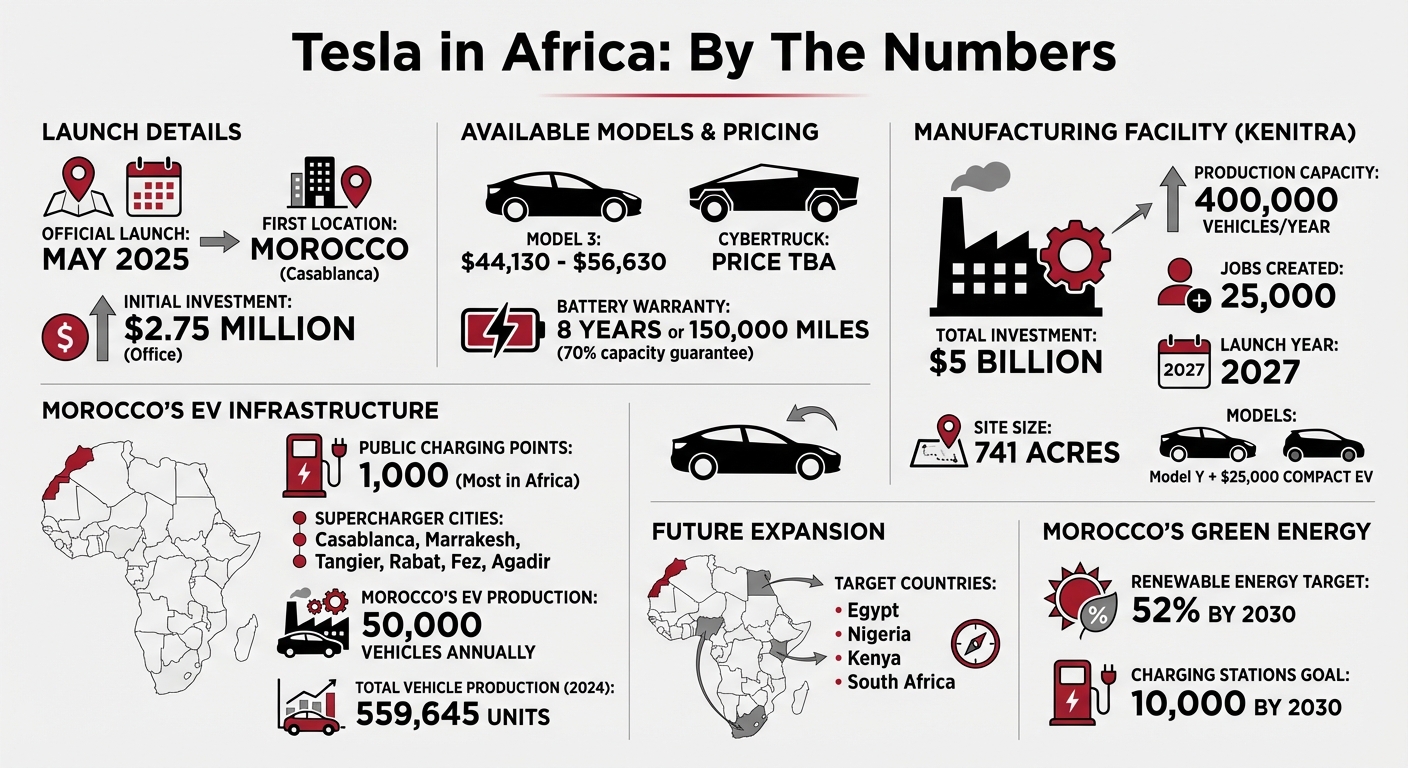
Tesla Africa Launch: Key Facts and Investment Overview
Where You Can Find Tesla Vehicles in Africa
Tesla’s First African Office in Morocco
Tesla’s main base in Africa is located at the Crystal Tower in Casablanca Marina, Morocco. This office handles everything from importing vehicles and direct sales to maintenance, after-sales support, and expanding Tesla’s charging network. Taking advantage of Morocco’s 0% VAT exemption on electric vehicle imports, the office also focuses on training staff and offering technical support to new Tesla owners. This setup is a key part of Tesla’s push for sustainable transportation across the continent.
With an initial investment of $2.75 million, this facility ensures smooth delivery logistics and provides local support for Tesla owners. This eliminates the need for customers to rely on service centers located far outside the region.
Primary Markets for Tesla in Africa
Right now, Morocco is the only African country with official Tesla operations. The choice to establish a hub here makes sense, given Morocco’s thriving automotive industry and its position as Africa’s top automotive hub.
In contrast, South Africa does not yet have official Tesla operations due to challenges like high tariffs, electricity issues, and limited government incentives for electric vehicles. Morocco’s advanced EV infrastructure gives it a clear edge over other markets in Africa. From this central hub, Tesla also decides which models to offer to local buyers.
Tesla Models You Can Buy in Africa
Through its Moroccan operations, Tesla offers two models: the Model 3 and the Cybertruck. The Model 3 is priced between $44,130 and $56,630, depending on the chosen configuration. It also comes with Tesla’s 8-year or 150,000-mile battery warranty, guaranteeing at least 70% battery capacity during that period.
For buyers outside Morocco, getting a Tesla is much more complicated. It often involves private importers and navigating a maze of regulations. For instance, some Model Y vehicles have made their way to Tunisia via independent channels. However, these vehicles lack access to an official service network or charging infrastructure, making ownership far less convenient. High import fees, local taxes, and limited after-sales support further complicate things for buyers in other African nations. For now, Morocco remains the most practical option for Tesla ownership in Africa.
How Much Tesla Vehicles Cost in Africa
Price Estimates for Tesla Models
For those in Africa, the Model 3 stands out as the most affordable Tesla option, with prices ranging between $44,130 and $56,630 via Tesla’s Morocco subsidiary. However, details on specific configurations are still under wraps. Meanwhile, the highly anticipated Cybertruck is also slated for availability through the same subsidiary, though its pricing has yet to be disclosed.
It’s worth noting that buyers outside Morocco will face extra expenses, including import duties, shipping fees, and local taxes. These base prices provide a glimpse into the financial considerations for Tesla ownership in Africa.
| Tesla Model | Estimated Price (USD) | Market Context |
|---|---|---|
| Model 3 | $44,130 – $56,630 | Available via Morocco Subsidiary |
| Cybertruck | TBA | Planned for Morocco Subsidiary |
Payment Plans and Financing Options
All official Tesla transactions in Africa are handled by the Morocco subsidiary. While financing options similar to those in other regions haven’t yet reached the continent, there are alternatives.
One such option is EV24.africa, which offers financing solutions and delivery services across all 54 African countries. Their approach simplifies the buying process with clear pricing and flexible payment plans, making Tesla ownership more accessible across the region.
Charging Stations and Service Support
Existing Charging Network
As of late 2025, Morocco boasts 1,000 public charging points, making it the leader in electric vehicle (EV) infrastructure across Africa. Tesla’s Supercharger network, which began rolling out in 2021, now covers key cities such as Rabat, Fez, Marrakesh, and Agadir. The initial V2 Superchargers, introduced in October 2021, provide 150 kW of power – enough to add roughly 200 miles of range in just 15 minutes.
Tesla’s Casablanca office serves as the hub for maintenance, repairs, and staff training, ensuring local support for Moroccan EV owners. However, Tesla owners outside Morocco face significant hurdles. Without access to Tesla’s official service network, they often rely on independent mechanics or imported parts for major repairs.
"If you have a serious issue with the battery, motor, or the car’s complex electronics, it gets tricky. You’ll likely need to have specialised parts shipped in from Europe or the Middle East." – Younes Rabeh, EV24.africa
In South Africa, Tesla owners navigate similar challenges, depending on private imports and third-party charging solutions. These gaps highlight the importance of Tesla’s plans to expand its footprint across the continent.
Plans to Expand Charging Infrastructure
Tesla is working to address these challenges by broadening its charging and support network. The company’s approach ties together vehicle sales, charging stations, and clean energy solutions like solar panels and Powerwall battery storage. In Morocco, Tesla has secured approval to sell electricity directly to consumers, positioning itself as a decentralized energy provider to power its charging infrastructure.
Leveraging Morocco’s strong foundation, Tesla plans to replicate this model across Africa. These efforts align with Morocco’s National Electric Mobility Strategy, which aims to establish 10,000 public charging stations by 2030. Additionally, Morocco’s commitment to generating 52% of its energy from renewable sources by 2030 creates opportunities for Tesla to integrate solar-powered EV charging networks.
A major step in this expansion is the construction of a Tesla manufacturing facility near Kenitra, announced by Elon Musk in April 2025. This facility will not only support local production but also serve as a launchpad for Tesla’s broader ambitions across the African continent.
sbb-itb-99e19e3
Tesla’s Plans for Africa
New Production Facility in Morocco
Tesla is making a bold move into Africa with a $5 billion investment to build its first manufacturing plant on the continent, located near Kenitra, Morocco. Announced by Elon Musk in April 2025, this facility is expected to produce 400,000 vehicles annually and create around 25,000 local jobs. Spanning 741 acres, the site will act as a production hub for both African and European markets, with operations slated to begin in 2027.
Initially, the factory will focus on producing the Model Y and a new compact electric vehicle aimed at emerging markets, priced at approximately $25,000. Morocco’s well-established automotive industry, which manufactured 559,645 vehicles in 2024, makes it the perfect location for this venture. The country has even surpassed South Africa as Africa’s top vehicle producer, providing Tesla with the necessary supply chain infrastructure to succeed.
"This is a historic investment marking the first gigafactory in Africa." – Hicham Chaoudri, Director at the Moroccan Investment Department
The site’s proximity to the Tanger Med port offers Tesla direct access to European markets, while Morocco’s commitment to generating 52% of its energy from renewable sources by 2030 aligns seamlessly with Tesla’s sustainability goals. The plant will integrate solar and battery storage systems into its operations, supported by local battery manufacturers like Gotion High-Tech and BTR New Material Group. This facility not only strengthens Tesla’s foothold in Europe but also underscores its dedication to advancing sustainable transportation in Africa. It lays the groundwork for Tesla’s broader strategy across the continent.
Expansion to Other African Countries
Tesla sees Morocco as the launchpad for its African ambitions, with plans to expand into Egypt, Nigeria, Kenya, and South Africa in the future.
"The plant is expected to follow the consolidation of Tesla’s distribution and retail network, using Morocco as a springboard for further continental expansion." – Elon Musk, Chairman, Tesla
The company’s expansion strategy is focused on regions with supportive government policies, reliable charging infrastructure, and stable power grids. Morocco’s success, driven by incentives like exemptions from value-added tax and customs duties on EV imports, serves as a blueprint for other markets. Tesla aims to replicate its integrated ecosystem in these countries, combining vehicle sales with solar panels, Powerwall storage solutions, and Supercharger networks. This approach not only positions Tesla to lead Africa’s growing EV market but also supports the continent’s shift toward sustainable transportation.
Tesla enters African market with its first Superchargers in Morocco
Conclusion
Tesla’s strategic moves and infrastructure initiatives are reshaping the electric vehicle (EV) landscape in Africa, marking a pivotal moment for the continent’s transportation future.
By establishing its first African subsidiary in Morocco in May 2025, Tesla has taken a bold step into a region where EV adoption is steadily gaining traction. The Morocco hub is more than just a sales office – it’s a launchpad for Tesla’s vision of sustainable mobility across Africa. This milestone highlights the shift from viewing EVs as a distant possibility to recognizing them as a growing part of everyday life on the continent.
Though Tesla’s vehicles fall within the premium price range, the company offers more than just cars. By integrating solar energy solutions and expanding its Supercharger network, Tesla is creating a self-sustaining ecosystem that directly addresses Africa’s energy challenges. This comprehensive approach not only enhances the appeal of EVs but also sets a standard for how such solutions can be successfully introduced in emerging markets.
Morocco’s experience serves as a model for Tesla’s future expansion into other African countries. The nation’s supportive policies and well-developed infrastructure underscore the importance of collaboration between governments and private companies in accelerating EV adoption. Tesla’s presence in Africa signals more than just improved access to EVs – it represents a commitment to sustainable transportation and a forward-thinking automotive industry, setting the stage for transformative change across the continent.
FAQs
Why did Tesla choose Morocco as its first hub in Africa?
Tesla selected Morocco as its first African hub because of the country’s impressive progress in energy infrastructure, its prime location as a gateway to the continent, and its dedication to renewable energy policies. These attributes position Morocco as a promising launchpad for Tesla’s entry into Africa.
Moreover, Morocco’s emphasis on sustainability and its investments in clean energy initiatives align seamlessly with Tesla’s mission to drive the global shift toward sustainable energy. This shared vision creates a strong platform for Tesla to establish itself and expand within the African market.
What challenges do Tesla owners in Africa face outside of Morocco?
Tesla enthusiasts in African countries, aside from Morocco, face a unique set of challenges due to Tesla’s absence in the region. Without official dealerships or service centers, potential buyers are left with no choice but to turn to third-party importers. This route often drives up the overall cost significantly. Why? Importing a Tesla means dealing with shipping fees, steep import duties, value-added taxes, and a mountain of customs paperwork. By the time the car arrives, its price tag is often far beyond the original cost.
But the hurdles don’t end there. Once the vehicle is in hand, owners face limited options for charging and maintenance. Supercharger stations are few and far between, leaving many to invest in home charging setups. These systems can be costly and, in some areas, entirely unavailable. When it comes to repairs, the situation is equally tricky. Spare parts have to be imported, and with no Tesla-certified service centers outside Morocco, repair times can stretch out and costs can pile up. On top of all this, navigating insurance and securing the right documentation can be another layer of complexity for Tesla owners in these regions.
What are Tesla’s plans for expanding its presence in Africa?
Tesla has officially entered the African market, marking its debut by setting up a subsidiary in Morocco. In May 2025, the company opened an office in Casablanca’s Crystal Tower, backed by an initial investment of $2.75 million. This new hub is set to oversee vehicle sales, manage deliveries, and spearhead the installation of Tesla-branded charging stations across the continent.
Morocco was chosen for this venture thanks to its booming automotive sector, which produces between 40,000 and 50,000 electric vehicles annually. The country also offers attractive tax benefits and an expanding network of charging stations, making it an ideal launchpad. From this base, Tesla aims to extend its reach into North, West, and Central Africa, introducing its full lineup of vehicles, solar energy products, and Supercharger infrastructure to these regions.