
 Thabo Nkosi
The GWM Ora 03 is South Africa’s newest electric vehicle offering, priced at R686,950 ($38,000) for its luxury model. While there’s talk of a pared-down version at R300,000 ($16,200), the current model remains out of reach for many South Africans. With a range of 193 miles (WLTP) and lower running costs compared to gasoline cars, it’s positioned as a city-friendly EV. However, limited charging infrastructure, power outages, and a high starting price pose challenges for broader adoption.
Key takeaways:
- Price: Starts at $38,000; potential $16,200 version could rival cheaper EVs like the BYD Dolphin Surf.
- Range: 193 miles (WLTP), but real-world performance often falls short.
- Running Costs: Around $0.22 per mile, significantly cheaper than gasoline cars.
- Features: Packed with tech like dual screens, adaptive cruise control, and optional massaging seats.
- Challenges: Limited rural charging, high upfront cost, and no vehicle-to-load feature for power outages.
The Ora 03 offers a solid option for urban drivers but doesn’t fully solve affordability and infrastructure issues for widespread EV adoption in South Africa.
SA’s New Cheapest EV Driven, Golf R Confirmed for SA, & New Data Shows Diesel is Top.
Price Comparison
The GWM Ora 03 is priced at R686,950 ($38,000), placing it firmly in the premium EV category. On the other hand, the BYD Dolphin Surf comes in at R339,900 ($18,400). Interestingly, there’s talk of a pared-down version of the Ora 03 priced at R300,000 ($16,200), which would make it about $2,200 cheaper than the Dolphin Surf.
But the cost story doesn’t end with the sticker price. When it comes to daily running costs, the Ora 03 has a clear edge. Charging at home costs between R2.18 and R3.50 per kWh ($0.12 to $0.19), translating to a full charge costing just R170 to R250 ($9.20 to $13.50). That’s a huge saving compared to traditional fuel costs. With an energy consumption of 16.7 kWh per 62 miles, the driving cost is only about $2.00 to $3.17 per 62 miles. Plus, GWM backs the Ora 03 with a 7-year/65,000-mile service plan and an 8-year/93,000-mile battery warranty, adding peace of mind for buyers.
For those relying on public DC fast charging, the cost is around R7.35 per kWh ($0.40 per kWh). When you compare this to similarly priced premium hatchbacks like the Audi A3, BMW 1 Series, and Mercedes-Benz A-Class, the Ora 03’s running costs are far lower, thanks to the cost advantages of electricity.
With its competitive pricing, lower operational expenses, and strong after-sales support, the Ora 03 has the potential to shake up South Africa’s EV market and make premium EV ownership more accessible.
Range and Performance
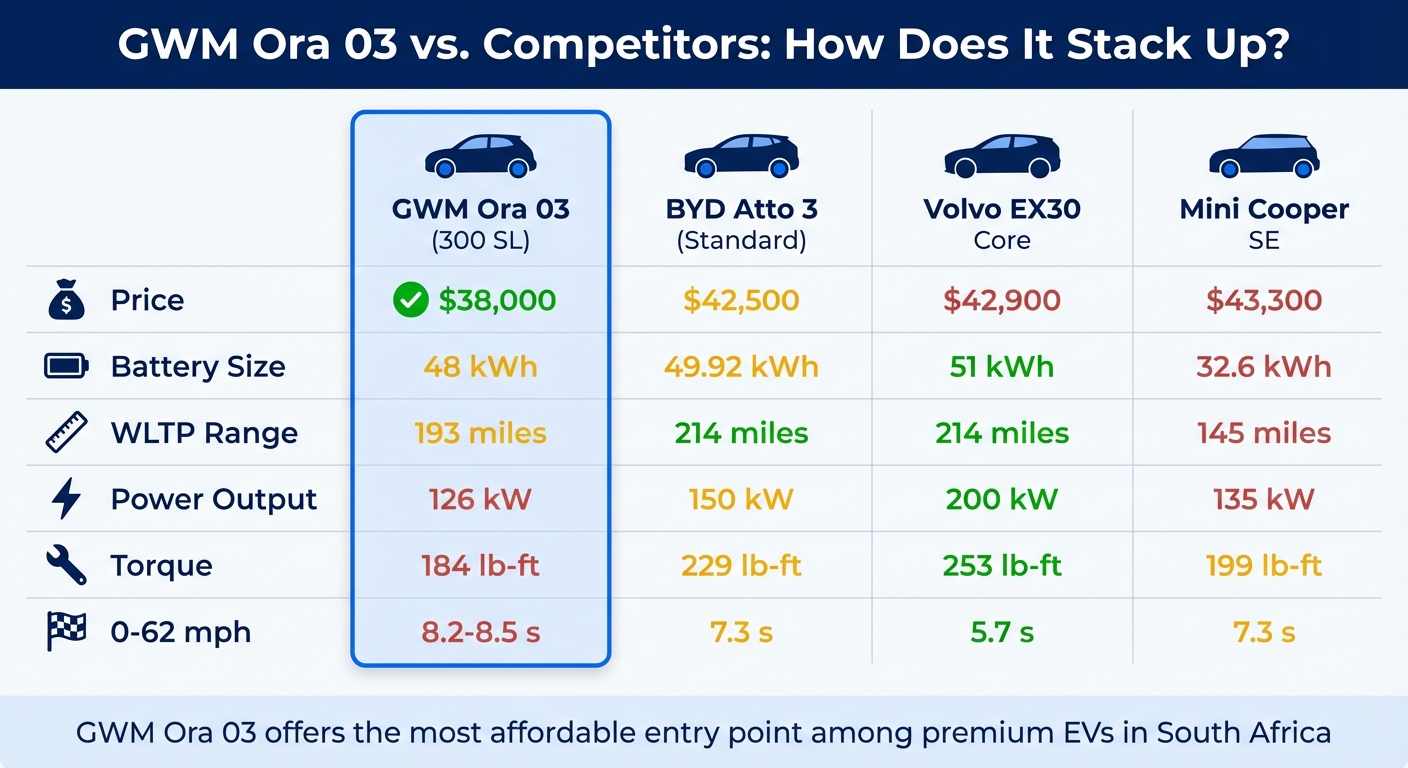
GWM Ora 03 vs Competitors: Price, Range, and Performance Comparison
The GWM Ora 03 comes with two battery options: a 48 kWh lithium-ion phosphate battery for the entry-level "300" models, which boasts a 193-mile WLTP range, and a 63 kWh nickel-manganese cobalt battery for the "400" models, promising up to 249 miles. However, real-world tests at 75 mph revealed that the 400 GT managed only 124 miles before reaching the 10% battery safety threshold – about 50% less than the advertised range .
This performance is tied to the consistent powertrain across all Ora 03 models, which feature a 126 kW motor delivering 184 lb-ft of torque. The car accelerates from 0–62 mph in 8.2 to 8.5 seconds and has an official energy efficiency rating of 16.7 kWh per 62 miles. However, during a 555-mile test, real-world usage averaged 18.7 kWh per 62 miles . In urban environments, the Ora 03 shines with its one-pedal driving capability, which recaptures energy during coasting and braking – perfect for stop-and-go city traffic .
"The Ora’s range claims across all models are believable and most drivers should get close." – Kyle Kock, Road Test Editor, CAR Magazine
Charging is relatively quick: a 67 kW DC fast charger can take the battery from 10% to 80% in about 50 minutes, while a full charge using an 11 kW AC charger takes approximately 5.5 hours . With a top speed just under 100 mph, the Ora 03 is well-suited for highway driving .
| Specification | GWM Ora 03 (300 SL) | BYD Atto 3 (Standard) | Volvo EX30 Core | Mini Cooper SE |
|---|---|---|---|---|
| Price | $38,000 | $42,500 | $42,900 | $43,300 |
| Battery Size | 48 kWh | 49.92 kWh | 51 kWh | 32.6 kWh |
| WLTP Range | 193 miles | 214 miles | 214 miles | 145 miles |
| Power Output | 126 kW | 150 kW | 200 kW | 135 kW |
| Torque | 184 lb-ft | 229 lb-ft | 253 lb-ft | 199 lb-ft |
| 0–62 mph | 8.2–8.5 s | 7.3 s | 5.7 s | 7.3 s |
These figures highlight the Ora 03’s practicality as an affordable city car. While its real-world range may fall short for those in areas with limited charging options, its efficiency and features make it a strong contender for urban use.
Features and Technology
The Ora 03 combines efficiency with a suite of advanced features designed to enhance the urban driving experience. One standout is its dual 10.25-inch screen setup, seamlessly merging the digital instrument cluster with the infotainment system for a sleek, wide-screen dashboard look. Standard across all trims are LED lights, a wireless smartphone charger, and adaptive cruise control. The GT model steps it up with additional features like auto parking, traffic-sign recognition, and lane-keep assist. A physical power cutoff switch, located near the driver’s knee, ensures zero power drain while the vehicle is parked – a thoughtful touch for EV owners. These features work together to create a tech-forward environment that feels more refined than expected.
For those opting for higher trims like the Ultra Luxury or GT, the Ora 03 introduces heated, ventilated, and even massaging front seats – comforts usually found in far more expensive vehicles. The 400 GT Ultra Luxury trim also includes a 360-degree panoramic camera, offering a bird’s-eye view to simplify tight parking situations. On the connectivity side, the car supports wireless Apple CarPlay, with Android Auto compatibility expected soon.
"The interior of the Ora is a winner, offering a blend of retro styling and modern chic just like the outer shell." – TopAuto Review
While the dual screens add a modern touch, some drivers have noted usability issues, such as small, unresponsive buttons on the central display. Additionally, settings for driver assistance features tend to reset to factory defaults after the car is restarted, which can be frustrating. Despite these quirks, the switchgear feels sturdy, and the interior materials – like microfiber surfaces and chrome accents – offer a level of quality that surpasses expectations for this price range.
| Feature Category | GWM Ora 03 (Standard/Super Luxury) | GWM Ora 03 (Ultra Luxury/GT) |
|---|---|---|
| Driver-Assist | Adaptive Cruise Control, 360° Camera, Rear Sensors | Auto Parking, Traffic-Sign Recognition, Lane-Keep Assist |
| Interior Comfort | Leatherette Seats, Electric Front Adjustment | Massaging, Ventilated, and Heated Front Seats |
| Connectivity | Wireless Apple CarPlay, Wireless Charging | Wireless Apple CarPlay, Wireless Charging, Android Auto (coming soon) |
| Safety | 6 Airbags, ABS, Tire-Pressure Monitoring | Emergency Braking (Pedestrian/Cyclist), Cross-Traffic Assist |
These premium features, often associated with luxury vehicles, position the Ora 03 as a strong contender in South Africa’s EV market. With amenities like massaging seats and a panoramic camera system, the Ora 03 offers an upscale feel at a starting price of around $38,000.
sbb-itb-99e19e3
African Market Fit
The GWM Ora 03 faces a tough question: can an EV built for city life thrive in South Africa, a market with limited charging infrastructure and unpredictable road conditions? South Africa’s automotive environment presents challenges that go beyond what European test cycles typically account for. For starters, 77% of the country’s power grid relies on coal, and frequent power outages make grid-dependent charging unreliable. Yet, the EV market is gaining momentum – South Africa experienced a 156% year-over-year growth in New Energy Vehicle sales in Q4 2024. This growth underscores the need for creative charging solutions and affordable options.
The biggest challenge? Infrastructure. GridCars has rolled out over 300 charging stations across the country, including 150 on major provincial routes. However, rural areas remain largely unserved. To tackle this, GWM has introduced financing options for inverters and batteries that enable off-grid, solar-powered charging. A great example is South Africa’s first off-grid EV charging station in Wolmaransstad, North West. This station is part of a planned 120-station network aimed at supporting long-distance travel without relying on the unstable grid.
"The company is making strides to make EV motoring more accessible with financing options that include inverters and batteries installed at your home." – Kyle Kock, Road Test Editor, CAR Magazine
While these infrastructure developments aim to provide reliability, the Ora 03 also faces the challenge of South Africa’s diverse driving conditions. The vehicle’s durability is tested on uneven roads and under the strain of grid instability. Reviewers highlight its solid build and suspension that manages rough tarmac with "little fuss". However, it’s important to note that the Ora 03 is designed as a "city car" and not for off-road adventures. Local tests also show its range falls short of the manufacturer’s claims under real-world conditions.
| Feature | GWM Ora 03 | Market Context |
|---|---|---|
| Charging Compatibility | Type 2 AC (78% market adoption), 64kW DC fast charging | Works with South Africa’s expanding charging network |
| Warranty Terms | 7-year/124,274-mile vehicle; 8-year/93,206-mile high-voltage parts | Includes 7-year/65,244-mile service plan and unlimited roadside assistance |
| Maintenance Costs | $9.44–$13.89 per full home charge; $13.89–$16.67 per DC fast charge | Costs about $0.22 per mile vs. $0.65 for gasoline vehicles |
| Environmental Impact | Solar-integrated charging reduces carbon emissions by 28.5 tons annually (campus model) | 50% lower running costs with solar compared to grid-only charging |
For urban buyers, the Ora 03 offers a cost-effective and practical option, with running costs of about $0.22 per mile compared to $0.65 for gasoline cars. However, its success hinges on the availability of home charging setups and its alignment with city-focused driving habits. With a 7-year comprehensive warranty and an included service plan, the Ora 03 provides a safety net for buyers navigating South Africa’s distinctive market challenges.
Pros and Cons
The GWM Ora 03 offers a high-end driving experience, but its starting price of $38,200 (R686,950) makes it less attainable for many South African buyers. It shines in city settings with smooth handling and excellent noise, vibration, and harshness (NVH) control. However, practicality takes a hit with a small 152-liter trunk, which may not meet the needs of families. While the Ora 03 delivers 126 kW of power and claims a 192-mile WLTP range, real-world tests suggest the actual range falls short of this promise.
On the plus side, the Ora 03 boasts running costs of about $0.22 per mile – around one-third of what similar gasoline-powered cars cost. This translates into meaningful annual savings. However, the absence of Vehicle-to-Load (V2L) functionality means the car can’t double as a power source during frequent power outages, a downside for those dealing with South Africa’s load-shedding challenges.
Here’s a quick look at the Ora 03’s main strengths and weaknesses:
| Strengths | Weaknesses |
|---|---|
| Industry-leading warranty with an included service plan | High starting price ($38,200) makes it less accessible to middle-class buyers |
| Running costs are significantly lower compared to similar petrol cars ($0.22 vs. $0.65 per mile) | Real-world range doesn’t meet the 192-mile WLTP claim |
| Excellent NVH control and a premium interior experience | No Vehicle-to-Load functionality, limiting backup power options during outages |
| Small 152-liter trunk limits family practicality |
For urban drivers, the Ora 03’s strengths and weaknesses align with the realities of South Africa’s growing but still limited EV infrastructure. The car’s appeal largely depends on having access to home charging and sticking to city driving, as rural public charging options remain scarce. Buyers who value a refined driving experience and an extensive warranty over upfront affordability may find the Ora 03’s lower running costs a compelling trade-off, helping to balance its higher initial price. This dynamic plays a key role in shaping the broader adoption of electric vehicles in the region.
As CAR Magazine’s Kyle Kock aptly puts it:
"Even though it undercuts all other EVs, the Ora is still out of reach even for middle-class South Africans… but that’s not the fault of GWM".
Conclusion
The GWM Ora 03 300 Super Luxury stands out as South Africa’s most affordable new EV, but it still comes with a hefty price tag. While it undercuts rivals by around R80,000 (roughly $4,400), it remains a tough sell in a market where cost is a major hurdle for potential EV buyers.
The Ora 03 does show potential as a stepping stone for EV adoption. Its compact design is tailored for urban environments, aligning well with South Africa’s preference for hatchbacks, which make up 67% of the EV market. On top of that, GWM’s financing packages – offering home inverter and battery installations – tackle the country’s ongoing power issues head-on.
However, the car’s technical limitations hold it back. The 300 Super Luxury model offers a WLTP range of about 192 miles, but real-world figures often fall short. For example, highway tests of the 400 GT variant revealed a range of just 124 miles before hitting the 10% battery mark. Its charging speed of 67 kW DC also lags behind competitors like the Volvo EX30, which delivers 134 kW. Additionally, the absence of bidirectional charging (vehicle-to-load) means it can’t power household devices during outages, a feature that could be a game-changer in South Africa.
While the Ora 03 is a practical and relatively economical option for city driving, it doesn’t fully address the affordability gap that keeps many South Africans from making the leap to EVs. It’s a step forward, but not the leap needed to drive widespread EV adoption in the country.
FAQs
How does the GWM Ora 03 save money compared to traditional gas-powered cars?
The GWM Ora 03 stands out for its savings compared to traditional gas-powered cars, thanks to its lower operating costs. With an energy consumption of around 16.7 kWh per 62 miles and an average home charging cost of about $0.25 per kWh, you’re looking at a full charge costing between $12 and $18, depending on the battery size. This translates to a cost per mile that’s much lower than what you’d typically spend on gas.
Beyond charging costs, the Ora 03 also benefits from reduced maintenance needs. Electric vehicles, including the Ora 03, have fewer moving parts and skip routine services like oil changes. For drivers aiming to cut down on both fuel and upkeep expenses, this EV offers a practical and wallet-friendly solution.
What are the biggest challenges to adopting electric vehicles in South Africa?
South Africa faces several hurdles in increasing the adoption of electric vehicles (EVs), with cost being one of the biggest obstacles. EVs are significantly pricier than traditional gas-powered cars, mainly due to high battery production costs and steep import taxes. For example, even the most affordable EVs are priced at over $20,000, far exceeding the cost of basic gas-powered vehicles.
Another significant challenge is the lack of charging infrastructure. The country’s ongoing energy crisis, coupled with frequent load-shedding, makes it difficult to establish a dependable network of charging stations. This infrastructure gap limits the practicality of owning and using an EV.
Lastly, government policies have not yet created a supportive environment for EV adoption. High import duties on EVs remain in place, and concerns about the power grid’s reliability discourage the implementation of EV-friendly measures. These combined challenges make it difficult for the EV market to grow, even though interest in these vehicles is increasing.
Is the GWM Ora 03 practical for long road trips with the current charging network?
The GWM Ora 03 delivers an estimated range of about 193 miles on a full charge, making it a practical choice for daily commutes and shorter trips. When it comes to charging, it offers flexibility: fast DC charging can get you back on the road in about 50 minutes, while an 11kW home charger takes roughly 5.5 hours to fully recharge the battery.
However, for longer road trips, the car’s range and the limited availability of fast-charging stations in some areas might pose challenges. Careful route planning and some extra travel time may be necessary to ensure a smooth journey.
In South Africa, where the charging network is still growing, the Ora 03 is currently better suited for urban and regional travel. As charging infrastructure continues to expand, this vehicle could become a more convenient option for longer drives.