
 Thabo Nkosi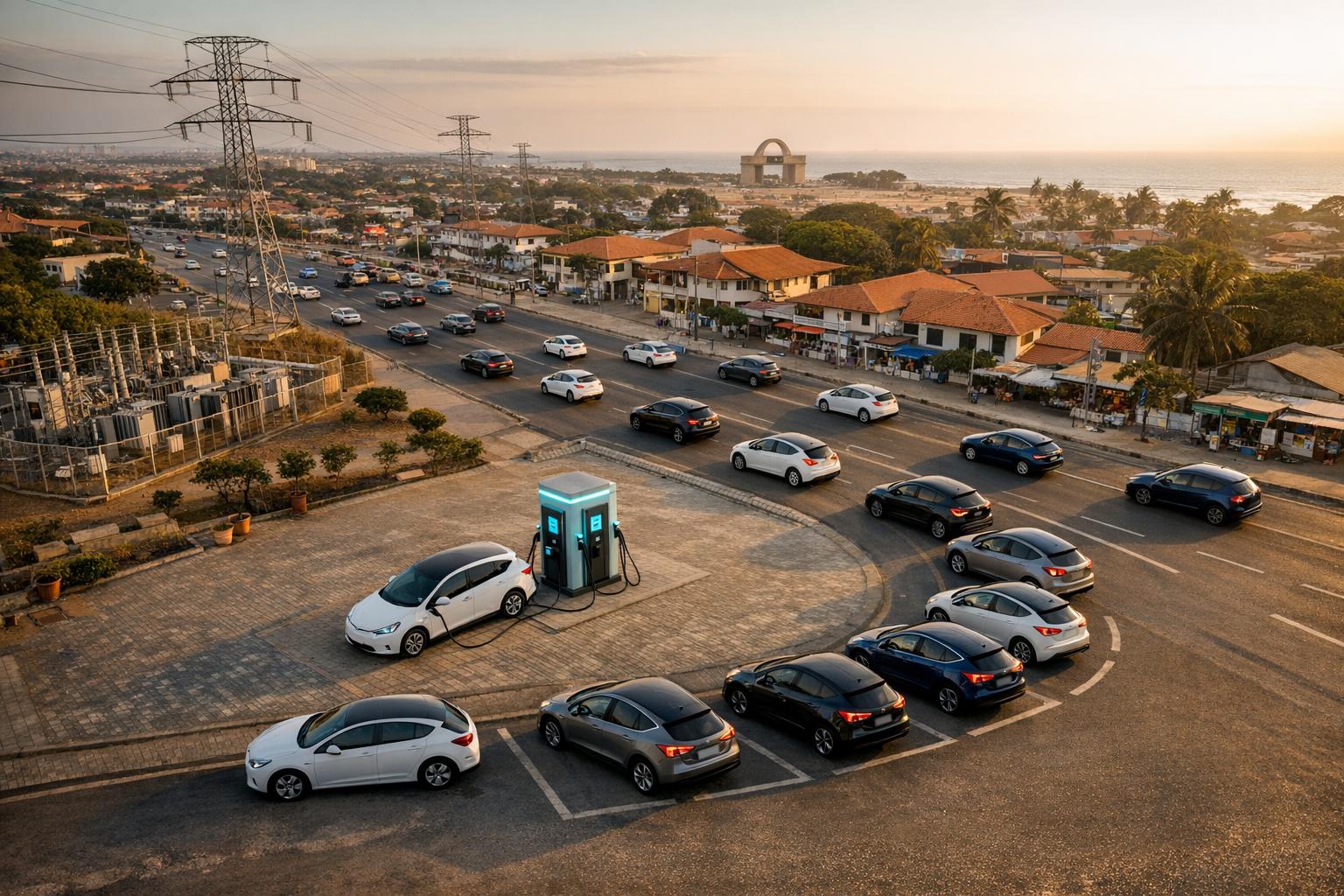
Ghana is making progress toward electric mobility but faces major challenges. By early 2024, 17,000 electric vehicles (EVs) were on its roads, yet the country has only 7 public charging stations, all concentrated in Accra. The government aims for 35% EV sales by 2035 and a 70% EV share by 2045, but infrastructure gaps, power grid issues, and high EV costs slow adoption. Key points:
- EV Benefits: Each EV saves $2,138 annually and reduces 5.23 tonnes of CO2 yearly.
- Infrastructure Issues: Limited charging stations, unreliable power supply, and lack of intercity options hinder growth.
- Policy Goals: Tax breaks and import duty exemptions are in place, but private buyers face high costs.
- Renewable Energy: Solar projects and hybrid charging stations are being developed to ease grid reliance.
- Financing: High upfront costs and loan rates (up to 40%) limit access, though leasing and green loans offer alternatives.
Ghana’s transition depends on expanding EV infrastructure, improving grid reliability, and offering affordable financing to make EVs more accessible.
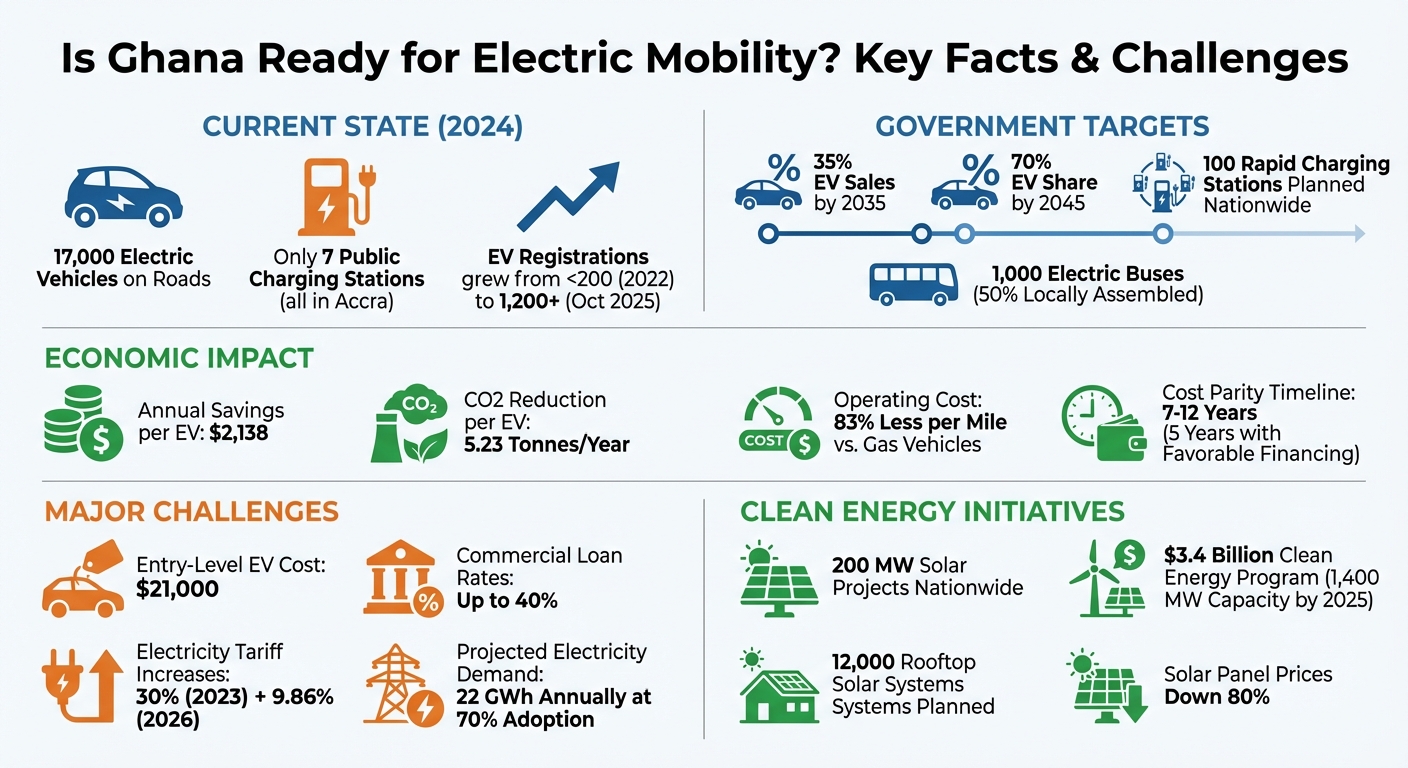
Ghana Electric Vehicle Adoption Statistics and Key Challenges 2024-2045
Petrol to Plug: Inside Ghana’s EV and Used Car Market @RydeChannel
sbb-itb-99e19e3
Infrastructure Gaps Limiting EV Adoption
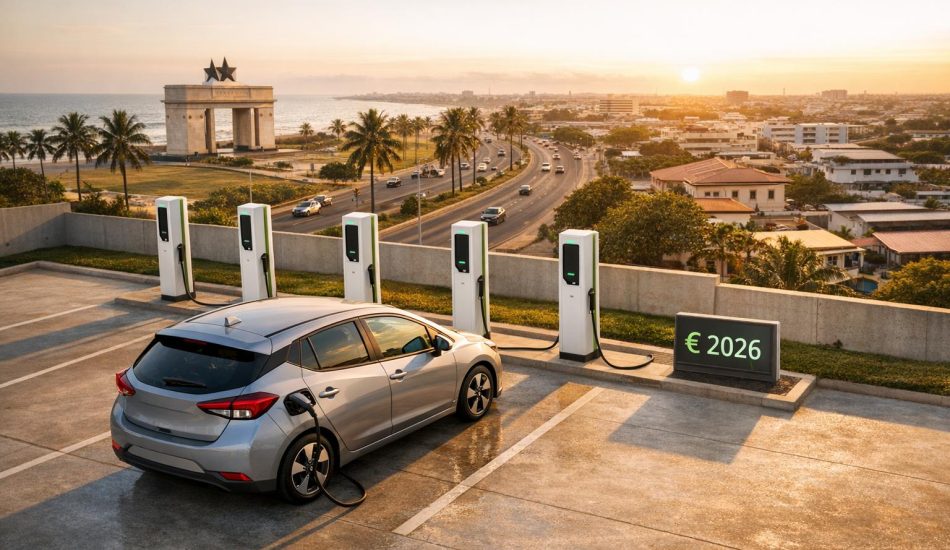
Ghana faces a significant challenge in building the infrastructure needed to support a growing number of electric vehicles (EVs). As of early 2024, the country has only 7 public charging stations to serve approximately 17,000 EVs. All these stations are located in the Greater Accra Region, leaving the rest of the country without any public charging options.
Charging Station Availability and Access
Currently, public charging stations are concentrated in Accra, leaving major cities like Kumasi and Takoradi without any facilities. This forces EV owners outside Accra to rely solely on home charging, making intercity trips nearly impossible.
"The current public infrastructure is heavily concentrated. If you live and work in the Greater Accra Region, you’re in luck… But this centralisation creates a major roadblock for anyone dreaming of a long-distance road trip."
- Younes Rabeh, African EV Market News
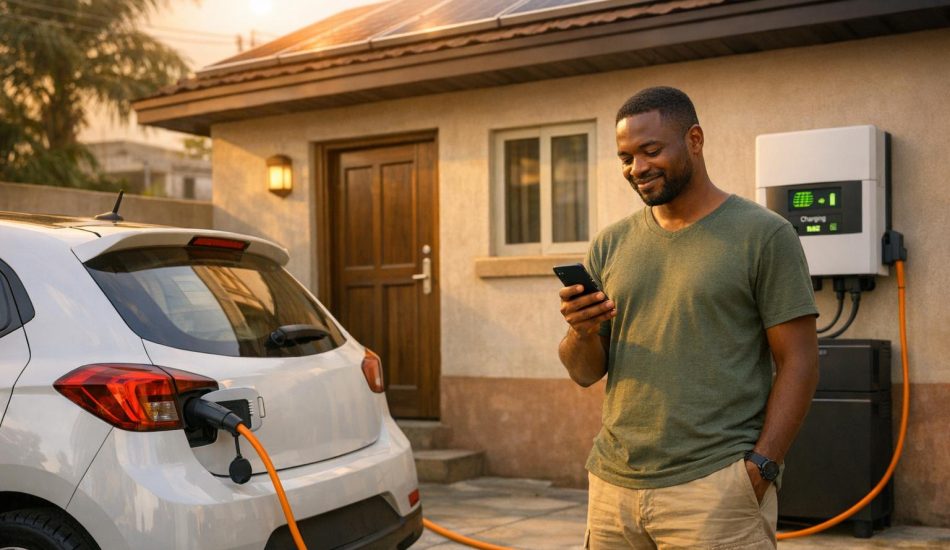
For urban EV owners, installing Level 2 home chargers is a viable solution, but this requires a dedicated 240-volt circuit and professional electrical work. Even in Accra, the few public charging stations face reliability problems, with surveys showing instances where none were operational due to maintenance issues or power fluctuations. While the government has announced plans to roll out 100 rapid charging stations nationwide, drivers must currently rely on mobile apps to check station availability and functionality before planning trips.
Power Grid Reliability Issues
Even in areas with charging infrastructure, Ghana’s inconsistent power supply presents another hurdle. Frequent power outages, locally known as "dumsor", disrupt charging schedules and can damage equipment over time. Although EV chargers are designed to pause and resume charging during outages, the interruptions create significant inconvenience for users.
The larger issue is whether Ghana’s power grid can handle the increased demand from widespread EV adoption. Dr. Godwin Ayetor, a consultant involved in a UNDP survey, highlighted this concern:
"The question is, are we ready to meet the demand for the electricity that will be needed to charge these vehicles? … if we can achieve the EV policy target of 2045, where 70 per cent of all vehicles in Ghana are electric, we will need a considerable amount of electricity to power the vehicles."
An average EV consumes about 23 kWh per day. If adoption rises as projected, this could require around 22 gigawatt-hours (GWh) annually – more than half of Ghana’s current electricity consumption. To address these challenges, some new charging stations are being designed as solar-grid hybrids with battery storage, ensuring they remain functional during outages.
These infrastructure limitations highlight the urgent need for strategic investments and policies to support Ghana’s transition to electric mobility.
Government Policies and Regulations
In December 2023, Ghana unveiled its National Electric Vehicle Policy, marking a significant step toward phasing out gasoline and diesel vehicles. This policy lays out a gradual transition plan, aiming to halt the sales and imports of new petrol and diesel vehicles by 2045. To manage this shift effectively, the Ministry of Transport established a specialized EV Unit. This unit collaborates with industry stakeholders to ensure the policy’s successful rollout. The government has set an ambitious goal: achieving 35% electric vehicle (EV) adoption by 2035. This is a notable increase from the current EV fleet, which stands at approximately 17,000 vehicles. The EV Unit is also tasked with ensuring that the transition benefits all sectors of society.
Tax Breaks and Import Duty Exemptions
To encourage EV adoption, Ghana has introduced an 8-year exemption on import duties for electric vehicles used in public transit. This waiver extends to semi-knocked down (SKD) and completely knocked down (CKD) electric vehicles imported by registered assembly companies. In July 2025, Transport Minister Joseph Bukari Nikpe announced amendments to the Value Added Tax (VAT) Act 2023 (Act 1107), granting VAT exemptions for electric vehicles intended for public transportation. However, private EV buyers continue to face high costs due to undifferentiated harmonized tariff codes and other vehicle taxes, limiting the reach of these incentives. These financial measures are part of broader regulatory efforts to build a thriving EV market. Additionally, the government is revising the Road Traffic Regulations, 2012 (L.I. 2180), to better align with the evolving EV landscape.
National EV Infrastructure Plans
In February 2026, the Energy Commission finalized the "EV Charging Infrastructure and Battery Swap Systems Regulations" after a three-day workshop in Ho. Professor John Gartchie Gatsi, Chairman of the Energy Commission, highlighted the importance of these regulations, stating:
"the passage of the draft regulations would empower the Energy Commission to effectively regulate and license all aspects of the EV infrastructure value chain, including the manufacturing, assembly, importation, installation, and operation of charging equipment and battery swap systems"
.
During the 2024–2026 preparatory phase, the government is focusing on solar-powered charging systems in public buildings to reduce reliance on the national grid. In January 2026, Energy Minister John Abdulai Jinapor emphasized the need for forward-thinking solutions, announcing plans for solar-powered charging stations accessible via mobile apps:
"Ghana currently has about 17,000 electric vehicles, the highest number in Africa. If we do not act proactively, these vehicles alone could place a heavy demand on our electricity supply. We want to be innovative and stay ahead of the curve"
.
The government is also planning to introduce 1,000 electric buses, evenly split between fully built units and locally assembled ones, supported by dedicated charging facilities. The initial phase includes installing 200 chargers across southern Ghana through a collaboration between a local company and the Electricity Company of Ghana (ECG). To further support the growing EV sector, mechanics are being retrained to handle EV maintenance and repairs. These comprehensive measures aim to address both market demand and affordability, paving the way for a more accessible electric vehicle ecosystem.
EV Affordability and Market Demand
To make electric vehicles (EVs) a practical choice for more people in Ghana, tackling upfront costs and financing hurdles is absolutely essential.
Purchase Costs vs. Operating Savings
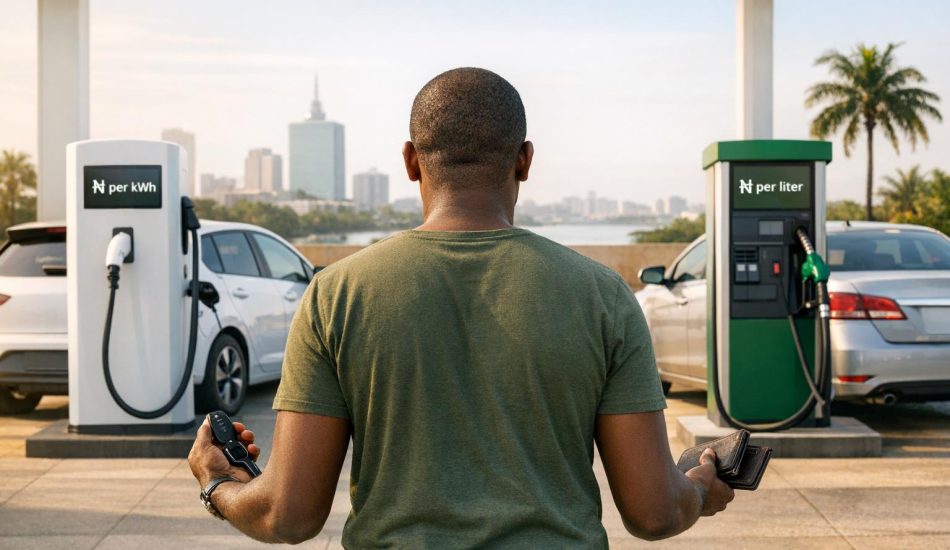
The starting price for entry-level EVs is around $21,000, while mid-range and premium options can climb to $67,000. These prices include shipping and import fees, making them a significant investment. But here’s the flip side: EVs cost 83% less per mile to charge compared to fueling a gas-powered car, potentially saving drivers over $2,100 annually in operating expenses. As Younes Rabeh from EV24.africa puts it:
"The sticker price can feel like a big mountain to climb, but the day-to-day running costs are the long road that follows".
Over the long haul, EVs prove much cheaper to maintain. For instance, they don’t require oil changes, spark plug replacements, or exhaust system repairs. Regenerative braking also helps extend brake pad life. On top of that, operating an EV over a decade is 2.3 times cheaper than maintaining a gas-powered vehicle.
However, rising electricity costs are beginning to eat into this advantage. Ghana experienced a 30% electricity tariff increase in 2023, followed by another 9.86% hike on January 1, 2026. For commercial operators, electricity now accounts for roughly 40% of revenue.
Even with these challenges, EVs can reach cost parity with gas vehicles after 7–12 years, or as quickly as 5 years with favorable financing. Electric two- and three-wheelers break even much sooner – sometimes within just two years. The Energy Commission of Ghana has suggested that waiving import tariffs could reduce the breakeven period for EVs to 10 years. Yet, as it stands, owning an EV still costs at least 13.5% more than owning a Toyota Corolla.
While the long-term savings are clear, the high upfront costs mean buyers need better financing options to make EV ownership a reality.
Financing Options for Buyers
Accessing affordable financing is one of the biggest roadblocks for potential EV buyers in Ghana. With commercial loan interest rates soaring as high as 40%, and dealerships generally offering just one-year payment plans, many buyers find EVs financially out of reach. Even the government’s proposed 8-year import duty exemptions for local assembly may not be enough to ease this burden.
Fortunately, some creative financing solutions are starting to emerge. For example, SolarTaxi introduced EV leasing models in Ghana between 2020 and 2025. Meanwhile, Moove offers revenue-based financing, allowing drivers to pay off their vehicles using a percentage of weekly earnings rather than dealing with steep bank loan interest rates.
Banks like Ecobank and Stanbic have also started offering "green loan" products tailored specifically for EV buyers. Platforms such as EV24.africa simplify the purchasing process by providing transparent pricing, detailed listings, and financing options designed for the African market. For commercial operators, innovative "energy-as-a-service" models like battery swapping offer predictable flat fees, helping businesses avoid the unpredictability of grid tariff hikes.
These new financing approaches are paving the way for broader EV adoption, making it easier for individuals and businesses to embrace this cleaner, more cost-effective form of transportation over time.
Renewable Energy for EV Charging
Electric mobility in Ghana can only deliver environmental gains if electric vehicles (EVs) are powered by clean energy. The country is making headway by integrating solar energy into its EV infrastructure, but improving the power grid remains a key challenge.
Solar Power Projects and EV Infrastructure
Ghana is actively pursuing solar energy initiatives, including 200 MW of solar projects spread across the country. Among these are innovative floating solar installations, such as the 30 MW system at the Bui Hydropower Station and the 35 MW project at the Kpong reservoir. Impressively, the floaters for the Bui solar panels are produced locally.
In addition, the government is rolling out 12,000 net-metered rooftop solar systems to power homes and businesses, along with 35 mini-grids designed to support off-grid communities. These decentralized systems provide a dual benefit: they can power residential EV charging while reducing strain on the national grid.
A significant milestone was achieved in February 2026 when the Energy Commission launched a solar-powered DC fast charging station at its Head Office in Accra. Supported by GIZ, this facility includes a solar carport equipped with 105 photovoltaic (PV) panels generating 61.43 kWp and a 60 kWh lithium-ion battery for energy storage. At the launch event, Minister for Energy Hon. John Abdulai Jinapor highlighted its impact:
"Charging with solar is charging clean".
Looking ahead, Ghana has approved a $3.4 billion program to install 1,400 MW of clean energy capacity nationwide by 2025. Falling solar panel prices – down 80% in recent years – are making these projects more affordable. However, profitability remains a hurdle for charging stations. For instance, a Level 2 station needs over 5,000 charging hours (or 208 continuous days) just to break even. While solar energy projects are expanding clean power access, the grid must be modernized to fully support the growing EV market.
Grid Improvements to Handle EV Demand
To meet the rising demand for EV charging, Ghana’s grid requires significant upgrades. Over the next five years, the Ministry of Energy plans to install at least 100 rapid charging stations nationwide. Achieving this goal will depend on investments in grid modernization and advanced load management technologies.
Improved grid management is essential to complement the country’s renewable energy expansion. The government is introducing smart metering and time-of-use pricing to encourage off-peak EV charging, helping to avoid grid overload. Decentralized energy solutions, such as lithium-ion batteries, also play a role in stabilizing the grid during periods of high demand.
In February 2026, the Energy Commission finalized the "EV Charging Infrastructure and Battery Swap Systems Regulations" during a workshop in Ho. These regulations, led by Board Chairman Professor John Gartchie Gatsi, set technical standards for residential, public, and commercial charging systems to align with Ghana’s 2070 target for phasing out internal combustion engine (ICE) vehicles. Professor Gatsi remarked:
"The passage of the draft regulations would empower the Energy Commission to effectively regulate and license all aspects of the EV infrastructure value chain".
Efforts are also underway to establish a Renewable Energy Authority (REA) to oversee investments and coordinate the clean energy transition. Meanwhile, traditional gas stations are being encouraged to transform into multi-functional energy hubs, incorporating solar-powered EV charging and battery-swapping facilities.
Conclusion: Next Steps for EV Adoption in Ghana
Ghana’s journey toward electric vehicle (EV) adoption is gaining momentum, with EV registrations skyrocketing from fewer than 200 in 2022 to over 1,200 by October 2025. This rapid growth highlights the urgency for both government and private stakeholders to address infrastructure, policy, and financing gaps.
A key priority for the government is finalizing the draft EV charging regulations. This move will enable the Energy Commission to oversee and regulate the charging infrastructure supply chain effectively. Additionally, introducing time-of-use pricing and EV-specific tariffs could incentivize off-peak charging, easing pressure on the national grid.
Beyond policy, private sector involvement is crucial. Leading companies should focus on building charging stations along high-traffic routes like Accra-Kumasi and Accra-Takoradi to make intercity EV travel more convenient. Establishing a reliable national charging network will require innovative financing models that blend public, private, and international resources. As Deputy Minister for Energy Richard Gyan-Mensah pointed out:
"The success of Ghana’s EV transition depends not only on infrastructure deployment but also on the availability of technicians trained to diagnose, repair, and maintain advanced electric mobility for safety purposes."
However, high commercial loan rates – reaching up to 40% – pose a significant barrier. To address this, financial institutions need to explore leasing and subscription models to lower upfront costs. Creative financing options, like revenue-based vehicle financing and mobile money-integrated payment systems, could also open doors for unbanked consumers, making EV ownership more accessible.
For Ghana to emerge as a leader in Africa’s EV revolution, progress must occur across multiple fronts: infrastructure development, regulatory action, innovative financing, and workforce training. With a $3.4 billion clean energy program and growing solar capacity, the country is well-placed to achieve this vision. Energy Minister John Abdulai Jinapor aptly noted that building a national charging network "would require strong private-sector investment" to turn Ghana’s potential into a sustainable reality.
FAQs
When will charging stations expand beyond Accra?
Charging stations in Ghana are set to grow beyond Accra, aligning with plans to develop electric mobility across the country. These efforts are backed by new government policies and initiatives designed to speed up infrastructure development and support the transition to electric vehicles.
Can Ghana’s power grid handle mass EV charging?
Ghana’s power grid is grappling with hurdles that make widespread EV charging a challenge. The existing electricity infrastructure is under strain, the supply can be unpredictable, and charging stations are still few and far between. To tackle these issues, the government is taking proactive steps. They’re working on finalizing regulations to standardize EV charging, modernizing the grid, and investing in renewable energy sources and smart grid technologies. While the grid isn’t quite ready yet, these initiatives are setting the stage for a more robust system capable of supporting the growing demand for EVs in the future.
What financing can make EVs affordable in Ghana?
Electric vehicles (EVs) could become more accessible in Ghana with the help of government initiatives like subsidies, tax incentives, and duty waivers to cut down the initial purchase costs. On top of that, creative business models – such as circular revenue systems for charging stations – can help bring down ongoing operational expenses.
Another key factor is the use of smart grid technologies and time-of-use tariffs, which can significantly lower electricity costs for EV charging. To make EVs even more attainable, financing options like loans, leasing programs, and public-private partnerships can provide consumers with flexible ways to afford these vehicles.