
 Thabo Nkosi
Egypt is making moves to embrace electric vehicles (EVs), but challenges remain. Here’s the situation at a glance:
- Why EVs Matter for Egypt: The country spends $4.2 billion annually on fuel subsidies and faces severe air pollution, especially in Cairo. EVs could reduce CO2 emissions and align with renewable energy goals, which aim for 42% of electricity from clean sources by 2030.
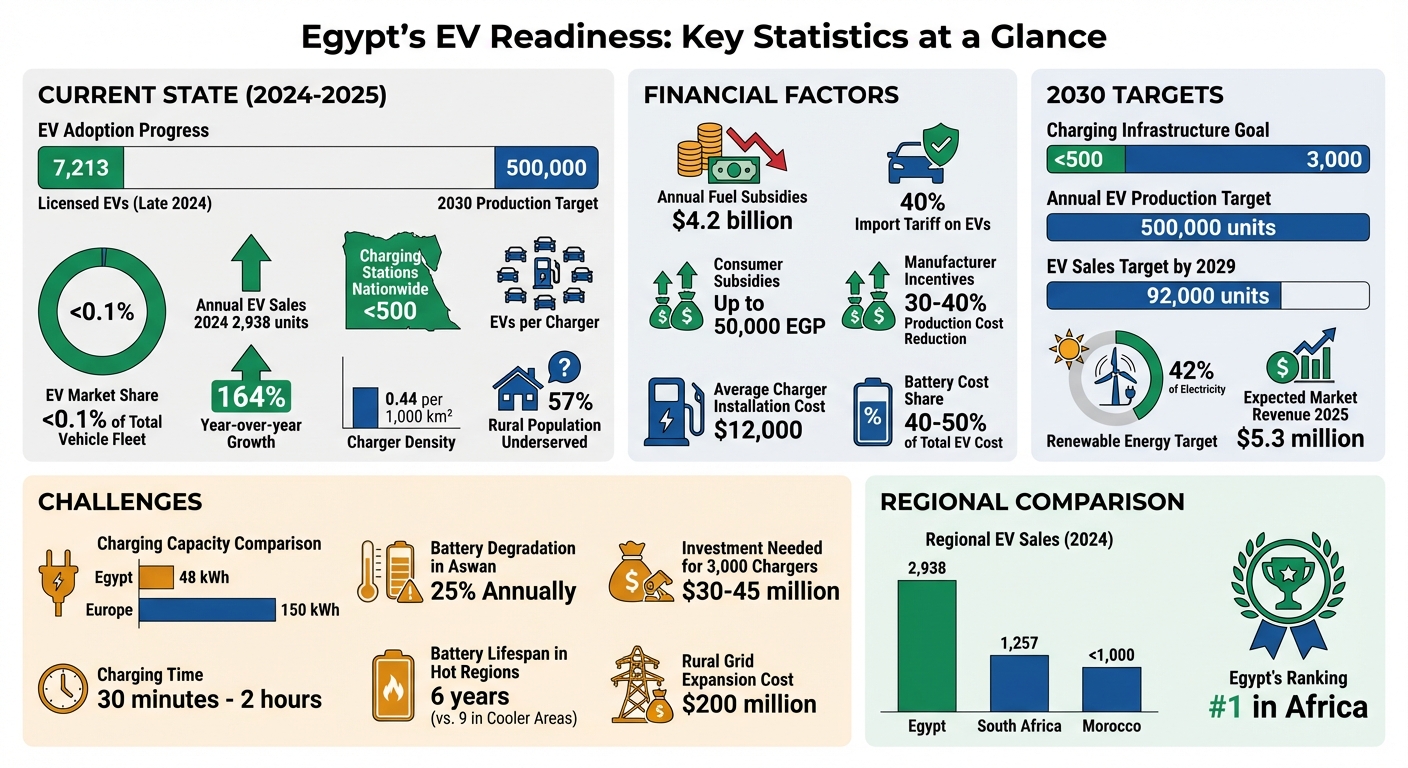
- Current EV Landscape: By late 2024, Egypt had 7,213 licensed EVs, with sales doubling year-over-year. However, EVs still represent less than 0.1% of the total vehicle fleet.
- Infrastructure Gaps: Fewer than 500 charging stations exist, with most concentrated in urban areas. Plans are in place to expand to 3,000 stations by 2030, but rural areas remain underserved.
- Barriers to Adoption: High costs, a 40% import tariff on EVs, limited charging networks, and battery degradation due to extreme heat are key obstacles. Public awareness about EV benefits is also low.
- Government Push: Egypt offers subsidies for locally made EVs, incentives for manufacturers, and partnerships with Chinese firms to build production capacity. The goal is to produce 500,000 EVs annually by 2030.
While momentum is building, Egypt must address infrastructure, affordability, and public awareness to scale EV adoption effectively.
Egypt’s Electric Vehicle Market Statistics and Infrastructure Overview 2024-2030
Egypt’s Current EV Infrastructure
Charging Stations: Current Status and Expansion Plans
As of early 2025, Egypt’s electric vehicle (EV) charging network is still in its early stages, with fewer than 500 charging stations across the country. Back in 2023, there were only 440 chargers, which translates to just 0.44 chargers per 1,000 km² and around 6.8 EVs per charger. Unsurprisingly, most of these stations are concentrated in urban hubs like Cairo and Alexandria, leaving rural areas – home to 57% of Egypt’s population – largely underserved.
Capacity is another major issue. Many of the existing chargers provide only 48 kWh, a far cry from Europe’s 150 kWh standard. This means charging times can take anywhere from 30 minutes to two hours, which is less than ideal for drivers.
However, there’s momentum for change. In February 2025, during the EGYPES conference in Cairo, the Ministry of Petroleum and Mineral Resources partnered with Hassan Allam Utilities and Infinity to expand both AC and DC charging infrastructure. This collaboration also includes state-owned Misr Petroleum and Gastec, aiming to install chargers at gas stations nationwide. Nayer Fouad, Co-founder and CEO of Infinity, highlighted the broader vision:
"By joining forces with industry leaders, we are not only expanding charging infrastructure but also laying the groundwork for a more sustainable mobility ecosystem."
The government has set a bold target to increase the number of public charging stations to 3,000 by 2030. This effort is backed by the European Bank for Reconstruction and Development (EBRD), which is supporting the rollout through a national Electric Vehicle Charging Infrastructure Deployment Strategy.
While these plans are promising, several significant hurdles stand in the way.
Barriers to Infrastructure Expansion
The cost of installing a single public charger is steep, averaging $12,000. Scaling up to 3,000 chargers would require an investment of $30–45 million.
Geographic inequality further complicates the rollout. Urban centers are gradually gaining infrastructure, but extending this to rural areas – where the grid often lacks the capacity to support EV chargers – could cost an additional $200 million. This urban-rural divide poses a real challenge to widespread EV adoption.
Another concern is the strain on Egypt’s electric grid. Large-scale EV adoption could lead to grid overload during peak hours, especially without smart metering systems to manage demand. To address this, the Egyptian Electricity Transmission Company (EETC) has teamed up with UAE-based AMEA Power to develop two battery storage facilities. These include the 500 MWh Banban Station and the 1,000 MWh Zafarana Station, which will store renewable energy to meet peak demand.
On top of these logistical issues, Egypt’s harsh summer climate adds another layer of complexity. Temperatures in regions like Aswan can reach up to 42°C (108°F), reducing EV battery capacity by as much as 25% annually. This rapid battery degradation highlights the need for a robust and reliable charging network to ensure vehicles remain functional and to build consumer trust in EV technology.
These challenges will play a critical role in shaping Egypt’s ability to support a large-scale transition to electric mobility, as well as influencing public confidence in EV adoption.
sbb-itb-99e19e3
Government Policies and Market Trends
Government Programs Supporting EVs
Egypt’s government has laid out a comprehensive plan to expand its electric vehicle (EV) industry. Through the National Automotive Development Programme, manufacturers can benefit from 30–40% production cost incentives, while consumers receive subsidies of up to 50,000 Egyptian pounds for purchasing locally manufactured EVs.
The policies go beyond financial incentives. A localization law mandates that manufacturers gradually increase the use of domestic components, starting at 45% and rising to over 60% by the third production phase. This approach aims to establish a strong local manufacturing base instead of relying heavily on imports. Prime Minister Mostafa Madbouly emphasized this vision, stating:
"The state aims to build a major industrial base capable of enhancing regional and international competitiveness."
To further accelerate progress, Egypt has partnered with Chinese firms to facilitate technology transfer. This includes the creation of a training center to develop EV production expertise. By October 2025, investments in Egypt’s free zones, which include automotive components, reached a staggering $38.5 billion.
These initiatives are already driving noticeable changes in the market.
Market Trends and Sales Data
Government support has sparked rapid growth in Egypt’s EV market, as reflected in rising sales figures. In 2024, Egyptians purchased 2,938 EVs, effectively doubling the total number of electric vehicles in the country to 6,150. This represents an explosive annual growth rate of approximately 164% between December 2023 and December 2024. By mid-2024, there were 7,213 licensed EVs, with 1,419 vehicles registered in just the first quarter – nearly one-third of the total registered over the previous three years.
Egypt has now emerged as Africa’s leading EV market, surpassing South Africa (1,257 units) and Morocco (fewer than 1,000 units) in 2024. Rising fuel costs have played a key role, with petrol prices increasing by 17% in 2024. As a result, 3 in 10 car buyers now consider EVs as part of their purchasing decisions.
Chinese brands dominate the Egyptian EV market, with BYD ranking as the second top-selling brand. Premium automakers like Porsche, XPENG, and Zeekr have also entered the scene. Looking ahead, Egypt has ambitious goals: 92,000 EV sales by 2029 and local production of 500,000 EVs annually by 2030. Revenue from the EV market is expected to reach $5.3 million in 2025.
Despite these impressive numbers, EV adoption remains limited – less than 0.1% of the total licensed vehicle fleet as of late 2024. High upfront costs and a 40% import tariff on EVs – much higher than Morocco’s 10% – remain significant barriers.
However, the focus on local assembly is gaining traction through key partnerships. In November 2024, state-owned Al Nasr Automotive Manufacturing Company (NASCO) formed a joint venture with Taiwan’s Tron Energy Technology and Euro Emirates Group to produce 300 electric minibuses and 600 electric batteries by 2026. In July 2025, Geyushi Motors secured a contract from the Cairo Transport Authority to deliver 100 locally manufactured electric buses meeting international standards. Additionally, the European Bank for Reconstruction and Development approved a €10.6 million loan in September 2025 for Go Bus to acquire 30 electric coaches and 6 electric minibuses for intercity travel.
Chinese EV companies step up investment in Egypt
Main Challenges to Large-Scale EV Adoption
Despite ambitious government plans and a growing market, Egypt faces several roadblocks in its transition to electric vehicles (EVs).
Limited Charging Network and Range Concerns
Egypt’s charging infrastructure is struggling to keep up with demand. By June 2024, there were only 7,213 licensed EVs on the road, but the charging network hasn’t grown to match this modest number. Most stations are limited to 48kWh, far below Europe’s 150kWh standard. Alaa Al-Sabaa, a member of the Automotive Division at the Federation of Chambers of Commerce, noted that this results in charging times ranging from 30 minutes to two hours. To make matters worse, the existing infrastructure is heavily concentrated in Cairo and Giza, leaving 57% of the population in rural areas with little to no access.
Adding to these challenges, a 93% hike in electricity prices in September 2025 increased charging costs to EGP 2.34 per unit ($0.48). While fuel prices only rose by 17% in 2024, this electricity price spike threatens the cost advantage EVs used to have over gasoline vehicles. Together, these factors create a significant barrier to widespread adoption.
High Costs and Poor Resale Value
The high upfront cost of EVs is another major obstacle. Batteries alone account for 40–50% of the total cost, and a 40% import tariff further inflates prices. The situation is worsened by rapid battery degradation due to Egypt’s extreme heat, which not only reduces performance but also slashes resale value. For instance, in Aswan, where summer temperatures average 108°F (42°C), EV batteries lose 25% of their capacity annually, resulting in a lifespan of just 6 years, compared to 9 years in cooler cities like Alexandria.
The financial strain is compounded by the Egyptian pound’s devaluation, which hit a record low of 53 against the USD in March 2026. This makes imported EVs and their components even less affordable. On top of that, the resale market is still in its infancy, and uncertainties about battery health discourage potential buyers who might need to sell their vehicles later. These economic hurdles make EVs a tough sell for many Egyptians.
Lack of Public Knowledge About EVs
While 3 in 10 car buyers in Egypt now show interest in EVs, a significant portion of the population still lacks basic knowledge about how they work. Many potential buyers worry about complex maintenance requirements, even though EVs typically need less servicing than traditional gasoline cars. This knowledge gap is especially stark in rural areas, where awareness is as low as 4%, as seen in regions like Assiut.
Without widespread information campaigns to address concerns about charging, battery longevity, and overall costs, many consumers stick to what they know – gasoline-powered cars. This hesitation is evident in the numbers: only about 3,000 EVs were sold in 2024, out of a total market of 102,200 vehicles. The lack of clear, accessible information remains a significant hurdle to greater EV adoption in Egypt.
Solutions to Accelerate EV Adoption
Egypt has several paths to overcome the challenges of electric vehicle (EV) adoption, including leveraging transitional technologies, expanding infrastructure, and educating the public. These efforts require collaboration between government bodies, private sector players, and consumers.
Using Range-Extended EVs as a Transitional Option
Range-extended electric vehicles (REEVs) and plug-in hybrids (PHEVs) offer a practical stepping stone for hesitant buyers. These vehicles combine electric power with a gasoline backup, easing concerns about range limitations. Egypt already has experience with alternative fuels – by 2025, 600,500 vehicles had been converted to compressed natural gas (CNG).
Pairing these transitional vehicles with improved infrastructure and financing options can further address current barriers.
Expanding Charging Networks and Financing Opportunities
In February 2025, the Egyptian Ministry of Petroleum and Mineral Resources announced a partnership with Hassan Allam Utilities and Infinity to create a nationwide EV charging network. This initiative will utilize existing Misr Petroleum and Gastec gas stations. Additionally, the Egyptian Electricity Transmission Company (EETC) teamed up with AMEA Power to develop 1,500MWh of battery storage at Banban and Zafarana stations. Dalia Wahba, CEO of HA Utilities, highlighted the significance of this project:
"The project underscores a strong commitment to investing in sustainable infrastructure that supports Egypt’s energy transition".
To ensure consistent growth, the Egyptian Electricity Regulatory Agency (EgyptERA) now mandates that licensed commercial charging companies install at least 50 new stations annually, totaling 250 stations over a five-year license period.
On the financing side, platforms like EV24.africa are simplifying the buying process by offering transparent vehicle listings and financing options. These tools make it easier for buyers to secure affordable payment plans, reducing financial barriers.
While infrastructure and financing are critical, consumer awareness plays an equally important role in driving EV adoption.
Educating Consumers About EV Benefits
Public education is a cornerstone of Egypt’s Vision 2030, yet awareness campaigns around EVs remain underdeveloped. Renewable Energy Expert Ali Habib pointed out:
"The current strategy to accelerate EV adoption in Egypt lacks any attention to information and awareness campaigns".
Although 43.6% of potential EV buyers in Egypt recognize the environmental advantages, many remain uncertain about issues like range, durability, and upfront costs. Effective campaigns should focus on the total cost of ownership, highlighting how reduced maintenance and fuel expenses can offset higher initial prices.
Research indicates that environmental awareness significantly impacts purchase decisions in Egypt. Linking EVs to renewable energy projects, such as the Benban Solar Park, could illustrate their broader environmental benefits. Additionally, vocational training programs for EV maintenance could reassure buyers that local mechanics will be equipped to service their vehicles in the long term.
Conclusion: Egypt’s Readiness for Electric Cars at Scale
Egypt’s electric vehicle (EV) market is poised for significant growth, driven by a mix of ambitious goals and strategic initiatives. As Africa’s leading EV market, Egypt has set its sights on achieving 92,000 EV sales by 2029, with strong sales momentum already building in 2024. A government-backed roadmap, which includes phasing out traditional fuels by 2040, provides a solid framework for this transition.
Collaborations between public and private sectors are playing a crucial role in expanding charging infrastructure and boosting local manufacturing. For example, agreements to install chargers at gas stations and plans to produce 20,000 electric cars annually highlight the progress being made. However, hurdles remain – charging capacity is still limited, upfront costs are steep, and consumer awareness about EVs is relatively low.
Innovative platforms like EV24.africa are stepping in to address these challenges by offering tools such as transparent EV listings, financing solutions, and educational content to help consumers navigate this evolving market.
Although Egypt’s EV sector is still in its early stages, the outlook is promising. Projections like a $5.3 million market revenue by 2025 and renewable energy targets reaching 42% of total power generation by 2030 reflect the growing momentum. Continued focus on improving infrastructure, offering financial incentives, and educating the public will be essential for Egypt to achieve widespread EV adoption.
FAQs
How much will home charging really cost in Egypt?
Home charging in Egypt usually costs between $0.16 and $0.22 per kWh, which translates to approximately EGP 50–90 ($1.00–$1.79) for a full charge, depending on the battery’s capacity. As of March 2026, electricity prices for home charging have remained steady, though future increases are anticipated due to planned tariff adjustments.
Will Egypt’s heat ruin EV batteries too fast?
Egypt’s scorching temperatures, which often hover between 86°F and 113°F, pose a real challenge for EV batteries. Such heat can speed up battery degradation, potentially cutting their lifespan by 25–30%. However, advancements in battery technology are stepping up to counteract this. Modern thermal management systems, along with improved materials and cooling mechanisms, are helping to keep battery temperatures in check. These developments are making EVs better equipped to handle extreme heat, suggesting that Egypt’s climate, though demanding, won’t stand in the way of broader EV adoption over time.
When will chargers reach smaller cities and rural areas?
Efforts are underway to bring EV chargers to smaller cities and rural areas in Egypt as part of the country’s infrastructure growth. By 2027, thousands of charging points are planned to be installed nationwide, with many located at existing fuel stations to enhance accessibility. The goal is to make charging electric vehicles easier and more convenient for drivers across Egypt.