
 Thabo Nkosi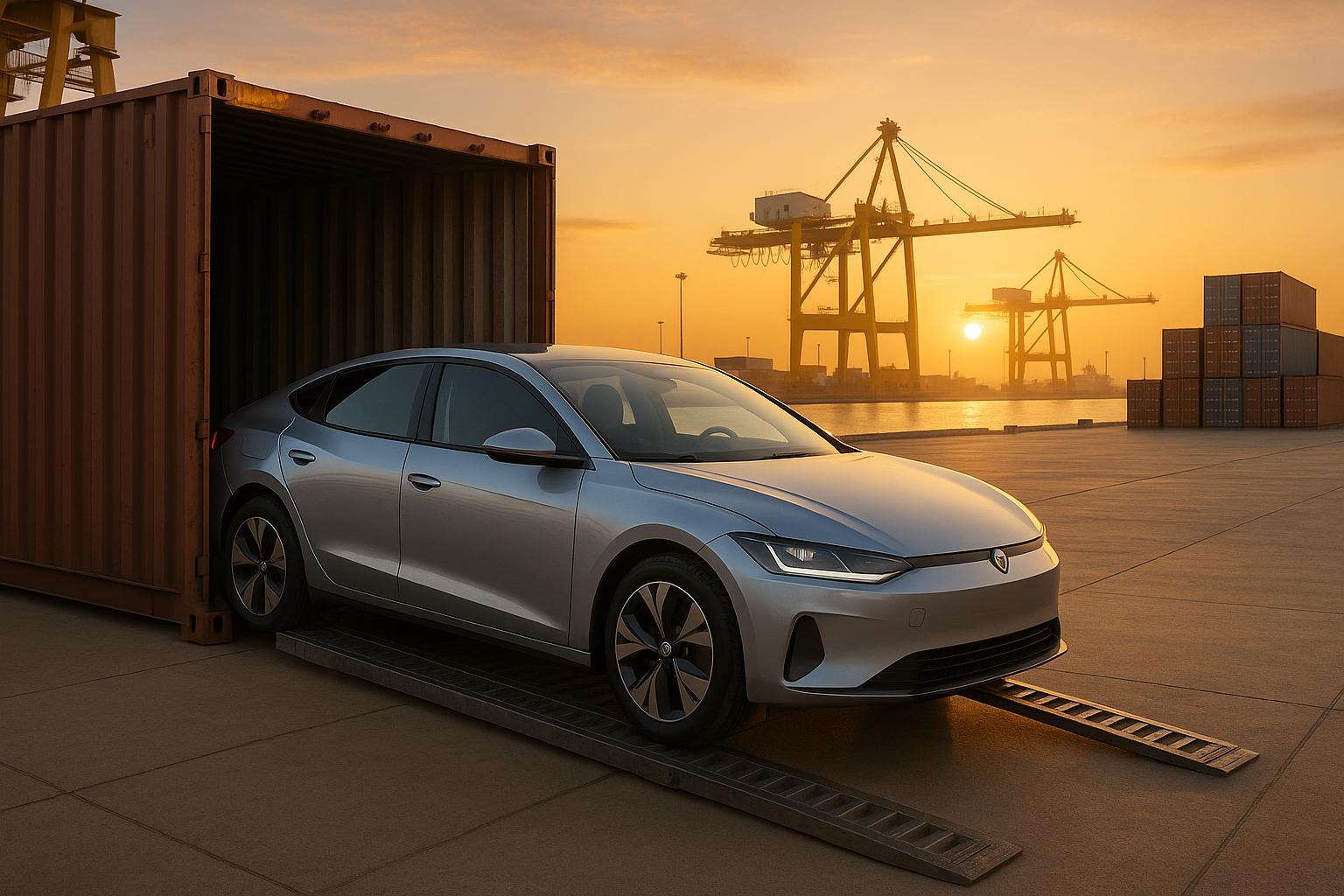
Importing an electric vehicle (EV) to Mauritania in 2025 involves a detailed process. Here’s a quick summary of what you need to know:
- Eligibility: EVs must be less than 8 years old, left-hand drive, and have batteries with UN38.3 certification.
- Documentation: Key documents include a commercial invoice, bill of lading, vehicle title, registration certificate, and pre-shipment inspection certificate.
- Costs: Import costs include purchase price, shipping, insurance, duties, VAT (18%), and customs fees. Total costs can increase by ~42% over the base price.
- Shipping: Choose between budget-friendly RoRo or protected container shipping.
- Customs: Use Mauritania’s ASYCUDA WORLD system for clearance, ensuring all paperwork is accurate.
- Registration and Charging: Register the EV locally and set up a home charging station, as public charging infrastructure is limited.
- Simplify the Process: Platforms like EV24.africa handle logistics, customs, and compliance for a smoother experience.
Step 1: Learn Mauritania’s EV Import Regulations
Before diving into the import process, it’s essential to understand Mauritania’s specific rules for bringing in electric vehicles (EVs). The country has clear guidelines that you’ll need to follow to ensure a smooth import experience.
Legal Requirements for EV Imports
Mauritania imposes several conditions on EV imports:
- The vehicle must be less than 8 years old from its first registration. For example, any EV imported in 2025 must have been registered in 2017 or later.
- Only Left-Hand Drive (LHD) vehicles are allowed. If your EV is Right-Hand Drive (RHD), it will need to be converted to LHD before import.
- The EV’s battery must comply with international safety standards. Specifically, batteries classified under HS code 8507 require UN38.3 certification.
Import Duties and VAT for EVs
While Mauritania has reduced taxes for EVs and introduced incentives for charging infrastructure, import duties remain relatively high. Make sure to account for these costs when planning your budget.
Once you’re familiar with these regulations, the next step is to confirm your vehicle’s eligibility and gather all necessary documentation in Step 2.
Step 2: Check Vehicle Eligibility and Collect Required Documents
Make sure your electric vehicle (EV) meets all the necessary requirements and gather the required paperwork. Having accurate documents on hand can save you from customs delays.
Required Documentation Checklist
Mauritania has specific requirements for EV imports. Submit all necessary documents to your customs clearing agent at least one month before your vehicle arrives.
Commercial and Purchase Documents
You’ll need a commercial invoice that includes details about the buyer and seller, the invoice date, the shipment method, a description of the EV, the price, and delivery terms. This invoice is critical for calculating import duties based on the Cost-Insurance-Freight (CIF) value. Additionally, provide a bill of sale or purchase invoice to prove ownership.
Transport Documentation
The Original Bill of Lading (OBL) is essential. It must include your EV’s chassis number, engine number, and weight. This document is key to proving the vehicle was legally shipped and helps customs confirm the specific unit being imported.
Vehicle-Specific Papers
You’ll need the original vehicle title with a clear title, the vehicle registration certificate, and a valid passport or driver’s license as the consignee. If you’re importing as a business, include your Tax Identification Number (NIF) or company registration details.
EV Battery Certification
Include the UN38.3 certification for the EV battery. Without this, your shipment will not clear customs.
Inspection Certificate
Secure a pre-shipment inspection certificate from SGS (Société Générale de Surveillance) to confirm your EV meets quality standards.
Once all your documents are ready, verify your vehicle’s technical eligibility.
Vehicle Eligibility Verification
Proper documentation is just the start. You’ll also need to confirm that your EV meets Mauritania’s technical requirements to streamline the import process. Beyond the age and left-hand drive stipulations discussed in Step 1, there are some additional technical checks to complete.
Propulsion Type Confirmation
Confirm whether your vehicle is a fully electric model or a plug-in hybrid. Check the manufacturer’s specifications to ensure the propulsion system qualifies, as this impacts your HS code classification. Different classifications for pure EVs and plug-in hybrids can affect duty rates.
VIN and HS Code Classification
Make sure the Vehicle Identification Number (VIN) is clearly visible and matches across all your documents. You’ll also need to use the correct 6-digit Harmonized System (HS) code on all declarations. This code, which must appear on your commercial invoice, determines your tariff rate. Misclassifying the code can lead to delays, inspections, or even seizure of your vehicle.
Electronic Components Inspection
Prepare for an inspection of your EV’s electronic systems, which are categorized under HS 8517.
SGS Pre-Shipment Verification
Schedule a pre-shipment inspection with SGS to confirm your EV meets Mauritania’s quality standards. Completing this step ahead of time can significantly speed up the customs clearance process.
Once your documents are compiled and your EV’s eligibility is confirmed, you’ll be ready to move forward to Step 3, where you calculate your total import costs.
Step 3: Calculate Total Import Costs
When importing an EV, the total cost goes beyond the purchase price. It’s essential to factor in shipping, taxes, and other fees. Below, we’ll break down these costs and walk through an example calculation.
Cost Breakdown for EV Imports
Here are the key expenses to account for:
- EV Purchase Price: This is the value listed on the commercial invoice for the vehicle.
- Shipping and Insurance: Together with the purchase price, these form the CIF (Cost, Insurance, Freight) value, which is used to calculate import duties.
- Import Duties and Taxes: In Mauritania, import duties are based on the CIF value and the tariff rate for the vehicle’s HS code. Additionally, imported goods are subject to VAT. Some countries in Africa may impose extra charges on EV batteries and components, which can significantly raise costs.
- Customs Processing and Port Fees: These include fees for customs clearance, port handling, and documentation.
Example Cost Calculation
Let’s break down the costs for importing a mid-range EV from Europe, priced at $25,000:
- Base Costs
- EV Purchase Price: $25,000
- Shipping: $2,500
- Insurance: $400
Total Base Costs: $25,000 + $2,500 + $400 = $27,900
- Import Duty
Assuming a 5% duty rate:
$27,900 × 5% = $1,395
(Note: Mauritania offers potential tax reductions for EV imports [2].) - VAT
VAT is calculated at 18% on the combined CIF value and import duty:
($27,900 + $1,395) × 18% = $5,273 - Customs Processing and Port Fees
Estimate between $800 and $1,200 for these fees. For this example, we’ll use $1,000.
Total Estimated Import Cost:
$25,000 (purchase price) + $2,500 (shipping) + $400 (insurance) + $1,395 (import duty) + $5,273 (VAT) + $1,000 (processing fees) = $35,568
This example shows that the total cost of importing an EV can increase by approximately 42% over the base purchase price. The actual cost will depend on the vehicle, its origin, and the current duty rates.
Check whether your vehicle qualifies for duty exemptions and consult a customs broker for accurate guidance. Once you’ve finalized these estimates, you’ll be ready to explore shipping options in Step 4.
Step 4: Select a Shipping Method and Prepare the EV
Once you’ve calculated the import costs, it’s time to decide how to transport your EV to Mauritania. The shipping method you choose will directly impact both the expense and the level of protection your vehicle receives during transit. If you’re working within a tight budget from Step 3, this decision becomes even more critical. Let’s take a closer look at the main shipping options to help you decide what works best.
Shipping Options: RoRo vs. Container
When shipping an EV internationally, you’ll typically choose between Roll-on/Roll-off (RoRo) and container shipping.
- RoRo shipping is often the more budget-friendly option. Your EV, as long as it’s operational, is driven onto the ship and secured alongside other vehicles. This method usually offers quicker transit times and more frequent departures. However, the trade-off is less protection, as your car is exposed to potential risks during loading and unloading.
- Container shipping offers a higher level of protection by securing your EV inside a dedicated container. This method minimizes the chances of damage but comes with a higher price tag and fewer departure schedules.
When choosing a shipping provider, go for one that offers transparent pricing and transit times that align with your schedule. These details can make the shipping process smoother and less stressful for you and your EV.
sbb-itb-99e19e3
Step 5: Complete Customs Clearance and Arrange Delivery
After your EV arrives at the port, the next step is to handle customs clearance and arrange for its delivery to your location in Mauritania. This involves submitting the required documents, paying the necessary fees, and coordinating transportation.
Customs Clearance Process
Clearing customs in Mauritania requires accurate documentation and adherence to specific procedures. Once your EV arrives, it must be declared through the ASYCUDA WORLD automated customs system.
If the value of your imported goods exceeds 30 million old ouguiyas (approximately $86,000), you’ll need a Numéro d’Immatriculation Fiscal (NIF) and registration in the Central Importers Register. Here’s what you’ll need to submit:
- A commercial invoice with details about the buyer, seller, shipping method, and terms.
- The bill of lading or certificate of origin.
- Transport documents and a packing list.
- An SGS Certificate of Inspection.
- A Power of Attorney if you’re using an agent.
The process includes reviewing your declaration, a physical inspection of the vehicle, and verification of manifests and freight lists. Customs duties and taxes must also be paid. For used EVs, the valuation is based on the Argus (trade-in) minimum import value.
Navigating customs can be tricky, so working with approved customs clearing agents is highly recommended. These professionals are familiar with the system and can help you avoid delays caused by incomplete or incorrect paperwork.
Once the customs clearance is finalized, you can move on to organizing the delivery of your EV.
Arranging Final Delivery
After clearing customs, the focus shifts to getting your EV to its final destination. Mauritania’s primary ports for EV imports are the Port of Nouakchott, the main deep-water port, and the Port of Nouadhibou, a key hub for commercial shipping.
You’ll need to decide whether to pick up the EV yourself or opt for a delivery service. Port-to-port delivery is the most affordable option but requires you to manage transportation from the port. If convenience is your priority, door-to-door delivery is a better choice, as a logistics provider will handle the transport to your specific location – though this option comes at a higher cost.
Many shipping companies and local freight forwarders offer complete logistics solutions, including customs clearance and delivery, often with real-time tracking. These services can be a great help, particularly if you’re unfamiliar with local procedures.
If temporary storage is needed before delivery, bonded warehousing is available in areas like the Nouakchott Industrial Zone.
When choosing a logistics provider, prioritize those with experience in vehicle transport within Mauritania. Make sure they offer transparent pricing based on the distance to your location, ensuring your EV arrives safely and on time.
Step 6: Register the EV and Install Charging Equipment
Once your EV is delivered, the next steps are to register it with the Mauritanian authorities and ensure you have reliable charging options in place.
EV Registration Process in Mauritania
To register your EV, you’ll need to visit the local registration office with the required documents. This includes your import paperwork, proof of ownership, and evidence that the vehicle meets local safety standards. Make sure you also secure insurance before taking your EV out on the road.
Once your registration is sorted, you can shift your attention to setting up a charging system that keeps your vehicle ready for use.
Setting Up EV Charging Stations
Mauritania’s charging network is still developing, so you’ll likely need to rely on home charging. Start by consulting local providers and hiring a licensed electrician to assess and, if necessary, upgrade your home’s electrical setup for safe EV charging.
If you’re thinking about installing a public charging station for business purposes, reach out to local authorities. They can provide details on available incentives and guide you through any permit requirements.
For daily use, plan to charge your EV primarily at home, using public charging stations as a backup when needed.
Step 7: Use EV24.africa to Simplify Your EV Import
If you’re ready to bring an electric vehicle (EV) into Mauritania, EV24.africa can make the entire process easier. Importing an EV involves juggling logistics, paperwork, and customs clearance, but EV24.africa takes care of these details, so you don’t have to.
Why Choose EV24.africa?
EV24.africa is more than just a marketplace – it’s a one-stop solution for importing EVs into Africa. The platform gives you access to a variety of EV models, complete with verified specifications and clear, upfront pricing.
"At EV24.africa, we simplify the process of importing and buying electric vehicles in Africa. Our expertise ensures a seamless, transparent, and stress-free experience, so you can focus on driving the future of mobility. From customs clearance to local registration, we handle everything to ensure a smooth import process."
- EV24.africa
The platform breaks down all costs – including shipping, duties, VAT, and other fees – so you know exactly what to expect. Every vehicle listed on EV24.africa meets Mauritania’s regulatory standards. This includes verifying battery safety, ensuring proper identification labels (like VIN and propulsion type), and securing Material Safety Data Sheets (MSDS) for hazardous materials compliance. Plus, EV24.africa collaborates with IMO-certified shipping companies skilled in handling EV batteries, ensuring safe and compliant transportation.
How EV24.africa Manages the Details
From compliance checks to logistics, EV24.africa handles every step of the import process. They take care of customs documentation, offer flexible shipping options, and ensure your vehicle is delivered either to the port or directly to your door.
The platform stays up-to-date with Mauritania’s customs regulations, including the 2025 electronic customs declaration system and the updated HS code classifications under the 2022 Harmonized System nomenclature. By notifying Mauritanian customs authorities and working with experienced brokers, EV24.africa minimizes the chances of delays, penalties, or paperwork issues at the Nouakchott terminal.
Once your EV arrives, EV24.africa doesn’t stop there. They guide you through vehicle registration and connect you with resources for charging infrastructure in Mauritania. For example, they provide details about local charging stations, including the first EV charging station in Nouakchott. With transparent pricing and flexible payment options, they also make the financial side of importing straightforward.
Conclusion
Bringing an EV into Mauritania in 2025 requires careful planning and strict attention to regulations. By following the seven-step process detailed in this guide, you can navigate the complexities of customs, paperwork, and logistics with confidence. Here’s a quick recap of the critical steps and considerations to keep in mind.
Stay informed about Mauritania’s updated customs procedures, including the newly implemented electronic customs declaration system and the revised HS code classifications based on the 2022 Harmonized System nomenclature. Double-check that your EV meets the eligibility requirements – vehicles older than 10 years may face import restrictions or higher tax rates. Plan your budget thoroughly, factoring in shipping costs, duties, taxes, and port handling fees.
Ensure your EV complies with all certification and shipping protocols mentioned earlier. Partnering with reliable logistics experts is essential, as proper classification and complete documentation are more important than ever. Submit all necessary paperwork well in advance; some agents may require documents up to a month before the vehicle arrives.
FAQs
What challenges might I face when importing an electric vehicle (EV) to Mauritania, especially with customs and paperwork?
Importing an electric vehicle (EV) to Mauritania involves a few hurdles, especially when it comes to dealing with customs and preparing the necessary paperwork. You’ll need to have all your documents in order – this includes invoices, certificates, and shipping records. Customs duties are determined based on the car’s value, which can depend on factors like its age and model.
The process isn’t always straightforward, so staying up-to-date on the latest regulations is crucial. Proper preparation can help you avoid delays or surprise expenses along the way.
What steps should I take to ensure my EV complies with Mauritania’s regulations before importing it?
To make sure your electric vehicle (EV) complies with Mauritania’s technical and regulatory requirements, start by carefully checking the country’s import regulations for electric vehicles. Pay close attention to areas like emissions standards, safety features, and battery specifications. Ensuring your EV meets these criteria is crucial to avoid unnecessary delays or fines.
You’ll also need to gather important documentation, including the vehicle’s certificate of conformity, proof of purchase, and any technical details provided by the manufacturer. For added clarity and a smoother process, consider consulting a local expert or customs agent who understands Mauritania’s import policies inside and out. Their insights can save you time and help you navigate any potential roadblocks.
What are the options for setting up EV charging at home or on the go in Mauritania, given the limited public charging stations?
Currently, the public EV charging network in Mauritania is still in its early stages, making a personal charging setup a smart choice for many EV owners. For most, charging at home is the most convenient option. Installing a Level 2 charger at your residence can significantly reduce charging time compared to using a standard wall outlet. Just make sure to hire a licensed electrician to confirm your home’s electrical system can handle the setup.
If you’re frequently on the move, portable charging equipment can be a lifesaver. This allows you to tap into available power sources while traveling. Another option worth exploring is partnering with local businesses or facilities that might offer charging access. As more people adopt EVs, keep an eye out for updates on the expansion of public charging infrastructure in Mauritania.