
 Thabo Nkosi
When buying a used electric vehicle (EV), the battery’s condition is critical. A healthy battery ensures good range, reliable performance, and avoids costly replacements, which can range from $8,000 to $22,000. In Africa, hot climates can accelerate battery degradation, making it even more important to check metrics like State of Health (SoH) and charging history.
Key Takeaways:
- SoH above 85%: Ideal for long-term reliability.
- 70%-85% SoH: Acceptable but expect reduced range.
- Below 70% SoH: Significant wear; proceed with caution.
- Avoid EVs with frequent fast charging or imbalanced cell voltages.
- Use tools like OBD-II scanners and apps (e.g., LeafSpy) for diagnostics.
- Professional battery testing costs $150-$300 and offers detailed insights.
Platforms like EV24.africa simplify the process by providing verified battery reports and delivery across Africa. Always prioritize battery health to ensure your EV investment meets your needs.
EV Battery Health Guide: SoH Ratings and Buying Decisions for Used Electric Vehicles
WILL IT LAST? The Truth about used EV batteries
Battery Health Metrics You Need to Check
When evaluating a used electric vehicle (EV), understanding the health of its battery is crucial. Key metrics can reveal how much capacity remains, how fast the battery is aging, and whether the cells are functioning correctly. Let’s break down these essential metrics and what they mean for potential buyers.
State of Health (SoH)
State of Health (SoH) is the most critical number to assess. It measures the remaining battery capacity compared to its original state when the vehicle was new, expressed as a percentage. Think of it this way: while the State of Charge (SoC) tells you how much energy is currently available – like a fuel gauge – SoH reflects how much the battery’s "tank" has shrunk over time.
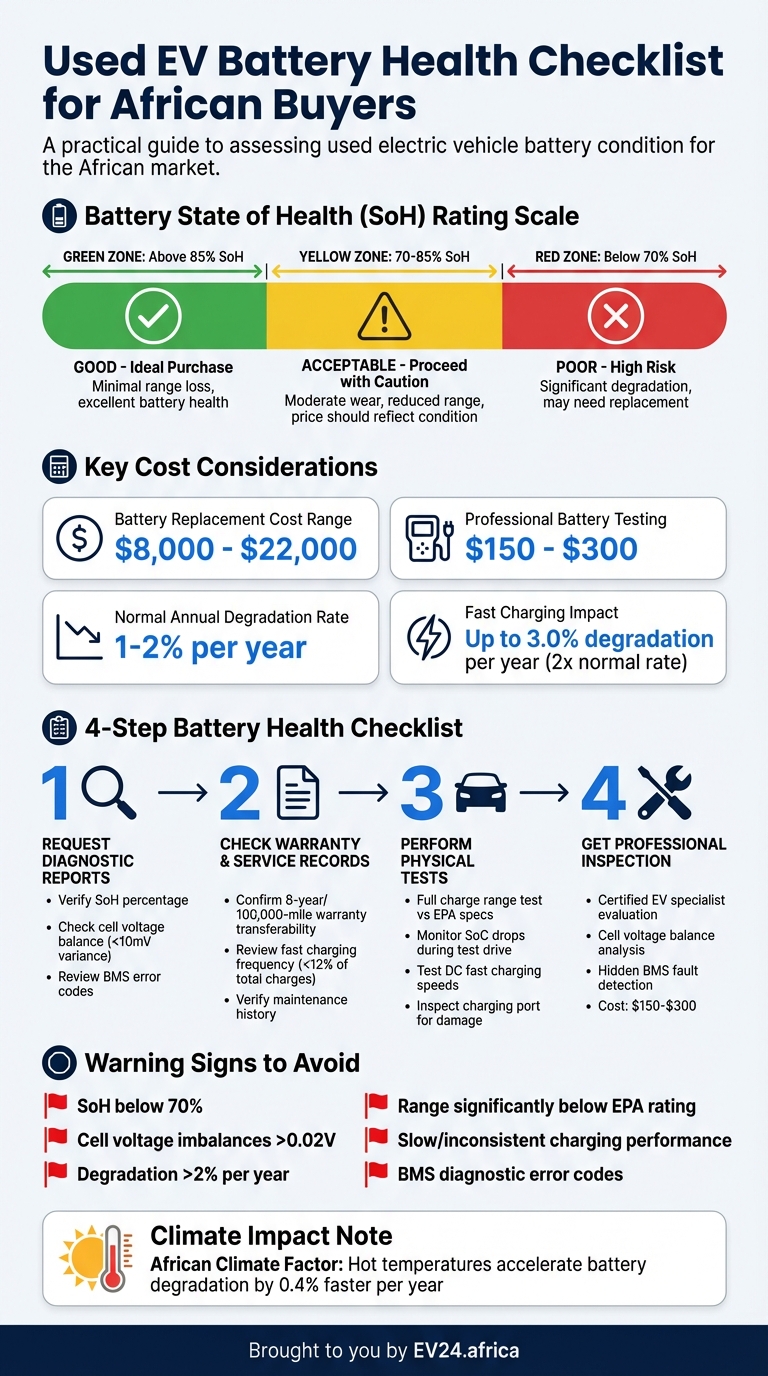
For EVs under five years old, an SoH of 85% or higher is ideal. This indicates minimal battery wear and suggests the vehicle will deliver reliable performance for years. An SoH between 70% and 85% is still acceptable but shows moderate degradation. You can expect a slightly reduced range, and the price of the vehicle should account for this wear. If the SoH dips below 70%, the battery has undergone significant degradation. Such a vehicle may qualify for warranty replacement if it’s still covered, but purchasing it carries a higher risk.
| SoH Percentage | Condition Category | Implications for Buyer |
|---|---|---|
| Above 85% | Good | Excellent battery health; minimal range loss; a solid choice for purchase. |
| 70% – 85% | Acceptable | Moderate wear; reduced range; ensure the price reflects the battery’s condition. |
| Below 70% | Significant Degradation | Poor condition; may qualify for warranty replacement but poses a higher risk overall. |
State of Charge (SoC) and Degradation Rates
State of Charge (SoC) reflects the current energy level in the battery, similar to a gas gauge in traditional vehicles. For accurate battery health assessments, the SoC should fall between 20% and 80%. Testing outside this range can lead to unreliable results.
On average, a healthy EV battery loses around 1% to 2% of its capacity per year. Over the vehicle’s lifespan, total capacity loss should remain under 20%. For example, a three-year-old EV should show a degradation of about 3% to 6%. If the loss is significantly higher, it could mean the battery has been exposed to harsh conditions, such as frequent fast charging, extreme heat, or repeated full discharges. It’s worth noting that many manufacturers, like Tesla, Toyota, and Volkswagen, offer 8-year or 100,000-mile warranties, often guaranteeing at least 70% capacity during that period.
Charge Cycles and Cell Voltage Balance
Beyond SoC, understanding charge cycles and cell balance provides deeper insight into battery health. Every charge cycle – charging from 0% to 100% – gradually wears down the battery. However, the type of charging matters. Regular use of DC Fast Charging (Level 3) accelerates wear compared to slower charging options like Level 1 or Level 2. When considering a used EV, ask the seller about their charging habits. If the vehicle has been heavily reliant on fast charging, the battery may show increased degradation.
Another key factor is cell voltage balance. An EV battery pack contains hundreds of individual cells, which should maintain nearly identical voltages. If there’s a significant imbalance, it points to issues with failing modules or the Battery Management System (BMS), which is responsible for regulating charge levels and keeping the cells balanced. Tools like an OBD-II scanner paired with apps such as LeafSpy (for Nissan LEAFs) or Tessie (for Tesla models) can help identify these imbalances. Uneven cell voltages are a serious warning sign, as they can lead to premature battery failure – even if the overall SoH appears acceptable.
Tools and Resources for Testing Battery Health
Diagnostic Tools and Apps
To start, you’ll need an OBD-II adapter, which plugs into your car’s diagnostic port and connects via Bluetooth. Popular options include ELM327 and OBDLink adapters – they’re affordable and easy to find. Once you have the adapter, choose an app tailored to your EV model.
For Nissan Leaf drivers, Leaf Spy is the go-to app. It provides detailed insights like State of Health (SoH) and individual cell voltages. If you own a Kia or Hyundai EV, try EV Watchdog. For broader compatibility across multiple brands, Car Scanner ELM OBD2 is a solid choice. This app not only shows SoH and cell voltage balance but also tracks charging history, including the ratio of fast charging to normal charging, giving you a clearer picture of how the battery has been used.
If you drive a Tesla, the vehicle includes a built-in Battery Health Test. You can access it through the touchscreen by navigating to Controls > Service > Battery Health. Keep in mind, this test requires the car to stay plugged into a charger for about 24 hours, so plan accordingly.
When using any OBD-II tool, pay special attention to cell voltage deviation. EV diagnostics expert Peter from the Speak EV Forum emphasizes:
"Cell voltage balance is another important parameter to be checked with OBD2 adapter – more than 0.02 V at rest is a cause for concern".
If the deviation between cells exceeds 0.10V, it’s a serious warning sign, while deviations over 0.02V can still indicate potential problems.
For a more comprehensive analysis, you might want to explore professional testing options.
Professional Battery Testing
While DIY tools are helpful, they might not uncover all issues. To confirm your findings, consider professional battery testing for a thorough evaluation.
Dealerships for brands like Tesla, Polestar, and Nissan offer detailed battery health reports. These services typically cost between $150 and $300 and include diagnostic scans and physical inspections of the battery pack. Some Polestar dealerships even offer these checks for free.
Professionals often use advanced equipment like Voltest, which connects to the OBD-II port and generates a detailed battery health report in just two minutes. These reports cover metrics such as total dischargeable energy (in kWh), cell-level analysis, and isolation resistance readings – values above 900 kOhms are considered safe. Independent EV mechanics are another option; they usually charge less than dealerships while still providing in-depth diagnostics.
When working with a professional, ensure they review the charging history to determine the balance of DC fast charging versus AC charging. Frequent fast charging can accelerate battery wear, and a professional can measure its impact. Additionally, make sure they scan for Battery Management System (BMS) faults and check for stored error codes. These issues might not trigger dashboard warnings but could signal potential problems down the road.
Battery Health Checklist: Step-by-Step Guide
Here’s how to evaluate the battery health of a used EV before making a purchase.
Request Battery Diagnostic Reports
Start by asking the seller for an official battery diagnostic report. This report should include key details like the State of Health (SoH), usable capacity, and any Diagnostic Trouble Codes (DTCs) stored in the system.
Pay close attention to the cell voltages – they shouldn’t vary by more than 10 mV. Be on the lookout for isolation faults or Battery Management System (BMS) errors, as these could signal moisture intrusion or internal safety problems. Additionally, ensure the temperature across the battery modules is evenly distributed.
If the seller doesn’t have an official report, you can still gather real-time BMS data yourself using an OBD-II scanner along with apps like "EV Health Checker".
Check Warranty and Service Records
Confirm whether the battery warranty is transferable to you as the second owner. Reach out to the manufacturer or dealer to verify the remaining coverage. Most manufacturers provide warranties for 8 years or 100,000 miles, often guaranteeing a minimum of 70% battery capacity retention.
Carefully review the vehicle’s maintenance records and software update history. Ask for documentation showing how often the car was fast-charged. Frequent DC fast charging – defined as more than 12% of total charging sessions – can significantly speed up battery degradation. In fact, it can double the annual degradation rate to 3.0%, compared to 1.5% for vehicles primarily charged at lower power levels. As Charlotte Argue, Senior Manager of Sustainable Mobility at Geotab, explains:
"High-power DC fast charging is the single largest stressor, leading to degradation rates up to twice that of the low power charging group."
Once you’ve reviewed the records, move on to hands-on testing to verify the EV’s performance.
Perform Physical and Charging Tests
After checking the records, it’s time to put the EV through its paces. Fully charge the vehicle and check if the estimated range aligns with EPA specifications. During a test drive, calculate the real-world range by dividing the miles driven by the percentage of battery used.
Keep an eye out for unexpected drops in the State of Charge (SoC) or erratic range estimates during the drive – these can point to failing cells or BMS issues. Inspect the charging port for any signs of overheating, scorched pins, or debris. To ensure the battery performs as expected, test the vehicle on a DC fast charger and confirm it achieves the manufacturer’s estimated charging speeds.
Get a Professional Inspection
For a thorough evaluation, hire a certified EV specialist. A professional inspection generally costs between $150 and $300 and provides a detailed report covering SoH, degradation rates, and the condition of individual cells. Authorized dealers are often a good choice since they have access to proprietary diagnostic tools and manufacturer-specific data.
The inspector should check for cell voltage balance, hidden BMS faults, and internal resistance. They should also observe the vehicle during a fast-charging session to assess efficiency and spot any potential issues with the circuitry.
| Battery Health Metric | Professional Benchmark |
|---|---|
| State of Health (SoH) | >85% (Good), 70-85% (Acceptable), <70% (Poor) |
| Degradation Rate | 1-2% per year (Normal) |
| Cell Balance | Uniform voltage across all cells (Required) |
| Inspection Cost | $150 – $300 (Standard Dealer Rate) |
sbb-itb-99e19e3
Warning Signs and Pricing Guidelines
Warning Signs to Watch For
Before purchasing, keep an eye out for these red flags:
- SoH below 70%: This suggests the battery is nearing the end of its usable life.
- Cell voltage imbalances: These could point to failing individual cells or issues with the Battery Management System (BMS).
- Annual degradation rates above 2%: Often a result of poor maintenance or excessive use of fast charging.
- Significant range discrepancy: If the current estimated range is far below the original EPA-rated range, it’s a concern.
- Charging performance issues: Slow charging or the inability to reach expected speeds can indicate degraded battery chemistry.
- Diagnostic error codes: Problems like high internal resistance, BMS faults, or module failures are serious warning signs.
- Erratic 12V accessories: If systems like HVAC or infotainment behave unpredictably before the vehicle fully powers on, it may point to a failing 12V battery, which can complicate the overall battery performance.
These issues not only reduce performance but also significantly affect the vehicle’s value.
Price Ranges for Common Models
Battery health plays a huge role in determining a vehicle’s price. Cars with a SoH above 85% usually sell at fair market value, while those with a SoH between 70% and 85% are often discounted moderately. If the SoH dips below 70%, expect a steep price reduction – or it might be better to avoid the purchase entirely.
The cost of replacing a battery is another critical factor. For example, replacing a Tesla battery can cost between $15,000 and $22,000, while a Chevrolet Bolt battery replacement ranges from $16,000 to $17,100. Early Nissan Leaf models (2011–2012) with severe degradation are often sold for just a few thousand dollars, as replacement batteries for these vehicles can cost $8,000 to $10,000, potentially exceeding the car’s overall value.
| Battery State of Health (SoH) | Condition | Pricing Impact |
|---|---|---|
| Above 85% | Good | Fair market price; minimal degradation |
| 70–85% | Acceptable | Moderate discount |
| Below 70% | Significant Degradation | Heavy discount or walk away |
How to Find Used EVs on EV24.africa
Benefits of Using EV24.africa
EV24.africa makes finding a reliable used electric vehicle (EV) easier by showcasing options with verified battery reports. These reports detail the State of Health (SoH) percentage, which tells you how much battery capacity remains compared to when the car was brand new. This level of detail helps you steer clear of hidden battery issues and ensures you know exactly what you’re investing in.
The platform offers a diverse selection of EVs from leading brands like Tesla, BYD, Volkswagen, Hyundai, and Toyota. Each listing is packed with useful information, including specifications, pricing, and expert reviews that highlight how well each model performs in African climates. This is important because EV batteries tend to degrade 0.4% faster per year in hotter regions compared to milder ones. Understanding these factors can make a big difference when choosing the right EV for your needs.
EV24.africa goes beyond just listings. The platform provides built-in EV financing options and manages delivery logistics across all 54 African countries. This means you can purchase a vehicle in one country and have it delivered to another without dealing with complex cross-border issues. With these features, EV24.africa simplifies the entire buying process, giving you peace of mind as you shop.
Using EV24.africa to Complete Your Purchase
Start by searching for EV models with a "verified" status. These listings include professional diagnostic reports that provide a clear score out of 100, along with detailed insights into battery performance. Prioritize vehicles that meet the recommended SoH standards to ensure long-term reliability.
Take advantage of the expert reviews to understand how each vehicle performs under specific conditions. Once you’ve found a car that fits your needs, complete the purchase directly through the platform. Use the financing tools to create a payment plan that works for you, and arrange for delivery to your location. With EV24.africa, you can handle everything – from browsing to delivery – without needing to juggle multiple service providers.
Conclusion
Buying a used EV in Africa requires careful consideration, especially since the battery pack is the costliest part of the vehicle. An EV’s value is closely tied to the condition of its battery cells. When evaluating a used EV, pay close attention to the State of Health (SoH) metrics. A reading of above 85% is ideal, while anything below 70% could signal significant degradation unless you’re prepared for potential performance issues.
It’s wise to request professional diagnostic reports, confirm warranty details, and conduct range tests to assess the battery’s condition. Keep in mind that frequent fast charging and exposure to high temperatures – common in many African regions – can speed up battery wear. These steps are essential for ensuring your EV investment aligns with your needs and local conditions.
On a positive note, modern EV batteries are becoming more durable. The average annual degradation rate has dropped from 2.3% in 2019 to just 1.8% in 2024, suggesting a potential lifespan of up to 20 years. This progress makes used EVs an increasingly practical long-term option.
Platforms like EV24.africa make the process even easier by offering verified battery reports, expert reviews tailored to African climates, and delivery services across all 54 countries. With the right tools and a thorough approach to battery evaluation, you can confidently choose a used EV that promises reliable performance and lasting value.
FAQs
Why is the State of Health (SoH) important when buying a used EV?
The State of Health (SoH) is a key indicator of how well a used EV’s battery is performing. It shows how much capacity the battery has left compared to when it was brand new, which directly affects the car’s driving range and dependability.
A higher SoH means the vehicle can cover more miles on a single charge and often holds a stronger resale value. By checking the SoH, you can make a smarter choice, ensuring the EV aligns with your needs and is worth your money.
Does frequent fast charging damage an EV’s battery?
Frequent use of high-power DC fast chargers (over 100 kW) can speed up battery wear, leading to quicker degradation compared to slower charging methods. For instance, fast charging might cause an annual battery degradation rate of about 3%, whereas slower charging typically results in a rate closer to 1.5% per year.
That said, not all batteries respond the same way. Lithium-iron-phosphate (LFP) batteries tend to handle frequent fast charging better than nickel-based chemistries. To keep your EV battery in good shape, it’s a smart move to limit fast charging and stick to slower, regular charging whenever you can.
What’s the best way to check the battery health of a used EV?
To check the battery health of a used EV, there are a few dependable methods you can try. Many EVs come with a built-in battery health feature that you can access through the car’s settings. For instance, Tesla includes a Battery Health option within its Service menu. This feature provides a quick snapshot of the battery’s condition.
If you want a more detailed analysis, you can opt for a professional diagnostic test from a dealership or an EV specialist. These tests often involve running a full charge and discharge cycle to evaluate the battery’s performance comprehensively.
For those who prefer a DIY approach, third-party diagnostic tools or OBD-II scanners can be a great alternative. These devices provide detailed battery data, such as state-of-charge and capacity, and are typically more budget-friendly and portable. Just make sure the tools or services you choose are compatible with the specific EV model you’re looking at.