
 Thabo Nkosi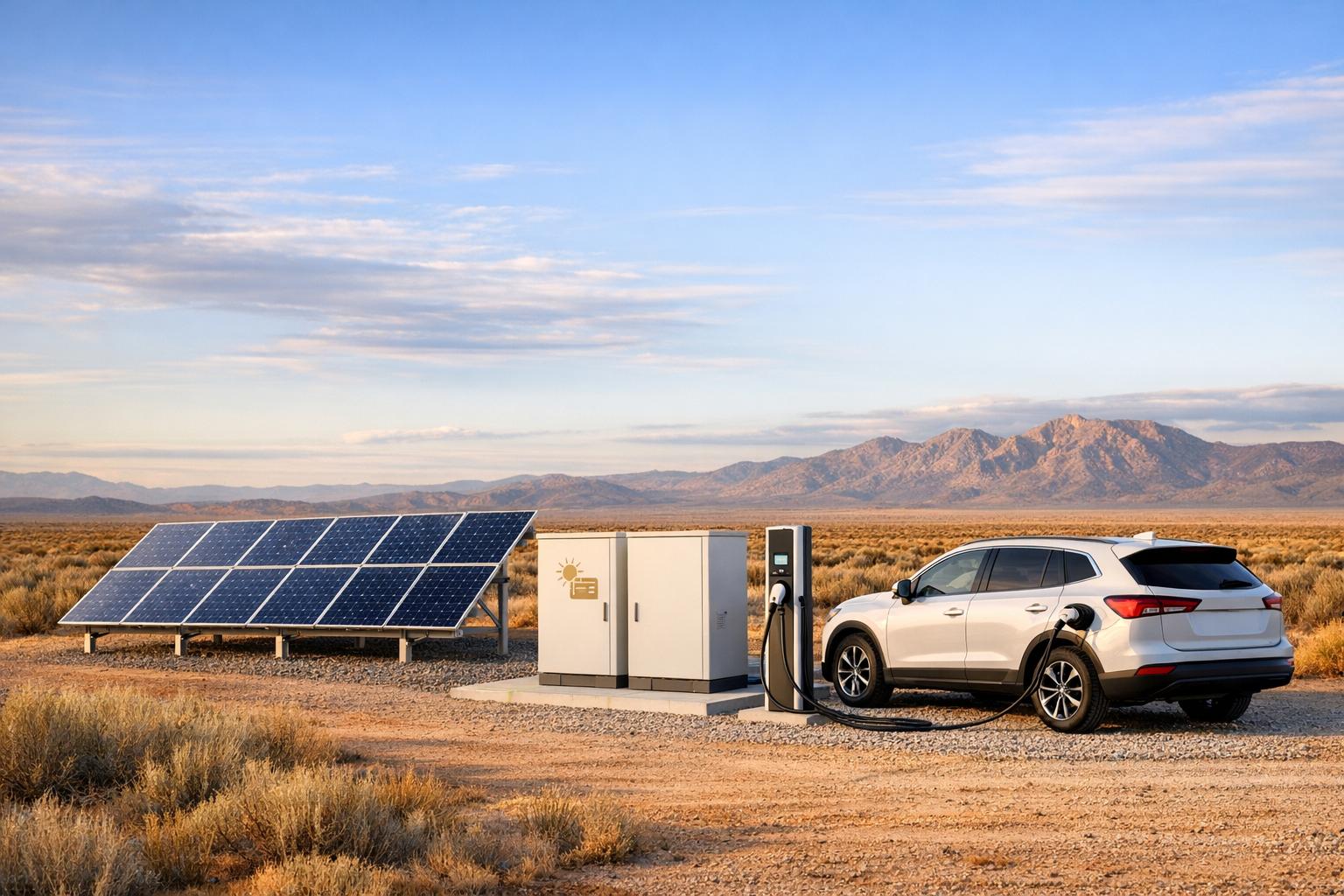
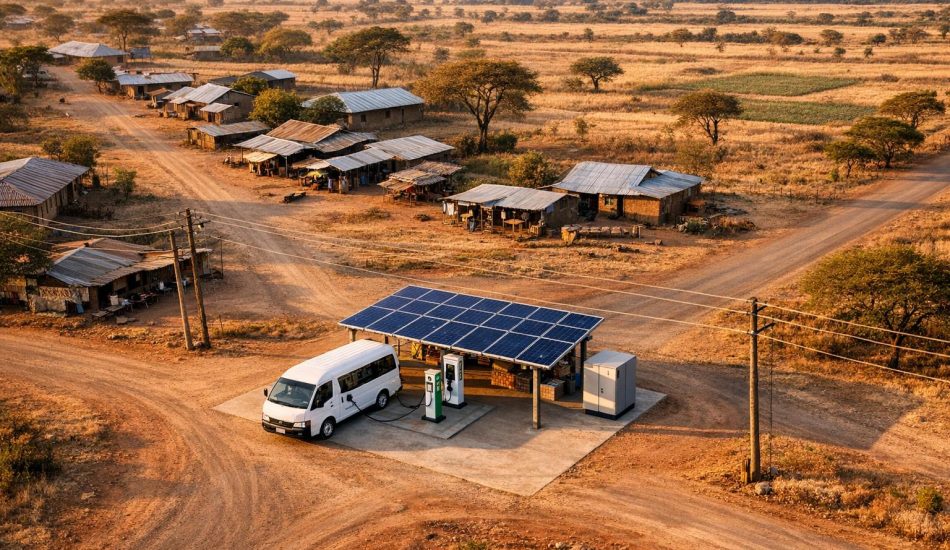
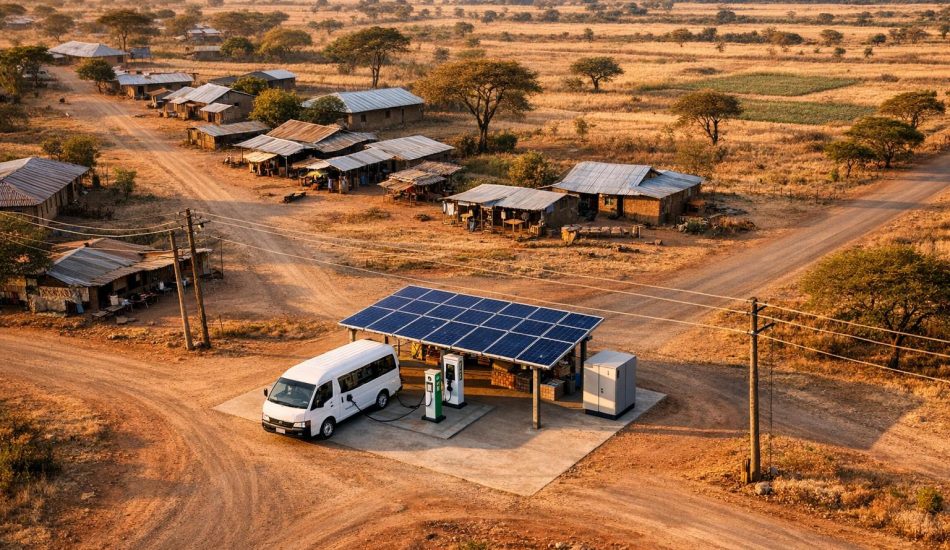
Solar EV charging stations are a practical solution for areas without reliable power grids, especially in remote regions. These systems use solar panels to generate electricity, store it in batteries, and power electric vehicles (EVs) without depending on traditional energy sources. Here’s a quick breakdown:
- How It Works: Solar panels convert sunlight into electricity, which is stored in batteries. Inverters transform this energy into a form usable by EVs.
- Off-Grid vs. Hybrid Systems: Off-grid systems operate independently, ideal for isolated areas. Hybrid systems combine solar power with grid connections for backup or energy export.
- Cost-Effectiveness: Charging costs are lower than grid electricity, with payback periods of 4–6 years for high-usage sites.
- Environmental Impact: Solar charging reduces CO₂ emissions by up to 0.9 kg per kWh compared to coal-based grids.
- Key Components: Solar panels, battery storage, inverters, charge controllers, and EV chargers work together to ensure efficient energy use.
Solar EV charging systems are transforming energy access in remote areas, offering a clean, reliable, and cost-efficient alternative to traditional power grids.
Off-Grid Solar EV Charging Station. Stand-alone solution for EV.
sbb-itb-99e19e3
How Solar EV Charging Systems Work
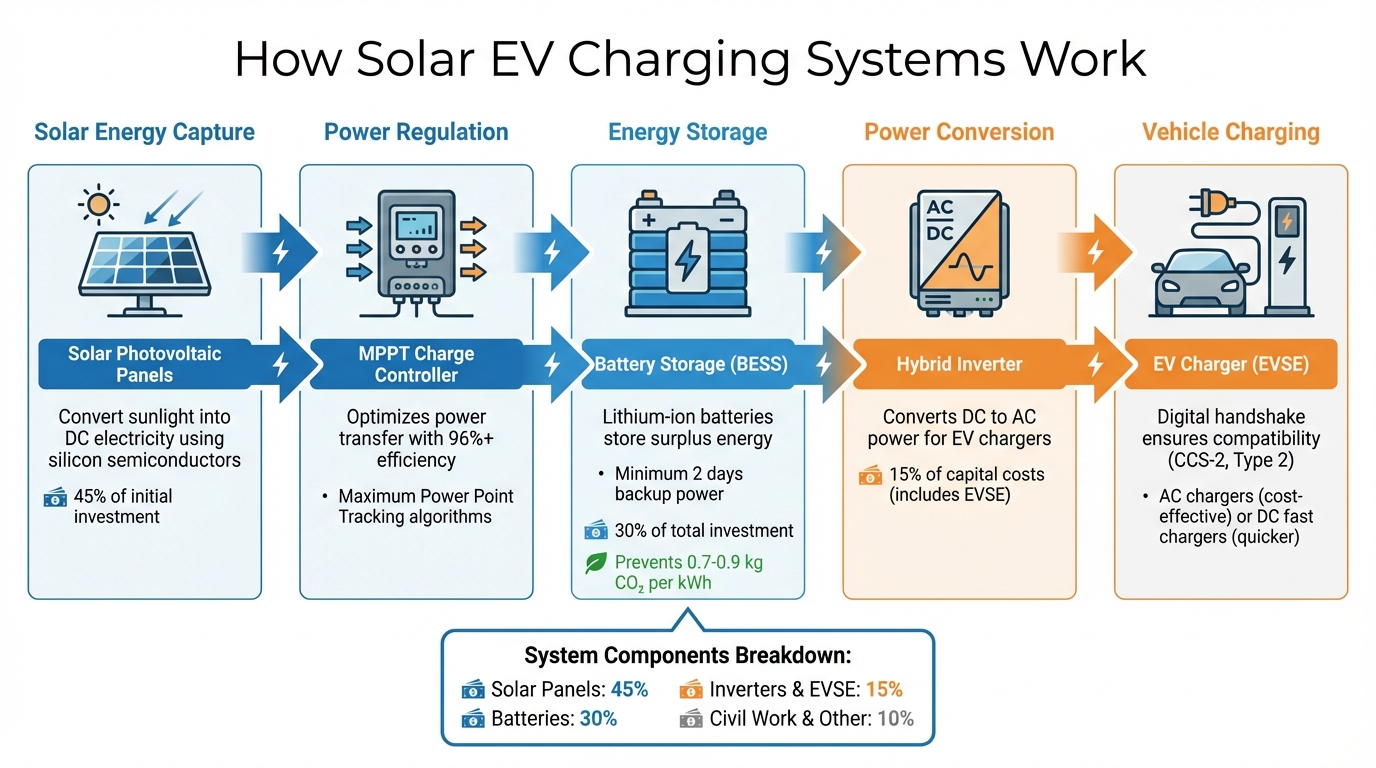
How Solar EV Charging Systems Work: From Sunlight to Vehicle Power
Solar Energy Conversion Basics
Solar panels rely on photovoltaic (PV) technology to transform sunlight into electricity. Inside each panel, semiconductor materials like silicon generate direct current (DC) electricity through the photovoltaic effect. To regulate this power, a charge controller equipped with Maximum Power Point Tracking (MPPT) technology ensures energy is efficiently transferred to the system. Since most EV chargers (Level 1 and Level 2) operate on alternating current (AC), an inverter is essential to convert DC power into AC. This seamless conversion process forms the backbone of solar-powered EV charging setups.
Energy Storage and Charging
Battery Energy Storage Systems (BESS) play a key role, especially in off-grid charging scenarios. These systems store surplus solar energy during sunny periods, enabling EV charging even at night or during cloudy weather. This ensures continuous operation without reliance on the grid. In off-grid stations, batteries make up around 30% of the total investment, but the environmental payoff is significant – every kilowatt-hour delivered through a solar-battery system prevents 0.7–0.9 kg of CO₂ emissions compared to coal-based electricity grids.
Off-Grid vs. Hybrid Systems
Choosing between off-grid and hybrid systems depends on location and energy needs. Off-grid systems are entirely independent, relying solely on solar panels and battery storage. They are ideal for remote areas with limited or no grid access, such as mining sites or disaster relief zones. These systems eliminate delays tied to grid connections and provide a self-sufficient energy solution.
Hybrid systems, on the other hand, combine solar energy with a grid connection. They use solar as the primary power source but can draw from the grid when needed or export excess energy back to it. This setup works well in peri-urban areas where grids are unreliable but accessible. However, hybrid systems require registration for net-metering and compliance with grid regulations, adding a layer of complexity.
| Feature | Off-Grid System | Hybrid System |
|---|---|---|
| Grid Connection | None; fully independent | Connected to utility grid |
| Energy Source | 100% on-site solar and batteries | Solar first; grid as backup or for export |
| Ideal Application | Remote areas, mining, disaster relief | Peri-urban areas with unstable grids |
| Complexity | Requires precise battery sizing | Involves net-metering and grid compliance |
Components of Solar EV Charging Stations
Solar Photovoltaic Panels
Solar photovoltaic (PV) panels are the backbone of a solar EV charging station, converting sunlight into DC electricity through silicon semiconductors. In off-grid setups, these panels can account for about 45% of the total initial investment. Proper placement is key – panels must be angled and positioned to capture the most sunlight throughout the day, avoiding any shading. For remote locations, the size of the panel array is determined by daily energy needs and seasonal sunlight variations. For example, a station designed to handle 10 EV charges per day will need a much larger panel setup than one catering to occasional use.
Battery Storage Systems
Lithium-ion batteries are the go-to choice for energy storage due to their high energy density and long lifespan. These batteries store surplus solar energy during peak sunlight hours, ensuring power is available even when the sun isn’t shining. For remote stations, batteries should provide at least two days of backup power to ensure uninterrupted operation during cloudy weather. To handle demanding conditions, battery packs should last for at least 6,000 cycles and include effective temperature management systems. A growing trend is the use of second-life EV batteries for storage, which can lower embodied emissions by up to 50%. Once energy is stored, power conversion systems manage the transfer of this energy to EVs.
Inverters, Charge Controllers, and EV Chargers
These components play a crucial role in regulating and converting the harvested and stored energy for EV charging. A Maximum Power Point Tracking (MPPT) charge controller acts as a DC-DC converter, using advanced algorithms like "Perturb and Observe" to extract the maximum possible power from the solar panels, even during inconsistent sunlight. Modern MPPT controllers can reach efficiencies over 96%.
The hybrid inverter transforms DC power from the panels and batteries into AC power, which is required by most EV chargers. It also provides essential features like islanding protection and overload handling. Together, the inverter and Electric Vehicle Supply Equipment (EVSE) make up about 15% of the total capital costs.
The EVSE connects directly to the vehicle. AC chargers rely on the vehicle’s onboard converter for cost-effective charging, while DC fast chargers bypass this step, delivering power directly to the battery for quicker charging times. Before charging begins, the EVSE performs a digital “handshake” with the vehicle to ensure compatibility with connector standards (e.g., CCS-2 or Type 2) and to match the vehicle’s specific charging needs. This setup is especially effective in areas with limited grid access.
In a practical example, researchers at Aligarh Muslim University installed a 6.4 kW solar PV charging station in September 2019. This system included a 10 kWh lithium-ion battery pack and utilized a 3 kW, 230 Vrms single-phase input to produce a 48 V DC output via a buck converter. This project showcased the potential of solar-powered EV charging in a campus setting.
Installation and Setup in Remote Areas
Site Assessment and Design
Before diving into installation, take a close look at your location’s potential for solar energy and any hurdles it might present. Start by measuring solar irradiance levels and checking for shading at various times of the day. You’ll also need to evaluate access for vehicles, flood risks, and soil conditions to ensure mounting stability. Another critical step is estimating your energy needs – calculate the expected number of daily charging sessions and peak power requirements. Tools for energy-balance modeling can help you size the system accurately, factoring in seasonal changes in sunlight. For remote areas, aim for at least two days of battery autonomy to keep things running smoothly during cloudy spells. Typically, the budget for such projects is divided as follows: 45% for the solar panels, 30% for batteries, 15% for inverters and charging equipment, and 10% for civil work and other associated costs. With your design in place, focus on addressing the unique logistical and environmental challenges that come with remote installations.
Overcoming Remote Area Challenges
Getting equipment to remote areas is no small feat, so careful logistics planning is a must. One efficient solution is using mobile containerized units, which can be deployed in just 14 days compared to the 6–10 weeks needed for fixed installations. These systems often come equipped with fold-out solar panels and integrated battery packs, making them ideal for locations with limited accessibility.
Durability is key in harsh conditions. Use cyclone-rated mounting structures and corrosion-resistant materials to withstand tough weather. In areas prone to high winds, low-profile roof mounts made of galvanized steel offer better stability than elevated designs. Pay extra attention to grounding, surge protection, and cable management to ensure the system can handle extreme weather. Training local technicians and forming partnerships with O&M providers who offer Service Level Agreements (SLAs) can help guarantee long-term reliability. For user-friendly operation, incorporate clear pictograms and color-coded labels – green for ON and red for OFF. Once everything is in place, move on to commissioning and testing to ensure everything works as intended.
System Commissioning and Testing
With the installation complete, it’s time to test and fine-tune the system. Start by verifying insulation resistance and measuring string I-V curves. Check the charger-to-vehicle handshake to ensure compatibility with standards like CCS-2 or Type 2. The remote monitoring system is another crucial element – test it thoroughly so you can track performance and troubleshoot issues without needing to visit the site. To enhance security, set passcodes for powering off field tablets and disable automatic file-open features in web browsers to prevent unauthorized access. Finally, run multiple charging cycles with various vehicles to confirm stable operation. Once all tests are successful, the station is ready to go public.
Benefits and Cost Considerations
Economic and Environmental Benefits
Solar EV charging stations offer major advantages, especially in remote areas. One of the standout benefits is grid independence – you can avoid the lengthy delays, complicated permits, and high demand charges often tied to traditional grid connections. On top of that, the environmental benefits are hard to ignore. Solar-powered systems can cut CO₂ emissions by more than 75% compared to diesel generators. For instance, a solar EV charging project in Cairo, Egypt, brought annual emissions down to 145.5 tons, compared to 633.7 tons from generator-based systems.
The financial appeal becomes even clearer when looking at real-world examples. In Tanzania, a study on a Battery Swap Station (BSS) powered by solar energy found it achieved a Levelized Cost of Energy (LCOE) of $0.095/kWh. That’s a 39% drop compared to the grid-only baseline of $0.155/kWh. These systems are also incredibly versatile – whether as fixed canopies for permanent setups or mobile trailers for temporary needs like mining or disaster relief. Beyond cost savings, solar EV charging infrastructure creates local job opportunities in installation and maintenance, boosting technical skills in underserved regions. Together, these environmental and economic benefits make a strong case for solar-powered EV solutions.
Initial Costs and Long-Term Savings
While the upfront costs of solar EV charging systems require careful budgeting, falling component prices are making these projects more feasible. For perspective, a large-scale 468 kW solar array with 29 kWh of storage and supporting infrastructure in Cairo had an initial cost of about $469,000.
The long-term savings, however, are impressive. That same Cairo project achieved an 8.2% Internal Rate of Return (IRR) and a payback period of just 5.8 years, delivering annual utility savings of around $409,326. Over 25 years, the system is expected to save $10.23 million compared to diesel generator alternatives. High-utilization sites typically see payback periods of 4–6 years, and government incentives for solar and EV infrastructure can shorten this timeline by 18–24 months. Additionally, reusing second-life EV batteries for stationary storage can slash embodied emissions by up to 50% while lowering overall project costs. These financial benefits, combined with operational efficiency and grid independence, make solar EV charging a practical solution for remote and underserved areas.
| Configuration | Lifetime Savings (25 yrs) | Annual CO₂ Emissions | Payback Period |
|---|---|---|---|
| PV + ESS + TOU | $10.23 Million | 145.5 t/yr | 5.8 Years |
| Generator + TOU | Baseline | 633.7 t/yr | N/A |
| PV + Generator | $8.12 Million | 210.2 t/yr | 6.2 Years |
(Data adapted from Egypt-specific techno-economic study)
Maintenance and Operations
Routine Maintenance Tasks
Keeping solar EV charging systems in top shape requires consistent maintenance. For instance, solar panels should be cleaned every quarter to remove dust and debris, especially in dry areas where sand buildup is common. Dirty panels can lose efficiency, so this step is crucial for optimal performance. Annual thermographic checks are also important – they help spot electrical hotspots or failing parts before they turn into bigger problems.
Battery health is another critical area. A Battery Management System (BMS) can monitor this in real time, ensuring proper temperature and current limits while tracking the battery’s cycle life. Even lithium-ion batteries, which are designed for at least 6,000 cycles, benefit from regular inspections to avoid capacity loss over time. Other components, like inverters and charge controllers, should also be checked yearly to confirm they maintain efficiency levels above 96%. Overload capacity and insulation resistance need to be inspected as well.
Don’t overlook the physical infrastructure. Mounting structures should be examined yearly for stability against wind loads, corrosion resistance, and correct cable management. This is especially important in remote areas where repairs can be challenging and expensive. Preventive steps, like enforcing power-off passcodes on field devices and disabling features like automatic file opens in browsers, can also help prevent unauthorized access or accidental system disruptions. Together, these practices ensure the system stays reliable and minimizes downtime.
Smart Energy Management
Routine maintenance is just one part of the equation – smart energy management takes things further by optimizing performance and extending the life of system components. Modern controllers equipped with Maximum Power Point Tracking (MPPT) algorithms can adjust to changing sunlight and temperature conditions, ensuring the solar array delivers as much power as possible. If the available solar power exceeds the battery’s safe charging capacity, the system automatically reduces the duty cycle to avoid overheating.
Time-of-Use (TOU) tariffs are another clever tool. They encourage users to charge EVs during peak solar production hours, letting vehicles draw power directly from the panels instead of relying on stationary batteries. This approach not only reduces battery wear but also maximizes solar energy usage. Remote monitoring systems, compliant with OCPP standards, further enhance efficiency by allowing firmware updates and real-time system health checks without requiring on-site visits. With features like automated protection, smart scheduling, and remote oversight, these systems reduce the need for manual intervention while keeping operations smooth – even in hard-to-reach locations.
Conclusion
Solar EV charging systems are changing the game for transportation in remote African regions by offering a way to achieve energy independence without relying on unreliable or nonexistent utility grids. These off-grid stations act as standalone power sources, helping communities avoid long delays associated with grid connections while protecting users from soaring fuel prices and unreliable power. Plus, they deliver an added bonus: substantial CO₂ reductions compared to traditional fossil-fuel systems, making them a win for both the environment and local economies.
The financial benefits are just as striking. Transport providers using solar-powered EVs can see their earnings jump by 250% to 1,300%, thanks to lower fuel and maintenance costs. Rwanda serves as a great example of this potential. The country’s EV fleet grew from just 19 vehicles in 2020 to about 515 by early 2024, a growth fueled by government policies that waive import duties, excise taxes, and VAT for electric vehicles. As Pulse Energy puts it:
"Off-grid EV charging stations have progressed from niche pilot projects to mainstream infrastructure, driven by economic viability, climate imperatives and the strategic need for energy independence".
With solar costs dropping, second-life battery programs expanding, and smarter energy management systems in play, remote communities no longer need to wait for traditional infrastructure. High-utilization solar charging stations can pay for themselves in just 4–6 years, all while delivering environmental benefits and solid financial returns.
Meanwhile, platforms like EV24.africa are making the transition to electric mobility even easier. They handle pre-shipment inspections, battery health checks, and customs paperwork, while offering vehicles from leading brands like Tesla, BYD, Leapmotor, and Toyota. With green financing options and clear pricing, EV ownership is now within reach for many Africans. Whether you’re a fleet operator, taxi driver, or individual buyer, EV24.africa connects you to the forefront of Africa’s clean transportation revolution.
FAQs
How do I size the solar panels and batteries for my charging needs?
To figure out the right size for solar panels and batteries for EV charging, start by estimating your daily energy needs. This involves calculating the miles you drive each day and multiplying it by your vehicle’s energy consumption, which typically ranges between 0.2 and 0.3 kWh per mile. Don’t forget to add an extra 20–30% to account for energy losses along the way.
When it comes to batteries, aim for enough storage to cover 1 to 2 days of your energy usage. This ensures you have a buffer for cloudy days or other disruptions. Also, factor in the amount of sunlight your area gets throughout the year. For the best results, it’s a good idea to consult a professional who can help customize the setup to suit your specific location and needs.
Can solar EV chargers work during cloudy days or at night?
Solar EV chargers can still function on cloudy days, though their efficiency decreases. Solar panels are capable of capturing diffuse light, generating roughly 76% of their peak output under light cloud cover. However, this drops to about 33% during heavy clouds, which can lead to longer charging times. At night, when solar panels stop producing energy, battery storage systems come into play. These systems store surplus energy generated on sunny days, ensuring a dependable charging option – even in remote locations with limited or no access to the grid.
What maintenance does an off-grid solar EV charging station need?
Maintaining an off-grid solar EV charging station is essential for keeping it running smoothly and efficiently. Some of the most important tasks include:
- Cleaning the solar panels: Dust, dirt, and debris can block sunlight and reduce energy absorption. Regular cleaning ensures the panels capture as much sunlight as possible.
- Inspecting the batteries: Batteries are the heart of the system. Checking them frequently helps prevent degradation and ensures they hold a charge effectively.
- Checking inverters and charger controllers: These components are critical for converting and managing power. Routine inspections help catch any issues before they cause bigger problems.
- Examining wiring and electrical connections: Loose or damaged connections can disrupt the system. Regularly inspecting and securing these ensures consistent performance.
By staying on top of these maintenance tasks, you can improve energy production, extend the system’s lifespan, and avoid unnecessary downtime – especially important in remote locations where getting technical support can be challenging.