
 Thabo Nkosi
Hybrid Electric Vehicles (HEVs) are gaining traction in Africa as a practical solution for cleaner and fuel-efficient transportation. Combining a gasoline engine with electric motors, HEVs offer better fuel economy and reduced emissions without relying on extensive charging infrastructure – an advantage in regions with unreliable electricity access.
Key points:
- How They Work: HEVs use regenerative braking and engine power to recharge their batteries, eliminating the need for external charging.
- Popular Models: Options like the Toyota Corolla Cross Hybrid ($23,935) and BYD Sealion 6 ($34,589) are available, offering varying electric ranges and features.
- Advancements in 2025: Improved battery technology, lower prices, and local repair facilities, like Kenya’s new battery lab, make HEVs more accessible.
- Challenges: Limited infrastructure, tough road conditions, and consumer concerns about repair services remain barriers.
With sales growing and more affordable models entering the market, HEVs are becoming a practical choice for African drivers seeking cost-effective, lower-emission vehicles.
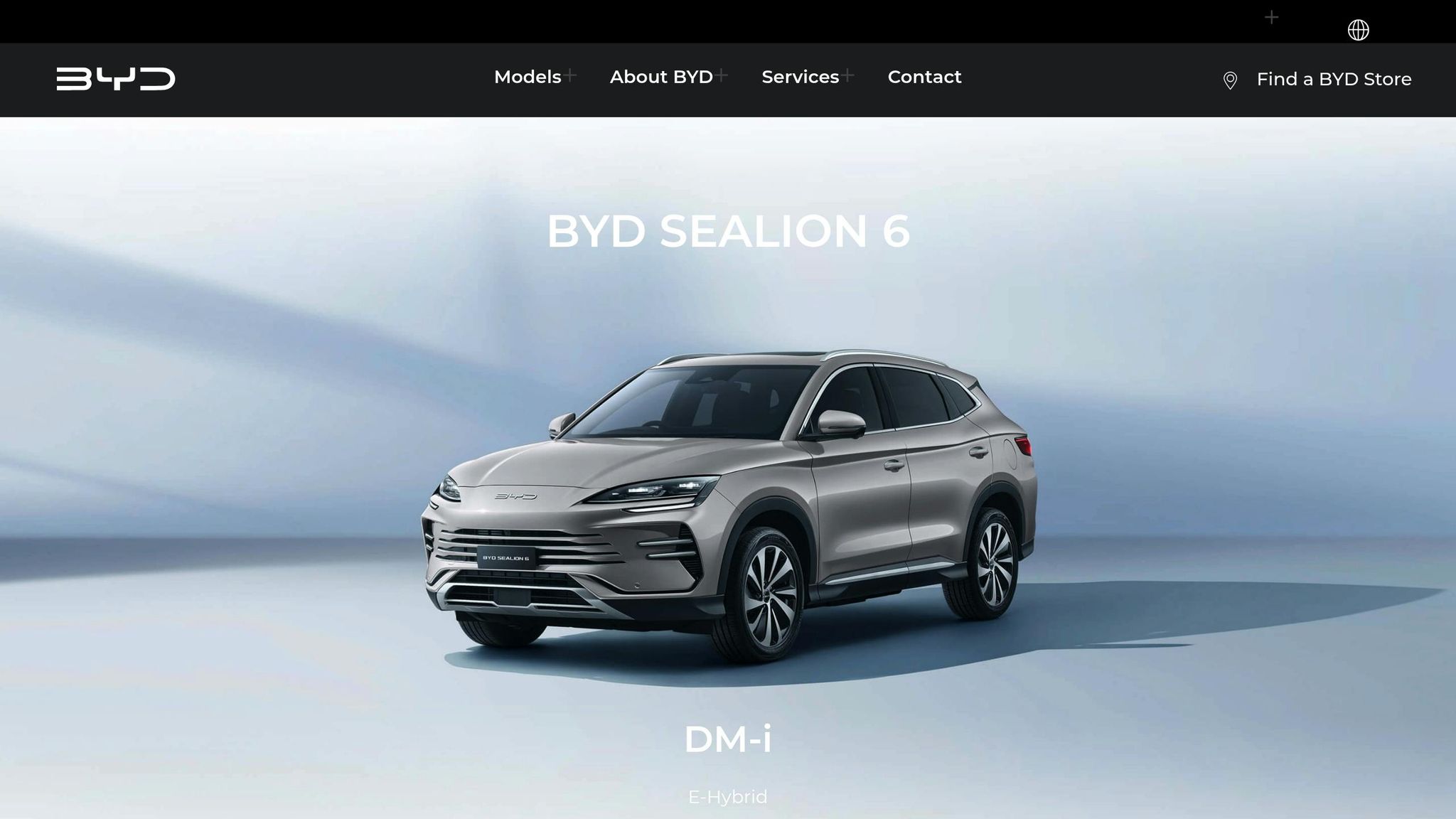
Is the BYD Sealion 6 the BEST Value Plug-In Hybrid SUV in SA? In-Depth Review! BYD‘s latest PHEV
How HEVs Work: Basic Mechanics and Features
To understand why hybrid electric vehicles (HEVs) are well-suited for the African market, it’s essential to look at how they work. HEVs combine two power sources: a traditional internal combustion engine (ICE) and one or more electric motors powered by batteries. This dual system allows the vehicle to switch between the two power sources or use both simultaneously for better efficiency and performance.
The hybrid powertrain is designed to intelligently manage the transition between the gasoline engine and the electric motor based on driving conditions. By supplementing the ICE with an electric motor, manufacturers can use smaller, more fuel-efficient engines without sacrificing performance. This feature is particularly useful in regions where infrastructure can be challenging. As Ramy Mohareb, Communications Head for Nissan Africa, explains regarding the e-Power system:
"Why we’re saying it fits Africa, is because you don’t need the extensive infrastructure, and battery cost is not as high as the current EVs. There is no range anxiety. So we think that this is the right technology to transition to full EVs in Africa."
Hybrid Powertrain and Energy Flow
HEVs come equipped with self-charging technology, which means their batteries recharge using regenerative braking and power generated by the ICE. This eliminates the need for external charging.
Regenerative braking is a key feature. Here, the electric motor functions as a generator, converting kinetic energy into electricity that gets stored in the battery. Additionally, the gasoline engine can act as a generator, either charging the battery directly or supporting the drivetrain when extra power is needed.
Some hybrid configurations take a slightly different approach. For instance, the Changan Hunter REEV, set to launch in South Africa in November 2025, uses a 31.2 kWh lithium-iron-phosphate battery alongside a 2.0-liter turbocharged petrol generator. In this setup, the engine’s role is limited to generating electricity rather than driving the wheels. This allows the vehicle to deliver approximately 90 miles of pure-electric driving, with a total range of up to 621 miles.
Driving Modes in HEVs
Modern HEVs feature multiple driving modes that adapt automatically to different conditions. Advanced power management systems monitor factors like speed, battery level, and power demand to ensure optimal efficiency.
- Electric mode: The vehicle runs solely on its electric motor, offering quiet and efficient operation at lower speeds.
- Hybrid mode: Both the gasoline engine and electric motor work together to balance performance and efficiency.
- Engine mode: The gasoline engine takes over, typically during highway driving or when the battery charge is low. Even in this mode, regenerative braking continues to capture and store energy.
For example, full hybrids like the Toyota Prius can operate using the gasoline engine, the electric motor, or both, depending on the situation. On the other hand, series hybrids like the Chevrolet Volt rely solely on the gasoline engine to generate electricity, which powers the electric motor to drive the car. These transitions happen seamlessly, allowing drivers to focus entirely on the road.
HEV Systems in 2025: Technology Updates
The year 2025 brings notable advancements to hybrid electric vehicle (HEV) technology, focusing on making these vehicles more efficient and affordable. For African drivers, these updates are particularly impactful. Research from the International Council on Clean Transportation (ICCT) highlights that strong hybrid electric vehicles achieve the highest level of greenhouse gas reductions possible for non-plug-in vehicles. Even better, automakers can integrate these technologies in a cost-effective manner starting in 2025.
One of the most exciting trends is the drop in HEV prices, making them more accessible to consumers across Africa. For drivers seeking dependable, fuel-efficient cars without the need for extensive charging infrastructure, this affordability is a game-changer.
These advancements build on well-established, affordable technologies, delivering greater fuel efficiency and lowering operational costs. This is particularly valuable for navigating Africa’s diverse and often challenging road conditions.
Battery technology has also taken a leap forward. HEVs now commonly use Lithium Iron Phosphate (LFP) batteries, which are better suited for Africa’s high temperatures thanks to their improved thermal stability and longer lifespan. To support these advancements, Africa’s first hybrid vehicle battery lab opened in Nairobi, Kenya, in April 2025. This facility offers critical services such as battery testing, analysis, and reconditioning, ensuring HEVs perform optimally in local conditions.
Key Components of Modern HEVs
Modern HEVs rely on a high-voltage battery pack that stores energy from both regenerative braking and the internal combustion engine (ICE). These batteries now boast higher energy density and longer lifespans, making them even more reliable.
The electric motor not only powers the vehicle but also recaptures energy during braking. Meanwhile, power control units and a planetary gearset work together to ensure smooth transitions between the electric and combustion power sources.
sbb-itb-99e19e3
Popular HEV Models Available in Africa in 2025
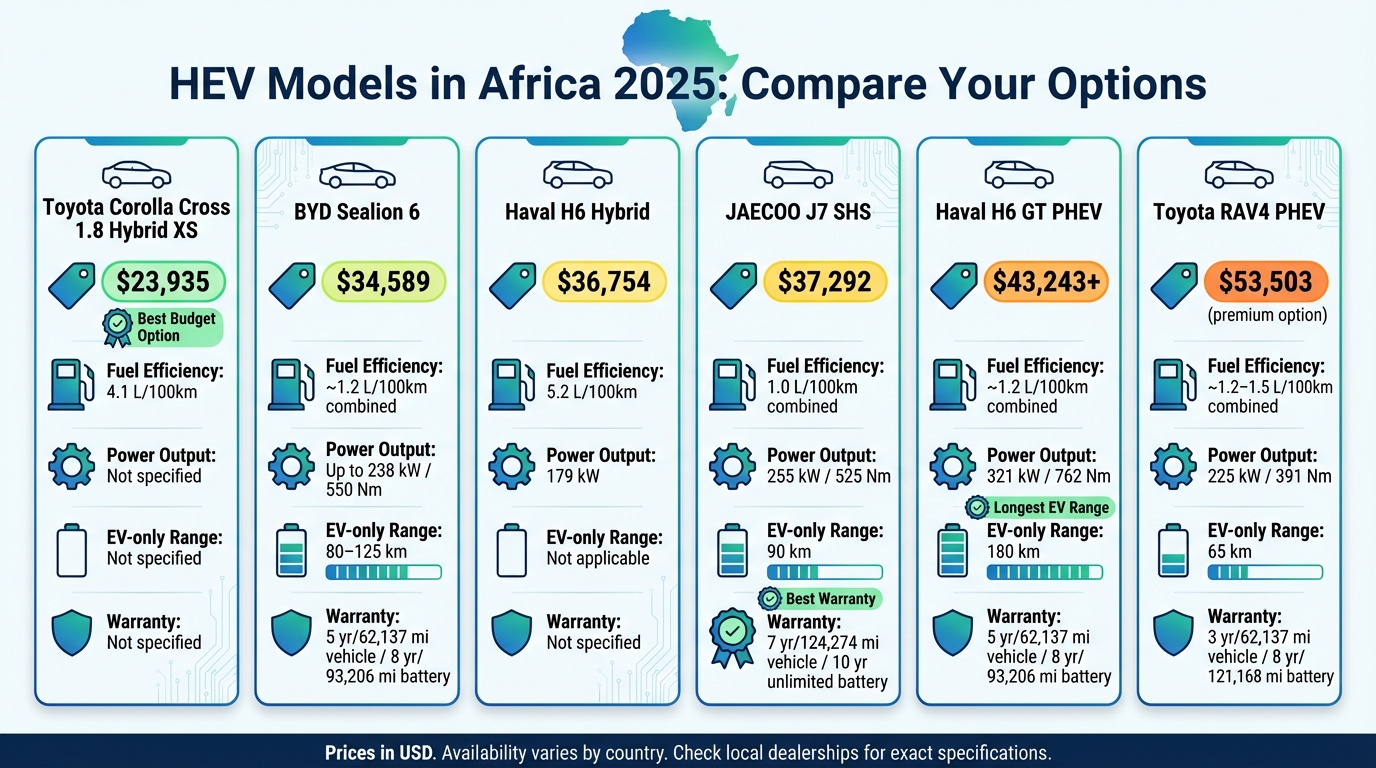
HEV Models Available in Africa 2025: Price and Performance Comparison
Drivers across Africa now have a growing selection of hybrid electric vehicles (HEVs) to choose from, tailored to meet both efficiency and performance demands. This market has seen notable growth in countries like South Africa and Kenya, driven by rising fuel prices and a stronger focus on eco-friendly transportation options. Whether you’re looking for a reliable commuter car or something for longer trips, there’s likely an HEV to match your needs.
One standout option is the Toyota Corolla Cross 1.8 Hybrid XS, which offers an affordable entry into hybrid ownership. Priced at approximately $23,935, it boasts a fuel consumption of just 4.1 L/100 km, making it perfect for urban commutes and city driving. For those wanting more power and a longer electric-only range, the JAECOO J7 SHS delivers an impressive 90 km of all-electric travel, with a combined output of 255 kW and 525 Nm of torque, priced around $37,292.
Chinese automakers are also making waves in the African HEV market. The BYD Sealion 6, for instance, offers an electric-only range of 80–125 km and up to 238 kW of power, all for about $34,589. Meanwhile, the Haval H6 GT PHEV stands out with its 180 km electric range, starting at approximately $43,243+.
Most of these models are available through authorized dealerships across Africa, ensuring buyers have access to reliable service and support. Platforms like EV24.africa provide detailed listings and transparent pricing to help buyers make informed decisions.
Comparison of Leading HEV Models
| Model | Fuel Efficiency (L/100km) | Power Output (kW / Nm) | EV-only Range (km) | Starting Price (USD) | Warranty (Vehicle / Battery) |
|---|---|---|---|---|---|
| Toyota Corolla Cross 1.8 Hybrid XS | 4.1 | Not specified | Not specified | ~$23,935 | Not specified |
| BYD Sealion 6 | ~1.2 combined | Up to 238 / 550 | 80–125 | ~$34,589 | 5 yr/62,137 mi / 8 yr/93,206 mi |
| Haval H6 Hybrid | 5.2 | 179 / Not specified | Not applicable | ~$36,754 | Not specified |
| JAECOO J7 SHS | 1.0 combined | 255 / 525 | 90 | ~$37,292 | 7 yr/124,274 mi / 10 yr unlimited |
| Haval H6 GT PHEV | ~1.2 combined | 321 / 762 | 180 | ~$43,243+ | 5 yr/62,137 mi / 8 yr/93,206 mi |
| Toyota RAV4 PHEV | ~1.2–1.5 combined | 225 / 391 | 65 | ~$53,503 | 3 yr/62,137 mi / 8 yr/121,168 mi |
When choosing an HEV, it’s important to think about your driving habits and access to charging infrastructure. Standard hybrids are excellent for short, city-based trips, while plug-in hybrids are better suited for those who can charge regularly at home or work. Also, check for local availability of authorized service centers, since HEVs often require specialized maintenance.
Benefits and Challenges of HEVs for African Drivers
Advantages of HEVs in Africa
Hybrid Electric Vehicles (HEVs) bring noticeable savings in fuel and maintenance costs. Take the May 2025 Haval Jolion hybrid in South Africa, for example – it consumed just 5.1 liters per 100 kilometers, compared to 7.5 liters for its gasoline-only counterpart. On top of that, HEVs experience less wear on components and longer-lasting brake pads, which further reduce maintenance expenses.
The environmental upside is equally striking. HEVs can cut greenhouse gas emissions by up to 50% compared to traditional combustion engine vehicles and improve fuel efficiency by 20–30% on average. This is particularly relevant for Africa, where emissions from the transport sector are expected to double, rising from 90 MtCO2eq in 2020 to around 180 MtCO2eq by 2030. Unlike fully electric vehicles, HEVs don’t rely on extensive charging infrastructure, making them a practical solution for regions with limited or unreliable power grids. Their ability to self-charge is a game-changer in areas where electricity access is inconsistent.
While these benefits are promising, the road to widespread adoption isn’t without its hurdles.
Challenges and Barriers to Adoption
Despite their advantages, HEVs face significant challenges in gaining traction across Africa. Even though their self-charging capability addresses some issues, unreliable electricity and tough road conditions remain major obstacles. Currently, 44% of Africa’s population lacks access to electricity, and 68% of manufacturing businesses report frequent power outages – more than in any other region globally. As Reuters highlights:
"Unreliable power availability and a lack of charging infrastructure have meanwhile held back EV uptake".
The lack of charging infrastructure is a critical issue. Hans Greyling, General Manager at Omoda & Jaecoo South Africa, summed up the situation:
"Battery electric vehicles have not really taken off in South Africa. We’ve gone the route of looking more towards traditional hybrids or plug-in hybrids".
Beyond infrastructure, concerns about vehicle quality, availability of spare parts, and resale value create further hesitation, particularly with newer Chinese brands entering the market. Additionally, Africa’s sparse road network – just 89 kilometers per 1,000 square kilometers, with fewer than 20% of roads paved – exposes vehicles to harsher conditions. This increases wear and tear, making reliable repair services a necessity.
Conclusion: The Future of HEVs in Africa
Hybrid Electric Vehicles (HEVs) are emerging as a cleaner, more efficient solution for transportation across Africa. Their ability to self-charge addresses the challenge of limited charging infrastructure, while offering better fuel efficiency and lower emissions compared to traditional vehicles. In South Africa, HEV sales surged to 13,617 units in 2024, accounting for 2.64% of all new vehicle sales.
This growing interest in HEVs reflects their practicality and cost-effectiveness. Strong hybrids, in particular, are gaining recognition as an economical option for both consumers and manufacturers. With production costs expected to decrease further, the market for these vehicles is set to expand. For instance, OMODA & JAECOO reported a staggering 370% quarter-on-quarter growth in New Energy Vehicle sales during Q1 2025. The company predicts that hybrids and EVs will make up over 50% of its global sales by the end of 2025.
Yet, the path to widespread adoption isn’t without hurdles. Africa’s limited infrastructure and ongoing power reliability issues remain significant challenges. To address these, automakers are focusing on introducing affordable HEV models and ensuring maintenance requirements are comparable to those of conventional vehicles. These efforts are paving the way for industry leaders to reshape the market.
Shannon Gahagan, Brand and Marketing Manager for OMODA & JAECOO South Africa, highlighted the company’s commitment to this transformation:
"South Africa remains a dynamic and growing part of our journey. With the arrival of our latest Super Hybrid and plug-in models, we’re setting the stage for a new era of intelligent mobility in Mzansi."
As HEV technology continues to evolve and become more accessible, these vehicles are positioned to provide African drivers with fuel savings, reduced emissions, and dependable performance – all without relying on extensive charging infrastructure.
FAQs
How do hybrid electric vehicles (HEVs) charge themselves without needing to plug in?
Hybrid electric vehicles (HEVs) keep their batteries charged through two primary methods: regenerative braking and the internal combustion engine. With regenerative braking, the energy produced when slowing down or braking is captured and converted into electricity, which is then stored in the battery. The engine also plays a role by generating electricity to recharge the battery while the car is in motion. This self-charging setup eliminates the need for external charging stations, making HEVs a convenient option for many drivers.
What are the biggest obstacles to hybrid electric vehicle (HEV) adoption in Africa?
The growth of hybrid electric vehicles (HEVs) in Africa is held back by several challenges. One major issue is the limited charging infrastructure paired with an unreliable electricity supply, which prevents drivers from taking full advantage of these vehicles. On top of that, the high upfront cost of HEVs remains a significant hurdle for many potential buyers.
Another challenge lies in inconsistent government policies. Without stable incentives or clear long-term strategies, it’s tough to encourage widespread adoption. Add to that the absence of local manufacturing and financing options, and it becomes even harder for HEVs to reach a larger segment of the population. Overcoming these barriers will be critical to increasing HEV adoption across the continent.
What advancements have been made in HEV battery technology by 2025?
By 2025, solid-state batteries have transformed the landscape of hybrid electric vehicles (HEVs). These batteries boast impressive features like higher energy density, ranging from 350 to 700 Wh/kg, and rapid charging capabilities – reaching 80% charge in just 12 to 15 minutes. They’re also much safer, thanks to their resistance to thermal runaway, and offer extended lifespans of up to 100,000 miles. On top of that, they’ve become far more affordable, with costs now between $800 and $1,200 per kWh.
At the same time, advancements in lithium-ion battery chemistries, such as NMC (Nickel-Manganese-Cobalt) and LFP (Lithium Iron Phosphate), have further improved performance, longevity, and safety. These breakthroughs make HEVs not only more efficient and dependable but also more accessible to drivers across Africa, helping to address concerns about both affordability and environmental impact in the region.