
 Thabo Nkosi
Leapmotor, a Chinese electric vehicle (EV) company, has officially entered the South African market through a partnership with Stellantis. This move brings the innovative C10 REEV (Range-Extended Electric Vehicle) to South Africa, addressing key challenges like limited charging infrastructure and high fuel costs. Here’s a quick summary of what you need to know:
- Who is Leapmotor? Founded in 2015, Leapmotor has sold over 600,000 EVs globally. Stellantis holds a 21% stake in the company and manages its operations outside China.
- Why South Africa? The country presents growth opportunities due to rising EV demand and energy challenges. Leapmotor’s REEV technology suits both urban and rural driving conditions.
- Key Model: The C10 REEV, a mid-size SUV, offers a total range of up to 590 miles (950 km), with 90 miles (145 km) running purely on electric power.
- Launch Timeline: The C10 REEV debuted in September 2025, with full availability announced in October 2025. More models are expected in 2026.
- Pricing & Availability: While exact pricing in South African rand is yet to be disclosed, the focus is on affordability. Vehicles are available at Stellantis dealerships.
Leapmotor’s entry aligns with South Africa’s growing EV market, supported by government incentives like tax deductions for EV manufacturers starting in 2026. The C10 REEV’s range-extending technology makes electric mobility more practical for South African drivers.
For more details, read on.
Leapmotor C10 REEV First Drive – The New-Thinking Electric Vehicle with a Generational Backup!

How Leapmotor Entered the South African Market
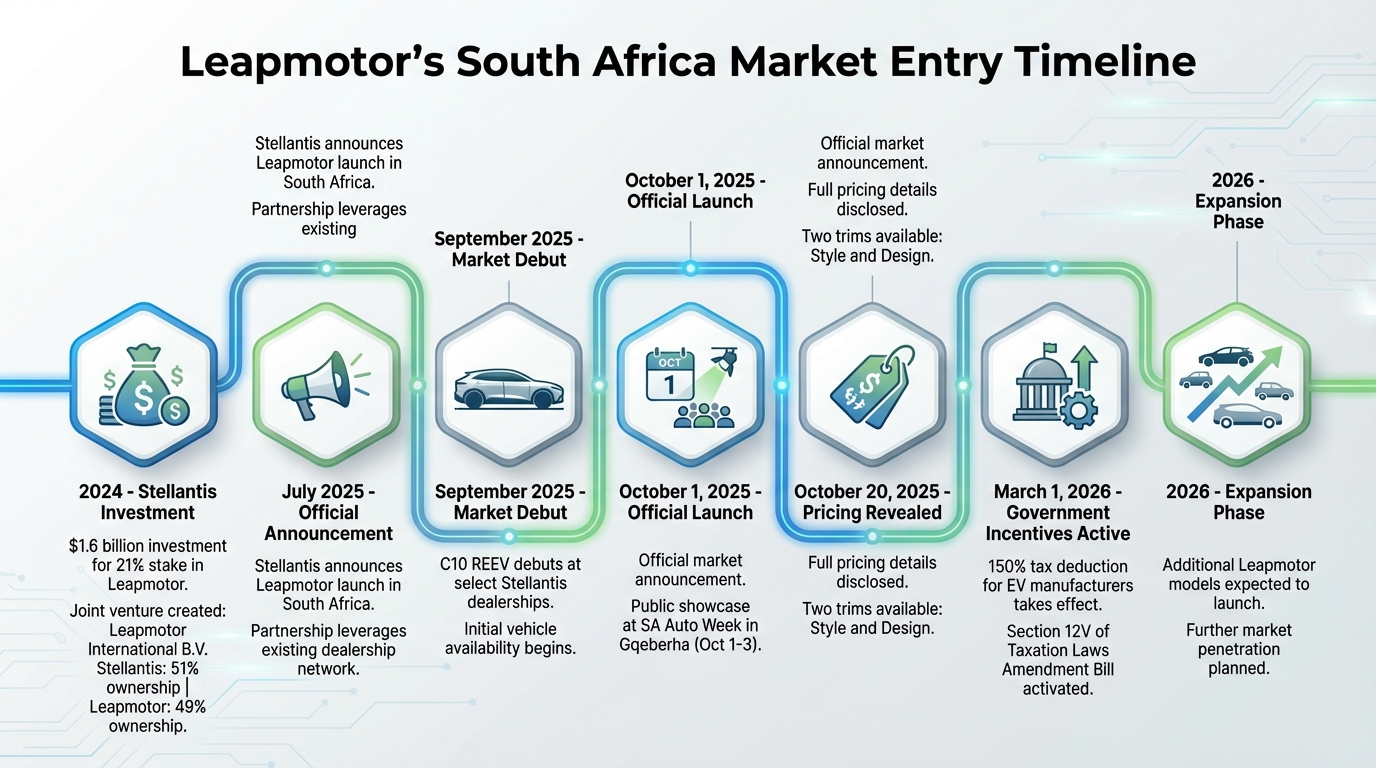
Leapmotor South Africa Launch Timeline and Key Milestones 2024-2026
The Stellantis Partnership
Stellantis made a bold move by investing $1.6 billion for a 21% stake in Leapmotor, creating a joint venture called Leapmotor International B.V. Stellantis holds 51% ownership in this partnership, while Leapmotor retains 49%. This arrangement gives Stellantis exclusive rights to export, sell, and manufacture Leapmotor electric vehicles (EVs) outside Greater China, including South Africa. Using its well-established dealership network, Stellantis has seamlessly integrated Leapmotor vehicles into its existing South African operations. Stellantis South Africa highlighted the synergy:
By leveraging Stellantis’ extensive infrastructure, extensive distribution network, and uncompromising quality standards, Leapmotor is well-positioned to bring its unique blend of advanced state-of-the-art technology, affordability and customer-first innovation to South Africa.
This collaboration has set the stage for Leapmotor’s smooth entry into the South African market.
Launch Timeline and Milestones
Leapmotor’s arrival in South Africa followed a carefully orchestrated timeline. In July 2025, Stellantis announced the launch, with the C10 REEV making its debut in September at select dealerships. The official announcement came on October 1, 2025, followed by a public showcase at SA Auto Week in Gqeberha. Full pricing details were revealed later on October 20, 2025. Looking ahead, additional models are expected to hit the market in 2026.
Leapmotor’s Global Expansion Plans
The South African launch is a key milestone in Leapmotor’s broader global expansion strategy. South Africa plays a central role in Leapmotor International’s push into new markets. After starting operations in Europe in 2024, Leapmotor is now targeting regions like India, Asia-Pacific, the Middle East, Africa, and South America, with this expansion kicking off in late 2024. The scale of their ambitions is evident in the UK, where Leapmotor initially launched in 44 Stellantis dealerships, with plans to expand to 80 locations by the end of 2025. The focus remains on delivering affordable, tech-forward electric mobility solutions tailored to emerging markets. Neville Matjie, CEO of Brand South Africa, underscored the importance of this move:
The introduction of Leapmotor by Stellantis reflects growing confidence in South Africa’s economy and our position as a hub for advanced manufacturing and green innovation. This investment not only strengthens the local automotive value chain but also showcases the country’s commitment to sustainable industrialisation, job creation, and global competitiveness.
Leapmotor’s global expansion underscores its dedication to providing accessible EV solutions, perfectly aligned with the needs of emerging markets like South Africa.
Leapmotor C10 REEV: Features and Technology
Understanding REEV Technology
The C10 REEV uses a 1.5-liter gas engine, but not in the way you might think. Instead of powering the wheels, this engine works as a generator to recharge the car’s 28.4 kWh battery. That means the vehicle is driven entirely by its electric motor, whether you’re charging it from the grid or letting the onboard generator handle it. This setup eliminates the worry of running out of range.
Stellantis South Africa highlighted why this tech makes sense locally:
"In South Africa, where energy challenges and limited charging infrastructure slow EV adoption, REEV offers a practical solution. By combining electric driving with built‐in charging flexibility, the technology ensures reliability across both urban and rural conditions, while supporting the country’s Just Energy Transition."
The system operates the engine at its most efficient level, resulting in impressively low emissions – just 10 g/km of CO₂ – and a fuel consumption of 0.4 L/100 km. These features make the C10 REEV stand out as a forward-thinking option for drivers.
C10 REEV Specifications
When the C10 REEV hit the market on October 1, 2025, it entered the mid-size crossover SUV category with two versions available. The vehicle is powered by a rear-wheel-drive electric motor producing 220 hp (158 kW), drawing energy from its 28.4 kWh battery pack. It offers an impressive total range of up to 590 miles (950 km) under the WLTP cycle. Of that, 90 miles (145 km) can be driven purely on electric power before the gas generator kicks in.
Inside, the C10 REEV is packed with modern features like a sleek infotainment system, a panoramic sunroof, and advanced driver assistance technologies. These elements make it a practical choice for drivers looking for long-range capability without depending entirely on charging stations.
Other Leapmotor Models Coming to South Africa
The C10 REEV is just the beginning for Leapmotor in South Africa. Additional models are expected to arrive in 2026. While the exact lineup hasn’t been revealed yet, Leapmotor International’s expansion plans suggest that fully electric models will join the range-extended options. This will give consumers more flexibility as the country’s charging infrastructure gradually improves.
sbb-itb-99e19e3
Pricing, Availability, and Ownership Costs
Leapmotor C10 REEV Pricing in South Africa
Leapmotor has introduced the C10 REEV as a budget-friendly option in South Africa’s growing EV market. Officially launched on October 1, 2025, the vehicle comes in two trims: Style and Design. While the exact pricing in South African rand hasn’t been revealed yet, the focus is clearly on affordability, making it an appealing choice for buyers looking for advanced features without paying a premium.
Cost of Ownership in South Africa
The C10 REEV isn’t just about a competitive price – it also promises notable savings over time. Thanks to its hybrid system, which prioritizes electric power for most driving, owners can expect reduced fuel costs and lower maintenance expenses compared to traditional gas-powered cars. Features like regenerative braking and fewer oil changes help keep upkeep costs manageable. Plus, the REEV design addresses South Africa’s energy challenges by minimizing reliance on charging infrastructure, all while providing a practical electric range suitable for daily commutes.
Where to Buy Leapmotor Vehicles
You can find the C10 REEV at select Stellantis dealerships across South Africa. After its unveiling at SA Auto Week 2025 (October 1–3, 2025), Leapmotor vehicles became available at these locations. For more details, including transparent pricing and listings, check out EV24.africa, which aligns with Leapmotor’s mission to make electric mobility more accessible and practical in South Africa.
Effects on South Africa’s EV Market
How Leapmotor Addresses Local Needs
Leapmotor’s REEV technology directly tackles some of the biggest challenges faced by South African EV buyers: range anxiety, limited charging infrastructure, and high costs. The C10 REEV boasts an impressive combined driving range of about 603 miles (970 km), thanks to its onboard generator. This feature allows drivers to travel long distances without worrying about finding a charging station. By producing 60% of its key components in-house, Leapmotor reduces costs while maintaining advanced technology. The company’s success in competitive markets highlights its ability to deliver practical and affordable solutions tailored to specific local needs.
South Africa’s Charging Infrastructure
South Africa’s EV market also faces hurdles due to its limited charging network, especially outside major cities. Leapmotor’s REEV design addresses this issue by incorporating a 1.5-liter gas engine that acts solely as a generator to recharge the battery. This onboard generator extends the vehicle’s range, ensuring dependable performance even in areas with minimal charging infrastructure. For areas where charging is available, the C10 REEV supports DC fast charging, reaching 50% in just 18 minutes and up to 80% in 30 minutes. Additionally, an overnight AC charge can fully recharge the battery in about five hours. Stellantis South Africa commented:
By combining electric driving with built-in charging flexibility, the technology ensures reliability across both urban and rural conditions, while supporting the country’s Just Energy Transition.
Government Policies Supporting EVs
South Africa’s forward-thinking policies are also helping to boost Leapmotor’s relevance in the market. In November 2023, the government released its Electric Vehicles White Paper, which identified EV manufacturing as a major opportunity for industrial growth. This was followed by the Taxation Laws Amendment Bill, signed on December 24, 2024. The bill introduces Section 12V, effective March 1, 2026, offering a 150% tax deduction for assets used by manufacturers producing electric or hydrogen-powered vehicles. Leapmotor’s partnership with Stellantis, a company already active in South Africa’s manufacturing sector, positions it well to take advantage of these incentives. Beyond just tax benefits, the partnership supports local job creation and industrial development.
Conclusion
Leapmotor’s entry into the South African market introduces fresh possibilities for electric mobility. Partnering with Stellantis, the company addresses key hurdles like range anxiety, limited charging infrastructure, and affordability. Their Range Extended Electric Vehicle (REEV) technology stands out by enabling the battery to recharge onboard, making electric vehicles practical even in areas where charging stations are sparse.
The market’s readiness is bolstered by government initiatives, such as a 150% tax deduction set to take effect on March 1, 2026, and improvements in power supply stability. Leapmotor’s impressive global performance – selling over 600,000 fully electric vehicles in under a decade – demonstrates their capability and reliability.
Damien Dally, UK Managing Director of Leapmotor, emphasizes their commitment to delivering both value and quality:
Our proposition is to deliver the best value EV brand in the UK, while at the same time delivering the top spec and the latest tech. All that with the peace of mind that Stellantis brings as the world’s fourth largest car maker.
With this combination of REEV innovation, Stellantis’ extensive network, and government support, South African consumers now have access to affordable, dependable EVs designed to meet local needs. The unveiling of the C10 REEV at SA Auto Week 2025, held from October 1–3, signals a significant step forward for the nation’s electric vehicle market.
FAQs
How does Leapmotor’s REEV technology address South Africa’s limited charging network?
Leapmotor’s REEV (Range-Extended Electric Vehicle) system offers a clever way to address the challenges posed by limited charging infrastructure. It pairs a full lithium-ion battery with a compact gasoline-powered generator. Unlike traditional engines, this generator doesn’t power the wheels directly. Instead, it kicks in to recharge the battery when its charge dips below a certain threshold, ensuring the vehicle keeps moving even when charging stations are scarce.
This setup gives drivers the convenience of charging the battery at home or at public stations while providing the reassurance of extended range during longer journeys or in areas without charging facilities. Since the engine is used solely to generate electricity, the system retains the low emissions of an EV while offering the versatility needed in regions where charging networks are still growing. Leapmotor’s REEV system is a practical approach to supporting South Africa’s current infrastructure while paving the way for a more electrified future.
How does the Stellantis partnership support Leapmotor’s launch in South Africa?
The partnership with Stellantis gives Leapmotor a solid entry point into South Africa by tapping into Stellantis’s well-established dealer and service network. This means buyers can purchase and maintain Leapmotor vehicles at familiar locations, with trained professionals ensuring dependable support. On top of that, Stellantis’s existing infrastructure takes care of spare parts, warranties, and maintenance – key factors that new EV owners often worry about.
This collaboration also allows Leapmotor to tailor its pricing, features, and offerings to match local preferences and take advantage of government incentives. With Stellantis’s market knowledge and reputation, Leapmotor is in a strong position to grow and cater to South African drivers stepping into the electric vehicle market.
What incentives does the South African government offer to support Leapmotor’s EVs?
The South African government is rolling out several incentives to encourage the production of electric vehicles (EVs), creating a promising landscape for Leapmotor’s expansion into the region. Starting March 1, 2026, manufacturers investing in EV or hydrogen vehicle production will be able to deduct 150% of qualifying capital expenses from their taxes in the first year. This policy is designed to give local EV manufacturing a significant push.
On top of that, a $54 million fund has been set aside to support the production of EVs and batteries, reinforcing South Africa’s position as a key automotive hub in sub-Saharan Africa. To further accelerate the shift, nearly $51 million has been redirected toward EV transition programs. These initiatives not only lower production costs for Leapmotor’s models but also encourage the development of local assembly operations and supply chains.