
 Thabo Nkosi
Ethiopia is leading the charge in electric mobility, setting itself apart with bold policies and rapid progress. In January 2024, it became the first country to ban the import of internal combustion engine (ICE) vehicles. This decision was driven by the need to cut its $5 billion annual fuel import costs, which had drained foreign currency reserves and led to a $3.4 billion IMF bailout. In just two years, electric vehicles (EVs) grew from less than 1% to 6% of registered vehicles, with over 100,000 EVs now on the road.
Key drivers of this transformation include:
- Abundant renewable energy: The Grand Ethiopian Renaissance Dam generates 5,150 MW of hydropower, keeping electricity costs low at $0.10 per kWh.
- Supportive policies: Import tariffs on fully assembled EVs were reduced to 15%, while locally assembled kits are tariff-free.
- Cost advantages: EVs like the BYD Seagull are now cheaper than secondhand gasoline cars, with operating costs as low as $4 per month compared to $27 for gas vehicles.
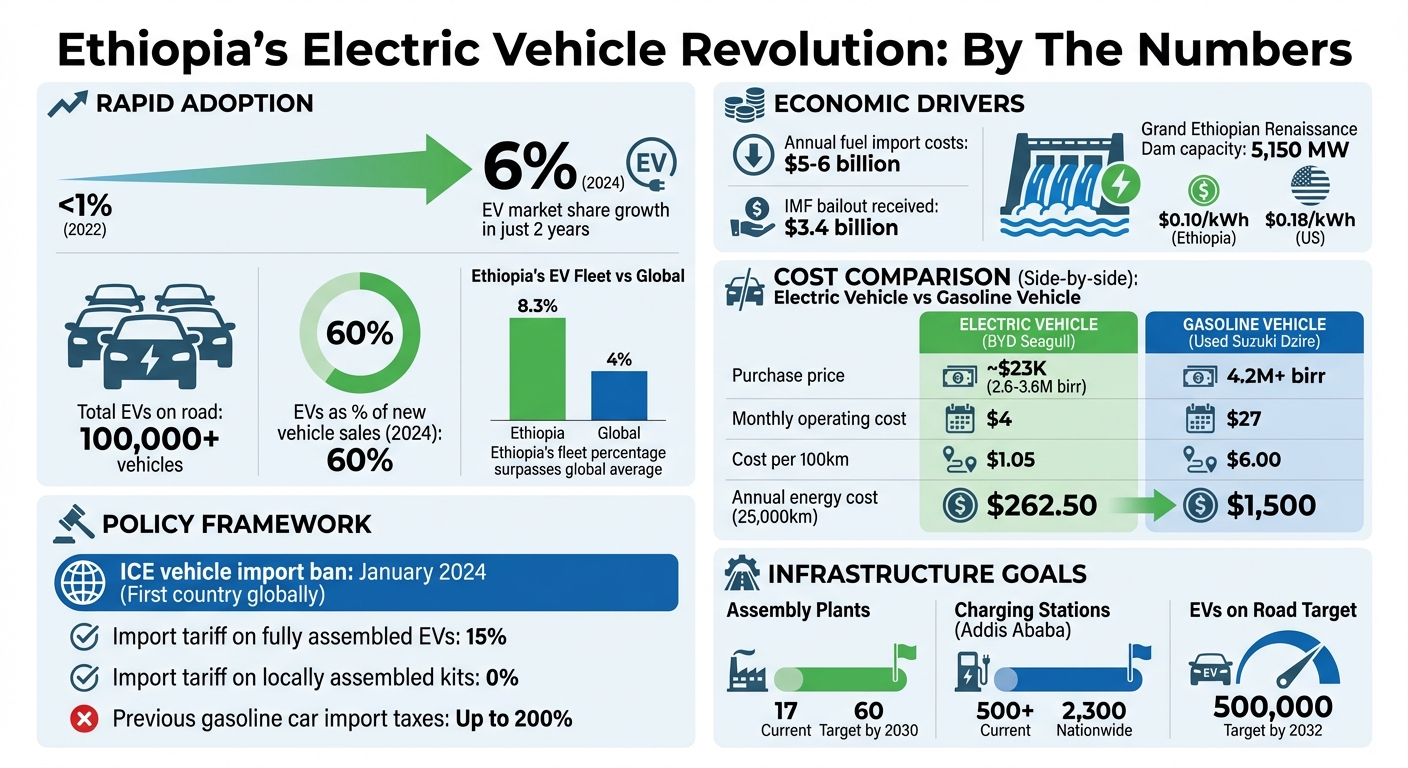
Ethiopia’s Electric Vehicle Transition: Key Statistics and Economic Impact
Transportation and Environmental Problems in Ethiopia
Dependence on Imported Fossil Fuels
Ethiopia’s transportation sector faces significant challenges due to its heavy reliance on imported petroleum. The nation spends over $6 billion each year on fuel imports, a massive financial strain for a country without domestic oil reserves. This dependency has put immense pressure on public finances.
Gasoline subsidies, which have been in place for years, have further drained government resources. At the same time, chronic fuel shortages disrupt daily life. Taxi driver Bethelhem Eshetie shared her struggles in February 2026, explaining how rising fuel prices and the costs of maintaining her aging vehicle forced her to temporarily stop working.
"Our transition to EVs is aimed at ensuring our energy sovereignty. As a net importer of fuel, we are affected by global supply and price fluctuations. In contrast, EVs use electricity, which we produce locally and can price ourselves."
- Bareo Hassen Bareo, Ethiopia’s State Minister for Transport and Logistics
The country’s vehicle market reflects these economic pressures. Around 85% of vehicles on Ethiopian roads are secondhand, with many over two decades old. High import duties – sometimes reaching 200% – and limited foreign currency availability have made purchasing new vehicles nearly impossible for most people. This has created a unique situation where older cars often increase in value over time.
These financial and logistical challenges also contribute to worsening environmental issues.
Environmental Damage from Fossil Fuels
In Addis Ababa, the combination of stop-and-go traffic and old, inefficient vehicles has significantly degraded air quality. Many of these secondhand cars emit thick black smoke, raising public health concerns.
"Most of the cars on the road are secondhand imports, and black smoke is often seen rising from the rear of these vehicles."
The impact goes beyond environmental harm – it directly affects the quality of life for city residents. Outdated vehicles, a lack of strict emissions standards, and worsening urban congestion highlight the urgent need for cleaner transportation solutions. Recognizing the growing economic and environmental toll, the government is ramping up efforts to shift toward electric mobility as a way to address both issues simultaneously.
sbb-itb-99e19e3
Government Policies Promoting Electric Vehicles
Ban on Internal Combustion Engine Vehicle Imports
Ethiopia’s decision to ban the import of internal combustion engine (ICE) vehicles starting in 2024 has dramatically reshaped its automotive market. Dealerships that once showcased used gasoline-powered cars now feature electric models, with brands like BYD and Chang’an replacing the once-dominant Toyota Corollas and Suzuki sedans. The government has set an ambitious goal to have 500,000 electric vehicles (EVs) on the roads by 2032.
"We didn’t know that the government was going to fully back a total ban."
- Jane Akumu, Program Officer, United Nations Environment Programme
This policy doesn’t stop at cars; it also targets two-wheelers. Addis Ababa has ceased issuing licenses for fuel-powered motorbikes and rolled out a plan to convert existing gasoline motorcycles to electric alternatives.
Lower Tariffs and Incentives for EVs
As part of Ethiopia’s push toward greener transportation, the government revamped its tax structure to make EVs more accessible. Previously, gasoline cars faced hefty import taxes of up to 200%, along with a 15% VAT, up to 100% in excise taxes, and a 10% surtax. In contrast, the new structure slashes costs for EVs: fully assembled electric cars are subject to only a 15% customs duty, semi-assembled units face a 5% duty, and completely knocked-down kits for local assembly are entirely exempt.
For instance, a BYD Seagull electric car now costs around 3.6 million Ethiopian birr (approximately $23,000), compared to over 4.2 million birr for a used gasoline-powered Suzuki Dzire. To further encourage EV adoption, banks have introduced more favorable credit terms for potential buyers. The government has also mandated the installation of EV charging stations in fuel stations, car showrooms, and new developments like housing complexes, parks, and hotels.
These policies are not just about affordability; they’re also driving local manufacturing and modernizing public transportation. In March 2026, the Addis Ababa City Administration demonstrated its commitment by purchasing 150 electric minibuses and 100 large electric buses from the Belayneh Kindie Group (BKG). These vehicles, assembled at BKG’s Sheger City plant using parts from Nanjing Golden Dragon Bus, are helping expand local EV assembly and electrify the city’s public transit system.
Using Ethiopia’s Renewable Energy Resources
Hydropower from the Grand Ethiopian Renaissance Dam
Ethiopia is fueling its electric vehicle (EV) transition with clean, locally generated hydropower. The Grand Ethiopian Renaissance Dam (GERD), completed in 2025, produces a massive 5,150 MW of electricity, ranking it among Africa’s largest hydropower projects. By tapping into GERD’s surplus energy, Ethiopia has reduced its reliance on imported fuel, easing the strain on foreign reserves once heavily drained by petroleum imports.
"The solution was stark: stop importing the problem and start using the solution flowing through the Grand Ethiopian Renaissance Dam: hydropower electricity."
- Piet Andries, Author, Newmobility.news
Electric vehicles play a key role in stabilizing the national grid. They absorb surplus power when GERD operates at full capacity, turning excess electricity into a domestic economic asset. This renewable energy advantage not only ensures energy independence but also keeps electricity costs low, further enhancing the appeal of EVs.
Low Energy Costs for Charging Infrastructure
Ethiopia’s abundant hydropower translates into some of the lowest electricity rates in the region. At approximately $0.10 per kilowatt-hour (kWh), electricity in Ethiopia costs about half as much as in neighboring countries and is significantly cheaper than the U.S. average of $0.18 per kWh. This pricing advantage directly reduces the operating costs for EV owners. For instance, running an electric vehicle in Ethiopia costs just $4 per month, compared to $27 per month for a gasoline-powered car.
| Cost Category | Electric Vehicle | Gasoline Vehicle |
|---|---|---|
| Monthly Cost | $4 | $27 |
| Energy Source | Domestic Hydropower | Imported Petroleum |
| Price Stability | Locally Priced | Subject to Global Oil Swings |
This cost structure makes EVs far more affordable for Ethiopian drivers. With "unbelievably cheap" electricity, EV owners avoid the steep fuel expenses that have long burdened motorists. These lower operating costs are a game-changer, making electric mobility a practical and attractive choice for the country’s growing population of vehicle owners.
Building Infrastructure and Local Manufacturing
Expansion of EV Charging Stations
Ethiopia is making strides in building a robust charging network to support its growing fleet of electric vehicles (EVs). By early 2026, Addis Ababa alone is home to over 100 public charging stations equipped with more than 460 chargers. The government has set an ambitious goal of establishing 2,300 charging stations nationwide by 2030, with 1,176 planned for Addis Ababa and 1,054 spread across regional cities.
To streamline this growth, the Ministry of Transport and Logistics introduced EV Charging-System Directive No. 1034/2024 in early 2025. This directive addresses key aspects such as installation standards, safety protocols, and pricing. It also mandates the placement of fast-charging stations every 31 to 75 miles along major highways, ensuring drivers can travel long distances without worrying about running out of charge. As State Minister Bareo Hassen put it, "this expansion reflects Ethiopia’s commitment not only to promoting clean vehicles but also to developing the infrastructure required to support their growth".
Ethio Telecom has also joined the effort, offering AI-powered super-fast charging hubs integrated with the telebirr digital payment system for seamless, cashless transactions. In November 2025, the company opened its third charging hub in Addis Ababa’s Summit–Fyel Bet area. This hub features 16 AI-enabled chargers capable of delivering up to 600 kW, enough to fully charge compatible vehicles in just 15 minutes. Since launching its first two hubs in February 2025, Ethio Telecom has facilitated over 165,000 charging sessions and supplied more than 4.3 million kWh of energy.
The Ethiopian government has made infrastructure development a priority for EV market entrants. Companies importing or assembling EVs locally are required to install charging stations before they can begin operations. Urban planners are also repurposing existing fossil fuel stations into EV charging hubs and including charging facilities in new parking structures.
While the charging network grows, Ethiopia is also ramping up its local EV manufacturing capabilities.
Growth of Local EV Assembly Plants
Ethiopia is currently home to 16 to 17 EV assembly plants, with an annual production capacity of 14,900 cars and 3,500 buses. By 2030, the government aims to increase the number of assembly plants to 60, a key step toward achieving its target of 500,000 EVs on the road by 2032.
To encourage local production, Ethiopia has introduced favorable tariff policies. Import duties on completely knocked-down (CKD) kits are set at 0%, while semi-assembled vehicles incur a 5% tax, and fully built EVs are taxed at 15%. This structure makes local assembly the most cost-effective option for manufacturers, helping to keep EV prices competitive for Ethiopian consumers.
International collaborations are fueling this manufacturing expansion. BYD has partnered with local distributor MOENCO, while the Belayneh Kinde Group (BKG) collaborates with China’s Xiamen Golden Dragon Bus Co Ltd and Chang’an to assemble vehicles locally. In April 2025, BKG launched East Africa’s largest electric bus project in Addis Ababa, delivering 100 fully electric buses to improve urban mobility. These partnerships are helping Ethiopia shift from reliance on second-hand gasoline vehicles to a market where new EVs can compete in price with used internal combustion engine models.
| Manufacturing Metric | Current Status (2025/2026) | 2030 Target |
|---|---|---|
| EV Assembly Plants | 17 | 60 |
| Annual Production Capacity | 14,900 cars + 3,500 buses | Expanding |
| Tax on CKD Kits | 0% | 0% |
| Tax on Fully Built EVs | 15% | 15% |
These coordinated efforts in infrastructure and manufacturing are laying the foundation for Ethiopia’s transition to a cleaner and more sustainable transportation system.
Economic and Market Effects of Electric Mobility
Price Comparison: EVs vs. Gas Vehicles
Ethiopia’s electric vehicle (EV) market has undergone a dramatic shift. New EVs now cost less than used gasoline cars. For instance, the highly sought-after BYD Seagull is priced between 2.6 and 3.6 million birr (about $23,000), whereas a used Suzuki Dzire exceeded 4.2 million birr before the 2024 import ban. This change is largely due to favorable tariff policies and the government’s decision to halt imports of internal combustion engine (ICE) vehicles.
The savings don’t stop at the purchase price. Operating costs for EVs are significantly lower. Driving 100 km costs around $1.05 for an EV, compared to $6.00 for a gasoline car. Over a year (averaging 25,000 km), energy costs for an EV total about $262.50, while gasoline vehicles rack up nearly $1,500. With electricity priced at approximately $0.10 per kWh – half the U.S. average – charging an EV is incredibly economical. Ethiopia’s State Minister for Transport and Logistics, Bareo Hassen Bareo, highlighted this advantage:
"As a net importer of fuel, we are affected by global supply and price fluctuations. In contrast, EVs use electricity, which we produce locally and can price ourselves".
Maintenance costs further tip the scales in favor of EVs. Without the need for oil changes, timing belt replacements, or exhaust system repairs, EV owners save on routine services. Moges Negash, Sales and Marketing Manager at Hallel Cars, observed:
"The majority of our customers are those making the switch from fuel cars to EVs".
Increased competition by mid-2025 has also driven prices down. Models like the BYD Seagull and Toyota bZ4X saw price reductions of up to 1 million birr. Following the import ban, EV adoption surged, jumping from less than 1% to nearly 6% of vehicles on the road within two years. By 2024, EVs made up over 60% of new vehicle sales. Beyond individual savings, private sector initiatives are accelerating this green transition.
Private Sector Investments and Financing Options
The rise of EVs in Ethiopia has spurred private investments, creating a robust ecosystem to support this shift. Currently, the country hosts 17 EV assembly plants, with plans to expand to 60 by 2030. Local manufacturers are collaborating with global companies to meet growing demand, particularly for electric mass transit.
This wave of investment is also transforming Ethiopia’s financial sector. Banks, which were previously hesitant to finance older gasoline vehicles, are now offering loans for EV purchases. Financial analyst Abdulmenan Mohammed explained:
"EVs are a new technology and increasingly being used in the country, so it’s a better opportunity for banks to provide credit".
Government policies are playing a key role in supporting this growth. Free or leased land is being allocated for service centers, and EV importers are required to install charging infrastructure before starting operations. By redirecting the $4.5 billion spent annually on fuel imports toward local green initiatives, Ethiopia is building a self-sustaining ecosystem. This approach combines private investment, supportive policies, and growing consumer interest to strengthen the country’s move toward electric mobility. Together, these efforts are expanding market capacity and cementing Ethiopia’s commitment to sustainable transportation.
Challenges and Solutions for Long-Term Growth
Main Challenges in Scaling Electric Mobility
Ethiopia’s efforts to promote electric vehicles (EVs) face several hurdles that could hinder progress. One notable issue is the disparity in infrastructure. While Addis Ababa enjoys reliable electricity access – over 90% of residents are connected, with approximately 500 charging stations – the situation is far less favorable nationwide. Only 55% of the population has electricity access, and by mid-2025, there were just 13 public charging stations available countrywide. This urban-rural gap poses a significant challenge to expanding EV adoption beyond the capital.
Financial constraints also play a major role. Although EVs are becoming cost-competitive with gasoline vehicles in cities, limited access to credit prevents many Ethiopians from affording the upfront costs. For instance, electric two-wheelers priced between $1,100 and $1,500 are out of reach for taxi riders earning about $6.90 daily. Additionally, the lack of trained mechanics for EV maintenance raises concerns about the long-term viability of owning these vehicles.
Supply chain issues further complicate matters. Ethiopia’s reliance on imported components for its 17 EV assembly plants makes costs unpredictable due to foreign currency shortages and devaluation. On top of that, bureaucratic obstacles – like complex registration processes and restrictions on electric scooters using major roads – limit the practicality of certain EV categories. These challenges underscore the need for targeted strategies to ensure sustained growth.
Solutions for Long-Term Success
Addressing these challenges requires a coordinated, multi-pronged approach. Expanding rural electrification is a critical step. Yizengaw Yitayih, a Sustainable Mobility Expert from the Ministry of Transport, emphasized the importance of international support:
"If we get international loans or grants, we can expand charging stations to rural communities, thereby advancing the adoption of electric vehicles throughout the country".
The government has plans to roll out off-grid solar charging stations roughly every 75 miles (120 km) along major routes, which could significantly improve access in underserved areas.
Improving financial access is another key priority. Partnerships between EV distributors and micro-finance institutions could introduce 20% down-payment plans, making EVs more attainable for a broader audience. Establishing mechanic training centers would also address the skills gap, boosting consumer confidence in EV reliability and maintenance.
Coordination among government agencies is equally important. Shantha Bloemen, Managing Director at Mobility for Africa, highlighted the complexity of aligning various stakeholders:
"It’s not just the ministry of transport; it’s the ministry of energy, industry, local government, and finance, and getting them all together on the same page is slightly difficult".
Achieving a unified approach across these sectors will be essential to creating a cohesive transport ecosystem. Balancing urban and rural electrification efforts while fostering collaboration among key agencies is crucial for Ethiopia to meet its ambitious goal of 500,000 EVs by 2030.
Ethiopia’s fossil fuel car ban is a vision of the future | Zero: The Climate Race
Conclusion
Ethiopia has surpassed its ambitious 10-year goal of 100,000 electric vehicles in just two years, with EVs now making up about 8.3% of its total vehicle fleet – double the global average of 4%. This rapid shift wasn’t just about environmental goals; it was driven by economic realities that spurred bold policy changes, transforming the country’s automotive industry.
The cornerstone of Ethiopia’s success lies in its coordinated policy reforms. In January 2024, the country became the first to ban the import of internal combustion engine vehicles. At the same time, it slashed customs duties on EVs to 0% for locally assembled kits and required importers to invest in charging infrastructure. These decisive measures created a system where electric vehicles became the most practical option.
Ethiopia’s reliance on renewable energy further solidified its electric mobility framework. By leveraging the 5,150 MW of power generated by the Grand Ethiopian Renaissance Dam, the country ensured that its transition to EVs also strengthened its national grid. This approach offers a powerful example for other African nations. For instance, countries like Zambia or Mozambique, rich in hydropower, could channel surplus energy into electrifying their transportation sectors. Similarly, nations with low motorization rates could skip the internal combustion engine era altogether, much like Africa leapfrogged landlines for mobile phones.
FAQs
What happens to existing gas cars after the 2024 import ban?
Ethiopia’s decision to ban the import of gas-powered cars starting in 2024 marks a significant shift toward greener transportation. Over time, this will lead to the gradual phase-out of internal combustion vehicles. To support this transition, the government is rolling out measures like incentives for electric vehicle (EV) buyers, expanding charging infrastructure, and promoting local EV manufacturing.
That said, the path forward isn’t without obstacles. Regulatory challenges and limitations within the local market could slow down the adoption process, making it a complex but critical transformation.
Can Ethiopia’s power grid handle millions more EVs and chargers?
Ethiopia’s power grid is grappling with the demands of supporting millions of EVs and their chargers due to its limited infrastructure. While the government is actively working to expand EV charging networks and boost investments in renewable energy, the grid – particularly in rural regions – faces persistent reliability issues. Efforts to upgrade and electrify the system are in motion, but adapting the grid to handle widespread EV adoption is proving to be a challenging and lengthy endeavor.
How will EV charging and maintenance work outside Addis Ababa?
Ethiopia is working to expand EV charging and maintenance infrastructure beyond Addis Ababa. New regulations mandate that charging stations be available every 50 kilometers along major highways and every 120 kilometers for long-range EVs. These stations will be strategically placed in rural towns and along highways, all while meeting government safety standards.
To address maintenance needs, local providers will play a key role, supported by partnerships with EV manufacturers. This effort aligns with the government’s broader initiative to promote local EV production and assembly, ensuring long-term accessibility and support for EV users across the country.