
 Thabo Nkosi
Electric cars are becoming a competitive option in Africa, especially when considering long-term costs. While they have higher upfront prices, their lower energy and maintenance expenses often make them cheaper to own over time. For example, in Ghana, EVs can cost between 9.4% and 24% less than petrol cars over a 10-year period. Key factors influencing this include:
- Upfront Costs: EVs are more expensive due to battery prices and taxes, while petrol cars are cheaper initially.
- Energy Costs: Charging an EV is about 83% cheaper per mile than fueling a petrol car.
- Maintenance Costs: EVs require less maintenance due to fewer moving parts.
- Government Policies: Tax incentives and subsidies can reduce EV costs, while petrol cars face higher taxes and levies.
Quick Comparison:
| Feature | Electric Cars (EVs) | Petrol Cars (ICEVs) |
|---|---|---|
| Upfront Cost | Higher | Lower |
| Energy Costs | ~5.5x cheaper per mile | Higher, fluctuates with oil prices |
| Maintenance Costs | Lower | Higher |
| Long-Term Savings | Potentially significant | Lower savings |
Government policies and infrastructure improvements, like solar-powered charging stations, are essential for boosting EV adoption. While upfront costs remain a challenge, falling battery prices and rising fuel costs are expected to tip the scales in favor of EVs across Africa in the coming years.
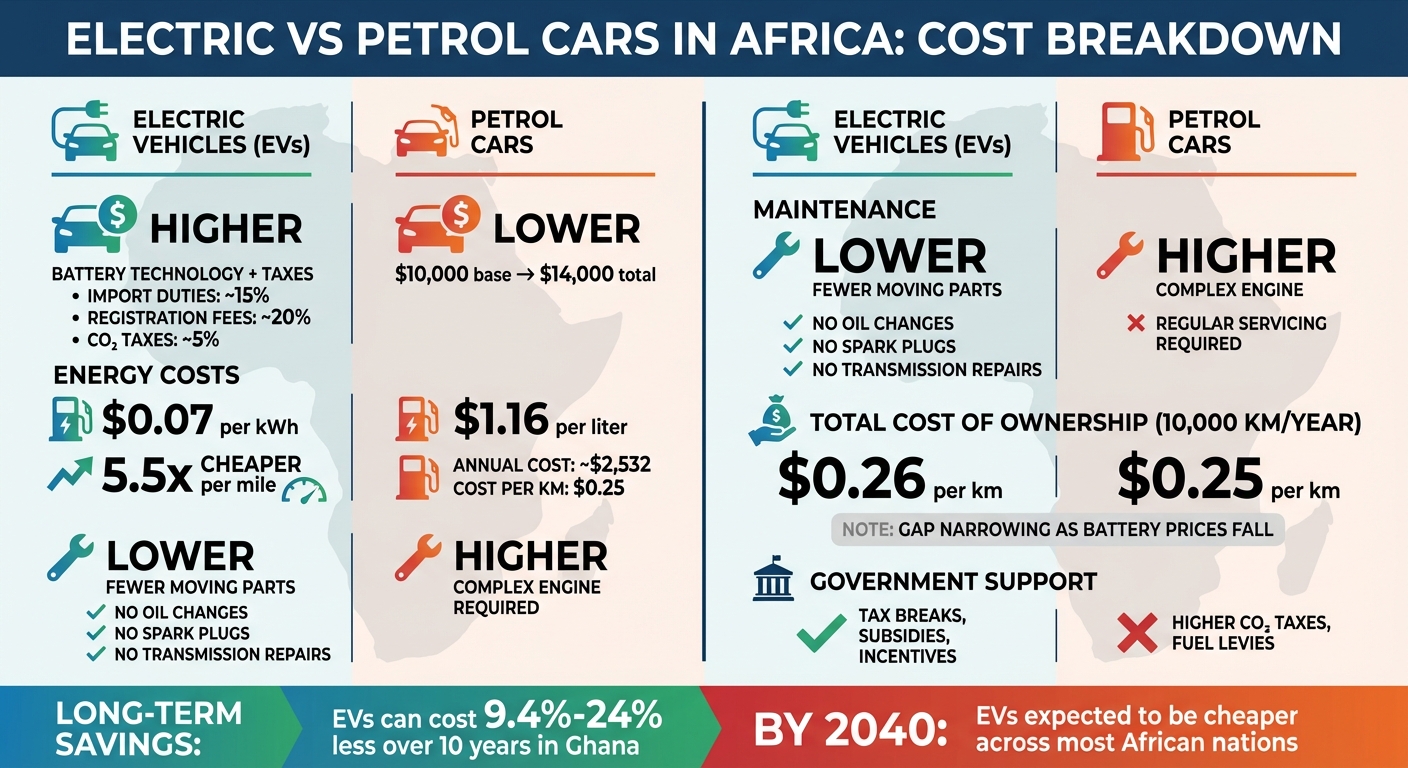
Electric vs Petrol Cars Cost Comparison in Africa
Electric Cars Don’t Make Sense In South Africa
sbb-itb-99e19e3
1. Electric Cars
Let’s take a closer look at the costs associated with electric vehicles (EVs) and how they compare to traditional petrol cars.
Purchase Price
Electric cars often come with a higher upfront price tag, largely due to the cost of battery technology. When you buy an EV, the total price includes the base cost of the car plus taxes like import duties (around 15%), registration fees (about 20%), and CO₂ taxes (roughly 5%). While the initial expense may seem steep, the lower day-to-day operating costs can help balance things out over time.
Energy/Fuel Costs
Charging an EV is much cheaper than filling up a petrol car. On average, electricity costs about $0.07 per kilowatt-hour (including taxes), compared to $1.16 per liter for petrol. According to the International Energy Agency:
a battery and motor combination is much more efficient than an internal combustion engine
This efficiency translates into significant savings on energy costs over the vehicle’s lifetime.
Maintenance Costs
EVs have fewer moving parts than petrol cars, which means fewer things can go wrong. There’s no need for oil changes, spark plug replacements, or transmission repairs, which makes maintenance much less expensive. These savings add to the financial appeal of owning an electric car.
Government Incentives
Governments worldwide are stepping in to make EVs more affordable. Subsidies, tax breaks, and other incentives reduce both the upfront cost and the total cost of ownership (TCO). The International Energy Agency highlights how these policies help offset the higher purchase price, making EVs a more financially attractive option.
2. Petrol Cars
Let’s break down what owning a traditional petrol vehicle looks like across Africa.
Purchase Price
Petrol cars tend to have a lower upfront cost compared to electric vehicles. The total cost includes the base price of the car and taxes. For instance, a petrol car priced at $10,000 can end up costing $14,000 after adding standard taxes. While this lower initial cost might seem appealing, the ongoing expenses can quickly outweigh those savings.
Energy/Fuel Costs
Fuel costs are one of the biggest expenses for petrol cars. In 2019, the average price at the pump was about $1.16 per liter. When looking at the total cost of ownership, a petrol vehicle averaged $0.25 per kilometer, translating to roughly $2,532 annually. A large chunk of this cost comes from government-imposed fuel taxes, which are likely to increase as stricter emission regulations are enforced. Your actual fuel expenses will depend on your car’s fuel efficiency (liters per 100 kilometers) and how much you drive, but the numbers add up fast. And fuel isn’t the only recurring cost – maintenance is another key factor.
Maintenance Costs
Petrol cars are more expensive to maintain compared to electric vehicles, thanks to the complexity of their internal combustion engines. Regular services like oil changes, spark plug replacements, and transmission repairs are unavoidable. However, Japanese brands such as Toyota, Suzuki, and Honda stand out for their affordability in Africa. These brands benefit from widely available spare parts and a strong network of independent mechanics. For example, Toyota Corolla maintenance costs in South Africa are 15% to 20% lower than those for comparable European models.
Government Incentives
On top of these costs, petrol cars don’t benefit from government incentives. Unlike EVs, they don’t qualify for subsidies or tax breaks aimed at reducing emissions. In fact, many African nations are introducing policies that make petrol cars less appealing financially, such as higher CO₂ taxes and fuel levies. This means petrol car owners bear the full cost of ownership, without any financial support or relief that EV buyers might enjoy.
Pros and Cons
Here’s a comparison of key cost factors between electric vehicles (EVs) and petrol-powered cars (ICEVs):
| Feature | Electric Cars (EVs) | Petrol Cars (ICEVs) |
|---|---|---|
| Affordability (Upfront) | Higher due to limited availability in the used market and steeper financing rates | Lower because of broader availability and lower initial costs |
| Energy Efficiency | High – uses electricity directly and benefits from regenerative braking | Lower – much of the energy is wasted as heat during combustion |
| Energy Costs | Roughly 5.5 times cheaper than petrol for the same distance | Higher and subject to fluctuations in global oil prices |
| Maintenance Costs | Lower because of simpler mechanical components | Higher due to regular oil changes and frequent engine repairs |
| Long-term Savings | Strong – lower operational costs can help achieve cost parity over time | Lower – ongoing fuel and maintenance costs accumulate |
This breakdown highlights the financial trade-offs between the two types of vehicles while reflecting trends in automotive markets across Africa.
Upfront costs remain a significant barrier for EV adoption. With higher financing rates, the total cost of purchasing an EV can effectively double. Bessie Noll, Senior Researcher at ETH Zürich, provides an optimistic perspective:
EVs have serious economic potential in most African countries in the not-so-distant future
When looking at the total cost of ownership, estimates show that for an annual driving distance of 10,000 kilometers (about 6,200 miles), battery electric vehicles cost approximately $0.26 per kilometer, compared to $0.25 per kilometer for petrol vehicles. However, as battery prices drop and petrol costs rise, EVs are expected to become more favorable over time.
This comparison sets the groundwork for understanding the broader trends shaping the future of transportation.
Conclusion
Cost analysis reveals that while electric vehicles (EVs) have higher upfront costs, their long-term savings are narrowing the gap with petrol-powered cars. Currently, the total cost of ownership for EVs is $0.26 per kilometer, compared to $0.25 per kilometer for petrol vehicles. This small difference is expected to shift further as battery prices drop and fuel costs rise.
Government policies play a key role in accelerating this transition. Measures like tax cuts, subsidies, and favorable financing terms can significantly influence cost parity. For instance, import duties, registration fees, and CO₂-based taxes can add over 40% to the base price of a vehicle. Countries that reduce these taxes or introduce financial incentives are likely to see faster EV adoption, while high tariffs and financing rates can slow progress. Beyond pricing, infrastructure improvements and alternative energy solutions are also crucial.
Solar-powered charging stations offer a practical way to address grid reliability issues, and projections suggest that by 2040, EVs will be cheaper than petrol cars in most African nations. Nelson Nsitem, Lead Africa Energy Transition Analyst at BloombergNEF, explains:
People will start to pick up these technologies when they’re competitive
Economic stability is another factor shaping this shift. Countries like South Africa, Mauritius, and Botswana, which have relatively stable economies, are seeing cost parity emerge. In contrast, nations with greater economic challenges will need stronger policy interventions to bridge the gap. Additionally, electric two-wheelers are expected to become cost-competitive by 2030, providing an earlier and more affordable option for African consumers.
Platforms like EV24.africa are helping to simplify the decision-making process by offering transparent pricing, detailed specifications, and financing options across 54 African countries. As Kelly Carlin, Manager at Rocky Mountain Institute, points out:
The global trend is unmistakable… the momentum is there
FAQs
How many years until an EV pays back its higher upfront cost?
By early 2026, most electric vehicles (EVs) recoup their higher upfront costs within 3 to 5 years. While their purchase prices tend to be steeper – partly due to import duties and taxes – EVs make up for it with substantial savings. Over a five-year period, owners can save more than $4,600 on fuel costs alone. On top of that, maintenance expenses are typically 30–50% lower compared to traditional gas-powered vehicles. The exact timeframe for breaking even varies based on factors like the specific EV model, how often it’s used, and any available local incentives.
Can I rely on charging access where I live and drive?
Charging access across Africa differs greatly depending on where you are. In urban areas, you’re more likely to find better infrastructure, including public Level 2 chargers and fast-charging stations. However, the costs and reliability of the power grid can vary significantly. On the other hand, rural areas often lack charging stations altogether. Many people in these regions rely on home charging setups or solar-powered solutions, though these can sometimes be inconsistent. Ultimately, whether you can count on charging access largely depends on your location, with urban centers typically offering more dependable options than rural areas.
Which taxes or incentives in my country affect EV costs the most?
Taxes and government incentives play a big role in determining how affordable an electric vehicle (EV) can be. In many African countries, governments are working to bring down EV costs through measures like tax breaks, rebates, and reduced import duties. Take South Africa, for example – it exempts EVs from carbon taxes. Similarly, Kenya and Rwanda have introduced reduced VAT rates and lower import duties on EVs. These kinds of policies help cut down both the initial purchase price and long-term ownership expenses, making EVs a more accessible option for many people.