
 Thabo Nkosi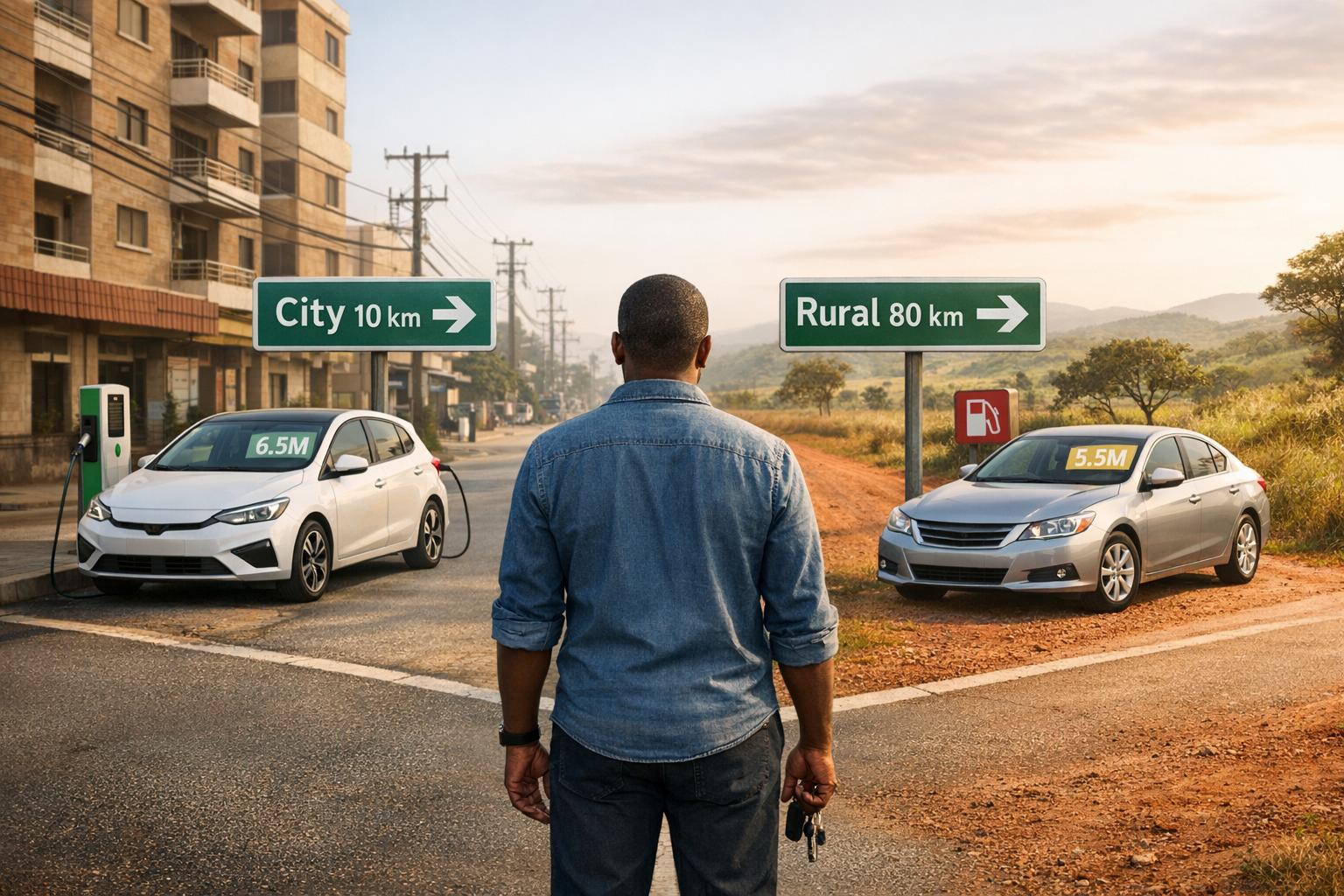
Electric and petrol cars both have pros and cons for buyers in Cameroon. Here’s the quick takeaway:
- Electric Cars: Lower running costs, reduced maintenance, and tax incentives make them appealing for city drivers. However, limited charging stations (only three in the country) and power outages can be a challenge.
- Petrol Cars: Easier to refuel with widespread petrol stations and better for rural or long-distance travel. But they face higher import taxes (up to 200%) and costly maintenance over time.
Key Points:
- Cost: EVs benefit from a 50% import tax rebate and no road tax, while petrol cars face steep taxes and recurring fees.
- Running Costs: EVs cost about CFA 25,200 per month for charging (1,500 km), compared to CFA 49,680 for fuel for petrol cars.
- Maintenance: EVs are simpler and cheaper to maintain due to fewer moving parts.
- Infrastructure: Only three public EV chargers exist, making petrol cars more practical for rural areas.
- Options: Affordable EVs like the Geely Panda Mini start at $5,880, while petrol cars are mostly older imports.
Quick Comparison:
| Feature | Electric Cars | Petrol Cars |
|---|---|---|
| Upfront Cost | Lower with tax rebates | Higher due to 200% import taxes |
| Monthly Running Cost | CFA 25,200 (charging) | CFA 49,680 (fuel) |
| Maintenance | ~30% cheaper | Higher due to frequent servicing |
| Refueling/Charging | Limited (3 public chargers) | Widespread petrol stations |
| Best For | Urban driving | Rural/long-distance travel |
If you drive mostly in cities and have access to home charging, EVs can save you money in the long run. For rural or long-distance travel, petrol cars remain more practical for now.
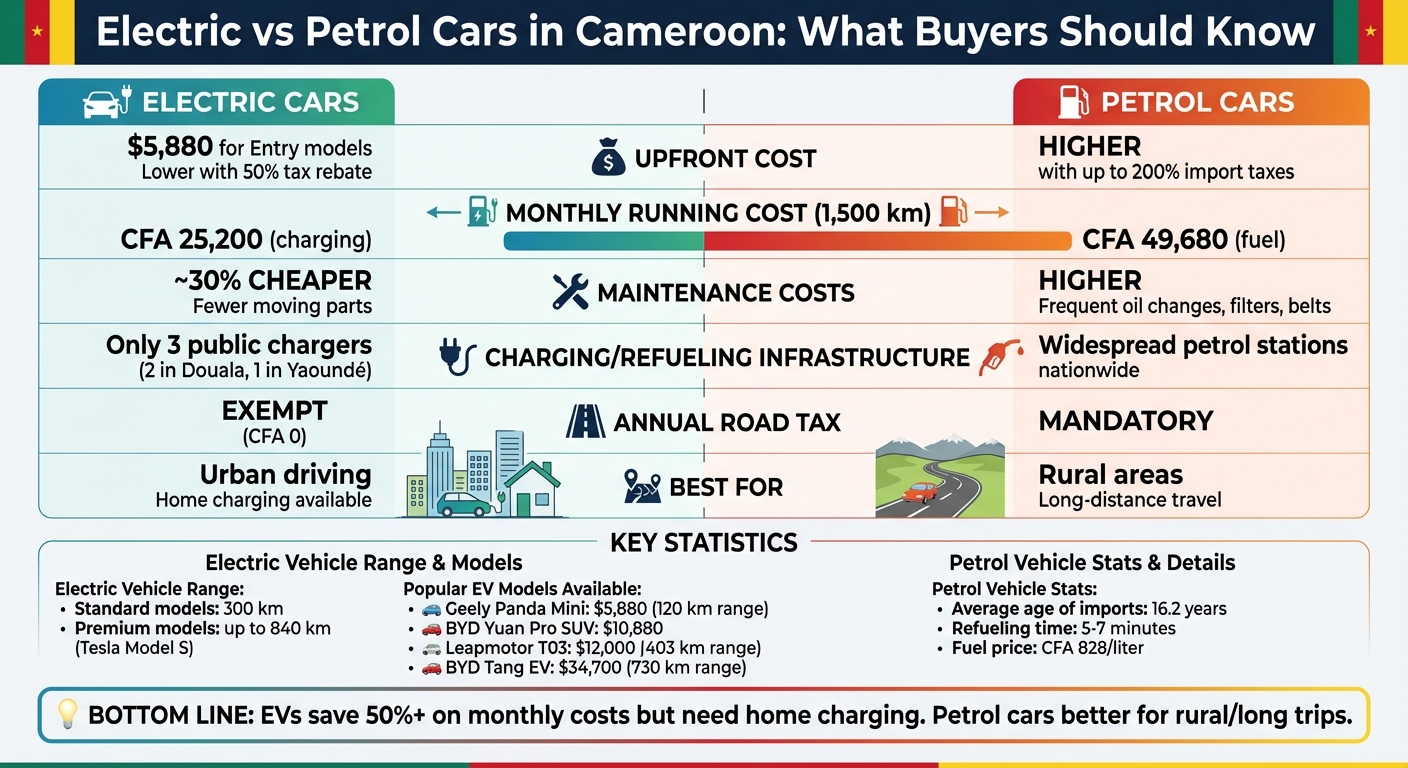
Electric vs Petrol Cars in Cameroon: Cost and Features Comparison
Movin’On Inside Special Edition – Electric Mobility in Africa
sbb-itb-99e19e3
Purchase Price Comparison
The cost of buying a car in Cameroon has seen a major shift, largely due to government policies that create a noticeable price gap between electric and petrol vehicles. Understanding these differences is key to making an informed choice. Here’s a closer look at the purchase prices for both types of vehicles.
Electric Car Prices
Electric vehicles listed on EV24.africa enjoy a 50% reduction in import duties and customs taxes. This tax break significantly lowers the overall cost of bringing an electric car into the country, making them more affordable compared to petrol cars. Brands like Tesla, BYD, Leapmotor, and Geely offer models with varying prices depending on their features. The tax rebate isn’t limited to the cars – it also applies to batteries and charging equipment, reducing the total cost of ownership even further. While the lower upfront cost is appealing, it’s worth noting that these savings extend to operational expenses as well.
Petrol Car Prices
Petrol cars, on the other hand, face a much steeper tax burden. Import taxes can climb as high as 200%, which dramatically increases the price of even the most affordable models. Most petrol cars entering the Cameroonian market are used vehicles with an average age of 16.2 years. Although their base prices might initially seem lower, the heavy taxes quickly drive up the final cost. Additionally, petrol car owners must pay annual road taxes, a recurring expense that electric vehicle owners are exempt from, adding yet another financial consideration to the equation.
Running Costs: Fuel, Charging, and Maintenance
When it comes to ongoing expenses, the gap between electric vehicles (EVs) and petrol cars in Cameroon is striking. While upfront costs vary, the monthly operating and maintenance costs of EVs can be at least 50% lower than those of petrol cars.
Fuel vs. Charging Costs
Let’s break down the numbers. With petrol priced at CFA 828 per liter and an average consumption of 4 liters per 100 km, driving a petrol car costs about CFA 3,312 per 100 km. For a typical monthly distance of 1,500 km, that’s CFA 49,680 spent on fuel.
Now compare that to EVs. Electricity prices in Cameroon range from CFA 50 to CFA 99 per kWh, with an average of CFA 80 per kWh. A typical EV with a 60 kWh battery can travel around 300 km on a full charge. Charging the battery fully requires 60 kWh of electricity, costing CFA 5,040 per charge. To cover 1,500 km in a month, you’d need about five charges, totaling just CFA 25,200. That’s nearly half the cost of petrol!
And that’s just the energy savings – maintenance costs are another area where EVs shine.
Maintenance Requirements
Electric vehicles are far simpler to maintain than petrol cars. They don’t need oil changes, spark plug replacements, timing belt adjustments, or exhaust system repairs. With fewer moving parts, there’s less that can wear out or break down.
In contrast, petrol cars require frequent oil changes, filter replacements, and regular upkeep of belts and other components. These recurring maintenance tasks quickly add up, making petrol cars more expensive to maintain over their lifetime. EVs, with their streamlined design, offer a much more cost-effective ownership experience.
Available Models in Cameroon
Electric Cars on EV24.africa
EV24.africa brings electric vehicles from over 60 brands to the Cameroonian market, including well-known names like Tesla, BYD, and Volkswagen, as well as others such as Leapmotor, Geely, Dongfeng, XPeng, Changan, Wuling, Mercedes-Benz, Citroën, and Peugeot. They handle everything from customs and registration to delivering the car right to your doorstep.
Entry-level models start at just $5,880 with the Geely Panda Mini, which offers a 120 km range. Other affordable options include the Dongfeng NanoBox at $8,300, the BYD Yuan Pro SUV at $10,880, and the Leapmotor T03, priced at $12,000 with an impressive 403 km range.
Mid-range models provide more features and extended range, with prices between $14,000 and $35,000. For instance, the BYD Qin Plus EV starts at $14,180, while the BYD Song Plus EV SUV, offering a 505 km range, is priced at $18,680. For those needing even more range, the BYD Tang EV 2024 comes in at $34,700 and delivers a remarkable 730 km range – perfect for longer trips.
If you’re looking for premium options, the AITO M5 EV is available for $35,330 to $39,410, and the ROX 01 SUV starts at $45,000, featuring cutting-edge technology and high performance. For ultimate luxury and range, the Tesla Model S offers an incredible 840 km of autonomy, with pricing provided upon request.
These prices have been made more attractive by recent government incentives aimed at encouraging EV adoption in Cameroon. While electric vehicles now cater to a wide range of budgets, the market also continues to offer a variety of used petrol cars for those exploring alternatives.
Petrol Car Options
Petrol cars remain the dominant choice in Cameroon, primarily as used imports. While their initial purchase prices are often lower than new electric vehicles, they come with hefty import duties – sometimes as high as 200% of the car’s value. This well-established market provides buyers with a vast selection of makes, models, and price points. However, it’s worth noting that the long-term operating costs of petrol vehicles are significantly higher compared to their electric counterparts.
Performance and Range on Local Roads
Electric and petrol vehicles each bring unique strengths to the table when navigating Cameroon’s roads. For buyers, understanding performance and range is key to making the right choice.
Electric Vehicle Range and Limitations
Electric vehicles (EVs) in Cameroon typically offer ranges of 300 km for standard models with 60 kWh battery packs, and up to 400 km for premium models like the BYD Tang. While these numbers sound promising, the country’s infrastructure poses significant challenges. With only 89 km of road per 1,000 km, and less than 20% of roads paved, EVs often struggle beyond urban centers.
Cameroon’s tropical climate also affects EV performance. High temperatures speed up the chemical processes inside batteries, leading to faster degradation. On average, batteries in hot climates lose capacity 0.4% faster per year compared to those in mild climates. After eight years of use, an EV battery retains roughly 81.6% of its original capacity.
Frequent power outages further complicate EV ownership. Charging schedules can be disrupted, leaving drivers vulnerable to being stranded during extended blackouts.
"Hot climates impose a penalty on battery life, with vehicles operating in hot conditions degrading 0.4% faster per year than those in mild climates." – Charlotte Argue, Senior Manager, Sustainable Mobility at Geotab
For urban commuters with access to home charging, EVs can be a practical solution. However, for rural travel or long-distance trips, range anxiety is a real issue. This is especially concerning in a region where 400 million people in Africa live more than 2 km from an all-season road. Petrol vehicles, by contrast, handle these challenges with ease due to their quick refueling and adaptability to rough terrain.
Petrol Car Performance
When it comes to long-distance and rural driving, petrol cars shine. They can be refueled in just 5 to 7 minutes at any of the numerous petrol stations across Cameroon, supporting the 90% of domestic passenger demand and 75% of goods transport that rely on road travel.
The durability of petrol vehicles is another advantage. The average imported used car in Cameroon is 16.2 years old, a testament to the resilience of petrol engines in the region. While these vehicles may not be as efficient in stop-and-go urban traffic, their ability to handle unpaved roads and reach remote areas makes them an ideal choice for those venturing outside city limits.
Environmental Impact and Government Policies
As debates around cost and performance continue to shape the electric vehicle (EV) market, environmental concerns have become a major driving force. In Cameroon, the government’s strong policies, particularly under the 2025 Finance Law, highlight both the ecological and financial advantages of EVs. While petrol-powered cars release pollutants that degrade urban air quality, EVs operate without producing any tailpipe emissions. This transition aligns with Cameroon’s goals to meet international climate commitments and improve air quality in its cities.
Environmental Benefits of EVs
The pollution caused by traditional vehicles has prompted the government to take decisive action. EVs, which produce no direct emissions, are especially suited for densely populated areas where air quality is a pressing concern. In addition to cleaner air, EVs also offer lower energy and maintenance costs. These environmental and financial benefits are closely tied to the government’s recent measures, which aim to encourage a shift toward EV adoption.
Government Support for EV Adoption
The government has introduced several incentives to make EVs more accessible and affordable. Starting in January 2025, EVs will be fully exempt from the 12.5% excise duty that previously applied to their importation. Additionally, a 50% reduction in the taxable value applies to new EVs, motorcycles, batteries, and charging stations for a period of 24 months. In stark contrast, traditional petrol vehicles face import taxes that can reach as high as 200%.
EV owners will also benefit from the elimination of the annual road tax in 2025, a cost that petrol vehicle owners will still have to pay. On top of that, the government has rolled out subsidies for taxpayers who sign up for EV charging services. Patrocle Petridis, Director General of TotalEnergies Marketing Cameroon, explained that these measures aim to "maintain the state’s purchasing power, facilitate access to new and low-income vehicles for Cameroonian consumers, and strengthen road safety". Similarly, the Ministry of Finance emphasized that these policies are designed to "promote the use of electric vehicles in the transport sector as part of efforts to protect the environment by combating pollution".
| Incentive Type | Electric Vehicles | Petrol Vehicles |
|---|---|---|
| Excise Duty | 0% (Exempted) | 12.5% |
| Import Tax Basis | 50% reduction | Full value (up to 200%) |
| Road Tax | Exempted | Mandatory |
| Maintenance Costs | ~30% lower | Standard rates |
Infrastructure and Ownership Practicalities
In Cameroon, owning an EV or a petrol-powered car comes with its own set of challenges, largely shaped by infrastructure limitations. While government incentives aim to ease some of the financial burden for EV adoption, the country’s charging network lags far behind the well-established petrol station system.
EV Charging Infrastructure
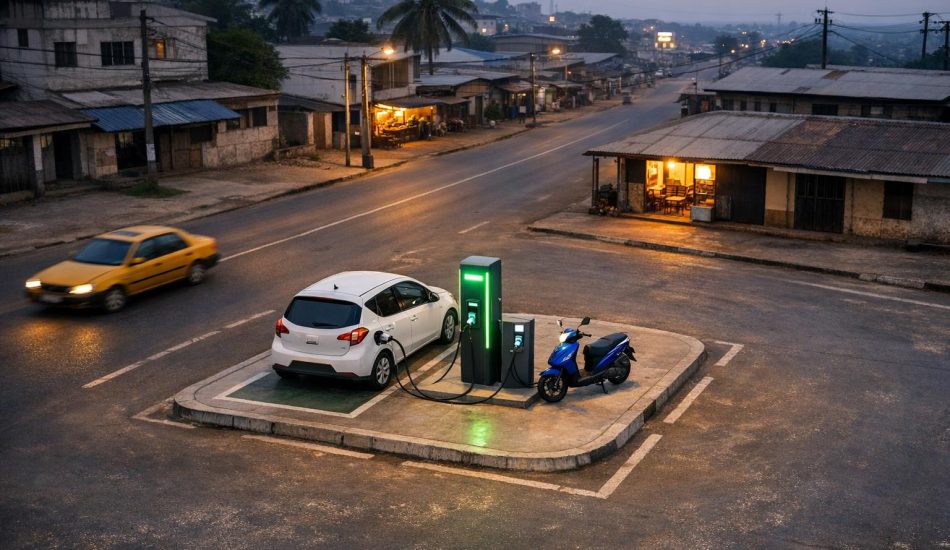
Cameroon currently has just three public EV charging stations – two in Douala and one in Yaoundé. With an electrification rate of only 54%, rural areas are almost entirely left out, making public EV charging outside major cities nearly impossible. For most EV owners, the only realistic option is home charging.
However, home charging comes with its own hurdles. It requires access to private parking and a reliable power supply, which tends to favor urban residents. While the government has taken steps to reduce the cost of charging equipment, installation can still be expensive. Slow chargers might cost a few hundred dollars, but medium-speed units can range anywhere from $10,000 to $50,000.
Petrol Station Accessibility
Petrol cars, on the other hand, have a clear edge when it comes to convenience. Fuel stations are scattered across Cameroon, even in rural and remote areas where EV infrastructure is nonexistent. With petrol priced at roughly CFA 828 per liter, refueling is straightforward and widely accessible. This makes petrol vehicles particularly practical for long trips or travel outside of urban zones. While EV owners must navigate limited charging options, petrol drivers benefit from an established and reliable refueling network.
Financing and Delivery Options
Addressing logistical challenges, EV24.africa offers financing and delivery services tailored to the Cameroonian market. The platform ships vehicles to key ports like the Port of Douala and the Port of Kribi, with delivery costs ranging from $1,500 to $3,500 and transit times of 4–6 weeks.
Shipping EVs, however, involves stricter regulations due to the lithium batteries they use. Compliance with IMO hazardous cargo rules is mandatory, requiring documentation like a Material Safety Data Sheet (MSDS) for the battery and proof that the batteries are undamaged and leak-free. Despite these extra steps, EV24.africa simplifies the process by managing all paperwork and customs clearance. Additionally, the platform’s financing options aim to tackle the high upfront costs that often deter buyers in Africa, where interest rates and risk premiums can be significant obstacles.
Conclusion: Choosing the Right Vehicle for Cameroon
When deciding between an electric vehicle (EV) and a petrol car in Cameroon, your choice boils down to three key factors: cost, performance, and infrastructure. These elements, combined with your driving habits and location, play a significant role in determining the best fit for your needs.
For those living in urban areas like Douala or Yaoundé, EVs offer several advantages, especially if you can charge at home. Monthly running costs for EVs are nearly half those of petrol cars, making them a cost-effective option over time. Additionally, the 2025 Finance Bill introduces a 50% tax rebate on imported EVs and exempts them from road tax, making this an appealing time to consider going electric – provided you have access to stable electricity and a home charging setup.
On the other hand, petrol cars remain the more practical choice for drivers in rural areas or those who frequently travel long distances. With only three public charging stations across the country – two in Douala and one in Yaoundé – the widespread availability of fuel stations makes petrol vehicles far more convenient for road trips or remote locations.
From a financial standpoint, EVs boast about 30% lower maintenance costs and significantly reduced energy expenses over time, though their higher upfront price can be a hurdle for some buyers. Petrol cars, while initially cheaper, are impacted by high import taxes that can reach up to 200%, gradually closing the price gap.
Ultimately, start by evaluating your access to charging. If you have reliable home charging and primarily drive in cities, an EV can help you save money and reduce maintenance hassles. However, if charging access is limited or you frequently drive outside urban centers, a petrol vehicle might be the better option for now. As Cameroon’s charging infrastructure continues to grow, the balance may shift, but for now, your choice should reflect the current realities of the country’s automotive landscape.
FAQs
Can I realistically own an EV in Cameroon without home charging?
Yes, owning an EV in Cameroon without access to home charging can work. Some employers have installed EV charging stations in their parking lots, giving employees a convenient way to charge their vehicles while at work.
How do power outages affect day-to-day EV use and trip planning?
Power outages can throw a wrench in the use of electric vehicles (EVs) by cutting off access to charging stations. This makes it crucial for EV owners to plan their trips thoughtfully. Keeping a close eye on battery levels and charging whenever the opportunity arises can help avoid the risk of being stranded during an outage. A little preparation goes a long way in navigating these challenges and maintaining a smoother driving experience.
What hidden costs should I expect when importing and registering a car in Cameroon?
When bringing a car into Cameroon, the expenses go far beyond just the purchase price. You’ll need to account for import duties and taxes, which depend on factors like the vehicle’s age, value, and engine capacity. On top of that, there are registration fees and customs handling charges to consider. For instance, importing an electric vehicle (EV) typically costs between $2,800 and $4,500, plus a VAT of 19.25% for EVs. Other potential costs include compliance inspections, administrative fees, and a $50 import verification tax for used cars.