
 Thabo Nkosi
Choosing between an electric car (EV) and a petrol car in Botswana boils down to weighing upfront costs against long-term savings. Here’s a quick breakdown:
- Upfront Costs: EVs like the Nissan Leaf cost more initially ($31,500 vs. $29,300 for a Toyota Corolla). Financing conditions in Botswana, however, make EVs more competitive when paying in cash.
- Running Costs: Charging an EV at home is far cheaper (as low as $0.43 per kilometer) compared to petrol cars ($1.52 per kilometer). But public fast chargers are pricey, reducing savings.
- Maintenance: EVs have fewer moving parts, no oil changes, and lower brake wear, saving as much as $7,500 over five years compared to petrol cars.
- Infrastructure: Gaborone has limited public charging options, so home charging is key for EV owners. Petrol cars benefit from a well-established fueling network.
- Driving Needs: EVs are ideal for city commutes, while petrol cars are better for long trips and rural areas.
Quick Comparison
| Factor | Electric Vehicle (Nissan Leaf) | Petrol Car (Toyota Corolla) |
|---|---|---|
| Starting Price | $31,500 | $29,300 |
| Fuel/Charging Cost | $0.43–$0.67/km (home charging) | $1.52/km |
| Maintenance Costs | Lower | Higher |
| Infrastructure | Limited charging stations | Extensive fueling network |
| Best For | City commutes | Long trips, rural areas |
In Botswana, EVs offer long-term savings but require access to affordable home charging. Petrol cars remain a practical choice for those prioritizing convenience and range.
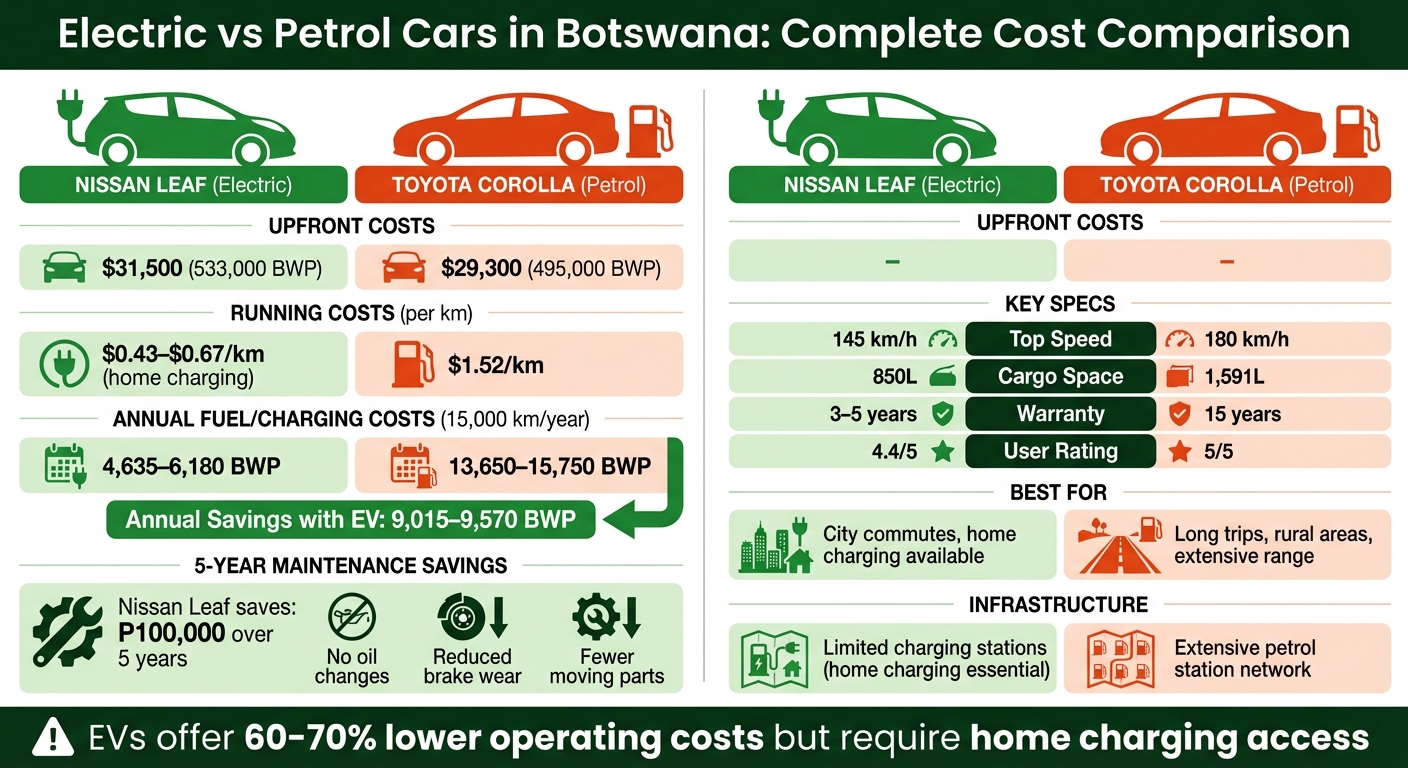
Electric vs Petrol Cars Cost Comparison in Botswana
Botswana’s Electric Vehicle (EV) Revolution led by Green Tech Car

sbb-itb-99e19e3
Purchase Price and Financing Options
Electric cars, like the Nissan Leaf, come with a noticeably higher upfront cost compared to petrol-powered models such as the Toyota Corolla. In Botswana, import duties apply equally to both types of vehicles, and there are no tax breaks specifically for EVs. This means buyers must navigate the full price difference without any financial incentives to bridge the gap.
However, Botswana’s stable economic environment plays a role in financing. For instance, the country’s lower-risk profile creates favorable financing conditions. Research suggests that paying cash upfront (excluding taxes) can make EVs financially competitive with petrol vehicles. This stability minimizes the need for significant reductions in financing costs to level the playing field between EVs and traditional cars.
Next, let’s dive into how the running costs of EVs stack up against petrol cars.
Operating Costs: Fuel vs Charging Expenses
The running costs of electric vehicles (EVs) compared to petrol cars in Botswana show a noticeable difference. Electricity prices range from 1.5 to 2 BWP per kWh, while petrol costs hover between 13 and 15 BWP per liter. This creates a clear cost advantage for EVs.
On the highway, a typical EV uses about 20.6 kWh per 100 km, while a similar petrol car consumes roughly 7 liters per 100 km. This translates to a cost of 30.9 to 41.2 BWP per 100 km for an EV, compared to 91 to 105 BWP per 100 km for a petrol car. Charging at home makes EVs around 60–70% cheaper to operate than petrol vehicles.
A real-world test conducted by MyBroadband in March 2026 highlighted this difference. Driving a GWM Ora 03 GT (with a 63kWh battery) from Pretoria to Gaborone – a 768 km round trip – consumed 158.3 kWh of energy. Using DC fast chargers, the cost was R1.52 per km, which is comparable to a petrol car with a 7L/100km efficiency. However, charging at home with slow AC charging dropped the cost to just R0.43 per km (about 0.31 BWP/km).
For someone driving 15,000 km annually, the savings can really add up. An EV would require about 3,090 kWh, costing between 4,635 and 6,180 BWP per year. In contrast, a petrol car covering the same distance would need approximately 1,050 liters of fuel, costing between 13,650 and 15,750 BWP. That’s a yearly savings of 9,015 to 9,570 BWP if you switch to an EV.
| Cost Component | Electric Vehicle | Petrol Car |
|---|---|---|
| Efficiency | 20.6 kWh / 100 km | 7.0 Liters / 100 km |
| Unit Price | 1.5 – 2.0 BWP / kWh | 13 – 15 BWP / Liter |
| Cost per 100 km | 30.9 – 41.2 BWP | 91.0 – 105.0 BWP |
| Annual Cost (15,000 km) | 4,635 – 6,180 BWP | 13,650 – 15,750 BWP |
| Annual Savings with EV | 9,015 – 9,570 BWP | N/A |
To make the most of these savings, it’s essential to rely on home or slow AC charging. Public DC fast chargers in the region can cost as much as R7.35 per kWh, which significantly reduces the cost advantage. These operating cost benefits pave the way for further comparisons in maintenance expenses over time.
Maintenance Costs Over 5 Years
Electric vehicles (EVs) come with lower maintenance expenses, largely because they have fewer moving parts and don’t require oil or transmission fluid changes.
In contrast, petrol cars demand regular upkeep like oil and filter changes, clutch and transmission repairs, and exhaust system maintenance – all of which EVs completely sidestep. Plus, EVs use regenerative braking, which significantly reduces wear on brake components.
Over a five-year period, EV owners can save around P100,000 compared to petrol car owners, thanks to these reduced maintenance needs. On top of that, EV batteries typically come with warranties lasting 8 to 10 years or over 100,000 miles – far longer than the 3 to 5 years provided for petrol vehicle powertrains. Real-world data reinforces this reliability: for instance, a Volkswagen ID.3 retained 91% of its battery capacity after roughly 107,000 miles of heavy use.
| Maintenance Item | Electric Vehicle | Petrol Vehicle |
|---|---|---|
| Oil changes and filters | Not required | Required every 3,100–6,200 miles |
| Brake System Wear | Reduced via regenerative braking | Standard friction wear |
| Transmission Service | Minimal to none | Regular fluid/gear maintenance |
| Moving Parts | Significantly fewer | Many |
| Battery/Powertrain Warranty | 8–10 years / 100,000+ miles | Typically 3–5 years |
To get the most out of your EV battery and keep costs low, aim to maintain the charge between 20% and 80% for daily use, and reserve DC fast charging for occasional long trips. Most modern EV batteries can last 12 to 15 years in moderate climates, with only a 10% to 20% capacity loss after the first 100,000 miles.
These maintenance savings make EVs an increasingly cost-effective option for drivers in Botswana.
Pros and Cons
When comparing the Nissan Leaf and Toyota Corolla, understanding their strengths and limitations can help you make a choice that fits your driving habits and fueling options. Here’s a breakdown of the key points to consider.
The Toyota Corolla has a lower starting price at $29,300 (495,000 BWP) compared to the Nissan Leaf’s $31,500 (533,000 BWP). However, the Leaf offers lower running costs thanks to its electric powertrain, with charging expenses ranging from $0.43 to $0.67 per kilometer, while the Corolla’s petrol costs average around $1.52 per kilometer. These differences highlight the tradeoff between upfront costs and long-term savings.
Charging infrastructure is another critical factor. In Gaborone, fast AC charging stations are limited, and public DC fast charging can cost as much as $7.35 per kWh, making it almost as pricey as refueling with petrol. This makes home or solar charging a necessity for Leaf owners. On the other hand, the Toyota Corolla benefits from a well-established petrol station network across Botswana and includes a 15-year warranty, adding to its appeal for long-distance and rural driving.
For city driving, the Nissan Leaf stands out with its smooth, quiet ride and impressive torque of 355 Nm, making it ideal for daily commutes. It has an average user rating of 4.4 out of 5, with one reviewer from DriveDuel noting:
"The Nissan Leaf is a practical, easygoing electric hatch that turns daily commutes into a quiet, effortless affair… though those chasing long-distance thrills might look elsewhere."
Meanwhile, the Toyota Corolla offers a 5-star rating, making it a favorite for longer journeys. It boasts a higher top speed of 180 km/h compared to the Leaf’s 145 km/h and nearly doubles the Leaf’s cargo space with 1,591 liters when the seats are folded versus the Leaf’s 850 liters.
| Factor | Nissan Leaf | Toyota Corolla |
|---|---|---|
| Ideal Use | Daily urban commuting, home charging | Long trips, rural areas, versatile use |
| Starting Price | $31,500 (533,000 BWP) | $29,300 (495,000 BWP) |
| Fuel/Charging Cost | $0.43–$0.67/km (home charging) | $1.52/km (petrol equivalent) |
| Infrastructure | Limited; typically home/solar charging | Extensive petrol station network |
| Warranty | 3–5 years | Up to 15 years |
| Top Speed | 145 km/h | 180 km/h |
| Cargo Space | 850 L | 1,591 L |
Conclusion
Choosing between an electric car and a petrol car in Botswana involves weighing upfront expenses against long-term savings on fuel, maintenance, and overall convenience. While electric vehicles come with a higher initial price tag, they can offer notable savings over time, especially when charged at home. In fact, research indicates that in Botswana, financing options can make the costs of electric and petrol vehicles relatively similar when paying in cash. These factors highlight the need to consider how each option fits different driving needs.
For city drivers with reliable access to home charging, electric vehicles can be a smart financial choice – particularly when combined with affordable off-grid solar charging systems. On the other hand, if you often travel long distances or live in areas with limited charging stations, a petrol car may be the better option due to the availability of fueling stations.
To make the most of an electric vehicle, adopting efficient charging habits is key. Following the 80/20 rule – keeping the battery charge between 20% and 80% – can help preserve battery health during daily use. For more details on pricing and financing options for electric vehicles in Botswana, visit EV24.africa.
FAQs
How much does home EV charging equipment cost in Botswana?
Specific details on the cost of home EV charging equipment in Botswana are not readily available. Prices can differ based on the type of charger you choose and the complexity of the installation process.
How far can an EV realistically go on a charge in Botswana conditions?
In Botswana, an electric vehicle (EV) generally covers around 260 km (162 miles) on a single charge. However, driving style and terrain can influence this range. For instance, after traveling this distance, an EV might still have approximately 63 km (39 miles) of range left. Of course, factors like road conditions and energy consumption habits can cause slight variations in these numbers.
When does an EV break even vs a petrol car if I drive 15,000 km a year?
Electric vehicles (EVs) tend to match the cost of petrol cars after covering around 15,000 kilometers per year. This calculation factors in the purchase price, fuel or charging costs, and maintenance. While EVs come with a higher initial price tag, their lower running costs make up for it over time. Plus, battery wear is generally minimal throughout the vehicle’s lifespan, contributing to long-term savings. However, the breakeven point can vary depending on local electricity and fuel prices.