
 Thabo Nkosi
South Africans are increasingly drawn to cars with alternative powertrains, but the choice between electric and hybrid vehicles depends on cost, infrastructure, and lifestyle needs. Here’s what you need to know:
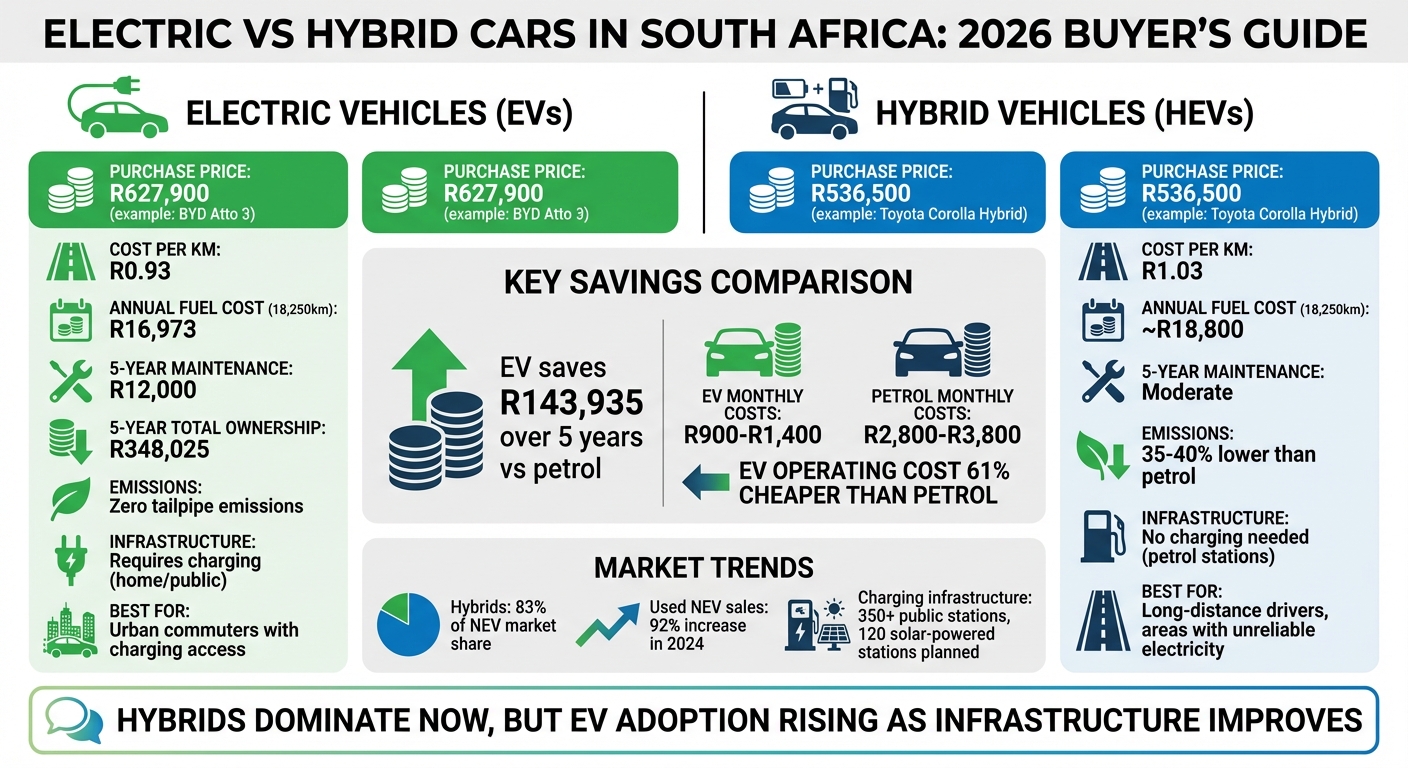
- Electric Vehicles (EVs): Cost less to operate (R0.93/km vs. R2.40/km for petrol), have lower maintenance needs, and produce no tailpipe emissions. However, they are more expensive upfront, rely on charging infrastructure, and face challenges like range anxiety and load shedding.
- Hybrid Vehicles (HEVs): Require no charging, work well with the existing petrol network, and offer better fuel efficiency in cities. They are less expensive than EVs but still produce emissions and have higher maintenance costs due to their dual systems.
Quick Comparison
| Feature | Electric Vehicles (EVs) | Hybrid Vehicles (HEVs) |
|---|---|---|
| Upfront Cost | Higher (e.g., R627,900 for BYD Atto 3) | Lower (e.g., R536,500 for Toyota Corolla Hybrid) |
| Running Cost | R0.93/km | ~R1.03/km |
| Fuel Dependency | None (electric only) | Requires petrol |
| Charging Needs | Yes (home/public charging) | None |
| Emissions | Zero | 35–40% lower than petrol |
| Maintenance | Lower (R12,000 over 5 years) | Moderate to high |
Key Insights:
- EVs are ideal for urban drivers with access to charging and predictable commutes.
- Hybrids suit buyers who travel long distances or live in areas with unreliable electricity.
- South Africa’s new tax incentives and expanding solar-powered charging may make EVs more appealing in the future.
Ultimately, hybrids dominate for now, but EV adoption is on the rise as infrastructure improves and costs decrease.
Electric vs Hybrid Cars in South Africa 2026: Cost and Features Comparison
Electric Cars: Benefits, Drawbacks, and Market Trends
Main Benefits of Electric Cars
Owning a battery electric vehicle (EV) can lead to substantial savings over time. For instance, South African drivers spend about R0.93 per kilometer with an EV compared to R2.40 per kilometer for a petrol vehicle – a 61% reduction in operating costs. For someone traveling 50 kilometers daily, this adds up to an annual fuel savings of approximately R26,827.
Maintenance costs are another area where EVs shine. Over five years, EV owners typically spend around R12,000 on maintenance, while petrol vehicle owners might face bills nearing R45,000. Although EVs often come with a 10% to 15% higher purchase price, this initial premium is usually offset within two to three years through savings on fuel and upkeep.
When looking at the total cost of ownership, EVs prove even more economical. For example, the BYD Atto 3 offers nearly R144,000 in savings over five years compared to a similar petrol-powered model. Monthly ownership costs for EVs range between R900 and R1,400, which is around R1,875 to R2,025 less than comparable petrol cars. These financial benefits are making EVs increasingly attractive to South African consumers.
However, despite these advantages, there are challenges to consider.
Main Drawbacks of Electric Cars
The higher upfront cost remains a major hurdle for many buyers. For instance, the BYD Atto 3 costs roughly R58,000 more than its petrol equivalent.
Another concern is range anxiety – the fear of running out of power without access to a charging station. This worry is particularly strong outside urban areas and has driven a 280% increase in plug-in hybrid electric vehicle (PHEV) sales in 2025, as these models include a backup combustion engine for added reassurance. While charging infrastructure is expanding, it still lags behind the convenience of petrol stations. Issues like load shedding and unreliable power grids further complicate matters, even for solar-powered charging networks.
Depreciation is another factor to consider. For example, the BYD Atto 3 is expected to lose about 60% of its value over five years. Additionally, specialized repair facilities are often concentrated in major cities, potentially causing service challenges for EV owners in smaller towns.
These drawbacks highlight the balancing act buyers face – higher initial costs and potential inconveniences versus long-term savings and environmental benefits.
Comparison Table: Electric Car Pros and Cons
| Feature | Benefits | Drawbacks |
|---|---|---|
| Operating Cost | 61% cheaper than petrol (R0.93/km) | 10–15% higher upfront purchase price |
| Maintenance | R12,000 over 5 years vs. R45,000 for petrol; monthly costs average R100–R200 | Limited specialized repair centers outside major hubs |
| Environment | Zero tailpipe emissions | Environmental impact of battery production |
| Performance | Instant torque and quiet operation | Range anxiety on long-distance trips |
| Charging Infrastructure | Convenient home charging options | Public charging network still developing; risks from load shedding |
| Total Cost of Ownership | Saves nearly R144,000 over 5 years | Higher initial investment |
sbb-itb-99e19e3
Hybrid Cars: Benefits, Drawbacks, and Market Trends
Main Benefits of Hybrid Cars
Hybrid cars are carving out a strong position in the market, offering a practical solution for regions where fully electric vehicles face challenges. In South Africa, for example, traditional hybrids have taken the lead in the electrified vehicle segment, with sales surpassing 3,000 units in early 2024 – far outpacing other new-energy options like battery-electric vehicles.
One of the biggest draws of hybrids is their independence from charging infrastructure. This is a game-changer in areas with unreliable electricity supply, like South Africa, where load shedding is a persistent issue. Unlike EVs, hybrids eliminate the need for charging stations entirely, relying instead on conventional petrol stations for refueling. This makes them a practical choice for buyers who value flexibility and convenience.
Hybrids also shine in urban settings, where stop-and-go traffic is common. Their fuel efficiency in these conditions can lead to significant savings, as the electric motor handles much of the workload.
"Traditional hybrids will help city commuters reduce fuel costs and be able to take a road trip when desired"
Additionally, hybrids feature regenerative braking systems, which reduce brake wear and help lower maintenance costs over time. Another often-overlooked perk is that insurance premiums for hybrids are generally lower than those for fully electric cars, thanks to the availability of parts and their overall reliability.
"Hybrids currently represent the sweet spot when it comes to addressing the needs of South African consumers, with lower prices than battery-electric vehicles, no charging times, and no range anxiety"
All these factors make hybrids an attractive option for consumers looking for a balance of affordability, reliability, and ease of use.
Main Drawbacks of Hybrid Cars
Despite their advantages, hybrids come with their own set of challenges. For starters, the dual-powertrain system – combining an internal combustion engine (ICE) with an electric motor – adds mechanical complexity. This complexity often leads to higher repair costs.
Maintenance is another consideration. Hybrids require regular servicing for both the combustion engine and the electric components, which can drive up long-term costs. Battery replacement is another major expense, as most hybrid batteries have a lifespan of about 10 years.
On highways, hybrids lose some of their efficiency edge. At sustained high speeds, the car relies more heavily on the combustion engine, reducing the fuel savings that make hybrids so appealing in city driving.
The environmental impact of hybrids is also less straightforward than it might seem. While they emit less than traditional petrol cars, hybrids still produce tailpipe emissions and depend on fossil fuels.
"The additional weight drives inefficiency, and the costs to run the vehicle are much higher than a battery-electric model, as it must adhere to standard internal combustion maintenance cycles and carry both a battery and a fuel tank"
These drawbacks highlight the compromises that come with hybrid technology, especially when compared to fully electric vehicles.
Comparison Table: Hybrid Car Pros and Cons
| Feature | Benefits | Drawbacks |
|---|---|---|
| Fuel Efficiency | Significant savings in urban traffic and stop-start conditions | Less economical at highway speeds where the ICE runs constantly |
| Infrastructure | No charging infrastructure required | Still requires petrol; produces tailpipe emissions |
| Range Anxiety | None; refuel at any petrol station | N/A |
| Maintenance | Lower brake wear due to regenerative braking | Complex dual powertrains increasing specialized repair costs |
| Grid Reliance | Complete independence from the electricity grid | N/A |
| Battery Life | N/A | Replacement needed after ~10 years |
| Purchase Price | More affordable than most EVs | Higher upfront cost than conventional petrol cars |
Let’s Talk Electric Episode 4: SA’s new energy vehicle revolution – what 2025 taught us
Electric vs Hybrid Cars: Side-by-Side Comparison
When South African buyers weigh the choice between electric and hybrid vehicles, they often focus on performance, cost, convenience, and environmental concerns. These considerations help determine which option aligns best with their lifestyle and priorities. Beyond the engines powering these vehicles, there are notable differences in running costs, infrastructure demands, and ecological impact.
Running costs are a standout factor. Driving an electric vehicle (EV) costs about R0.93 per kilometer, compared to R2.40 per kilometer for petrol-powered cars. Hybrids, like the Toyota Corolla Hatch, strike a middle ground, averaging R1.03 per kilometer with a fuel consumption rate of 4.3 liters per 100 kilometers. These figures highlight the financial contrast between the options, laying the groundwork for a broader discussion about infrastructure and environmental considerations.
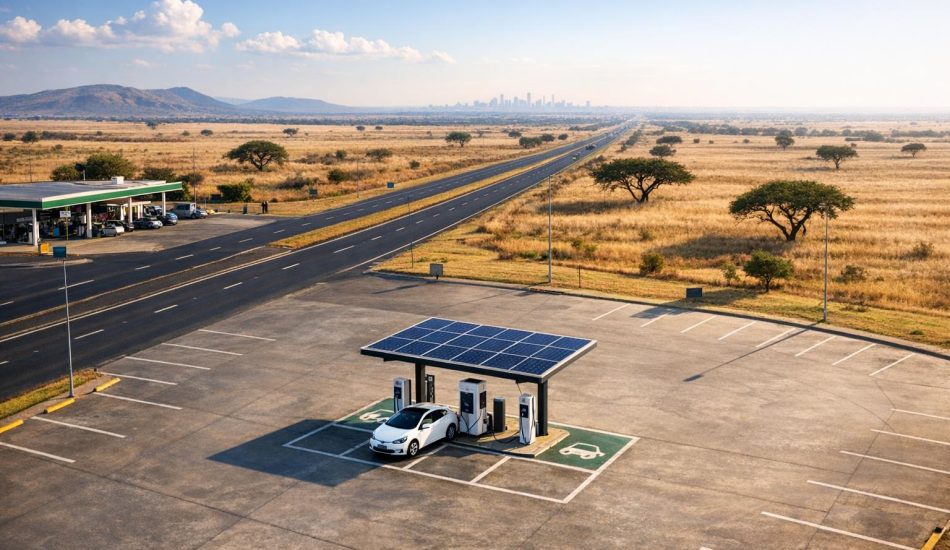
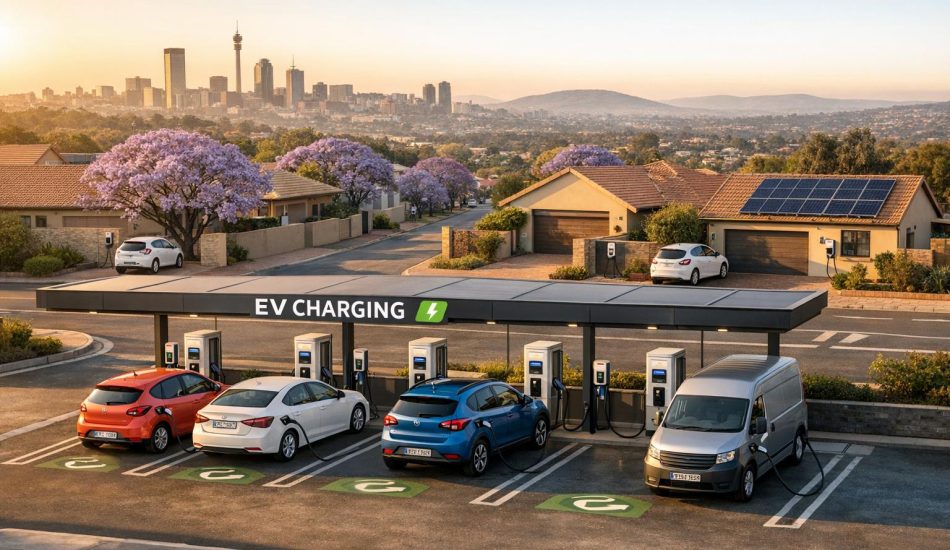
Infrastructure requirements differ significantly. Hybrids have the advantage of relying on South Africa’s extensive petrol station network, while EVs depend on charging infrastructure. Fortunately, charging options are expanding, including off-grid, solar-powered stations that reduce reliance on the national grid. For EV owners, charging at home remains the most practical solution, with a full charge for a 60kWh battery costing about R309 and offering a range of approximately 400 kilometers.
Environmental impact is another critical factor. South Africa’s coal-heavy electricity grid complicates the ecological benefits of EVs. As motoring journalist Jason Woosey points out:
"Reaping the environmental advantages of EV ownership should ideally mean having a solar infrastructure at home. Because what’s the point of a coal-powered car?"
Hybrids, while more fuel-efficient than traditional petrol vehicles, still produce CO₂ emissions and particulates, albeit at levels 35–40% lower than their petrol-only counterparts.
The table below provides a side-by-side comparison of key factors for electric, hybrid, and petrol vehicles:
Comparison Table: Electric vs Hybrid Vehicles
| Factor | Electric Vehicle (EV) | Hybrid (HEV) | Petrol (ICE) |
|---|---|---|---|
| Purchase Price (Entry) | ~R400,000 (Dayun S5) | ~R536,500 (Toyota Corolla Hatch Petrol Hybrid) | <R200,000 |
| Cost per Kilometer | R0.50 – R0.93 | ~R1.03 (est.) | R2.40 – R3.00+ |
| Annual Fuel Cost (18,250km) | R16,973 | ~R18,800 (est.) | R43,800 |
| 5-Year Maintenance | R12,000 | Moderate | R45,000 |
| 5-Year Total Ownership Cost | R348,025 (BYD Atto 3) | N/A | R491,960 (Toyota Corolla Cross) |
| Tailpipe Emissions | Zero | 35–40% lower than petrol | High |
| Infrastructure Needs | Charging station/Solar | None (Self-charging) | Petrol station |
| Resale Value (5-Year) | ~40% (60% depreciation) | ~40% (60% depreciation) | ~40% (60% depreciation) |
| Best Use Case | Urban commuting with home charging | Mixed driving without charging access | Budget-conscious buyers |
What Influences South African Buyer Choices in 2026
Economic and Practical Factors
The financial landscape plays a significant role in shaping buyer decisions. While electric vehicles (EVs) typically cost 10–15% more upfront than comparable petrol models, lower operating costs often offset this within 2–3 years. For instance, the BYD Atto 3 is priced at R627,900, compared to the Toyota Corolla Cross 1.8 petrol model at R569,900. Over five years, the EV incurs total costs of R348,025, significantly lower than the petrol model’s R491,960 – resulting in a savings of R143,935.
Fuel prices, which hit R24.00 per liter in 2026, further sway decisions. Monthly ownership costs for EVs range between R900 and R1,400, while petrol vehicles cost between R2,800 and R3,800. Financing options, such as those offered by EV24.africa, aim to make EVs more accessible for buyers concerned about budget constraints.
Government policies add another layer of complexity. A 150% tax incentive for EV production contrasts with a 25% import duty, creating mixed signals for the market. As Joubert Roux, Co-Founder and Chair of Zero Carbon Charge (CHARGE), aptly puts it:
"You cannot incentivise EV production on one hand and penalise EV adoption on the other."
This interplay of costs, fuel prices, and policy incentives sets the foundation for lifestyle and environmental considerations.
Lifestyle and Environmental Priorities
Beyond economics, lifestyle needs and environmental goals heavily influence buyer preferences. Urban residents with access to home charging find EVs ideal for predictable daily commutes. However, those lacking dedicated parking often lean toward hybrids, which align with South Africa’s well-established petrol station network. To address concerns like range anxiety and load shedding, off-grid solar-powered charging stations are expanding, though their reach is still limited to major cities.
Environmental concerns are another driving force. Hybrids, which cut CO₂ emissions by 35–40% compared to petrol vehicles, appeal to buyers seeking a balance between practicality and sustainability. This middle ground has fueled a surge in hybrid sales, rising from 4,050 units in 2022 to about 6,484 in 2023.
Decision-Making Table: Electric vs Hybrid Buyer Factors
| Decision Factor | Choose Electric If… | Choose Hybrid If… |
|---|---|---|
| Daily Commute | Predictable, shorter commutes with reliable charging access | Longer or less predictable commutes without charging options |
| Budget Priority | Long-term savings matter (R26,827/year saved) | Lower upfront cost |
| Infrastructure Access | Home or workplace charging availability | Reliance on petrol station network |
| Travel Patterns | Mostly urban with occasional long trips | Frequent long-distance or unpredictable routes |
| Environmental Goal | Zero tailpipe emissions | 35–40% emissions reduction without charging hassle |
| Maintenance Costs | Minimal service needs (R12,000 over 5 years) | Moderate service costs |
Conclusion: What South African Buyers Choose in 2026
Hybrids lead the way in South Africa’s used NEV market, making up 83% of sales. These vehicles average a price of R748,096, while BEVs come with a 46% premium. Among hybrids, the Toyota Corolla Cross Hybrid stands out, selling at R439,289.
Electric vehicles are steadily gaining ground, thanks to the expansion of charging infrastructure. With over 350 public charging stations already available and plans for 120 solar-powered chargers in the works, the country is making strides toward supporting EV adoption. A tax incentive set for December 2024 is expected to further lower prices and accelerate this shift. George Mienie, CEO of AutoTrader, highlights this growing trend:
"South Africa’s growing interest in new-energy vehicles highlights the growing appetite towards more sustainable mobility solutions"
The numbers back this up – used NEV sales in 2024 surged by 92% compared to the previous year.
South African buyers face a balancing act between practicality and sustainability. For those with access to reliable home charging and predictable urban driving patterns, electric vehicles offer lower long-term costs. On the other hand, hybrids are a better fit for drivers with inconsistent charging options or those covering long distances, thanks to their immediate fuel savings. Plug-in hybrids provide a middle ground, offering electric driving for city commutes while maintaining the flexibility of a combustion engine for extended trips.
The automotive landscape in South Africa is evolving. Hybrids are the practical choice for now, but as infrastructure improves and costs come down, electric vehicles are poised to take the lead.
FAQs
Can I own an EV in South Africa without home charging?
Yes, owning an EV in South Africa without home charging is possible by using public charging stations. While many EV owners enjoy the convenience of charging their vehicles overnight at home, public charging stations provide a practical solution for those who don’t have access to home charging.
How does load shedding affect EV charging day to day?
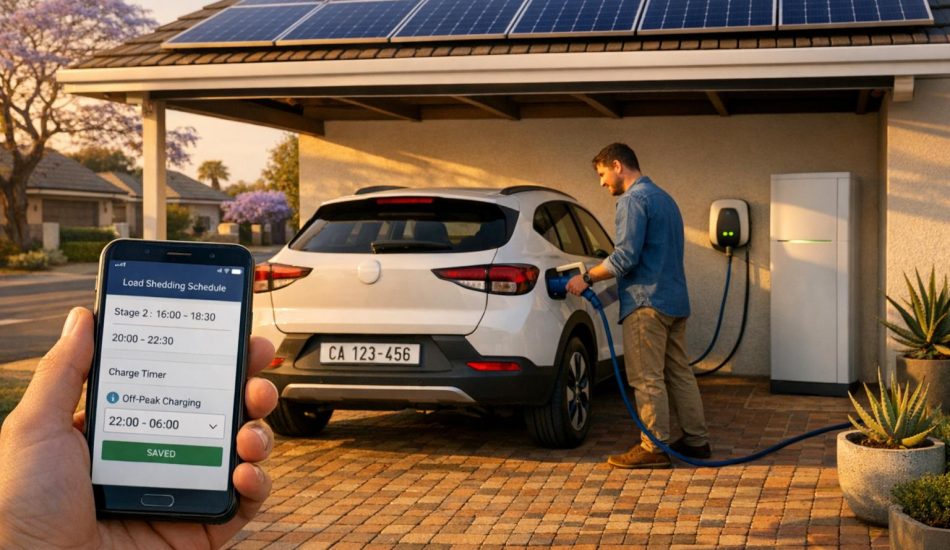
Load shedding in South Africa creates significant challenges for daily EV charging. Frequent power outages disrupt home charging, making it unreliable, and limit access to public charging stations. As a result, maintaining a consistent charging schedule for electric vehicles becomes increasingly difficult.
Which is cheaper over 5 years: an EV or a hybrid?
Over a five-year period, owning an electric vehicle (EV) often proves to be more affordable than a hybrid when considering the total cost of ownership. Although EVs come with higher initial purchase prices, their much lower running costs – approximately R0.93 per kilometer compared to R2.40 per kilometer for petrol vehicles – translate into significant savings on fuel and maintenance. For instance, the BYD Atto 3, an EV, costs around R348,025 over five years, whereas a hybrid like the Toyota Corolla Cross totals approximately R491,960 in the same timeframe.