
 Thabo Nkosi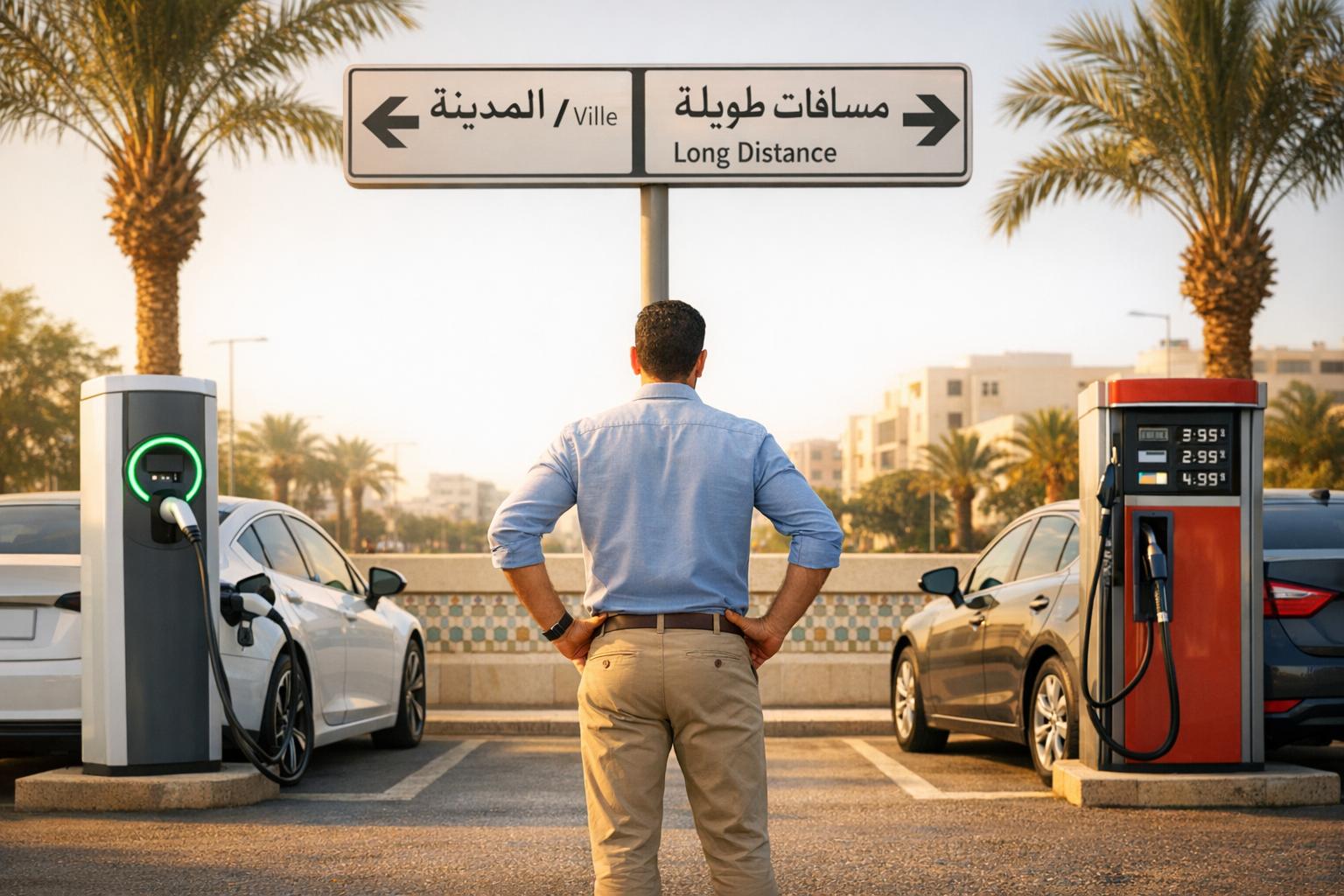
Electric and hybrid cars are gaining traction in Morocco, but which one suits you better? Here’s a quick breakdown:
- Electric Cars: Lower running costs (around 4 MAD/km vs. 10 MAD/km for petrol), government incentives (VAT exemptions, customs duty waivers), and growing infrastructure with 2,500 charging stations planned by the end of 2026. However, higher upfront costs and limited rural charging options may be drawbacks.
- Hybrid Cars: More affordable than EVs, no reliance on charging stations, and ideal for long trips or rural areas due to fuel backup. Though fuel-efficient, hybrids still have higher running costs compared to EVs and aren’t entirely emission-free.
Key Factors to Consider:
- Driving Habits: City driving favors EVs; long-distance travel suits hybrids.
- Budget: EVs save money in the long term, but hybrids are cheaper upfront.
- Infrastructure: EVs depend on charging networks, while hybrids rely on Morocco’s extensive fuel station network.
Quick Comparison:
| Factor | Electric Cars (EVs) | Hybrid Cars (HEVs) |
|---|---|---|
| Upfront Cost | Higher (~$64,034) | Lower (~$48,883) |
| Running Cost | ~4 MAD/km | Moderate (~6–8 MAD/km) |
| Infrastructure | 1,000+ charging stations | Extensive fuel stations |
| Environmental Impact | Zero tailpipe emissions | Reduced emissions |
| Best For | Urban driving | Long-distance/rural trips |
Choose based on your driving needs, location, and budget. Both options help reduce your carbon footprint and align with Morocco’s green goals.
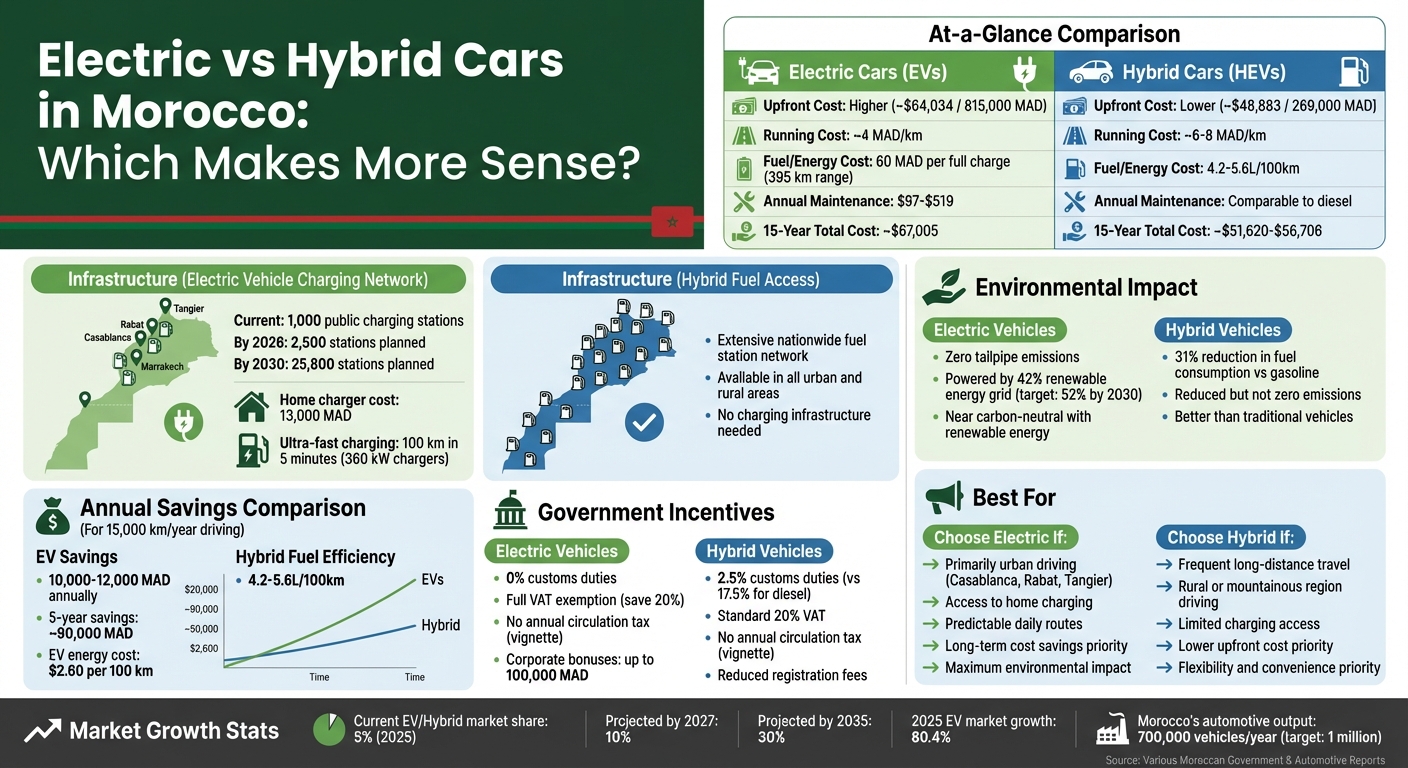
Electric vs Hybrid Cars in Morocco: Cost, Infrastructure & Performance Comparison
Old Ioniq EV Takes on 2500Km Road Trip From France to Morocco
sbb-itb-99e19e3
Electric Cars: What You Need to Know
Electric vehicles (EVs) run entirely on battery power, meaning zero tailpipe emissions and less maintenance due to fewer moving parts. In Morocco, the EV market is gaining momentum with local models like the Citroën Ami and Opel Rocks-e, alongside imports from brands such as Tesla, BYD, and Renault. Let’s dive into how costs and infrastructure are shaping EV ownership in Morocco.
Purchase Price and Maintenance Costs
EVs come with a hefty price tag upfront. For example, entry-level options like the Dacia Spring are priced at around 223,500 MAD, while high-end models such as the BMW i4 and Audi e-tron can cost approximately 815,000 MAD and 1,050,000 MAD, respectively. However, government incentives, including tax exemptions and lower import duties, help soften the blow.
On the flip side, running costs are much lower. Charging a Renault Zoe (with a 52 kWh battery) costs about 60 MAD for a range of up to 395 km, with electricity priced at roughly 1.15 MAD/kWh. This translates to an estimated 4 MAD/km (including maintenance), compared to 10 MAD/km for petrol cars. For someone driving 15,000 km a year, this could mean savings of 10,000–12,000 MAD annually, adding up to around 90,000 MAD over five years.
Installing a home charger costs about 13,000 MAD, and adding solar panels can further reduce charging expenses. Combined with Morocco’s growing charging infrastructure, EV ownership is becoming increasingly practical.
Charging Stations in Morocco
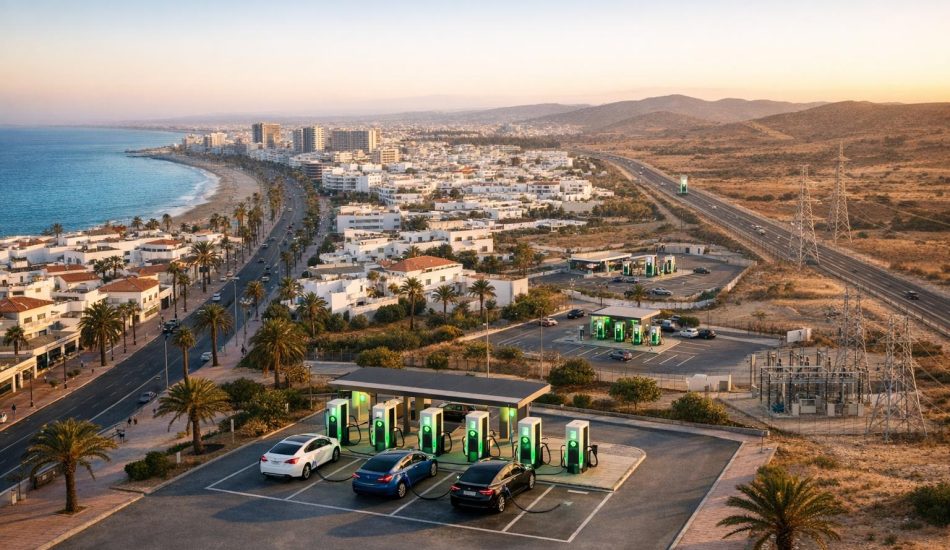
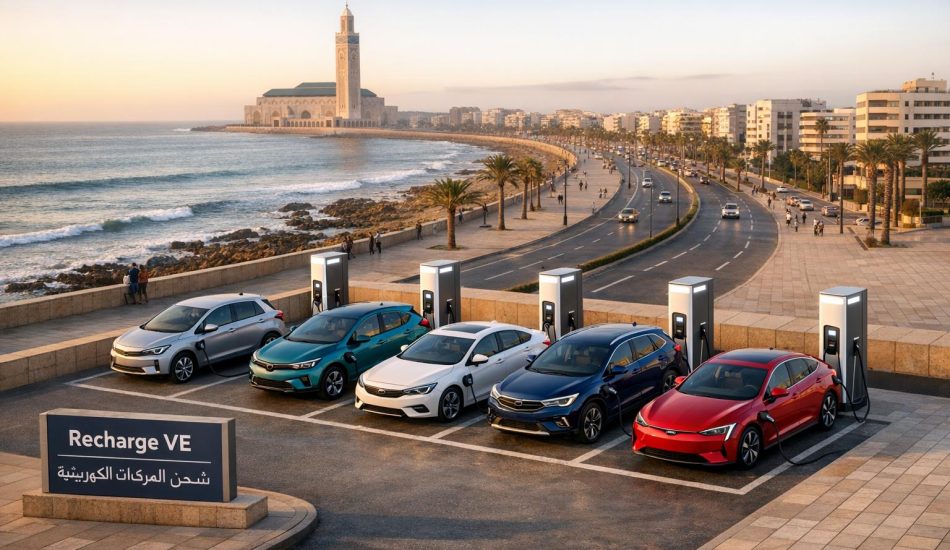
Morocco currently has around 1,000 public charging stations, with most located in Casablanca, Rabat, Tangier, and Marrakech. Plans are in place to expand this network to 2,500 stations by the end of 2026. Partnerships with fuel companies like Afriquia are introducing fast chargers (50–100 kW) along major highways, making inter-city travel more convenient.
FASTVOLT, for instance, operates over 200 charging connectors across 65 stations nationwide. Notably, Morocco’s first 360 kW ultra-fast charger, capable of adding 100 km of range in just 5 minutes for compatible models like the XPENG G9, is now operational.
"Charging infrastructure can now match the performance of modern electric vehicles. This alignment… is exactly what African markets need to unlock large-scale EV adoption."
- Younes Rabeh, African EV Market News
While cities are seeing rapid growth in charging infrastructure, rural areas still lag behind, creating potential range anxiety for longer trips. Tools like interactive maps and apps can help locate chargers, although home charging remains the most reliable solution for daily needs.
With these developments, EVs are gaining traction not just as cost-efficient alternatives but also as environmentally friendly options.
Environmental Impact
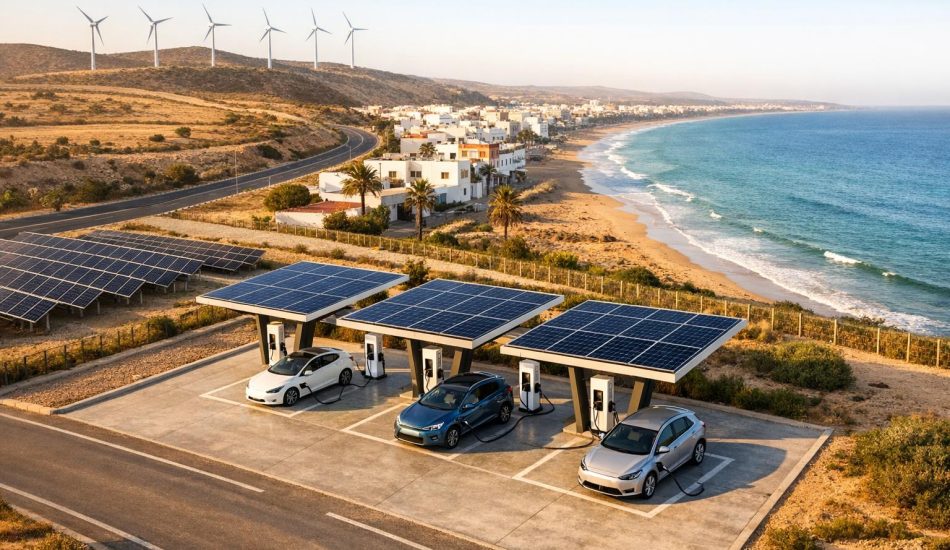
Electric vehicles eliminate tailpipe emissions, which helps cut down urban air pollution. When powered by Morocco’s renewable energy grid – which reached 42% renewable energy in 2020 and aims for 52% by 2030 – EVs come close to being carbon-neutral. Even with the current energy mix, they still have a smaller life-cycle carbon footprint compared to petrol or diesel cars.
Transportation accounts for 23% of Morocco’s CO₂ emissions, making the shift to electric mobility a key part of the country’s green goals. Morocco’s commitment to reducing carbon emissions by 42% by 2030 aligns with the adoption of EVs. Models like the BYD Tang EV, offering ranges between 400 and 528 km, are ideal for highway travel between cities while contributing to lower emissions overall.
Hybrid Cars: What You Need to Know
Hybrid vehicles combine a gasoline engine with an electric motor, offering extended range without depending entirely on charging stations. Unlike fully electric vehicles (EVs), hybrids don’t rely on a charging network. When the battery runs low, the gasoline engine takes over, and regenerative braking helps recharge the battery. This makes hybrids a practical option for Moroccan drivers seeking better fuel efficiency without the hassle of finding charging stations.
Purchase Price and Fuel Efficiency
While hybrids typically cost more upfront than traditional gasoline cars, they’re generally less expensive than most EVs. For instance, the MG HS Hybrid+, introduced in November 2025, starts at 269,000 MAD for the base model and 299,900 MAD for the Ultimate trim. Government incentives – such as exemptions from VAT, registration taxes, and the annual road tax (Vignette) – help make hybrids more affordable.
The real financial advantage comes from fuel savings. The Hyundai Ioniq Hybrid uses around 4.2L/100km, the Toyota Corolla Hybrid about 4.5L/100km, and larger models like the Toyota RAV4 Hybrid average 5.6L/100km. For drivers covering 2,000–3,000 km each month, these efficiencies translate into significant savings, particularly with gasoline priced at 12.02 MAD per liter as of January 2026.
"The HS Hybrid+’s ability to run on electric power alone during stop-and-go conditions [is] particularly valuable… potentially [saving] hundreds of dirhams for drivers covering 2,000-3,000 km per month." – 234Drive Review
Hybrids shine in urban settings. Their electric motors take over during stop-and-go traffic, while regenerative braking recaptures energy, reducing brake wear and lowering maintenance costs. Combined with their accessibility to fuel stations, hybrids offer a cost-effective and convenient solution for Moroccan drivers.
Fuel Station Availability
One of the biggest advantages of hybrids in Morocco is their ability to refuel at any of the country’s numerous fuel stations. Unlike EVs, which depend on charging points concentrated in major cities, hybrids are well-suited for travel to rural areas, mountainous regions like the Rif Mountains, or desert destinations with limited charging infrastructure.
"The trend towards EVs and hybrids is relatively recent in Morocco… but the trend is now very clear – the market is moving more and more towards hybrids and EVs." – Salma Moukbil, General Manager of Jameel Motors Morocco
This flexibility is especially beneficial for drivers who frequently travel between cities or venture off main highways. With a built-in fuel backup system, hybrids ensure convenience and reliability.
Environmental Impact
Hybrids offer reduced emissions compared to traditional gasoline or diesel vehicles, even though they aren’t entirely emission-free. For example, the MG HS Hybrid+ boasts a 31% reduction in fuel consumption compared to standard gasoline models, which directly lowers CO₂ emissions. This makes hybrids a practical choice for drivers looking for a greener option without fully committing to EVs.
Morocco’s automotive market is also shifting away from diesel, which once dominated 96% of new vehicle sales. Major brands like Toyota have phased out diesel options. Currently, hybrids and EVs make up about 5% of new vehicle purchases, with projections suggesting this figure will double by 2027.
Electric vs Hybrid: Direct Comparison
Cost Breakdown
In Morocco, the average price of battery electric vehicles (BEVs) is about $64,034, while hybrid electric vehicles (HEVs) cost significantly less at $48,883 – roughly $15,000 cheaper. Conventional gasoline cars, on the other hand, are priced even lower, averaging around $38,565. Among the more affordable electric options, the Dacia Spring starts at 215,000 MAD (around $21,500), and the BYD Seagull is available for about 199,900 MAD (around $20,000).
Both BEVs and HEVs benefit from tax incentives like VAT exemptions and reduced customs duties. BEVs also have an edge in maintenance costs, which range between $97 and $519 annually due to their simpler mechanical systems. In contrast, HEVs incur higher maintenance expenses, comparable to those of diesel vehicles.
| Cost Factor | Electric Cars (BEV) | Hybrid Cars (HEV) |
|---|---|---|
| Average Purchase Price | ~$64,034 | ~$48,883 |
| Annual Maintenance | $97 − $519 | Comparable to Diesel |
| VAT Exemption | Yes (10–20%) | Yes (10–20%) |
| Customs Duties | Exempt | Reduced (e.g., 2.5%) |
| Fuel/Energy Cost per 100 km | Lowest (Electricity) | Moderate (Fuel + Electric) |
| 15-Year Ownership Cost | ~$67,005 | ~$51,620 – $56,706 |
Over a 15-year period, BEVs are estimated to cost around $67,005 in total ownership expenses, while HEVs range from $51,620 to $56,706. Although BEVs have lower running costs, their higher purchase price keeps their overall expenses higher in the long run.
This financial perspective sets the stage for evaluating the infrastructure available to support these vehicles.
Infrastructure Availability
Morocco has approximately 1,000 public charging stations, primarily located in urban areas like Casablanca, Rabat, and Tangier, as well as along the Tangier-Agadir highway. The government has plans to expand this network to 2,500 stations by 2026 and to 25,800 by 2030. However, rural and mountainous regions, such as the Rif or Sahara, remain underserved.
Hybrids sidestep this issue by relying on Morocco’s extensive fuel station network, which covers both cities and remote areas. This makes hybrids a more practical choice for long-distance travel. While EV owners can install home charging units – averaging around 13,000 MAD (about $1,300) – this solution isn’t feasible for everyone, particularly for those living in apartments.
| Infrastructure Aspect | Electric Vehicles | Hybrid Vehicles |
|---|---|---|
| Home Charging | Available (~13,000 MAD) | Not Applicable |
| Public Charging Stations | ~1,000 (mostly urban) | Not Required |
| Fuel Stations | Not Applicable | Widely Available Nationwide |
| Long-Distance Travel Support | Constrained by Charging Availability | Fully Supported |
Daily Driving and Practicality
Daily usability often depends on where and how the vehicle will be used. In cities such as Casablanca and Rabat, where charging networks are expanding, electric vehicles shine with their lower operating costs. For instance, fully charging a Renault Zoe with a 52 kWh battery costs about 60 MAD (around $6) at an average electricity rate of 1.15 MAD/kWh.
However, range anxiety becomes a challenge during longer trips, as charging stations outside urban centers are limited. Hybrids alleviate this concern with their fuel backup systems, offering peace of mind for extended journeys. As of 2023, internal combustion engine vehicles dominate Morocco’s market, making up 99.77% of the fleet, while hybrids and EVs account for just 0.19% and 0.04%, respectively.
"For longer trips across the country, especially towards destinations like the Sahara or the Rif Mountains, a hybrid vehicle offers more peace of mind thanks to its fuel backup system." – Clooper
Electric vehicles are ideal for urban drivers with predictable routes and access to charging stations, while hybrids provide flexibility and reliability for those navigating Morocco’s varied terrain and infrastructure challenges.
Government Support and Market Growth in Morocco
Tax Breaks and Government Programs
Morocco has been offering generous tax incentives for electric and hybrid vehicles since 2017. Electric and hybrid cars are exempt from the annual circulation tax (vignette), a recurring cost for traditional car owners. On top of that, electric vehicles (EVs) enjoy 0% customs duties and complete VAT exemptions – avoiding the usual 20% VAT applied to gasoline and diesel cars. Hybrid vehicles also benefit from reduced customs duties of 2.5%, compared to the 17.5% rate for diesel vehicles.
To qualify for these perks, buyers need to provide a Certificate of Conformity (CoC) and ensure their vehicle aligns with Morocco’s technical standards. Even with a small parafiscal tax of around 0.25% on imports, the savings are substantial. For example, a $25,000 gasoline car could face taxes between $8,000 and $13,750, while a $25,000 EV might only cost $200–$800 in taxes. Additionally, corporations transitioning to EV fleets can receive purchase bonuses of up to 100,000 MAD (approximately $10,000).
| Vehicle Type | Customs Duty (%) | VAT Status | Other Incentives |
|---|---|---|---|
| Electric Vehicles (EVs) | 0% | Full Exemption | No circulation tax; Potential CO₂ credits |
| Hybrid Vehicles | 2.5% | 20% (Standard) | No circulation tax; Lower registration fees |
| Diesel Vehicles | 17.5% | 20% (Standard) | None |
This supportive fiscal framework is driving Morocco’s transition to greener transportation and encouraging market growth.
Market Growth Predictions
Morocco’s EV market is expected to grow by 80.4% in 2025, with market penetration climbing from 1.9% in 2024 to 3.4% by 2026. Experts predict that EVs and hybrids will make up 30% of the market within the next decade.
The country is also evolving into a key EV producer. In October 2025, Neo Motors introduced the "Dial-E", Morocco’s first fully locally designed electric car, with mass production set to kick off in January 2026.
Industry and Trade Minister Ryad Mezzour highlighted Morocco’s automotive achievements:
"Thanks to the royal vision, Morocco has reached an output of 700,000 vehicles annually and aims to surpass the 1 million mark by the end of this year".
Anari Energy further emphasized Morocco’s leadership in the EV space:
"Morocco is well-positioned to lead Africa’s electromobility transition, supported by progressive policies, a growing EV market, and renewable energy leadership".
Infrastructure development is also ramping up. The government plans to install 2,500 charging stations by 2026 and expand that number to 25,800 by 2030. Additionally, private Moroccan companies have pledged $140 million to set up 5,000 charging stations by 2028, focusing on highways and public areas. On the production side, Morocco is joining an elite group of five countries worldwide with an integrated battery value chain, with battery cell production slated to begin by June 2026.
These combined efforts – from tax incentives to infrastructure and manufacturing – are creating a fertile environment for Morocco’s EV market to thrive.
Which Car Should You Choose?
Final Recommendations
If most of your driving happens in cities like Casablanca, Rabat, or Tangier, and you have the ability to charge at home, an EV might be the way to go. With energy costs averaging about $2.60 per 100 km and yearly maintenance around $600, the five-year total cost of ownership for an EV is nearly the same as a hybrid – approximately $58,620 for an EV compared to $58,800 for a hybrid. While the $13,000 installation cost for a home charging station is a steep upfront expense, it can be balanced out by long-term savings. For instance, drivers covering around 15,500 miles annually could save about $1,900 per year on energy costs.
On the other hand, a hybrid might suit you better if your driving often involves longer trips between cities or you live in areas with limited charging infrastructure. Hybrids eliminate the worry of running out of charge, thanks to Morocco’s well-established fuel station network. This makes them a reliable option for extended journeys, whether you’re traveling to the Sahara or exploring the Rif Mountains. Additionally, hybrids generally come with lower initial costs compared to EVs.
These recommendations are based on Morocco’s current automotive landscape, as outlined in the cost and infrastructure comparisons above. Choosing between an EV and a hybrid should depend on your driving habits and the availability of charging or fueling options in your area. Both options contribute to reducing your carbon footprint, especially with Morocco’s 40% renewable energy grid.
FAQs
How much range do I really need for driving in Morocco?
When choosing an EV, consider the range based on your usual driving habits. For city commutes in places like Casablanca, Rabat, or Marrakech, a range of about 117 km (73 miles) should cover your needs comfortably. However, if you often travel longer distances or venture into rural areas, aim for a range of 150-200 km (93-124 miles) to ensure more flexibility. Alternatively, hybrids can be a smart choice for extended trips or regions where charging stations are scarce, as they provide a longer range and added convenience.
Can I own an EV in Morocco if I live in an apartment?
Yes, owning an EV in Morocco is entirely feasible, even for those living in apartments. While setting up a home charging station might involve working with your building management or arranging for a private charger installation, there’s good news: public charging networks are steadily growing in urban areas. On top of that, government initiatives, such as exemptions from VAT and customs duties, have made EVs more accessible. As charging options continue to improve, owning an EV in an apartment is becoming a more practical choice.
Which option holds its resale value better in Morocco: EV or hybrid?
In Morocco, hybrid cars tend to hold their resale value much better compared to electric vehicles. On average, hybrids retain about 90% of their value over time, whereas EVs typically hold onto only 49%. This makes hybrids a more dependable option for anyone focused on maintaining resale stability.