
 Thabo Nkosi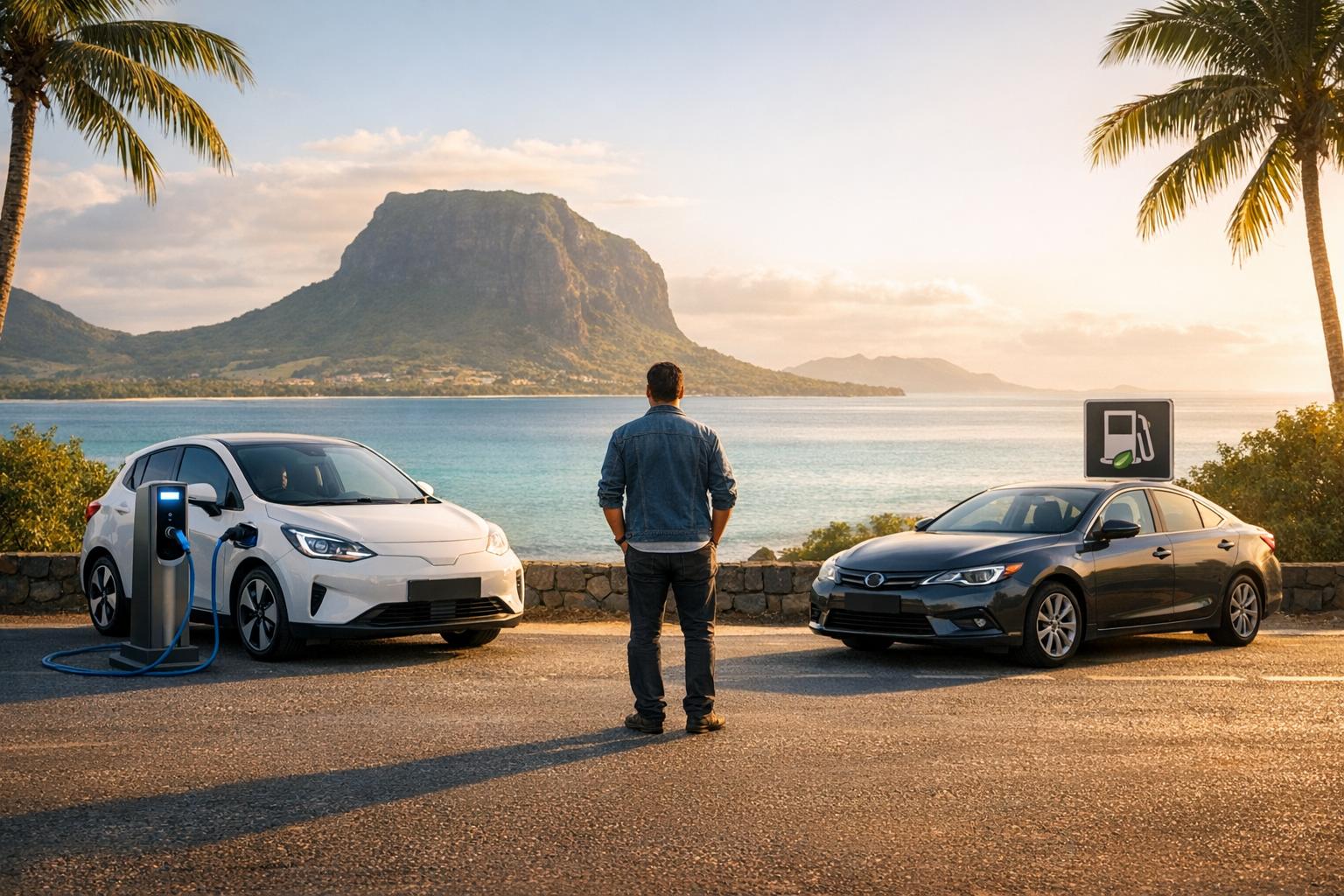
Choosing between electric and hybrid cars in Mauritius comes down to your driving habits, access to charging, and budget. Here’s a quick breakdown:
- Electric Cars (EVs): Fully powered by batteries, they have no fuel costs and lower maintenance. Ideal for daily commutes (average 37 miles/60 km in Mauritius) and zero emissions. However, charging infrastructure is still limited, and upfront costs can be high.
- Hybrid Cars: Combine a gasoline engine with an electric motor. No need for charging, making them convenient for longer trips. They have lower fuel consumption but still produce some emissions. Maintenance may be higher due to dual systems.
Key Points:
- Costs: EVs benefit from 0% excise duty (under 180 kW), while hybrids face 25%. EVs have lower running costs but higher purchase prices.
- Range: Mauritius’ small size makes range anxiety minimal for EVs. Hybrids offer flexibility with gas refueling.
- Charging vs. Refueling: EVs rely on home/public charging, while hybrids can refuel anywhere.
- Environmental Impact: EVs produce no emissions but depend on the island’s electricity mix. Hybrids emit less than traditional cars but are not emission-free.
Quick Comparison:
| Criteria | Electric Cars (EVs) | Hybrid Cars |
|---|---|---|
| Fuel Cost | $0 (electricity only) | Reduced (gasoline + electric) |
| Maintenance | Lower (fewer parts) | Moderate (dual systems) |
| Range | ~350 km (average EV range) | Unlimited (with gas refueling) |
| Charging/Refueling | Home/public charging needed | Gas stations, no charging |
| Upfront Cost | Higher (0% duty under 180 kW) | Lower (25% excise duty) |
| Emissions | None (tailpipe) | Lower than gas cars |
Recommendation:
- Choose electric if you have home charging access, want lower running costs, and prioritize emissions-free driving.
- Opt for a hybrid if you need refueling flexibility, travel longer distances, or lack access to charging infrastructure.
Mauritius’ small size, duty exemptions, and growing EV support make both options viable. Your choice depends on your lifestyle and priorities.
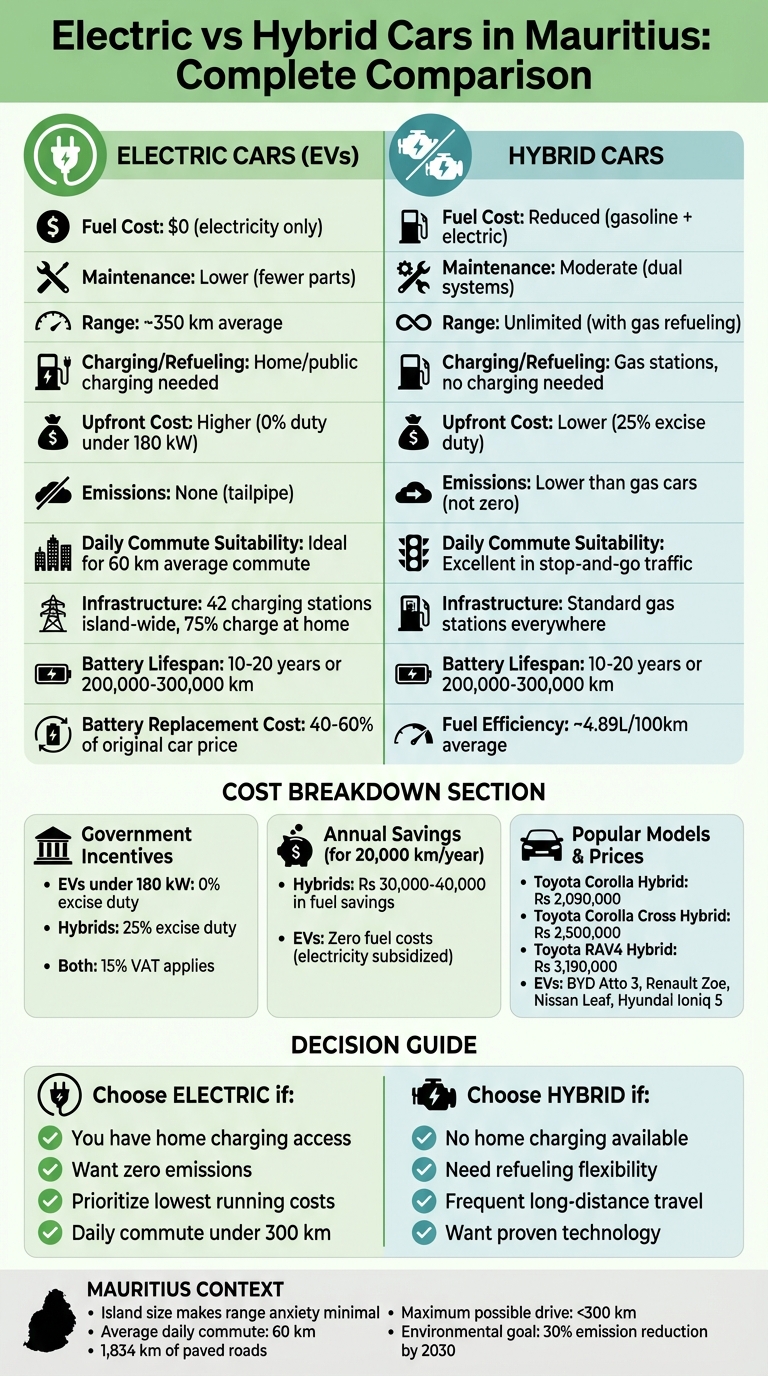
Electric vs Hybrid Cars in Mauritius: Complete Comparison Guide
Electric Cars in Mauritius
How Electric Cars Work
Electric vehicles (EVs) run entirely on battery power. You simply plug them in to charge and enjoy instant torque, quiet operation, and a smooth, gear-free driving experience.
In Mauritius, popular EV models include the Renault Zoe, Nissan Leaf, Hyundai Ioniq 5, Kia Niro, and BYD Atto 3. BYD also offers the Dolphin (a compact hatchback) and the Seal (a sedan), while luxury options like the Volvo XC40 electric cater to more premium preferences. Platforms like EV24.africa make it easy to browse these models, compare their specifications, and even arrange delivery across the island.
These features provide practical advantages for day-to-day driving.
Benefits of Electric Cars
Electric cars can significantly cut operating costs in Mauritius. Since you’re not spending on fuel and electricity rates are subsidized, charging costs far less than filling a gas tank. Maintenance is also simpler because EVs have fewer moving parts compared to traditional cars.
Most EV batteries come with warranties lasting five to eight years, and they’re designed to last anywhere from 10 to 20 years or 200,000 to 300,000 kilometers before needing replacement. For typical daily commutes of around 37 miles (60 kilometers), even entry-level EVs offer more than enough range.
Drawbacks of Electric Cars in Mauritius
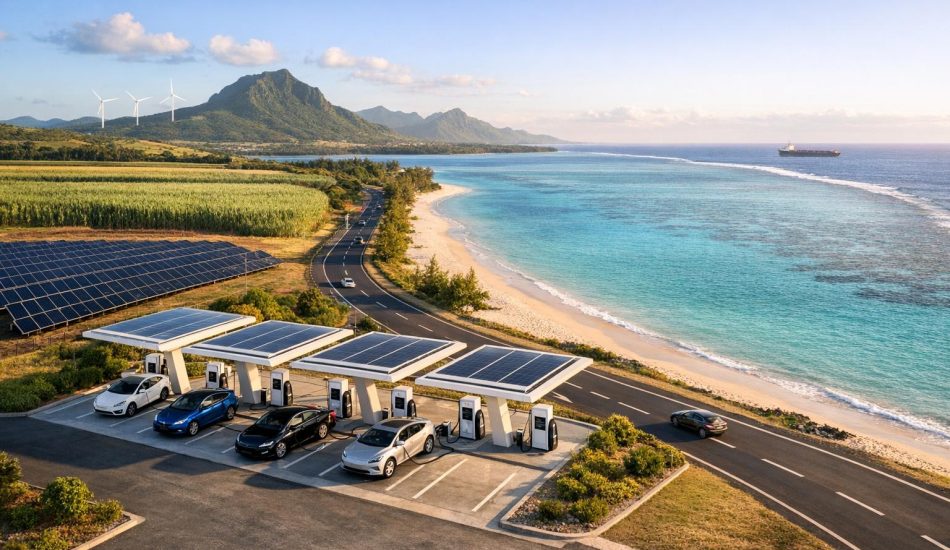
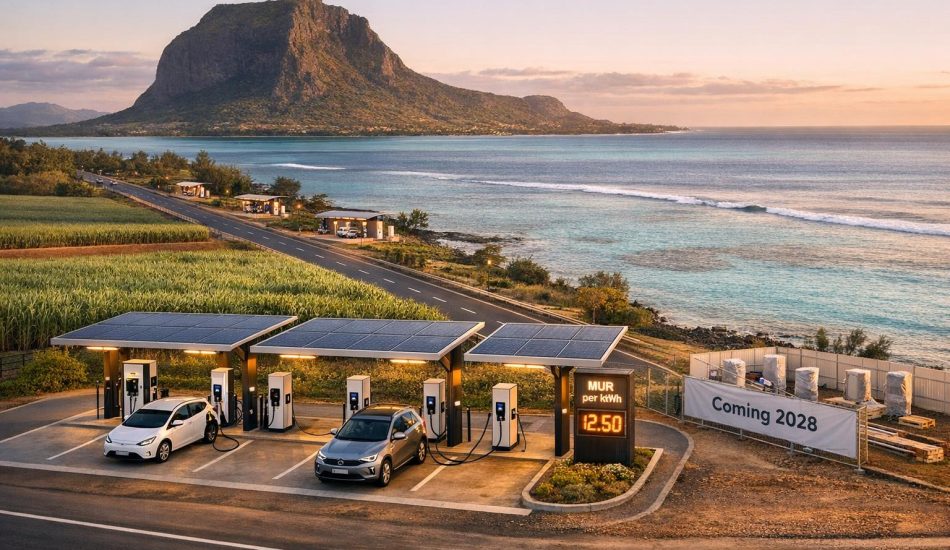
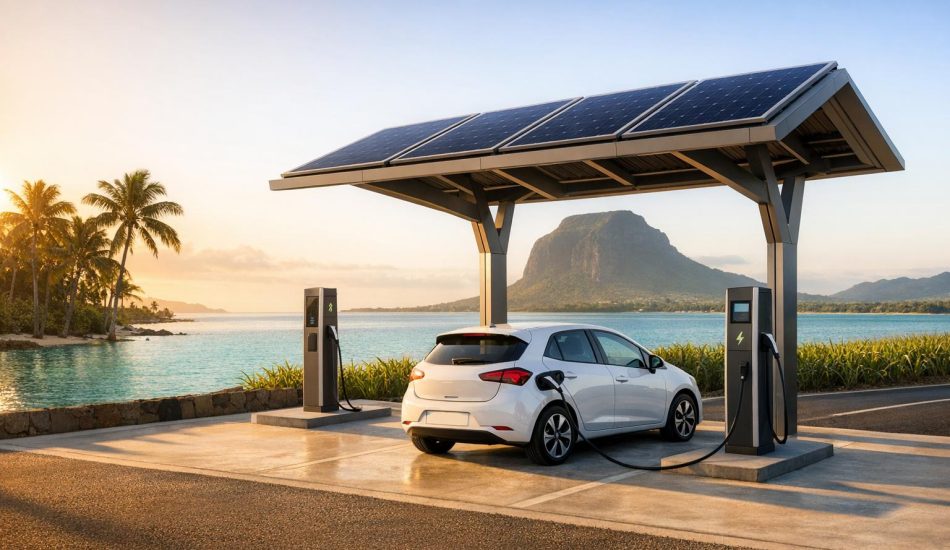
One major challenge is the limited public charging infrastructure. In April 2025, Vivo Energy Mauritius, in collaboration with the University of Mascarene, launched the country’s first solar-powered EV demonstration charging station. While this is a step in the right direction, many EV owners still depend on home charging to meet their needs, which slows the adoption of electric vehicles locally.
The upfront cost of EVs is another hurdle. While they are generally more expensive than gasoline-powered cars, a duty exemption helps reduce the price gap. However, replacing a battery can cost 40–60% of the car’s original price. There’s also some uncertainty about whether local workshops are fully prepared to handle the technical demands of EV battery repairs. That said, as more EVs hit the roads, the necessary support infrastructure is gradually improving.
sbb-itb-99e19e3
Hybrid Cars in Mauritius
How Hybrid Cars Work
Hybrid vehicles, like those using Toyota’s Hybrid Synergy Drive, combine a gasoline engine with an electric motor to improve fuel efficiency and performance. Unlike fully electric cars, hybrids are self-charging. This means you never need to plug them in – the battery recharges automatically through the engine and regenerative braking.
Popular hybrid models in Mauritius include the Toyota Corolla Cross, Honda CR-V, Toyota RAV4, Hyundai Tucson, and Suzuki Grand Vitara. The Toyota Corolla Hybrid, for example, pairs a 1.8L engine with two electric motors, delivering 138 horsepower through a CVT transmission. Drivers can choose from EV, ECO, NORMAL, and SPORT modes, adjusting the car’s performance to suit different road conditions. These features illustrate how hybrids balance advanced technology with practical benefits, making them a suitable choice for Mauritian roads.
In urban traffic, hybrids excel by relying on the electric motor at low speeds, while the gasoline engine activates at higher speeds. Local testing showed impressive fuel efficiency, with the Corolla Sedan hybrid averaging 4.25L/100km and the Corolla Cross averaging 5.02L/100km.
Benefits of Hybrid Cars
Understanding how hybrids operate sheds light on their cost-effectiveness. They eliminate "range anxiety" since they can refuel at any gas station, all while maintaining an efficient fuel consumption rate of around 4.89L/100km – translating to daily savings.
Since the 2022 budget, hybrid vehicles have been duty-free in Mauritius, significantly reducing their purchase price. For instance, the Toyota Corolla Hybrid starts at Rs 2,090,000, and the Corolla Cross Hybrid starts at Rs 2,500,000. Another advantage is the lack of reliance on home charging infrastructure, making hybrids ideal for drivers who don’t have access to chargers or frequently travel long distances.
"The integration of electric and petrol power sources in the hybrid system enhances both performance and efficiency, delivering a driving experience that is not only powerful but also environmentally friendly." – Toyota (Mauritius) Ltd
However, while hybrids offer numerous benefits, they do come with certain limitations.
Drawbacks of Hybrid Cars in Mauritius
One challenge with hybrids is their dual powertrain, which introduces additional components that may require maintenance. Although hybrid batteries are designed to last between 10 to 20 years or 200,000 to 300,000 kilometers, there’s concern about whether local workshops have the expertise to service high-voltage lithium-ion systems. If a battery replacement is needed outside the warranty period, the cost can be substantial. That said, the dual powertrain does provide some flexibility compared to fully electric vehicles.
Hybrids also produce emissions, albeit less than traditional gasoline cars. However, they are not a zero-emission solution and are better viewed as a transitional step toward cleaner technologies. For buyers focused on minimizing their carbon footprint, a fully electric vehicle may be a better fit – assuming the charging infrastructure meets their needs.
Up next, we’ll examine how hybrid and electric cars compare in terms of purchase price, operating costs, and government incentives.
Cost Comparison: Electric vs Hybrid Cars
Purchase Price
In Mauritius, the 2022 budget introduced a significant benefit for electric vehicles under 180 kW: they incur 0% excise duty. In contrast, hybrids face a 25% excise duty, creating a noticeable price gap at the dealership.
For instance, the Toyota RAV4 Hybrid has a starting price of Rs 3,190,000. Electric vehicles, on the other hand, cover a broader price range. While premium electric models sit at the higher end, more affordable options like the BYD Atto 3, Renault Zoe, and Nissan Leaf are available locally. Experts also point out that, with current incentives, a Tesla Model 3 can rival the price-value ratio of a traditional Toyota Corolla. Both vehicle types are subject to a standard 15% VAT.
Although purchase prices vary widely, the differences in ongoing costs make the comparison even more compelling.
Operating Costs and Maintenance
Electric vehicles come with lower day-to-day costs, largely thanks to subsidized electricity rates in Mauritius. Charging an electric car is significantly cheaper than refueling a hybrid, which relies on gasoline. Additionally, electric cars are simpler to maintain due to their fewer moving parts, unlike hybrids that combine a gasoline engine with electric components.
However, there’s a major consideration: battery replacement. Typically needed after 10–20 years or 200,000–300,000 km, a new battery can cost up to 60% of the car’s price if it’s not under warranty. Also, local workshops may lack the expertise to handle these advanced systems, potentially complicating maintenance.
These savings in operating costs are further amplified by government-backed incentives.
Government Incentives
Mauritius has designed its incentives to favor electric vehicles. Cars under 180 kW enjoy 0% excise duty, while hybrids are taxed at 25% regardless of engine size. For electric vehicles exceeding 180 kW, the excise duty matches that of hybrids at 25%.
For second-hand imports, excise duty is calculated based on the FOB value. A 9% reduction applies for the first month of use, with an additional 1% reduction for each following month, capped at a 50% maximum reduction. Combined with subsidized electricity for daily charging, these incentives make the overall cost of owning an electric car appealing, even if the initial purchase price is close to that of premium hybrids.
Infrastructure and Daily Use in Mauritius
Charging Options for Electric Cars
Mauritius has a network of 42 charging stations spread across the island, with Port Louis boasting the highest concentration at five stations. The Pamplemousses District leads with seven charging points, followed by Rivière Noire with six. This network continues to expand; for instance, in April 2025, a new station was launched at MEP Engineering Ltd in Trou-aux-Biches, enhancing access in the northern coastal region.
Around 75% of EV owners prefer charging their vehicles overnight at home. This option is not only more convenient but also less expensive compared to using public stations. For those who rely on public stations, an electropass provides universal access across various networks. Tools like the Electromaps app make it easier to locate available chargers and check their real-time status. While public charging options are growing, hybrid vehicles retain the advantage of immediate refueling at widely available gas stations.
Refueling Options for Hybrid Cars
Hybrid cars benefit from Mauritius’ established fuel infrastructure, allowing drivers to refuel quickly at any gas station. This is particularly useful for spontaneous trips or when navigating unfamiliar routes without worrying about charging availability.
In contrast, electric cars rely heavily on home charging. However, Mauritius’ small size ensures that range limitations are rarely a concern for either type of vehicle. For most EV owners, overnight home charging is more than sufficient for daily commutes.
Driving Range and Road Conditions
Mauritius’ well-maintained roads align well with the range capabilities of both electric and hybrid vehicles. Out of the island’s 1,910 kilometers of roads, 1,834 kilometers are paved, including the M1 Motorway, which runs about 65 kilometers from Plaisance Airport to Grand Bay. Given the island’s compact geography, it’s nearly impossible to drive more than 300 kilometers in one stretch.
Modern electric cars typically offer a range of about 350 kilometers, which easily covers the average daily commute of 60 kilometers. Even factoring in a potential 30% battery capacity reduction over eight years, an EV could still handle daily driving needs for up to 20 years. On the other hand, hybrids remain a convenient option with quick refueling through their gas engines, making range anxiety a minor issue in Mauritius. These conditions highlight how the island’s road network and infrastructure cater effectively to both electric and hybrid vehicles for everyday use.
Environmental Impact: Electric vs Hybrid Cars
Electric Cars: Zero Emissions
Electric cars stand out for producing zero tailpipe emissions, making them a key player in Mauritius’s plan to cut greenhouse gas emissions by 30% by 2030. This also ties into the Vision 2030 goal of achieving 35% renewable electricity.
That said, the environmental benefits of EVs depend heavily on the source of electricity. Currently, the Central Electricity Board (CEB) relies significantly on fossil fuels. As Pablo888 of Serial Expat pointed out:
"I am sure that the CEB is currently not providing green electricity and will at best be providing grey electricity".
Some EV owners are addressing this by pairing their cars with home solar panels and battery systems, ensuring their vehicles are charged with clean energy. This approach makes it possible to achieve truly zero-emission driving, but it requires additional investment and infrastructure.
While EVs clearly lead in cutting emissions, their reliance on the electricity grid highlights the need for cleaner energy sources to maximize their potential.
Hybrid Cars: Lower Emissions
Hybrids, on the other hand, offer a middle ground. They combine a gasoline engine with an electric motor and use regenerative braking to recapture energy. This design results in lower fuel consumption and reduced emissions compared to traditional gas-powered vehicles. However, hybrids aren’t entirely emissions-free, as they still rely on internal combustion engines.
For drivers in Mauritius, hybrids can be a practical choice, especially given the limited charging infrastructure. They serve as a transitional option while the country works to expand its renewable energy grid and charging network.
When weighing the environmental impact, these differences between electric and hybrid vehicles are key considerations, especially when factoring in long-term benefits, costs, and infrastructure challenges.
Which Car Should You Buy?
What to Consider Before Buying
When deciding between electric and hybrid cars in Mauritius, there are a few key factors to weigh:
Home charging access is a major consideration for electric vehicle (EV) owners. Studies show that around 75% of EV owners prefer charging their vehicles at home. Without this option, you’ll need to rely on the expanding – but still limited – public charging network. If you’re leaning toward a Battery Electric Vehicle (BEV), ensure your home can support a charging station installation.
Daily driving habits in Mauritius make range less of a concern. Given the island’s size, it’s rare to drive more than 300 km in one go. The average daily commute is approximately 60 km, which even a BEV with a moderate range can easily handle. On the other hand, hybrid cars shine in stop-and-go traffic, making them a solid choice for drivers often stuck in congestion.
Long-term costs are another big factor. Hybrids deliver fuel savings of around Rs 1.50 per kilometer, which could add up to Rs 30,000 to Rs 40,000 annually for someone driving 20,000 km a year. BEVs, on the other hand, eliminate fuel costs entirely and have lower maintenance expenses. Both types of vehicles have been duty-free since the 2022 budget, making them more affordable options.
Think about battery lifespan and specialized maintenance too. Modern EV batteries are built to last between 10 to 20 years, or 200,000 to 300,000 km, before needing replacement. However, having access to workshops equipped to handle high-voltage systems is crucial for long-term ownership.
As Sachin Sooknah from Toyota Mauritius points out, the market in Mauritius is evolving:
"The hybrid market will grow in the future with upcoming new technologies and advancements in electric engines. Mauritius might take some time, but will eventually have to catch up with the international inclination."
These considerations should help you align your choice with your lifestyle and priorities.
Recommendations
Here’s how to decide:
- Go for an electric vehicle if you have access to home charging and prioritize zero emissions and low running costs. Opt for a model with a longer range to offset the effects of natural battery wear over time.
- Choose a hybrid if home charging isn’t an option or if you prefer the convenience of traditional refueling. Hybrids strike a balance between energy efficiency and range flexibility. For high-mileage drivers, the fuel savings can be substantial – up to Rs 200,000 over five years. As Le Mauricien notes:
"If you research a versatile and proven solution, a hybrid car could be the ideal compromise between energy efficiency and autonomy."
Ultimately, the decision comes down to whether charging infrastructure or conventional refueling aligns better with your lifestyle and driving needs in Mauritius.
EV, Gas or Hybrid? A Complete Analysis
FAQs
Can I realistically own an EV in Mauritius without home charging?
Owning an EV in Mauritius without a home charging setup is entirely doable. With more than 42 public charging stations available across the country, EV owners have plenty of options to keep their vehicles charged. Plus, the convenience of tracking real-time availability through apps makes it easier to plan charging stops and avoid unnecessary delays. This infrastructure ensures that EV ownership remains practical, even without private charging facilities.
What will an EV vs hybrid cost me per month in Mauritius (energy, maintenance, insurance)?
Monthly expenses for EV owners in Mauritius tend to be lower, thanks to the cost advantage of electricity over fuel and reduced maintenance requirements. EV upkeep usually involves simple tasks like battery inspections and software updates. In contrast, hybrids often come with higher fuel and maintenance costs. Insurance rates can differ, but many providers now offer extended coverage tailored to EVs. Additionally, local policies and a growing network of trained mechanics help make EV ownership more accessible. The tax incentives introduced in 2022 further contribute to reducing overall costs.
How easy is it to service or replace an EV or hybrid battery in Mauritius?
Servicing or replacing EV and hybrid batteries in Mauritius is entirely possible, though it tends to be more intricate compared to traditional vehicles. Professional services, including onsite installation for battery replacement, are accessible. That said, the infrastructure and technical expertise required for advanced maintenance are still in the process of maturing. As the market for EVs and hybrids expands, prospective buyers should weigh the current and developing availability of trained mechanics and specialized workshops.