
 Thabo Nkosi
Choosing between electric vehicles (EVs) and hybrids in Ghana depends on your driving habits, location, and budget. Here’s a quick breakdown:
- Electric Vehicles (EVs):
- Best for city driving with access to home charging.
- Save up to 70% on running costs compared to petrol cars.
- Limited by Ghana’s still-developing charging infrastructure, mainly in Accra.
- Higher upfront costs but lower maintenance expenses.
- Hybrid Vehicles:
- Ideal for longer trips or areas without charging stations.
- Use both petrol and electricity, offering flexibility.
- Lower initial costs than EVs but higher maintenance due to dual systems.
Current Reality in Ghana:
EVs are great for Accra-based drivers with predictable commutes, while hybrids are better for intercity travel or areas with limited infrastructure. The government is expanding EV support, but hybrids remain the more practical choice for many drivers today.
Quick Comparison:
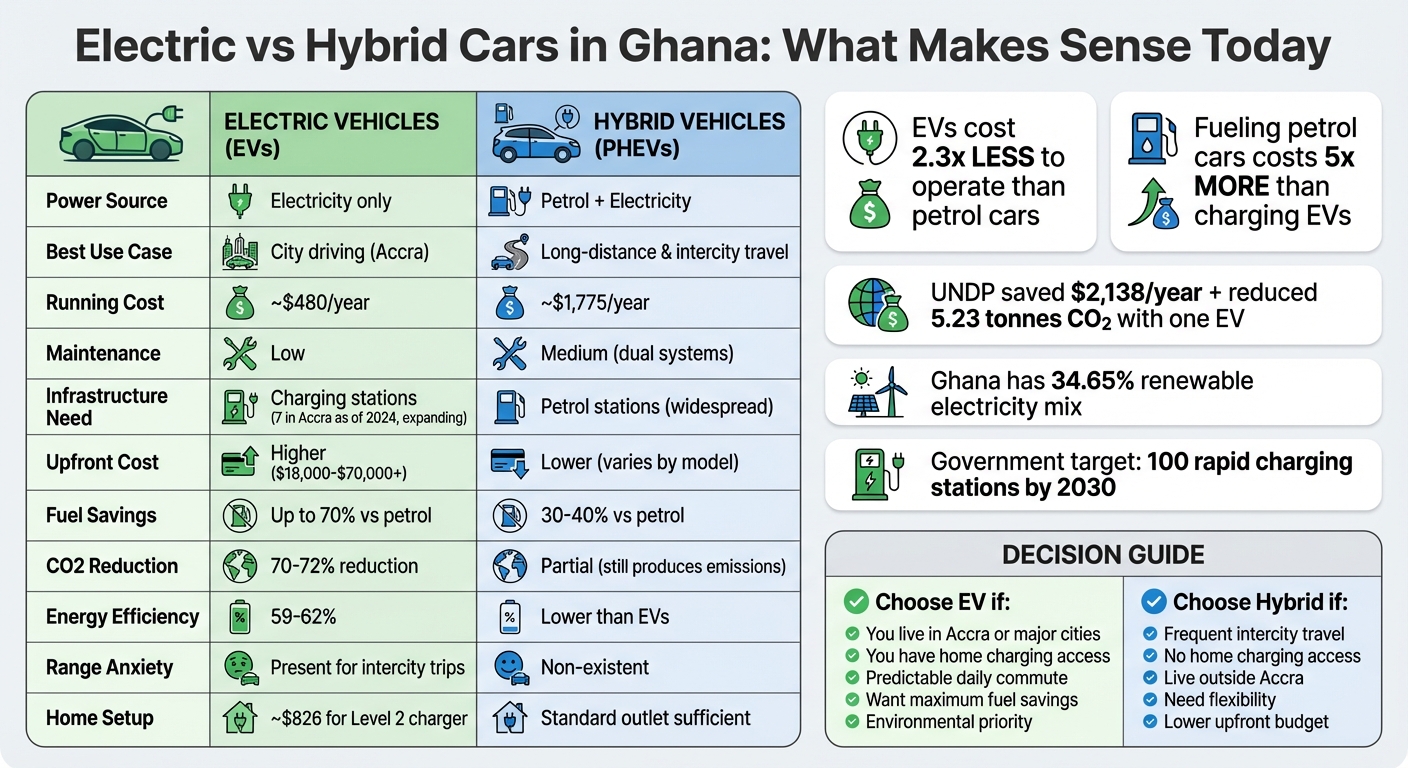
| Feature | Electric Vehicles (EVs) | Hybrid Vehicles |
|---|---|---|
| Power Source | Electricity only | Petrol + Electricity |
| Best Use Case | City driving | Long-distance travel |
| Running Cost | ~$480/year | ~$1,775/year |
| Maintenance | Low | Medium |
| Infrastructure Need | Charging stations | Petrol stations |
| Upfront Cost | Higher | Lower |
Key Insight:
If you live in Accra and can charge at home, EVs offer long-term savings. For flexibility and long trips, hybrids are the safer bet – at least until Ghana’s charging network improves.
Electric vs Hybrid Cars in Ghana: Complete Comparison Guide
Advantage Conversations S2 E1 | Driving Electric in Ghana: Everything You Must Know
sbb-itb-99e19e3
Electric Vehicles in Ghana: What You Need to Know
Electric vehicles (EVs) are powered entirely by electricity, eliminating the need for fuel stops. Instead, you simply plug in at home or at a charging station. This shift impacts not just your daily driving habits but also your monthly expenses, while playing a role in Ghana’s move toward greener transportation. Here’s a closer look at the advantages and hurdles shaping EV adoption in Ghana.
Why Choose an Electric Vehicle
One of the biggest perks of owning an EV is cutting out fuel costs entirely. Unlike hybrids, which still require gasoline, EVs rely solely on electricity. For instance, when the United Nations Development Programme (UNDP) in Ghana added an electric vehicle to its fleet in September 2025, the organization saved over $2,138 annually in operating costs and reduced CO2 emissions by approximately 5.23 tonnes per year.
EVs are also easier and cheaper to maintain due to their simpler design with fewer moving parts. Over time, this means lower servicing costs. Plus, EVs offer a smoother and quieter ride in city traffic compared to the mechanical systems found in hybrids.
From an environmental perspective, EVs produce zero tailpipe emissions. Studies reveal that a typical petrol car in Ghana emits 3.35 times more CO2 than an EV. Charging at home also provides a layer of independence from fluctuating global fuel prices, which can add financial stability to your transportation costs.
Problems Facing Electric Vehicles in Ghana
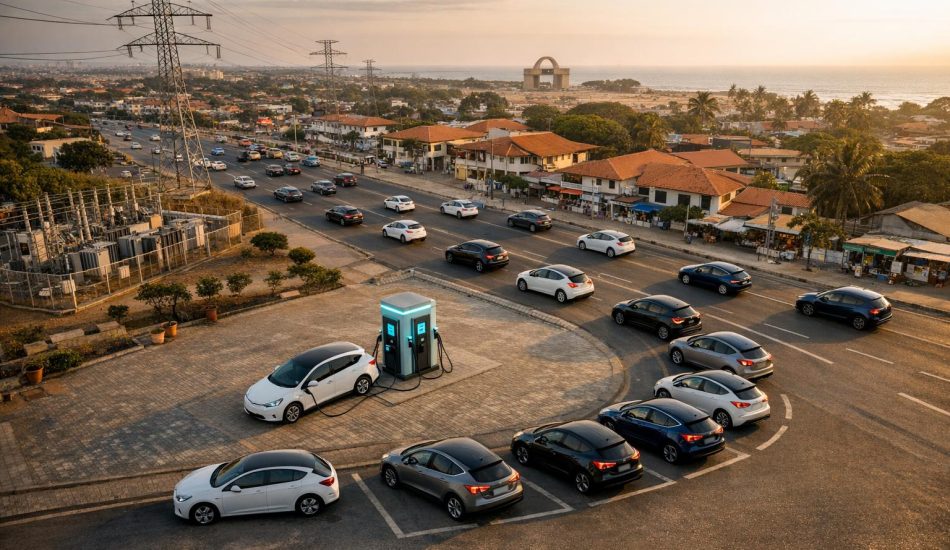
Despite their benefits, EVs face significant challenges in Ghana. A major issue is the lack of charging infrastructure. As of 2024, the country had only seven public charging stations, all located in Accra. This limits intercity travel and often leads to "range anxiety" for drivers planning trips beyond the capital.
"There are only seven charging stations in the country, all located in Accra, and no charging stations in other regions, which was hindering the widespread adoption of EVs." – Dr. Godwin Kafui Ayetor, Consultant for the Energy Commission
Outside major cities, unreliable electricity supply complicates both home and public charging. Additionally, there’s a shortage of skilled technicians trained to service EVs, which can make maintenance a challenge.
Another hurdle is the higher upfront cost of EVs compared to traditional vehicles. While government incentives aim to bridge this gap, buyers still need to budget for extras like a home charger, which costs about $826, and ensure their electrical systems can support a 240-volt circuit.
Electric Vehicle Models Available in Ghana
Despite these obstacles, the range of EV models available in Ghana is expanding to meet local needs. Drivers now have access to several options through EV24.africa, including the BYD Yuan Plus, BYD Seagull, BYD Titanium 3, Chery iCAR 03, Tesla Model 3, and Nissan Leaf. These vehicles are built to handle Ghana’s conditions, with advanced lithium-ion batteries that can operate efficiently even in temperatures as high as 131°F (55°C).
These models shine in city driving, offering a smooth, quiet, and responsive experience. They’re ideal for predictable daily commutes, where overnight home charging is convenient. However, for longer trips, careful planning is crucial due to the limited charging network. The government’s goal to establish 1,000 charging stations by 2028 offers hope for improving this situation. These vehicles reflect the evolving landscape of Ghana’s push toward sustainable transportation.
Hybrid Vehicles in Ghana: What You Need to Know
Hybrid vehicles combine a petrol engine with an electric motor and battery, offering a mix of electric driving for shorter trips and fuel power for longer distances. Plug-in hybrids (PHEVs) take it a step further by operating primarily on electric power – typically providing around 62 miles (100 km) of pure electric range – before automatically switching to the fuel engine when the battery level drops to 10%-15%. This setup is perfect for addressing "range anxiety", a common concern with fully electric vehicles (EVs), especially when traveling between cities like Accra and Kumasi or heading to remote areas where charging stations are scarce. Hybrids are well-suited for Ghana’s diverse landscapes and the availability of fuel stations.
Why Choose a Hybrid Vehicle
Hybrids offer unmatched versatility. With a standard outlet, you can fully charge the battery in 3–6 hours, making them ideal for short commutes without worrying about frequent charging. Many modern hybrids boast impressive combined ranges exceeding 600 miles. For instance, the Huawei Luxeed R7 can reach up to 869 miles, while the Changan Deepal L07 offers around 826 miles. A round trip from Accra to Kumasi, which spans 310 miles (500 km), is easily manageable without additional charging stops.
Another major perk is fuel savings. The Jetour T2 PHEV, for example, can cut fuel costs by as much as 78.2% compared to traditional petrol vehicles. In December 2025, Hybrid Motors Africa delivered a 2025 Changan Deepal S07 to Mr. Benjamin Baidoo in Accra. This vehicle demonstrated its practicality by running on electricity for daily errands after a home charge, while still being capable of switching to fuel for extended trips. Built to endure Ghana’s heat, heavy rains, and rugged roads, hybrids are a reliable choice for both city commutes and off-road adventures.
Next, let’s take a closer look at the challenges hybrids face in Ghana.
Problems Facing Hybrid Vehicles in Ghana
While hybrids offer several advantages, they also come with some challenges. One of the key concerns is higher maintenance costs compared to EVs, as hybrids require servicing for both the internal combustion engine and the electric motor. This places their maintenance expenses in the middle range – higher than full EVs but lower than traditional petrol cars.
Another drawback is their ongoing reliance on fossil fuels. While hybrids produce fewer emissions than petrol-only vehicles, they can’t match the zero emissions of fully electric cars. For drivers aiming to minimize both environmental impact and running costs, this dependency on fuel might be a downside.
Despite these issues, hybrids continue to gain popularity due to their practicality and flexibility in a market with varying needs.
Hybrid Vehicle Models Available in Ghana
Ghana’s hybrid market has grown significantly, offering a range of options from affordable used vehicles to high-end new models. Budget-conscious buyers can choose from used models like the 2016 Nissan Note Hybrid (approximately $6,900), the 2023 Toyota Aqua (around $14,700), or the 2023 Toyota Prius (about $19,550). For those looking for newer models, the 2025 Toyota Corolla Cross is available at $23,550.
Chinese automakers have also made their mark with advanced plug-in hybrids featuring luxury amenities. The Chery Tiggo 7 CHS PHEV series, for example, provides 59 miles (95 km) of electric-only range and comes equipped with a 24.6-inch dual screen and Sony audio system, priced between $32,000 and $36,000. Higher-end options include the Changan Deepal S07 PHEV at $49,700 and the GWM Haval Raptor Hi4 at $51,500. BYD’s lineup includes off-road-ready models like the Leopard 5 and Leopard 8, the Titanium 7 premium SUV, and the luxury Yangwang U8. These vehicles are ideal for drivers who frequently venture beyond urban areas or need the convenience of fuel in regions with limited charging infrastructure.
Infrastructure and Daily Use: EVs vs. Hybrids in Ghana
The kind of vehicle you choose has a direct impact on the infrastructure you’ll need. Electric vehicles (EVs) rely on charging stations, while hybrids use both electricity and petrol, offering more flexibility for various driving conditions.
Charging Stations for Electric Vehicles
In the past, Accra had just seven charging stations, but by 2026, the network expanded to include other key cities like Tema, Kumasi, Takoradi, and Cape Coast. These stations are often found at malls, hotels, and fuel stations, with many operating on solar-grid hybrid systems to handle power outages. Looking ahead, the Ministry of Energy and Green Transition plans to roll out at least 100 rapid charging stations nationwide by 2030.
For EV owners, home charging is almost a necessity. On average, an EV in Ghana uses about 23 kilowatt hours (kWh) daily. Charging options include Level 1 wall sockets, which take 8–12 hours, and Level 2 chargers, which cut that time to 4–6 hours. Installing a Level 2 charger costs around $826. With over 80% of households having access to electricity, home charging is a viable option for most.
A practical example of EV benefits comes from the UNDP in Ghana. In March 2025, they introduced an EV to their fleet, saving over $2,138 annually on fuel and maintenance while cutting 5.23 tonnes of CO₂ emissions. This initiative, supported by the Energy Commission, played a role in shaping the country’s EV policies.
With these advancements, both home and public charging are becoming more accessible, making EVs increasingly practical for daily use.
Fuel and Maintenance for Hybrid Vehicles
Hybrids, on the other hand, avoid the challenges of charging altogether. They rely on Ghana’s well-established fuel network, switching to petrol when electricity isn’t available. This makes hybrids ideal for long trips or areas where charging stations are scarce. Drivers can simply refuel at any petrol station, eliminating concerns over charging infrastructure.
Maintenance for hybrids is a bit more involved compared to EVs. While EVs are simpler due to fewer moving parts – no engine oil changes or exhaust systems – hybrids require upkeep for both their internal combustion engine and electric motor. This dual system can lead to higher maintenance costs, but it offers the flexibility many drivers need for travel beyond urban areas.
Infrastructure Comparison Table
Here’s a side-by-side look at the infrastructure needs and daily usability of EVs and hybrids:
| Feature | Electric Vehicles (EVs) | Hybrid Vehicles (PHEVs) |
|---|---|---|
| Primary Power Source | Electricity only | Petrol + Electricity |
| Charging Requirement | Essential for operation | Optional (can run on fuel only) |
| Best Use Case | Predictable city driving | Long-distance and remote travel |
| Infrastructure Dependency | High (requires home or public chargers) | Low (uses existing fuel stations) |
| Maintenance Complexity | Low (fewer moving parts) | Medium (dual systems to service) |
| Range Anxiety | Present for intercity trips | Non-existent |
| Home Setup Cost | ~$826 for charger installation | Standard electrical outlet sufficient |
| Public Infrastructure Availability | Limited but expanding (Accra, Kumasi, Takoradi) | Widespread (all petrol stations) |
"The current infrastructure is built for city life. While a long road trip is a hurdle today, the planned expansion of rapid chargers along major highways is designed to connect Ghana’s cities and make those journeys possible." – EV24.africa
Cost Comparison: Electric vs. Hybrid Vehicles
Purchase Price and Financing Options
When buying an EV in Ghana, the landed cost includes not just the car’s price but also shipping, import duties, taxes, and registration fees.
"The ‘landed cost’ is the true price tag of your EV right as it arrives. It’s the vehicle’s purchase price plus all the shipping, insurance, and handling fees needed to get it to Tema Port." – EV24.africa
For entry-level EVs like the Leapmotor T03, prices range from $18,000 to $22,000. Mid-range models such as the BYD Atto 3 are priced between $35,000 and $42,000, while premium options like the Tesla Model Y go for $60,000 to $70,000 or more. Shipping an EV from the U.S. East Coast to Ghana costs about $1,600. Hybrid prices, on the other hand, vary significantly depending on the model and features, with luxury options like the BYD Yangwang U8 available in the market.
Government policies help make EVs more affordable. Local assembly incentives include an eight-year import duty waiver and zero VAT on locally assembled vehicles, reducing the overall cost. Meanwhile, a carbon levy introduced in 2023 adds GHS 75–GHS 300 to high-emission vehicles, making traditional cars less competitive. Financing options, such as "green loans" offered by Ecobank and Stanbic Bank, further improve affordability compared to petrol-driven cars.
Next, let’s dive into how operating costs compare between EVs and hybrids.
Operating Costs: Fuel vs. Electricity
Beyond the purchase price, operational costs play a big role in the total expense. Running an internal combustion engine vehicle (ICEV) in Ghana costs 2.3 times more than an EV. Even more striking, fueling an ICEV is five times as expensive as charging an EV for the same distance.
"We found the cost of operating the ICEV was 2.3 times more than the BEV but the cost of fuelling the ICEV was five times the cost of charging the BEV." – Energy Commission of Ghana’s Drive Electric Initiative report
Take the Hyundai Kona Electric as an example. Driving 24,000 km annually, charging it costs around $480 per year. In contrast, the petrol version racks up $2,535 in yearly fuel costs. Hybrids offer some relief, delivering 30%–40% savings on fuel compared to ICEVs. Zhang Hongye, Sales Director at Zonda Tec Ghana Limited, explains, "Hybrids can save you 30 to 40 percent in fuel consumption. It literally means that every month you can save at least 1,000 Ghana cedis on fuel".
"Most EV drivers in Ghana tell us their monthly ‘fuel’ bill drops by 60-70%, sometimes even more." – EV24.africa
Maintenance is another area where EVs shine. With fewer moving parts, they generally require less upkeep. Hybrids, however, have moderate maintenance needs since they combine an engine with an electric motor. Both EVs and hybrids benefit from regenerative braking, which reduces wear on brake pads.
Total Cost of Ownership Comparison Table
Below is a side-by-side comparison of key cost factors for EVs and hybrids in Ghana:
| Cost Factor | Electric Vehicles (EVs) | Hybrid Vehicles |
|---|---|---|
| Purchase Price (Landed) | $18,000–$70,000+ | Varies by category |
| Annual Fuel/Charging Cost | $480 | ~$1,775 |
| Maintenance Complexity | Low | Medium |
| Home Setup Cost | ~$826 | Standard outlet |
| Government Incentives | Duty waivers, zero VAT | Standard duties apply |
| Carbon Levy | Exempt | GHS 75–GHS 300 |
| Time to Cost Parity | 5–12 years | Faster due to lower initial price |
Without government incentives, it takes around 12 years for an EV to break even with a petrol vehicle in Ghana. However, with import tariff waivers, this timeframe drops to 10 years. Favorable loan terms can reduce it even further to just 5 years. Hybrids typically achieve cost parity faster, thanks to their lower upfront costs and compatibility with existing fuel infrastructure.
Environmental Impact: EVs vs. Hybrids in Ghana
Emissions and Energy Efficiency
Electric vehicles (EVs) operate without producing tailpipe emissions, while hybrids still release greenhouse gases. In Ghana, 34.65% of electricity comes from renewable sources, making EVs an effective way to cut pollution. By switching to EVs, emissions can be significantly reduced: CO2 by 70–72%, NOx by 79–83%, VOCs by 99%, and particulate matter by up to 56%.
"The current renewable energy mix allows BEVs to reduce CO2 emissions by 70%, NOx emissions by 83%, SOx emissions by 31%, PM10 emissions by 53%, PM2.5 by 47%, and Volatile Organic Compounds (VOC) by 99%." – Energy Commission of Ghana, Drive Electric Initiative Report
Hybrids, while more fuel-efficient than traditional vehicles, reduce fuel use by only 30% to 40%. They remain a step behind EVs in achieving zero emissions. In 2016, road transportation contributed 11.11% of Ghana’s total CO2 emissions, highlighting the pressing need for cleaner alternatives. A complete shift to e-mobility could slash transportation-related CO2 emissions by 72%.
EVs also excel in energy efficiency. They convert 59% to 62% of electrical energy into motion, far outperforming gasoline vehicles, which manage only 17% to 21%.
These advantages underline why Ghana is prioritizing EV adoption through supportive policies and infrastructure development.
Government Incentives and Policies
To capitalize on EVs’ environmental benefits, Ghana’s government has introduced several initiatives. The National Electric Vehicle Policy (2024–2026) aims to encourage imports and local assembly through tax incentives, including an eight-year import duty waiver for locally assembled EVs. Additionally, a carbon levy introduced in 2023 charges GHS 75 to GHS 300 annually for high-emission vehicles, making conventional cars less appealing.
Infrastructure expansion is also a priority. The government plans to establish at least 100 rapid charging stations nationwide by 2030. By 2045, Ghana intends to phase out new petrol and diesel vehicle imports, with a target of 35% EV penetration in new vehicle sales between 2027 and 2035. Public transportation goals include converting 32% of public buses (about 12,027 vehicles) to electric by 2050.
"Transport is the ‘lifeblood of every economy’… my government is working to decarbonize the transport sector, expand electric mobility infrastructure, and promote climate-smart investments." – President John Dramani Mahama
To ensure the charging network remains sustainable, the government is exploring solar-grid hybrid systems for public charging stations. The "Government Goes Solar" initiative, launched in 2025, includes a GH₵1.2 billion reform package to boost clean energy generation for EV infrastructure. With an energy surplus of 98.59 GWh, Ghana has the capacity to charge at least 1.5 million EVs, making large-scale adoption feasible.
These policies and environmental benefits are shaping the future of transportation in Ghana, offering a balance between sustainability, practicality, and affordability for consumers.
Which Option Makes Sense for Ghana Today?
When deciding between an electric vehicle (EV) and a hybrid in Ghana, your choice largely depends on where you live and how you drive. In Accra, for instance, EVs can cut running costs by up to 70% and make maintenance easier – if you have access to home charging. A pilot program by the UNDP highlighted these benefits, showing significant yearly savings while reducing around 5.23 tonnes of CO₂ emissions.
However, the limited charging infrastructure makes long-distance EV travel challenging. Without highway fast-chargers, trips between cities like Kumasi and Takoradi remain difficult.
"The current infrastructure is built for city life. While a long road trip is a hurdle today, the planned expansion of rapid chargers along major highways is designed to connect Ghana’s cities and make those journeys possible."
– EV24.africa
Hybrids, on the other hand, provide a practical alternative. They remove the worry of running out of power, as you can refuel at any petrol station. Plus, they still offer the perks of electric driving for city use. For those living outside Accra or without access to home charging, hybrids are a more flexible option.
While plans to install 100 rapid charging stations by 2030 signal progress, the current reality favors hybrids for intercity travel. Your decision should reflect your current parking setup, driving habits, and access to charging points, rather than relying on future developments. The best choice is the one that aligns with your immediate needs and infrastructure.
FAQs
Can I own an EV in Ghana without home charging?
Yes, owning an EV in Ghana without home charging is possible by using alternatives such as public charging stations, workplace charging facilities, or depot charging setups. That said, home charging continues to be the most convenient and commonly preferred option for most EV owners.
How do power outages affect EV charging in Ghana?
Power outages in Ghana pose a challenge for electric vehicle (EV) owners, particularly those who depend on home or public grid-based charging stations. To navigate these issues, many EV users turn to backup power options or plan their charging during periods of reliable electricity supply. Although the country’s infrastructure is still evolving, initiatives such as upgrading the power grid and incorporating renewable energy sources are working toward minimizing these interruptions. These efforts are gradually making EV ownership a more feasible option.
Should I buy a regular hybrid or a plug-in hybrid?
When deciding between a regular hybrid and a plug-in hybrid, it all comes down to your lifestyle, budget, and access to charging options. Regular hybrids tend to be less expensive, don’t require external charging, and work well in areas where charging stations are hard to find. On the other hand, plug-in hybrids come with larger batteries, allowing you to take short trips using electricity alone – cutting down on fuel consumption and emissions. However, they do need charging access and typically come with a higher initial price tag. Think about your daily driving needs and the availability of charging stations in your area before making a choice.