
 Thabo Nkosi
Zimbabwe’s electricity shortages – 16 to 20 hours of load-shedding daily – raise questions about the practicality of electric vehicles (EVs) in the country. Despite these challenges, EVs can still work with proper planning and alternative charging solutions. Early adopters have shown that charging EVs overnight during limited power windows is feasible. Additionally, solar-powered home systems and community mini-grids offer off-grid charging options, reducing reliance on the national grid.
Key takeaways:
- Zimbabwe generates only 866 MW of electricity daily, far below the 2,400 MW demand.
- Load-shedding limits grid electricity to just 4 hours a day for many residents.
- Solar systems and mini-grids are emerging as reliable EV charging solutions.
- Policy reforms, like reduced import duties on EVs and solar rebates, aim to support EV adoption.
While the current power situation poses hurdles, a mix of solar energy, grid reforms, and supportive policies can make EVs a practical option in Zimbabwe.
Zimbabwe’s Power Problems and EV Charging
Power Supply vs. Demand
Zimbabwe faces a stark energy imbalance. The country’s power demand hovers around 2,200 MW, but supply rarely exceeds 1,400 MW, leaving an 800 MW shortfall that impacts all sectors.
Hwange Thermal Power Station, originally built to generate 920 MW from its aging Units 1–6, struggles with frequent breakdowns due to outdated equipment and poor management . On top of that, drought has severely affected the Kariba South Power Station, slashing its output from a capacity of 1,050 MW to as low as 125 MW – a drop of over 80%. As of January 13, 2025, the Kariba dam’s water levels were alarmingly low, at just 3% full compared to 13% the previous year.
Even when electricity is generated, delivering it to consumers is another hurdle. The national grid suffers from transmission losses exceeding 18%, caused by worn-out substations and outdated transmission lines. Edzai Kachirekwa, CEO of Power Giants, highlights the issue:
"Transmission has become a major bottleneck. We need to invest in green transmission that integrates new sources with real-time monitoring and storage".
These systemic challenges make EV charging heavily dependent on strategic grid management. With such supply constraints, load-shedding is inevitable, creating significant obstacles for EV owners.
Load-Shedding Effects on EV Charging
Zimbabwe’s extreme load-shedding schedule is a nightmare for EV owners. Power outages often last between 18 and 20 hours a day, with electricity usually available only during the narrow window of midnight to 4:00 AM . Loveness Madangawa, a resident of Mutare, describes the situation:
"Electricity is switched off as early as 4am and restored at 10pm. That is bedtime".
This limited access forces EV owners to adjust their charging habits. For example, vehicles with smaller battery packs, like a 24 kWh battery, can recharge to 80–100% within this four-hour window using a standard home charger. However, larger battery packs or daytime charging needs face significant challenges, especially since public charging stations are scarce, with only a handful located in Harare, Bulawayo, and Mutare.
Tanaka Kutama, a business consultant and EV specialist, explains the broader implications:
"We have seen an increase in inquiries and imports, but infrastructure and energy reliability remain major hurdles. People don’t see EVs as a solution if they can’t charge them".
While some EV owners manage by charging overnight, the reliance on this midnight-to-dawn window means grid-based charging is practical only for specific scenarios. For many, these limitations are pushing them to explore creative, off-grid charging solutions to make EV ownership feasible.
sbb-itb-99e19e3
Power Sector Reforms in Zimbabwe
Hwange Expansion and Renewable Energy Plans
Zimbabwe is making strides in reforming its power sector, with major projects aimed at boosting capacity and reliability. The Hwange Power Station expansion in 2023 added 600 MW to the grid through the commissioning of Units 7 and 8. Further plans are in motion to rehabilitate the older Units 1–6, built in the 1980s, which currently operate at about one-third of their 920 MW design capacity. In December 2025, ZESA Holdings signed a $455 million agreement with India’s Jindal Steel and Power to refurbish these units under a 15-year "Rehabilitate, Operate and Transfer" deal. This project is expected to add 400 MW of dependable power within 48 months.
Cletus Nyachowe, Acting CEO of ZESA, highlighted the impact of this agreement:
"The 15-year agreement with Jindal will lead to enhanced power generation, which will add 400MW to our output within the next 48 months".
Once the refurbishment is complete, Hwange’s total generation capacity is projected to reach 1,500 MW. Alongside this, the government is targeting 1,100 MW of renewable energy capacity by 2026. These initiatives aim to stabilize the grid, a critical factor in making electric vehicles (EVs) a practical option for Zimbabwe. A more reliable grid will also support the development of consistent EV charging infrastructure across the country.
Competitive Bidding and Market Liberalization
In addition to infrastructure upgrades, Zimbabwe is reshaping its electricity distribution model. Starting in 2026, private companies will be allowed to purchase electricity from suppliers like ZESA or solar independent power producers and distribute it directly to end-users in assigned zones. This shift breaks the state monopoly and encourages private investment in local grid infrastructure.
Edington Mazambani, CEO of the Zimbabwe Energy Regulatory Authority (ZERA), explained the potential of this approach:
"For instance, you can adopt Cowdray Park and reticulate the whole locality… You connect them and get the bulk supply of electricity… distribute power within the locality, and collect revenue".
Nearly 400 "dark cities" – developed areas that remain off-grid – have been identified as promising opportunities for these partnerships.
Another reform is the introduction of competitive bidding for new power projects beginning in 2026. Edgar Moyo, Minister of Energy and Power Development, emphasized the importance of this change:
"From 2026, we will introduce competitive bidding in the power sector, which will improve transparency and accountability".
Mazambani added that this approach would ensure cost efficiency, transparency, and higher-quality projects, potentially lowering electricity tariffs. These reforms are expected to support the creation of localized EV charging networks tailored to Zimbabwe’s specific needs.
With a government goal of attracting $4.42 billion in private energy investments by 2026 and doubling generation capacity to 5,400 MW by 2030, Zimbabwe is laying the groundwork for a more robust and EV-compatible power grid. These efforts not only promise better electricity access but also pave the way for expanding EV infrastructure.
Off-Grid Charging Solutions for Zimbabwe
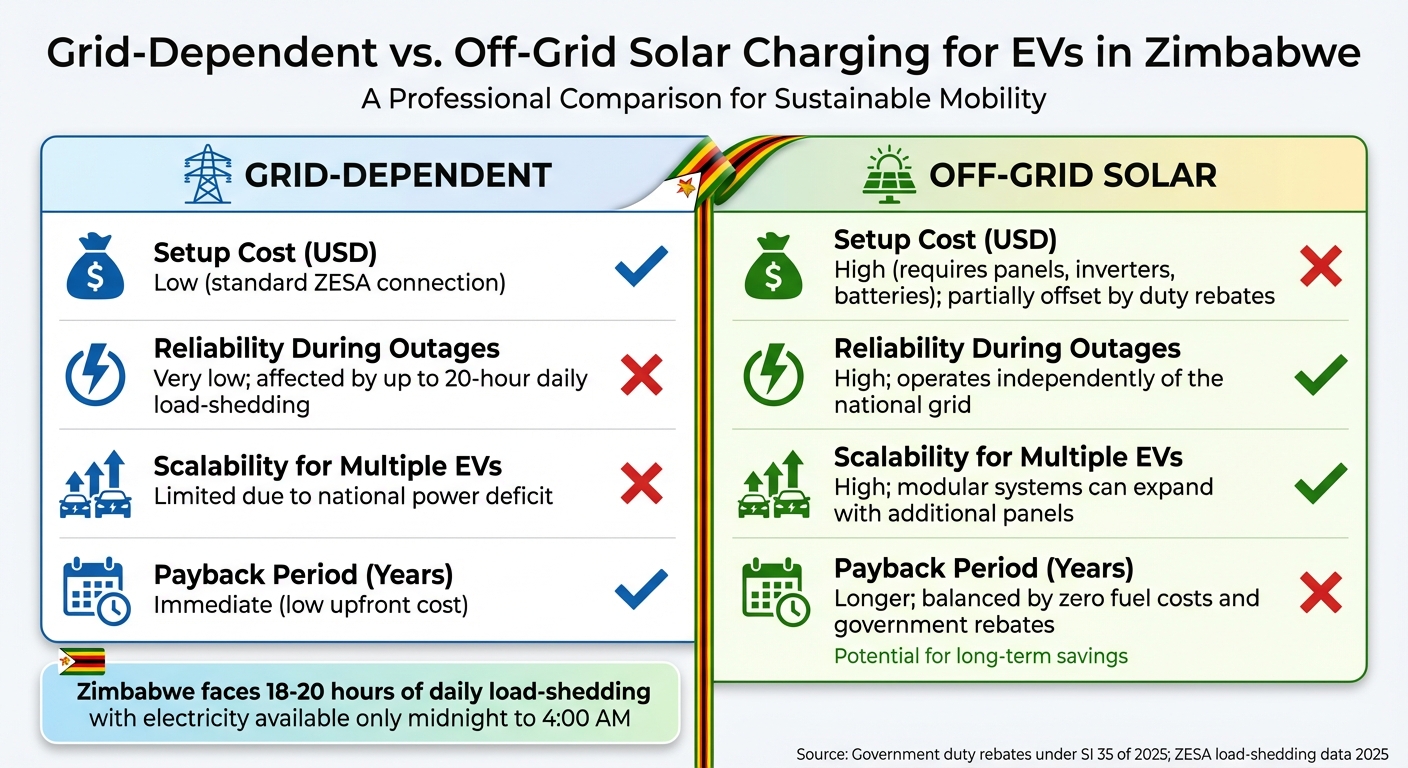
Grid vs Off-Grid EV Charging in Zimbabwe: Cost, Reliability & Scalability Comparison
Home Solar Charging Systems
Home solar systems allow EV owners to charge their vehicles during the day while storing extra energy for nighttime use. These setups typically include solar panels, inverters, and battery storage, enabling users to operate independently of the national power grid.
To make this option more accessible, the Zimbabwean government has introduced financial incentives. Under Statutory Instrument 35 of 2025, a duty rebate on imported solar equipment specifically for EV charging stations was established. This rebate covers essential components like solar panels, inverters, chargers, and lithium battery storage. However, to qualify for this benefit, operators must obtain approval from the Zimbabwe Energy Regulatory Authority (ZERA). This policy helps lower the upfront costs of installing a home solar charging system.
While smaller solar setups may struggle to meet the energy demands of large EVs, systems with sufficient solar panels can fully charge high-capacity vehicles without relying on the grid. Modern lithium batteries, which can last up to 15 years, ensure efficient energy storage for later use. For urban residents living in apartments, private solar installations may not be feasible. However, for homeowners, solar charging offers a practical and sustainable solution. Community-based alternatives could provide a scalable option for those unable to install private systems.
Community Mini-Grids for Shared Charging
Community solar mini-grids are another effective off-grid charging solution. In September 2024, the Hakwata community in Chipinge launched a 200 kW solar mini-grid through a collaboration between the United Nations Development Programme (UNDP), the Zimbabwean government, and the UK’s Foreign, Commonwealth and Development Office (FCDO). This system includes 416 solar panels and three inverters, delivering reliable power to 80 households, a business center, and a clinic serving over 12,000 residents.
Currently, the Hakwata mini-grid operates at 108 kW of its 200 kW capacity, with 92 kW allocated for shared EV charging. To maintain the system, community members contribute to a small fund, showcasing a sustainable cost-sharing model.
Ayodele Odusola, UNDP Resident Representative, highlighted the impact of this initiative:
"The solar mini-grid project was a development in action and a transformation… people in here to be experiencing the amenities that I have been experiencing at the centre, shows development has come to this community".
In addition to Hakwata, the Rural Electrification Fund (REF) completed several other mini-grids in 2024, including the 60 kW Bemba mini-grid in Tsholotsho, the 120 kW Chitulipasi mini-grid in Beitbridge, and the 120 kW Dete mini-grid in Hurungwe. These projects demonstrate the potential for expanding this model across the country. However, funding remains a significant obstacle to scaling mini-grid solutions nationwide.
Grid vs. Off-Grid Charging Comparison
The table below highlights the differences between grid-dependent and off-grid solar charging options.
| Feature | Grid-Dependent Charging | Off-Grid Solar Charging |
|---|---|---|
| Setup Cost (USD) | Low (standard ZESA connection) | High (requires panels, inverters, batteries); partially offset by duty rebates |
| Reliability During Outages | Very low; affected by up to 20-hour daily load-shedding | High; operates independently of the national grid |
| Scalability for Multiple EVs | Limited due to the national power deficit | High; modular systems can expand with additional panels |
| Payback Period (Years) | Immediate (low upfront cost) | Longer; balanced by zero fuel costs and government rebates |
For Zimbabwean EV owners, off-grid solar systems offer reliability that the national grid cannot match. Although the initial investment is higher, government incentives and the elimination of fuel costs make off-grid solar a viable long-term option for sustainable charging.
EV24.africa: Supporting EV Adoption in Zimbabwe
Solar-Compatible EVs and Financing
EV24.africa highlights electric vehicles designed to work seamlessly with solar energy, addressing Zimbabwe’s ongoing power challenges. The platform features a diverse range of models from top manufacturers like Tesla, BYD, Leapmotor, ROX, Dongfeng, Geely, Hyundai, Toyota, and Suzuki. Each listing includes detailed specs, transparent pricing, and battery capacity details, making it easier for buyers to choose vehicles that fit their charging infrastructure.
One of the biggest hurdles in Zimbabwe is the lack of affordable, long-term vehicle financing. Most buyers rely on cash payments or short-term bank loans, which limits accessibility. To address this, the government is working on a national electric vehicle policy that will include financing options and tax incentives. EV24.africa contributes by offering delivery services and clear financing guidance, helping buyers take advantage of reduced import duties. Together, these efforts make EV ownership more attainable, pairing financial options with practical solutions like off-grid charging.
Pairing EVs with Off-Grid Charging
EV24.africa also helps customers pair their electric vehicles with solar charging systems, an essential feature in a country where power outages are common. By promoting off-grid solar solutions, the platform addresses the challenges of unreliable electricity. This guidance is especially relevant since 28% of Zimbabwean households already rely on off-grid or renewable energy sources.
For rural areas with limited grid access, combining EVs with solar charging ensures reliable, independent transportation. EV24.africa provides insights on which vehicles work best with home solar setups, enabling buyers to choose models that match their energy capacity. This approach not only overcomes grid reliability issues but also promotes sustainable and self-sufficient mobility solutions.
Recommendations for Consumers and Policymakers
Both consumers and policymakers in Zimbabwe can take practical steps to improve EV charging reliability and promote sustainable electric mobility. Here’s how:
Consumer Strategies for Reliable Charging
For consumers navigating Zimbabwe’s power challenges, there are a few ways to ensure reliable EV charging. One effective approach is installing a Level 2 home charging station paired with solar panels and battery storage. This setup allows for independent charging, bypassing the limitations of the national grid. Early adopters have shown that EVs with smaller battery capacities can reach full charges during the grid’s limited operational hours.
For renters who can’t install solar systems, there are still options. Choosing EVs with smaller batteries, using public charging networks – like those at Fidelity Life Centre in Mutare, Century Towers in Harare, and ZITF grounds in Bulawayo – and negotiating with landlords for solar installation rights are viable alternatives. Additionally, both homeowners and renters can schedule charging during the grid’s active hours to maximize efficiency.
Policy Recommendations for EV Growth
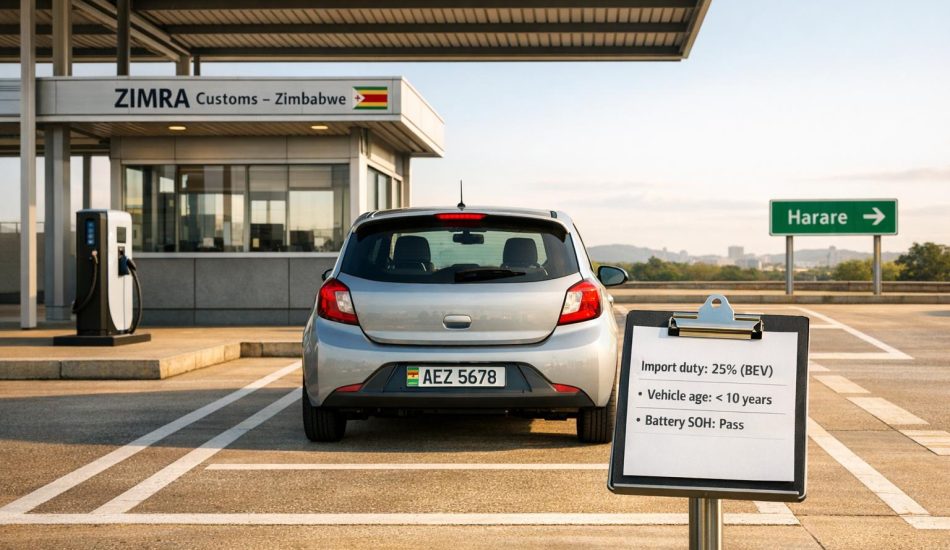
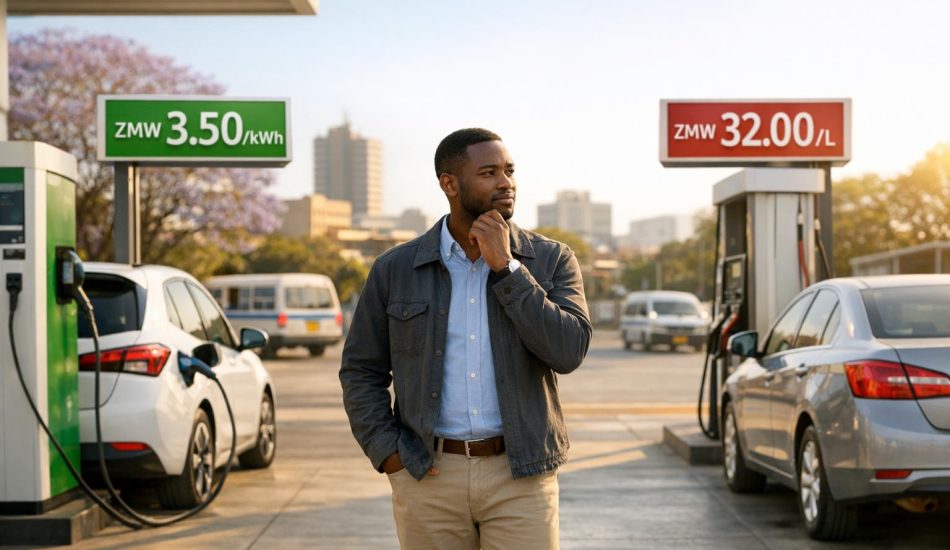
Policymakers have a critical role in turning Zimbabwe’s power challenges into opportunities for EV adoption. Building on initiatives like Statutory Instrument 35 of 2025, which reduced import duties on EVs from 40% to 25% starting January 1, 2025, further measures could accelerate adoption. For instance, experts suggest eliminating customs duties entirely to make EVs more affordable, especially since they reduce dependence on imported fuel. Removing the carbon tax on EVs would also align with their zero-emission benefits.
Expanding the duty rebate program to include VAT waivers on solar equipment could make off-grid charging solutions more accessible. The Horticultural Development Council highlighted the importance of this step:
"Removing VAT on solar equipment would make off-grid energy alternatives more financially accessible, ensuring the sub-sector’s productivity and competitiveness amidst ongoing power challenges".
Another policy option is introducing net-metering programs, allowing solar-powered EV owners to feed surplus energy back into the grid. This could strengthen both the energy and transport sectors.
Transport and Infrastructural Development Secretary Engineer Theodius Chinyanga underscored the government’s commitment:
"The policy is still at crafting stage… We want it to accommodate everyone. We are also working with the Zimbabwe Investment Development Authority (ZIDA) to ensure that we lure investors into the sector".
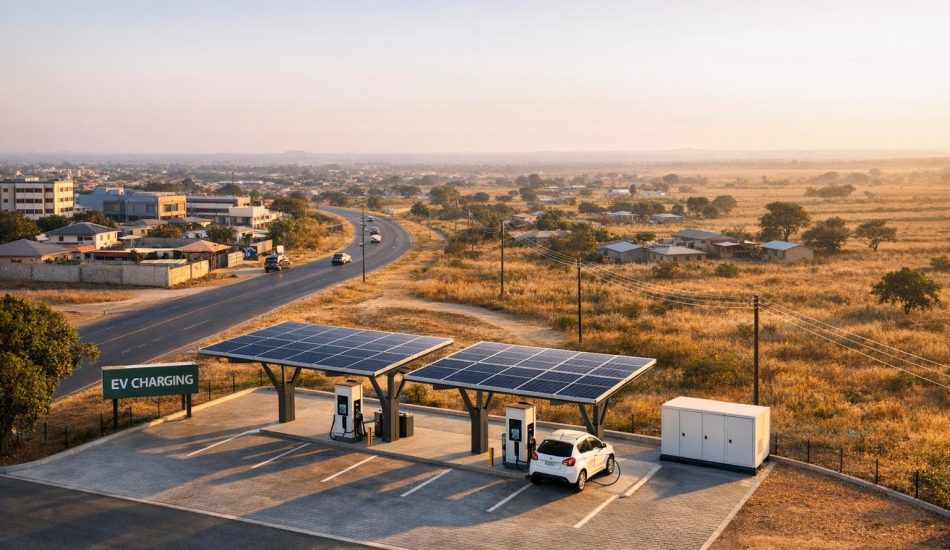
To support these efforts, investments in solar-powered charging stations along key transport routes are crucial. Streamlining approval processes through the Zimbabwe Energy Regulatory Authority will also be key to developing the necessary infrastructure for a sustainable electric mobility future.
Conclusion
Electric vehicles (EVs) are proving to be a feasible option in Zimbabwe, even in the face of serious power challenges. The country’s extended load-shedding – lasting up to 18 to 20 hours a day – and its outdated grid infrastructure pose significant hurdles. Yet, early adopters have shown it’s possible to make EVs work. Journalist and EV owner Remeredzai Joseph Kuhudzai summed it up perfectly:
"If I can drive an electric car in Zimbabwe, you can drive one anywhere!"
This firsthand experience highlights the potential for broader EV adoption in Zimbabwe.
To overcome these challenges, a combination of strategies is essential. Off-grid solar charging systems offer a way to sidestep grid instability. Reforms in the energy sector, like the 25 MWp Centragrid solar plant in Nyabira, demonstrate progress. Additionally, supportive policies – such as reduced import duties – can encourage EV adoption. For homeowners, solar-plus-battery setups provide a reliable, independent charging solution. Renters, meanwhile, can turn to public charging stations, like those at the Fidelity Life Centre in Mutare or Century Towers in Harare, as an alternative to relying on the grid.
Companies like EV24.africa are also stepping in to make the transition smoother. They connect buyers with affordable, solar-compatible EVs, such as 2017 40 kWh Nissan Leafs priced around $11,000 from Japan. They also guide users on off-grid charging options, helping to address the country’s unique challenges.
The real question isn’t whether EVs can succeed in Zimbabwe – it’s how quickly these proven solutions can scale. With investments in distributed solar energy, continued policy support, and a growing embrace of off-grid charging, Zimbabwe has a chance to transform its power issues into an opportunity for sustainable, locally powered transportation.
FAQs
How big a solar system do I need to charge an EV at home in Zimbabwe?
To charge an EV at home in Zimbabwe, you’ll generally need a solar system capable of producing around 1,200 kWh per month. Achieving this output typically involves installing between 7 and 12 solar panels, though the exact number depends on factors like the efficiency of the panels and the amount of sunlight in your area. The specific setup can vary based on your household’s energy needs and the design of your solar system.
What’s the cheapest way to charge an EV during daily load-shedding?
Charging an electric vehicle (EV) during load-shedding in Zimbabwe can be tricky, but off-grid solar charging systems offer a practical solution. By installing solar panels at home or in shared locations, you can generate your own electricity without relying on the grid. This setup allows you to charge your EV during daylight hours when solar energy is abundant.
For added flexibility, portable solar chargers or battery storage systems can store any extra energy collected during the day. This stored energy can then be used later, ensuring your EV stays charged even during power outages. It’s a budget-friendly and environmentally conscious way to keep your vehicle running without interruptions.
Is an EV still worth it in Zimbabwe if I rent and can’t install solar?
If you’re renting and unable to install solar panels, owning an EV in Zimbabwe can be tough. Frequent power outages and a lack of charging options make it challenging to keep your vehicle charged. Without dependable access to alternative energy sources, charging becomes a real hurdle. While ideas like community charging stations or portable solar chargers could offer solutions down the line, owning an EV might not be practical until the energy infrastructure improves or more charging options are introduced.