
 Thabo Nkosi
Electric cars are becoming more popular in Egypt, with sales growing by nearly 20% in 2025. While EVs still make up less than 1% of all vehicles, government incentives, local manufacturing efforts, and a growing charging network are driving adoption. Here’s what you need to know:
- Prices: EVs range from $10,600 for budget models to over $100,000 for luxury cars. Popular budget options include the Renault Twizy and Dongfeng Box, while premium choices include the Tesla Model 3 and BMW iX.
- Charging: Egypt has 68 public charging locations (mainly in Cairo and Alexandria), with plans to expand to over 1,000 stations. Charging costs range from $0.04/kWh for AC to $0.08/kWh for DC fast charging.
- Availability: Over 20 EV models are on the market, dominated by Chinese and European brands. Used EVs are also growing in popularity, starting at $6,000.
- Government Support: Tax breaks, local production incentives, and reduced customs duties aim to make EVs more affordable. However, high import tariffs (40%) and limited rural infrastructure remain challenges.
Egypt’s EV market is evolving, with a focus on affordability, infrastructure expansion, and local production to meet growing demand.
ملخص معرض اوتومورو للسيارات الكهربائية – Automorrow 2026
sbb-itb-99e19e3
Electric Car Prices in Egypt
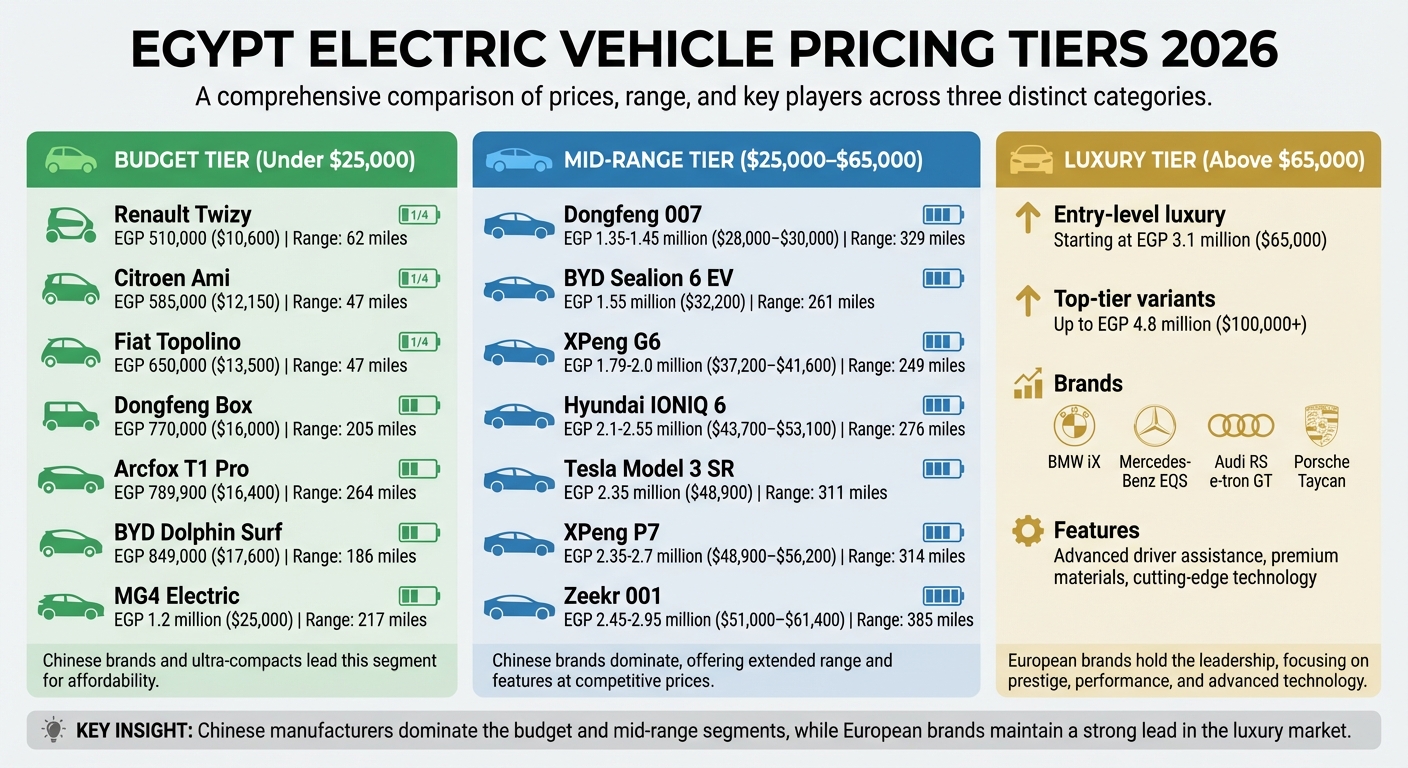
Electric Vehicle Price Ranges and Models in Egypt 2026
In 2026, Egypt’s electric vehicle (EV) market offers a variety of options, ranging from compact, affordable cars to high-end luxury models. Prices are clearly presented in both Egyptian pounds (EGP) and US dollars (with an exchange rate of EGP 48 = $1). Chinese manufacturers dominate the budget and mid-range categories, while European brands lead in the luxury segment.
The market is divided into three pricing tiers to suit different budgets. Entry-level models start at EGP 510,000 (about $10,600), while luxury vehicles can exceed EGP 4 million (around $83,000). Government tax incentives and lower global EV prices have made the market more competitive. Below, we explore the budget, mid-range, and luxury segments in greater detail.
Budget Electric Cars (Under $25,000)
This category includes small EVs and compact hatchbacks, primarily from Chinese manufacturers. The Renault Twizy is the least expensive option at EGP 510,000 ($10,600), offering a range of 62 miles, ideal for city driving. Other compact city-friendly models include the Citroen Ami (EGP 585,000 / ~$12,150) and the Fiat Topolino (EGP 650,000 / ~$13,500), both with ranges around 47 miles.
For those needing a more practical, primary vehicle, the Dongfeng Box provides excellent value. According to Mobility Rising:
The new Dongfeng Box, Dongfeng 007 and the 2026 MG 4 are the three cheapest cars in Egypt, with prices having dropped to about $16,000 for the Dongfeng Box.
The Dongfeng Box starts at EGP 770,000 ($16,000) with a 205-mile range, while the higher trim at EGP 870,000 ($18,000) offers a 267-mile range. Other options include the BYD Dolphin Surf (EGP 849,000 / $17,600, 186-mile range) and the Arcfox T1 Pro (EGP 789,900 / $16,400, 264-mile range). The MG4 Electric, priced at EGP 1.2 million (~$25,000), rounds out the budget tier with a range of 217 miles.
Buyers should check charging port compatibility before purchasing, as Egyptian regulations now require Chinese EVs to use European-standard plugs.
Mid-Range Electric Cars ($25,000–$65,000)
Mid-range models strike a balance between performance and cost, with Chinese brands leading the way. The Dongfeng 007 is priced between EGP 1.35 million and EGP 1.45 million (~$28,000–$30,000), offering up to a 329-mile range. The BYD Sealion 6 EV starts at EGP 1.55 million (~$32,200) with a 261-mile range, while the XPeng G6 falls between EGP 1.79 million and EGP 2.0 million (~$37,200–$41,600) and delivers up to 249 miles on a charge.
For those seeking premium mid-range options, the Tesla Model 3 SR costs EGP 2.35 million (~$48,900) with a 311-mile range. Similarly, the XPeng P7 is priced between EGP 2.35 million and EGP 2.7 million (~$48,900–$56,200) and offers a range of up to 314 miles. At the top of this segment, the Zeekr 001 ranges from EGP 2.45 million to EGP 2.95 million (~$51,000–$61,400) with a 385-mile range. The Hyundai IONIQ 6 offers a Korean alternative, priced between EGP 2.1 million and EGP 2.55 million (~$43,700–$53,100), with a range of 276 miles.
Luxury Electric Cars (Above $65,000)
European brands dominate the luxury category, offering advanced engineering and premium features. Models like the BMW iX, Mercedes-Benz EQS, and Audi RS e-tron GT showcase refined performance and cutting-edge technology. For sports car enthusiasts, Porsche’s Taycan lineup delivers electrified driving dynamics.
These high-end EVs benefit from Egypt’s customs duty exemptions and reduced licensing fees. Features often include advanced driver assistance systems, luxurious materials, and state-of-the-art technology. Entry-level luxury models start at EGP 3.1 million (~$65,000), while top-tier variants can exceed EGP 4.8 million (~$100,000), depending on trim and options.
Electric Car Availability in Egypt
The electric vehicle (EV) market in Egypt has grown significantly, with 20 electric vehicle models officially available as of early 2025. Chinese brands, including BYD, Dongfeng, MG, Arcfox, and Zeekr, dominate the market, while European luxury manufacturers maintain a strong presence through dealership networks. Egypt is now ranked among the top three African importers of Chinese electric cars, highlighting a rising demand for more affordable EV options.
Most new EVs are sold through specialized dealers concentrated in Cairo, Giza, and nearby cities. In 2025, the Arab Group for Automobiles introduced the Smart brand to Egypt, launching the Smart #1 and Smart #3 crossover SUVs. Meanwhile, luxury brands like Mercedes-Benz, BMW, and Porsche continue catering to premium buyers. Below is an overview of the availability of both new and used electric vehicles in the Egyptian market.
New Electric Vehicles
Chinese automakers have brought a variety of competitively priced EVs to Egypt. For instance, the Dongfeng Box is priced at EGP 770,000 (around $16,000), making it one of the most affordable models. The Arcfox T1 Pro follows closely at EGP 854,900 (approximately $17,800). For buyers seeking mid-range options, models like the MG4 (Standard) (EGP 1,200,000, about $25,000) and the Smart #1 Pure+ (EGP 1,890,000, roughly $39,300) offer added features and extended driving ranges.
Luxury European EVs are also available through certified dealerships, with prices starting at EGP 3.5 million (approximately $73,000) for the BMW iX1. At the high end, ultra-luxury models like the Mercedes EQS SUV Maybach can cost up to EGP 11.8 million (around $245,000).
Used Electric Vehicles
The market for used EVs is expanding, providing more affordable options for buyers. Prices for used EVs start at EGP 300,000 (around $6,000). Government regulations allow the import of used electric vehicles up to three years old, enabling a competitive market that often rivals the pricing of new internal combustion engine cars. This sector is forecasted to grow at a CAGR of 15.3% through 2026.
Used EVs can be purchased through organized programs like BMW Pre-Owned and Mercedes-Benz Certified, as well as through independent dealers and car tents, which are prevalent in Cairo and Giza. Online platforms such as Hatla2ee, Yallamotor, OLX, and Contactcars have become key resources for listings and lead generation. For imported used EVs, buyers should ensure compatibility with European charging port standards and verify that the vehicle is no older than three years to meet import regulations.
Charging Stations in Egypt
Public Charging Network
Egypt’s EV charging network is primarily concentrated in Greater Cairo and Alexandria, with most stations located in bustling commercial hubs like shopping malls, upscale hotels, and business centers. By early 2026, there were about 68 EV charging locations across the country. Key players in this space include Revolta, operating 35 stations, and Sha7en, with 19 stations. Notable charging sites include IKEA Cairo Festival City, Arkan Plaza, Mall of Arabia, and the Smart Village in Greater Cairo, as well as King’s Ranch and Green Plaza in Alexandria. These stations follow European charging standards.
The network uses Type 2 connectors for AC charging and CCS2 (Combined Charging System) for DC fast charging. DC fast chargers can juice up an EV to 80% in just 30 minutes, while Level 2 AC chargers add about 12–19 miles of range per hour. For those charging at home using standard 220V outlets, the process is much slower, adding only 4–5 miles of range per hour. Payments for public charging are typically handled via mobile wallets, making the process convenient for users.
While urban areas dominate the current network, rural cities like Mansoura, Tanta, and Kafr El Sheikh are beginning to see some progress. Tourist hotspots along the coast, including Hurghada, El Gouna, and Ain Sokhna, are also receiving attention to cater to visitors. A significant expansion strategy involves retrofitting existing gas stations – such as those operated by Wataniah, Shell, Mobil, Misr Petroleum, and Gastec – with EV chargers along national highways. In 2025, the Ministry of Petroleum teamed up with Infinity and Hassan Allam Utilities to speed up this rollout.
"This partnership marks a transformative step in accelerating the adoption of EVs in Egypt. By joining forces with industry leaders, we are not only expanding charging infrastructure but also laying the groundwork for a more sustainable mobility ecosystem."
– Nayar Fouad, Co-founder and CEO, Infinity
Public charging costs vary by charger type. AC charging typically ranges from EGP 1.69–1.86 per kWh (around $0.04), while DC fast chargers come in at about EGP 3.75 per kWh (roughly $0.08), reflecting higher operational costs. Users can conveniently load mobile app wallets like Sha7en with debit or credit cards to handle payments.
Chinese Charging Plug Ban Impact
Despite significant infrastructure upgrades, recent regulatory changes have reshaped the EV charging landscape. In April 2025, Egyptian authorities mandated that all public fast-charging stations exclusively use the European CCS2 standard, effectively phasing out Chinese-standard (GB/T) chargers. This decision impacts around 80% of EV owners, forcing them to purchase CCS2 adapters at a cost of approximately $1,500. This additional expense has shifted consumer preferences toward European and non-Chinese EV brands like Citroën, Hyundai, and MG, which natively support CCS2.
"The choice of a charging standard is key as it could determine where a country will be buying its EVs from. Egypt’s choice of the European standard gives European EV manufacturers an edge in the market."
– Mobility Rising
To align with the new regulations, major charging providers such as Ikarus Electric, Sha7en, and Elsewedy Plug have transitioned their networks to CCS2, ensuring compliance and a seamless experience for EV users.
Government Policies and Support
Tax Benefits and Import Rules
Egypt’s government has rolled out tax incentives aimed at growing the electric vehicle (EV) industry and encouraging adoption. According to Decree No. 503 of 2026, industrial projects focused on EV production or electric motor manufacturing enjoy notable tax deductions based on their location. Projects in "Sector A" regions – such as Upper Egypt, the Suez Canal Economic Zone, and the New Administrative Capital – can deduct 50% of their investment costs from net taxable profits. For projects in "Sector B" regions, the deduction is 30%. These benefits are available for seven years, with a cap at 80% of the paid-in capital.
"The decision represents a qualitative step toward the broader activation of the Investment Law to support the localisation of industry."
– Mohamed Farid Saleh, Investment and Foreign Trade Minister
Small EV businesses also benefit from simplified tax rates under Law No. 6 of 2025, with turnover-based rates ranging from 0.4% to 1.5%. However, the country imposes a 40% import tariff on EVs, keeping consumer prices high compared to Morocco, where the rate is just 10%. Additionally, individuals are restricted to importing one personal vehicle every five years, with the vehicle limited to the current model year or one year old.
To address these challenges, the government is actively promoting domestic production to reduce import reliance and lower costs.
Local Assembly and Manufacturing
By focusing on local EV production, Egypt aims to reduce imports, create jobs, and make EVs more accessible to consumers. The National Automotive Industry Strategy (NAIS) 2024–2030 sets an ambitious goal of producing 400,000 to 500,000 vehicles annually by 2030, with 25% designated for export. To support this vision, President el-Sisi has allocated approximately $2 billion to the automotive sector, while the FY 2024/2025 budget includes EGP 1.5 billion (around $31 million) for localization efforts.
Several major investments highlight this push toward local production. Mansour Group began constructing the $150 million MAC Automotive plant in 6th of October City in November 2025, targeting a production capacity of 100,000 units annually within five years. Similarly, Volkswagen announced a $240 million investment in December 2025, initially using existing Egyptian-German Automotive facilities before establishing a dedicated factory in East Port Said. Additionally, Jetour and El Kasrawy Group committed $123 million in May 2025 to build a new assembly facility. The government is also setting up an electric battery production line capable of producing 600 units annually by 2026, aiming to increase the local component ratio to 50–60%.
Local assembly provides a major cost advantage. Customs duties on production components are just 7%, compared to a hefty 65% for fully imported cars with 1600cc engines. This 58-percentage-point difference makes locally assembled vehicles much more affordable. For instance, the Geely assembly plant, operational since January 2025 with a 45% local content ratio, underscores the progress being made. Over time, these initiatives are expected to lower EV prices and expand availability for Egyptian consumers, especially as 2026 unfolds.
Conclusion
Egypt’s electric vehicle (EV) market has seen a remarkable shift since 2026, moving from a niche sector to a mainstream choice for many. This year, EV sales are expected to hit 15,000 units – almost double the 8,000 sold previously – highlighting the speed of adoption. Much of this growth is concentrated in Cairo and Alexandria, where rapid infrastructure development has fueled the expansion of EV services. This momentum is paving the way for a broader range of pricing options and an expanding network of charging stations.
Today’s pricing landscape caters to a variety of buyers, offering models that range from budget-friendly options under $25,000 to high-end luxury vehicles priced above $65,000. On the infrastructure front, there are now around 300 charging stations across the country, with plans to increase that number to over 1,000. The market, currently valued at $1.2 billion, is backed by a $95 million investment (EGP 1.5 billion) dedicated to expanding the charging network. Interestingly, around 80% of EV charging occurs at home, while partnerships with major players like Siemens, ABB, and Schneider Electric are helping to speed up the growth of public charging facilities.
Government support has played a key role in driving this transformation. Tax incentives reduce purchase costs by as much as $3,200 (EGP 50,000), and ambitious targets aim for EVs to make up 30% of the market by 2030 and 50% by 2040. However, challenges persist. High import tariffs continue to affect affordability, and charging infrastructure remains sparse outside major cities. Egypt’s ranking of 28th in the Global Electric Mobility Readiness Index, with a score of 32 out of 100, underscores both the progress made and the hurdles that still need to be addressed.
FAQs
How much does it cost to charge an EV in Egypt per month?
Charging an EV in Egypt is relatively affordable for home users, costing around EGP 50–90 ($1.00–$1.79) per month. However, using public fast chargers comes at a higher price, ranging between EGP 150–250 ($2.99–$4.98). These figures reflect rates as of June 2025.
Can I install a home charger in Egypt, and what do I need?
Yes, installing a home charger in Egypt is possible. To do so, you’ll need to ensure your home’s electrical system can support a Level 2 charger, which offers faster charging speeds. It’s essential to work with a licensed electrician who can evaluate your system’s capacity and handle the installation safely. Charging your EV at home is an affordable option, with costs ranging from approximately EGP 50–90 ($1.00–$1.79). With Egypt’s expanding EV infrastructure, having a home charger is a practical and convenient choice for EV owners.
Will a CCS2 adapter work with my Chinese EV, and is it worth buying?
If you’re wondering whether a CCS2 adapter can work with your Chinese EV, the answer depends on compatibility. Most Chinese EVs are built with the GB/T standard, which doesn’t naturally align with CCS2. However, a high-quality CCS2 to GB/T adapter can bridge this gap, allowing you to access fast charging at CCS2 stations.
Before buying, make sure the adapter is compatible with both your vehicle and the charging station’s standards. It’s a worthwhile investment if you often rely on CCS2 chargers, but prioritize safety and proper functionality when selecting an adapter.