
 Thabo Nkosi
Africa’s electric vehicle (EV) story is a mix of real progress and ambitious promises. While bold announcements grab headlines, the ground reality often tells a different story. Here’s what you need to know:
- Two- and Three-Wheelers Lead the Way: Electric motorbikes and tuk-tuks are driving adoption, with companies like Spiro deploying over 60,000 electric motorbikes across Uganda, Kenya, Nigeria, and Rwanda. Battery-swapping networks, such as Spiro‘s 1,500 stations, are making EVs more practical despite power grid challenges.
- Passenger Cars Lag Behind: In South Africa, battery-electric vehicles accounted for only 0.17% of car sales in 2025, with sales dropping 17% from the previous year.
- Infrastructure Challenges: Weak power grids and high EV taxes in some countries slow adoption. Only eight African nations meet high grid reliability standards.
- Affordability Matters: Electric motorbikes save riders significant costs. For example, in Nairobi, switching to electric motorbikes reduces daily fuel costs from $7.50 to $3.00 for unlimited battery swaps.
While operational projects like battery-swapping networks are delivering results, large-scale commitments – such as Ethiopia’s ban on non-electric private vehicle imports or Morocco’s planned battery gigafactory – depend on major investments and infrastructure upgrades. The gap between what’s happening now and what’s promised highlights the need for better policies, reliable data, and focused investments.
1. What’s Actually Happening: Projects in Operation
Current Impact
As of May 2025, Africa has over 30,000 active electric vehicles on its roads. This number isn’t just theoretical – it represents real-world deployment. The focus is primarily on two- and three-wheelers, while passenger car adoption remains slower. Tanzania leads the way with around 10,000 electric two- and three-wheelers, followed by Kenya with 8,421 units. Egypt boasts the largest e-bus fleet on the continent with 200 units, and South Africa has 1,559 light-duty electric vehicles in operation.
BasiGo exemplifies what scaling up looks like. By May 2025, the company had 100 electric buses running in Kenya and raised $42 million to expand to 1,000 buses across Kenya and Rwanda. Meanwhile, Dakar has 120 electric buses charging overnight to avoid overloading the grid during peak hours. These aren’t experimental projects – they’re fully operational systems serving passengers daily. Such successes pave the way for building the infrastructure needed to expand further.
Scalability
One of the most promising developments is the rise of battery-swapping networks, which make scaling electric mobility more practical. By late 2025, Spiro had rolled out 1,500 battery swap stations alongside its 60,000 electric motorbikes across Uganda, Kenya, Nigeria, and Rwanda. In Nairobi, ARC Ride has strategically placed 80 swapping cabinets so riders are never more than 2 to 2.5 miles from a swap point.
"Africa’s local market is starting to really take off. There’s already some local assembly of electric two-wheelers in countries including Morocco, Kenya, and Rwanda." – Nelson Nsitem, Lead Africa Energy Transition Analyst, BloombergNEF
Local assembly is proving to be a game-changer, reducing costs and creating jobs. For instance, locally assembled mini-buses in Kenya cost between $55,000 and $60,000, far less than the $250,000 to $300,000 price tag for imported BYD buses in South Africa. Morocco is also making strides with its $5.6 billion Gotion High-Tech gigafactory, which will produce 20 gigawatt-hours of batteries annually starting in 2026 – enough to power hundreds of thousands of vehicles.
Affordability
Lower operating costs are a major advantage of electric vehicles, benefiting both individuals and the broader shift to sustainable mobility. In Kenya, driving an electric light-duty vehicle for 62 miles (100 km) costs between $0.62 and $0.92, compared to $6.62 for gasoline. The savings are even more pronounced for heavy-duty buses, where the same distance costs $19.14 to $28.50 for electric buses versus $61.07 for diesel.
For motorcycle taxi riders like Thomas Omao in Nairobi, the switch to electric has been transformative. He used to spend 1,000 Kenyan shillings ($7.50) daily on gasoline but now pays a flat rate of 400 shillings ($3.00) for unlimited battery swaps.
"The electric motorbikes… are very easy to ride compared to the other ones. Number two, it’s cost effective." – Thomas Omao, Nairobi Motorcycle Taxi Rider
These cost savings are significant. Electric vehicle operators in Kenya report operating costs that are 47% to 83% lower than those of conventional vehicles. Additionally, Kenya Power noted a 188% increase in electricity consumption for EVs in 2025, signaling that e-mobility is becoming a meaningful revenue source for utilities.
sbb-itb-99e19e3
2. What’s Been Promised: Government and Manufacturer Commitments
Current Impact
In 2024, Ethiopia took a bold step by banning non-electric private vehicle imports. This decision was driven by a mix of rising gasoline prices, environmental concerns, and an energy surplus generated by the Grand Ethiopian Renaissance Dam, which doubled its peak capacity to 5 GW in September 2025. By mid-2025, Ethiopia had transformed itself into Africa’s most electrified vehicle market, despite previously being one of the least motorized.
Morocco has ambitious goals as well, aiming to produce up to 100,000 electric vehicles by 2025 while also setting up battery factories to cater to both African and European markets. South Africa, on the other hand, has allocated about $54 million to support local production of electric vehicles and batteries [12, 13]. Meanwhile, a regional partnership involving the Democratic Republic of Congo, Morocco, and Zambia is expected to lead to a Memorandum of Understanding in 2025. This agreement aims to develop regional supply chains for electric mobility and battery production.
"Morocco, aiming to produce up to 100,000 electric vehicles in 2025 and establish battery factories, would gain reliable access to strategic minerals and position Africa as a major EV producer ready to serve even the European market."
– Adam Elhiraika, Director for North Africa at the UN Economic Commission for Africa
While Ethiopia’s rapid progress is promising, the commitments from other nations highlight the scale and ambition of what’s being planned.
Scalability
The African electric vehicle market is expected to generate roughly $263 million in revenue by 2025, with an annual growth rate of 8.5% projected through 2030. By then, EV sales are anticipated to surpass 7,000 units, while the continent’s overall vehicle fleet is set to double by 2050. This presents a dual reality: a significant opportunity for growth alongside a massive challenge for policymakers and manufacturers [9, 13].
Major automakers are ramping up their efforts across Africa. Countries like Egypt, Benin, Kenya, Nigeria, and Rwanda are focusing on expanding local manufacturing and assembly of electric buses, cars, and two-wheelers to meet rising demand. However, achieving these targets isn’t without hurdles. For instance, supporting a 30% shift to electric vehicles would require many African nations to redirect over 20% of their electricity demand growth over the next decade. The success of these plans will largely depend on addressing these infrastructure challenges.
Infrastructure Support
One of the biggest obstacles to large-scale EV adoption in Africa is the reliability of power grids. Currently, only eight African countries meet high standards for grid reliability. The 2025 EV Readiness Index evaluates 48 nations on their ability to adopt electric vehicles at scale, focusing on five key areas: enabling policies, market potential, affordability, grid infrastructure, and power sector maturity. Cities like Nairobi, Lagos, and Johannesburg are tackling these challenges by prioritizing fast-charging hubs, often powered by solar energy, to bypass weak grid infrastructure. Despite these efforts, affordability remains a significant barrier to widespread adoption.
Affordability
To make EVs more accessible, Kenya and Rwanda have reduced taxes on EV imports. In South Africa, a survey revealed that 75% of consumers are drawn to electric vehicles because of lower fuel costs, while 67% cite environmental benefits as their primary motivation. However, affordability remains a critical issue. As experts from the Energy for Growth Hub point out, "The biggest barrier to EV affordability isn’t just cost – it’s poverty". While 24 African nations show high potential for EVs to improve air quality and cut fuel imports, only 12 are considered highly prepared for adoption. This gap between potential and readiness underscores the challenges in turning ambitious goals into reality.
Africa’s EV Revolution & Urban Mobility Solutions | Anazi Zote-Piper
Pros and Cons
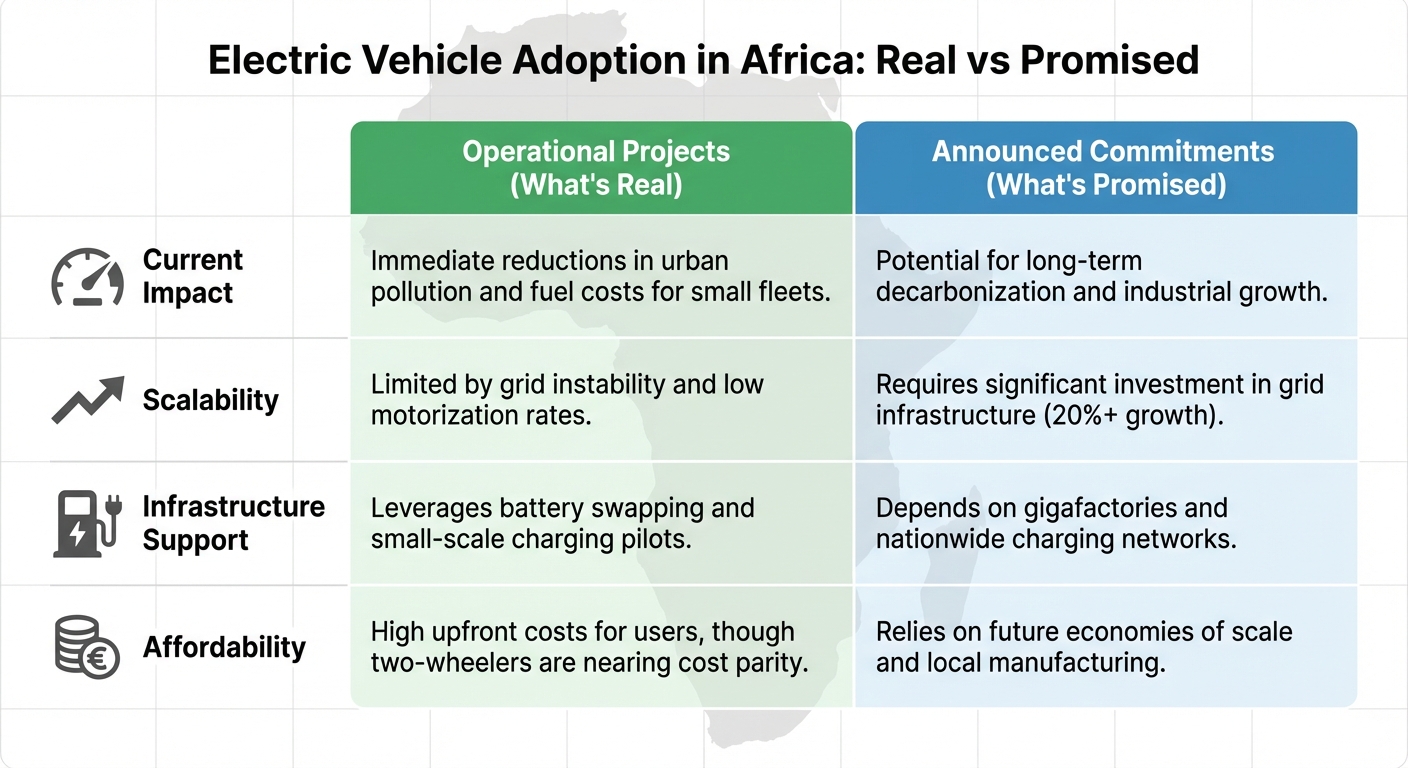
Electric Vehicle Adoption in Africa: Operational Projects vs Announced Commitments Comparison
The pros and cons below shed light on the practical advantages of operational projects compared to the ambitious promises of announced commitments. While operational projects aim for quick wins – like cutting urban pollution and lowering fuel costs for small fleets – announced commitments focus on long-term goals such as decarbonization and economic expansion.
Here’s a breakdown of how these two approaches stack up across key areas:
| Criterion | Operational Projects (Real) | Announced Commitments (Promised) |
|---|---|---|
| Current Impact | Immediate reductions in urban pollution and fuel costs for small fleets | Potential for long-term decarbonization and industrial growth |
| Scalability | Limited by grid instability and low motorization rates | Requires significant investment in grid infrastructure (20%+ growth) |
| Infrastructure Support | Leverages battery swapping and small-scale charging pilots | Depends on gigafactories and nationwide charging networks |
| Affordability | High upfront costs for users, though two-wheelers are nearing cost parity | Relies on future economies of scale and local manufacturing |
This comparison underscores the contrast between immediate, practical solutions and ambitious, future-focused strategies. Operational projects, like Spiro’s battery-swapping networks, address current grid challenges and enable deployment without waiting for large-scale infrastructure. In contrast, announced commitments hinge on extensive investments, such as building gigafactories and scaling grid capacity, which could take decades to achieve.
The lack of comprehensive data adds to the uncertainty surrounding these commitments. Rose Mutiso, Research Director at Energy for Growth Hub, points out:
"Africa lacks rigorous EV data and analysis, limiting policy and investment. Anecdotal narratives dominate the discourse around EVs in Africa, focusing narrowly on promising EV startups in a few hotspot countries"
This data gap makes it harder to evaluate whether ambitious promises will deliver the same measurable benefits that operational projects already provide. The trade-off is clear: while operational projects yield tangible results today, their scalability is constrained by existing infrastructure. Meanwhile, announced commitments aim to address these limitations but depend on investments and grid upgrades that may take years, if not decades, to materialize.
Conclusion
Africa’s electric vehicle (EV) sector tells two stories: real progress with two- and three-wheelers and ambitious promises yet to materialize. The success so far lies in the deployment of two- and three-wheel EVs. For instance, Spiro has rolled out more than 60,000 electric motorbikes across Uganda, Kenya, Nigeria, and Rwanda by late 2025. Battery-swapping models have shown that EVs can work even in the face of high costs, unreliable power grids, and the demand for quick turnarounds. However, the gap between current achievements and future ambitions highlights the need for more focused efforts.
Challenges like poor infrastructure, limited financing, and weak policy frameworks continue to hinder progress. Many announced commitments fail to translate into real-world deployments due to these barriers. To bridge this gap, a clear strategy is essential. Governments need to prioritize investments in charging infrastructure and grid improvements over simply incentivizing vehicle imports. Models like Spiro’s battery-swapping network offer a blueprint for success. Standardizing charging plugs and ensuring compatibility across the continent can prevent fragmented, supplier-specific systems. Additionally, addressing the lack of reliable data is critical – policymakers and investors need solid evidence rather than anecdotal reports to make informed decisions.
While operational projects are delivering tangible results today, the transformative potential of announced initiatives remains unrealized. Ensuring these promises become reality is the next big challenge. With China’s Gotion High-Tech planning to start battery production in Morocco by 2026 and Ethiopia’s five-gigawatt hydropower dam already running, the foundation for broader EV adoption is being laid. The key lies in execution – turning these initiatives into widespread, impactful change.
FAQs
Why are electric motorbikes taking off faster than electric cars in Africa?
Electric motorbikes are gaining traction in Africa at a quicker pace than electric cars, largely because they align better with the financial realities of many consumers. These bikes are only marginally pricier than their gas-powered counterparts, but they come with much lower running costs – thanks to savings on fuel and maintenance. Plus, they don’t rely heavily on extensive charging infrastructure, making them a practical choice for areas with limited networks. This makes them especially appealing for urban applications like delivery services and motorcycle taxis.
What needs to change for reliable charging across more African countries?
Expanding access to reliable charging in more African countries involves tackling several key challenges. First, there’s a need to expand and standardize charging infrastructure to accommodate the increasing number of electric vehicles. Second, improving the reliability of the power grid is crucial to ensure consistent energy availability. Lastly, efforts must focus on increasing electricity access, particularly in rural areas where infrastructure is often limited. These steps are critical to supporting the broader adoption of electric vehicles across the continent.
Which policies actually boost EV adoption (and which ones backfire)?
Policies that help drive electric vehicle (EV) adoption in Africa often focus on financial incentives, local manufacturing support, and charging infrastructure investments. For example, South Africa has seen success with tax deductions aimed at EV production and expanding charging networks. On the other hand, policies that lack proper implementation tend to fall short. Take Ghana, where promised tax exemptions have not been fully realized, or Ethiopia, where EV bans were introduced without adequate infrastructure to support the transition. These missteps highlight the importance of thoughtful execution.