
 Thabo Nkosi
Electric cars (EVs) in South Africa are becoming more accessible, but the real question is: are they worth it? While EVs often cost 10-15% more upfront compared to petrol cars, their lower running and maintenance costs can lead to major savings over time. Here’s a quick breakdown:
- Upfront Costs: EVs like the BYD Atto 3 (R627,900) are pricier than petrol cars like the Toyota Corolla Cross (R569,900). Import duties play a big role in this price gap.
- Running Costs: EVs cost R0.93/km to operate, compared to R2.40/km for petrol cars. A daily 50 km commute could save you R26,900 annually on fuel.
- Maintenance: EVs require fewer repairs, costing around R12,000 over five years, compared to R45,000 for petrol cars.
- Charging: Home charging is affordable (R3.00–R4.00 per kWh), while public fast chargers can be double that. Installing a home wallbox charger costs R9,000–R24,000.
Over five years, an EV like the BYD Atto 3 could save you R143,935 compared to a petrol car, despite the higher upfront cost. For commuters with access to home charging, EVs offer a clear financial advantage. However, if you rely on public chargers or drive less frequently, the savings may be less noticeable.
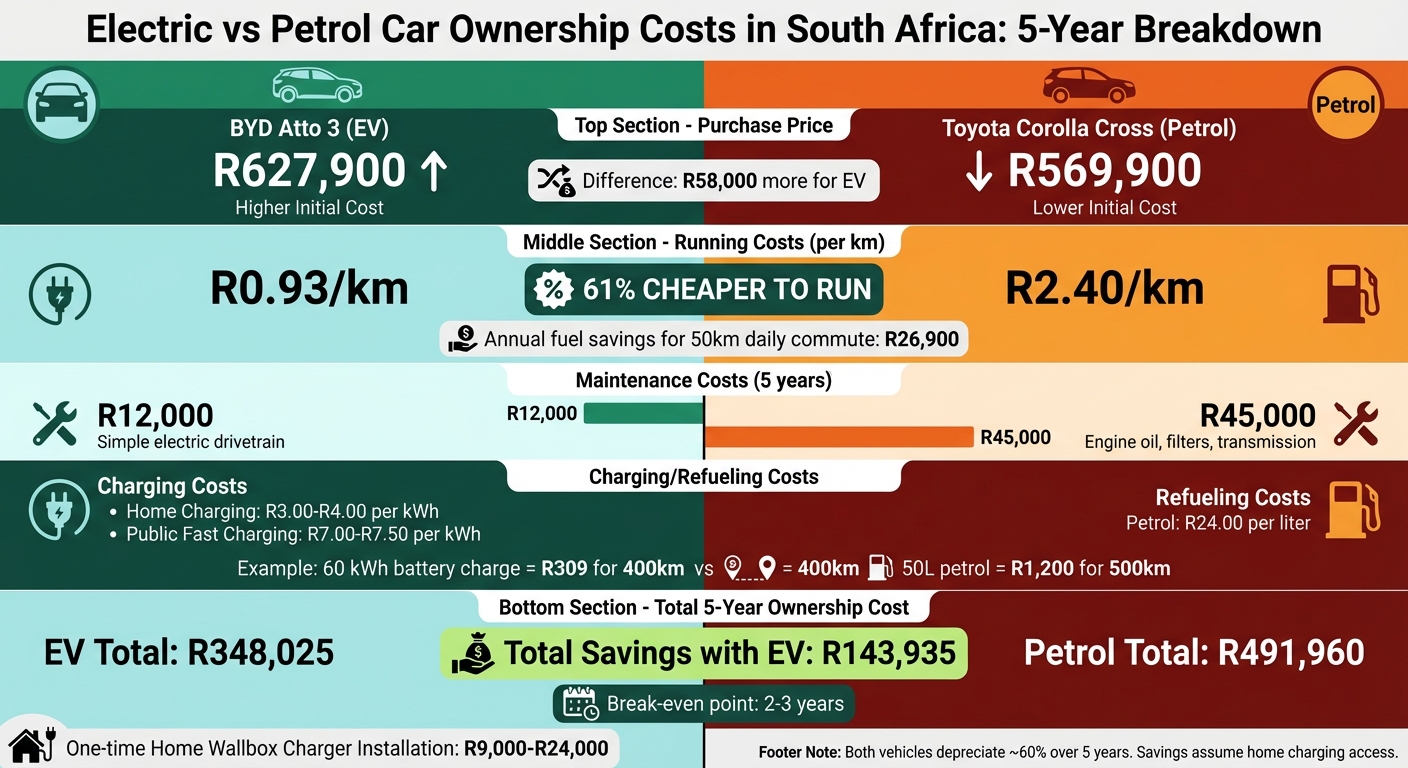
Electric vs Petrol Car Ownership Costs in South Africa: 5-Year Comparison
1. Electric Vehicles (EVs)
Purchase Price and Financing
In South Africa, the upfront cost of an electric vehicle (EV) is generally 10% to 15% higher than a comparable petrol-powered car. For instance, the BYD Atto 3 is priced at R627,900, while the Toyota Corolla Cross 1.8 costs R569,900 – a difference of R58,000. This price gap is largely due to high import duties. However, EV owners can offset this difference within 2–3 years through savings on fuel and maintenance. Models like the GWM Ora (R686,950) and Volvo EX30 (R775,900) highlight this trend of growing affordability.
If you’re planning to install a home charging setup, expect to pay between R9,000 and R24,000 for a wallbox charger, plus an additional R1,000–R2,500 for installation. Beyond the initial purchase, the real financial benefits of EVs become evident in their operational costs.
Monthly Operating Costs
Running costs for EVs are significantly lower than for petrol vehicles. On average, EVs cost around R0.93 per kilometer to operate, compared to R2.40 per kilometer for petrol cars – an impressive 61% saving. Charging at home typically costs between R3.00 and R4.00 per kWh, while public DC fast chargers can range from R7.00 to R7.50 per kWh, which could double your monthly energy costs if used frequently.
To put this into perspective, charging a 60 kWh battery at R5.15 per kWh costs about R309 and provides roughly 400 kilometers of range. In contrast, filling a 50-liter petrol tank for a 500-kilometer range costs approximately R1,200. Home charging can lower per-kilometer costs to R0.60–R0.80, compared to R1.20–R1.50 when relying on public charging stations.
Maintenance Costs
EVs also shine when it comes to maintenance. With fewer moving parts, they avoid many of the costly repairs associated with internal combustion engines. Over five years, the BYD Atto 3 is estimated to require around R12,000 in maintenance, while the Toyota Corolla Cross is expected to cost about R45,000. EVs benefit from features like regenerative braking, which reduces the wear on brake components, and they don’t require oil changes or transmission repairs.
Long-Term Savings
The overall cost of owning an EV becomes even more appealing when you consider the long-term savings. Over five years, the total cost of ownership for the BYD Atto 3 is estimated at R348,025, compared to R491,960 for the Toyota Corolla Cross – a difference of R143,935, despite the higher upfront cost of the EV. Both vehicles depreciate at a similar rate (about 60%), so the savings mainly come from reduced fuel and maintenance expenses. Adding solar panels for daytime charging can lower your per-kWh cost even further, boosting these long-term savings.
Electric Cars Don’t Make Sense In South Africa
2. Petrol Vehicles
Even though petrol vehicles often have lower upfront costs, their hidden expenses can add up quickly when compared to EVs.
Purchase Price and Financing
In South Africa, entry-level petrol vehicles like the Volkswagen Polo, Toyota Starlet, or Suzuki Swift start at around R250,000. For mid-range SUVs like the Toyota Corolla Cross 1.8, prices hover around R569,900, partially thanks to reduced import duties. While these prices may seem appealing, they don’t reveal the full financial picture.
Financing options like balloon payments might make monthly installments more manageable – around R4,174 per month for a R250,000 hatchback – but they come with a catch. Balloon payments defer 35% of the vehicle’s cost, leaving you with a lump sum to pay later, along with refinancing fees. This setup often stretches the repayment period to as long as seven years. And remember, your monthly loan payment typically covers just 50-60% of the actual ownership costs once you add expenses like fuel, insurance (approximately R1,000/month), and maintenance.
Monthly Operating Costs
Unlike EVs, which are known for their lower running costs, petrol vehicles rack up significant ongoing expenses. With petrol priced at R24.00 per liter, running a car with a fuel consumption of 10L/100km will cost about R2.40 per kilometer. For a compact hatchback averaging 8L/100km and driving 1,000 kilometers a month, expect to spend around R2,000 on fuel alone. If you’re an average commuter covering 18,250 kilometers annually, that figure climbs to approximately R43,800 per year.
Other recurring costs also add to the burden. License disc renewals are about R600 per year, regular car washes cost around R400 per month, and finance admin fees add R69 per month. Combined, these expenses make petrol vehicles far from cheap to operate.
Maintenance Costs
Petrol engines require routine maintenance that EVs don’t. This includes oil changes, spark plugs, oil filters, and repairs to exhaust systems and brakes – all of which wear out over time. Maintenance costs for petrol vehicles are typically 30% higher than for EVs. Without a service plan, annual maintenance expenses can easily surpass R6,000.
And while both petrol and electric vehicles depreciate at roughly 60% over five years, petrol cars don’t offer any resale value advantages. When you factor in the higher upkeep costs, the financial drawbacks of petrol vehicles become even clearer.
sbb-itb-99e19e3
Pros and Cons
Looking at the cost breakdown above, here’s a closer look at the trade-offs between electric vehicles (EVs) and petrol cars.
Choosing between the two depends on what you value most. EVs come with a higher price tag upfront, largely due to import duties. But that initial expense is often balanced out by significantly lower fuel and maintenance costs over time.
On the plus side, EVs offer much lower monthly running costs. Charging at home is especially affordable, and the savings on maintenance – thanks to fewer moving parts – can really add up. On the flip side, public DC fast charging can be pricey, and EV charging infrastructure still has room to grow. Petrol cars, meanwhile, provide the convenience of quick refueling at an extensive network of stations, though each stop at the pump comes with a higher ongoing cost.
Here’s a quick comparison to sum it all up:
| Feature | Electric Vehicle (EV) | Petrol Vehicle (ICE) |
|---|---|---|
| Initial Price | Higher (due to import duties) | Lower upfront cost |
| Running Cost | Low (approx. R0.93/km) | High (approx. R2.40/km) |
| Maintenance | Minimal (fewer moving parts) | Higher (regular oil changes, etc.) |
| Refueling | Home charging; slower public options | Fast refueling at widespread stations |
| Environmental | Zero tailpipe emissions; ideal with solar | High CO2 emissions; fossil fuel dependent |
| Resale Value | Emerging market; potential for higher depreciation | Established market; predictable resale |
Over a five-year period, EVs tend to save owners a significant amount on total ownership costs. Many drivers see the break-even point within just 2 to 3 years.
Conclusion
After closely examining the costs and benefits, the numbers show that while electric vehicles (EVs) come with a higher upfront price tag, they can lead to substantial long-term savings. Even though EVs are typically 10% to 15% more expensive than comparable petrol cars, their lower running costs – especially for fuel and maintenance – help offset this premium within just 2 to 3 years.
Over a five-year period, the savings become even more apparent. For example, a BYD Atto 3 owner could save around R143,935 compared to driving a Toyota Corolla Cross. High-mileage drivers benefit even more. If you commute 50 kilometers daily, you could save approximately R26,827 per year on fuel alone.
Home charging is key to maximizing these savings. Residential electricity costs, ranging from R3.00 to R4.00 per kWh, are about half the price of public DC fast chargers. Installing a home wallbox, which costs between R9,000 and R24,000, quickly pays for itself. Pairing this setup with solar power can bring charging costs down to nearly zero. If public charging is unavoidable, consider free stations at dealerships like BMW or Nissan, or opt for AC chargers instead of pricier DC fast chargers. These strategies significantly enhance the financial benefits of owning an EV.
Ultimately, whether an EV is the right choice for you depends on your driving habits and access to charging options. Daily commuters with home charging access stand to gain the most, while occasional drivers relying on public charging may find the cost advantages less compelling. To decide, calculate your typical monthly mileage and evaluate your charging options.
This detailed breakdown of purchase prices, fuel savings, and maintenance costs highlights the financial advantages of owning an EV. For more information, transparent listings, and financing options, visit EV24.africa.
FAQs
How do import duties influence the price of electric cars in South Africa?
In South Africa, import duties significantly contribute to the high price tag of electric vehicles (EVs). Imported EVs face a 25% import duty, along with VAT and other taxes, such as luxury or ad valorem taxes. These additional charges vary based on the vehicle’s retail price and classification, making EVs more expensive upfront compared to locally manufactured cars.
The South African government has started rolling out policies to ease these taxes over time, with the goal of making EVs more accessible. Despite the steep initial costs driven by import duties, EVs can still be a smart long-term choice. Their lower fuel and maintenance expenses often offset the high purchase price, offering potential savings for buyers in the years to come.
What are the key advantages of charging your electric car at home?
Charging your electric vehicle (EV) at home comes with some clear perks, like saving money and the ease of use it offers. For starters, electricity is often much cheaper than gasoline, which means powering up your EV at home can cost you less. If you charge your car overnight, you might even benefit from lower off-peak electricity rates, trimming those costs down even more.
Beyond the financial advantage, home charging is a major time-saver. You won’t have to make trips to public charging stations, which can be a hassle. Instead, you’ll have a dependable and convenient way to keep your EV ready to roll every morning. Plus, having control over your charging schedule means you can plan things around your routine without extra stress. In short, home charging makes owning an EV simpler and helps keep operating costs manageable.
How do the maintenance costs of electric cars compare to gas-powered cars?
Electric vehicles (EVs) are generally cheaper to maintain than their gas-powered counterparts. On average, maintaining an EV costs around $0.06 per mile, while gas vehicles average $0.10 per mile. Over 30,000 miles, this adds up to a potential 40% savings in maintenance costs.
This cost difference is largely due to EVs having fewer moving parts and eliminating the need for routine tasks like oil changes, spark plug replacements, and fuel system repairs. Over time, the savings become even more apparent. Studies indicate that servicing an EV over 90,000 miles can cost more than 50% less compared to a gas-powered vehicle. For many drivers, this long-term reduction in maintenance expenses makes EVs a smart financial choice.