
 Thabo Nkosi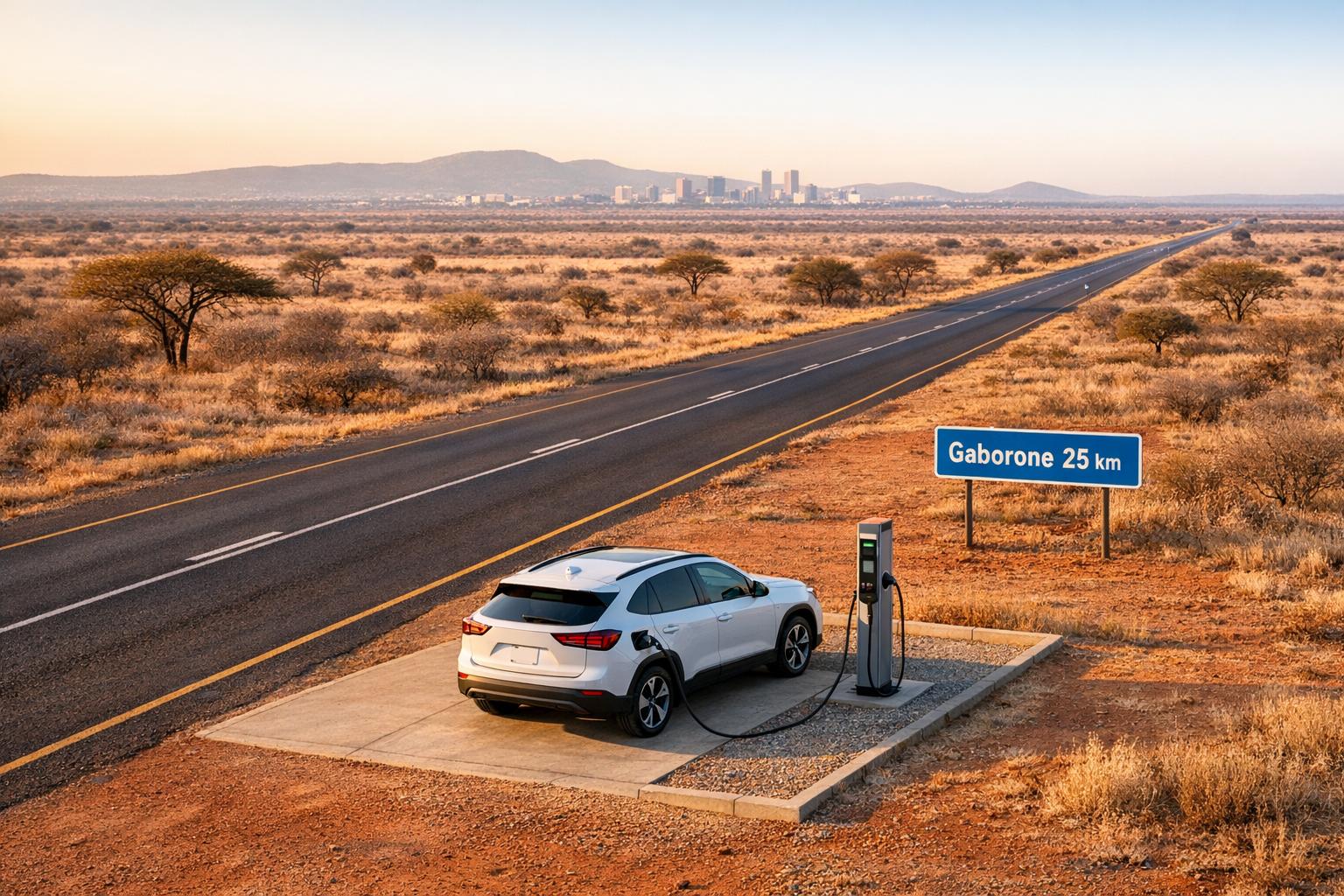
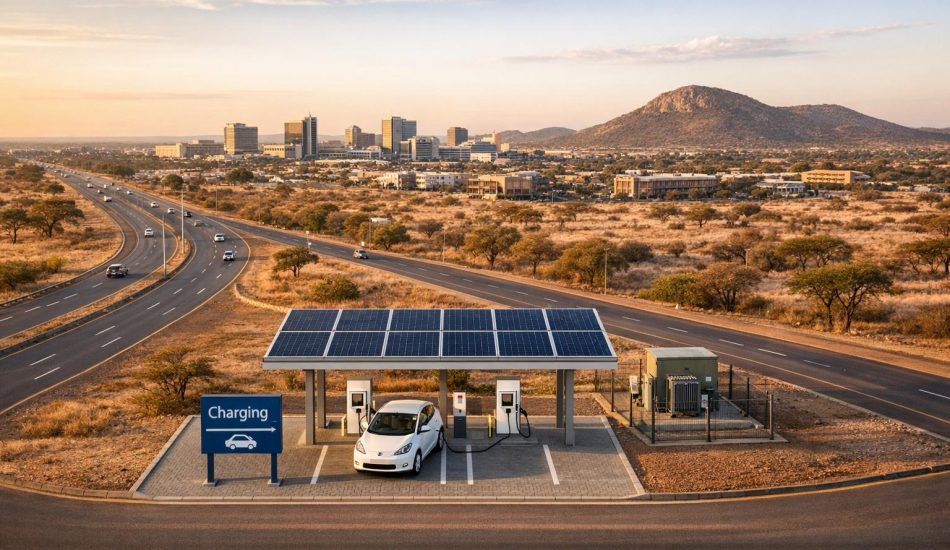
Charging an electric car in Botswana can be challenging due to limited infrastructure. As of early 2026, charging options are sparse, with only a few stations concentrated in Gaborone and none along major highways. Most EV owners rely on home charging using 3 kW portable chargers, which take around 20-21 hours to fully charge a 63 kWh battery. Public fast chargers are virtually absent, with the nearest 60 kW DC fast charger located 160 miles away in Rustenburg, South Africa.
Key Points:
- Home Charging: Costs about $6.93 to fully charge a 63 kWh battery, taking ~21 hours.
- Public Charging: Limited to a few Level 2 AC stations in Gaborone.
- Long-Distance Travel: Requires careful planning; no fast chargers between South Africa and Botswana.
- Government Initiatives: Efforts are underway to expand EV infrastructure and support local assembly of EVs.
For now, EV ownership in Botswana requires meticulous route planning, reliance on home charging, and digital tools to locate scarce charging points.
We Drove from South Africa to Botswana in an Electric Car and Charged Where There was No Electricity
sbb-itb-99e19e3
Current Charging Infrastructure in Botswana
Botswana’s electric vehicle (EV) charging network is still in its early stages and is mostly centered in Gaborone, the capital. Most available charging points are located at private businesses, such as car dealerships and hotels, where they are often reserved for customers or guests. As a result, EV owners often rely on private and portable charging solutions.
At present, charging options are quite limited. Many EV owners use portable 3-kilowatt (kW) chargers that plug into standard wall outlets. For example, at Sethloa Village Luxury Estate in Gaborone, charging a 63kWh battery with a 3kW portable charger took 21 hours and cost about $5.80 (R110.73) at a rate of R2.07/kWh. For faster charging, the nearest 60kW DC fast charger is located at Waterfall Mall in Rustenburg, South Africa – approximately 160 miles (260 km) away. This highlights the challenges faced by EV owners, particularly when planning longer trips.
Available Charging Station Types
The charging infrastructure in Botswana is fairly basic. Most chargers are Level 2 AC units with Type 2 sockets, such as the one at BMW Capital Motors on Plot 1279 Luthuli Road in Gaborone. These chargers typically provide over 2kW of power and are compatible with most modern EVs. However, DC fast chargers – capable of recharging a battery in under two hours – are virtually nonexistent in the country.
Due to the lack of fast charging options, many EV owners continue to depend on slower 3kW portable AC chargers. Reports suggest there are two fast AC chargers in Gaborone that serve as backup options, but detailed information about their exact locations or performance is scarce. This makes finding charging stations a task that requires additional planning and effort.
Where to Find Charging Stations
Most charging stations are concentrated in and around Gaborone. For instance, there’s a Level 2 AC station at BMW Capital Motors, and guests at the Hilton Garden Inn in Gaborone have access to charging facilities. Residential estates, like Sethloa Village Luxury Estate, also provide access to portable chargers through standard outlets.
Outside Gaborone, public charging options are even harder to come by. There are no known charging stations along major highways connecting Botswana to neighboring countries. Long-distance travelers must verify charging access in advance by contacting potential locations to confirm their availability. Given the limited infrastructure, careful planning and flexibility for longer charging times are essential for EV owners in Botswana.
Charging Costs, Times, and What to Expect
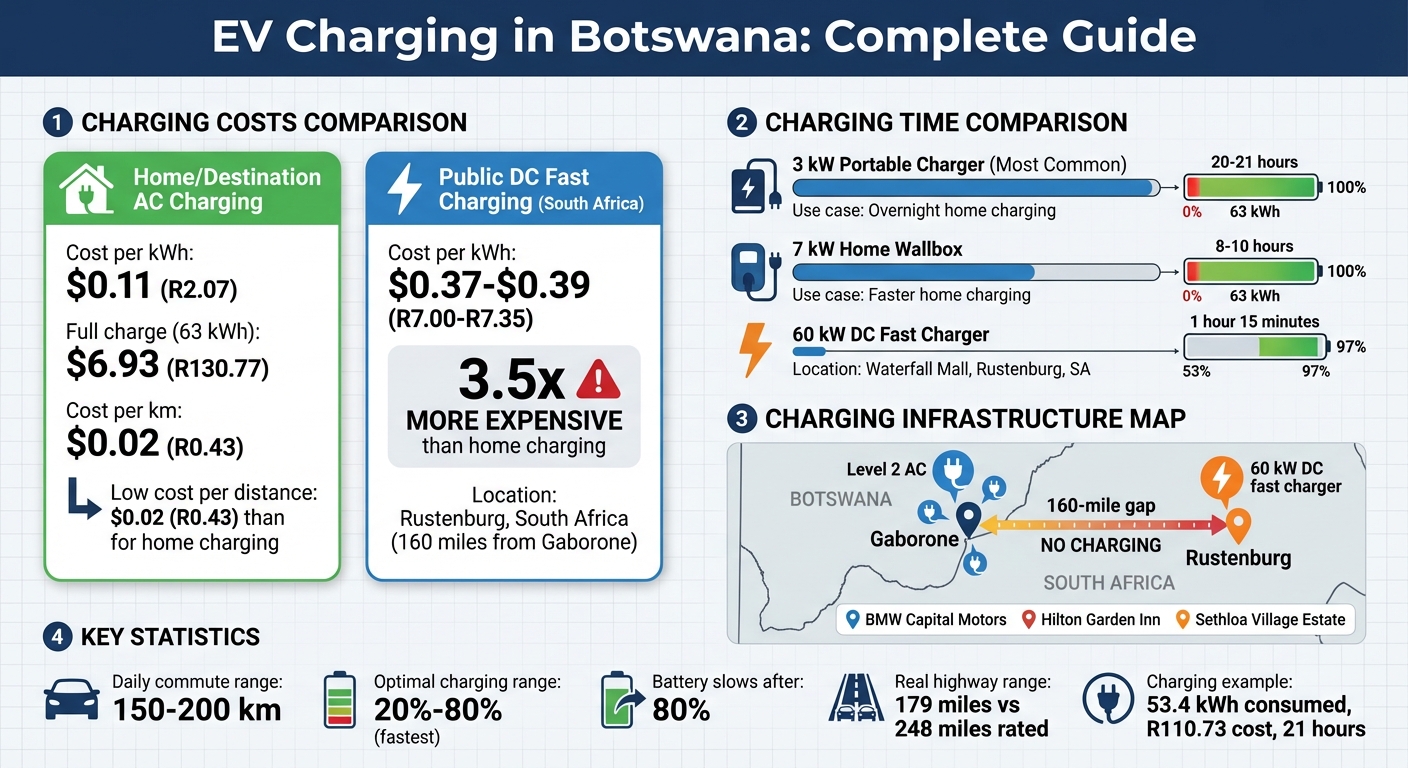
EV Charging Options in Botswana: Costs, Times & Locations Compared
What Charging Costs in Botswana
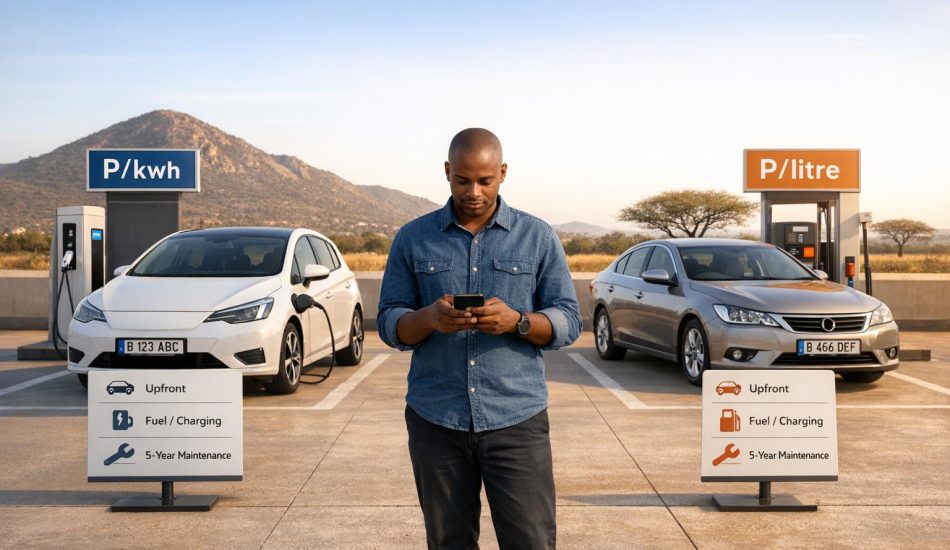
Charging your EV in Botswana largely depends on where and how you charge. Home or destination AC charging is significantly less expensive compared to the limited public DC fast-charging options.
For home and destination charging, the cost averages around $0.11 per kWh (R2.07). To fully charge a typical 63 kWh battery from empty, you’d spend about $6.93 (R130.77), with the process taking roughly 21 hours using a 3 kW portable charger.
On the other hand, public DC fast chargers – mainly located across the border in South Africa – charge between $0.37 and $0.39 per kWh (R7.00–R7.35). That’s nearly 3.5 times more expensive than home charging. During a test drive, a 60 kW DC fast charger at Waterfall Mall in Rustenburg, South Africa, charged an EV from 53% to 97% in about 1 hour and 15 minutes.
While costs are important, the time it takes to charge is just as critical for EV owners.
How Long Charging Takes
Charging times vary depending on the method and equipment. Most EV owners in Botswana rely on overnight AC charging at home, as fast chargers are scarce. Knowing the time it takes to recharge helps you plan better.
Using a 3 kW portable charger, which is the most common home option, it takes about 20 to 21 hours to fully charge a 63 kWh battery from empty. If you upgrade to a 7 kW home wallbox, that time drops significantly to around 8 to 10 hours. For those who can access the rare 60 kW DC fast charger at Waterfall Mall, charging from 53% to 97% takes just 1 hour and 15 minutes.
It’s worth noting that EV batteries charge fastest between 20% and 80%, with speeds slowing down after 80% to protect the battery’s longevity. Additionally, driving at lower highway speeds can help conserve battery life, reducing the frequency of charging stops.
Charging at Home and Work
Setting Up Home Charging
In Botswana, where public charging infrastructure is limited, home charging becomes a practical and reliable option. Using a standard 3 kW portable charger, it takes about 20 hours to fully charge a 63 kWh battery. While 20 hours might sound lengthy, it aligns well with overnight or extended idle periods. For typical daily commutes of 150–200 km, charging for 10–12 hours overnight is generally enough.
The cost of charging at home is surprisingly affordable. In Gaborone, residential electricity costs around $0.11 per kWh (R2.07), so a full charge costs approximately $5.87 (R110.73). This works out to just $0.02 per km (R0.43), making home charging not only convenient but also economical. For example, in March 2026, a GWM Ora 03 GT was charged from 6% to 100% using a 3 kW portable charger over 21 hours. The process consumed 53.4 kWh and cost R110.73 in total.
Workplace Charging Options
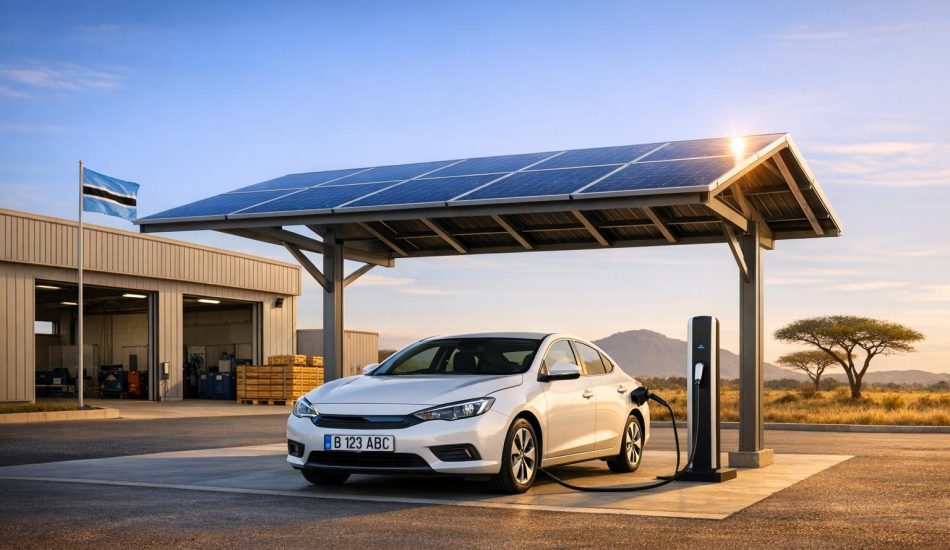
Workplace charging is also becoming an option in Botswana, albeit on a smaller scale. Businesses, rather than government initiatives, are leading this effort. For instance, BMW Capital Motors in Gaborone introduced a Level 2 charging station with a Type 2 socket in April 2026, available for staff, visitors, and customers.
These workplace chargers, typically offering more than 2 kW, are perfect for topping up during the workday. Arriving at work with a partially charged battery and adding range during business hours can ensure enough power for evening commutes and errands. Though still limited in availability, workplace charging serves as a valuable supplement to home charging.
Government and Business Support for EV Charging
Government Programs and Policies
Botswana is steadily developing its electric vehicle (EV) ecosystem, spearheaded by the Botswana Institute for Technology Research and Innovation (BITRI). In October 2024, BITRI launched its first semi-automated EV assembly center in Gaborone. This milestone event was led by Minister Thulagano Segokgo and Project Engineer Dr. Patrick Sebudubudu. The facility operates under intellectual property rights from Chinese manufacturers Skywell (specializing in SUVs) and CHTC (focused on buses) and currently produces three vehicles daily.
BITRI’s eMobility program is structured in three phases: building technical capacity, retrofitting combustion-engine vehicles, and establishing a full-scale assembly plant. So far, the government has trained 150 technicians in EV assembly and retrofitting. The program’s initial production goal includes assembling 50 electric SUVs and 30 electric buses. These SUVs, assembled locally, boast a travel range of about 520 kilometers and can fully charge in just 20 minutes.
"By investing in electric vehicles, charging infrastructure, and sustainable energy sources, we are laying the groundwork for a greener, smarter Botswana."
– Thulagano Segokgo, Minister of Communication, Knowledge, and Technology
Vice President Slumber Tsogwane highlighted the broader economic opportunities tied to the EV program, explaining, "What is important is that this will create value chains such as production of batteries, even mining companies will produce materials used for production of batteries". Additionally, Botswana has finalized a renewable energy strategy aimed at attracting private investment in solar and wind energy, which will play a key role in supporting the EV charging infrastructure.
These government-led initiatives set the stage for private companies to expand Botswana’s EV charging network.
Private Companies Building Charging Networks
Private companies are also stepping up to enhance the EV charging infrastructure. BMW Capital Motors is contributing to the local charging network, while GridCars supports cross-border travel with its 60kW DC fast chargers, such as the one located at Waterfall Mall in Rustenburg. However, there remains a 260-kilometer gap between the South African border and Gaborone that lacks high-speed DC charging options. On a smaller scale, private residential estates like Sethloa Village Luxury Estate in Gaborone are offering destination charging solutions.
Common Challenges and How to Handle Them
Dealing with Limited Charging Stations
Botswana’s sparse charging infrastructure presents a real hurdle for long-distance travel. Outside the capital, public charging options are almost nonexistent, making planning essential for EV drivers. A particularly challenging stretch is the route between the South African border and Gaborone. A recent test drive highlighted this issue when a vehicle’s battery reached critically low levels after covering 160 miles without a single charging opportunity. This underscores the importance of careful planning and speed management in areas with limited infrastructure.
To navigate this, ensure your battery is charged to at least 95% at the last fast charger before crossing into Botswana. A common choice is the GridCars 60kW DC fast charger in Rustenburg, South Africa. Keep in mind that highway driving significantly reduces range compared to manufacturer estimates. For example, a vehicle rated for 248 miles (400 km) might only achieve about 179 miles (288 km) at highway speeds.
Once in Botswana, you’ll likely need to rely on portable 3kW chargers that plug into standard wall outlets. However, these chargers are slow – charging a 63kWh battery can take around 21 hours. Some private locations, such as BMW Capital Motors in Gaborone, offer Level 2 chargers, but access may be restricted. Always confirm availability and any usage conditions beforehand.
Finding Charging Stations with Apps
Given the challenges, digital tools can be a lifesaver. Open Charge Map is a key resource for locating the few available charging stations. It provides details on power levels, plug types, operational status, and whether a station is public or restricted. For longer trips, A Better Route Planner (ABRP) is invaluable for estimating charging stops based on your vehicle’s real-world performance. It factors in variables like topography and driving speed. Additionally, EVDatabase offers more accurate range estimates than standard WLTP figures, which can help set realistic expectations.
Before heading to a charging station, double-check its operational status and any access requirements. For instance, the BMW Capital Motors station in Gaborone – listed on Open Charge Map as a Level 2 Type 2 socket – restricts access to staff and visitors. Always carry a portable AC charger as a backup, especially since public charging infrastructure is scarce, and residential locations may be your only option.
Conclusion
Charging an electric car in Botswana requires careful planning and realistic expectations. The country’s charging infrastructure is still in its early stages, with Gaborone being the central hub. As of early 2026, only a few charging stations are available nationwide, and the nearest DC fast chargers, like a 60kW unit in Rustenburg, are located across the border in South Africa.
Botswana’s charging network is limited, which makes strategic use of resources essential. For now, home charging is the most dependable option. Using a portable 3kW AC charger, you can fully recharge a 63kWh battery in around 20 hours, and the cost is significantly lower than fast-charging rates in South Africa.
For long-distance travel, thorough preparation is a must. Test drives have shown that route planning is critical, especially on routes without charging infrastructure. Driving at reduced highway speeds can help conserve energy and provide a safety margin. Digital planning tools can guide you through Botswana’s limited network, but always check station availability before setting off. Carrying a portable charger and keeping a buffer of 10–20% battery at your destination can make a big difference. With thoughtful planning and the use of digital tools, EV owners can navigate Botswana’s developing charging infrastructure with confidence. While the network is expected to improve over time, patience and preparation remain key to successful EV ownership in the country.
FAQs
Can I road-trip across Botswana in an EV today?
Botswana’s electric vehicle (EV) charging network is still growing, so taking a road trip in an EV requires some careful planning. Charging stations might be sparse depending on your route, so it’s important to map out available chargers in advance and allow extra time for charging stops. Both government and private efforts are underway to increase charging options, which will make future trips easier. For now, hitting the road in an EV is doable, but it demands some preparation and adaptability.
What home setup do I need to charge an EV in Botswana?
To charge an EV at home in Botswana, you’ll need a proper electrical setup tailored for EV charging. Start by consulting a qualified electrician to evaluate your home’s electrical system. They can install a dedicated circuit breaker, a compatible charging outlet – such as a Type 2 connector – and, if needed, a home charging station for quicker charging. Make sure the installation aligns with safety standards and suits your EV’s specific charging needs.
How do I find reliable charging spots in Botswana?
You can find dependable charging stations in Botswana with tools like Open Charge Map. This platform provides a comprehensive database of verified charging spots. Its map feature makes navigation simple, offering reliable options for charging – particularly useful when you’re on the move. It’s a practical way to locate trusted charging locations throughout the country.