
 Thabo Nkosi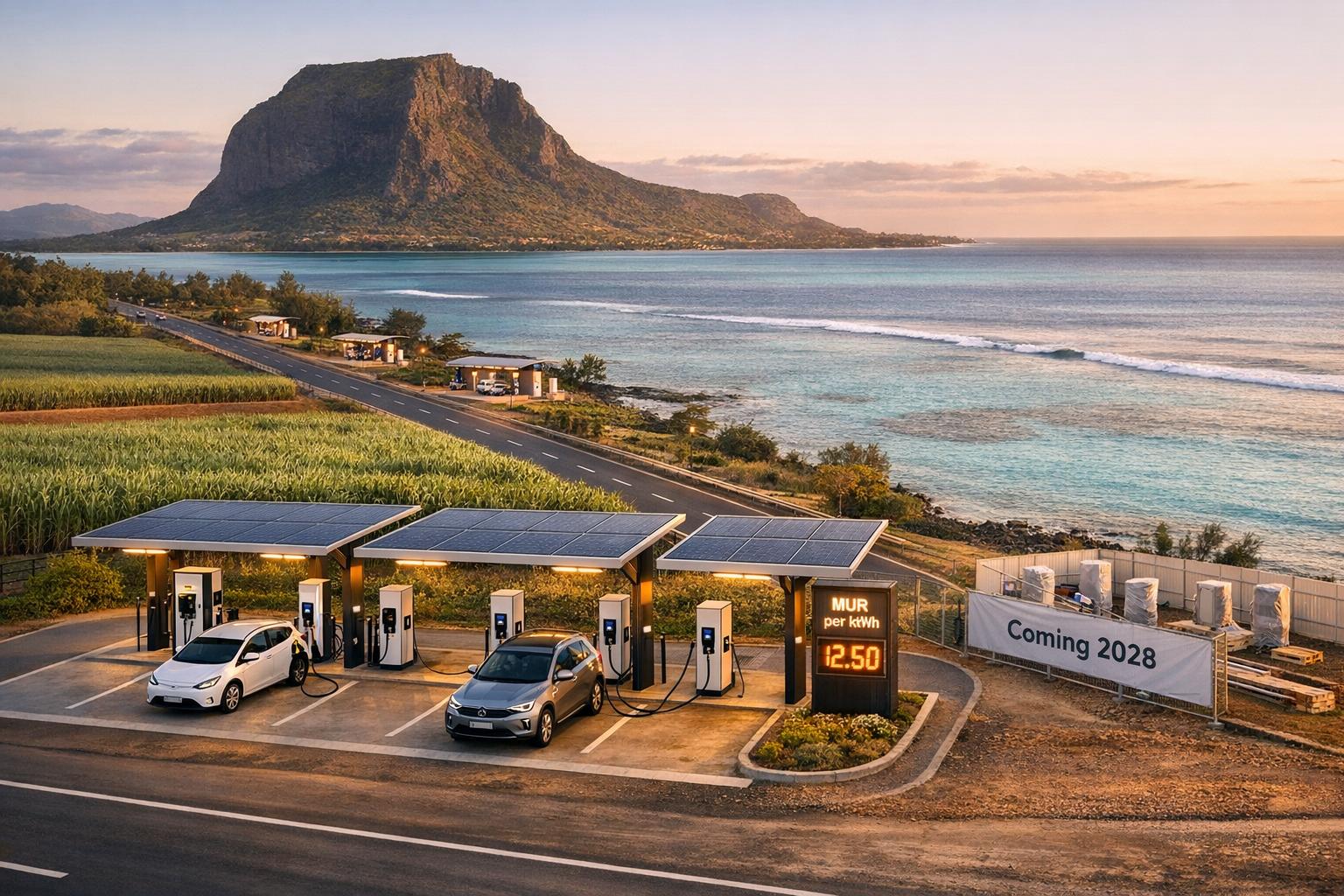
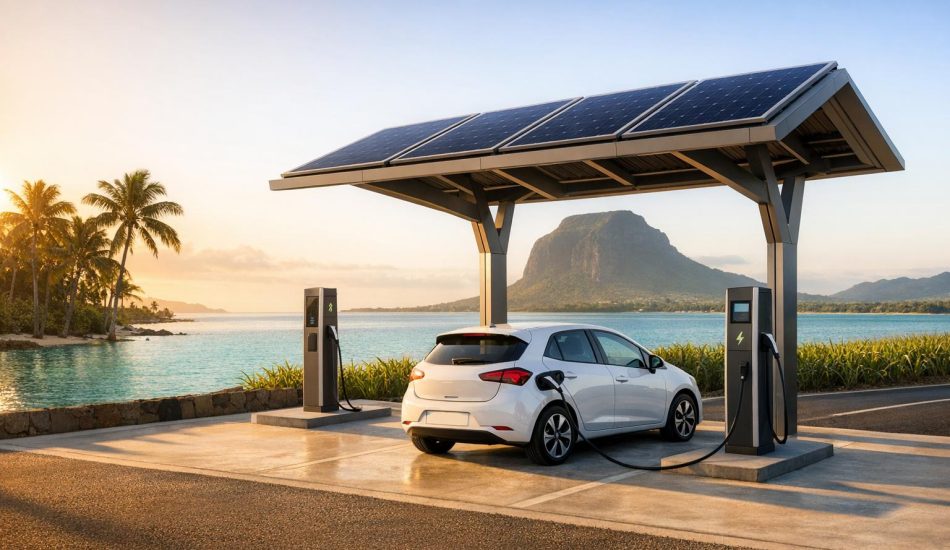
Mauritius is expanding its electric vehicle (EV) charging network to support a growing number of EVs. With 42 charging stations available across the island as of April 2026, urban areas like Port Louis and Pamplemousses have the highest concentration, while rural and coastal regions still lack sufficient coverage. Key players like E-Motion and the Central Electricity Board (CEB) are driving progress, with plans to increase the number of stations to 100 by 2028, half of which will be solar-powered.
Here’s what you need to know:
- Types of Chargers: AC chargers (up to 22 kW) are suited for long parking periods, while DC fast chargers (40 kW) offer quicker charging for short stops.
- Operators: E-Motion leads with stations at Shell locations and malls, while independent providers and dealerships also contribute to the network.
- Challenges: Limited rural access and reliance on fossil-fuel-based electricity are key hurdles.
- Future Plans: Solar-powered charging and high-capacity chargers are being developed to improve access and reduce emissions.
Use apps like Electromaps to find stations and follow tips like the 80/20 charging rule to optimize battery life. Mauritius is on track to meet its goal of 30,000 EVs by 2030.
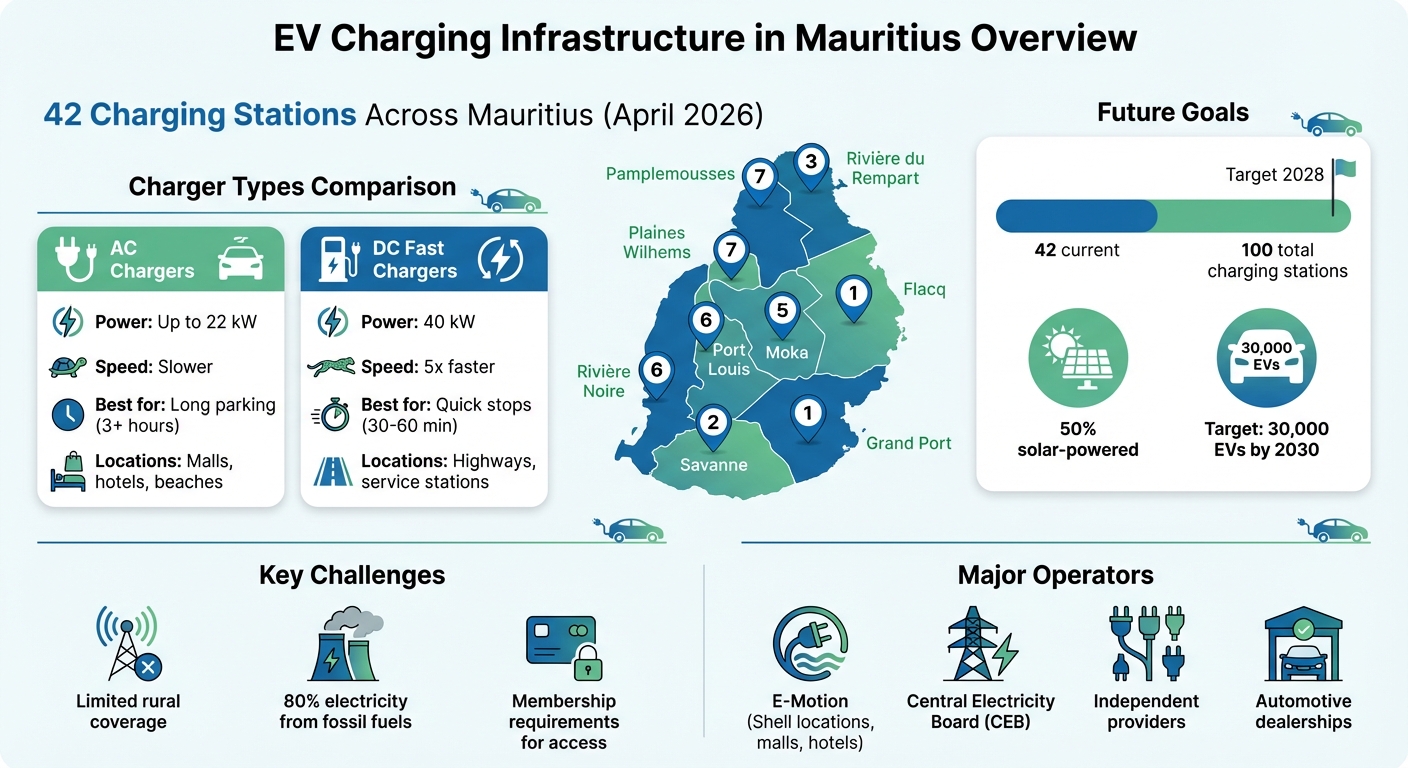
EV Charging Infrastructure in Mauritius: Current State and 2028 Goals
Current State of EV Charging Infrastructure
Charging Station Availability and Distribution
The availability and placement of charging stations play a critical role in ensuring efficient EV usage. In Mauritius, there are currently 42 charging stations spread across its nine districts. Urban hubs like Pamplemousses and Plaines Wilhems lead with the highest number of stations, hosting seven each. In contrast, rural and coastal regions remain underserved. Here’s how the distribution looks across other districts: Rivière Noire has six stations, Port Louis and Moka each have five, Rivière du Rempart hosts three, Savanne has two, and both Flacq and Grand Port have just one station each.
A notable development occurred in June 2023 when E-Motion installed the island’s first 40kW DC fast charger at a Shell station in Moka. Conveniently located near a McDonald’s, this site offers amenities like free Wi‑Fi and dining options, making it a user-friendly charging stop. Krishnen Vencadachellum, Retail Manager of Vivo Energy Mauritius, highlighted future plans:
"A plan has already been established so that other 40 kW DC stations will soon be available in strategic areas… the Port-Louis highway towards the north and south, the west and the center"
This growing network is managed by a mix of major and independent operators, ensuring that EV owners have access to charging facilities across various locations.
Operators of EV Charging Stations in Mauritius
Mauritius’ charging infrastructure is supported by a variety of operators, each contributing to the network’s reach and reliability. E-Motion is a key player, running stations at Shell locations, shopping malls, and hotels.
Automotive dealerships are also involved. Allied Motors operates a charging station on State House Avenue in Moka, equipped with a 50kW CCS EU connector and a 22kW Type 2 charger. Similarly, Leal has established charging facilities in Pailles.
Independent providers add further accessibility to the network. For instance, SEFA manages a 22kW AC charging point on Ligne Berthaud Road in Vacoas. In April 2025, MEP Engineering Ltd introduced a station in Trou-aux-Biches, improving access for EV users in the northern coastal area.
Additionally, the Central Electricity Board (CEB) launched a program in April 2022 to encourage the installation of solar-powered EV chargers. Speaking about this initiative, Minister of Transport Alan Ganoo stated:
"The collaboration of these two main players will contribute to making electric mobility more accessible to motorists… This will greatly facilitate the transition to a green economy"
These efforts by various stakeholders are gradually shaping a more comprehensive and accessible EV charging network across Mauritius.
sbb-itb-99e19e3
Types of Charging Stations and Their Features
AC vs. DC Chargers Explained
Mauritius has two main types of charging technologies for electric vehicles: AC and DC chargers. Here’s how they differ:
- AC chargers rely on the vehicle’s onboard converter to transform alternating current (AC) into direct current (DC). This process limits power output to 7.4 kW, 11 kW, or 22 kW, depending on the vehicle’s converter.
- DC chargers, on the other hand, bypass the onboard converter entirely. They deliver power directly to the battery, enabling much faster charging – up to five times quicker than AC chargers.
Krishnen Vencadachellum, Retail Manager of Vivo Energy Mauritius, explains:
"For AC chargers, the onboard converter limits the power drawn, whereas DC chargers deliver the full 40 kW available."
In Mauritius, most public AC chargers offer up to 22 kW. However, newer DC fast chargers, like the one installed at Shell Moka in June 2023, provide 40 kW of power, significantly reducing charging time. AC chargers are ideal for places where vehicles are parked for extended periods, such as shopping malls, hotels, or beaches. Meanwhile, DC chargers are better suited for quick stops, like those at highway service stations.
Comparison Table: AC vs. DC Chargers
| Feature | AC Chargers | DC Fast Chargers |
|---|---|---|
| Power Output | Up to 22 kW | 40 kW (current standard) |
| Charging Speed | Slower; limited by the onboard converter | Up to 5x faster; bypasses onboard converter |
| Common Locations | Shopping centers, hotels, beaches | Service stations, major highways |
| Best Use Case | Long-duration parking (3+ hours) | Quick top-ups during travel (30–60 minutes) |
| Connector Types | Type 2 | CCS, CHAdeMO, GB/T |
When using an AC charger, it’s important to check your car’s converter specifications. For example, even if a station offers 22 kW, a vehicle with an 11 kW converter will only draw 11 kW. This explains why charging times can vary between different electric vehicle models. Knowing these details can help EV owners pick the right charging station for their specific needs.
Challenges and Opportunities for EV Charging
Infrastructure Gaps and Limitations
Expanding the EV charging network in Mauritius comes with its share of obstacles. One of the biggest issues is the limited coverage, which makes long-distance travel challenging. While urban areas are relatively well-equipped, rural and coastal regions lag behind in access to charging facilities.
Access restrictions also pose a problem. Many charging stations require specific memberships or registration – like the Electropass – to activate chargers. This lack of universal access can be frustrating for EV owners who are used to the convenience of traditional gas stations.
Another challenge stems from misconceptions about the environmental benefits of EVs. While EVs don’t produce tailpipe emissions, about 80% of Mauritius’ electricity is generated from fossil fuels. Bonnie Qiu, CEO of HSBC Mauritius, highlighted this concern:
"The availability of electric vehicles in Mauritius is certainly progress, but not so much if they are charged using the national electricity grid, because this electricity is 80% produced from fossil fuels".
This raises valid concerns about how sustainable the current charging infrastructure truly is. Even so, efforts are underway to modernize and expand the network to address these issues.
Opportunities for Future Growth
Mauritius is actively working to address these challenges by exploring innovative solutions like solar-powered charging and high-capacity fast chargers. With EV sales doubling annually, there’s a growing demand for better and more accessible charging infrastructure.
Solar-powered charging presents a promising path forward. In April 2022, the University of Mascareignes launched the "Green Charging of Electric Vehicles in Mauritius" project in collaboration with the University of Perpignan, HSBC Mauritius, and Business Mauritius. Led by Dr. Lekhramsingh Latchoomun, the initiative focuses on optimizing charging station locations and developing smart systems to manage solar energy intermittency. By late 2022, preliminary results confirmed that solar-powered charging is viable under current EV adoption levels. Partners like Vivo Energy Mauritius Ltd and Leal Energie Ltd are also contributing to these efforts.
Public-private partnerships are already driving progress. For example, in April 2025, Vivo Energy Mauritius signed an agreement with the University of Mascareignes to conduct research on solar-powered battery charging. This collaboration aims to collect scientific data to support clean mobility infrastructure development.
As more players enter the market and technology advances – such as ABB‘s Terra 360 charger, capable of delivering up to 360 kW and charging four vehicles at once – the EV charging network in Mauritius is expected to become more efficient and accessible.
Practical Tips for EV Owners
How to Locate Charging Stations
Finding a charging station in Mauritius is easier than it seems. Apps like Electromaps and Chargemap, available on both iOS and Android, provide real-time updates on the status of all 42 charging stations across the island. These tools allow you to check whether a charger is available before heading out, saving you time and unnecessary detours.
Port Louis has the highest concentration of charging stations, while areas like Flacq and Grand Port only have one each. Before you plug in, confirm that the station is compatible with your vehicle’s connector type. Most public stations in Mauritius support 22kW AC Type 2 or 50kW DC Combo CCS chargers. You’ll find these chargers in convenient spots, such as Shell filling stations (Floreal, La Vigie, and Ebene) and hotels like the Hennessy Park Hotel.
To make charging even simpler, consider getting a universal pass like the Electropass or Chargemap Pass. These passes – available as digital versions or keyfobs – let you activate chargers from various operators without needing multiple accounts. If you’re a Tesla owner, you can even link your Chargemap Pass to your Tesla app wallet to access Tesla Superchargers.
Once you’ve got charging locations sorted, the next step is figuring out how to keep costs under control.
Managing Charging Costs
One smart tip is to follow the 80/20 rule: stop charging at 80% to avoid the slower, more expensive charging speeds that occur as the battery nears full capacity.
For most EV owners, charging at home is the go-to option – about 75% of them do so for its convenience and cost-effectiveness. If home charging isn’t an option for you, look into the Central Electricity Board’s Solar PV Scheme for Charging of Electric Vehicles, which can help reduce costs. For public charging, it’s worth checking the CEB website regularly for updated electricity tariffs tailored to EV users.
Planning Charging Sessions
To make the most of your EV, plan your trips with charging hubs in mind. For longer drives across Mauritius, map out routes that pass through areas with more charging stations. For example, Pamplemousses has seven stations, compared to six in Rivière Noire. If you’re heading to less-equipped regions like Flacq or Grand Port, ensure your car is fully charged before starting your journey.
Use apps to check real-time charger availability, as some stations have limited operating hours. For instance, the SEFA station in Vacoas is closed on weekends and certain weekdays. Stay informed about new additions to the charging network as well. For example, MEP Engineering Ltd added a new station in Trou-aux-Biches as recently as April 2025. Keeping your apps updated ensures you’re always in the know about the latest charging options.
Future Developments in Mauritius EV Infrastructure
Mauritius is gearing up to tackle its EV infrastructure challenges with a mix of government initiatives and private sector involvement, aiming to make green mobility a reality across the island.
Government Expansion Plans
The Mauritian government has rolled out several focused programs through the Central Electricity Board (CEB) to build a more extensive electric vehicle (EV) charging network. These initiatives, outlined in the Government Budget Speech 2021-2022 (Measure B.3. (b)(ii)), include:
- Solar PV Scheme for Charging of EVs (launched November 2021): Designed for residential EV owners.
- Scheme for Corporate Entities’ EV Charging (launched March 2022): Tailored to corporate businesses.
- Scheme for Public Charging Service Providers (launched April 2022): Targeting commercial charging operators.
A key component of these programs is the "net zero CO2 emission principle", requiring solar photovoltaic (PV) systems to power EV chargers. This approach addresses Mauritius’ reliance on fossil fuels and aligns with the nation’s goal to decarbonize its transport sector by 2030. These government measures lay the groundwork for a greener future, creating opportunities for private stakeholders to expand on this framework.
Private Sector Contributions
The private sector is stepping up to complement government efforts, with companies actively working on innovative charging solutions. A notable initiative is the "Green Charging of Electric Vehicles in Mauritius" project, launched in April 2022 by Vivo Energy Mauritius (Shell’s franchise owner) in partnership with the University of Mascareignes. The project, supported by HSBC Mauritius, Business Mauritius, and other collaborators like Leal Energie Ltd and Rose Hill Transport Ltd, focuses on solar-powered EV charging.
Preliminary findings from this project, shared in December 2022, confirmed the technical viability of solar-based charging systems for the current level of EV adoption. HSBC Mauritius has been a key financial supporter, with CEO Bonnie Qiu emphasizing the importance of this transition:
"HSBC Mauritius est proud to sponsor a research program in this regard. The transition to green energy is a necessity and the decarbonization of the transport sector will open a world of opportunities".
Additionally, Business Mauritius is leading efforts through its Club des entrepreneurs de la transition énergétique. This group collects and analyzes data on energy use and mobility patterns to strategically determine the best locations for charging stations, ensuring an efficient and user-focused network.
Conclusion
As of April 2026, Mauritius boasts 42 charging stations spread across the island, with notable clusters in areas like Port Louis, Pamplemousses, and Rivière Noire. This growth stems from a mix of government-led initiatives, such as solar-powered charging projects, and private sector efforts like the E-Motion network’s ambitious plan to add 100 more stations. These efforts align with the island’s goal of reaching 30,000 electric vehicles by 2030. Impressively, about half of the public charging stations are powered by solar energy, highlighting Mauritius’ push toward greener transportation.
For electric vehicle (EV) owners, convenience is key. Real-time mobile apps make it easy to locate available chargers, while flexible subscription packages offer cost-effective alternatives to pay-as-you-go systems. Following the 80/20 charging rule – keeping your battery charged between 20% and 80% – is a handy tip to extend battery life and reduce wait times at public stations.
Whether you’re exploring the idea of owning an EV or already driving one, Mauritius’ growing network of charging stations is prepared to support you. If you’re ready to take the next step, check out EV24.africa for a wide selection of models from leading brands like Tesla, BYD, Hyundai, and Toyota, all available with delivery across Africa.
Mauritius is steadily advancing its electric mobility infrastructure, setting the stage for a more sustainable future.
FAQs
Do I need a pass to use most public chargers?
Yes, most public EV charging stations in Mauritius need a pass or some type of authentication to activate them. Make sure to confirm the specific requirements of the station you plan to use to avoid any issues during your charging session.
Which plug types work at chargers in Mauritius?
Chargers in Mauritius primarily support high-power DC fast charging and smart AC charging. While these chargers accommodate various connector types, the exact plug types aren’t clearly specified in available information. To avoid any inconvenience, it’s best to double-check your vehicle’s compatibility with the charging station before use.
Can I drive across the island using only public charging?
Yes, it’s possible to explore Mauritius using only public charging stations. The island has about 21 public charging points located in areas such as Flacq and Moka. Route planning is crucial – use apps or maps to check real-time availability, as some stations might need prior registration. Although the network is still developing, with thoughtful preparation, you can travel across the island. Future expansions will only make this process smoother.