
 Thabo Nkosi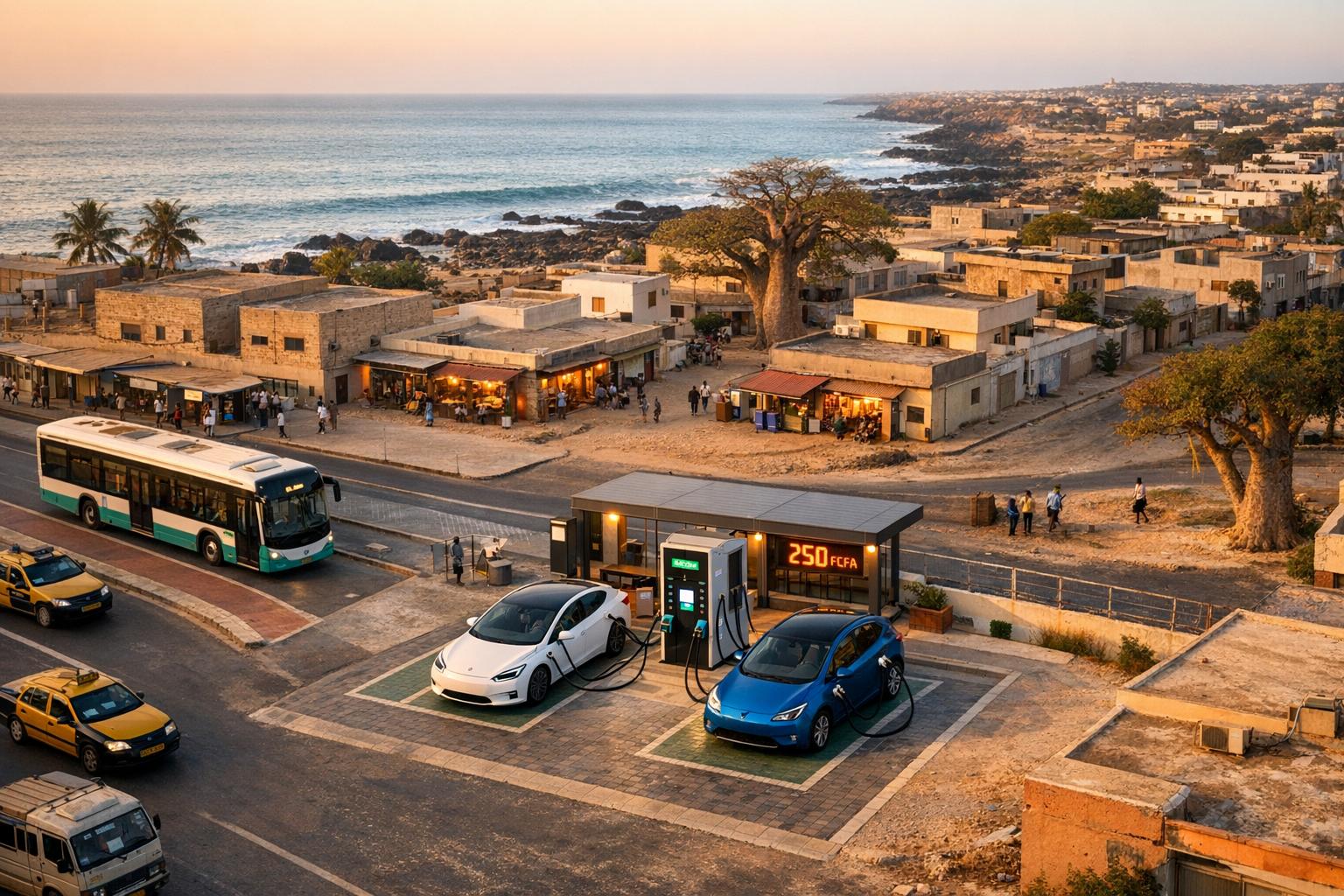
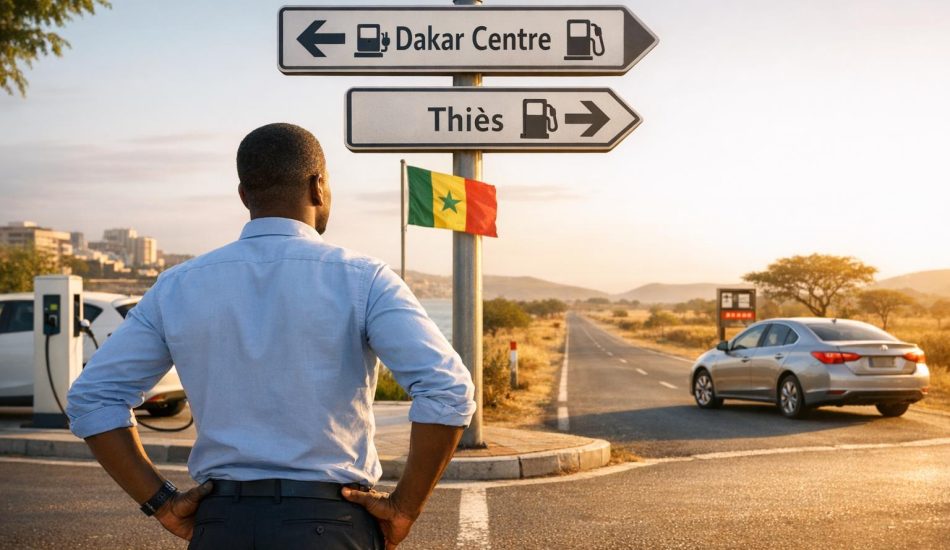
Charging an electric car in Dakar remains a challenging experience due to limited infrastructure, inconsistent pricing, and unreliable power supply. Here’s a quick breakdown of the key issues and progress:
- Lack of Charging Stations: Public charging options are nearly nonexistent, and many stations are either offline or under maintenance.
- Unpredictable Costs: EV owners rely on crowdsourced information to estimate charging expenses.
- Power Grid Instability: Frequent outages and unreliable infrastructure make charging inconvenient.
- Limited Standards: Compatibility issues with connector types and a lack of clear regulations complicate usage.
Despite these obstacles, efforts are underway to improve the situation. Government partnerships, like a 60-month project funded at $3.1 million, focus on electrifying public transportation and expanding the grid. Dakar’s all-electric Bus Rapid Transit (BRT) system and shared home charging networks are early signs of progress. However, more collaboration and user-driven data sharing are needed to build a reliable EV ecosystem.
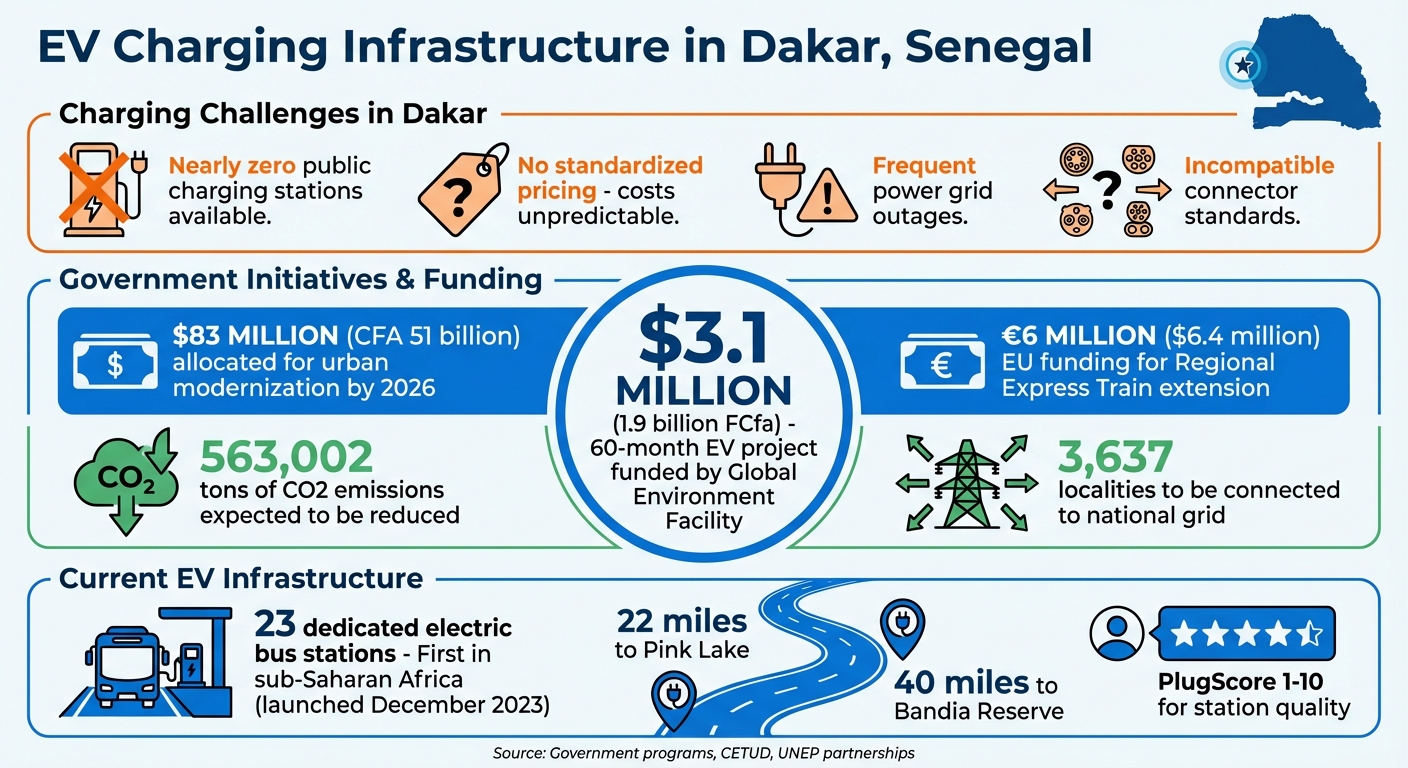
EV Charging Infrastructure in Dakar: Key Statistics and Government Initiatives
Senegal embraces electric cars to fight pollution in Dakar • FRANCE 24 English
sbb-itb-99e19e3
Challenges of Charging an EV in Dakar
Dakar faces several hurdles when it comes to establishing a reliable charging infrastructure for electric vehicles (EVs). These challenges impact both the availability and usability of charging options.
Shortage of Charging Stations
Public charging stations in Dakar are almost non-existent. Early surveys revealed no user-registered stations, leaving EV drivers dependent on private or home-based setups. Even for short trips, like a 22-mile drive to Pink Lake or a 40-mile journey to Bandia Reserve, drivers need to check ahead to ensure stations are operational. Many stations are either offline or undergoing maintenance, adding another layer of inconvenience.
High Costs and Inconsistent Pricing
Charging an EV in Dakar comes with unpredictable costs. Prices are not standardized, and EV drivers often rely on crowdsourced information from other users to estimate expenses. This lack of consistency makes it tough for owners to plan or compare charging options. Combine this with an already unstable power grid, and managing costs becomes even more challenging.
Unreliable Power Supply
The city’s power supply issues further complicate charging access. Digital maps now feature icons – like a "wrench" for stations under maintenance or a greyed-out indicator for uncertain availability – forcing drivers to confirm the status of stations before heading out. This is especially critical in peri-urban areas where infrastructure is sparse and often unreliable.
Lack of Regulations and Standards
Dakar’s charging network also suffers from a lack of clear regulations and standardization. For example, connector types vary widely, and Tesla-compatible connectors aren’t universally available. Drivers must verify compatibility at individual stations. To address quality concerns, stations receive a "PlugScore" from users, rated on a scale from 1 to 10. Lower scores often indicate issues like malfunctioning equipment or unreliable service. This user-driven feedback highlights the pressing need for official oversight and standardized practices.
Current Charging Options in Dakar
Dakar is steadily building a framework for electric vehicle (EV) charging, though much of the focus is on public transportation rather than private vehicles. This reflects the city’s broader strategy to improve urban mobility and reduce emissions.
Public and Private Charging Networks
Private charging options in Dakar remain limited and are often tied to user-submitted locations. Some private companies have started installing chargers with varying power levels, but these are typically restricted to fleet operations or private users.
An interesting development in the private sector is the emergence of community-shared home charging stations. Digital platforms now allow EV drivers to locate these shared stations, check for connector compatibility (including Tesla-compatible plugs), and even view user-reported pricing and reliability ratings. While still in its early stages, this approach highlights how technology is helping to bridge gaps in the charging network.
Government Programs and Partnerships
The government, through the Executive Council of Urban Transport (CETUD), has partnered with international organizations to advance EV adoption. A notable initiative is a 60-month project funded by the Global Environment Facility, with a budget of 1.9 billion FCfa (around $3.1 million), and coordinated alongside the United Nations Environment Programme (UNEP). Lamine Gaye, Director of Strategy, explained the program’s goals:
"This project, with a duration of 60 months, is part of the government’s continued efforts to promote sustainable and low-carbon mobility, mitigate greenhouse gas emissions, but also reduce energy consumption and fuel import costs while improving air quality."
The program focuses on several areas, including regulatory improvements, pilot demonstration projects, and integrating EVs into public transport and logistics. It also emphasizes sustainability by incorporating renewable energy and battery management systems. One standout initiative is the use of electric "feeder" services to connect passengers to the Bus Rapid Transit (BRT) and Regional Express Train (TER) systems. Collectively, these efforts are expected to cut 563,002 tons of CO2 emissions.
In addition to these EV-specific measures, the government has allocated CFA 51 billion (about $83 million) for urban modernization by 2026. This includes upgrades to mobility infrastructure and plans to connect 3,637 more localities to the national grid, which could significantly enhance charging accessibility across the region.
BRT System Integration
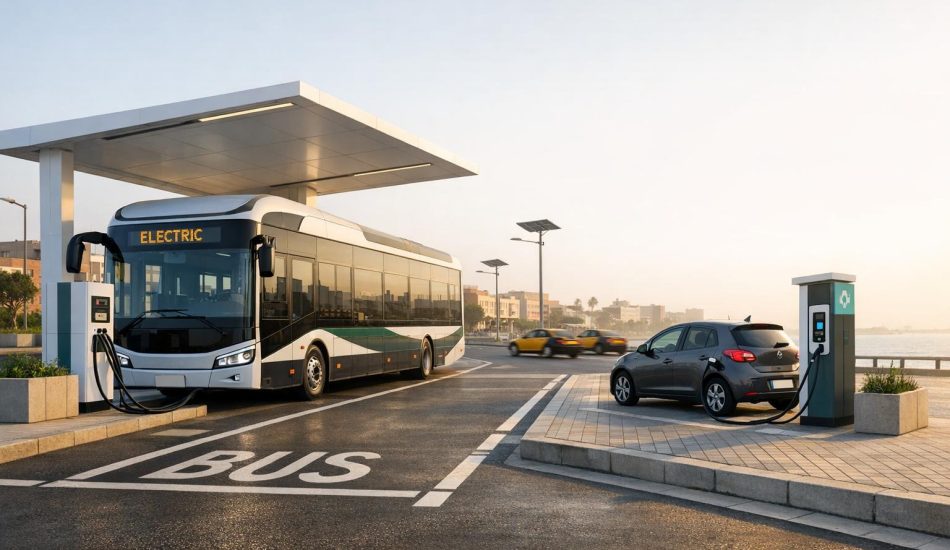
Dakar’s electric mobility efforts are further bolstered by its all-electric Bus Rapid Transit (BRT) system, which launched in December 2023. With 23 dedicated bus stations, this network is the first of its kind in sub-Saharan Africa. The BRT aims to reduce particulate matter (PM2.5) pollution while providing a cleaner, more efficient transit option.
The European Union has also contributed to these efforts, approving €6 million (around $6.4 million) in late 2025 to extend the Regional Express Train (TER) from Dakar to Thiès. This expansion enhances sustainable transport options and lays the groundwork for future charging infrastructure.
Although much of this progress centers on public transit, the BRT stations currently serve as Dakar’s most prominent public charging infrastructure. These projects signal a broader commitment to expanding EV support citywide.
Solutions for EV Owners in Dakar
Navigating the challenges of EV ownership in Dakar requires practical strategies to make charging more convenient and affordable.
Locating Charging Stations
Digital mapping tools can be a lifesaver when searching for charging stations. These platforms use community-sourced data to help pinpoint public, high-power, and shared charging points across Dakar. Before heading out, double-check the station’s PlugScore and connector compatibility to avoid surprises.
Reducing Charging Expenses
Managing charging costs starts with comparing prices. Digital platforms that feature user-submitted pricing details can guide you to more affordable options, such as community charging networks, which often beat commercial station rates. Choosing an EV model that maximizes range per kilowatt-hour also helps stretch your budget. For short trips, plan your routes carefully to avoid unreliable charging stations. Checking recent reviews and ratings can help you dodge inefficient chargers .
Ensuring Consistent Power Access
Power grid instability can be a concern, but there are ways to work around it. Home solar systems paired with battery storage are a great option, especially when charging during off-peak hours. According to the National Renewable Energy Laboratory:
"EV charging infrastructure can also support grid stability and improve distribution systems especially when paired with distributed solar, storage, or when equipped with smart charge management".
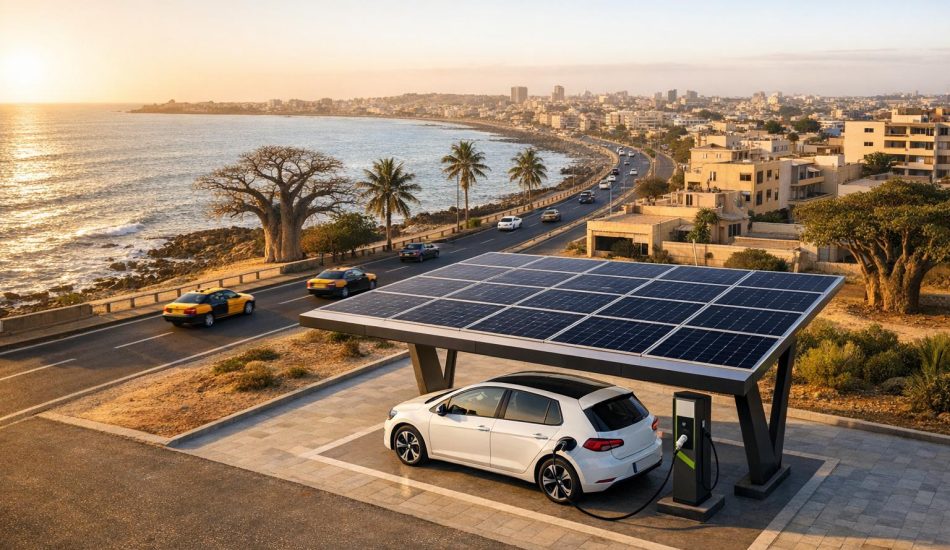
Installing a Level 2 home charger (240V) is another smart move. It provides a more efficient and reliable setup, adding 12–32 miles of range per hour. By taking advantage of these solutions, EV owners can enjoy more consistent power access while reducing dependence on the public grid.
Supporting Infrastructure Development
EV owners have an important role to play in improving Dakar’s charging network. Sharing usage data and advocating for standardized pricing and expanded charging options can help accelerate the development of better infrastructure.
Conclusion: What’s Next for EV Charging in Dakar
The future of EV charging in Dakar holds promise, though challenges like limited public charging stations and uneven pricing remain. Progress is being made with initiatives such as community-shared home charging setups and the introduction of high-power DC fast chargers.
Moving forward, collaboration among government bodies, private companies, and EV owners will be key. Government agencies and businesses are working to establish a baseline network by deploying Level 1-3 public charging stations. However, the role of individual EV owners is just as critical. By sharing access to home chargers and contributing real-time data about pricing, connector types, and station reliability, they can significantly accelerate the development of a robust charging network.
Platforms like EV24.africa are stepping in to support this shift. They connect buyers with electric vehicles that align with Dakar’s current infrastructure and offer resources to help navigate the charging landscape. With transparent pricing and detailed vehicle specifications, the platform empowers potential EV owners to make informed choices about range, efficiency, and charging compatibility.
To strengthen the network, EV owners need to actively participate by reporting new installations, updating station ratings, and verifying connector compatibility. As more drivers contribute data and push for standardized pricing and better access, Dakar’s charging infrastructure will gradually evolve to meet the needs of its expanding EV community.
Through these combined efforts, Dakar is on track to develop a more reliable and efficient EV charging ecosystem.
FAQs
Where can I reliably charge an EV in Dakar today?
Finding reliable EV charging stations in Dakar can be a bit challenging. Currently, options include public chargers listed on local maps and user-reported locations. To ensure accuracy, it’s best to verify availability and exact locations through EV mobility platforms or dedicated apps. As of March 8, 2026, these tools remain the most practical way to locate charging stations in the city.
What should I budget per full charge in Dakar?
Charging your vehicle in Dakar will typically cost between $0.49 and $0.65 per kWh for a full charge. However, the exact price may differ depending on the charging station you choose.
Which plug types should my EV support in Dakar?
Your EV should be equipped to handle Type 2 connectors for AC charging, as these are the most widely used in Dakar. For faster charging options, check if your vehicle supports CCS or CHAdeMO, depending on its specifications. These two standards will cover the majority of charging scenarios in the region.