
 Thabo Nkosi
Charging an electric car in Accra has its challenges, but it’s possible with careful planning. As of early 2024, there were only seven public charging stations available for approximately 17,000 EVs, all located within the city. This makes home charging the most practical option for daily use. Longer trips, like to Kumasi or Takoradi, are difficult due to the lack of highway charging stations.
Here’s what to know:
- Public Chargers: Accra’s stations include Level 2 and Level 3 (DC Fast) chargers. Key locations are malls, hotels, and business districts.
- Reliability Issues: Power outages and maintenance problems often disrupt charging.
- Costs: Public charging is pricier than home charging but still cheaper than fueling gas-powered cars.
- Future Plans: Ghana’s government aims to install 100 rapid chargers nationwide by 2029, with private companies adding more chargers in workplaces and malls.
For now, home charging is essential, with setups costing about $826. Apps like PlugShare help locate public chargers, though availability can be unreliable. EV ownership in Accra requires planning, but infrastructure improvements are on the horizon.
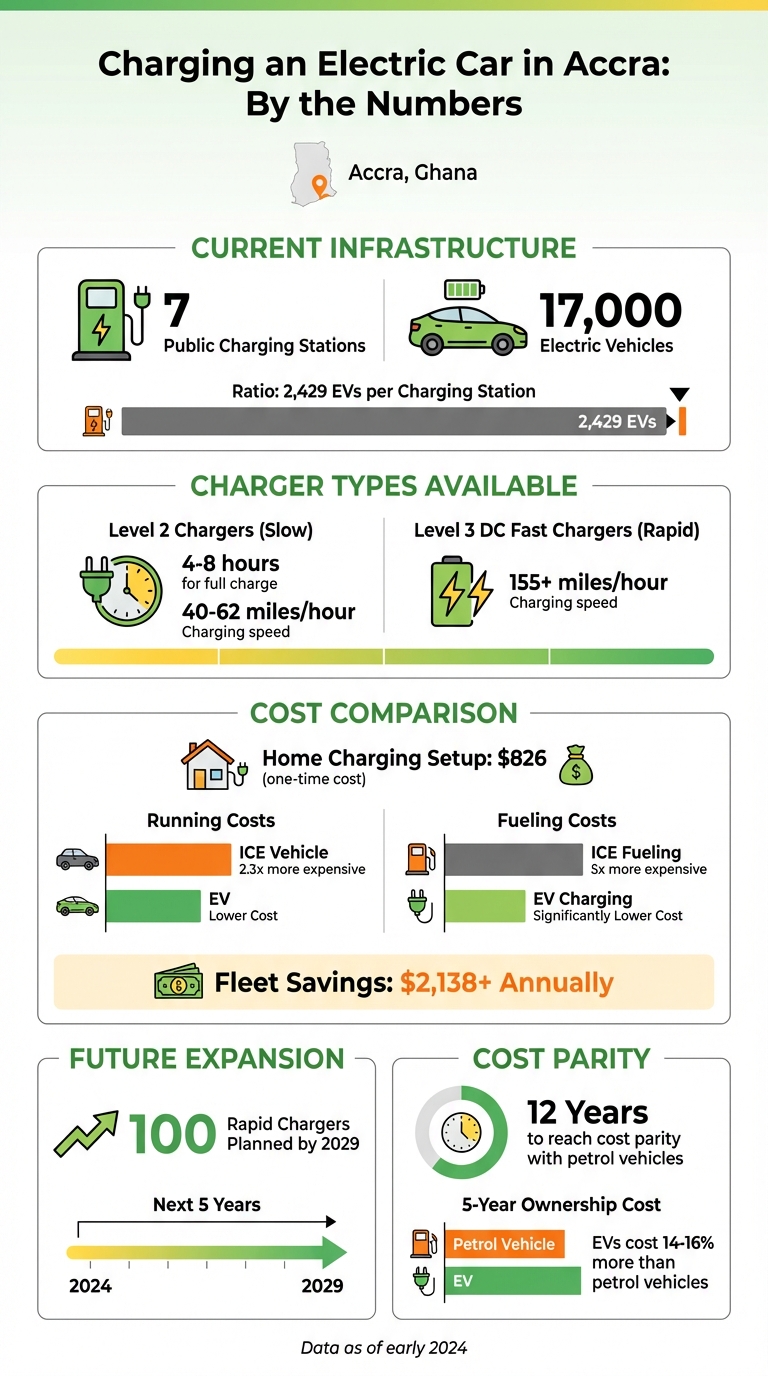
EV Charging Infrastructure in Accra: Key Statistics and Costs 2024
Ghana’s First 24/7 Fast EV Charging Station
sbb-itb-99e19e3
Charging Infrastructure in Accra Today
Accra currently has seven public charging stations, all situated within the capital. The rollout is spearheaded by private companies like XCharge, POBAD, and IJANU, with stations strategically placed in commercial and residential hotspots. You’ll find them in locations such as malls, hotels, and business districts, making them accessible for urban residents.
For those living and working within Greater Accra, these stations generally provide enough options for daily charging needs. However, the network’s reach is limited to the capital. So, if you’re planning a trip to cities like Kumasi or Takoradi, you’ll need to carefully map out your charging stops to avoid running out of power.
Charger Types and Charging Speeds
The type of chargers available plays a big role in how convenient it is to charge your EV in Accra. The city’s public charging stations feature Level 2 and Level 3 (DC Fast) chargers:
- Level 2 chargers: These are the most common and operate on a 240-volt connection. They can fully charge an electric vehicle in 4 to 8 hours, adding around 40 to 62 miles of range per hour.
- Level 3 DC Fast Chargers: These are much quicker, adding over 155 miles of range per hour. They’re perfect for drivers who need a fast top-up. For instance, in early 2026, XCharge installed 120kW fast chargers at No. 38A Lagos Avenue and Friendly Mall on Spintex Road. Meanwhile, the IJANU station at the Dizengoff Complex offers a 60kW dual-port setup with CCS2 and GB/T connectors, and Tesla adapters are also available.
The industry in Accra is aligning with global standards, using Type 2 connectors for AC charging and the Combined Charging System (CCS) for DC fast charging. This ensures compatibility with most modern EVs sold locally.
Where to Find Charging Stations
Most public chargers in Accra are located in high-traffic areas, making them convenient for drivers. Here are some key locations:
- XCharge station at Lagos Avenue: Open 24/7, this station is near cafes and offices, making it ideal for quick stops.
- Friendly Mall on Spintex Road: This station operates daily from 6:00 AM to 10:00 PM, allowing drivers to charge while shopping.
- A&C Mall in East Legon: Operated by POBAD, this Level 2 charger serves one of the busiest residential and commercial areas in the city.
- Total Energies station on Liberation Road: Offers Level 2 charging alongside traditional fuel pumps.
- Palace Mall on Spintex: Features a Porsche-branded Level 2 charger.
- Kempinski Hotel on Ridge: Provides Level 2 charging in its luxury parking area, though it’s mainly for hotel guests.
While these locations are convenient, reliability remains a challenge. Dr. Godwin Ayetor, who led a UNDP survey in 2024/2025, highlighted this issue:
throughout the study, there were times none of the seven charging stations were working… there were also maintenance issues and power fluctuations damaging the charging stations.
To avoid frustration, EV drivers are encouraged to use apps like PlugShare or Electromaps to check a station’s availability before heading out.
For payment, most stations accept Mobile Money, Visa, Mastercard, and RFID cards, with billing typically done per kilowatt-hour or per minute. This system encourages drivers to move their vehicles promptly once charging is complete.
These details paint a clear picture of both the conveniences and challenges that EV owners face in Accra’s growing charging network.
Problems EV Owners Face When Charging
Accra’s limited charging network creates significant obstacles for EV drivers, especially when it comes to longer journeys.
Too Few Charging Stations
The number of charging stations in Accra falls far short of what’s needed. With 17,000 EVs relying on just seven public stations, most drivers are left with no choice but to charge at home. This lack of infrastructure makes intercity travel almost impossible. For instance, trips to cities like Kumasi or Cape Coast are out of reach due to the absence of public charging options.
As Philip Akrofi Atitianti, Ph.D., points out:
The current EV user in Ghana can at best commute within the capital.
This shortage stems from several factors, including the high cost of building charging infrastructure, long payback periods for investments, and a lack of skilled local technicians to handle installation and maintenance.
Reliability and Compatibility Issues
Even the few existing stations come with their own set of problems. Maintenance challenges and frequent power outages – locally referred to as "dumsor" – often render these stations inoperable. Dr. Godwin Ayetor, who led a UNDP survey, highlighted these issues:
Throughout the study, there were times none of the seven charging stations were working… there were also maintenance issues and power fluctuations damaging the charging stations.
While stations usually resume operation after power is restored, these interruptions can disrupt travel plans.
Compatibility also poses a hurdle. Although Type 2 connectors for AC charging and CCS connectors for DC fast charging are becoming standard, some imported EV models, like Teslas, require specific adapters to use local stations. To address grid reliability issues, newer stations are being built as solar-grid hybrids, ensuring they can function during power outages.
Charging Costs
Charging costs add another layer of complexity. Public charging is more expensive due to the high costs of infrastructure and operation. Stations typically charge either per kilowatt-hour (kWh) of energy used or per minute connected, a pricing strategy meant to encourage faster turnover at busy locations.
Despite these challenges, charging an EV is still cheaper than fueling a gas-powered car. Running an internal combustion engine vehicle (ICE) costs about 2.3 times more overall, and fueling is nearly five times as expensive. However, the initial investment for EVs remains a barrier. According to a 2022 Energy Commission survey, the five-year total cost of owning a battery electric vehicle is 14% to 16% higher than that of a petrol vehicle. It takes about 12 years for EV ownership to reach cost parity under current conditions. For now, home charging remains the most practical and economical option for most EV owners in Accra.
How to Charge Your EV in Accra
Even with the challenges in infrastructure, EV owners in Accra have found practical ways to ensure their vehicles stay charged and ready for daily use.
Making the Most of Public Charging Stations
When relying on Accra’s limited public charging stations, planning ahead is key. Apps like PlugShare can help you locate stations, check their real-time availability, and read user reviews through PlugScores (rated 1 to 10). These reviews often highlight maintenance issues or other problems, so it’s worth verifying a station’s status before heading out.
Some popular charging spots include A&C Mall, Kempinski Hotel, and TotalEnergies service stations. These locations allow you to multitask, such as running errands or catching up on work while your EV charges. For faster charging, look for Level 3 DC fast chargers, which can add roughly 155 miles of range per hour. If you have more time, Level 2 chargers are ideal for longer charging sessions. Once your vehicle is fully charged, move it promptly to avoid idle fees and free up the station for others. Given the limited availability and occasional unreliability of public chargers, many EV owners opt to install home charging solutions.
Installing a Home Charger
Home charging is a convenient and cost-effective choice for many EV owners, complementing the limited public options. Start by consulting a licensed electrician to ensure your electrical panel can handle a dedicated 240-volt circuit. A Level 2 home charger can provide a full charge in 4 to 8 hours, offering speeds up to seven times faster than a standard outlet.
To keep installation costs down, position your charger in a garage or parking area close to your main electrical panel. Charging during off-peak hours can also help reduce energy costs. Some owners are now integrating solar-grid hybrid systems to maintain power during outages. If you live in an apartment complex, consider teaming up with other EV owners to install a shared Level 2 charging station, which can make the process more affordable.
Planning for New Charging Stations
The future of EV charging in Accra looks promising. The Ministry of Energy and Green Transition has committed to setting up at least 100 rapid charging stations across Ghana over the next five years. Additionally, private businesses, hotels, and real estate developers are stepping in to fill the gaps by adding their own charging points.
Stay updated on new station openings by following local EV communities and regularly checking charging apps. As EV24.africa explains:
The current infrastructure is built for city life. While a long road trip is a hurdle today, the planned expansion of rapid chargers along major highways is designed to connect Ghana’s cities.
Although careful planning is still necessary, these upcoming stations will make intercity travel – like trips to Kumasi or Cape Coast – much easier in the near future.
How EV24.africa Helps EV Owners in Accra
As Accra grapples with a limited public charging network and a growing number of electric vehicle (EV) users, EV24.africa steps in to simplify the process of finding, purchasing, and owning an EV. This online marketplace is designed to make it easier to select and import EVs that align with Accra’s charging infrastructure and daily driving needs.
EVs That Fit Accra’s Charging Network
EV24.africa offers a handpicked selection of vehicles from leading brands like BYD, Tesla, and Dongfeng, all tailored to work with Ghana’s charging standards. These models are compatible with Type 2 and CCS connectors, supporting both AC and DC fast charging. Chinese brands such as BYD and Dongfeng have even established local partnerships to ensure access to spare parts and trained technicians for maintenance.
With only seven public charging stations available for roughly 17,000 electric vehicles in Accra as of early 2024, many EV owners rely on home-installed Level 2 chargers. This platform helps users navigate these technical requirements, ensuring they select vehicles that match their charging setups. Beyond the technical guidance, EV24.africa also streamlines the buying process by offering financing options and delivery services.
Financing and Delivery Made Easy
EV24.africa doesn’t just stop at helping you choose the right EV – it also manages the logistics of importing and delivering your vehicle across all 54 African nations. The platform offers clear pricing and flexible financing plans, making EV ownership more accessible. Once you’ve made your purchase, you’ll have direct access to EV experts via WhatsApp for ongoing support, updates, and exclusive perks.
To ensure you’re ready for home charging, EV24.africa connects you with resources to assess your electrical setup. As the platform explains:
At EV24.africa, we make it easy to find and import the perfect electric vehicle for your needs. Explore our wide selection of top brands and discover a smarter way to drive.
Conclusion
Charging an electric car in Accra takes some planning and realistic expectations. With just seven public charging stations available for around 17,000 electric vehicles as of early 2024, home charging isn’t just convenient – it’s practically a necessity for daily use. While city driving is well-supported by the current infrastructure, longer intercity trips require careful route planning and a thorough understanding of where recharge points are located.
EV owners face obstacles like unreliable public chargers and the steep cost of home charging setups, which average about $826. Overcoming these issues involves installing a dedicated home charger, using real-time apps to check station availability, and opting for EVs that feature standardized Type 2 and CCS connectors.
Still, there’s progress on the horizon. The Ministry of Energy and Green Transition has pledged to install at least 100 rapid charging stations across Ghana in the next five years. Additionally, private businesses are stepping up by adding chargers at malls and hotels, and some new stations are being equipped with solar-grid hybrid systems to ensure they work even during power outages.
Platforms like EV24.africa are simplifying the switch to electric vehicles by offering services like vehicle selection, financing, and technical support – all through WhatsApp. The platform addresses key challenges like limited charging stations and expensive home installations by aligning vehicle options with Accra’s evolving infrastructure. It even handles importation and delivery across 54 countries, making the buying process much easier. For fleet users, the savings are already clear, with annual cost reductions exceeding $2,138.
To make EV ownership in Accra work, it’s all about planning ahead, investing in a reliable home charging setup, and keeping tabs on new station developments. With the network steadily expanding, early adopters who prepare well will find owning an EV increasingly practical and cost-effective.
FAQs
Can I own an EV in Accra without a home charger?
Yes, it’s possible to own an EV in Accra without having a home charger. However, you’ll need to depend on public charging stations. Keep in mind that these stations are still in the early stages of development across the city, so availability is limited. Careful planning will be essential to ensure your vehicle stays charged when you need it.
How do I plan around power outages when charging?
To handle power outages while charging your EV in Accra, here are some practical tips:
- Set up backup power sources: Equip your home with solar panels or a generator to keep your EV charger running during outages.
- Plan charging at public stations: Opt for charging during times when electricity supply is stable or choose stations equipped with backup power systems.
- Keep track of outage schedules: Regularly check for planned outages in your area to avoid surprises and adjust your charging plans accordingly.
These approaches can help maintain consistent EV charging even during power disruptions.
What adapter do I need for my EV to use Accra chargers?
To charge your EV in Accra, you’ll need the right adapter based on your vehicle’s plug type and the local charging standards. This could be a CCS to NACS (Tesla) adapter or a Type 2 to CCS adapter. Make sure to review your vehicle’s specifications to ensure compatibility with the charging infrastructure available in the area.