
 Thabo Nkosi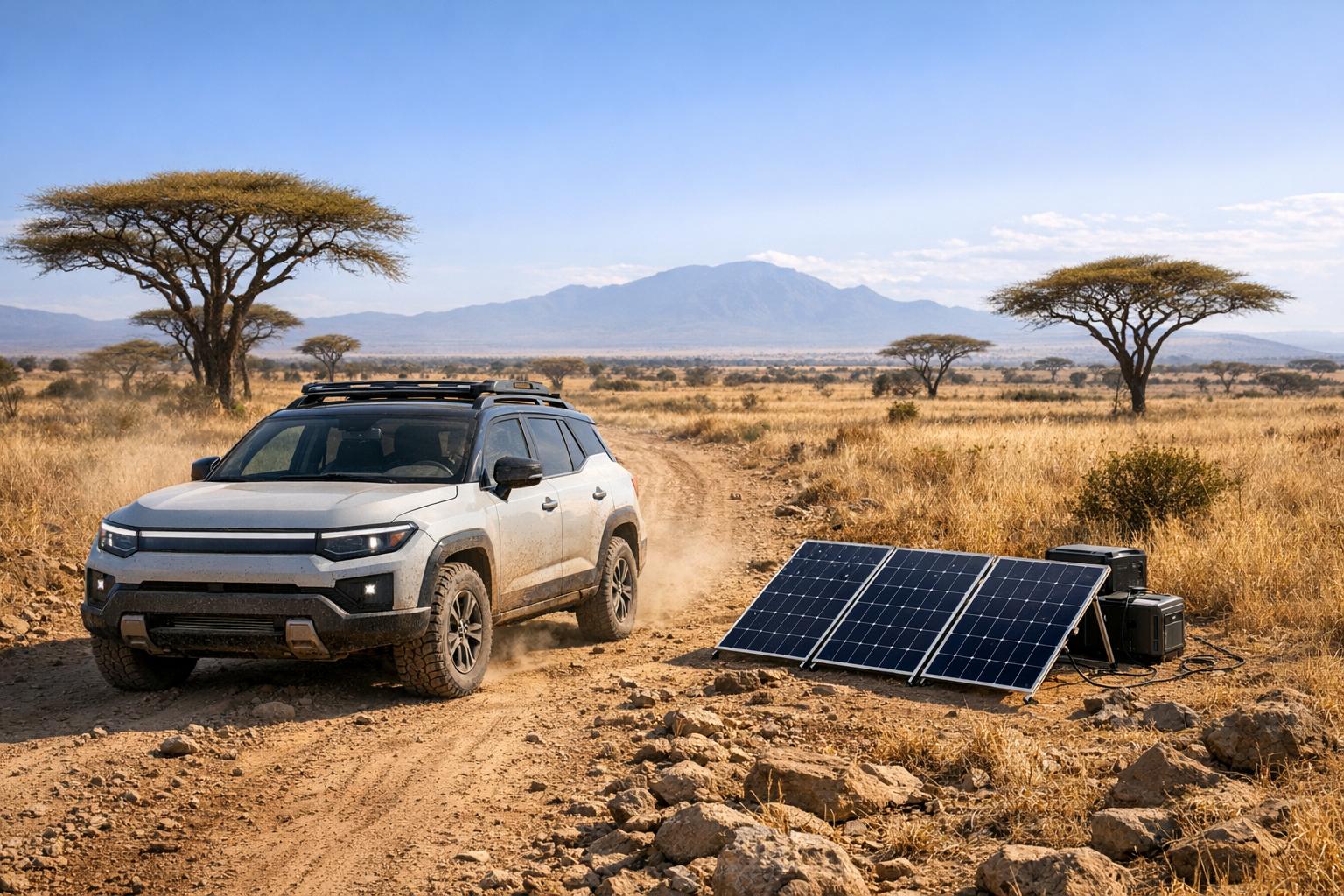
Driving an electric car across East Africa is possible, but it’s far from simple. Limited charging stations, unreliable electricity, and high upfront costs make long-distance EV travel a serious challenge. However, recent expeditions prove it can be done with the right preparation and tools.
Here’s what you need to know:
- Charging Infrastructure: Most stations are in urban areas like Nairobi and Kigali, with rural areas and highways severely lacking coverage. DC fast chargers, critical for road trips, are rare due to high installation costs.
- Grid Reliability: Frequent power outages in sub-Saharan Africa make charging stations unreliable, even where they exist.
- Solutions in Action: Portable solar panels, battery-swapping systems, and off-grid charging hubs are helping bridge infrastructure gaps.
- Affordability: EVs save on fuel costs but remain expensive to purchase. Public charging costs range from $0.05 to $0.10 per kWh, but residential rates can exceed $0.20 per kWh.
- Real-World Tests: Expeditions like Uganda’s 13,000-km electric bus journey and solar-powered motorcycle trips from Nairobi to South Africa show EV travel is achievable with detailed planning and innovative charging methods.
Long-distance EV travel across East Africa requires careful route planning, reliable charging solutions, and vehicles suited for tough terrain. While infrastructure is improving, cross-country EV trips remain an adventure for those willing to navigate the challenges.
Inside KABISA: Rwanda’s EV Revolution | WIB Documentary
Charging Infrastructure in East Africa Today
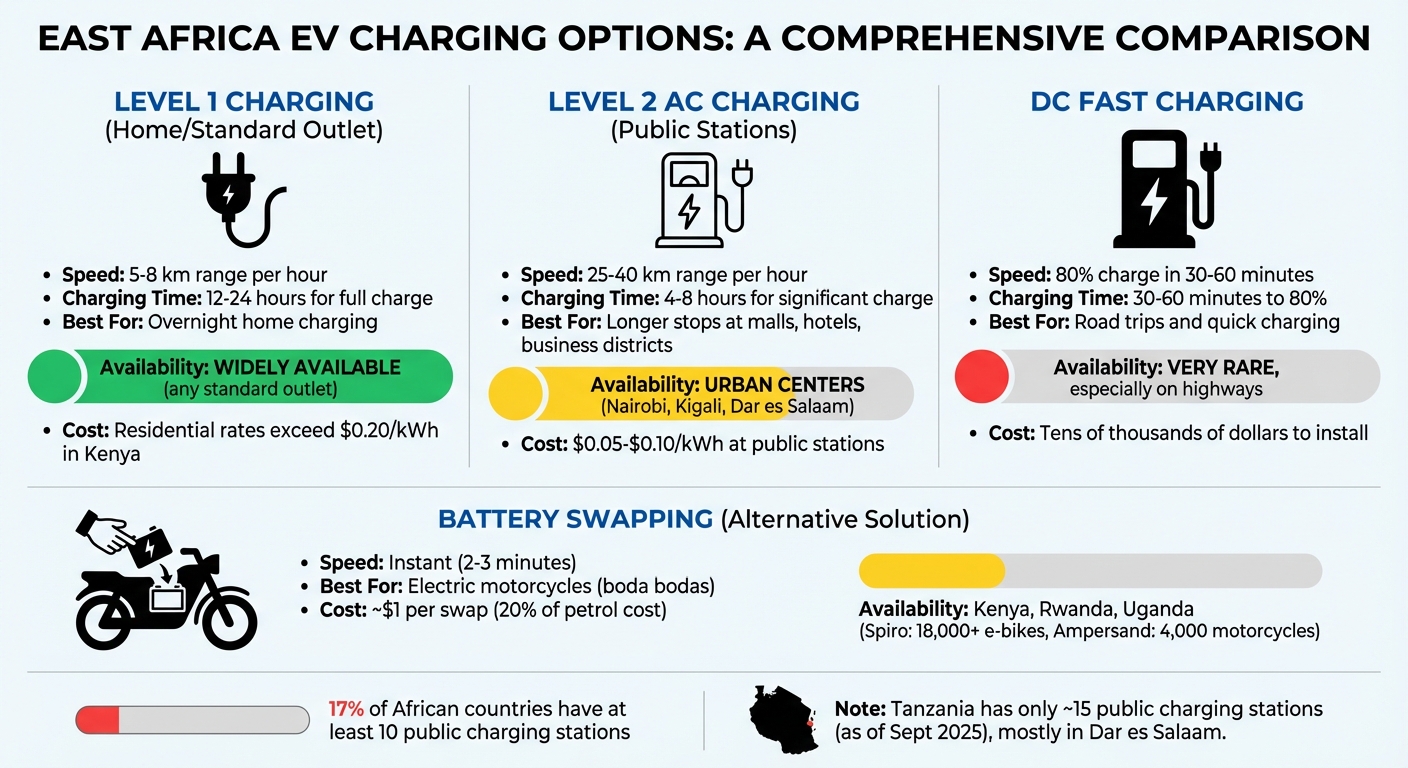
EV Charging Options in East Africa: Speed, Cost and Availability Comparison
After looking at the hurdles EV drivers face, it’s time to dive into the state of charging infrastructure in East Africa.
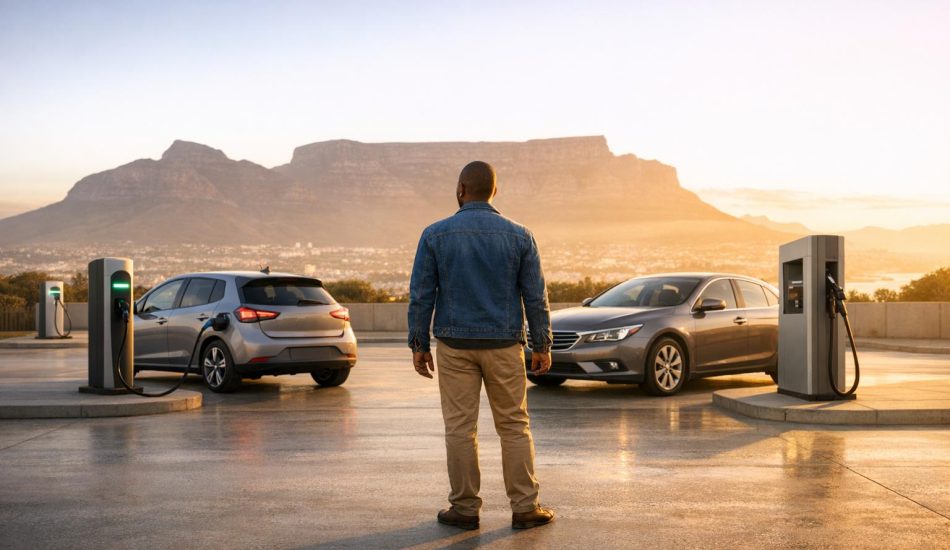
The region’s charging network is still in its infancy. As of September 2025, Tanzania had only about 15 public charging stations, most of which are located in Dar es Salaam. Across Africa, just 17% of countries have at least 10 public charging stations, making long-distance EV travel a logistical headache.
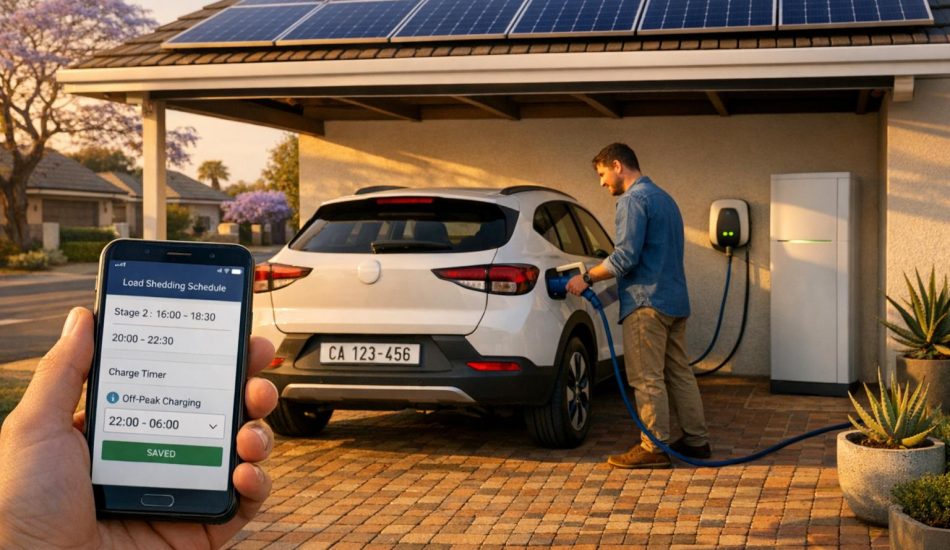
For most EV owners, home charging remains the go-to option. Level 1 chargers, which use standard wall sockets, add 5–8 km of range per hour, while Level 2 chargers provide a quicker boost at 25–40 km per hour. Public chargers are typically installed in high-traffic locations like malls, hotels, and business districts.
Urban vs. Rural Coverage
Urban centers are far better equipped with charging options than rural areas, which are largely left out. Cities like Nairobi, Kigali, and Dar es Salaam dominate the public charging landscape. For example, in March 2024, Kenyan startup BasiGo set up four dedicated charging stations in Nairobi to support its fleet of electric matatus (minibuses). In Tanzania, private partnerships are funding 24 new charging stations along key trade and transport routes, aiming to expand the network beyond Dar es Salaam by 2025.
Kenya, with an electrification rate of 75%, leads the region in terms of readiness. However, its highway corridors still lack the infrastructure needed for seamless long-distance travel. The idea of "National EV Corridors", which would connect major cities like Dar es Salaam and Mwanza with charging networks, is gaining momentum, but it’s still in the planning stages. This uneven distribution of infrastructure makes cross-country EV trips particularly challenging.
Types of Charging Stations
East Africa’s charging options vary in speed and purpose. Level 1 chargers are the slowest, taking 12–24 hours for a full charge, making them better suited for overnight use at home. Level 2 AC chargers, often found in public spaces, provide a range boost of 25–40 km per hour, making them ideal for longer stops of 4–8 hours.
For road trips, DC fast chargers are critical. These can recharge an EV battery to 80% in just 30–60 minutes. However, they’re costly to install and can strain the power grid, especially in rural areas where electricity supply is less stable. An alternative gaining traction is battery swapping, particularly for boda bodas (electric motorcycles). In Kenya, swapping a battery costs about $1 – roughly 20% of what you’d spend on petrol for the same distance. Companies like Spiro are leading the charge here, operating over 18,000 e-bikes across Kenya, Rwanda, Uganda, Benin, and Togo. Similarly, Rwanda-based Ampersand manages nearly 4,000 electric motorcycles and plans to scale up to 40,000 by 2026.
To navigate the fragmented charging network, drivers are turning to mobile apps like ChargeNet. These apps offer real-time maps showing station availability, plug types, and pricing. Payments are also becoming more convenient, with systems integrated into local mobile money platforms. Still, the lack of DC fast chargers – especially along highways – remains a major hurdle for cross-country EV travel. The variety of charging solutions highlights the urgent need for smarter, scalable infrastructure to meet growing demand.
Challenges for Long-Distance EV Travel in East Africa
Although urban areas in East Africa are gradually building charging networks, traveling across the region in an electric vehicle (EV) is still far from straightforward. Gaps in infrastructure, unreliable electricity, and high costs present serious hurdles for anyone planning a road trip outside city limits. Let’s break down these challenges, starting with the lack of charging stations.
Charging Station Gaps
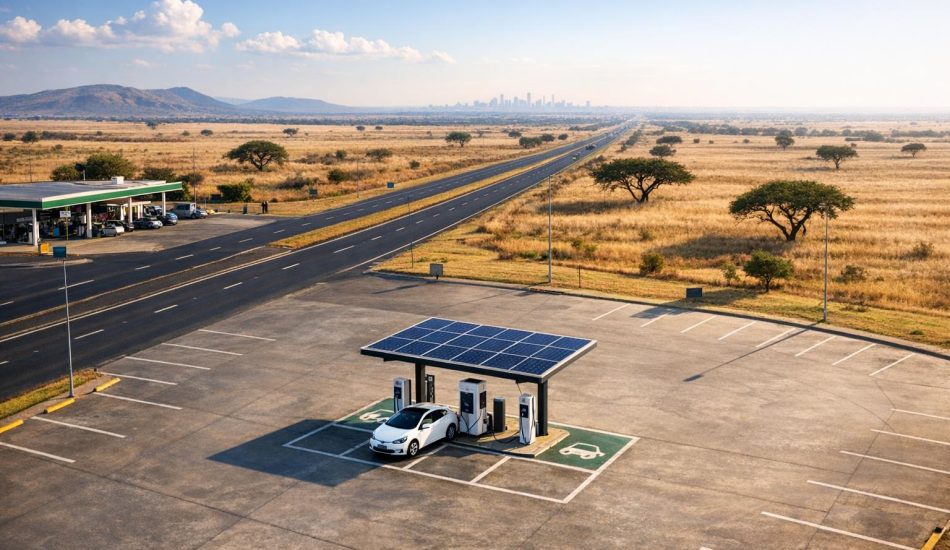
The most obvious issue is the scarcity of charging stations in the right places. Over 90% of vehicle owners in key East African markets like Kenya report range anxiety as their top concern. Why? Because while cities are slowly developing charging networks, highways and rural areas are largely left out.
Long-distance EV travel relies on DC fast chargers, but these are expensive to install – costing tens of thousands of dollars per unit. This creates massive gaps, especially on cross-border routes. For example, when Renske Cox and Maarten van Pel embarked on an ambitious road trip through eight African countries in August 2024, they had to carry foldable solar panels to keep their EV running in areas with no charging infrastructure.
"Africa, however, is comparatively a much smaller market and there isn’t the same degree of investment – which, on the surface, makes long-distance EV driving a little more challenging."
- Europe Team, Geotab
Grid Reliability and Power Supply Issues
Sparse charging networks are only part of the problem. Even when charging stations exist, they often face power outages, making them unreliable for EV travelers.
Ethiopia offers a clear example of this challenge. Despite having around 70,000 EVs on its roads, the country has only about 50 charging stations – and many of these are frequently out of service due to technical problems or electricity failures. In March 2024, Meklit Mussie, an EV owner in Addis Ababa, shared her struggle with using her Volkswagen ID4, citing inconsistent electricity and a lack of public fast chargers.
"Driving an electric car has its perks because you don’t have to suffer when there is a shortage of fuel… But at the same time, we don’t have a consistent and reliable electricity supply either."
- Meklit Mussie, EV Owner
This issue isn’t unique to Ethiopia. Across 34 African countries, fewer than half of grid-connected households enjoy a reliable electricity supply. For EV travelers, this means that even in areas with charging stations, there’s no guarantee they’ll be operational.
Cost and Affordability
While EVs promise lower running costs, the upfront expenses remain a barrier. For example, a 1,200 km (about 745 miles) trip costs only $25–$27 in an EV compared to $125–$132 in a diesel pickup. However, the majority of vehicles sold in sub-Saharan Africa are used internal combustion engine (ICE) cars priced between $6,000 and $10,000 – far below the cost of most new EVs.
Charging costs also vary widely. Public charging stations typically charge between $0.05 and $0.10 per kWh, but residential electricity rates in Kenya exceed $0.20 per kWh. And then there’s the cost of infrastructure: Level 2 chargers range from $200 to $1,000, while DC fast chargers cost tens of thousands of dollars each.
In September 2024, Rodrigue Mucyo’s trip from Kigali to Nairobi in a Radar RD6 highlighted these challenges. His team had to charge for eight hours at a Rubis station in Mbarara, Uganda, using a distribution box after their portable generator failed. Without standardized and accessible charging points, long-distance EV travel becomes both time-consuming and expensive.
"The infrastructure [must] be made easily accessible and more affordable. Otherwise… Africa runs the risk of being left behind altogether."
- Céleste Vogel, Co-founder, eWAKA
sbb-itb-99e19e3
Solutions for EV Travel Across East Africa
Efforts to make long-distance EV travel practical in East Africa are gaining traction. From portable solar panels to battery-swapping systems, these approaches address the challenges of limited infrastructure and grid reliability.
Off-Grid Charging Solutions
In regions where charging stations are sparse, off-grid charging has become a game-changer. Between 2023 and 2024, Renske Cox and Maarten van Pel embarked on an extraordinary 24,855-mile (40,000 km) journey in a modified ŠKODA ENYAQ iV 80. Using portable solar panels, they generated 54% of their energy over 76 charging sessions, each lasting an average of 7.5 hours.
"With the sun, we effectively have our own power station with us at all times, providing clean and stable energy."
- Renske Cox and Maarten van Pel, Founders, 4x4electric
Roam, another innovator, utilized a support vehicle outfitted with solar panels to pre-charge spare batteries, enabling uninterrupted travel. During a 17-day trip, the Roam Air motorcycle achieved a single-battery range record of 70 miles (113 km).
For larger-scale applications, companies are investing in off-grid charging hubs. In South Africa’s Eastern Cape, Zero Carbon Charge launched a $640 million initiative to build 29 solar-powered charging stations, including 11 for electric trucks. These hubs operate independently of the national grid, ensuring reliability even during power outages.
"Crucially, both electric passenger and light commercial vehicle and electric truck charging sites will be completely independent of Eskom’s predominantly coal-powered grid, which means they will be green and completely loadshedding-proof."
- Zero Carbon Charge
These off-grid solutions are helping EV travelers navigate East Africa with greater confidence and adaptability.
Route Planning and Vehicle Selection
Careful planning is essential for EV journeys across East Africa. Travelers need to consider factors like distance, weather, terrain, and charging availability.
Solar-powered expeditions, for instance, must account for seasonal weather patterns. Teams have had to adjust routes to avoid heavy cloud cover, which reduces charging efficiency. Positioning solar panels to maximize energy capture during varying weather conditions is also crucial.
In areas without dedicated EV chargers, standard electrical outlets become lifelines. Masa Kituyi, Product Owner at Roam, highlighted this during a journey from Nairobi to South Africa:
"Anywhere you can charge your phone, you can charge the bike. That means with enough planning and lodging in hotels that have electricity, you are able to do this journey yourself."
- Masa Kituyi, Product Owner, Roam
Given that Level 1 charging adds only 3 to 5 miles (5 to 8 km) of range per hour, overnight stops at hotels with stable power are vital. For more remote areas, some travelers modify their EVs with rooftop tents and internal water storage, allowing for self-sufficient camping while batteries charge via portable solar panels. Additionally, maintaining a range buffer is critical – especially on challenging terrain like dirt roads or steep inclines, which can drain batteries faster.
While technical adjustments are important, broader institutional efforts are also shaping the future of EV travel.
Private and Government Initiatives
Private companies and governments are working together to expand charging networks and encourage EV adoption across East Africa.
Startups are targeting commercial sectors where the economic benefits of EVs are immediately apparent. For example, BasiGo has established four dedicated charging stations in Nairobi for its fleet of electric matatus, addressing a critical gap in public charging infrastructure. Samuel Kamunya, BasiGo’s Head of Business Development, explained:
"One of the biggest challenges is that it takes time and resources to build infrastructure."
- Samuel Kamunya, BasiGo
Governments are also stepping in with supportive policies. Rwanda has eliminated import taxes on electric vehicles to encourage adoption, while Kenya has banned the import of used cars older than eight years, aiming to phase out older internal combustion models.
The economic benefits of EVs are already evident. Electric motorcycle riders in East Africa save between $400 and $700 annually on fuel costs, with electric boda boda drivers earning roughly $16 per day compared to $12 per day for their gasoline counterparts.
Research partnerships are advancing EV technology tailored to local needs. Roam, for example, collaborates with Stellenbosch University to study powertrain efficiency and battery life cycles suited to the region’s unique climates and terrains. The African EV market, valued at around $16 billion in 2024, is expected to grow to $25 billion by 2029, with two-wheelers projected to reach 22% electrification by 2030.
Testing EV Travel Across East Africa
Real-world trials have offered valuable insights into the practical challenges and successes of long-distance EV travel across East Africa. Expeditions in Kenya, Uganda, and Tanzania have shown that with thoughtful planning and the right strategies, EV travel over long distances is not only possible but also impactful.
Case Studies: Kenya, Uganda, and Tanzania
Between November and December 2025, Kiira Motors Corporation put its Kayoola E-Coach – a 64-passenger electric bus – to the test on a 7,125-km (4,427-mile) journey from Kampala to Cape Town. The route passed through Tanzania and five additional countries, successfully completing the trip without a single incident. Impressively, the journey offset 907.5 kg (2,000 lbs) of CO₂ emissions, with MTN Uganda managing real-time telematics and charging payments throughout the expedition.
"This achievement proves that Uganda can build world-class technology that performs reliably across Africa."
- Monica Musenero, Minister of Science, Technology and Innovation, Uganda
The trip was more than just a test run; it also resulted in contracts for 450 buses and 75 DC fast chargers, signaling strong commercial interest in the technology.
In another test, during September and October 2024, Roam’s Roam Air electric motorcycle embarked on a 6,000-km (3,728-mile) journey from Nairobi through Tanzania, Malawi, Zambia, and Botswana, eventually reaching South Africa. This 18-day expedition relied entirely on solar charging, with two support vehicles outfitted with solar panels providing the necessary energy. Meanwhile, the 4x4electric project took a different approach. Founders Renske Cox and Maarten van Pel modified a ŠKODA ENYAQ iV 80 by adding 200 kg (441 lbs) of portable solar panels. They drove through Kenya and Tanzania as part of their ambitious 40,000-km (24,855-mile) African expedition. Using Geotab telematics, they studied how altitude and temperature affected battery performance, finding that efficient solar charging required meticulous panel alignment. On average, they spent 7.5 hours per session charging with solar panels.
These trials highlight the importance of strategic planning and adaptable technology in overcoming East Africa’s unique infrastructural and environmental challenges.
EV Performance in Different Climates and Terrains
East Africa’s diverse landscapes and climates have a notable impact on EV performance. In urban areas like Nairobi, stop-and-go traffic allows regenerative braking to recover energy efficiently. However, mountainous terrains present a different challenge. For instance, the Kiira Motors E-Coach consumed an average of 0.87 kWh/km (1.4 kWh/mile) on routes with varying altitudes in Tanzania and Uganda. While climbing increased energy use, regenerative braking during descents helped recover some of that energy. In contrast, hot lowland areas require careful thermal management. Tests showed that driving at 71 mph (115 km/h) with air conditioning running at 90°F (32°C) resulted in an energy consumption rate of 15.2 kWh/100 km (24.5 kWh/100 miles). Using cruise control and slightly reducing speed on highways could improve energy efficiency by 5–7%.
Solar charging performance also varies depending on location and weather. The 4x4electric team discovered that precise panel alignment was critical for maximizing solar energy yield. Even slight misalignments significantly reduced output, while rainy seasons and cloud cover posed additional challenges. To navigate these unpredictable conditions, maintaining a range buffer proved essential, as difficult road conditions and sudden weather changes could drain batteries faster than anticipated.
Conclusion: Can You Drive an EV Across East Africa?
Yes, but it requires careful preparation and planning. Real-world expeditions, like the 4x4electric team’s impressive 24,855-mile solar-powered journey, have shown that long-distance EV travel across East Africa is achievable. However, these trips rely heavily on off-grid charging setups, detailed route planning, and vehicles built to handle tough conditions.
The biggest challenge is infrastructure. Gaps in charging networks and unreliable power grids make this journey far from straightforward. For now, travelers must rely on solutions like portable solar panels or carefully plan routes around urban areas with established charging points. These obstacles highlight the need for practical, creative solutions for current EV travel in the region.
Focusing on routes between major cities like Nairobi, Kigali, and Dar es Salaam is more feasible. Electric motorcycles offer a particularly promising option – battery swaps in Kenya cost about $1, roughly 20% of the price for gasoline. Vehicle choice is critical, so look for models with durable suspension systems and efficient regenerative braking to handle the rugged roads and hilly terrain. Policy changes and advancing technology offer hope for smoother EV travel in the future.
There are positive signs ahead. Government actions, such as Ethiopia’s ban on non-electric vehicle imports and Rwanda’s removal of EV import taxes, suggest progress is being made. Still, until charging networks expand beyond city centers, cross-country EV travel will remain an adventure suited only for those who are well-prepared.
"I learned that it is impossible to plan and prepare to the last percentile when running projects in Africa. At some point, you just must step into action." – Stephan Lacock, PhD Student, Stellenbosch University
FAQs
What challenges might you face driving an electric car across East Africa?
Driving an electric car across East Africa presents a unique set of challenges, mainly stemming from limited infrastructure and the region’s natural conditions.
Charging stations are few and far between, with some routes stretching over 200 miles without access to fast-charging points. This creates what’s known as "range anxiety", pushing drivers to plan meticulously. In more remote areas, self-sufficiency becomes crucial, with options like portable solar panels serving as a practical backup.
Another hurdle is the scarcity of local service and repair options. Mechanics trained to work on electric vehicles are hard to find in many areas. As a result, EV owners often have to depend on private charging setups or patch together makeshift solutions. A breakdown can quickly turn into a costly and time-consuming ordeal.
The harsh climate and rugged terrain also take a toll on electric vehicles. High temperatures, dusty roads, and uneven surfaces increase energy demands, while inconsistent electricity grids make reliable charging a challenge. Despite these obstacles, with careful planning and the right tools, long-distance EV travel in East Africa can transform into a rewarding adventure.
How can drivers handle limited charging options in rural East Africa?
Driving an electric car across rural East Africa comes with its own set of challenges, but with some planning and resourcefulness, it’s absolutely doable. One of the first steps is to map out your route carefully, pinpointing any available charging points. Many drivers opt to charge their vehicles at hotels or guesthouses equipped with reliable 220V outlets, making it easy to combine an overnight stay with a battery recharge. Carrying portable chargers or Level 2 AC units can also be a game-changer in areas where charging options are scarce.
When public chargers aren’t available, portable charging solutions can save the day. Some travelers rely on solar panels to harness sunlight for a slow, steady charge during extended stops. Others keep small generators on hand as a backup for emergencies. And don’t forget about regenerative braking – it’s especially useful on hilly terrain or in stop-and-go traffic, helping you squeeze out extra miles between charges.
Another strategy is to work with local businesses and communities to find charging options. Some rural areas are starting to install solar-powered chargers, and small businesses might let you use their outlets if you arrange it ahead of time. By staying prepared and open to creative solutions, you can confidently explore even the most remote corners of East Africa without worrying about running out of power.
Are governments in East Africa supporting electric vehicles?
Several East African nations are taking bold steps to encourage the use of electric vehicles (EVs) through a mix of policies and initiatives:
- Ethiopia has announced a ban on importing new gasoline and diesel vehicles starting January 2024. To support EV adoption, the government has lowered import duties on electric cars, backed local EV assembly efforts, and introduced electric buses for public transportation.
- Rwanda is prioritizing electric motorcycles by restricting petrol-powered motorcycle taxis in Kigali. Additionally, the government provides tax breaks for EVs and their spare parts to make them more accessible.
- Kenya is focusing on building EV charging infrastructure, aiming to establish approximately 1,000 public charging stations. The country also offers tax incentives to make EV purchases more appealing.
These measures – ranging from import bans and tax incentives to infrastructure expansion – are helping to accelerate the shift toward electric mobility across the region.