
 Thabo Nkosi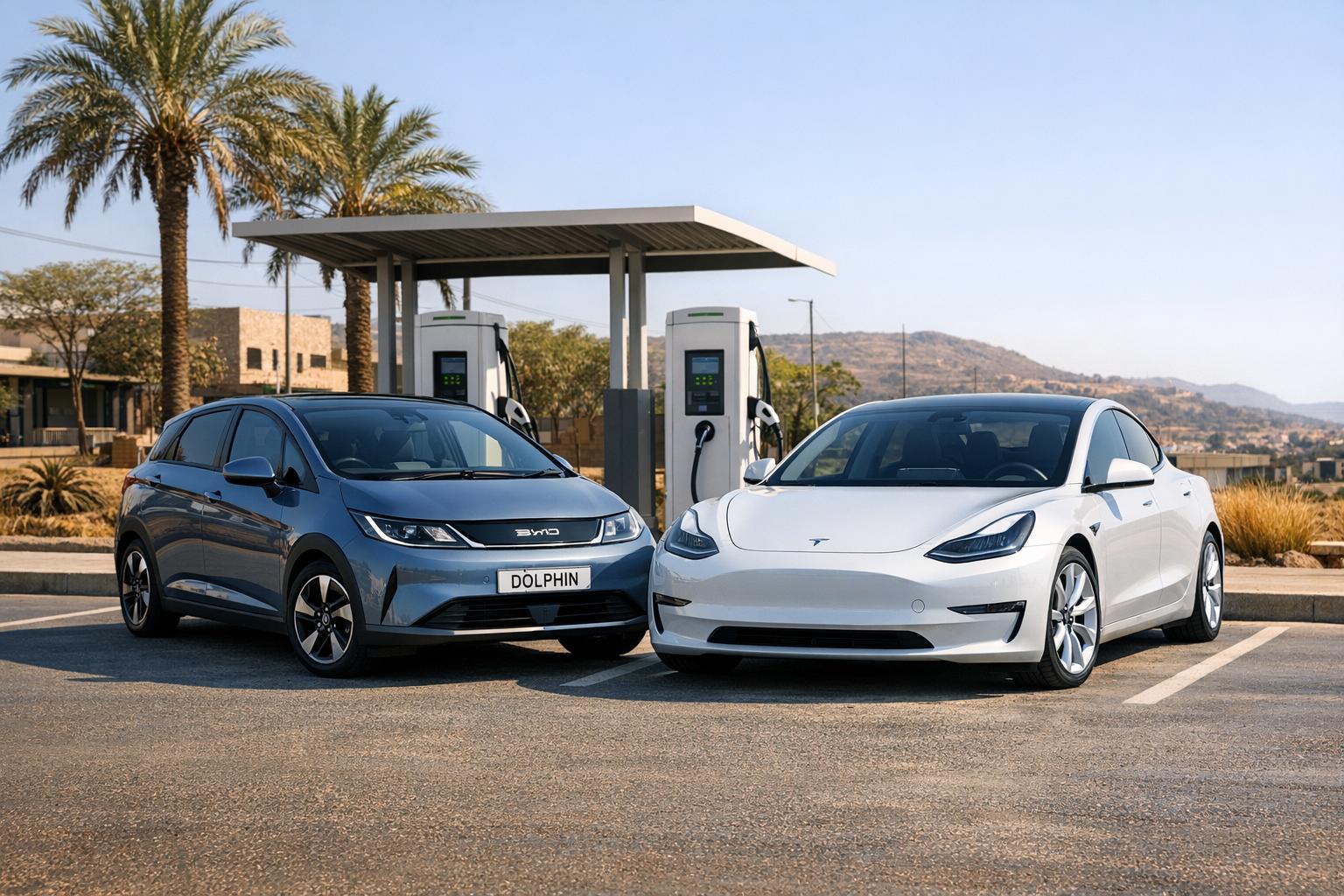
Choosing between the BYD Dolphin and Tesla Model 3 depends on your budget, driving needs, and access to EV infrastructure in Africa. Here’s a quick breakdown:
- BYD Dolphin: Affordable at ~$34,800, designed for urban driving with a range of 144–183 miles, simpler maintenance, and local dealer support in Africa. Ideal for budget-conscious buyers prioritizing practicality.
- Tesla Model 3: Premium at ~$50,000+ import fees, offering a range of 272–323 miles and advanced tech. However, Tesla lacks official sales and service centers in Africa, making it harder to maintain.
| Feature | BYD Dolphin | Tesla Model 3 |
|---|---|---|
| Price | ~$34,800 | ~$50,000+ (import fees apply) |
| Range | 144–183 miles | 272–323 miles |
| Charging | 30–40 kW DC fast charging | Tesla Supercharger (limited in Africa) |
| Performance | 0–62 mph in 7.0 seconds | 0–62 mph in 5.6 seconds |
| Maintenance | Local dealer network available | Limited support in Africa |
| Suitability | Urban driving, affordability | Long-range, premium experience |
Verdict: The BYD Dolphin is the better choice for most African buyers due to its lower price, easier maintenance, and local availability. The Tesla Model 3 is suited for those willing to pay a premium for performance and advanced features but must navigate import challenges.
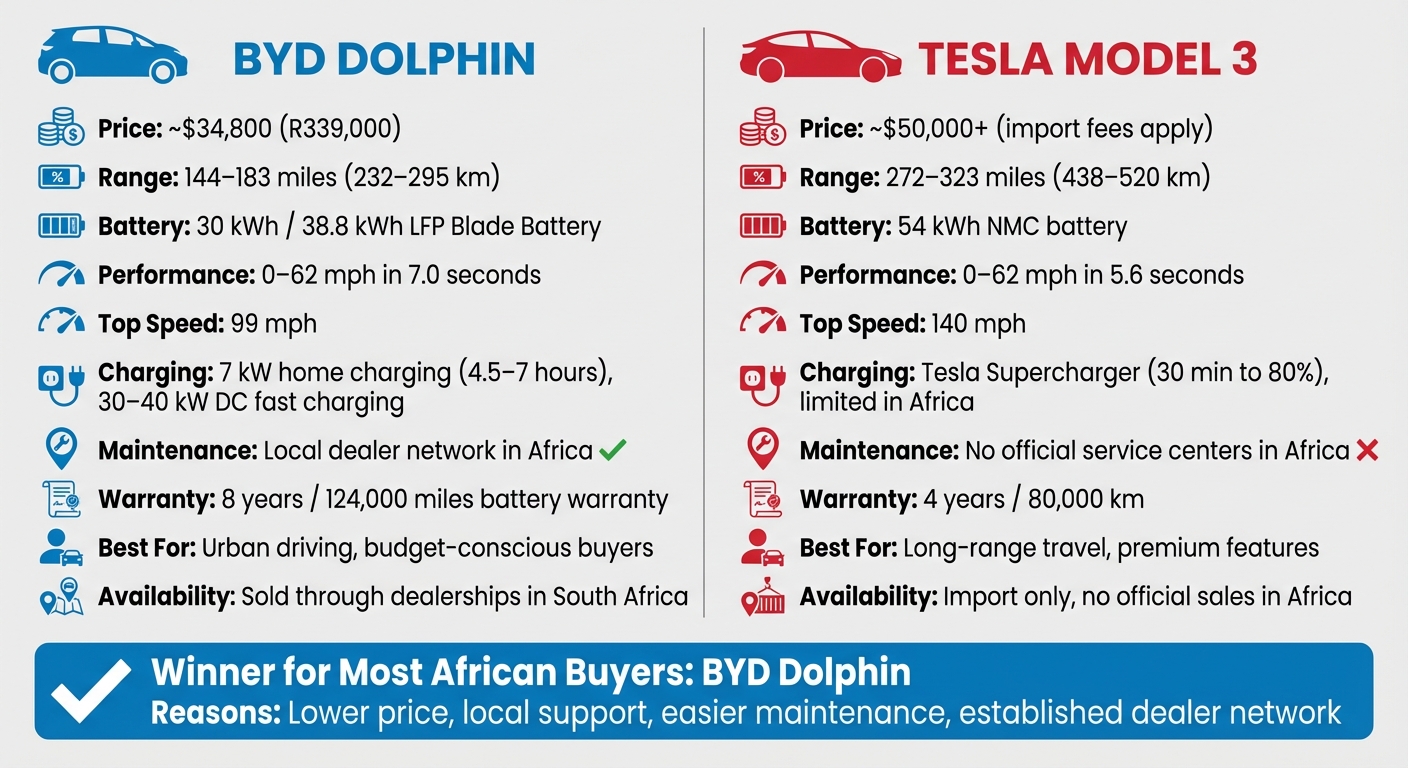
BYD Dolphin vs Tesla Model 3 Comparison for African Buyers
BYD Dolphin vs. Tesla Model 3: Which EV Wins?
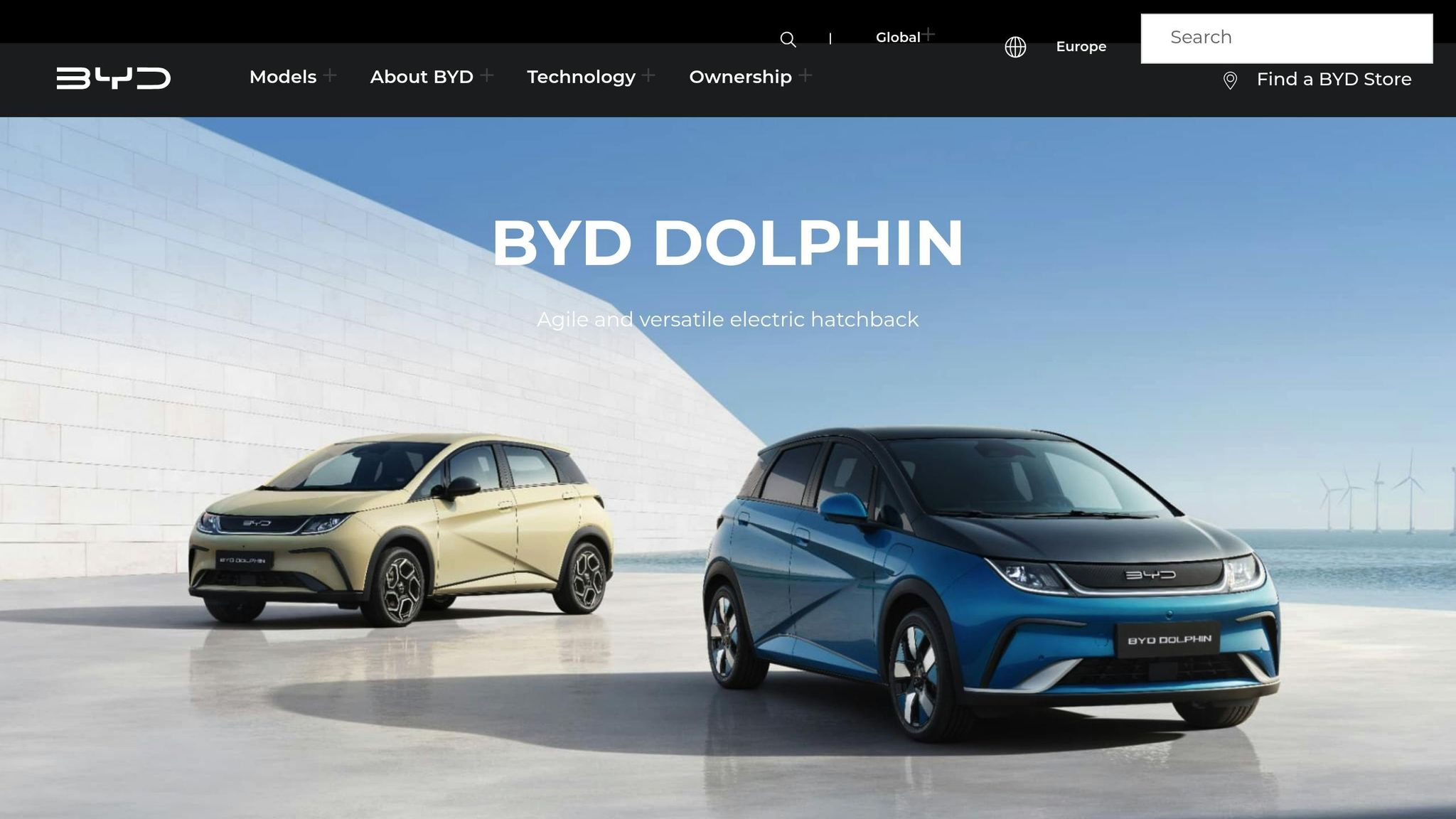
BYD Dolphin Overview
The BYD Dolphin is designed as an entry-level urban electric vehicle, aimed at making EV ownership more accessible to a wider range of African buyers. With a starting price that appeals to budget-conscious consumers, the Dolphin is built on BYD’s Ocean Aesthetics design language, featuring sleek LED lighting and smooth, aerodynamic lines. Its compact size makes it ideal for navigating busy city streets.
"The BYD Dolphin Surf represents a pivotal moment for electric mobility in South Africa. We are bringing a truly affordable and well-equipped urban electric vehicle to the mass market." – Ming Xing, Brand and Marketing Manager, BYD South Africa
One of the Dolphin’s standout advantages is BYD’s established dealer and service network. This offers hands-on, in-person support – a critical factor for first-time EV buyers transitioning from traditional gasoline-powered cars. Below are some of the key features that make the Dolphin a practical choice for urban driving.
Main Features
The BYD Dolphin is available in two models: the Comfort and the Dynamic. The Comfort model is equipped with a 30 kWh Blade Battery, delivering a WLTP range of 144 miles (232 km). The Dynamic model, on the other hand, comes with a larger 38.8 kWh battery, offering a range of 183 miles (295 km). Both models feature a 55 kW electric motor and include a 10.1-inch rotating touchscreen as standard.
A unique feature of the Dolphin is its Vehicle-to-Load (V2L) capability, which enables the car to function as a mobile power source with an output of up to 3.3 kW. Charging options include a 7 kW wallbox for home use and DC fast charging at speeds of 30–40 kW.
Safety is another strong suit for the Dolphin, with 5-star safety ratings from both Euro NCAP and ANCAP. Its body structure incorporates 61% high-strength steel for added durability. In South Africa, the Dolphin is backed by an 8-year/124,000-mile (200,000 km) power battery warranty. The model has also earned accolades such as "Best Small Electric Car" at the Carbuyer Best Car Awards 2024 and "Japan EV of the Year 2023".
Performance in African Conditions
The Dolphin’s features are particularly well-suited for urban environments, where its compact size and moderate power output shine in stop-and-go traffic. However, its range, especially the Dynamic model’s 183 miles (295 km), may require careful planning for longer trips.
Some challenges have been reported in certain markets. These include reliability issues, such as sudden power loss caused by Main Domain Controller malfunctions and erratic braking from autonomous safety systems. Additionally, in September 2024, BYD recalled approximately 96,714 vehicles in China due to a fire risk linked to the electric power steering column assembly. The issue was resolved by installing insulation pads at dealerships.
Tesla Model 3 Overview
The Tesla Model 3 stands out as a high-end electric sedan, designed for those who value cutting-edge technology and performance over affordability. Unlike the budget-friendly BYD Dolphin, the Model 3 positions itself as a premium option, leveraging Tesla’s strong global reputation to enhance its appeal.
As a battery electric vehicle (BEV), the Model 3 achieved impressive global sales in 2023. Tesla shipped 1.8 million vehicles worldwide, securing about 19% of the global BEV market share.
"Tesla’s Model 3 is more premium than BYD’s cheapest offerings." – George Whitcombe, Analyst, Rho Motion
The Model 3’s price tag ranges from $12,000 to over $30,000 more than the BYD Dolphin, depending on the market. This pricing reflects Tesla’s emphasis on performance, advanced technology, and build quality rather than affordability. However, this strategy may limit its appeal in cost-sensitive regions like Africa, where rugged vehicles like the Toyota Hilux dominate. These factors set the stage for a deeper dive into the Model 3’s features and its suitability for African markets.
Main Features
The Tesla Model 3 Standard Plus boasts a 54 kWh battery pack, offering an estimated range of 272 miles (438 km) under WLTP testing. At 184.8 inches long, the Model 3 is significantly larger than the compact BYD Dolphin. Its rear-wheel-drive setup and multi-link rear suspension deliver a smoother and more refined ride compared to the Dolphin’s torsion beam system.
With the ability to accelerate from 0-62 mph in 5.6 seconds and a top speed of 140 mph, the Model 3 easily outpaces the Dolphin. Inside, it features electric adjustable leather seats, a minimalist interior centered around a large touchscreen, and Tesla’s Autopilot system for semi-autonomous driving. These elements cater to buyers who prioritize modern technology and an elevated driving experience.
The Model 3 comes standard with 18-inch wheels and a range of safety features. However, its battery remains its most expensive component, contributing significantly to its higher price compared to Chinese competitors. Tesla’s direct-to-consumer sales model, conducted primarily through its website, further differentiates it from BYD’s reliance on local distributors and dealerships. While these features underscore the Model 3’s premium positioning, its practicality in African markets requires closer examination.
Performance in African Conditions
Despite its impressive specs, the Model 3’s performance might not fully align with the demands of African roads. Its lower ground clearance – measuring just 56.8 inches (1,443 mm) in total height compared to the Dolphin’s 61.8 inches (1,570 mm) – could pose challenges on unpaved or poorly maintained roads. African buyers often prioritize vehicles known for their durability and reliability to handle tough road conditions.
As of March 2025, Tesla has no official sales or service presence in Africa, focusing instead on markets in North America and Europe. This lack of local dealerships and service centers is a significant hurdle, leaving potential buyers uncertain about maintenance, repairs, and warranty support. In contrast, BYD has already established a dealer network in markets like South Africa, providing a clear advantage.
The Model 3’s larger battery and extended range make it theoretically better suited for long-distance travel than the Dolphin. However, the limited availability of DC fast-charging stations in many African regions could diminish this advantage, making it harder for drivers to fully utilize the vehicle’s range. Buyers drawn to Tesla’s advanced technology and brand prestige will need to weigh these practical challenges against the Model 3’s standout performance and features.
Price Comparison
Cost Breakdown
In South Africa, the BYD Dolphin offers an entry point into the electric vehicle (EV) market with prices starting at R339,000 for the Comfort model and R389,900 for the Dynamic model. This makes it the first EV priced under R400,000 in the region.
On the other hand, the Tesla Model 3 isn’t officially sold in Africa, which means potential buyers must rely on imports. This process adds layers of complexity and cost, including shipping fees, customs duties, and other related expenses. To get a sense of the price gap, in markets like Thailand, the Tesla Model 3 costs over $30,000 more than the BYD Dolphin.
"Tesla’s Model 3 is more premium than BYD’s cheapest offerings." – George Whitcombe, Analyst at Rho Motion
Import duties and taxes further increase the Model 3’s price. While South Africa’s specific tariffs on EVs are not publicly detailed, other markets like the UAE and South Korea impose tariffs ranging from 5% to 8% on Chinese EVs. Importing a Tesla also comes with the added challenge of limited local dealer support, which can make maintenance and service less convenient.
Meanwhile, EV24.africa offers financing options to make EV ownership more accessible. However, even with financing, the BYD Dolphin’s lower base price and established dealer network make it the more affordable choice for African buyers.
These pricing differences highlight the importance of evaluating the overall value each vehicle offers.
Value Analysis
For African buyers, the BYD Dolphin stands out as a practical and cost-effective choice. Its affordability, combined with local dealer support, makes it well-suited for everyday use. The Dolphin’s lithium iron phosphate (LFP) Blade Batteries help reduce production costs while maintaining reliability, offering a dependable option for budget-conscious drivers.
"Being able to compete on cost is a huge thing in the Chinese EV market. And then, as BYD expands globally, the knock-on effect is that the vehicles are able to be produced cheaply." – George Whitcombe, Analyst at Rho Motion
In contrast, the Tesla Model 3 positions itself as a premium EV with advanced features and extended range capabilities. However, its higher upfront cost, coupled with the lack of local service centers and warranty coverage in Africa, presents significant challenges for ownership.
BYD’s partnership with Eskom to develop charging infrastructure at schools, malls, and corporate locations in South Africa further strengthens the Dolphin’s appeal. This effort addresses one of the key barriers to EV adoption – access to reliable charging options.
With its combination of affordability, local support, and a growing charging network, the BYD Dolphin emerges as the more practical and accessible choice for African EV buyers.
sbb-itb-99e19e3
Range, Battery, and Charging
Range and Battery Specs
The Tesla Model 3 Standard Plus comes equipped with a 54 kWh battery, offering an estimated range of 272 miles. This makes it a strong contender for longer road trips and extended daily commutes.
The BYD Dolphin, available in two versions in South Africa, provides a different set of options. The Comfort model delivers a range of 144 miles (232 km), while the global version with a 60.4 kWh battery extends this to 265 miles (426 km). A key distinction lies in the battery technology: the BYD Dolphin uses LFP Blade Battery technology, which excels in heat management, while Tesla relies on NMC batteries.
| Vehicle Model | Battery Capacity | Range (WLTP) | AC Charging (0–100%) | DC Fast Charging (30–80%) |
|---|---|---|---|---|
| BYD Dolphin Surf (Comfort) | 44.9 kWh | 144 miles (232 km) | 4.5–7 hours | Not available (30 kW max) |
| BYD Dolphin (Global 60kWh) | 60.4 kWh | 265 miles (426 km) | ~9 hours | 29 minutes (at 88 kW) |
| Tesla Model 3 (Standard) | 54 kWh | 272 miles (438 km) | 5.6 hours | 30 minutes |
In African driving conditions, factors like high temperatures, heavy payloads, and frequent highway use can impact real-world range. However, the BYD Dolphin’s LFP battery chemistry helps it maintain consistent performance in hot climates.
"Smaller particles [in BYD cells]… mean lithium ions flow through them easily, leading to better charging capabilities and lower resistance" – Jonas Gorsch, Battery Engineer at RWTH Aachen University
These specifications highlight each vehicle’s strengths, setting the stage for a closer look at their charging compatibility.
Charging Infrastructure Compatibility
When it comes to charging, both the Tesla Model 3 and BYD Dolphin can connect to standard charging infrastructure, but their usability in Africa varies significantly. Tesla’s global Supercharger network is a big advantage in many regions, but this benefit is limited in most African countries due to Tesla’s minimal presence.
On the other hand, the BYD Dolphin aligns more effectively with Africa’s emerging charging infrastructure. Using a 7 kW home charger, the BYD Dolphin can fully charge in 4.5–7 hours, making it ideal for overnight charging.
For longer inter-city trips, the Tesla Model 3’s extended range offers flexibility, especially in areas where fast-charging stations are scarce. This makes it a practical choice for those who frequently travel long distances.
Performance and Road Conditions
Performance Specs
When it comes to performance, the Tesla Model 3 stands out with its ability to accelerate from 0–62 mph in just 5.6 seconds and reach a top speed of 140 mph. This makes it a strong contender for highway driving. On the other hand, the BYD Dolphin (global version with a 60.4 kWh battery) takes 7.0 seconds to hit 62 mph and has a top speed capped at 99 mph.
| Metric | BYD Dolphin (Global 60kWh) | Tesla Model 3 (Standard) |
|---|---|---|
| Power Output | 201 hp (150 kW) | 283 hp |
| Torque | 229 lb-ft (310 Nm) | 258 lb-ft (350 Nm) |
| 0–62 mph | 7.0 seconds | 5.6 seconds |
| Top Speed | 99 mph (160 km/h) | 140 mph (225 km/h) |
| Drive Type | Front-Wheel Drive | Rear-Wheel Drive |
The Tesla Model 3’s rear-wheel drive configuration is paired with a Double Wishbone front suspension, which sharpens handling and control on smooth, well-paved roads. In contrast, the BYD Dolphin uses a simpler MacPherson Strut front suspension combined with a Torsion Beam rear setup. This design leans more toward comfort than sporty performance. These specs give us a solid foundation for comparing how these vehicles handle the unique challenges of African roads.
African Road Performance
While official specs tell part of the story, real-life performance on Africa’s diverse road conditions highlights distinct differences between these two models. Both vehicles have relatively low ground clearance – 5.1 inches (130 mm) for the BYD Dolphin and 5 inches (128 mm) for the Tesla Model 3. This low stance makes them better suited for urban roads with decent paving, rather than rugged, unpaved rural routes.
The BYD Dolphin’s softer suspension tuning helps it absorb minor bumps more comfortably. However, reviewers have noted that sharp potholes and speed bumps can still send noticeable jolts through the cabin. The vehicle’s body structure, which incorporates 61% high-strength steel, adds durability for rougher surfaces.
During Africa’s rainy seasons, the Dolphin’s factory tires may struggle with grip on wet roads, requiring cautious acceleration. Upgrading the tires can improve stability in heavy rain. In contrast, the Tesla Model 3’s Multi-Link rear suspension provides more refined handling and stability, particularly on slippery surfaces. However, the complexity of this suspension system could mean higher maintenance demands compared to the Dolphin’s simpler Torsion Beam design.
Another point worth noting is the BYD Dolphin’s built-in heat pump, which helps maintain battery performance during extreme temperature swings – a feature well-suited for Africa’s varying climates. Additionally, its LFP Blade Battery is designed to resist penetration and reduce fire risks, offering extra safety in the event of underbody impacts on rough terrain.
Availability and Maintenance
Market Availability
The BYD Dolphin entered the South African market in September 2025, debuting as the most affordable EV option with a starting price of R339,000 (around $18,800). Buyers can purchase it directly through dealerships, making it a convenient choice. In contrast, Tesla vehicles are mostly accessible through import channels, which can be less straightforward.
For those across the continent, EV24.africa offers delivery of both BYD and Tesla models to all 54 African countries, providing expert assistance via WhatsApp to guide buyers through the process.
BYD is also making strides in Southern Africa by teaming up with Eskom to install charging stations at key locations like hospitals, malls, government buildings, and schools. This initiative aims to make EV adoption more practical and accessible across the region.
Maintenance and Service
Each BYD Dolphin comes equipped with a 7 kW home charger, and its Vehicle-to-Load feature allows it to power external devices during outages – an especially handy function in areas with inconsistent electricity supply.
When it comes to maintenance, the Dolphin stands out for its simplicity. Its physical controls make repairs easier compared to Tesla’s software-heavy systems. Additionally, the Dolphin’s LFP Blade Battery and comfort-focused suspension are designed to minimize upkeep compared to Tesla’s more specialized components.
In South Africa, BYD Auto SA has an established service network, ensuring warranty support and easy access to parts. For other African regions, while some parts may need to be sourced internationally, the Dolphin’s use of conventional components simplifies the maintenance process, making it a practical choice for EV owners.
Which Vehicle to Choose
Main Differences
When comparing the BYD Dolphin and the Tesla Model 3, several distinctions stand out, especially when considering cost, performance, and practicality. The BYD Dolphin is crafted with affordability in mind, starting at R339,000 (approximately $18,800) in South Africa. It comes with a 6-year/150,000 km warranty and is tailored for urban environments, offering a range of 144–183 miles, straightforward physical controls, and V2L (Vehicle-to-Load) functionality. Its LFP Blade Battery is not only structurally integrated but also highly resistant to thermal damage, making it a reliable choice for the diverse conditions found across Africa.
On the other hand, the Tesla Model 3 caters to those seeking a premium electric vehicle experience. With a range exceeding 318 miles and impressive acceleration (0–62 mph in 5.9–6.1 seconds), it delivers high-end performance. However, it’s only available in Africa through import channels, comes with a shorter 4-year/80,000 km warranty, and costs significantly more – over $30,000 more than the Dolphin in markets like Thailand.
"The company [Tesla] doesn’t sell in any African or South Asian country… BYD, on the other hand, has expanded in several markets outside of Europe." – George Whitcombe, Analyst, Rho Motion
For those prioritizing affordability, ease of service, and lower running costs, the Dolphin is an obvious choice. Meanwhile, the Model 3 appeals to buyers who value long-range capability and advanced performance, despite the challenges of importing and maintaining the vehicle.
Final Recommendation
As previously highlighted, the BYD Dolphin emerges as the more practical option for most buyers. Its competitive pricing, extensive warranty, and dealer network make it a convenient and reliable choice for African markets. With features tailored to local needs, it’s a vehicle that aligns with everyday usability and affordability.
In contrast, the Tesla Model 3 targets a niche audience seeking cutting-edge performance. However, its higher cost, limited availability, and lack of official support in Africa make it less practical for the majority of buyers.
For most African consumers, the BYD Dolphin stands out as the better option. To make the transition to electric vehicles even easier, EV24.africa offers both models across all 54 African countries, along with expert guidance and support to simplify the buying process.
FAQs
How do the BYD Dolphin and Tesla Model 3 compare for African buyers?
The BYD Dolphin and Tesla Model 3 appeal to very different types of buyers in Africa. The Dolphin, priced at around $11,800, is a budget-friendly, compact electric vehicle (EV) designed for city use. It features a heat-resistant lithium-iron-phosphate battery, making it well-suited for hot climates. On the other hand, the Tesla Model 3 is a high-end sedan starting at $57,000, offering a range of up to 348 miles and packed with advanced technology – but it comes with a much heftier price tag.
For those concerned about upkeep and charging, the Dolphin stands out. It’s easier to maintain, compatible with standard charging stations, and better suited for areas where EV infrastructure is still developing. Meanwhile, the Model 3 depends on Tesla’s proprietary Supercharger network, which remains limited across the continent. Maintenance for the Model 3 can also be more expensive and less accessible.
In short, the Dolphin is ideal for buyers focused on affordability and practicality, while the Model 3 caters to those who prioritize luxury and a longer driving range.
How does Africa’s EV charging infrastructure influence the choice between the BYD Dolphin and Tesla Model 3?
Africa’s evolving EV charging infrastructure plays a major role in choosing between these two models. Public fast-charging stations remain scarce, primarily concentrated in major cities, which means many EV owners depend on home charging solutions. The BYD Dolphin fits well into this scenario, with its lower price range (approximately $28,500–$30,000), compatibility with slower residential chargers, and handy features like vehicle-to-load (V2L) capability. These attributes make it a practical and cost-effective option for areas where charging infrastructure is still limited.
On the other hand, the Tesla Model 3 offers a longer range and access to Tesla’s global Supercharger network. However, in Africa, the scarcity of Superchargers and the high-power grid requirements for its fast-charging capabilities make it less convenient. For those living in regions with limited public charging or relying heavily on home charging, the Dolphin’s affordability and ease of use stand out. That said, in urban areas where public fast-charging networks are growing, the Model 3 becomes a more appealing choice for buyers who prioritize premium features and performance.
Why is the BYD Dolphin often seen as a more practical choice for African buyers compared to the Tesla Model 3?
The BYD Dolphin stands out as a practical choice for African buyers, thanks to its affordability, availability, and adaptability to local conditions. With a price range of $15,000 to $25,000, it’s far easier on the wallet compared to the Tesla Model 3, which starts at over $35,000. This makes the Dolphin a more accessible option for a broader audience across the region.
When it comes to availability, the Dolphin benefits from a growing network of local sales and service centers. Models specifically tailored for the market are already available in South Africa, with more expected to roll out in other areas soon. On the other hand, the Tesla Model 3 faces challenges with limited availability and infrastructure in many African countries, making it less convenient for buyers.
The Dolphin’s design is also well-suited for African driving conditions. Its battery options, offering a range of 144 to 186 miles, align well with the region’s charging infrastructure, enabling efficient recharging even in areas with limited facilities. Its durable construction and low-maintenance battery design add to its reliability, especially in regions with inconsistent road quality and electrical grid stability. For African EV buyers, the Dolphin presents a practical and cost-effective solution.