
 Thabo Nkosi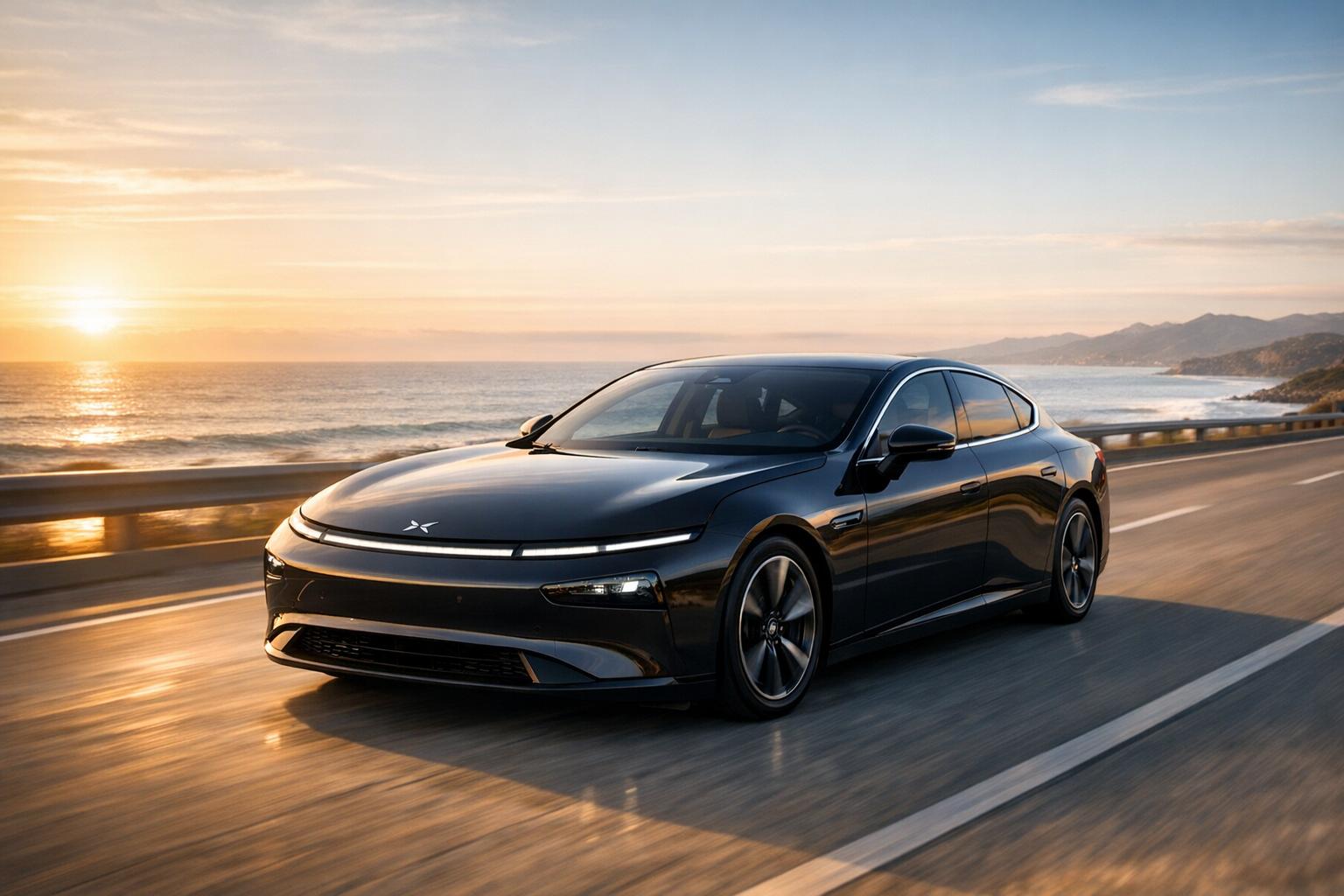
The XPENG P7 is an electric sedan that combines fast acceleration, advanced AI, and a premium build. It offers a range of up to 510 miles, rapid charging (80% in 12 minutes for some models), and features like Vehicle-to-Load (V2L) for powering external devices. Designed on a Porsche co-developed platform, it boasts high safety ratings, a sleek aerodynamic design, and a luxury interior with Nappa leather and Dolby Atmos sound. However, challenges like low ground clearance, limited service networks in some regions, and reliance on proprietary software (no Apple CarPlay/Android Auto) may affect its appeal. Starting at $54,000, it’s a strong contender for buyers seeking a high-tech EV sedan.
Key Features:
- Performance: 0-60 mph in 3.7 seconds (AWD model), up to 510-mile range.
- Charging: 80% in 12 minutes (5C battery models), V2L capability.
- Interior: 15.6-inch touchscreen, 23-speaker Dolby Atmos audio, AR-HUD.
- Safety: 5-star Euro NCAP rating, 31 sensors for driver assistance.
While its tech and range are impressive, buyers in areas with limited charging infrastructure or rugged roads should consider the challenges.
Exterior Design and Build
Body Design and Construction
The XPENG P7 combines sleek styling with impressive aerodynamic performance. Its design includes a lowered hood, a streamlined silhouette, hidden door handles, and a flattened underbody, achieving a drag coefficient of 0.236 Cd. The updated P7+ model takes this even further, reducing drag to an impressive 0.201 Cd, placing it among the most aerodynamic sedans available.
Built on the "Edward" platform, which was co-developed with Porsche, the P7 delivers high-quality construction. The chassis incorporates aluminum die-cast structures at both the front and rear, enhancing structural strength while minimizing weight. The RWD Long Range version weighs 4,380 pounds, while the 4WD High Performance model comes in at 4,623 pounds – making the P7 nearly 200 pounds lighter than a dual-motor Tesla Model S. Its lightweight, multi-link suspension ensures smooth handling, whether you’re cruising on highways or navigating uneven terrain, such as African roads. This thoughtful combination of aerodynamic design, weight optimization, and solid build quality underscores the P7’s focus on performance while addressing practical needs.
"The fit and finish throughout is superior to the Model S… Exterior panel gaps are more consistent and trim pieces better aligned." – Angus MacKenzie, Writer, MotorTrend
The P7’s dimensions – 192.4 inches in length, a 118.0-inch wheelbase, and 57.1 inches in height – offer a stable and balanced ride, ideal for long highway drives. However, its low-slung profile may require extra care on roads with large speed bumps or deep potholes. The vehicle also boasts a 5-star safety rating from Euro NCAP in 2023, earning an 87% score for Adult Occupant protection. These design elements not only enhance safety but also contribute to the vehicle’s refined exterior profile.
Lighting Systems and Wheels
The P7’s "X-BOT" face features a continuous LED light strip that does more than just look cool – it communicates essential vehicle statuses like charging progress, locking, and unlocking, a practical touch for those charging in public spaces. Standard equipment includes 19-inch alloy wheels paired with 245/45 Michelin Pilot Sport 4 tires and Brembo brakes. This setup ensures reliable braking performance, even under the strain of the AWD model’s 559 lb-ft of torque. These features not only enhance safety and performance but also add to the car’s polished aesthetic.
Available Colors
The P7 comes in five color options: Arctic White, Jet Black, Space Grey, Silver Frost, and Kaitoke Green. For those looking to stand out, XPENG also offers a "Wing Edition" with striking scissor-style front doors. This variety of colors and unique styling options allows buyers to personalize their car while maintaining its elegant and modern appeal.
Interior and Technology Features
Digital Displays and Controls
The cabin of the P7 is all about blending technology with simplicity. It features a 10.25-inch instrument cluster and a 15.6-inch central touchscreen, both powered by XPENG’s Xmart OS. But the real showstopper? An 87-inch AR-HUD that projects navigation details and driver data directly onto the windshield, keeping essential information right in your line of sight.
In keeping with its minimalist design, physical buttons are nearly eliminated. Most functions are handled through the touchscreen or voice commands, while the steering wheel retains two physical scrollers for quick access to essentials like audio volume and temperature adjustments. A new addition for the 2026 model is the innovative "Touch Pad" interface, which allows you to control features like seat massage or open the trunk with ease. Plus, over-the-air updates continuously refine systems such as climate control and driver assistance.
"The interior has a family resemblance with the G9 and is based on a minimalist ‘VIP lounge’ concept… those fluent in driving a Tesla will be right at home here."
- James Attwood, Associate Editor, Autocar
Beyond the screens and controls, the cabin’s audio and lighting systems take the experience to another level.
Audio System and Cabin Lighting
The P7 doesn’t just deliver sound – it creates an immersive experience. Its Dynaudio audio system includes a whopping 23 speakers, with some even built into the driver’s headrest for personalized audio prompts. Thanks to Dolby Atmos integration via XPENG’s XOPERA 5D Media System, the sound quality is rich and enveloping. For a bit of fun, the car also has exterior speakers that can turn it into a boombox when parked.
The cabin is designed to keep things quiet, even at highway speeds. The five Nappa leather sports seats offer heating and ventilation, while customizable ambient lighting lets you match the mood of the interior to your journey. However, the P7 does not support Apple CarPlay or Android Auto, as XPENG prioritizes its proprietary Xmart OS.
"Noise levels – wind, tire, and mechanical – are impressively low. The ride is good… impact harshness was well-suppressed."
- Angus MacKenzie, Writer, MotorTrend
AI-Powered Functions
The P7 takes convenience to the next level with its advanced AI features. The "Hey XPENG" AI assistant responds to voice commands for tasks like adjusting the climate, opening windows, or checking real-time range updates. What’s even cooler? The system recognizes which seat the command is coming from, making it possible to tailor settings for individual passengers. In the 2026 model, the voice assistant even detects physical gestures, such as a nod, adding a new layer of interaction.
At the core of the P7+ model’s intelligence are two Nvidia Orin X chips, delivering an impressive 508 TOPS of computing power to handle its AI and vision-based systems. The Xmart OS drives a 3D user interface and smart navigation, creating a seamless connection between you and the road. And with continuous OTA updates, the AI assistant and infotainment system keep getting smarter over time.
"This is a software-defined car."
- Piotr Chmielewski, Head of EV Charging in Europe, XPENG
XPENG P7 Dynamic Review: Beauty Is More Than Skin Deep!
Performance and Battery Options
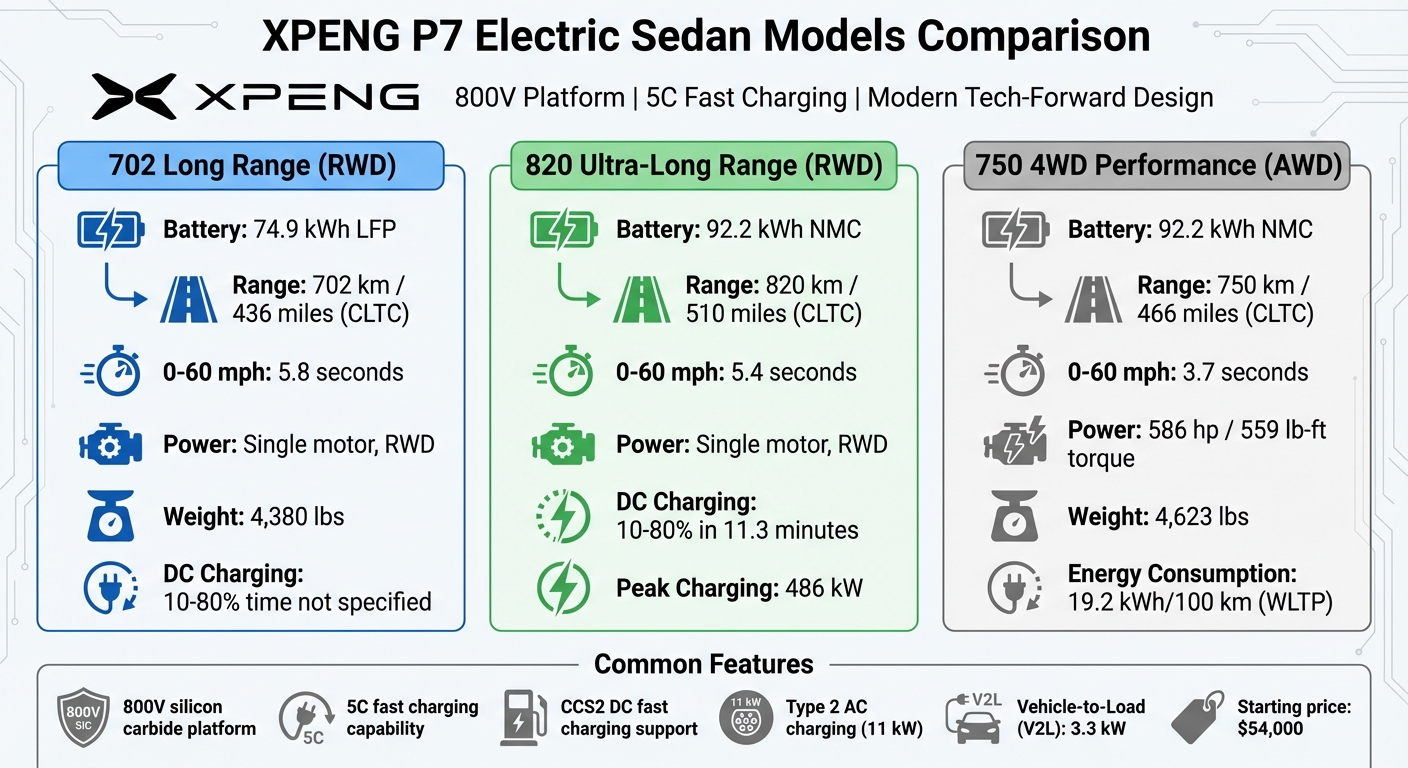
XPENG P7 Model Comparison: Specifications and Performance
Battery Specifications and Power
The P7 comes with two distinct battery setups, tailored to meet different performance needs. The first is a 74.9 kWh Lithium Iron Phosphate (LFP) battery, powering the "702 Long Range" rear-wheel-drive model. This setup delivers a CLTC-rated range of 702 km (around 436 miles). The second option is a 92.2 kWh Nickel Manganese Cobalt (NMC) battery, featured in the "820 Ultra-Long Range" model, offering an impressive 820 km (approximately 510 miles) of range. Both configurations are built on an 800V silicon carbide platform – an upgrade from the previous 400V architecture. This advanced platform supports faster charging and improves energy efficiency.
The NMC battery variant can handle a peak DC charging power of 486 kW, while the "750 4WD Performance" model, equipped with all-wheel drive, delivers a total output of 586 hp. Independent tests have reported an energy consumption of 14.4 kWh/100 km for the P7 Long Range, while the 4WD High Performance model achieved a WLTP rating of 19.2 kWh/100 km (30.9 kWh/100 mi).
"The impressive 358-mile range… is enabled by the sleek, sharp styling… which results in an official efficiency of 3.7 mpkWh."
- James Attwood, Associate Editor, Autocar
The P7’s aerodynamic design, which boasts a drag coefficient as low as 0.201 Cd, plays a key role in maximizing efficiency. Additionally, the P7i facelift introduced a standard heat pump that reduces energy consumption for climate control, particularly in colder weather.
Acceleration and Range
The P7’s performance is closely tied to its configuration. The 702 Long Range model, equipped with the LFP battery, accelerates from 0 to 60 mph in about 5.8 seconds. The 820 Ultra-Long Range model, featuring the NMC battery, shaves that time down to 5.4 seconds. For those seeking more power, the "750 4WD Performance" model achieves an impressive 0-60 mph in just 3.7 seconds.
Range estimates, based on the CLTC cycle, are equally competitive. The 702 Long Range model offers 436 miles, the 820 Ultra-Long Range delivers 510 miles, and the 750 4WD Performance provides 466 miles. These figures firmly position the P7 as a strong contender in the EV sedan market for U.S. driving conditions.
Charging Capabilities
The P7’s charging system is designed for speed and convenience. Thanks to its 800V architecture, it supports 5C fast charging, allowing the battery to recharge at five times its capacity per hour. At a high-power DC station, the 92.2 kWh NMC battery can go from 10% to 80% in just 11.3 minutes, adding a remarkable 525 km (326 miles) of range in just 10 minutes.
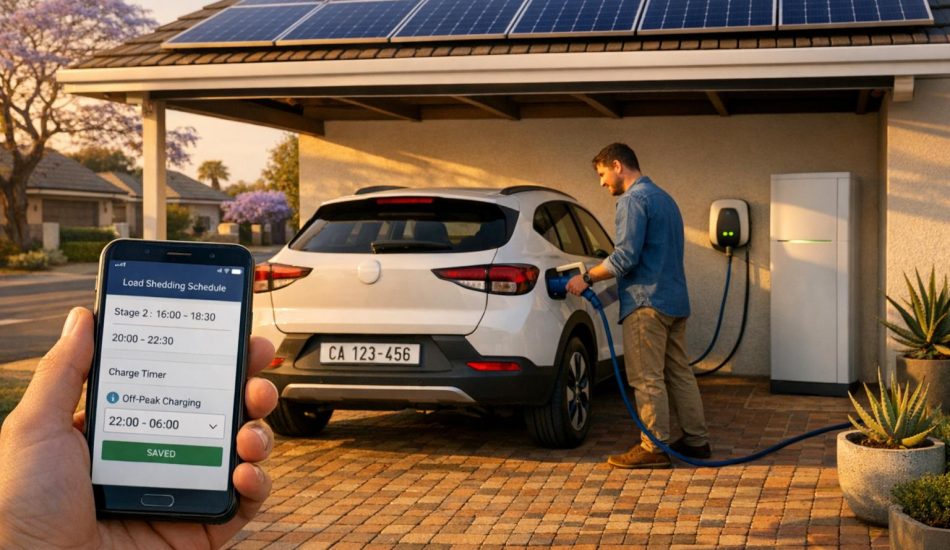
For home charging, the P7 features a standard Type 2 AC connection, typically operating at 11 kW with a 3-phase setup. Using an 11 kW wall box, a full charge from empty takes about 9 to 10 hours. The P7 also supports CCS2 for DC fast charging, which is widely available on public networks in various regions, including emerging African markets. Additionally, the car includes a Vehicle-to-Load (V2L) feature, capable of delivering up to 3.3 kW to power external devices.
For buyers in African markets, access to CCS2-compatible DC fast chargers is crucial to fully utilize the P7’s rapid charging capabilities. Installing a 3-phase 11 kW home charger is also recommended to avoid the long charging times associated with standard wall outlets.
Driver Assistance and Safety Systems
XPILOT System Features
The P7’s XPILOT ASSIST system is packed with 28 sensors designed to make driving and parking easier and safer. These include 5 high-definition millimeter-wave radars, 12 ultrasonic sensors, 4 surround-view cameras, and 7 high-perception cameras, all working together to enhance situational awareness and control.
One standout feature is the Navigation Guided Pilot (NGP), which provides lane-level navigation on highways. It can handle lane changes and route guidance with minimal input from the driver. The system also incorporates Intelligent Adaptive Cruise Control, which maintains speed accurately within 5 km/h (≈3.1 mph), and offers lane assist functions that activate at speeds above 60 km/h (about 37 mph).
Parking becomes much simpler with tools like Car Park Memory Parking (VPA) and a remote "Summon" feature, accessible through the XPENG App. For added safety, eye-tracking cameras monitor driver alertness when the vehicle is moving at speeds above 20 km/h (around 12 mph). Over-the-air updates continuously improve these features, although some advanced functions might not be available in all markets.
These systems work together to enhance safety and instill confidence in drivers, making every trip more comfortable and secure.
Safety Ratings and Sensors
The P7 doesn’t just rely on its advanced technology – it also excels in safety. In 2023, the P7 secured a 5-star Euro NCAP safety rating, scoring 87% for Adult Occupant protection, 81% for Child Occupant safety, 81% for Vulnerable Road Users, and 78% for Safety Assist features. Impressively, it achieved a perfect score of 24.0 out of 24 points in child crash tests for passengers aged 6 and 10.
The car’s Autonomous Emergency Braking (AEB) system is another key highlight, operating effectively at speeds as low as 4 km/h (approximately 2.5 mph). It can detect and respond to various road users, including vehicles, pedestrians, cyclists, and motorcyclists. Euro NCAP praised the system, noting:
"the autonomous emergency braking system of the XPENG P7 can respond to vulnerable road users as well as to other vehicles. The system performed well in tests of its response to pedestrians and cyclists".
Additional safety features include Forward Collision Warning, Multi-Collision Braking, and a center airbag, all of which help reduce the risk of injury in the event of a crash.
However, the performance of these systems can be affected by external factors. Rain, snow, or wet road conditions may impact sensor effectiveness, and clear road markings are crucial for accurate lane-keeping. Drivers should always be ready to take control, as XPILOT is designed to assist rather than replace human oversight.
sbb-itb-99e19e3
Driving Dynamics and Comfort
Acceleration and Braking Performance
The 4WD High Performance variant of the P7 delivers impressive acceleration, going from 0 to 62 mph in just 4.1 seconds with 757 Nm (558 lb-ft) of torque. Its regenerative braking system offers multiple modes, including a "High" setting that allows for near-one-pedal driving. This feature not only enhances energy recovery but also extends range, especially in stop-and-go traffic. According to MotorTrend’s Angus MacKenzie, "the transitions between regenerative and mechanical braking are smooth", creating a natural, seamless braking experience without any abruptness.
The P7 is equipped with Brembo brakes, which add to its performance credentials. However, some testers have noted that the brake pedal feels "soft", requiring a firmer press to achieve full stopping power. Despite this, the braking system integrates effectively with the car’s suspension, ensuring a balanced driving experience.
Handling and Suspension
The P7 pairs its rapid acceleration with sharp, precise handling, thanks to its advanced suspension system. The car features a front double-wishbone and rear five-link independent suspension setup, which ensures responsive and confident handling. James Attwood, Associate Editor at Autocar, remarked, "The steering has a sharpness and fluency that can be lacking in some Chinese machines: it responds well to inputs and offers some feedback".
The Continuous Damping Control (CDC) system further enhances the ride by adjusting damping in real time based on road conditions. With three predefined settings, drivers can fine-tune the balance between comfort and sportiness. On smooth highways, the P7 feels stable and composed, aided by its ultra-low drag coefficient of 0.236. The car also provides strong lateral support during cornering, making it feel secure and capable through curves.
That said, the ride can feel "overly stiff" on rougher roads. While the suspension does a good job of handling smaller bumps and potholes, it struggles with larger imperfections, leading to noticeable firmness and increased tire noise on uneven surfaces. For drivers in regions with poorly maintained or unpaved roads, this stiffness may be more apparent. Adjusting the CDC settings can help strike a better balance for different terrains.
Above 25 mph, tire noise becomes more noticeable, particularly on coarse surfaces. For those who frequently drive on rough roads, investing in premium noise-canceling tires might help maintain a quieter cabin environment.
Energy Consumption
Despite its performance-oriented nature, the P7 demonstrates commendable energy efficiency. The 4WD High Performance variant consumes 19.2 kWh/100 km (30.9 kWh/100 miles), while the RWD Long Range variant uses approximately 16.8 kWh/100 km (27 kWh/100 miles), offering an impressive range of up to 358 miles.
In urban settings, using the "Economy" mode maximizes regenerative braking, which not only extends range but also reduces wear on the brakes. Of course, real-world energy consumption can vary depending on driving habits, terrain, and weather conditions, but the P7’s figures are competitive within its class.
Weighing in at 4,718 lbs for the 4WD version, the P7 is about 200 pounds lighter than a dual-motor Tesla Model S. This weight advantage contributes to its agile handling and helps maintain respectable energy efficiency, even with its focus on high performance.
Pricing and How to Buy on EV24.africa
Model Pricing
The XPENG P7 comes in multiple configurations, with prices varying based on the model and region. The RWD Long Range model starts at around $54,000, while the AWD Performance models are priced between $53,000 and $64,000.
Standard features include a panoramic sunroof, heated front and rear seats, Nappa leather trim, Dolby Atmos audio, and the XPILOT system. For those seeking a little extra flair, the Wing Edition is available at an additional cost.
Important note: Prices do not include import duties, VAT, registration fees, shipping costs, or the installation of a home charging station. Even with these additional expenses, the P7 offers an enticing option for buyers in Africa who value advanced technology and premium features.
EV24.africa Purchase Options
After reviewing the pricing, buying your XPENG P7 through EV24.africa is straightforward. The platform offers a user-friendly marketplace with transparent pricing and delivery services across all 54 African countries.
EV24.africa provides detailed P7 specifications, allowing buyers to compare features side-by-side. Financing options are available, tailored to regional conditions and buyer eligibility. The platform also manages international shipping, as well as local import and customs requirements, making the process hassle-free.
For dealers or private sellers, EV24.africa offers free Basic Listings and custom Dealer Plans for bulk listings. These plans include tools for increased visibility, helping sellers connect with potential buyers more effectively. Whether you’re purchasing or selling, EV24.africa simplifies every step of the process.
Advantages and Drawbacks for African Buyers
Advantages
The XPENG P7 offers features that cater well to the needs of African buyers, especially for those who frequently travel long distances. Its impressive range makes it suitable for trips between major cities, even in regions where charging stations are scarce. One standout feature is its Vehicle-to-Load (V2L) capability, which allows the car to function as a mobile power source – an invaluable asset during power outages or load shedding. Additionally, the battery supports fast charging, and the Xmart OS enables over-the-air updates for battery management and air conditioning. This reduces the need for frequent visits to service centers.
When it comes to quality and performance, the P7 doesn’t disappoint. Reviews praise its high-quality build, with precise exterior panel gaps and premium interior materials. The chassis, developed in collaboration with Porsche, includes a double-wishbone front suspension and a five-link rear suspension, paired with standard Brembo brakes. These features ensure a smooth and reliable driving experience.
Drawbacks
That said, the XPENG P7 does have some challenges that African buyers should keep in mind. The all-wheel-drive (AWD) version weighs approximately 2,215 kg (4,882 lbs), which can lead to faster wear and tear on tires and suspension, particularly on poorly maintained roads. Its low-slung design may also struggle with rough roads, high speed bumps, and uneven terrain commonly found in certain areas.
Charging infrastructure poses another significant challenge. While the P7 supports DC fast charging at speeds of up to 175 kW, high-capacity CCS2 charging stations are still rare across much of Africa. This often results in longer charging times when using lower-capacity public chargers. Furthermore, the car’s official service network is limited, with most support concentrated in China, Europe, and select North African countries like Egypt. For buyers in Sub-Saharan Africa, accessing specialized parts and repairs could prove difficult.
Final Verdict: Should You Buy the XPENG P7?
After examining its performance, safety features, and cutting-edge technology, here’s the bottom line: the XPENG P7 is a strong choice for anyone looking to embrace electric mobility. It delivers an impressive range, quick charging capabilities, advanced onboard tech, and practical versatility, all wrapped in a premium package. One standout feature is its Vehicle-to-Load (V2L) capability, which lets the car double as a mobile power source – an especially useful perk during power outages or outdoor adventures, making it particularly appealing for buyers in regions like Africa.
"The XPeng P7 is one of the most impressive new cars we’ve driven this year. It has, of course, the punchy, silent acceleration you expect from a contemporary electric car, but what makes it stand out is how refined everything else about it feels." – Angus MacKenzie, Writer, MotorTrend
The P7 shines in the tech department. Its Xmart OS gets regular over-the-air updates, so you can enjoy improvements without ever stepping into a service center. Meanwhile, its XPILOT system, equipped with 31 sensors, offers a robust driver assistance suite. The car’s quality is further underscored by its 5-star Euro NCAP safety rating and a chassis developed in collaboration with Porsche. Starting at around $54,000 for the RWD Long Range model, the P7 is positioned to compete seriously in the premium EV sedan market.
For those hesitant about making the switch to electric vehicles, the P7 addresses common concerns. Its sleek design, strong performance, intuitive smart features, and top-tier safety systems make it a well-rounded option. Even in areas where charging infrastructure is still growing, the P7’s long-range capabilities and V2L functionality provide practical solutions. While limited service networks and rugged road conditions may pose challenges, these can be mitigated with access to reliable charging options.
If the XPENG P7 has piqued your interest, check out available models and financing options on EV24.africa. Their transparent pricing and delivery services make the transition to electric vehicle ownership easier than ever. Head to EV24.africa to explore how the P7 could fit into your life.
FAQs
What challenges might XPENG P7 owners face in areas with limited charging infrastructure?
Owning an XPENG P7 in areas with fewer charging options can present some hurdles, especially since the car performs best with access to high-power DC fast chargers. These chargers can add up to 326 miles of range in just 10 minutes, making them incredibly convenient. However, outside major urban centers, such stations are often hard to find. Without them, owners are left relying on Level 2 chargers, which take much longer – several hours – to fully recharge the battery.
The car’s range can also vary quite a bit based on factors like weather and driving conditions. For instance, in colder temperatures (around 14°F), the range can drop to roughly 208 miles, a noticeable decrease from its maximum of 407 miles in milder conditions. This means trip planning becomes crucial in regions with fewer charging stations. Many owners may find it helpful to keep a portable Level 2 charger handy for use at home or work, but they’ll also need to account for longer charging times, which can make the P7 less convenient in areas where charging infrastructure is still developing.
How does the XPENG P7’s AI and driver assistance technology improve the driving experience?
The XPENG P7 takes driving to a new level with its advanced AI and driver assistance features, turning it into much more than just a car – it’s a true driving companion. Thanks to its Xpilot system, the P7 integrates data from cameras, radar, and ultrasonic sensors to deliver features like adaptive cruise control, lane-centering, and traffic-jam assist. These tools help the car maintain safe distances, stay firmly within its lane, and handle stop-and-go traffic with ease, making long drives far less exhausting.
What really sets the system apart is its ability to handle complex situations. Using a highly responsive perception platform, the P7 reacts swiftly to challenges like sudden lane changes or unexpected pedestrians, ensuring smoother steering and timely braking. On top of that, it adapts to your driving habits and traffic patterns, offering predictive speed adjustments, early warnings, and even automated parking assistance. With clear visual and audio feedback keeping you in the loop, the P7 makes every journey – whether through busy city streets or on the open highway – feel effortless and secure.
What are the main differences between the XPENG P7’s battery options?
The XPENG P7 comes with two battery options: ternary lithium-ion and lithium iron phosphate (LFP).
The ternary lithium-ion battery is the high-capacity choice, featuring an 86.2 kWh pack (with about 82.7 kWh usable). This setup delivers a real-world range of up to 495 km (307 miles) and supports fast charging, taking the battery from 10% to 80% in roughly 29 minutes.
On the other hand, the LFP batteries are designed with affordability in mind and come in several configurations. The P7i 550 model includes a 64.4 kWh LFP battery, offering a range of 550 km (342 miles) under the CLTC standard. Meanwhile, the newer P7+ model provides two LFP options: a 60.7 kWh pack for shorter trips and a 76.3 kWh pack for longer distances. These LFP batteries also support fast charging, with the same 10% to 80% charge time of about 29 minutes. However, the range will depend on the specific battery size.
With these options, the XPENG P7 caters to a variety of needs, striking a balance between performance, range, and cost.