
 Thabo Nkosi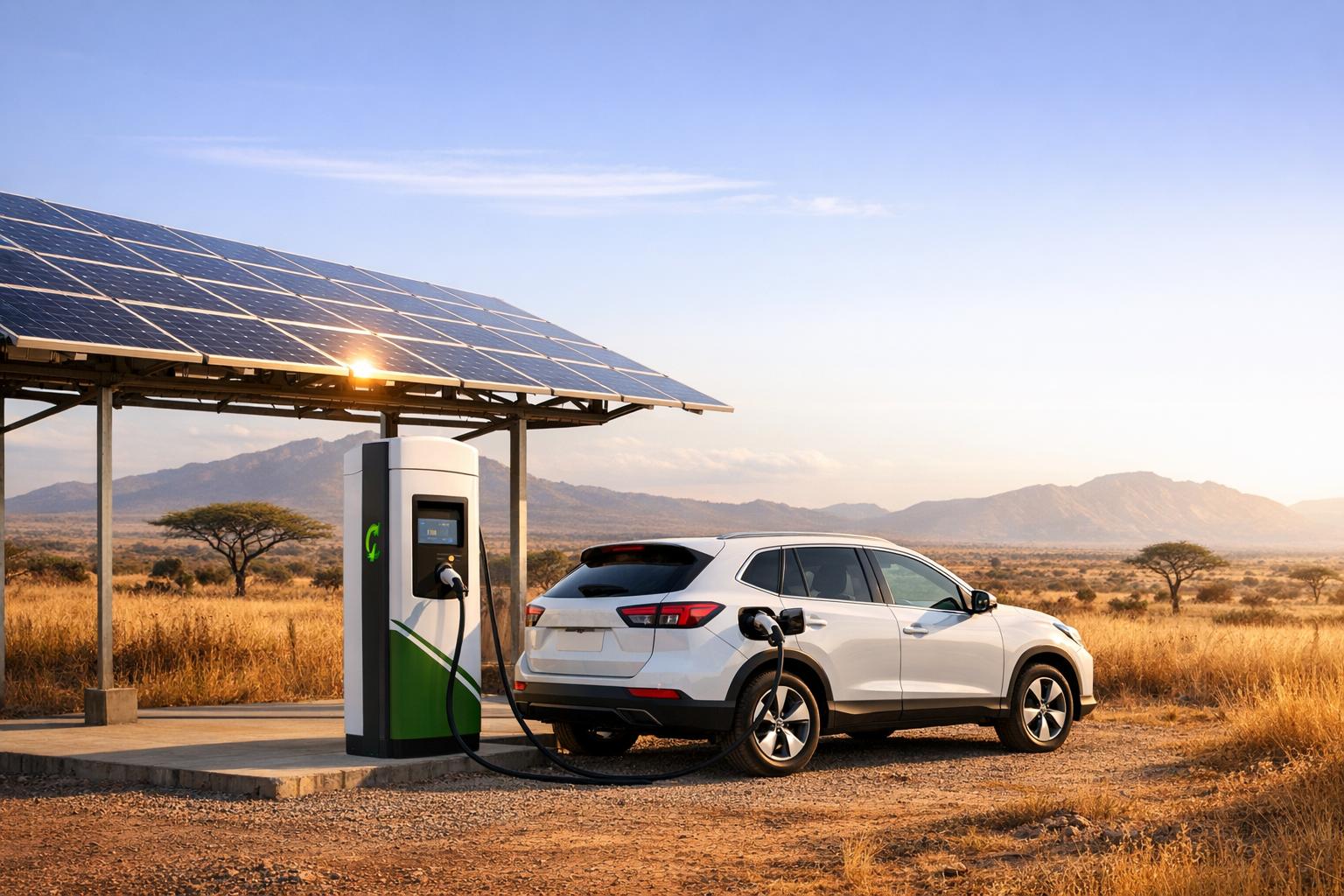
Off-grid solar EV charging is emerging as a game-changer in Africa, addressing the continent’s unreliable and underdeveloped power grids. By combining solar panels with battery storage, these systems ensure consistent energy for electric vehicles (EVs) without relying on traditional grids. With EV adoption accelerating – South Africa nearly doubled EV registrations in 2025, and Ethiopia banned internal combustion engine imports – 2026 is poised to see major advancements in charging infrastructure.
Key drivers include:
- Falling costs of solar panels and battery storage.
- Growing EV markets: Over 30,000 EVs in Africa, with two- and three-wheelers growing 38% annually.
- Energy challenges: 600 million Africans lack access to reliable electricity.
- Technological progress: Efficient solar panels, durable batteries, and faster charging solutions.
Off-grid solar systems offer a practical solution, especially in rural areas where grid expansion is costly. Projects like South Africa’s highway charging networks and The Gambia’s community-based solar taxis highlight scalable models. Investments from governments, banks, and private firms are accelerating this shift, but a $21 billion funding gap remains. As costs drop and infrastructure expands, 2026 could mark a turning point for clean, reliable EV charging in Africa.
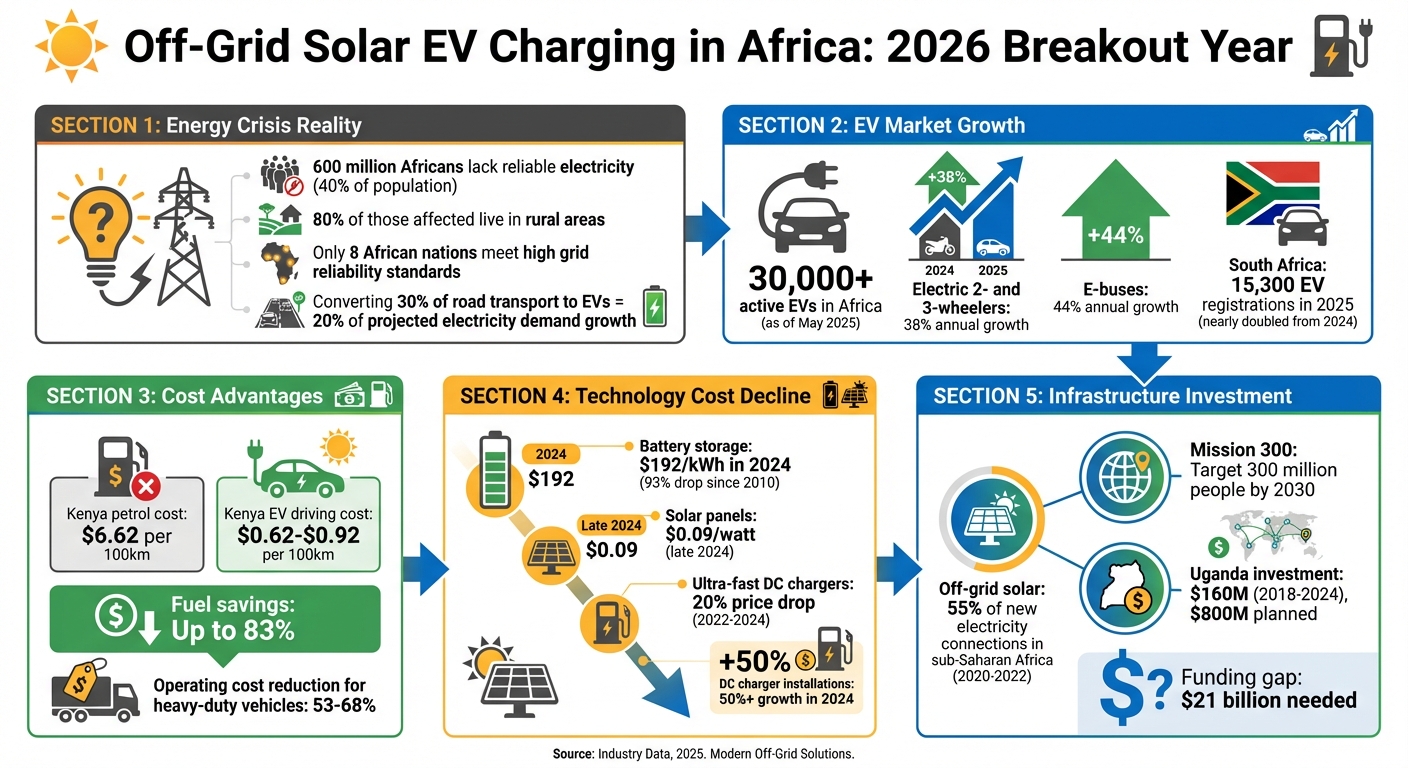
Africa’s Off-Grid Solar EV Charging Growth: Key Statistics and Market Drivers for 2026
Africa’s Energy Challenges and Off-Grid Solutions
Power Grid Limitations Across Africa
Africa’s electricity infrastructure struggles to keep up with demand, creating significant hurdles for electric vehicle (EV) adoption. Around 600 million people – roughly 40% of the continent’s population – live without electricity, with rural areas accounting for 80% of those affected. National grids in many countries are plagued by unreliable supply, frequent power cuts, and limited rural coverage. In fact, only eight African nations meet high standards for grid reliability. Take Uganda, for instance: over 90% of its energy consumption comes from biomass sources like firewood and charcoal, while rural areas endure an unreliable and inconsistent grid.
Financial challenges further exacerbate the problem. Public utilities in sub-Saharan Africa are burdened with heavy debt, which limits their ability to expand electrification in underserved areas. Adding EV charging infrastructure to these already strained grids could worsen the situation, causing voltage fluctuations, instability, and higher power losses during peak times. To put it into perspective, converting just 30% of road transport to EVs would consume more than 20% of a country’s projected electricity demand growth over the next decade. These challenges highlight the critical need for alternative, independent energy solutions.
Solar Charging as an Alternative
Off-grid solar systems offer a practical and sustainable way to overcome these grid limitations. Solar-powered charging stations, equipped with battery storage, operate independently of the grid, ensuring a steady power supply even during outages or load shedding. This approach is particularly effective in rural areas, where extending grid infrastructure would be prohibitively expensive.
Globally, off-grid solar is seen as the most affordable solution to bring electricity to the 41% of people still living without power by 2030. Between 2020 and 2022, sub-Saharan Africa accounted for 55% of new electricity connections worldwide, thanks largely to off-grid solar systems. Beyond providing reliable energy, these systems are environmentally friendly, producing no direct CO₂ emissions and reducing air pollution compared to grid-connected systems that rely on fossil fuels.
| Charging System Type | Grid Dependency | Reliability | Environmental Impact |
|---|---|---|---|
| Grid-Connected | High; relies on national utility | Low; prone to outages and load shedding | Varies; depends on the grid’s energy mix |
| Off-Grid Solar | None; fully independent | High; stable supply through battery storage | 100% renewable and clean |
| Hybrid (Solar-Grid) | Moderate; grid serves as backup | Moderate; solar minimizes grid instability | Reduces reliance on fossil fuels |
Technology Advances in Off-Grid Solar Charging
Improved Solar Panel Efficiency
Today’s TOPCon solar cells have achieved a 25% conversion efficiency, meaning they can produce more power with less space. Bifacial panels take it a step further by capturing up to 28% extra energy in high-reflectivity (albedo) environments, delivering a combined output of 220W from the primary side and 175W from the rear side. These advancements are paired with lithium iron phosphate (LFP) and sodium-ion chemistries, which perform reliably even in high temperatures. With rugged IP68 waterproof ratings, these systems are built to withstand extreme weather conditions. These innovations tackle the challenges of energy generation in regions like Africa, where climate and infrastructure can pose significant hurdles.
Advances in Battery Storage
Lithium iron phosphate (LFP) batteries are quickly replacing older lead-acid technology, offering a lifespan of 3,000 to 6,000 charge cycles with minimal upkeep. These batteries can safely use over 80% of their capacity, making them an efficient and reliable choice. To handle high temperatures, liquid cooling systems prevent performance losses during heavy use, ensuring stable power delivery even in extreme conditions.
The cost of utility-scale battery systems has plummeted to about $192 per kilowatt-hour in 2024, a staggering 93% drop since 2010. Battery-integrated charging units now cater to a range of needs, from smaller 60–150 kWh systems priced between $29,000 and $80,000, to larger 800–2,000 kWh installations costing $140,000 to $320,000. These systems provide "delivery certainty", ensuring consistent charging regardless of local grid reliability. Such advancements pave the way for more efficient and dependable off-grid charging solutions.
Faster Charging Innovations
Rapid charging technology is revolutionizing off-grid systems by significantly reducing charging times. Ultra-fast DC chargers, operating at 150 kW or more, can add about 93 miles (150 km) of range in just 15 minutes – perfect for high-demand fleets. The adoption of these chargers has surged, with global installations growing by over 50% in 2024, while prices dropped 20% between 2022 and 2024.
Cutting-edge battery technologies are also making waves. CATL’s Shenxing batteries can recharge 40% of their capacity in only 5 minutes, and BYD’s Super-e platform offers an impressive 248 miles (400 km) of range within the same timeframe. These breakthroughs are supported by advanced 1,000-volt architectures and silicon carbide power chips.
"The ability to charge EVs in a timeframe comparable to refueling conventional cars could further accelerate consumer adoption." – IEA Global EV Outlook 2025
Pairing ultra-fast chargers with stationary battery storage creates a robust off-grid setup. During the day, solar energy is stored in batteries, which then release power in high-energy bursts when needed. This approach reduces the need for oversized solar arrays and eases the load on local minigrid systems. With solar module prices dropping to around $0.09 per watt in late 2024, scaling up solar capacity has become more cost-effective than ever.
What’s Driving EV Adoption and Off-Grid Charging in 2026
Economic and Environmental Benefits of EVs
Switching to electric vehicles (EVs) is proving to be a game-changer, especially in regions like Kenya. Driving an EV for 62 miles (100 km) in Kenya costs between $0.62 and $0.92, compared to $6.62 for a petrol vehicle – a staggering fuel savings of up to 83%. These savings are particularly appealing for high-mileage commercial fleets, including boda bodas (motorcycle taxis), delivery vans, and public buses, which are increasingly making the shift to electric mobility.
However, there’s a catch: when EVs are charged using a coal-heavy grid, their annual emissions reach 5.8 tonnes of CO₂, compared to 4.4 tonnes from a petrol car. This highlights the importance of off-grid solar charging. Solar-powered EVs not only eliminate emissions but also reduce dependence on unstable national grids, making them a practical and environmentally sound solution.
"It is clear that the development of a network of off-grid, renewably powered EV charging stations is the only way we will reduce transport emissions in the country." – Joubert Roux, Executive Chairman, CHARGE
These advantages are fueling investments in renewable energy infrastructure, paving the way for a cleaner future.
Increased Investment in Renewable Energy Infrastructure
Efforts to expand renewable energy are accelerating across Africa. Mission 300, a collaboration between the World Bank and the African Development Bank, aims to connect 300 million people to electricity by 2030, with off-grid solar systems powering businesses and transportation. In May 2025, the Development Bank of South Africa committed $5.8 million to Zero Carbon Charge to install seven solar-powered EV charging stations.
Companies are also stepping up. BasiGo raised $42 million during 2024/2025 to deploy 1,000 electric buses in Kenya and Rwanda. Meanwhile, Uganda has invested $160 million in electric mobility between 2018 and 2024, with plans for an additional $800 million in the near future. These investments are critical for deploying off-grid solar charging systems that align with Africa’s renewable energy ambitions. By sidestepping costly grid upgrades, off-grid solutions enable quicker infrastructure development in both urban hubs and remote areas.
Africa’s Growing EV Market
Africa’s EV market is on a rapid upward trajectory, driven by economic incentives and environmental concerns. As of May 2025, the continent’s EV fleet surpassed 30,000 active vehicles, with electric 2- and 3-wheelers growing at an impressive 38% year-over-year and e-buses seeing a 44% surge. South Africa, for instance, nearly doubled its EV registrations from 2024, reaching an estimated 15,300 vehicles in 2025. Policy changes are further accelerating this growth. Ethiopia, in 2024, became the first country to ban internal combustion engine vehicle imports, while Kenya offers VAT exemptions and South Africa provides tax incentives for local EV production.
Commercial fleets are leading the way in this transition. In Kenya, locally assembled electric mini-buses, priced between $55,000 and $60,000, are proving competitive with diesel options. When factoring in operating cost reductions of 53–68% for heavy-duty vehicles, the economic case becomes even stronger. Off-grid solar charging is essential to this expansion, offering reliable and cost-effective infrastructure that operates independently of grid limitations. Platforms like EV24.africa are stepping in to connect buyers across the continent with available EV options, making it easier to navigate this growing market.
sbb-itb-99e19e3
Off-Grid Solar EV Charging Projects in Africa
South Africa’s Off-Grid Charging Stations
In November 2024, Zero Carbon Charge launched South Africa’s first fully off-grid EV charging station at Farm Palmiet, located on the N12 highway. This facility in Wolmaransstad is equipped with 480 bifacial solar panels and a 546 kWh liquid-cooled battery system. It offers six DC fast chargers and two AC charging points, capable of boosting an EV’s battery from 10% to 80% in about 25 minutes.
This station serves as the foundation for a planned network of 120 charging stations, spaced approximately 93 miles apart along major highways. The technology relies on equipment from Chinese suppliers Greencore Energy Solutions and Magic Power. Landowners hosting these stations benefit by earning 5% of the revenue generated from vehicle charging. By late 2024, construction had already started on two additional stations along the N3 corridor – Charge N3 Roadside in Free State and Charge N3 Tugela in KwaZulu-Natal. These two locations, spaced 112 miles apart, aim to make travel between Johannesburg and Durban more convenient, with both facilities expected to be operational by 2026.
While South Africa leads the way with its highway-focused infrastructure, similar off-grid charging models are beginning to appear in other parts of Africa.
Regional Networks and Expansion Plans
Beyond high-traffic highways, smaller community-based projects are showcasing the potential of off-grid solar charging to address energy access challenges across the continent. A notable example comes from The Gambia, where the Solar Taxi pilot project took shape. Initiated in 2019/2020, researchers from De Montfort University introduced a solar-powered EV taxi service in Manduar village. The project featured a Nissan e-NV200 Evalia and a 4.5 kWp solar carport. Led by Dr. Rupert Gammon and Momodou Sallah, the initiative demonstrated how EVs could serve as "dispatchable anchor loads" for village minigrids. By consuming excess solar energy during peak production hours, the need for costly stationary battery storage was reduced. The results were striking: taxi drivers saw their earnings increase by 250% to 1,300% compared to traditional operations.
These efforts offer two distinct yet complementary models: South Africa’s highway-focused, ultra-fast charging network for long-distance travel and The Gambia’s community-based system that integrates with local minigrids. Together, these initiatives are paving the way for a sustainable EV charging infrastructure across Africa.
100% Solar Powered Ultrafast EV Charger | Pioneer
Conclusion: The Future of EV Charging in Africa
The landscape for EV charging in Africa is evolving rapidly, with 2026 shaping up to be a pivotal year. Falling solar energy costs, advancements in battery storage, and the availability of affordable electric vehicle (EV) models are driving this change. Off-grid solar charging is no longer a stopgap for weak electrical grids – it’s becoming the most cost-effective and dependable solution.
Recent data underscores this transformation. From 2020 to 2022, off-grid solar systems were responsible for 55% of new electricity connections in sub-Saharan Africa. Meanwhile, EV registrations are climbing steadily, fueled by supportive policies and growing infrastructure.
The economic argument for off-grid solar charging is stronger than ever. Battery electric vehicles (BEVs) paired with solar systems are on track to deliver lower total ownership costs than fossil-fuel vehicles across much of Africa well before the anticipated 2040 mark. For commercial fleets, motorcycles, and three-wheelers – vehicles that cover significant daily distances – the financial benefits materialize even sooner.
However, hurdles remain. Addressing infrastructure gaps will require substantial financial backing. GOGLA has identified a $21 billion investment shortfall, and high financing costs continue to slow progress. Bridging this gap will demand coordinated efforts from governments, development organizations, and private investors. Lowering borrowing costs and scaling production are essential steps. The technology works, the economics are improving, and now the focus must shift to building a financial ecosystem that matches the emerging physical networks in cities, along highways, and in rural minigrids.
FAQs
Why is 2026 likely to be a turning point for off-grid solar EV charging in Africa?
The year 2026 is set to mark a major milestone for off-grid solar EV charging in Africa, thanks to a mix of promising developments. For starters, the cost of solar panels and batteries continues to decline, making renewable energy solutions more affordable than ever. Combine this with Africa’s plentiful sunlight, and you have the perfect conditions for building sustainable charging networks.
On top of that, advancements in solar technology are making systems more efficient and reliable. Governments and private companies are also stepping up, offering support to tackle issues like inconsistent electrical grids. As the electric vehicle market grows at a rapid pace, off-grid solar charging is emerging as a practical solution to improve energy access and accelerate EV adoption across the continent.
How can off-grid solar systems solve Africa’s unreliable power grid challenges?
Off-grid solar systems produce electricity right where it’s needed, using photovoltaic panels paired with battery storage. This setup removes the dependency on unreliable central power grids, offering a steady and self-sufficient energy option for charging electric vehicles (EVs) and handling other energy demands.
By tapping into the plentiful resource of sunlight, these systems provide a practical and environmentally conscious way to address power shortages, particularly in places with underdeveloped infrastructure. They also play a key role in supporting EV adoption by guaranteeing access to clean energy, even in isolated or remote locations.
What key technologies are enabling off-grid solar EV charging in Africa?
Off-grid solar EV charging is making strides with new technologies that allow electricity to be generated, stored, and delivered independently of a central grid. High-efficiency solar panels, like next-generation monocrystalline and bifacial models, now produce more energy while taking up less space. This improvement lowers both the size and cost of solar setups, making them more practical. On top of that, advanced battery systems, such as modular lithium-ion and flow batteries, provide dependable energy storage and ensure fast power delivery, even during cloudy weather or nighttime.
Adding to the mix are smart power electronics – components like MPPT controllers, bidirectional converters, and V2G inverters – that optimize how energy flows between the solar panels, batteries, and vehicles. These systems also support remote monitoring and load balancing, which boost both reliability and efficiency. Combined, these advancements are paving the way for compact and easy-to-install solar charging solutions. Whether installed on rooftops, parking canopies, or mobile units, they’re particularly well-suited for reaching remote and underserved areas, such as those in parts of Africa.