
 Thabo Nkosi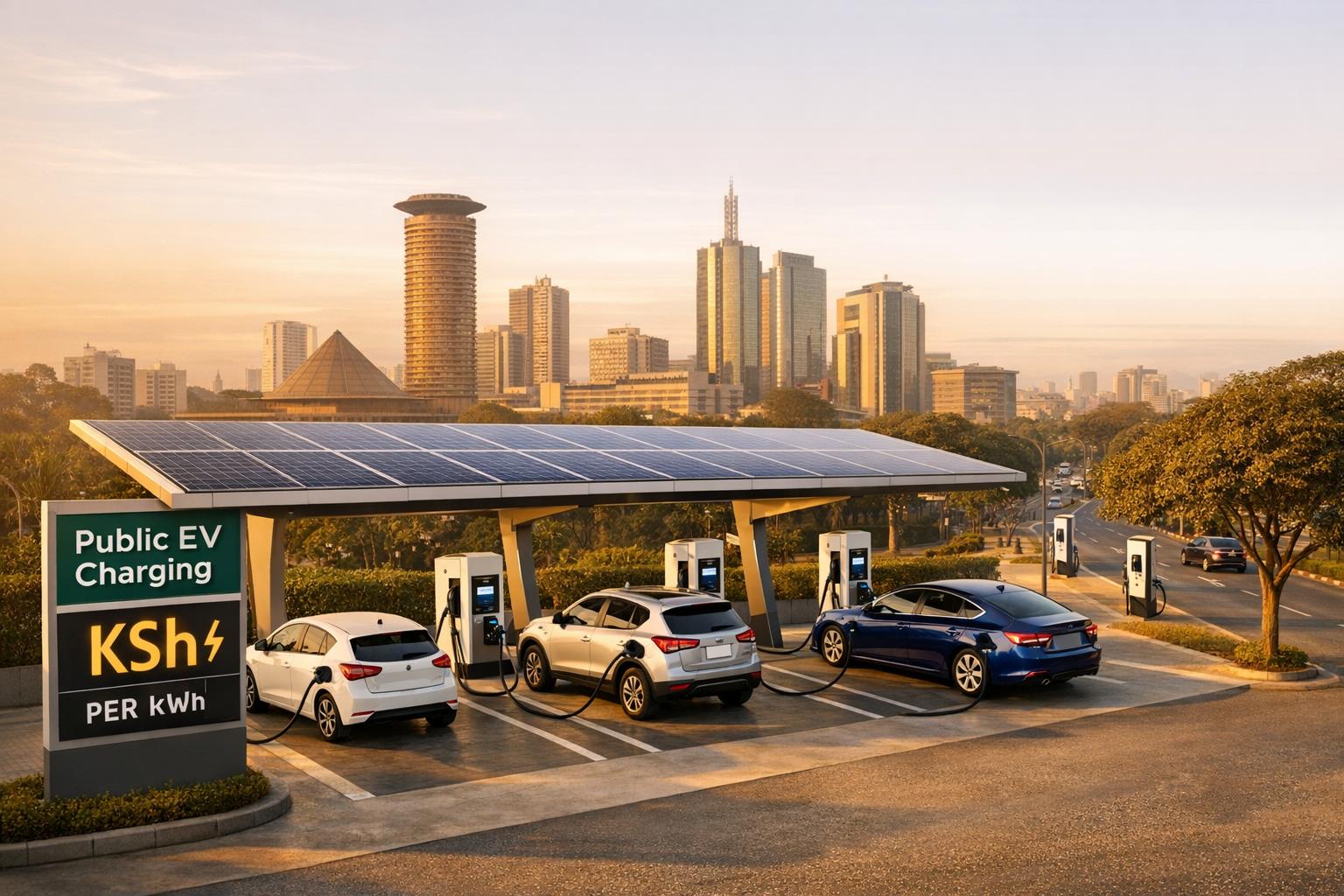
Kenya’s electric vehicle (EV) market is growing fast, with over 24,754 EVs registered by February 2026 – a 47% increase in just 18 months. The shift is driven by lower costs (up to 75% savings on fuel and maintenance), government tax exemptions, and expanding charging infrastructure. EVs are now more accessible, with options ranging from affordable local models starting at KES 1.3M ($10,000) to premium imports like Tesla and BYD. Charging stations have grown significantly, with over 200 public stations available and a target of 10,000 by 2030. Platforms like EV24.africa simplify EV ownership by handling imports, financing, and education.
Quick Facts:
- Cost Savings: Charging an EV is 60% cheaper than fueling with petrol.
- Local Models: TAD Motors offers EVs from KES 1.3M, while Autopax‘s AirEv YETU starts at KES 1.7M.
- Charging: Home charging costs KES 600–1,800 per full charge, depending on battery size.
- Government Incentives: EVs enjoy 0% import duty and 0% VAT, making them more affordable.
- Infrastructure: Fast chargers can deliver 80% charge in 20–40 minutes, with growing solar-powered options.
Kenya is making EVs an everyday choice by reducing costs, increasing accessibility, and building a robust charging network.
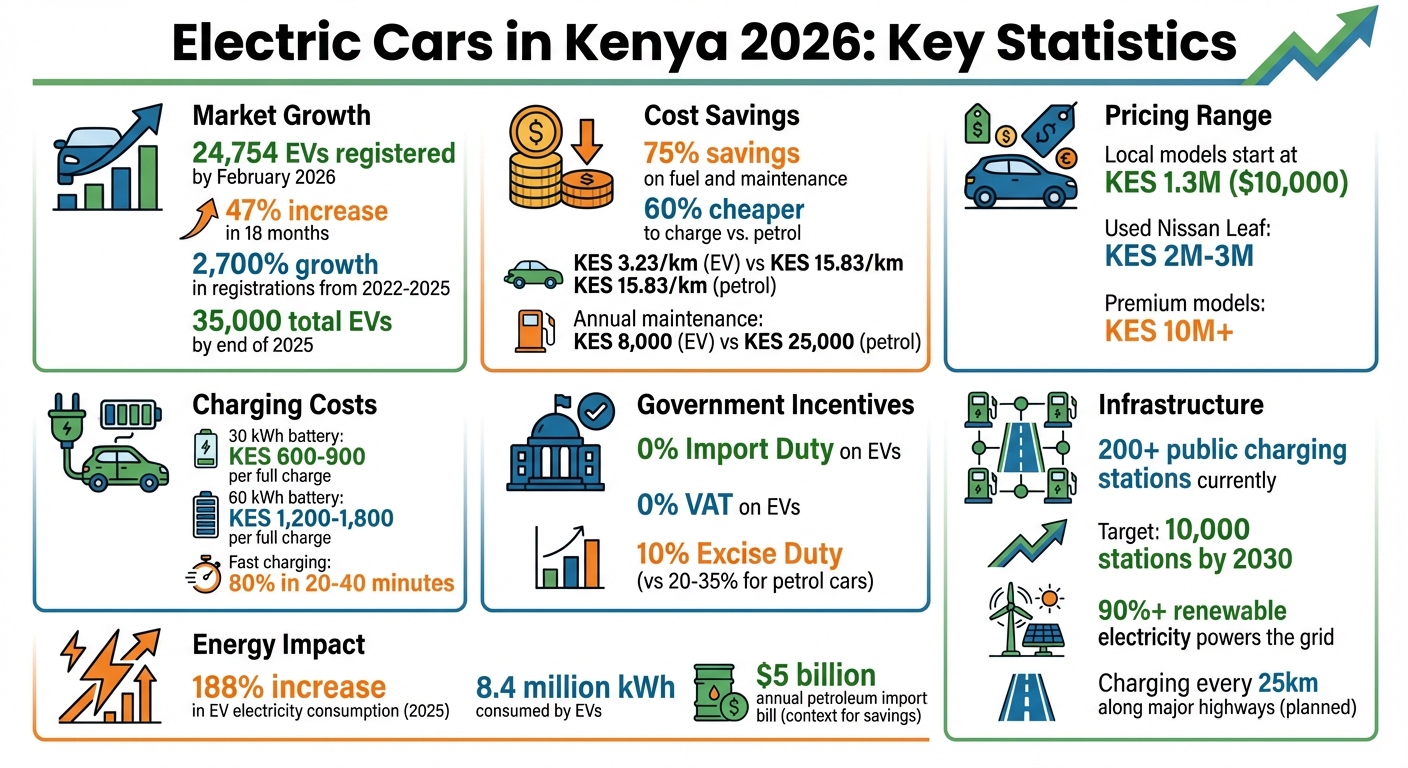
Kenya Electric Vehicle Market Statistics 2026: Costs, Savings & Infrastructure Growth
Where to Find Electric Cars in Kenya
If you’re looking to buy an electric car in Kenya, you have three main options: local dealerships, online platforms, and locally assembled vehicles. Each route offers its own perks, depending on your budget and how soon you need the car.
Local dealerships like Autopax, Magari Deals, and Motorcar make it easy to get pre-cleared vehicles that are ready to drive off the lot. These cars often come with limited warranties and are available for immediate pickup. On the other hand, online platforms such as EV24.africa offer a wider selection, including models imported from Japan and the UK.
Local assembly is also picking up speed. In January 2026, TAD Motors introduced five new models built at their Naivasha plant. These include two SUVs, the Dhahabu and Amani, and three sedans, the Taji, Makena, and Fahari. Prices start at KES 1.3 million (about $10,000). Founder Tadesse Tessema highlighted their affordability:
"We are coming with a price range of $10,000 dollars. There is no company, even in China, that can make these cars for this price".
The company plans to produce 3,000 units annually, targeting buyers who might otherwise choose used petrol vehicles.
Autopax is also in the local assembly game with its AirEv YETU model, priced around KES 1.7 million. CEO Joy Kalua emphasized the savings:
"If you drive an Autopax Electric Vehicle, you will spend 40 percent of what you would have spent on petrol. In other words, if you would have spent Sh100 on fuel, you will now spend a maximum of Sh40".
Meanwhile, Dongfeng has teamed up with Associated Vehicle Assemblers to locally produce its ePureCitie hatchbacks, priced between KES 4 million and KES 4.5 million.
Top Electric Car Brands and Models
Kenya’s electric car market features a mix of global brands and locally assembled options, catering to a range of buyers. For premium customers, Tesla’s Model 3 and Model Y are popular choices, available through platforms like EV24.africa. Chinese brand BYD has also gained traction with models like the Atto 3, Seal, and Dolphin, which are sold through local dealerships and online.
For those on a tighter budget, the Nissan Leaf – available new or used via Magari Deals, Motorcar, and direct imports – is a go-to option. If you’re considering a used Leaf, it’s smart to ask for a "State of Health" (SoH) battery report to check how much life the battery has left. In the mid-range segment, the Neta V is a solid pick, priced at around KES 4.6 million.
Locally assembled models are designed with affordability and practicality in mind. TAD Motors offers sedans like the Taji, Makena, and Fahari, priced between KES 1.3 million and 1.6 million, and SUVs like the Dhahabu and Amani, which range from KES 2 million to 2.6 million. These vehicles typically provide a range of 150–186 miles (240–300 km), ideal for Kenya’s average daily commute of 31–43 miles (50–70 km).
Here’s a quick look at some popular options:
| Brand | Popular Models | Price Range (KES) | Where to Buy |
|---|---|---|---|
| Tesla | Model 3, Model Y | (Pricing varies) | EV24.africa, Motorcar |
| BYD | Atto 3, Seal, Dolphin | (Pricing varies) | Local Dealerships, EV24.africa |
| TAD Motors (Sedans) | Taji, Makena, Fahari | 1.3M – 1.6M | TAD Motors (Local Assembly) |
| TAD Motors (SUVs) | Dhahabu, Amani | 2M – 2.6M | TAD Motors (Local Assembly) |
| Autopax | AirEv YETU | 1.7M | Autopax (Local Assembly) |
| Nissan | Leaf (New & Used) | (Pricing varies) | Magari Deals, Motorcar, Imports |
| Neta | Neta V | 4.6M | Magari Deals |
| Dongfeng | ePureCitie Classic/Lux | 4M – 4.5M | ePureMotion, AVA (Local Assembly) |
Locally assembled cars benefit from major tax breaks since they avoid the 35% import duty on fully built units.
How EV24.africa Makes EVs Accessible
EV24.africa simplifies the process of buying an electric car by handling everything from sourcing vehicles in Japan and the UK to shipping, customs clearance, and registration. This all-in-one service removes many of the hurdles that typically come with buying an EV. Their listings feature both new and used models from brands like Tesla, BYD, Leapmotor, ROX, Dongfeng, Geely, Hyundai, Toyota, and Suzuki. Each listing includes detailed specs and transparent pricing.
The platform also connects buyers with financing options through local banks, offering asset financing with down payments of 10% to 30% and repayment terms of 3 to 5 years. For direct imports, EV24.africa ensures vehicles pass the mandatory KEBS (Kenya Bureau of Standards) inspection before shipment.
Younes Rabeh from EV24.africa highlighted the appeal of EVs:
"The pain at the petrol station is real, making the low, stable cost of charging an EV at home look incredibly attractive".
Beyond selling cars, the platform provides educational resources to help first-time buyers understand charging, maintenance, and the total cost of owning an EV. With delivery services to all major cities in Kenya, EV24.africa is making EV ownership possible for a wide range of buyers across the country.
sbb-itb-99e19e3
Electric Car Prices and Affordability in Kenya
New and Used EV Price Ranges
In Kenya, the price of electric vehicles (EVs) varies widely depending on whether you’re looking at new or used models. Compact new EVs typically start at around KES 4 million, but premium options can go beyond KES 10 million. For those on a tighter budget, the used market offers more accessible choices. Popular models like the Nissan Leaf range between KES 2 million and KES 3 million, while a used Renault Zoe can be found for approximately KES 1.45 million.
The cost of operating an EV is another big advantage. On average, EVs cost about KES 3.23 per kilometer, compared to KES 15.83 per kilometer for petrol vehicles – this translates to more than 75% savings. Maintenance costs are also significantly lower. Annual servicing for an EV is roughly KES 8,000, compared to about KES 25,000 for a petrol hatchback. Charging costs depend on the battery size: a full charge for a 30 kWh battery costs between KES 600 and KES 900 at home, while a larger 60 kWh battery costs between KES 1,200 and KES 1,800.
When buying a used EV, it’s crucial to check the battery’s health using a State of Health (SoH) certificate to ensure it performs well. Although the sharp price drops seen between 2022 and 2024 have stabilized, demand for 5- to 6-year-old used EVs may keep resale values strong heading into 2026.
With lower operating costs and competitive pricing in the used market, EV ownership is becoming even more appealing, especially with the added benefit of government incentives.
Government Tax Breaks and Incentives
Kenya’s National Electric Mobility Policy has played a key role in making EVs more affordable, thanks to a range of tax breaks. Fully assembled electric vehicles now enjoy 0% Import Duty and 0% VAT, a stark contrast to petrol cars, which face 25% to 35% Import Duty plus 16% VAT. Additionally, EVs are subject to a flat 10% excise duty, compared to the 20% to 35% levied on internal combustion vehicles.
A unique feature of Kenya’s EV push is the introduction of green license plates for fully electric vehicles, symbolizing the country’s commitment to combating climate change. These tax incentives result in significant savings. For petrol cars, combined taxes and duties can double the vehicle’s landed cost – an expense largely avoided with EVs.
The policy has already had a massive impact. Between 2022 and 2025, EV registrations skyrocketed by 2,700%, jumping from 1,378 to over 39,000 vehicles. Even more incentives are on the horizon: starting July 2026, additional tax cuts are planned for EV parts and components for charging stations. To fully benefit from these savings, buyers should ensure the 10% excise duty is correctly applied during customs clearance.
Kenya’s supportive tax policies and growing infrastructure make it an exciting time for EV adoption in the country. The combination of affordability, cost savings, and environmental benefits is driving the shift towards electric mobility.
EV Charging Infrastructure in Kenya
Charging Station Availability
Kenya’s EV charging network is growing quickly, with key hubs in cities like Nairobi, Mombasa, Kisumu, Nakuru, Eldoret, and Nyeri. By September 2025, the country had 9,047 registered EVs, a big jump from 2,694 in 2023. Charging stations are strategically placed at high-traffic locations such as The Hub Karen, Two Rivers Mall, and Sarit Centre, as well as in hotels, resorts, and office buildings. Coverage along major highways, including the Nairobi–Mombasa and Mombasa–Busia routes, is also expanding.
Finding a charging station has become more convenient thanks to tools like PlugShare, the AEMP map, and apps such as ChargeNet. Payment options are user-friendly – most stations accept M-Pesa, while newer DC fast chargers also support RFID cards, mobile apps, and credit/debit cards.
The 2024 National Building Code introduced a new regulation requiring 5% of parking spaces in new commercial buildings to be equipped for EV charging. This move is expected to boost infrastructure growth in urban areas. Additionally, Kenya Power has committed $1.9 million (258 million KES) over three years to expand the charging network. As accessibility improves, new charging technologies are also gaining traction.
New Charging Technology
Kenya’s EV infrastructure includes both AC (Level 2) and DC Fast Charging (Level 3) technologies. AC chargers, ranging from 7 kW to 22 kW, typically require 4–8 hours for a full charge. In contrast, DC fast chargers, with capacities from 50 kW to over 150 kW, can deliver an 80% charge in just 20–40 minutes – perfect for longer trips. Most modern EVs in Kenya are equipped with CCS2 ports, which support both AC and high-power DC charging.
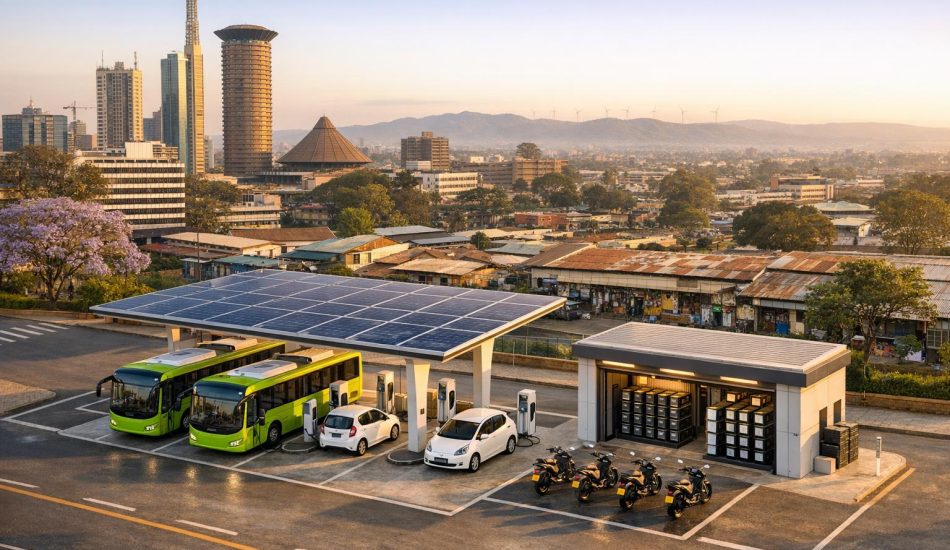
Battery swapping is gaining popularity, especially for electric motorcycles and taxi fleets. This innovation allows users to replace drained batteries with fully charged ones in just minutes, eliminating downtime. Solar-powered charging stations are also emerging, taking advantage of Kenya’s abundant sunshine to reduce reliance on the grid and promote cleaner energy.
In November 2025, Roam unveiled "Roam Point" on Waiyaki Way in Nairobi, marking Kenya’s first universal fast-charging station for light electric vehicles. Using Type 6 connectors, the station provides 10–20 km (6–12 miles) of range in just five minutes. Explaining the concept, Country Manager Habib Lukaya said:
"The Roam Point builds on the battery ownership model, which gives riders full control of their batteries, allowing them to ‘ride everywhere and charge anywhere’".
These advancements are paving the way for a broader rollout of charging infrastructure nationwide.
Plans for Network Expansion
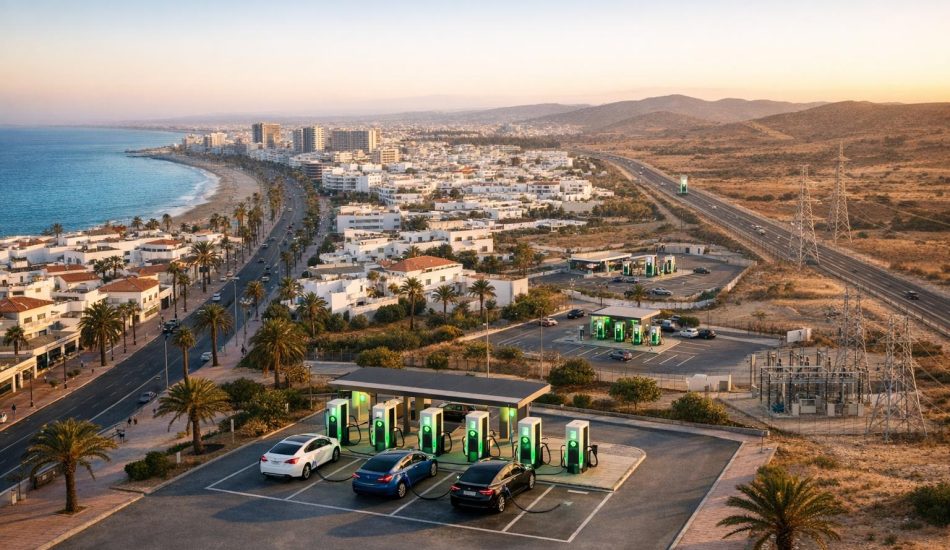
Kenya’s government is planning a massive expansion of the EV charging network. By 2030, the goal is to install 10,000 public charging stations through a 6 billion KSh (approximately $39.5 million) program. The rollout will happen in three phases: starting with 17 key cities and transport corridors like the Mombasa–Busia route, then extending to 23 more cities, and finally connecting district capitals and surrounding areas. The plan also aims to place charging stations every 25 kilometers (15.5 miles) along major highways.
Kenya Power is leading these efforts, with plans to install 45 fast-charging stations across six counties, including Nairobi, Mombasa, Kisumu, Nakuru, Eldoret, and Nyeri. In May 2025, six charging stations were added at Jomo Kenyatta International Airport (JKIA) to support electric taxis and airport transfer vehicles. By February 2026, Kenya Power reported onboarding 205 customers to its special e-mobility tariff since March 2023 and announced plans to upgrade its corporate fleet with 20 electric vehicles and 100 electric bikes by the end of 2026.
"The Government of Kenya is looking to deploy 10,000 EV charging stations in the country by 2030."
- Joseph Siror, Managing Director and CEO, Kenya Power
Private companies like BasiGo and Roam are also working on their own charging and battery-swapping networks to support their fleets, addressing gaps in public infrastructure. The launch of the National E-Mobility Policy on February 3, 2026, which introduces regulatory guidelines and financial incentives, is expected to speed up infrastructure development and encourage more widespread EV adoption.
Challenges and Future of EVs in Kenya
Barriers to EV Adoption
The high initial cost of electric vehicles (EVs) remains a major obstacle for many potential buyers, even though EVs offer much lower operating costs over time. Local EV startups also face significant hurdles in securing financing, which limits their ability to scale production.
Infrastructure issues further complicate the situation. For instance, in February 2026, the Outer Ring Matatu Association (OMA Services) shared that they had reserved 68 electric buses from BasiGo but received fewer than 30 due to delays in rolling out charging stations. George Githinji, CEO of OMA, highlighted the importance of batteries, stating:
"The battery is the bus. Everything else is just a shell".
Charging infrastructure remains far below the target of 10,000 stations by 2030. Hamna Tariq, a Research Associate at Energy for Growth Hub, pointed out:
"Charging stations are few and far between… building 10,000 more in the next few years seems a little bit improbable".
Kenya’s electric grid reliability adds another layer of difficulty. Frequent blackouts, especially outside urban areas, disrupt charging. Affordable EV models, which typically offer a range of about 150 miles (240 km), amplify concerns about range anxiety in regions with limited charging options. On top of this, fragmented charging networks – where manufacturers create private systems for their fleets – create interoperability challenges, making it hard for operators to switch providers.
Another challenge is financial. The growing adoption of EVs has led to a revenue gap for Kenya’s Road Maintenance Levy, which traditionally depends on fuel taxes. By 2025, this shortfall had reached KES 2 billion.
Despite these barriers, these challenges are sparking innovative solutions and paving the way for new opportunities.
Growth Opportunities
Even with these obstacles, the EV market in Kenya is growing rapidly. The number of registered EVs jumped from 796 in 2022 to 35,000 by the end of 2025. Electricity consumption by EVs also surged by 188% in 2025, reaching 8.4 million kilowatt-hours. Local assembly initiatives are driving this growth. For example, in early 2026, Rideence Africa partnered with Associated Vehicle Assemblers (AVA) in a $2.46 million deal to establish Kenya’s first EV assembly line for taxis and minibuses. AVA aims to produce 5,000 vehicles annually. Minnan Yu, Managing Director of Rideence Africa, expressed the company’s vision:
"We are now moving decisively from operator to manufacturer. Our aim is to build a Kenya-rooted new-energy mobility company serving Africa".
Financing options for EVs are also improving. In February 2026, NCBA Bank introduced Kenya’s first EV-specific loan product, offering interest rates 2% lower than those for conventional vehicles. Additionally, ARC Ride secured $10 million in debt financing from Mirova in September 2025 to roll out 600 battery-swapping cabinets and 25,000 batteries nationwide.
The launch of the National E-Mobility Policy in February 2026 has provided a strong regulatory framework to support the sector’s growth. Tax incentives, such as zero-rated VAT on electric buses, motorcycles, and lithium-ion batteries, further enhance the market’s appeal. Davis Chirchir, Cabinet Secretary for Roads and Transport, underscored the importance of this transition:
"Electric mobility is no longer optional, but a strategic necessity for Kenya’s economic resilience and environmental sustainability".
With nearly 90% of Kenya’s electricity coming from renewable sources and an annual petroleum import bill of about $5 billion, the shift to EVs makes both economic and environmental sense. As infrastructure improves and local production reduces costs, Kenya is poised to lead the way in East Africa’s EV transformation.
Conclusion
By 2026, Kenya has made impressive strides in electric mobility, transitioning from a niche concept to a practical, everyday solution with over 35,000 registered EVs and a growing charging network spanning 15 counties. This progress is guided by the National Electric Mobility Policy, which provides a strong framework for the country’s EV ambitions.
Switching to EVs offers substantial benefits, including a 75% reduction in fuel costs and government incentives that ease both financial and environmental pressures. Considering Kenya’s annual $5 billion petroleum import bill and the fact that over 90% of its electricity comes from renewable sources, electric mobility emerges as a smart solution for both economic and ecological challenges.
Platforms like EV24.africa are simplifying the EV adoption process, making it easier for Kenyans to purchase and register electric vehicles.
While infrastructure gaps remain, they are being tackled through public-private partnerships and the introduction of an e-mobility tariff with competitive charging rates. As Joseph Siror, Managing Director of Kenya Power, highlighted:
"Over 90% of the electricity we supply comes from renewable sources, ensuring that electric mobility is not only innovative but also sustainable".
These advancements not only address current challenges but also lay the groundwork for continued growth. Kenya is emerging as a leader in East Africa’s electric mobility transformation. With a strong policy framework, expanding infrastructure, and accessible platforms like EV24.africa, the vision of cleaner, more sustainable transportation is no longer a distant dream – it’s becoming an everyday reality.
FAQs
How do I choose the right EV range for my daily driving in Kenya?
When deciding on the right EV range, think about how far you drive daily and the availability of charging stations in your area. If most of your trips are within the city or relatively short, an EV with a range of 150–300 km should work well. However, for longer commutes or trips beyond urban areas, a range closer to 400 km might be a better fit. If charging options are scarce where you live, consider an EV with a longer range or one that supports fast charging to make your experience more convenient.
What should I check before buying a used EV (especially the battery)?
Before purchasing a used EV in Kenya, it’s crucial to assess the battery’s remaining capacity – ideally, it should still hold at least 80% of its original charge. Take a close look at the battery’s age, number of charging cycles, and overall condition to spot any signs of wear. Additionally, examine the vehicle’s charging and maintenance records for insights into its care. Finally, ensure that spare parts are accessible and check if there’s any warranty coverage left to make future repairs less of a hassle.
Can I rely on home charging if there are power outages?
Frequent power outages and unreliable grid connections in Kenya can make home charging a tricky option during blackouts. Since consistent electricity isn’t always guaranteed, relying solely on home charging may not be practical. If power interruptions are a regular occurrence in your area, it’s worth exploring other charging methods to ensure you’re not left stranded.