
 Thabo Nkosi
Electric vehicles (EVs) are now a viable choice for long-distance travel in Africa, thanks to advancements in range, durability, and charging options. The 2026 lineup includes models designed to handle rugged terrains, high temperatures, and limited charging infrastructure. Here are the top five EVs tailored for Africa’s unique challenges:
- Tesla Model X Plaid: Offers a range of 335 miles, fast charging (179 miles in 15 minutes), and adjustable air suspension for rough roads. Price: $116,630.
- BYD Tang EV: Features a durable Blade Battery, 329-mile range, and V2L capability for powering devices. Price: ~$71,500.
- Hyundai Ioniq 9: Provides a 335-mile range, 24-minute fast charging, and spacious seating for seven. Price: $60,555-$79,090.
- Toyota bZ4X: Balances affordability and performance with a 353-mile range, off-road capabilities, and a strong service network. Price: $38,520-$45,330.
- Geely Geometry C: Budget-friendly with a 286-mile range, 42-minute fast charging, and regenerative braking. Price: TBD, expected ~$30,000-$40,000.
Quick Comparison:
| Model | Range (miles) | Charging Time (10%-80%) | Price Range | Key Feature |
|---|---|---|---|---|
| Tesla Model X Plaid | 335 | 15 minutes (179 miles) | $116,630 | High performance & durability |
| BYD Tang EV | 329 | 48 minutes | ~$71,500 | Long battery life & V2L |
| Hyundai Ioniq 9 | 335 | 24 minutes | $60,555-$79,090 | Spacious interior & fast charge |
| Toyota bZ4X | 353 | 28 minutes | $38,520-$45,330 | Strong service network |
| Geely Geometry C | 286 | 42 minutes | ~$30,000-$40,000 | Affordable price-to-range ratio |
Each model caters to different needs, from premium performance to affordability. Whether you prioritize range, durability, or charging speed, there’s an EV ready to tackle Africa’s demanding roads.
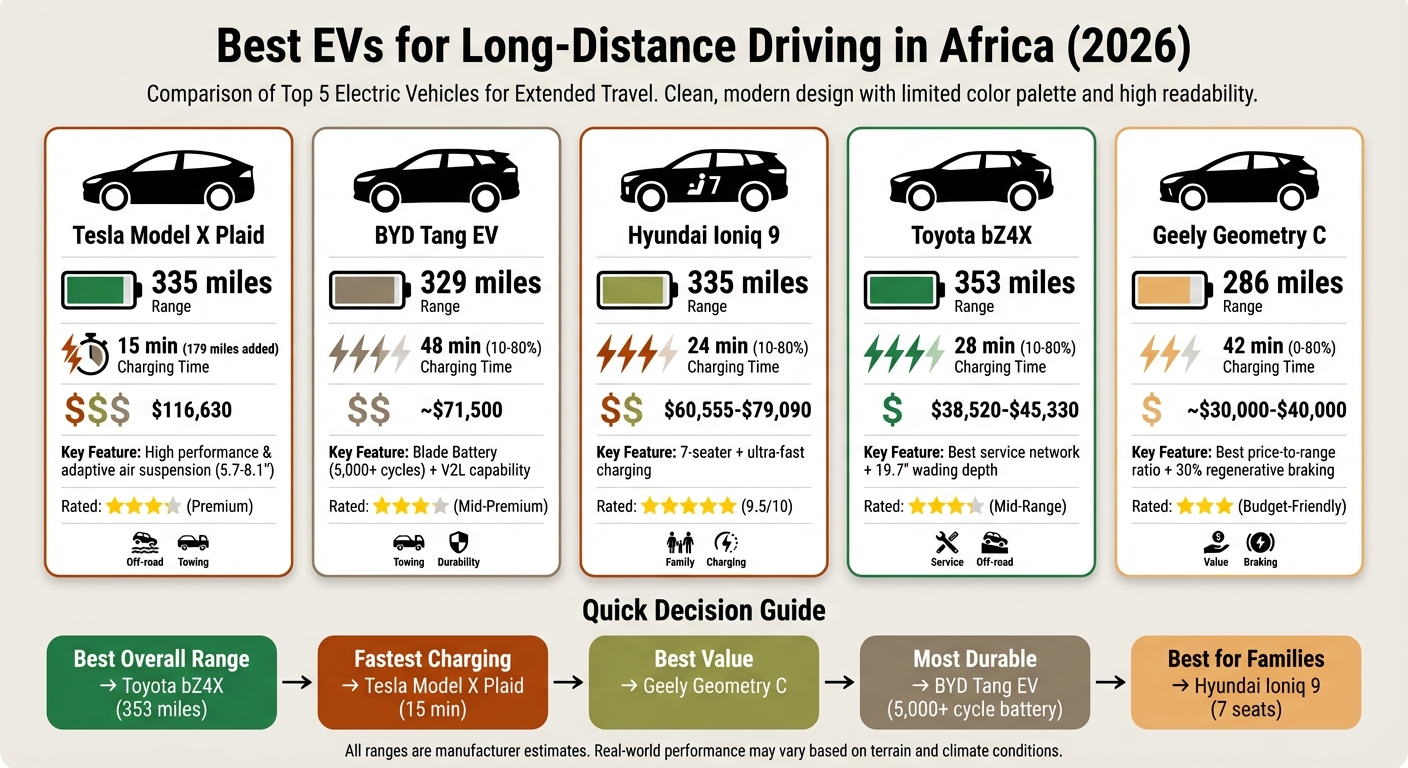
Top 5 EVs for Long-Distance Driving in Africa 2026: Range, Charging & Price Comparison
Has Toyota Redeemed Itself? | NEW 2026 bz4X
1. Tesla Model X Plaid
The Tesla Model X Plaid packs a punch with its tri-motor all-wheel-drive system, delivering a whopping 1,020 horsepower. It’s also built for convenience, supporting 250 kW DC fast charging, which can add up to 179 miles of range in just 15 minutes. This quick charging capability is especially handy for long-distance travel across Africa, where minimizing downtime is key.
Range
The Model X Plaid offers an EPA-estimated range of 335 miles, with a practical "1-Stop Range" of about 320 miles under average conditions. Real-world performance, however, varies based on driving habits and weather. At a steady 68 mph on the highway in mild weather, you can expect around 267 miles. Combined driving might stretch that to 326 miles. Cold weather reduces the 1-Stop Range to about 285 miles, while mild conditions can boost it to roughly 366 miles. The vehicle is powered by a 100 kWh battery pack (96 kWh usable) with NCA (Nickel Cobalt Aluminum) technology. Its aerodynamic design, with a drag coefficient of 0.208, helps maintain efficiency even at higher speeds.
With its robust range and efficiency, the Model X Plaid is well-suited for tackling Africa’s vast and varied landscapes.
Durability for African Terrains
Built with Africa’s rugged roads in mind, the Model X Plaid features adaptive air suspension that adjusts ground clearance between 5.7 inches and 8.1 inches. The 2026 updates bring improved suspension bushings and a front camera for better obstacle detection. Its tri-motor all-wheel-drive system, combined with torque vectoring, ensures excellent traction on challenging unpaved surfaces. The vehicle also comes equipped with Mud and Snow (M+S) rated Continental CrossContact RX tires for better grip.
However, some durability concerns have emerged. Recent tests have pointed to build quality issues, such as inconsistent panel gaps and occasional air-suspension errors under stress, which could impact performance on rough terrain. Additionally, the Falcon Wing doors, while stylish, may struggle in dusty or uneven environments.
Charging Infrastructure Compatibility
The Model X Plaid is equipped with a CCS Combo 2 port for DC fast charging and a Type 2 port for AC charging, ensuring it can connect to the growing network of third-party chargers across Africa. It also features an "Autocharge" function, which automatically starts charging sessions at compatible stations. Using a 250 kW charger, the battery can go from 10% to 80% in about 30 minutes. As Car and Driver noted:
"Widespread Supercharger network makes for stress-free charging,"
though Tesla’s proprietary Supercharger network is still limited in many parts of Africa.
Cost and Availability
For all its performance and rugged capabilities, the 2026 Model X Plaid starts at $116,630. It’s also a practical choice for adventurers, with a towing capacity of up to 5,000 pounds, making it ideal for hauling extra gear on long trips. Tesla backs the Model X Plaid with an eight-year, unlimited-mileage warranty on its powertrain and battery, along with a four-year/50,000-mile limited warranty. Car and Driver gave the Plaid an impressive rating of 8.5/10.
2. BYD Tang EV
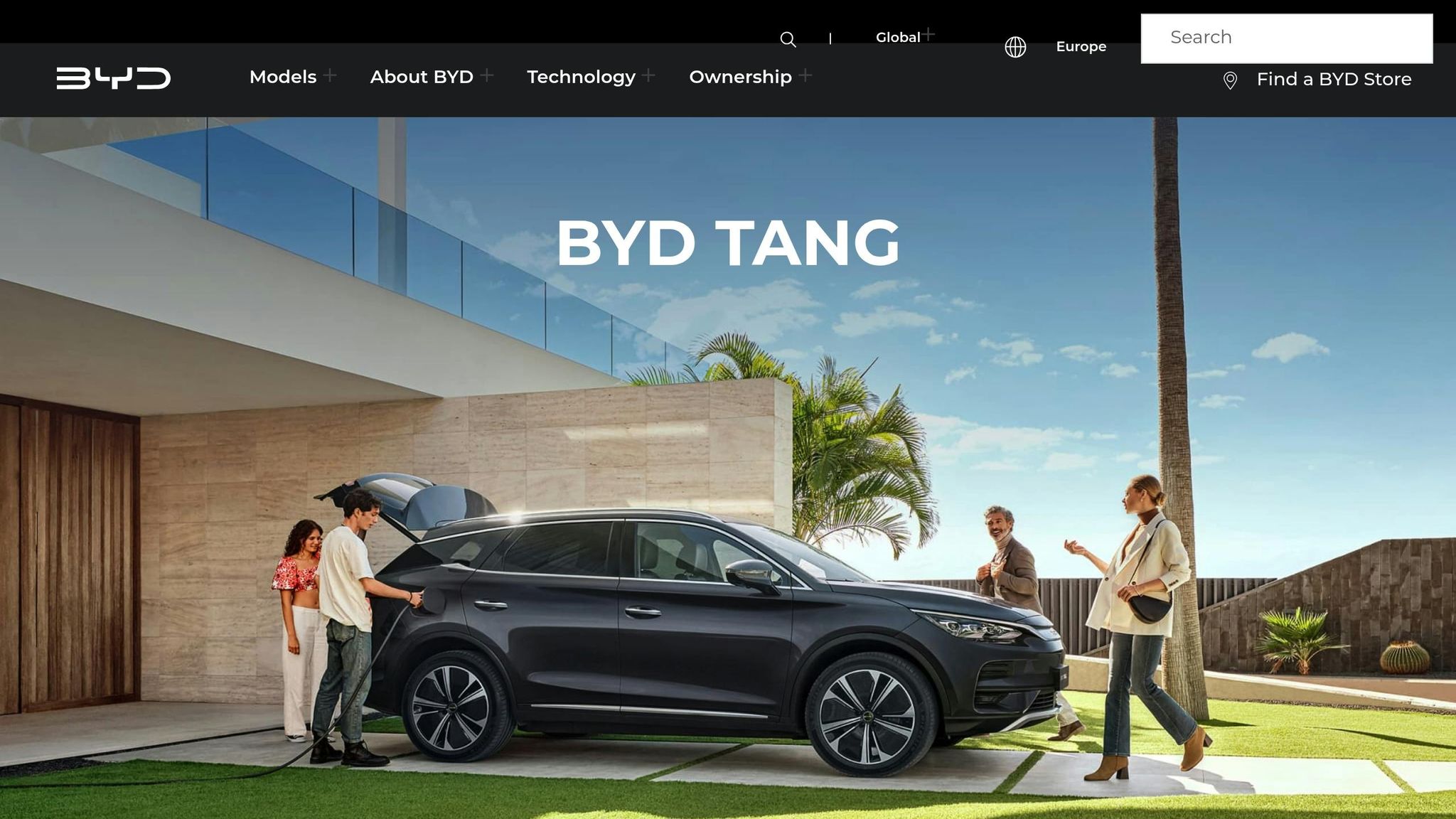
The BYD Tang EV packs a punch with its 108.8 kWh Blade Battery and an impressive 329-mile WLTP range. This new model has seen a range boost from 249 miles to 329 miles (530 km), making it a solid step up from older versions, though it still trails some of the top long-range competitors. In everyday driving, you can expect around 286 miles (460 km), which can climb to 410 miles (660 km) in city conditions. Its real-time electric AWD system smartly switches between front-wheel drive for efficiency and all-wheel drive for better traction. This flexibility makes it well-suited for Africa’s diverse road conditions. These features make it a rugged option for challenging terrains.
Built to Handle African Roads
The Tang EV is built tough with a body made of 77.4% high-strength steel, ensuring it can withstand rough environments. It’s equipped with DiSus-C intelligent damping and an all-aluminum independent suspension system. Plus, the Blade Battery doubles as a structural beam, adding to its stability and durability. For adventurers, it offers a towing capacity of 3,307 pounds (1,500 kg) and 58.5 cubic feet (1,655 liters) of cargo space when the seats are folded, making it perfect for gear-heavy trips. The Bosch IPB braking system, paired with Brembo calipers, ensures safety with a 100–0 km/h stopping distance of just 118 feet (36 meters) – a critical feature for handling steep descents or unexpected obstacles.
Charging Made Simple
Charging infrastructure is a key consideration in Africa, and the Tang EV is ready for the challenge. It supports CCS Combo 2 for DC fast charging and Type 2 for AC charging, both of which are gaining traction in emerging EV networks in countries like South Africa, Kenya, and Morocco. With 170 kW DC fast charging, it can go from 10% to 80% in just 48 minutes. A standout feature is its Vehicle-to-Load (V2L) capability, which provides up to 3.7 kW AC to power external devices – an especially useful function in areas with grid instability or load shedding. Additionally, a standard heat pump ensures battery efficiency across different climates.
Price and Safety
The Tang EV combines cutting-edge features with competitive pricing. In Europe, it’s priced at €67,390 (roughly $71,500) in the Netherlands and €69,615 (about $73,900) in Germany as of late 2024. Prices in African markets vary depending on local duties, though some countries like Kenya and Rwanda benefit from reduced EV import taxes. Safety-wise, the Tang EV has earned a 5-star Euro NCAP safety rating, with scores of 87% for both adult and child occupant protection. Its Blade Battery is built to last, capable of over 5,000 charge and discharge cycles, and remains cool under pressure – during nail penetration tests, surface temperatures stayed between 86°F and 140°F (30°C and 60°C) without any fire or smoke. This reliability is a major plus for operating in hot climates.
3. Hyundai Ioniq 9
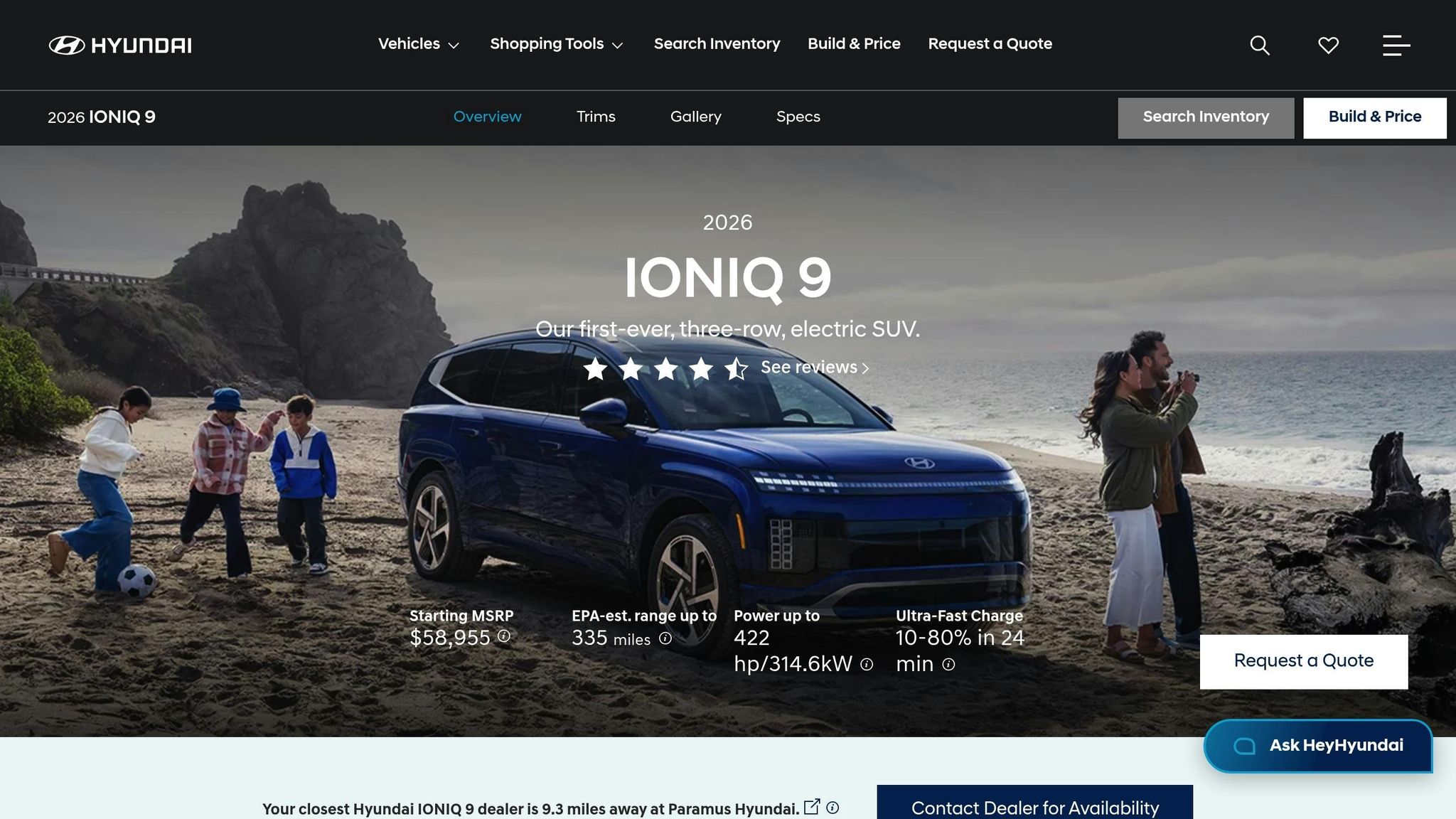
The 2026 Hyundai Ioniq 9 is powered by a 110.3-kWh lithium-ion battery, delivering an impressive range of up to 335 miles (539 km). This maximum range is achieved with the standard rear-wheel-drive model, while dual-motor all-wheel-drive versions offer slightly less – 320 miles for SE/SEL trims and 311 miles for the Performance model. Speaking of performance, the Ioniq 9 Performance can go from 0 to 60 mph in just 4.4 seconds. Car and Driver gave the Ioniq 9 a near-perfect 9.5/10 rating, highlighting its "library-quiet interior" and spacious seating for up to seven passengers. Andrew Wendler from Car and Driver noted:
"With ample interior space and competitive range, the Georgia-built Ioniq 9 EV exudes sensible style".
Range
The Ioniq 9’s 335-mile range is more than adequate for most routes, even in regions with limited charging infrastructure. To further enhance usability, the car comes with integrated EV route planning software, helping drivers locate charging stations along the way. Its liquid-cooled battery system ensures reliable performance, even in the high temperatures often experienced in many parts of Africa. Combined with engineering tailored for rugged terrains, this makes the Ioniq 9 a dependable option for long trips.
Built for Challenging Terrains
The Ioniq 9 is constructed on Hyundai’s E-GMP platform, which includes features like self-leveling dampers and torque-vectoring for better handling. It also boasts a towing capacity of up to 5,000 pounds with the AWD model (or 3,500 pounds for RWD) and up to 46 cubic feet of cargo space when the seats are folded down. These capabilities make it well-suited for unpaved roads and tough weather conditions.
Charging Made Easy
One of the Ioniq 9’s standout features is its fast-charging capability. Using a 350-kW DC fast charger, the battery can go from 10% to 80% in just 24 minutes – putting it among the fastest in its class. The car also supports standard CCS charging, and for those who want access to Tesla’s Supercharger network, a CCS-to-NACS adapter is available for $235. For slower charging, the onboard 11.0-kW AC charger works with Level 2 stations. Additionally, the Vehicle-to-Load (V2L) feature allows the car to power external devices, a handy feature in areas with unreliable electricity.
Pricing and Market Potential
The 2026 Ioniq 9 is priced between $60,555 and $79,090 for the top-tier Performance Calligraphy trim. While it costs more than comparable gas-powered SUVs, its lower operating costs make it an attractive option. In fact, 75% of South African consumers prefer EVs for their reduced fuel costs, and 43% appreciate the lower maintenance requirements. Tax incentives in countries like Kenya and Rwanda are also making EVs more affordable, while South Africa’s $54 million investment in local EV and battery production is expected to improve the availability of parts and service networks.
sbb-itb-99e19e3
4. Toyota bZ4X
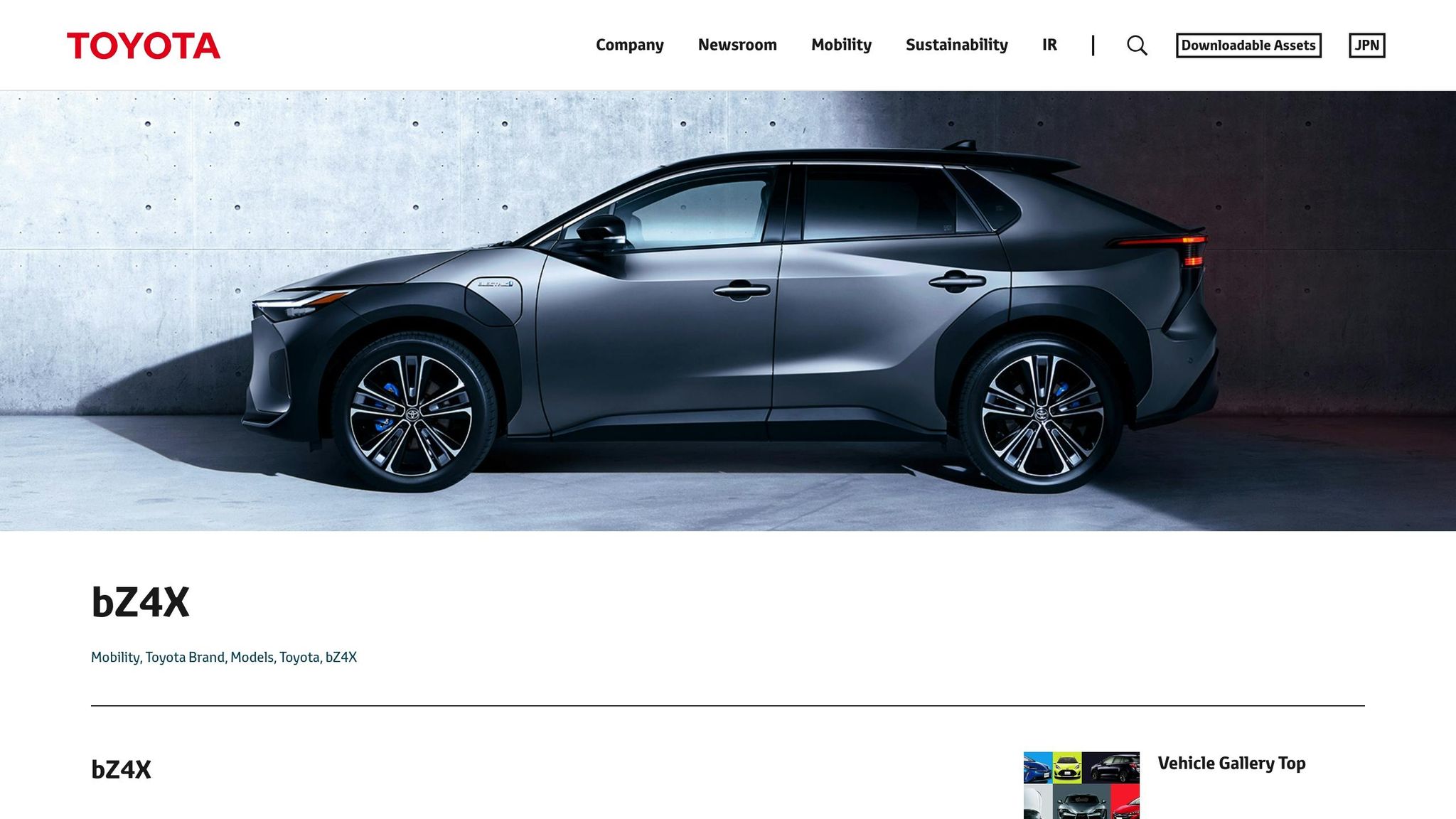
The 2026 Toyota bZ4X comes with two battery options – 57.7 kWh and 73.1 kWh – designed to cater to different driving ranges. It balances affordability with advanced features, making it a practical choice for Africa’s varied road conditions. For those tackling long distances, the front-wheel drive (FWD) model with the 73.1 kWh battery offers up to 353 miles (569 km) of range under WLTP testing. Meanwhile, the all-wheel drive (AWD) version provides up to 320 miles (516 km) and includes X-MODE and Grip Control to handle rough or muddy terrain.
Range
While the WLTP range estimates are impressive, real-world highway tests show a drop to around 160 miles, compared to the EPA’s 252-mile estimate. This difference is important for planning trips in regions where charging infrastructure is still developing. An optional solar roof adds an interesting touch, generating enough energy for approximately 1,118 miles (1,800 km) of driving annually, depending on sunlight availability. Additionally, the FWD model is efficient, consuming about 13.9 kWh per 62 miles.
Durability for African Terrains
Built for tough environments, the AWD bZ4X features a wading depth of 19.7 inches (500 mm), making it suitable for flood-prone areas and river crossings. Aerodynamic updates for 2026, including a smoother underbody and redesigned spoilers, have lowered the drag coefficient from 0.29 to 0.27. Towing capacity has also been improved, with the AWD model capable of towing up to 3,307 pounds (1,500 kg) and the FWD version up to 1,653 pounds (750 kg). For off-road adventures, the Multi-Terrain Monitor offers real-time views around and beneath the vehicle, aiding navigation on unpaved roads. Toyota backs its battery performance with a guarantee of 70% capacity retention for up to 621,371 miles (1,000,000 km) or 10 years.
Charging Infrastructure Compatibility
The bZ4X supports DC fast charging, with the FWD model capable of up to 150 kW and the AWD version up to 100 kW. Using the battery pre-conditioning system, a 10% to 80% charge takes about 28 minutes. For 2026, Toyota has increased the DC fast-charging limit to five sessions per 24 hours, up from three in earlier models, which is especially helpful for multi-stop trips. The "Plug & Charge" feature streamlines the charging process by automatically identifying and authorizing the vehicle at compatible public stations. For home charging, the 6.6-kW onboard charger completes a Level 2 charge in about nine hours. The bZ4X also offers Vehicle-to-Load (V2L) functionality, rated at 220V/1,500W, allowing it to power external devices – ideal for areas with unreliable electricity.
Cost and Availability
The Toyota bZ4X starts at an MSRP of around $38,520, with higher trims priced near $45,330. This makes it an appealing option for long-distance travel in Africa. Toyota sweetens the deal with complimentary maintenance for two years or 25,000 miles and an eight-year/100,000-mile warranty on electrical components. With 75% of South African consumers showing interest in EVs due to lower fuel costs, and policy incentives like reduced import taxes in countries such as Kenya and Rwanda, the bZ4X is well-positioned to thrive in the African market.
5. Geely Geometry C
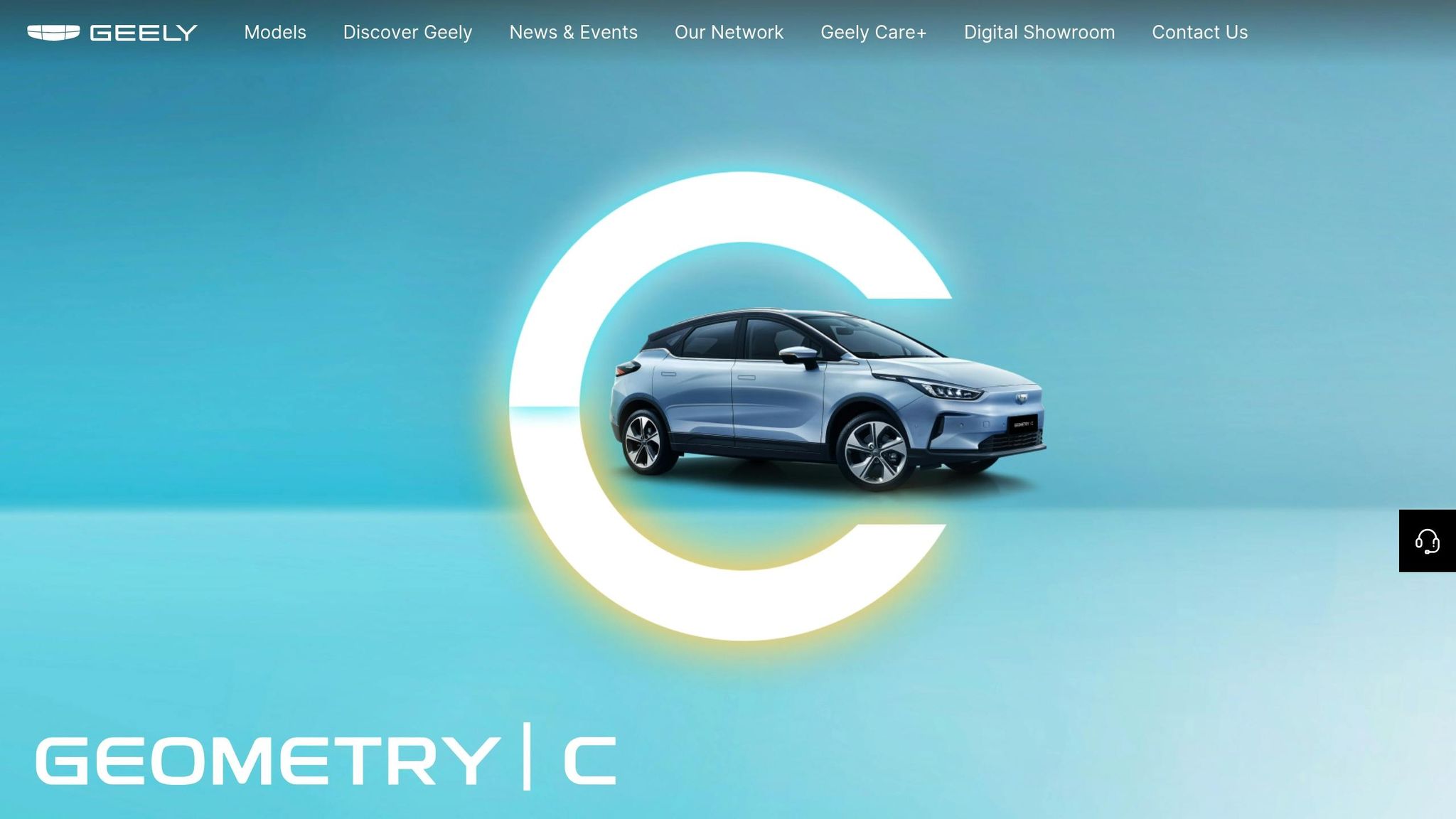
The Geometry C stands out as a solid choice for tackling Africa’s demanding road conditions while offering impressive efficiency and safety features. The 2026 Geely Geometry C boasts a 286-mile WLTP range, powered by a high-density battery pack that prioritizes energy efficiency. Its IBOOSTER system recovers up to 30% of range through regenerative braking, a crucial feature for regions with limited charging infrastructure, allowing drivers to stretch their journeys between charging stops.
Range
For those covering long distances, the Geometry C’s 286-mile range holds its own against competitors like the Toyota C-HR Electric (~290 miles) and the Chevrolet Bolt (~255 miles). Equipped with super fast charging, the Geometry C can recharge from 0% to 80% in just 42 minutes. This quick turnaround makes it a practical option for multi-stop trips across Africa’s emerging EV hubs, including cities like Nairobi, Lagos, and Johannesburg. With this charging speed, drivers can minimize downtime and keep moving on extended routes.
Built for African Roads
The Geometry C is designed with African terrains in mind. Its 540° AR Chassis View enhances visibility, making it easier to navigate unpaved roads and avoid obstacles like rocks and uneven terrain. The AQS filtration system helps maintain air quality in dusty environments, a common challenge on secondary routes. Additionally, this system protects the battery pack and undercarriage by offering real-time visibility of potential hazards. The car’s three-in-one electric drive system simplifies mechanical components, which could improve reliability – an advantage in remote areas where service centers are sparse.
Charging Infrastructure Compatibility
Like other models in its class, the Geometry C is equipped to handle long journeys with its fast-charging capabilities. Designed for overseas markets, it supports CCS2 charging standards, commonly used in many African countries. The 42-minute fast-charge time to 80% capacity ensures drivers can quickly resume their trips. The regenerative braking system further extends the effective range, capturing energy during downhill drives and braking to add up to 30% more range. Features like Adaptive Cruise Control and Lane Keeping Assist also contribute to a safer, less tiring driving experience on Africa’s extensive highway networks.
Cost and Availability
While Geely has yet to announce the 2026 Geometry C’s pricing for African markets, comparable EVs, such as the Chevrolet Bolt ($29,990) and Toyota C-HR Electric (around $40,000), provide a reference point. With 75% of South African consumers expressing interest in EVs due to lower fuel costs and government incentives like reduced import taxes in Kenya and Rwanda, the Geometry C could see strong demand. Additionally, South Africa’s $54 million investment in local EV and battery production may improve regional availability and affordability, making the Geometry C an attractive option for long-distance travel.
Advantages and Disadvantages
When it comes to tackling Africa’s unique long-distance driving conditions, each electric vehicle (EV) comes with its own set of strengths and challenges.
The Tesla Model X Plaid delivers over 310 miles of range and exceptional performance. However, its steep price tag and the limited availability of charging stations outside major urban areas make long trips more difficult.
The BYD Tang EV shines with its Blade Battery technology, known for surviving nail penetration tests with surface temperatures reaching only 86–140°F without emitting smoke or fire. Rated for over 5,000 cycles, this battery is built to withstand tough conditions. That said, its 248-mile WLTP range is the shortest in this lineup, which means more frequent charging stops.
The Hyundai Ioniq 7 offers an 800V fast-charging system, enabling quicker recharging. However, this benefit is somewhat diminished by the limited availability of ultra-fast chargers outside major cities.
Toyota’s bZ4X stands out for its extensive service and parts network across the continent – a critical factor for remote-area reliability. With EV repair costs averaging about 6.7% higher than those for traditional vehicles due to expensive battery components, Toyota’s wide service reach adds peace of mind. Its moderate range and charging speed, however, may limit its appeal.
The Geely Geometry C offers the most affordable price-to-range ratio, making it a practical choice for budget-conscious buyers in African markets. Its 42-minute fast-charging capability helps balance its mid-range capacity of 286 miles.
| Model | Range | Key Advantage | Primary Drawback | Price Positioning |
|---|---|---|---|---|
| Tesla Model X Plaid | 310+ miles | Superior performance & range | Limited charging infrastructure; high cost | Ultra-Premium |
| BYD Tang EV | 248 miles (WLTP) | Durable Blade Battery rated for 5,000+ cycles | Shortest range; frequent charging stops | Mid-Premium |
| Hyundai Ioniq 7 | ~298 miles | 800V ultra-fast charging capability | Limited ultra-fast charger availability | Mid-Premium |
| Toyota bZ4X | 248–310 miles | Best service network in Africa | Moderate range & charging speed | Mid-Range |
| Geely Geometry C | 286 miles | Affordable price-to-range ratio; 42-min charging | Smaller service network in Africa | Affordable |
What becomes clear from these comparisons is that while range and performance vary among models, charging speed and infrastructure are equally critical. All of these EVs perform better in city conditions than on highways. As Alex Knizek from Consumer Reports puts it:
"How quickly you can add miles is what matters most".
This insight emphasizes that when choosing an EV for long-distance travel, charging accessibility and speed are just as important as the vehicle’s range.
Conclusion
Choosing the right EV for long-distance travel in Africa boils down to balancing your priorities and budget. If range and top-tier performance are what you’re after, premium models like the Tesla Model X Plaid are hard to beat. With a range surpassing 300 miles and impressive features, it’s a standout option – though its high price may limit its practicality in less urbanized areas.
For those mindful of costs, the Geely Geometry C offers an excellent balance of affordability and range, delivering 286 miles per charge and a fast-charging time of just 42 minutes. Meanwhile, the BYD Tang EV, with its Blade Battery technology rated for over 5,000 cycles, ensures durability but requires more frequent stops with its 248-mile range. The Toyota bZ4X shines with its extensive service network across Africa, and the Hyundai Ioniq 7 impresses with 800V ultra-fast charging – perfect for areas where infrastructure supports it.
If your travels include rugged terrain or unpaved roads, prioritize EVs with strong off-road capabilities. The Tesla Model X Plaid’s adaptive air suspension (adjustable between 5.7 and 8.1 inches) and the Toyota bZ4X’s 19.7-inch wading depth make them excellent choices for challenging conditions. Additionally, buyers in countries like Kenya and Rwanda can benefit from import tax reductions, while South African drivers may take advantage of the government’s $54 million investment in local EV production.
For remote journeys, consider integrating solar charging solutions and keeping tire pressure optimized to stretch your range. Portable solar chargers and battery-swapping systems can be game-changers in areas lacking traditional charging stations. Ultimately, the best EV for you will depend on how well it balances range, durability, and access to charging infrastructure to meet Africa’s unique driving demands.
FAQs
What features make an EV ideal for long-distance travel in Africa?
An electric vehicle (EV) designed for Africa’s long-distance travel needs to strike a balance between range, durability, and practicality. To cover the vast distances between charging points, an EV should ideally offer a range of at least 200 miles per charge. In regions where charging infrastructure is sparse, range-extended EVs (REEVs) can be a game-changer. These vehicles incorporate a small gasoline generator to keep the battery charged, making them a smart choice for such conditions.
Durability is another crucial factor. African roads often require vehicles equipped with heat-resistant batteries, higher ground clearance, and reinforced suspensions. These features help EVs withstand extreme heat, uneven terrain, and dusty environments. Vehicles like pickup trucks and SUVs, especially those with off-road capabilities and strong towing power, are particularly well-suited for these challenges.
On the practicality side, features like fast-charging options, the ability to charge at home or work, and solid warranties are indispensable. These ensure drivers face minimal downtime, making the EV both reliable and efficient for long journeys across the continent.
What challenges does Africa’s charging infrastructure pose for EV travel?
Africa’s charging infrastructure poses a real hurdle for long-distance EV travel. Public charging stations are few and far between, mostly concentrated in urban hubs, leaving highways and remote regions with limited access to fast chargers. This uneven distribution often triggers range anxiety, as drivers worry about running out of power before reaching the next available station. To make matters worse, unreliable power grids in some areas can render existing chargers unusable, especially during extreme weather conditions.
For those planning long trips, careful preparation becomes a must. This often involves using route-planning tools and relying heavily on charging at home or work. Some EVs, like range-extended models, offer a workaround by pairing electric power with gasoline generators to boost mileage. But in truly remote areas, such as the vast stretches of the Sahara, drivers can face hundreds of miles with no charging options at all. In such cases, alternative energy solutions aren’t just helpful – they’re essential.
What’s the most affordable EV with a great range for long-distance travel in Africa?
The BYD Dolphin is a standout option, priced at about $21,200 and delivering a range of roughly 183 miles per charge. Its balance of affordability and dependability makes it a great fit for African roads, particularly for covering long distances.
Built to tackle various terrains with ease, this EV also ensures a smooth and comfortable ride, making it a smart choice for the region’s distinct driving conditions.