
 Thabo Nkosi
Electric vehicles (EVs) are transforming Africa’s corporate and taxi sectors, offering lower operational costs, reduced emissions, and innovative solutions like battery-swapping systems. Here’s a quick breakdown of the top EV options for fleets in Africa:
- Uber’s Henrey Minicar (South Africa): Compact EV with a 155-mile range, 60-second battery swaps, and weekly rentals at $220, cutting fuel expenses by 30–40%.
- BYD Models (Morocco/South Africa): Diverse lineup with long ranges (up to 323 miles) and durable Blade Batteries, ideal for corporate shuttles and taxis.
- eKamva Minibus Taxi (South Africa): 15-seater with a 124-mile range, fast charging in 75 minutes, and a cost-saving subscription model for the battery.
- Cape Town’s MyCiTi Electric Buses: 30 buses with a 155-mile range, 55% lower maintenance costs, and annual fuel savings of $36,300 per bus.
- EV24.africa Marketplace: Over 200 EV models for fleet buyers, offering import services, solar-powered charging, and management tools.
Switching to EV fleets can reduce operating costs by 40–70%, but challenges like charging infrastructure and upfront costs remain. Battery-swapping and local assembly are helping address these issues, making EVs a practical choice for Africa’s growing demand for sustainable transportation.
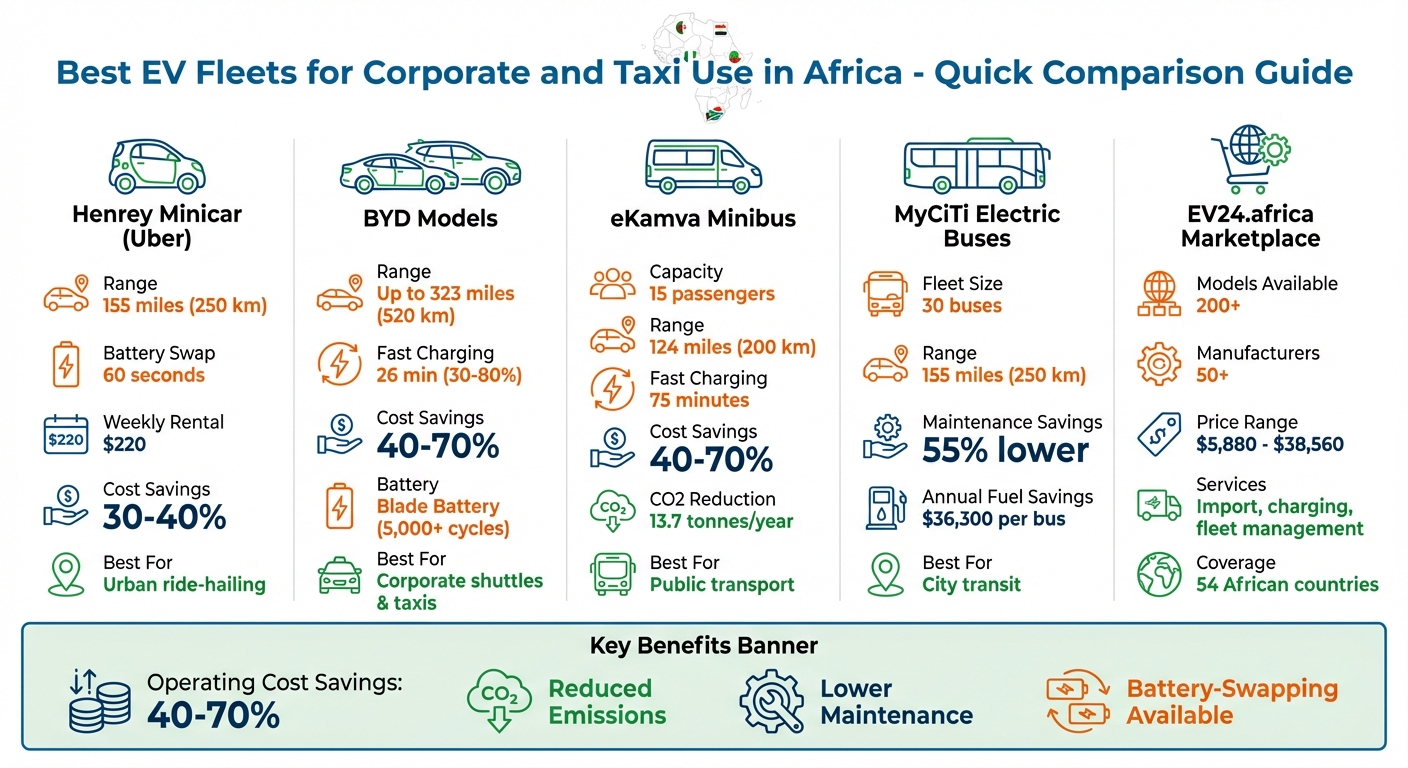
EV Fleet Comparison for Africa: Range, Cost & Charging Time
South Africa’s first retrofitted electric minibus taxi exceeds expectations | VOANews
1. Uber EV Fleet with Henrey Minicar in South Africa

In November 2025, Uber Go Electric made its debut in Johannesburg, introducing the Henrey Minicar – better known locally as the Valternative EV4 – through a partnership with Valternative Energy. This compact four-seater hatchback is tailored for high-mileage, urban ride-hailing, making it an ideal fit for taxi operations. The launch marks a step forward for urban EV fleet performance in Africa.
The Henrey Minicar features a 25 kWh battery that provides a range of 155 miles (250 km) and a 35 kW motor capable of reaching speeds up to 53 mph (85 km/h). Designed for city driving, it also boasts a game-changing battery-swap system that allows a depleted battery to be replaced in under 60 seconds. This feature increases a driver’s trips by 20–30% per shift compared to traditional petrol vehicles.
"Uber has cracked the code on electric ride-hailing in emerging markets – not with hours-long charging waits, but with battery swaps that take under 60 seconds." – 234Drive
Drivers can rent the Henrey Minicar for about $220 per week (R4,000), which includes insurance, maintenance, and unlimited battery swaps. This eliminates daily fuel expenses of $11–$17 (R200–R300), reducing overall operating costs by 30–40% and increasing net income by 15–25%. The initial fleet launched with 70 vehicles, with plans to expand to 350 by late January 2026.
Valternative Energy supports the fleet with more than 100 battery-swap stations. Many of these stations are equipped with solar panels and hybrid backup systems to tackle power outages caused by load-shedding. While the Henrey Minicar is compatible with DC fast-charging (20% to 80% in 40 minutes) and AC charging (over 8 hours), the battery-swap system remains the primary method to keep drivers on the road efficiently. This approach sets the stage for further advancements in EV fleets across the continent.
2. BYD Models for Fleet Operations in Morocco and South Africa
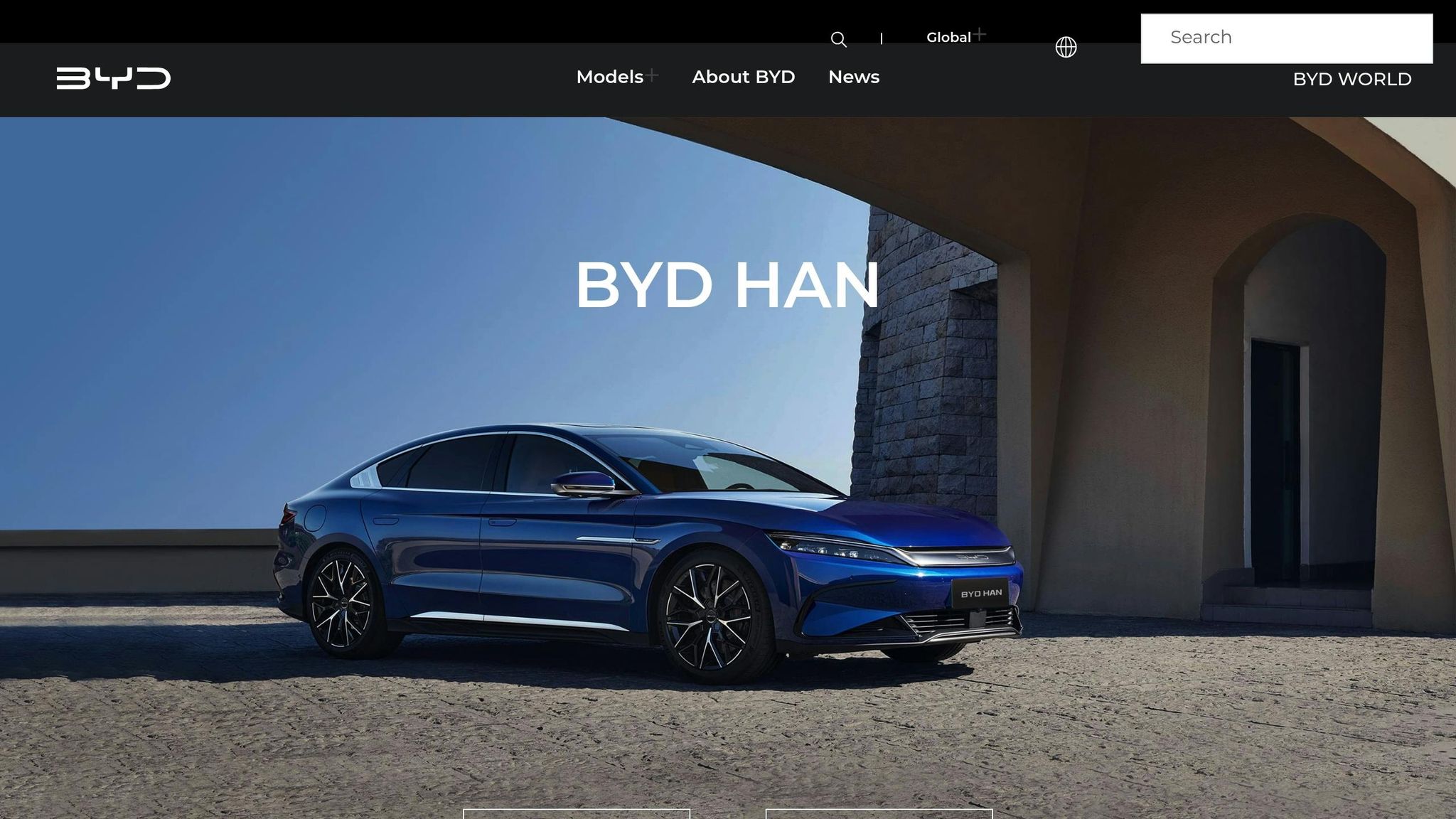
BYD continues to strengthen its presence in urban EV fleets, offering a range of vehicles tailored to meet diverse operational needs. In Morocco and South Africa, BYD’s lineup includes the compact Dolphin Surf, the mid-range Seal sedan, versatile SUVs like the Atto 3 and Sealion 7, and the Shark 6 pickup. This variety gives fleet managers the flexibility to choose vehicles that best suit their requirements, whether it’s for corporate shuttles or high-mileage taxi services.
At the core of BYD’s fleet-focused innovation is the Blade Battery, which uses lithium iron phosphate (LFP) technology and is free of cobalt. Known for its safety and durability, the Blade Battery has been rigorously tested, maintaining temperatures between 86°F and 140°F (30°C to 60°C) under impact without emitting smoke or catching fire. Its lifecycle exceeds 5,000 charge and discharge cycles, making it especially ideal for demanding applications like taxi services.
"The Blade Battery uses lithium iron phosphate (LFP) which offers a higher level of safety, durability, longevity, and performance compared with conventional lithium-ion batteries." – BYD South Africa
For corporate fleets, the BYD Seal Performance stands out with a 520 km (323 miles) WLTP range. It supports fast charging from 30% to 80% in just 26 minutes using a 150 kW DC charger, while an 11 kW Type 2 AC connection enables convenient overnight charging. BYD’s expertise in fleet deployment was on display in November 2025 when it rolled out a 130-vehicle fleet for shuttle services at the COP30 United Nations Climate Change Conference in Belém, Brazil. These features not only enhance operational efficiency but also contribute to cost savings.
Switching to EVs for taxi and shuttle fleets can slash running costs by 40% to 70% while significantly reducing maintenance compared to traditional fuel-powered vehicles. Morocco now supports over 10,000 EVs with more than 400 charging stations, while South Africa is steadily expanding its commercial charging network. For regions with less developed infrastructure, BYD offers the Sealion 6 DM-i hybrid, which combines the efficiency of electric power with the extended range of a hybrid system. This hybrid option ensures a smoother transition for fleets in areas still building their EV infrastructure.
With Morocco’s established network and South Africa’s growing infrastructure, BYD’s vehicles deliver cost-efficient, reliable solutions for taxi and corporate fleets alike. Whether it’s reducing operational costs or ensuring dependable performance, BYD’s fleet options are well-suited for the evolving needs of these markets.
3. Flx EV Minibus Taxi for High-Usage Scenarios in South Africa
The eKamva is South Africa’s first electric minibus taxi, designed specifically for the country’s demanding public transport sector. This 15-seater vehicle, introduced under the flx EV model, brings together the vehicle itself, a dedicated charging network, and a fleet management app to tackle the challenges of high-usage taxi operations in the region. Let’s dive into its standout features.
With a driving range exceeding 200 km (124 miles), the eKamva is well-suited for daily operations. It can be charged quickly – just 75 minutes on a 60 kW DC fast charger – or more slowly overnight in 10 hours. This flexibility aligns with existing taxi schedules, ensuring that charging fits seamlessly into downtime.
"Most taxis spend up to three hours a day between morning and evening peak hours at the ranks we have analysed, more than sufficient time to fast-charge an eKwamva." – Rudi Kriel, Project Lead
To make the switch to electric more accessible, the total cost of ownership model separates the vehicle chassis from the battery, which is provided through a subscription plan. This setup significantly lowers the steep upfront costs that often deter operators. Without the 40% luxury EV tax, the eKamva would be priced between $35,800 and $41,300 (R650,000–750,000). However, with the tax, it currently costs $60,500–$66,000 (R1.1–1.2 million). Even so, operators can still save 40%–70% on operating costs compared to traditional diesel taxis.
The flx EV app further enhances the experience by enabling operators to monitor vehicle status, manage fleets, and prepay for charging at specialized hubs. The first of these hubs are planned for Stellenbosch and Century City. Beyond financial benefits, the eKamva also delivers significant environmental advantages, cutting 13.7 tonnes of carbon dioxide emissions per vehicle annually. Additionally, it boasts fewer breakdowns and a longer lifespan compared to diesel alternatives. These features position the eKamva as a game-changer in South Africa’s evolving taxi landscape.
sbb-itb-99e19e3
4. Low-Floor Electric BRT Buses for MyCiTi Fleet in Cape Town
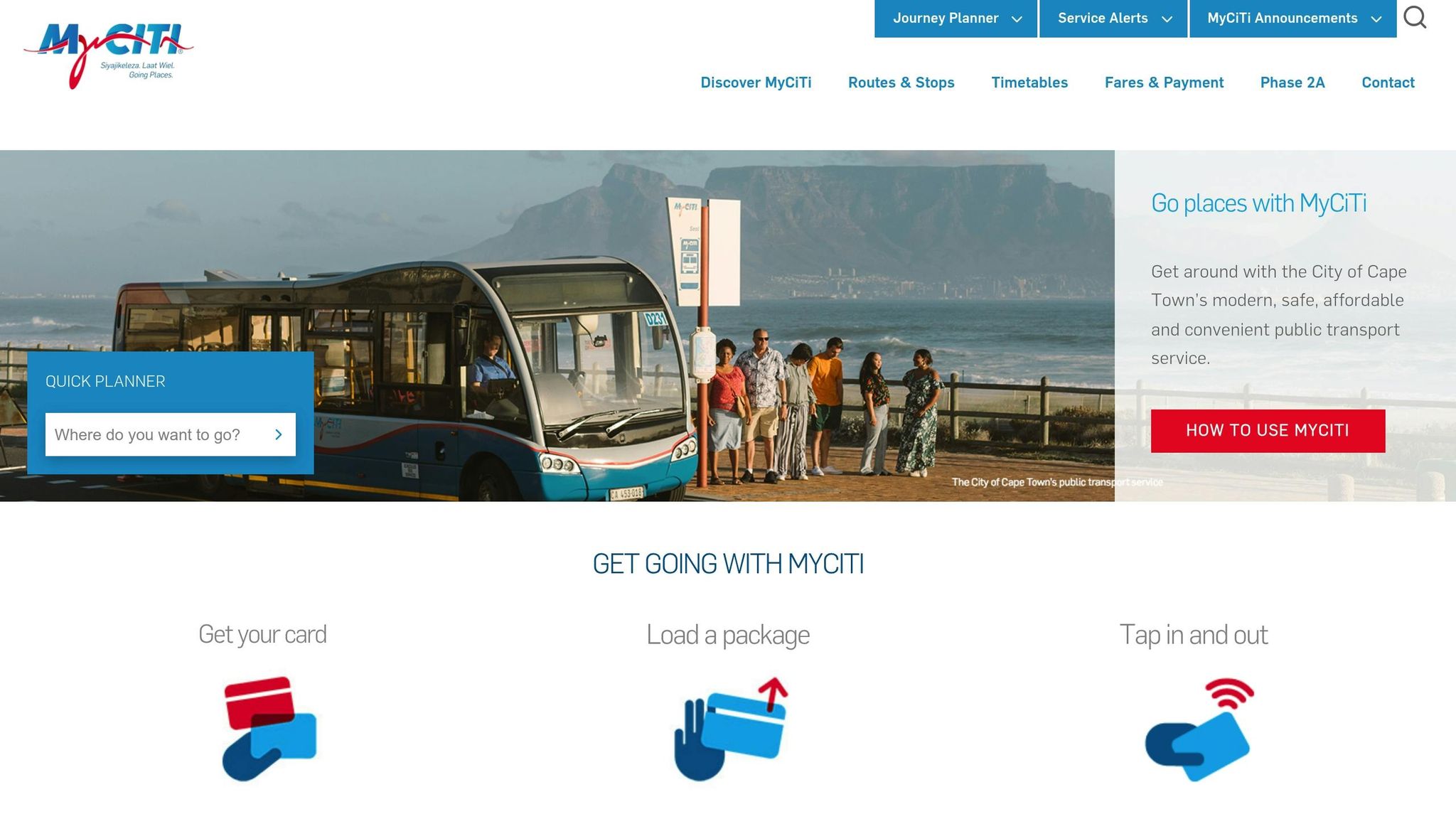
Cape Town’s MyCiTi service is making a bold move toward electrifying its public transport system with an order of 30 fully electric buses from Volvo Bus Southern Africa. These buses will feature the imported Volvo BZRLE chassis, combined with bus bodies manufactured locally at the Blackheath facility. The first bus is expected to be completed and homologated by the end of 2025, with testing to follow shortly after. This marks a significant shift in the city’s approach to public transportation.
"This will be the first electric bus manufactured in South Africa for South Africa." – Leon Nelson, Director, Volvo Bus Southern Africa
With a range of 250 kilometers (155 miles) in urban conditions, these buses are designed to handle the demands of daily service. While a 12-meter diesel bus typically costs between $247,000 and $275,000 (R4.5M–R5M), the electric version comes in at around $495,000 (R9M), nearly double the price. However, the total cost of ownership becomes more favorable from years 9 to 13, even when factoring in the cost of charging infrastructure. Additionally, maintenance costs are 55% lower, and operators can save approximately $36,300 (R660,000) per bus annually on fuel expenses. These financial benefits are driving the adoption of electric fleets across the continent.
To facilitate this transition, Cape Town has launched a tender process for dedicated charging infrastructure for the MyCiTi fleet. Installation is set to begin soon. This infrastructure will not only ensure smooth fleet operations but also cut annual CO₂ emissions by an estimated 1,080 tonnes, further cementing Cape Town’s position as a leader in environmentally conscious public transport. This initiative underscores the city’s commitment to advancing sustainable transportation in Africa.
5. EV24.africa Listings for Corporate and Taxi Fleets
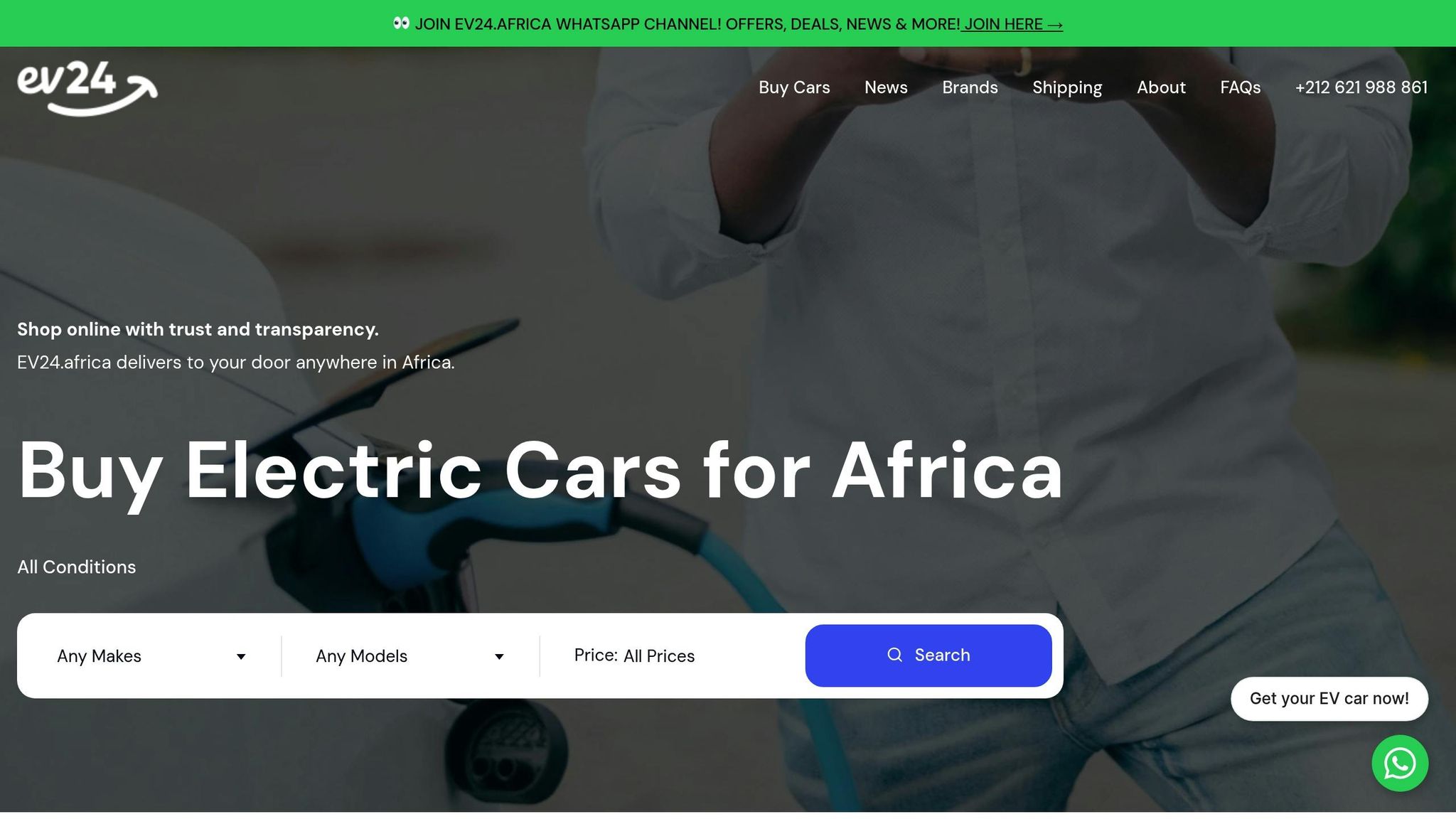
EV24.africa serves as a dynamic marketplace, offering over 200 electric vehicle (EV) models from more than 50 global manufacturers like BYD, Tesla, Leapmotor, Dongfeng, and Geely. Designed specifically for fleet buyers across Africa, the platform has already garnered significant interest, receiving over 350 qualified vehicle requests from more than 30 African countries in just its first three months. This platform simplifies the process of sourcing and managing EV fleets, complementing the broader advancements in electric mobility across the continent.
EV24.africa provides comprehensive import services to all 54 African countries. These services cover everything from sourcing and RoRo/container shipping to customs clearance and vehicle registration [22,23]. Vehicle prices are diverse, starting at $5,880 for the Geely Panda Mini and going up to $16,700 for the Geely Maple Caocao 60, which boasts a 450 km range. For commercial needs, options include the Dongfeng Fengon Windstar E380 van at $23,300 and the DF6 EV pickup at $38,560, ideal for utility fleets.
"In just three months, we’ve proven that the demand for electric mobility in Africa is not only real but accelerating. Our team is building more than a marketplace – we are laying the infrastructure and services to support Africa’s electric transition at scale." – Younes Rabeh, Business Manager, EV24.africa
The platform also offers advanced fleet management tools, including real-time monitoring, preventive maintenance alerts, and smart recharge planning tailored for taxi and ride-hailing services. Buyers can access solar-powered off-grid charging solutions for rural areas, battery and motor warranties, and a robust spare parts network spanning the continent. EV24.africa has already delivered vehicles to 10 African countries, with logistics operations covering more than 20 ports across Africa.
For urban mobility, popular models include the BYD Dolphin, priced at $11,800 with a 340 km (211 miles) range, and the Leapmotor T03, available for $9,500 with a 250 km (155 miles) range – both ideal for daily taxi operations [24,22].
Pros and Cons
Switching to an electric vehicle (EV) fleet for corporate or taxi services in Africa comes with clear trade-offs. The operating cost advantage is undeniable. For light-duty EVs, the cost ranges between $0.62 and $0.92 per 62 miles (100 km), compared to $6.62 for internal combustion engine (ICE) vehicles – a savings of 86% to 90%. For heavy-duty electric buses, the cost drops from $61.07 to $19.14–$28.50 per 62 miles, cutting expenses by 53% to 68%. These savings make EVs particularly appealing for high-usage fleets, where the cost recovery is faster.
However, range and charging remain significant hurdles. For instance, current electric minibus taxis cover only 21% of the range their diesel counterparts manage, with charging speeds falling far behind. While DC fast charging adds just 1.2 miles (2 km) per minute, diesel refueling can achieve 466 miles (750 km) in a single minute. Battery-swapping technology, offered by companies like Ampersand and Zembo, has been a game-changer for motorcycle fleets, but this innovation hasn’t yet scaled to larger passenger vehicles.
Durability in African conditions is another area still being tested. Manufacturers such as Isuzu East Africa are conducting trials to assess battery health and payload performance, while Kenya has implemented a ban on importing batteries with less than 80% health to safeguard fleet operators. Locally assembled EVs, like those from BasiGo in Kenya ($55,000–$60,000) and Kiira in Uganda ($58,800–$90,000), are much more affordable than imported options, such as BYD buses in South Africa, which cost $250,000–$300,000.
Here’s a comparison of key metrics for different EV fleet types:
| Vehicle Type | Range | Battery Swap | Operating Cost (per 62 mi) | Charging Time |
|---|---|---|---|---|
| Light-Duty Taxis (e.g., BYD Dolphin) | 211 miles (340 km) | No | $0.62–$0.92 | 30–75 min (DC fast) |
| E-Motorcycles (Ampersand/Zembo) | Varies | Yes | 40% savings vs. petrol | Instant swap |
| Electric Minibuses (eKamva) | ~93 miles (150 km) | No | $2.40–$3.58 | 6–10 hours (standard) |
| Heavy-Duty Buses (BYD/BasiGo) | High capacity | No | $19.14–$28.50 | DC fast charging |
This breakdown highlights the strengths and limitations of various EV options. For high-mileage taxi services, battery-swapping motorcycles or compact EVs with fast charging are practical choices. Meanwhile, corporate fleets with predictable routes can save more by relying on overnight charging. However, policy also plays a crucial role – South Africa’s 40% ad valorem tax on electric minibuses significantly increases upfront costs, impacting the overall affordability of EV adoption.
Conclusion
For corporate and taxi operations across Africa, selecting an EV fleet requires careful consideration of factors like cost efficiency, durability, and range. Models like the eKamva stand out, offering a range of over 200 km, fast charging in just 75 minutes, and operating savings between 40% and 70%. Locally assembled EVs bring additional benefits, such as better after-sales support and reduced customs duties compared to fully imported vehicles.
Charging strategies need to align with the specific needs of different fleet types. For instance, battery-swapping systems are ideal for motorcycle and delivery fleets to counter long charging times. On the other hand, larger passenger vehicles depend on fast-charging solutions, making robust infrastructure planning a key factor in ensuring fleet efficiency.
EV24.africa simplifies the fleet acquisition process with a comprehensive approach. From partnerships with manufacturers and vehicle sourcing to handling logistics, customs, and charging infrastructure, the platform takes care of it all. It also offers flexibility with CIF (Cost, Insurance, and Freight) and DDP (Delivered Duty Paid) options, reducing the challenges posed by import regulations. Plus, you can access real-time deals and expert advice directly through WhatsApp.
When building a fleet, focus on vehicles with strong battery warranties and buyback agreements – essential for high-mileage taxi operations. To ensure long-term profitability, assess the total cost of ownership over a five-to-seven-year period.
FAQs
What are the key advantages of using electric vehicle fleets for corporate and taxi services in Africa?
Electric vehicle (EV) fleets bring a range of advantages to the table, including lower costs, reduced emissions, and improved efficiency – qualities that make them a smart option for corporate and taxi services across Africa. Over five years, EVs can cut total ownership costs by around 25%, thanks to reduced fuel expenses and their low-maintenance design. On top of that, they generate up to 85% fewer tailpipe emissions, contributing to cleaner air in bustling urban areas.
Vehicles like the BYD Dolphin and Hyundai Kona, tailored for African markets, offer impressive ranges exceeding 125 miles per charge and support fast charging, which keeps downtime to a minimum. These EVs are also designed to endure the region’s rugged roads and high temperatures, making them reliable for daily operations. As EV adoption continues to gain momentum across Africa, they present an efficient, scalable, and eco-conscious choice for businesses and taxi operators aiming to cut costs while meeting sustainability goals.
How does a battery-swapping system make EV taxis more efficient?
A battery-swapping system lets EV taxi drivers replace a depleted battery with a fully charged one in less than two minutes. This eliminates the usual wait time for recharging, keeping vehicles on the road longer and enabling them to serve more passengers efficiently.
This method boosts productivity while cutting down on operational expenses and lowering the overall environmental footprint, making it a smart choice for busy taxi fleets.
What are the main challenges for adopting EV fleets in Africa?
Adopting electric vehicle (EV) fleets across Africa comes with a unique set of hurdles. Cost is a big one – EVs typically carry a higher price tag compared to traditional vehicles. Add to that limited financing options, and it becomes even tougher for businesses to make the switch. On top of that, most EVs and their spare parts are imported, which not only inflates prices but also leads to delays in delivery and repairs.
Another significant roadblock is the lack of charging infrastructure. Public fast-charging stations are few and far between, and many regions face unreliable power supply. This raises concerns about how far the vehicles can travel and whether they’ll be dependable.
Other challenges include minimal local manufacturing, a shortage of skilled technicians for maintenance, and inadequate systems for recycling EV batteries. Policy gaps and the lack of inclusivity in e-mobility discussions further complicate the transition. Together, these factors make adopting EV fleets a complex process in many parts of Africa.