
 Thabo Nkosi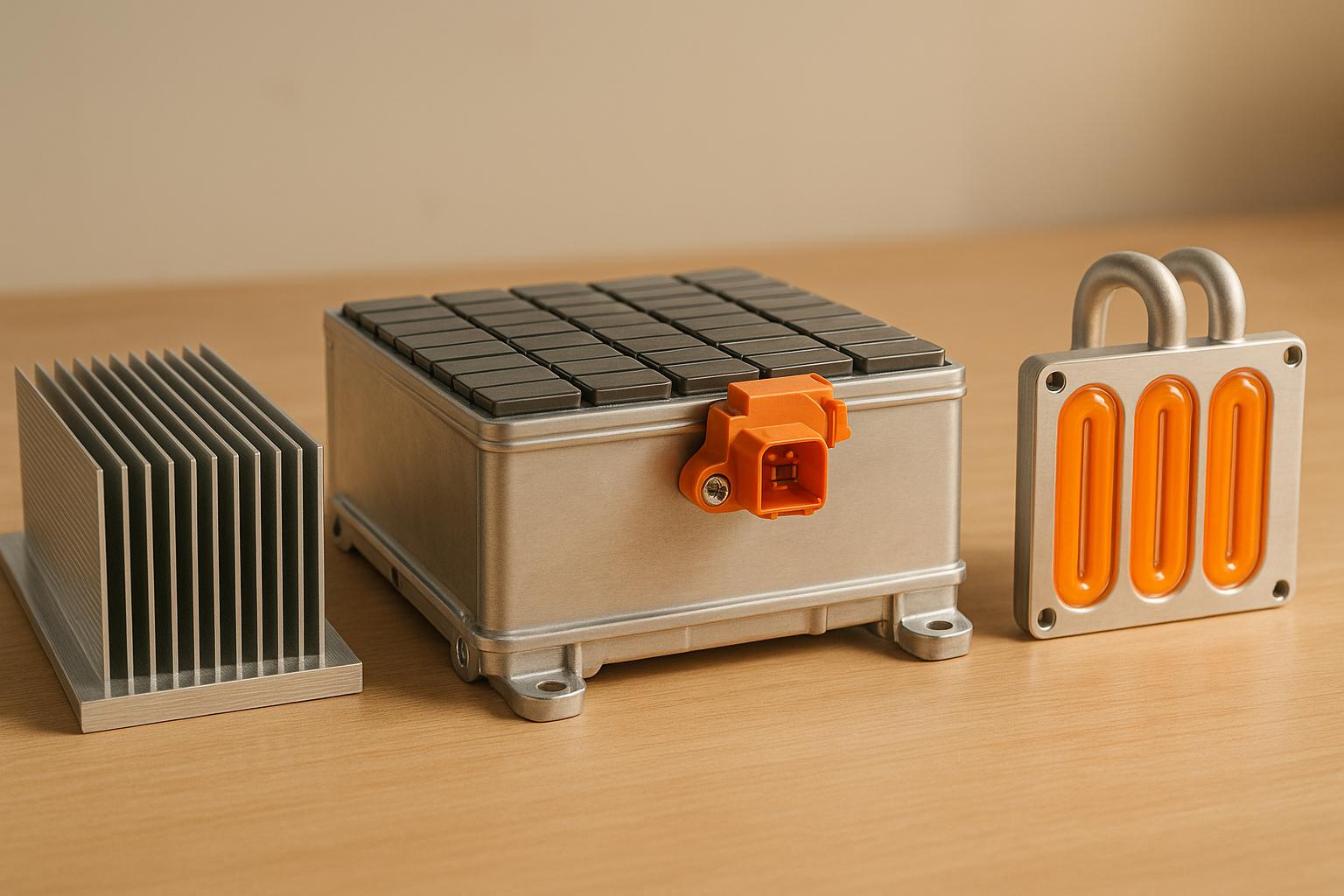
Electric vehicles (EVs) rely on effective cooling systems to manage battery temperatures and maintain performance. The two main methods – air cooling and liquid cooling – offer distinct advantages and challenges.
- Air Cooling: Simpler, cheaper, and lighter, making it suitable for entry-level EVs or mild climates. However, it struggles with high heat loads, leading to uneven cooling and faster battery degradation in hot conditions.
- Liquid Cooling: More efficient and consistent, ideal for fast charging, hot climates, and high-performance EVs. It extends battery life but comes with higher upfront costs, more components, and additional maintenance needs.
Quick Comparison
| Factor | Air Cooling | Liquid Cooling |
|---|---|---|
| Efficiency | Limited under heavy use | Superior heat management |
| Cost | Lower initial cost | Higher upfront investment |
| Maintenance | Minimal upkeep | Requires regular coolant checks |
| Battery Longevity | Shorter lifespan in hot climates | Longer lifespan with stable temps |
| Fast Charging | Limited support | Handles high-power charging easily |
Choosing the right system depends on your priorities: affordability and simplicity vs. performance and durability. For high-demand scenarios or warmer regions, liquid cooling is the better choice.
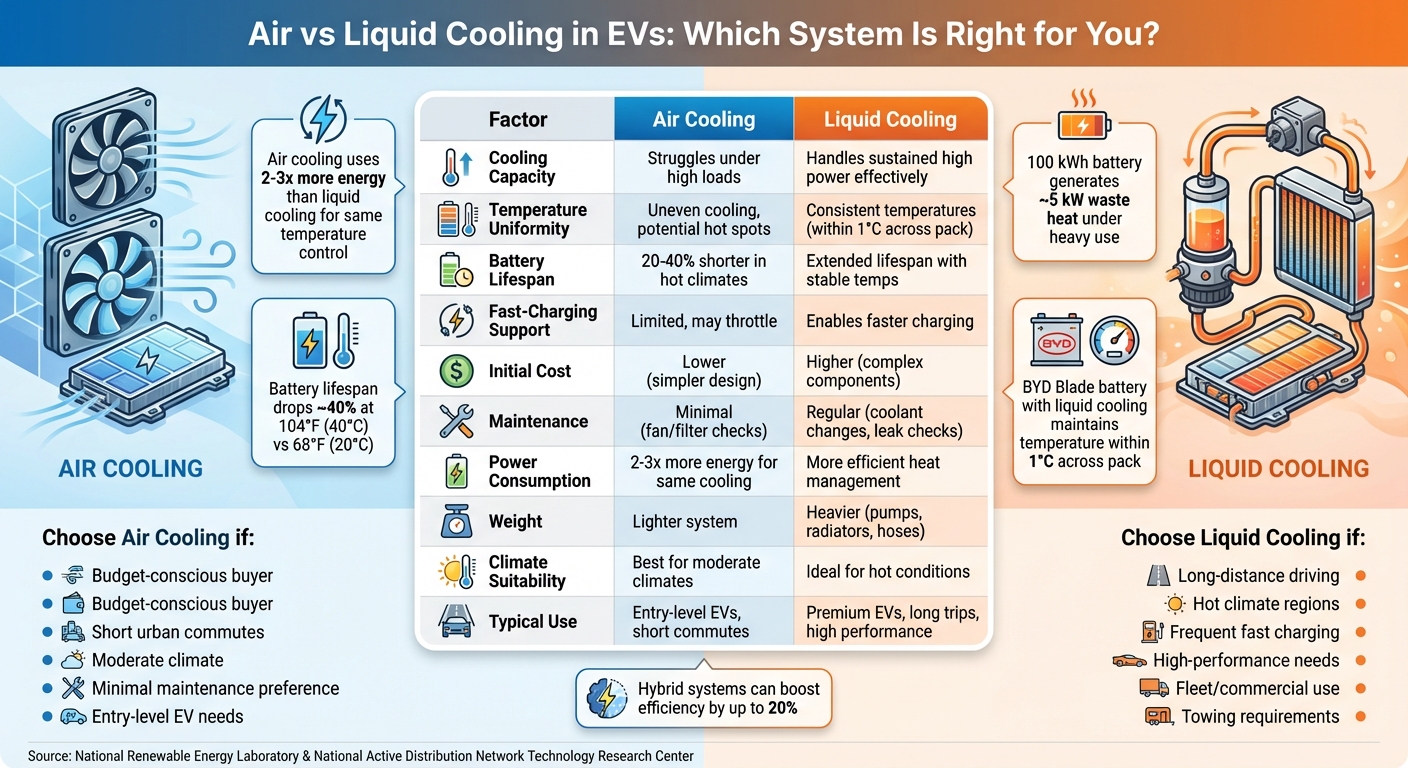
Air vs Liquid Cooling Systems in Electric Vehicles: Complete Comparison
Air Cooling in Electric Vehicles
How Air Cooling Works
Air cooling removes heat from the battery pack by relying on convection. In this setup, air is circulated over the battery modules using fans, ducts, and heat sinks to transfer heat away. There are two main types of air cooling: active and passive. Active systems use fans to force air over the batteries, while passive systems depend on natural airflow combined with strategically placed heat sinks to get the job done.
That said, air cooling has its limitations. Air’s relatively low thermal conductivity means it struggles to dissipate heat under heavy loads or during fast charging. Still, the simplicity of the system makes it appealing for certain applications, particularly where cost and ease of maintenance are key priorities.
Benefits of Air Cooling
Air cooling keeps things simple. There’s no coolant to leak, no pumps to break down, and fewer components overall. This simplicity translates into lower upfront costs and a lighter system – factors that are especially important for entry-level electric vehicles (EVs) or hybrids, where affordability and weight savings are critical. Maintenance is also straightforward. At most, you might need to clean a fan or replace a filter occasionally, but you won’t have to deal with coolant changes or seal inspections.
For automakers aiming at cost-conscious buyers, air cooling is a practical choice. It’s easy to scale for vehicles with moderate thermal demands, and it sidesteps environmental concerns tied to coolant disposal. These advantages made air cooling a popular choice in the early days of EVs when simplicity and affordability were more important than high performance.
Drawbacks of Air Cooling
Despite its simplicity and lower costs, air cooling has a major downside: it’s not very efficient under high thermal loads. When batteries are under heavy use – like during fast charging or extended high-power driving – air cooling often falls short. For example, a 100 kWh battery can generate around 5 kW of waste heat under heavy use, which is more than air cooling systems can handle effectively. This can lead to uneven cooling, creating hot spots that speed up battery degradation in those areas.
Hot climates only make things worse. High ambient temperatures reduce the system’s efficiency, forcing it to work harder to keep the batteries cool. According to research from the National Renewable Energy Lab, air cooling can use 2-3 times more energy than liquid cooling to maintain the same level of temperature control. A real-world example of these limitations is the early Nissan Leaf. Owners in warmer regions reported faster battery wear and thermal throttling, which limited performance. These challenges have led most modern EV manufacturers to adopt liquid cooling for vehicles that demand more robust thermal management.
Liquid Cooling in Electric Vehicles
How Liquid Cooling Works
Liquid cooling in electric vehicles (EVs) relies on a water-glycol mixture that circulates through cold plates or channels near the battery cells. This mixture, pumped by an electric motor, absorbs heat much more effectively than air does. Once the coolant captures the heat, it moves to a radiator or heat exchanger, where an electric fan helps release the heat into the surrounding air.
The system is made up of several key components: a coolant reservoir, pump, hoses, manifolds, temperature and pressure sensors, valves, and a control unit. The control unit adjusts the flow rate based on real-time battery conditions. In many modern EVs, the cooling system is integrated with other vehicle components, such as power electronics and motor cooling. Some systems even connect to the cabin HVAC to precool or preheat the battery, optimizing it for fast charging. The water-glycol mixture performs well across a wide temperature range, from below 32°F (0°C) to about 113°F (45°C), and also protects metal parts from corrosion. This efficient cooling mechanism is essential for better battery performance and safety.
Benefits of Liquid Cooling
Liquid cooling provides outstanding heat transfer and ensures even temperature control, thanks to the higher thermal conductivity and heat capacity of liquids. Research from the National Renewable Energy Lab and the National Active Distribution Network Technology Research Center in China shows that indirect liquid cooling systems achieve the lowest maximum temperature rise among tested methods. This uniform cooling prevents the development of hot spots and keeps the entire battery pack within its optimal temperature range, even under heavy loads or during repeated fast-charging cycles.
Another major advantage is that liquid-cooled systems can handle high-power DC fast charging and 800-volt architectures without excessive heat buildup, which is now a common feature in high-performance EVs. By maintaining better temperature control, these systems reduce capacity loss and resistance growth in lithium-ion cells, significantly extending battery life compared to air-cooled alternatives. This is particularly important in warmer climates, where liquid cooling ensures stable performance, reliable fast charging, and slower battery degradation over time.
Despite these clear advantages, liquid cooling does come with its own set of challenges.
Drawbacks of Liquid Cooling
One of the primary downsides of liquid cooling is its higher initial cost. These systems require extra components – such as pumps, radiators, cold plates, valves, sensors, and hoses – that make them more complex and expensive than air-cooled designs. Additionally, pumps and fans consume some power, creating a moderate parasitic draw, though this is often offset by the system’s overall efficiency.
Maintenance is another consideration. Liquid-cooled systems need periodic coolant replacement, as well as regular inspections of hoses, clamps, and pumps. Common issues include coolant leaks, pump failures, sensor malfunctions, and degraded coolant, which can lead to corrosion or reduced heat transfer efficiency. Early detection of these problems is critical – if left unchecked, issues like coolant loss or pump failure can result in localized overheating, faster battery wear, or even safety shutdowns. However, for high-performance and fast-charging EVs, manufacturers often accept these added costs and complexities. The trade-off is longer battery life, improved performance, and fewer warranty claims.
Air Cooling vs Liquid Cooling: Side-by-Side Comparison
Cooling Efficiency and Battery Health
When it comes to keeping batteries cool, liquid cooling outperforms air cooling by a wide margin. Research from the National Renewable Energy Laboratory and the National Active Distribution Network Technology Research Center shows that indirect liquid cooling consistently results in the lowest temperature rise among tested methods. Air cooling, which relies on moving air over battery surfaces, often leads to uneven cooling. This can create hot spots that speed up battery wear and tear. On the other hand, liquid-cooled systems, used by brands like Tesla, Jaguar, and BMW, deliver more even cooling, which helps extend battery life. For instance, BYD‘s Blade battery packs with liquid cooling maintain temperature differences within just 1°C across the pack. Temperature matters – a lot. Lithium-ion batteries last about 20% longer at 68°F (20°C) compared to 86°F (30°C), and their lifespan drops roughly 40% at 104°F (40°C). These differences in cooling efficiency directly impact costs and maintenance.
Cost Analysis: Initial and Long-Term
Air cooling systems are simpler and cheaper to set up. They rely on basic components like fans, ducts, and straightforward controls, which keep upfront costs low. Liquid cooling, however, requires more sophisticated parts – think pumps, radiators, cold plates, and hoses. This makes it pricier to install and more intricate to engineer. While air cooling has lower direct maintenance costs, its reduced thermal performance can lead to faster battery degradation, which might mean replacing the battery sooner or seeing a dip in resale value. Liquid cooling, although requiring more upkeep (like coolant changes and pump maintenance), helps batteries last longer by preserving their capacity over more charge cycles. For EV24.africa buyers, the choice boils down to priorities: air-cooled EVs save money upfront but could cost more over time, especially in hotter climates where batteries degrade faster.
Maintenance Requirements
Air-cooled systems are low-maintenance. They usually just need occasional fan checks, filter replacements, and duct cleaning. However, issues like fan wear, clogged vents, and performance drops in dusty environments can arise. Liquid-cooled systems, on the other hand, demand more attention. Routine tasks include replacing coolant, inspecting for leaks, checking pumps, and watching for corrosion. While the added complexity of liquid cooling introduces more potential points of failure, a well-designed system with proper care can perform reliably for years. This is especially critical in regions with limited access to repair services.
Performance in African Climates
In hot climates, the challenges of air cooling become more apparent. Since air-cooled systems depend on ambient air, they’re more likely to overheat in high temperatures. This can lead to quicker battery degradation, as seen in air-cooled EVs losing capacity in hotter regions. Dusty conditions and bumpy roads – common in many parts of Africa – can further reduce their effectiveness by clogging vents and overworking fans. Liquid cooling, with its greater ability to handle heat, offers a more reliable solution. It keeps battery temperatures stable even during demanding scenarios like long drives or repeated fast charging. For instance, a 100 kWh battery generating around 5 kW of waste heat under heavy use is a tough challenge for air-cooled systems, but liquid cooling handles it with ease. For African EV buyers using EV24.africa, liquid-cooled models are generally better for fast charging and hot climates, while air-cooled EVs might suit shorter commutes in milder conditions when upfront cost is a key factor.
Comparison Tables
Here’s a quick breakdown to help you weigh the pros and cons:
| Factor | Air Cooling | Liquid Cooling |
|---|---|---|
| Cooling Capacity | Struggles under high loads | Handles sustained high power effectively |
| Temperature Uniformity | Uneven cooling, potential hot spots | Consistent temperatures throughout the battery pack |
| Battery Health Impact | Higher risk of degradation | Supports longer battery life |
| Fast-Charging Support | Limited, may throttle during high-power charging | Enables faster charging with better heat control |
| Initial Cost | Lower due to simpler design | Higher due to complex components |
| Long-Term Costs | Cheaper maintenance but faster battery wear | Higher upkeep but better long-term battery health |
| Parasitic Power Draw | Minimal | Moderate (due to pumps and sensors) |
| Maintenance Needs | Basic fan and filter checks | Coolant changes, leak inspections, pump checks |
| Typical Applications | Entry-level EVs, short commutes | Premium EVs, long trips, high-performance use |
| Climate Suitability | Best for moderate climates | Ideal for hot and challenging conditions |
This side-by-side comparison highlights the trade-offs between air and liquid cooling, helping you make a choice that fits your needs and environment.
sbb-itb-99e19e3
Keep Your Cool: Electric Vehicle Battery Cooling Methods
Choosing the Right Cooling System
Selecting the right cooling system for your electric vehicle (EV) depends largely on how and where you plan to use it. Factors like driving habits, climate, and performance expectations all play a role in making the best choice.
When to Choose Air Cooling
Air cooling works best for smaller, entry-level EVs designed for short trips at lower speeds, particularly in areas with moderate climates. These systems are simple and require minimal upkeep – typically just occasional fan checks or filter replacements. If you’re browsing EV24.africa for an affordable second car or a reliable urban vehicle, an air-cooled model could be a budget-friendly option.
When to Choose Liquid Cooling
Liquid cooling is the go-to choice for high-performance EVs or for those used in demanding conditions. Whether you’re driving long distances, towing, or frequently using fast chargers, liquid cooling helps keep battery temperatures stable, which extends battery life. This is especially important in hotter regions, like the U.S. Sunbelt or parts of Africa, where air-cooled systems may struggle. Many top-tier EVs rely on liquid cooling because it supports faster charging, enhances battery longevity, and improves overall performance. For fleet operators, ride-hailing drivers, or anyone covering high mileage, the higher upfront cost of liquid cooling pays off through reduced downtime and longer-lasting batteries.
Emerging Cooling Technologies
New cooling technologies are shaking things up. Hybrid systems, which combine air and liquid cooling, aim to strike a balance between cost, weight, and performance, offering better temperature control without the complexity of full liquid systems. Some advanced designs claim to boost powertrain efficiency by up to 20%, meaning more power and faster charging without burning extra energy.
Other cutting-edge approaches include immersion cooling, where battery cells are submerged in a special fluid to eliminate hot spots, and two-phase subcooled boiling systems, which can remove heat up to 10 times more efficiently than standard liquid cooling. These advancements support ultra-fast charging and high-current demands. As these technologies develop, EV enthusiasts on EV24.africa can look forward to vehicles that are better equipped to handle diverse climates and driving styles.
FAQs
Why is liquid cooling better for high-performance electric vehicles?
Liquid cooling stands out as a superior choice for high-performance electric vehicles (EVs) due to its ability to effectively regulate heat. By keeping batteries at optimal temperatures, even under intense driving conditions, it helps prevent overheating, boosts overall performance, and allows for faster charging and higher power output.
This temperature stability not only enhances efficiency but also extends the lifespan of the battery, making liquid cooling a perfect solution for EVs that demand top-tier performance.
How does maintenance differ between air-cooled and liquid-cooled systems in EVs?
Air-cooled systems are known for being relatively easy to maintain since they consist of fewer components. However, they might need periodic cleaning to clear out dust or debris from filters and vents. On the other hand, liquid-cooled systems require a bit more care. This includes routine tasks like checking and replacing coolant, inspecting hoses and pumps, and watching for potential leaks. While liquid cooling provides superior temperature regulation, it does come with the trade-off of needing more consistent upkeep to keep the system running smoothly and avoid overheating issues.
How do air and liquid cooling systems impact EV battery life in hot weather?
In warm climates, liquid cooling systems excel at keeping electric vehicle batteries at an optimal temperature. They manage heat more effectively, preventing overheating and minimizing thermal stress, which can help the battery last longer.
In contrast, air cooling systems struggle to disperse heat efficiently in high temperatures. This can lead to increased battery wear, which may reduce its longevity over time.