
 Thabo Nkosi
Africa’s electric vehicle (EV) market is growing, driven by the need to cut fuel import costs and improve urban air quality. But readiness for EV adoption varies widely across the continent due to differences in infrastructure, policies, and electricity reliability. South Africa, Kenya, Nigeria, and Egypt are leading the charge, each addressing challenges in their own way:
- South Africa: Leverages its strong automotive industry and relatively stable electricity grid but faces grid reliability issues.
- Kenya: Rapid EV growth thanks to supportive policies, VAT exemptions, and expanding charging networks powered by clean energy.
- Nigeria: A large market with potential, but limited infrastructure and an unstable power grid slow progress.
- Egypt: Benefits from surplus energy production and long-term goals to phase out petrol vehicles by 2040.
A lack of reliable electricity grids and low motorization rates remain key obstacles across Africa. While large-scale public charging networks are still far off, smaller initiatives like fleet electrification and startup-driven projects offer a practical way forward.
| Country | Strengths | Weaknesses |
|---|---|---|
| South Africa | Strong automotive industry, global research | Grid stability concerns |
| Kenya | Growing EV market, clean energy | Low vehicle ownership, income barriers |
| Nigeria | Large economy, entrepreneurial activity | Weak infrastructure, unstable electricity |
| Egypt | Surplus energy production | Grid reliability varies by region |
The next steps? Strengthen grids, focus on urban electrification, and support startups to create a cleaner, more affordable transportation future.
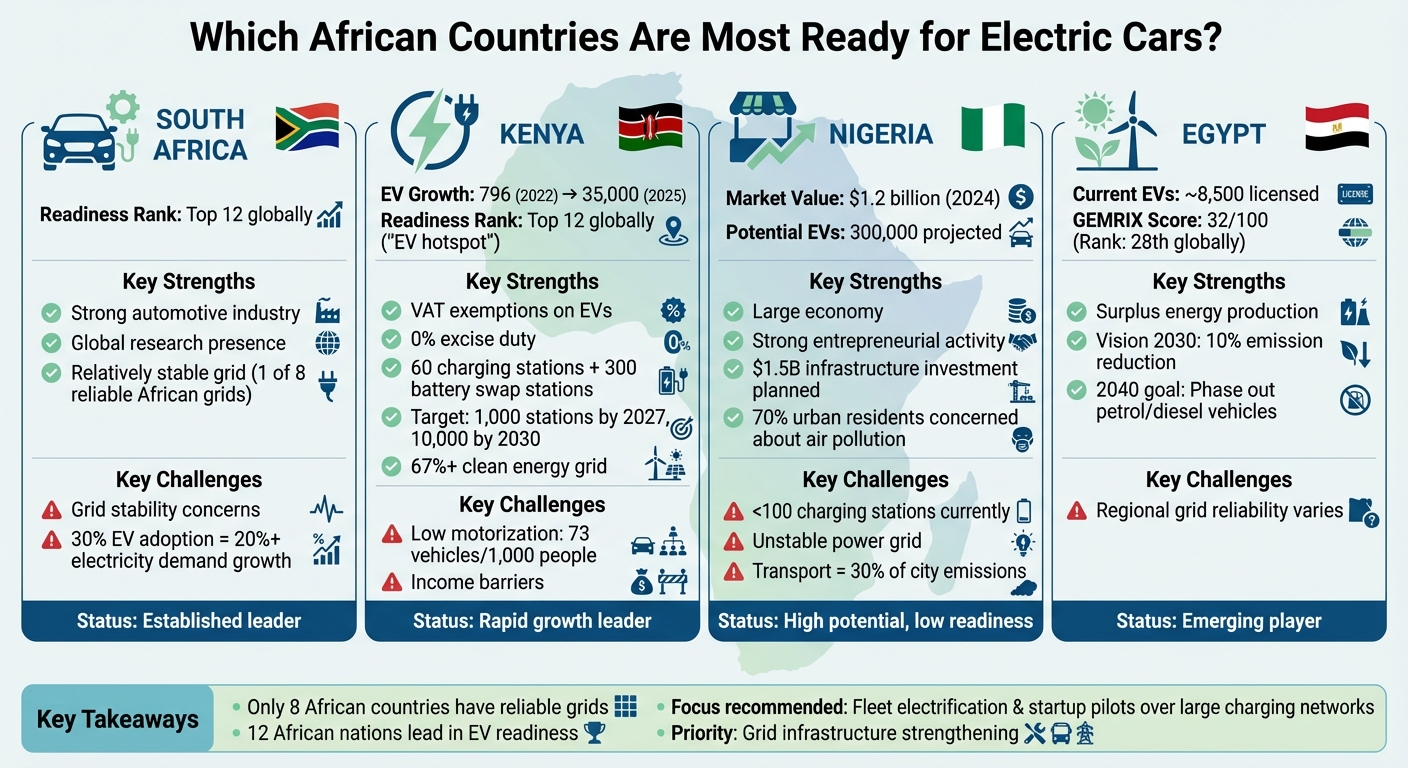
EV Readiness Comparison: South Africa, Kenya, Nigeria, and Egypt
Nigeria Wants to Build Electric Cars, Is This the Right Time?
sbb-itb-99e19e3
1. South Africa
South Africa stands out among African nations preparing for the shift to electric vehicles (EVs). With strong policies and a well-established automotive industry, the country is paving the way for others facing similar infrastructure and economic challenges. These efforts highlight South Africa’s strategic approach to EV adoption .
Government Policies
South Africa’s readiness for EV adoption stems from its supportive policies and its long-standing automotive manufacturing industry. As a producer of vehicles for major global brands, the country is well-positioned to transition to electric mobility. However, its policies focus on addressing immediate economic and social needs rather than prioritizing decarbonization. This balanced approach creates a framework for tackling infrastructure challenges.
Grid Reliability
Electricity infrastructure remains a significant hurdle. South Africa uses the SAIDI (System Average Interruption Duration Index) to monitor grid reliability, offering a more accurate picture than standard power outage surveys. While grid stability issues persist, South Africa is one of only eight African countries with relatively dependable electricity systems. Transitioning 30% of road transportation to EVs would require over 20% of the projected electricity demand growth over the next decade.
Market Potential
South Africa’s established automotive sector and relatively mature power infrastructure provide fertile ground for EV adoption. Policymakers and investors evaluate the market across five major categories to identify opportunities that could deliver both public health and financial gains.
Renewable Energy Integration
Renewable energy plays a critical role in scaling EV adoption. South Africa’s ability to integrate renewable energy into its power grid is essential for supporting widespread EV deployment. The country is assessed using two key metrics: the EV Readiness Index, which measures current preparedness, and the EV Impact Index, which evaluates potential benefits for climate and public health. As the Energy for Growth Hub explains:
"Key drivers of the EV transition in Africa will differ from those in mature markets, requiring tailored policies and infrastructure".
2. Kenya
Kenya’s electric vehicle (EV) numbers skyrocketed from 796 in 2022 to an impressive 35,000 by December 2025. This rapid growth is the result of expanded infrastructure and bold government initiatives, showcasing a successful collaboration between public utilities and private sector innovators.
Government Policies
On February 3, 2026, Kenya introduced its National Electric Mobility Policy, creating a detailed regulatory framework packed with financial incentives. Key highlights include:
- VAT exemptions on electric buses, motorcycles, bicycles, and lithium-ion batteries.
- Zero excise duty on these items.
- Import duty waivers for EV assemblers, replacing the standard 35% rate with a reduced 10% excise duty.
These measures significantly cut operating costs, making EVs much cheaper to use compared to traditional petrol vehicles.
Additionally, in March 2023, the government rolled out tailored e-mobility electricity tariffs. Rates are set at approximately $0.12 per kilowatt-hour during peak hours and $0.058 per kilowatt-hour during off-peak times. Joseph Siror, Managing Director and CEO of Kenya Power, emphasized the company’s commitment to green energy:
"E-mobility is one of the key areas the company is focused on under our green agenda, which seeks to power livelihoods and support our communities with solutions that reduce carbon emissions".
These policies are complemented by an aggressive push to expand the country’s EV charging network.
Charging Infrastructure
Kenya’s charging network is growing fast, thanks to partnerships between Kenya Power (KPLC) and private players like ChargeNet, Roam, and BasiGo. The government aims to install 1,000 EV charging stations by 2027 and expand to 10,000 stations by 2030. By September 2025, the country had around 60 charging stations for four-wheelers and 300 battery swap stations.
Public AC charging stations have been set up at major shopping hubs like Two Rivers Mall, Sarit Centre, and The Hub Karen. Meanwhile, BasiGo is actively building 16 EV bus charging depots along key transport routes in Nairobi, catering to its fleet of electric public service vehicles. To ease long-distance travel, high-capacity charging plazas have also been established along the Nairobi–Mombasa highway.
Renewable Energy Integration
Kenya is one of only 13 African nations where over two-thirds of electricity comes from clean energy sources, making it an ideal setting for EV adoption. With geothermal and wind power dominating its energy mix, EVs in Kenya offer genuine environmental benefits while reducing reliance on expensive fossil fuel imports.
3. Nigeria
Nigeria may not yet be fully prepared for widespread EV adoption, but its large economy and regional influence make it a country with immense potential in this space. Currently, there are fewer than 100 EV charging stations nationwide, but the government has ambitious plans to establish 1,000 stations in key urban areas. By 2024, the market value stood at $1.2 billion, and there’s optimism that up to 300,000 electric vehicles could hit Nigerian roads in the near future. These opportunities and challenges are shaping Nigeria’s approach to EV policies and infrastructure.
Government Policies
In February 2026, Nigeria’s EV Transition and Green Mobility Bill 2025 passed its second reading in the Senate, laying the groundwork for a national EV ecosystem. While taking cues from countries like South Africa and Kenya, Nigeria is tailoring its policies to meet local needs. A key feature of the legislation is its focus on local production, requiring foreign automakers to collaborate with domestic assemblers and ensure 30% of components are sourced locally by 2030. Additionally, local assemblers must produce at least 5,000 units annually.
The bill also includes strict enforcement measures. Companies failing to meet local content requirements could face fines of up to ₦250 million (about $156,000), while importing unlicensed EVs could result in penalties of ₦500 million (around $312,000) and vehicle confiscation. Senator Titus Zam emphasized the urgency of these measures, stating:
"Nigeria risks falling behind if it does not codify EV policy now".
To encourage infrastructure development, the government is also proposing tax breaks for fuel stations that install EV charging points. This initiative aims to transform existing mobility corridors into hubs that cater to both traditional and electric vehicles.
Market Potential
Nigeria’s growing EV market is fueled by pressing environmental and social concerns. Transportation contributes to roughly 30% of emissions in major cities. To address this, the government is planning a $1.5 billion investment in EV infrastructure, with $500 million allocated for the initial phase. Public awareness is also on the rise – 70% of urban residents are concerned about air pollution, driving demand for cleaner transportation options.
Currently, charging infrastructure is concentrated in Lagos, Abuja, and Port Harcourt. Development efforts are focusing on a mix of AC chargers for residential use and DC Fast Charging for public spaces. To reduce reliance on an already strained national grid, developers are increasingly incorporating renewable energy sources like solar and wind into charging stations.
Grid Reliability
The lack of a stable power grid is Nigeria’s most significant obstacle to EV adoption. Unlike eight other African nations with more reliable grids, Nigeria’s electricity infrastructure struggles to meet demand. To achieve a 30% shift to electric vehicles, the country would need to redirect over 20% of its projected electricity demand growth over the next decade to the transport sector. While renewable energy capacity is expected to reach 10,000 MW to support EV needs, experts recommend prioritizing the allocation of electricity for transport to improve charging reliability.
Until major grid upgrades are completed, the focus should remain on strengthening the power sector and launching smaller-scale pilot projects, such as electrifying fleets, rather than investing heavily in large-scale infrastructure.
4. Egypt
Egypt is making strides as an emerging player in Africa’s electric vehicle (EV) market, joining the ranks of South Africa, Kenya, and Nigeria. The country placed 28th in the 2023 Global Electric Mobility Readiness Index (GEMRIX), earning a score of 32 out of 100. With around 8,500 licensed EVs on its roads, Egypt is aligning its renewable energy goals with its ambitions for the EV sector.
Government Policies
As part of its Vision 2030 initiative, Egypt is aiming for a 10% reduction in emissions from the energy sector by 2030. Additionally, the country plans to phase out petrol and diesel vehicles entirely by 2040. These policies are designed to draw both local and international investments into the EV market. However, the specifics of these incentives and timelines remain a work in progress.
Renewable Energy Integration
Egypt’s surplus energy production creates an opportunity to expand EV charging infrastructure. That said, the reliability of the power grid varies across different regions, underscoring the importance of customized infrastructure solutions to meet local needs.
Market Potential
With its current fleet of approximately 8,500 EVs, Egypt’s market is expected to expand as regulations and infrastructure catch up. The country’s renewable energy goals, available power capacity, and strategic location position it as a potential leader in Africa’s shift toward electric mobility. While challenges remain, these factors highlight Egypt’s readiness to carve out a significant role in the continent’s EV landscape.
Strengths and Weaknesses
The journey toward EV adoption in Africa is shaped by the unique strengths and challenges of each country. By examining these factors, we can better understand how the EV landscape is evolving across the continent.
Here’s a quick comparison of key readiness factors for four countries:
| Country | Key Strengths | Key Weaknesses |
|---|---|---|
| South Africa | Strong ties to the automotive industry; frequently highlighted in global EV research; ranked in the top 12 for EV readiness | Concerns about grid stability under growing demand |
| Kenya | Known as an emerging "EV hotspot"; also ranked in the top 12 for readiness | Low motorization rate (around 73 vehicles per 1,000 people); income barriers limit adoption |
| Nigeria | Boasts a large economy with strong entrepreneurial activity and market potential | Falls behind in EV readiness despite its economic size; lacks infrastructure and policy support |
| Egypt | Surplus energy production offers opportunities for charging infrastructure development | – |
One major hurdle shared by all four nations is Africa’s infrastructure gap. Reliable energy grids are essential for widespread EV adoption, but only eight African countries currently meet high grid reliability standards. This makes the development of consistent charging infrastructure a significant challenge. Additionally, low motorization rates and limited income levels across the continent further hinder consumer adoption of EVs.
Given these obstacles, experts suggest focusing on smaller-scale initiatives like fleet electrification pilots and supporting EV startups. These approaches are seen as more viable at this stage than investing heavily in large-scale public charging networks.
Despite these challenges, each country is leveraging its unique strengths to carve a path forward. South Africa draws on its established automotive industry, Kenya capitalizes on its growing EV market momentum, Nigeria relies on its entrepreneurial drive, and Egypt utilizes its surplus energy production. Instead of mirroring Western EV strategies, these nations are crafting solutions tailored to their specific contexts.
Conclusion
The future of EV adoption in Africa is already beginning to take shape, with several nations paving the way. Among the 12 leading African countries, Seychelles and Mauritius stand out, while South Africa, Kenya, Rwanda, Uganda, Morocco, Ethiopia, and Ghana also showcase strong potential across five critical areas: enabling policies, market potential, affordability, grid infrastructure, and power sector maturity. While much attention has been given to South Africa, Kenya, Nigeria, and Egypt, these countries complement the broader progress being made across the continent.
For businesses and investors, the focus should be on fleet electrification pilots and startup-driven experiments rather than large-scale charging networks at this stage. Countries like Ethiopia and Ghana, though receiving less media attention, are emerging as promising destinations for investment in EV development.
Policymakers, on the other hand, need to prioritize strengthening grid infrastructure. As Rose Mutiso highlights:
"investing in grid infrastructure is especially valuable, as it supports broader economic growth beyond just EVs".
This foundational work is crucial for enabling large-scale EV adoption in the future.
As grids improve, urban centers and public transportation systems are likely to see the first wave of electrification. For consumers, this shift promises cleaner air in cities and reduced dependence on costly imported fuel. The investments being made today in EV readiness will play a major role in shaping the future of transportation across Africa.
FAQs
Which factor matters most for EV readiness: grid reliability or charging stations?
Both grid reliability and charging stations play essential roles in preparing Africa for electric vehicles (EVs). However, a stable power grid has a bigger overall impact. Without consistent electricity, even the most advanced charging networks can’t function effectively. For example, while South Africa has made strides in building charging infrastructure, unreliable power systems across much of the continent – especially in rural areas – continue to hinder broader EV adoption.
Where will EV adoption start first in Africa: personal cars or fleets?
In Africa, the adoption of electric vehicles (EVs) is likely to start with fleets instead of personal cars. This shift is influenced by factors such as reduced operating costs, government incentives, and efforts to cut emissions in public transportation and logistics. Nations like South Africa, Kenya, Morocco, and Ethiopia are prioritizing commercial EVs, including buses and motorcycles. These initiatives aim to establish infrastructure and showcase the advantages of EVs, laying the groundwork before expanding to personal vehicle use.
How can EV charging work in countries with frequent power outages?
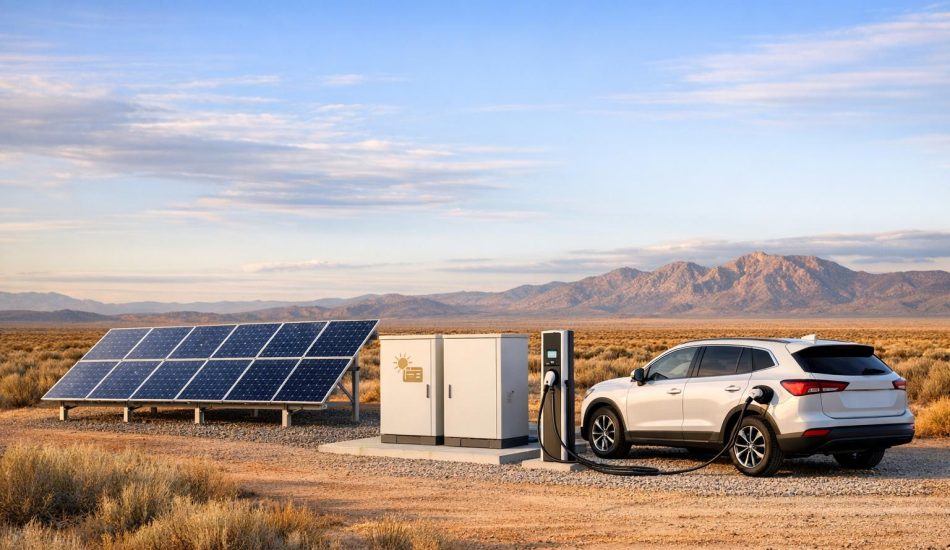
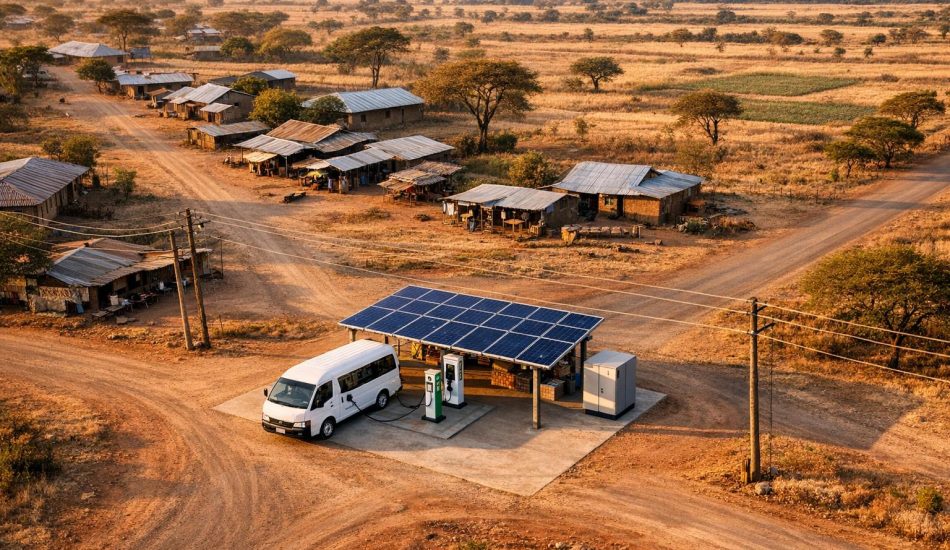
EV charging in regions prone to power outages can benefit from a mix of smart strategies. For instance, incorporating renewable energy sources like solar panels or wind turbines can help supplement the grid, ensuring a more consistent power supply. Pairing these with energy storage systems, such as batteries, can store excess energy for use during outages, keeping charging stations operational.
Additionally, decentralized options, like off-grid or solar-powered charging units, offer a level of independence from the main grid. These setups can provide reliable charging even when the central power supply is disrupted. Smart grid technologies also play a key role by improving energy distribution and optimizing resource use, making charging solutions more dependable in challenging conditions.