
 Thabo Nkosi
Africa is making progress in electric vehicle (EV) infrastructure, with countries like South Africa, Morocco, Kenya, and Rwanda adopting different strategies to encourage EV use. Here’s a quick look:
- South Africa: Focuses on passenger cars and public charging networks, with over 450 charging stations. Government incentives are boosting local EV production, but high import duties on EVs remain a challenge.
- Morocco: Expanding EV manufacturing and charging stations, supported by tax breaks and partnerships with companies like Gotion High-Tech. The country aims to produce 107,000 EVs annually by 2025.
- Kenya: Prioritizes electric motorcycles and battery-swapping systems, with over 200 charging stations and growing local assembly efforts for buses and two-wheelers.
- Rwanda: Offers tax exemptions and zero VAT on EVs, with a focus on smart charging and battery-swapping for motorcycles.
Each country is tackling unique challenges like grid reliability, high costs, and infrastructure gaps while leveraging opportunities in renewable energy, local manufacturing, and innovative business models. These efforts highlight Africa’s potential to reduce fuel dependency and improve urban mobility.
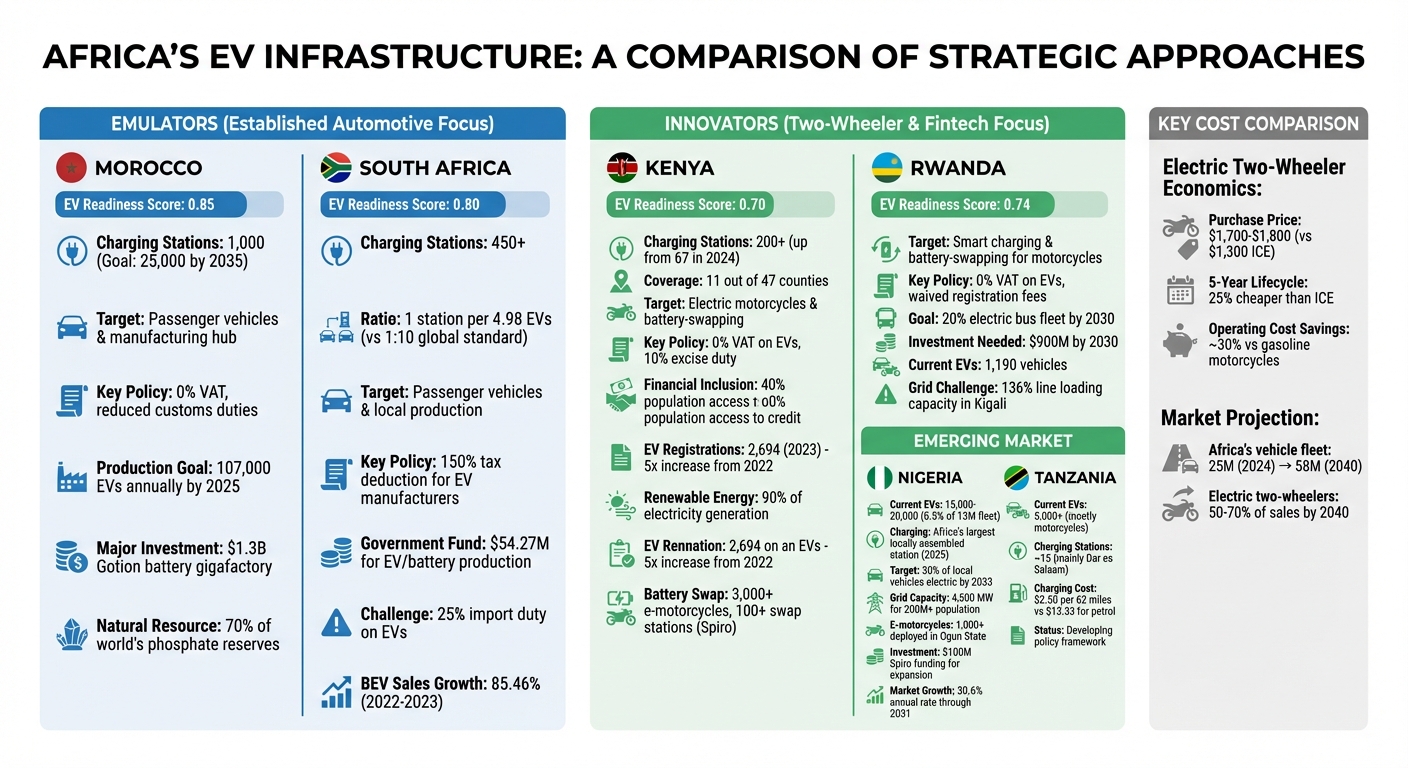
Africa EV Infrastructure Comparison: Leading Countries by Strategy and Key Metrics
1. South Africa
Charging Infrastructure
As of 2025, South Africa features over 450 publicly accessible charging stations, primarily located in Gauteng, the Western Cape, and KwaZulu-Natal. Impressively, the country has achieved a ratio of one public charging station for every 4.98 private passenger EVs – far surpassing the globally recommended ratio of 1:10. This availability helps ease concerns about range and charging accessibility.
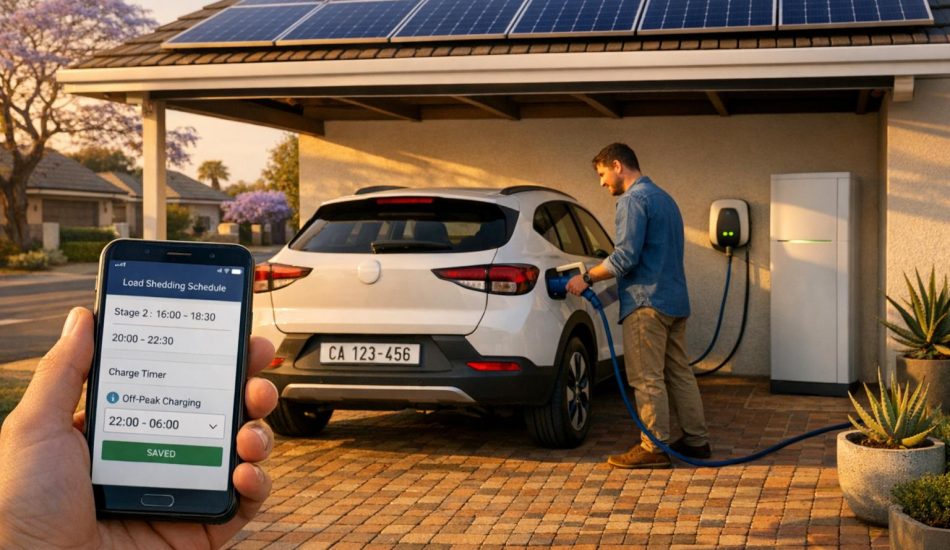
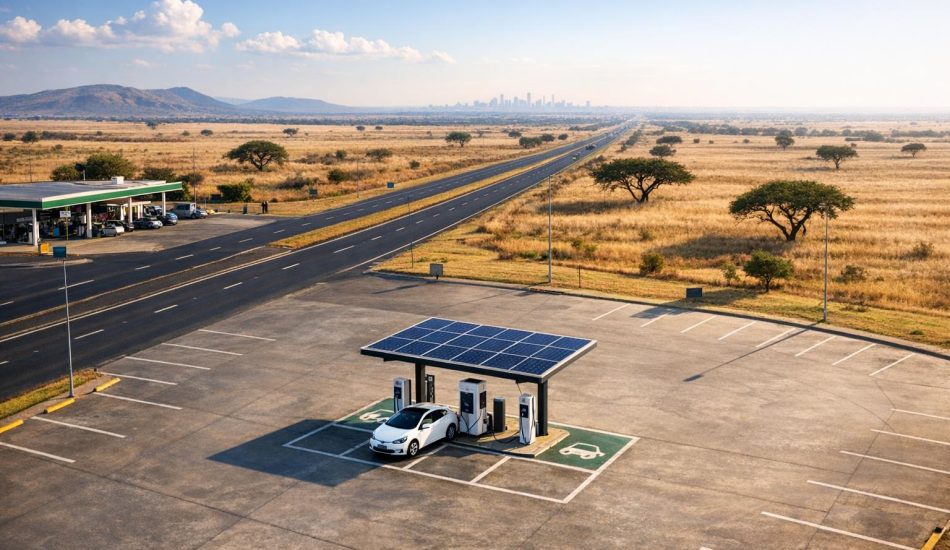
The charging network, once dominated by private companies, is now seeing state involvement. In August 2024, Eskom, in collaboration with GridCars, introduced pilot EV charging at the Eskom Academy of Learning in Midrand, Johannesburg. This included the installation of 60 kW DC fast chargers and 22 kW dual AC chargers. To address load shedding and grid instability, companies like CHARGE are stepping up with off-grid solutions. In March 2025, CHARGE launched South Africa’s first solar-powered, off-grid EV charging station in Wolmaransstad, North West province. This station is the first in a planned network of 120 stations designed to support highway travel without relying on the Eskom grid.
Government Policies and Incentives
South Africa is taking steps to encourage EV adoption and production. In December 2024, the Taxation Laws Amendment Bill introduced Section 12V, which allows manufacturers to deduct 150% of costs for EV and hydrogen vehicle production facilities from March 2026 through March 2036. Additionally, the National Treasury has allocated 1 billion rand (around $54.27 million) to support local energy vehicle and battery production.
However, challenges remain. The country imposes a 25% import duty on EVs, compared to just 18% for internal combustion engine vehicles. This disparity has drawn criticism, with Elon Musk calling the duties "super high", making the market less attractive for companies like Tesla. President Cyril Ramaphosa has acknowledged this issue, suggesting that incentives for manufacturers and tax rebates or subsidies for consumers could accelerate EV adoption.
These measures aim to attract investment and strengthen South Africa’s position as a key automotive manufacturing hub.
Local Manufacturing and Investments
South Africa is already a leader in automotive manufacturing in sub-Saharan Africa, hosting major global brands like Toyota, Ford, Volkswagen, and Mercedes. Recent policy changes have spurred significant investments. For example, BMW Group South Africa is committing $238 million over five years to prepare its Rosslyn plant for hybrid vehicle production, starting with the next-generation BMW X3 30e xDrive plug-in hybrid. Toyota has also made strides, with its locally produced Corolla Cross Hybrid dominating 2024 hybrid sales, accounting for 74% of the market with 10,109 units sold.
Battery EV sales, while still modest, are growing rapidly – rising by 85.46% from 502 units in 2022 to 931 units in 2023. Although hybrids currently lead the market due to infrastructure challenges, local battery EV production is expected to begin in 2026. The $54.27 million incentive is projected to attract approximately $1.6 billion in private sector investment.
EV Adoption Rates
While South Africa’s overall EV adoption lags behind global leaders, the cost benefits for high-mileage operators are undeniable. For example, an electric minibus, though priced at around $80,300 compared to $36,500 for an internal combustion model, offers significant savings in operational costs – about $6.16 per 62 miles versus $12.94. Over an annual mileage of 44,700 miles, the electric option becomes more economical within ten years despite its higher upfront cost.
"By investing in eMobility and the charging infrastructure needed for electric vehicles, we are not only reducing our carbon footprint but also stimulating the local economy and creating new opportunities for growth."
– Gabriel Kgabo, General Manager, Eskom
To meet its decarbonization goals, the transport sector will require an estimated $6.84 billion in investments between 2023 and 2027. With 46% of South Africa’s vehicle exports destined for Britain and the European Union – both of which plan to phase out new internal combustion engine vehicle sales by 2035 – the push for transition has become increasingly urgent.
2. Morocco
Charging Infrastructure
Morocco currently operates around 1,000 EV charging stations in key cities like Casablanca, Rabat, and Tangier. The country has set an ambitious goal to expand this network to 25,000 stations by 2035 to encourage electric vehicle (EV) adoption. One noteworthy initiative, Apime, plans to add 2,500 new stations along the Atlantic axis route, stretching from Agadir to Tangier, by 2026.
Local startup I-Smart is stepping up to address gaps in charging infrastructure by building a domestic network and manufacturing charging stations. These developments are paving the way for broader government support and incentives.
Government Policies and Incentives
To boost EV demand, the Moroccan government has rolled out several incentives, including VAT exemptions, reduced customs duties, and corporate purchase bonuses of up to MAD 100,000. In 2022, import duties on lithium-ion cells were slashed from 40% to 17.5%, aiming to promote local battery assembly. Additionally, the EU-Morocco Association Agreement provides duty-free or low-duty access for vehicles and components, positioning Morocco as a key nearshoring hub for European markets. These policies align with global trends toward more sustainable transportation.
"Morocco has no choice, because 90% of our automotive exports go to Europe and Europe has decided to switch to all-electric by 2035."
– Ryad Mezzour, Moroccan Minister of Industry
The impact of these measures is already visible. Morocco’s automotive sector reached $14 billion in industrial exports in 2023, marking a 27% increase from the previous year. EV sales also doubled in 2023, though they still represent just 0.6% of the overall automotive market.
Local Manufacturing and Investments
Morocco is transitioning from being a vehicle assembly hub to becoming an EV manufacturing powerhouse. In June 2024, Chinese company Gotion High-Tech committed to a $1.3 billion investment to establish Africa’s first battery gigafactory in Kenitra. Production is scheduled to begin in Q3 2026, with an initial capacity of 20 GWh, eventually scaling up to 100 GWh. The total investment could reach as high as $6.5 billion.
"This is a historic investment marking the first gigafactory in Africa."
– Hicham Chaoudri, Director at the Moroccan Investment Department
In addition to this, Moroccan automaker Neo Motors is set to launch the "Dial-E", the first fully Moroccan-made electric vehicle, in January 2026. Meanwhile, Dacia has emerged as the leading EV brand in the country, accounting for 32% of all EV sales as of 2024.
Morocco is also leveraging its rich natural resources to strengthen its position in the EV supply chain. The country holds over 70% of the world’s phosphate rock reserves, a critical material for Lithium Iron Phosphate (LFP) batteries. In 2020, BMW signed a $113 million deal with Moroccan mining company Managem to secure 20% of the cobalt needed for its electric drivetrains. Renault Group followed suit in 2022, agreeing to receive 5,000 tons of cobalt sulfate annually for seven years starting in 2025.
EV Adoption Rates
While EVs in Morocco currently cost 50–70% more upfront than traditional vehicles (averaging $45,000 compared to $30,000), their five-year total cost of ownership is nearly equivalent. The annual energy costs for EVs are about $624, significantly lower than the $2,520 spent on fuel for conventional cars. Operating costs also favor EVs, coming in at $2.6 per 62 miles compared to $10.5 for gasoline vehicles.
Looking ahead, the government aims to have 2.5 million EVs on the road by 2050, which would make up 30% of the country’s total vehicle stock. By the end of 2025, Morocco’s EV production capacity is expected to reach approximately 107,000 units, a 53% increase. However, financial accessibility remains a challenge, as only 5% of the population over age 15 has access to credit through formal financial institutions. These factors highlight both the opportunities and hurdles Morocco faces as it works to establish itself as a leader in Africa’s EV market.
3. Kenya
Charging Infrastructure
Kenya’s charging network has expanded quickly, jumping from about 67 stations in 2024 to over 200 by early 2025. This infrastructure now spans 11 out of the country’s 47 counties, with key hubs in Nairobi, Kiambu, and Nakuru. Electric mobility electricity consumption hit 5.04 GWh for the financial year ending June 30, 2025, a 300% increase compared to the previous year.
The country supports multiple charging standards, including Type 1, Type 2, CCS2, CHAdeMO, and Chinese GB/T. This variety reflects Kenya’s diverse vehicle imports from regions like the UK, Japan, and China. Kenya Power is playing a crucial role, committing to allocate 1,100 MW of off-peak electricity specifically for electric mobility.
Battery swapping has taken off in the electric motorcycle sector, offering a practical solution for commercial riders by eliminating charging delays. Spiro, which entered Kenya in October 2023, has already deployed over 3,000 electric motorcycles and established more than 100 battery-swap stations in cities like Nairobi, Mombasa, Eldoret, and Kisumu. This approach has cut operating costs by around 30% compared to gas-powered motorcycles. Kenya’s rapidly growing infrastructure aligns with supportive government policies aimed at accelerating EV adoption.
Government Policies and Incentives
Kenya has introduced several tax breaks to encourage EV adoption. The government has zero-rated VAT for EVs and their components, while also reducing excise duties on fully electric vehicles from 20% to 10%. Additionally, the National Building Code now requires that 5% of parking spaces in commercial buildings be EV-ready, complete with pre-installed plugs and outlets.
The government has set an ambitious goal for EVs to make up 5% of all new vehicle registrations by 2025. To help achieve this, over 1,000 EVs will be deployed for government officials and police, aiming to build public confidence in the technology. Kenya’s nearly 90% renewable electricity generation – drawn from geothermal, hydro, wind, and solar – provides a clean energy backbone for this transition.
"Kenya’s growing adoption of EVs, driven by proactive government measures… is positioning the country as a regional leader in sustainable transportation."
– BMI, A Fitch Solutions Company
Local Manufacturing and Investments
Kenya’s efforts to promote EV adoption are bolstered by local manufacturing and creative financing solutions. In 2023, BasiGo partnered with Associated Vehicle Assemblers (AVA) in Mombasa to locally assemble electric buses. By mid-2023, BasiGo had nearly 20 buses in operation and secured over 450 orders from Kenyan bus operators.
The country’s advanced fintech ecosystem is also making EVs more accessible. With 40% of the population using formal financial institutions or mobile money, Kenya leads the region in financial inclusion. Companies like M-KOPA and Watu Credit are providing digital loans tailored for electric two-wheelers, enabling commercial riders to afford these vehicles without the burden of upfront costs.
EV Adoption Rates
Kenya has seen a dramatic increase in EV registrations, growing fivefold from 475 in 2022 to 2,694 in 2023. However, electric cars still represent only 0.18% of all vehicle registrations in 2024. The two-wheeler market is expanding more rapidly, thanks to battery-as-a-service models that help bridge the cost gap – electric motorcycles are priced between $1,700 and $1,800, compared to $1,300 for gas-powered equivalents.
Kenya ranks 9th in Africa with an EV readiness score of 0.70. Its EV impact score of 0.76 highlights the country’s potential to reduce reliance on fossil fuels and improve urban air quality. Classified as an "Innovator", Kenya focuses on two- and three-wheelers and relies on startup-driven business models, setting it apart from markets like South Africa and Morocco that prioritize passenger cars.
4. Nigeria
Charging Infrastructure
In March 2025, Nigeria took a bold step in the EV space by unveiling Africa’s largest locally assembled EV charging station in Abuja. The event, attended by John Uwan-Enoh, the Minister of State for Industry, Trade, and Investment, also showcased locally manufactured electric buses and taxis. Despite this milestone, Nigeria still lags behind other African countries in overall EV readiness, held back by an unstable power grid and a limited charging network.
The numbers paint a challenging picture: Nigeria’s national power grid generates just 4,500 MW for a population exceeding 200 million – a significant hurdle for building a reliable charging infrastructure. To work around these grid limitations, battery swapping has emerged as a practical alternative. Ogun State has taken the lead with its E-Mobility Program, partnering with Spiro to introduce battery-swapping stations. By September 2024, the program had deployed over 1,000 Spiro Commando electric motorcycles in Abeokuta and established three battery-swapping stations. These infrastructure gaps have also spurred new policy initiatives aimed at addressing the challenges.
Government Policies and Incentives
The passage of Nigeria’s Electric Vehicle Transition and Green Mobility Bill in 2025 marked a turning point for the country’s EV ambitions. Key provisions include requiring all existing fuel stations to install EV charging points and mandating foreign automakers to set up local assembly plants within three years of starting operations. The National Automotive Industry Development Plan (NAIDP) further sets a goal for 30% of all locally produced vehicles to be electric by 2033.
To encourage adoption, the government offers a range of incentives: tax holidays, customs duty waivers, subsidies, exemptions from road taxes and emission tests, and toll-free highway access for EV users. The removal of gasoline subsidies in May 2023, which led to a surge in fuel prices, has also driven interest in electric vehicles.
"Electric vehicles are the future, but that future must start today. We must promote it now and ensure that we achieve it."
– John Uwan-Enoh, Minister of State for Industry, Trade, and Investment
These policies are complemented by efforts to boost local manufacturing.
Local Manufacturing and Investments
Under the 2025 EV bill, foreign automakers must source 30% of vehicle components locally and produce at least 5,000 electric vehicles annually by 2030. In July 2024, Ogun State partnered with Spiro to launch the first phase of its E-Mobility Program. This initiative deployed 2,000 electric motorcycles to gig workers and announced plans for a $40 million assembly plant dedicated to two-, three-, and four-wheelers. The project is expected to create 60,000 jobs. Later, in November 2025, Spiro secured $100 million in funding from Afreximbank to expand its electric motorcycle production and charging network across Nigeria, Kenya, Uganda, and Rwanda.
The NAIDP also aims to generate 200,000 jobs in the automotive sector as Nigeria pivots toward local EV production. However, not everyone is optimistic about the timelines.
"A 30% local content requirement by 2030 may not be realistic given Nigeria’s current infrastructure and workforce constraints. A ten-year roadmap would be more feasible."
– Stanley Awelewa, Senior Sales Manager at Tim International Group
EV Adoption Rates
Nigeria currently has an estimated 15,000–20,000 electric vehicles on the road, making up about 0.5% of its 13-million-vehicle fleet. Adoption has been driven primarily by electric motorcycles and tricycles, especially in ride-hailing and gig work, where lower operating costs are a major draw. For instance, Spiro Commando e-bikes are sold to gig workers for ₦1.4 million–₦1.6 million (around $833–$952), with daily charging costs of about ₦2,500 (roughly $1.53) – almost 50% cheaper than fueling traditional motorcycles.
While the EV market in Nigeria is projected to grow at an annual rate of 30.6% through 2031, the country still trails other African leaders like South Africa, Morocco, Egypt, and Ethiopia in EV adoption. Even smaller economies like Seychelles and Mauritius rank higher on the 2024 Africa EV Readiness Index, primarily due to Nigeria’s ongoing infrastructure challenges.
sbb-itb-99e19e3
5. Tanzania and Rwanda
Charging Infrastructure
Rwanda has been making strides in developing its EV charging network. In November 2024, the country introduced a strategic plan to coordinate the rollout of charging stations across districts like Nyamagabe. A key focus is on "smart charging" technology, which helps shift electricity demand to off-peak hours, potentially easing strain on distribution networks by up to 15%. Major transit hubs are also being upgraded. For instance, the Nyabugogo Terminal received a $7.7 million investment that included 18 chargers, an 800-kW rooftop solar system, and battery storage.
Tanzania, on the other hand, currently has about 15 public charging stations, most of which are located in Dar es Salaam. The country is working with fuel station owners to expand charging infrastructure as part of its evolving national strategy. To tackle grid reliability issues, Tanzania is piloting solar-powered charging stations in rural areas like Lindi and Mtwara. Charging an EV for a 62-mile trip in these regions costs roughly TZS 6,000 (around $2.50), a significant saving compared to the TZS 32,000 (about $13.33) needed for a petrol vehicle. These developments are paving the way for more robust EV policies in both nations.
Government Policies and Incentives
Rwanda has taken an ambitious approach to encourage EV adoption. The government offers strong fiscal incentives, such as a 0% VAT on electric vehicles and waived registration fees. Additionally, Rwanda plans to electrify 20% of its bus fleet by 2030, a goal supported by Ecofleet Solutions, a state-owned enterprise established in September 2025. The country’s efforts are reflected in its EV readiness score of 0.74, placing it among Africa’s top "Innovator" nations.
Tanzania, meanwhile, is still in the early stages of policy development. By December 2024, the government was crafting a framework to address EV importation, registration, and usage, with plans to introduce tax incentives in the 2024/25 fiscal year.
"We are working towards including incentives in the tax laws to create a supportive environment for EV registration and charging infrastructure", said Dr. Gerald Kafuku, Innovation and Technology Manager at Costech.
In addition, institutions like Arusha Technical College are updating their programs to train mechanics for EV maintenance.
Local Manufacturing and Investments
Rwanda estimates it will need $900 million to fund EV purchases and charging infrastructure to meet its 2030 goals. Startups such as BasiGo, Ampersand, and Spiro are leading the way with innovative business models for electric buses and motorcycles. Ampersand, for example, has popularized a battery-swap model, allowing drivers to exchange depleted batteries for charged ones in minutes.
In Tanzania, efforts are focused on reducing import costs by fostering local production of EV components. The country is collaborating with European firms to set up training centers for EV mechanics. Chinese manufacturers are also stepping in to supply affordable electric cars, while European expertise is contributing to technical advancements. Tanzania has a history with EVs, having pioneered their use in Africa over a decade ago. By June 2025, tour operators had successfully converted diesel safari trucks into electric vehicles for eco-friendly tourism in the Serengeti.
EV Adoption Rates
Both countries are seeing growth in EV adoption, reflecting broader trends in the region. Tanzania has over 5,000 electric vehicles on the road, primarily motorcycles, three-wheelers, and converted safari trucks. Rwanda, meanwhile, has around 1,190 electric vehicles in operation. Urban areas like Dar es Salaam, Arusha, and Kigali are experiencing a surge in two- and three-wheelers, which are widely used as taxis.
Electric two-wheelers, priced at $1,700–$1,800 compared to $1,300 for internal combustion models, are about 25% cheaper over a five-year lifecycle due to lower fuel and maintenance costs. Sales of electric two-wheelers in sub-Saharan Africa are expected to dominate the market, accounting for 50%–70% of all sales by 2040.
However, challenges remain, particularly with infrastructure. In Kigali, for example, peak power demand is projected to rise by 64% by 2030. By 2024, the city’s electricity network had already exceeded safe capacity levels, operating at 136% of its line loading limit.
How Africa Is Powering a New Electric Future – AU Transport Boss Breaks It Down
Strengths and Weaknesses by Country
Each country in Africa brings its own mix of strengths and hurdles when it comes to developing EV infrastructure. By examining the "Emulators" and "Innovators" models, we can see how various nations align with these approaches.
Morocco and South Africa fall under the "Emulators" category, thanks to their established automotive industries and relatively strong power grids. Morocco, with a readiness score of 0.85, is positioning itself as a manufacturing hub for European EV markets. South Africa, on the other hand, has a slightly lower score of 0.80, but its progress is often hindered by persistent power outages and load shedding challenges.
Kenya and Rwanda are considered "Innovators", with readiness scores of 0.70 and 0.74, respectively. Kenya stands out for its high financial inclusion – 40% of its population has access to formal credit, compared to just 5% in Morocco. This has allowed companies like M-KOPA and Watu Credit to offer digital loans for electric motorcycles. Rwanda, meanwhile, has implemented progressive policies such as 0% VAT on EVs and waived registration fees. However, Kigali’s electricity network is under strain, operating at 136% of safe line loading limits.
Nigeria presents a unique scenario. Despite having one of the continent’s least reliable grids (with a SAIDI of 39.30 compared to 0.87 in OECD countries), Nigeria ranks high in potential EV impact. This is largely due to its severe air pollution problems and the economic burden of fuel subsidies. Tanzania, while still developing its EV policy framework, has over 5,000 EVs on its roads and is experimenting with solar-powered charging stations in rural areas.
No single country excels across all metrics. Morocco and South Africa lead in infrastructure readiness but face challenges in financial inclusion. Kenya and Rwanda showcase innovation and supportive policies but struggle with grid reliability. Nigeria has enormous potential but requires significant infrastructure upgrades. Tanzania is making strides but remains in the early stages of policy development.
These diverse challenges underscore the importance of customized strategies to advance EV infrastructure across the continent.
Conclusion
Africa’s electric vehicle (EV) landscape is being shaped by two distinct strategies. Morocco and South Africa have emerged as "Emulators", building on their established automotive industries and relatively advanced power grids. Their focus lies in passenger vehicles and public charging networks, aiming to position themselves as manufacturing hubs for both local markets and exports. On the other hand, Kenya and Rwanda are carving a path as "Innovators", sidestepping traditional infrastructure challenges by prioritizing electric two- and three-wheelers. These efforts are backed by fintech solutions and battery-swapping networks, providing practical and scalable solutions for their unique needs.
Each approach is driven by specific factors that contribute to success. Key elements include supportive government policies – such as Rwanda’s 0% VAT on EVs – targeting high-use commercial vehicles where the total cost of ownership is most favorable, and innovative financing models that address the challenge of high upfront costs. Ghana exemplifies how these strategies can work, leading the way in EV adoption across Africa, thanks to duty waivers and a focus on two- and three-wheelers.
For other African nations, prioritizing segments where EVs already make financial sense can pave the way for growth. Electric two-wheelers and commercial fleets stand out as prime candidates, with electric models proving to be 25% cheaper over a five-year lifespan despite higher initial costs. With the continent’s vehicle fleet expected to grow from 25 million today to 58 million by 2040, electric two-wheelers are poised to dominate sales. Additionally, 24 African countries have significant potential to reduce urban air pollution and ease the burden of fuel imports through EV adoption, even if their current infrastructure is still developing.
FAQs
How are African countries advancing electric vehicle infrastructure and addressing challenges?
African countries are making notable progress in establishing electric vehicle (EV) infrastructure by blending government policies, renewable energy initiatives, and partnerships between public and private sectors. Take Kenya, for example – its E-Mobility Policy simplifies the process for obtaining permits for charging stations and encourages private investment. Similarly, Uganda is setting national EV standards and allocating public funds to create pilot charging hubs. Over in Ethiopia, solar energy is being harnessed alongside updated import regulations to lower EV costs and power charging stations in an eco-friendly way. Meanwhile, Rwanda is working to expand electric public transportation in Kigali by collaborating with local utilities to install fast chargers.
Other nations, including South Africa, Morocco, Seychelles, and Mauritius, are implementing advanced measures like standardized charging protocols, incentives for fleet electrification, and the integration of EVs into broader climate action plans. To make EVs more affordable, many governments across the continent are introducing tax breaks and reducing import duties. By combining these efforts with renewable energy projects and strategic partnerships, African nations are addressing infrastructure challenges and setting the stage for a future of sustainable transportation.
How are government incentives driving EV adoption in Africa?
Government incentives are playing a big part in speeding up the adoption of electric vehicles (EVs) across Africa. By cutting import duties and offering tax breaks, many governments are making EVs more affordable, helping them compete with traditional gas-powered vehicles. These steps also encourage private investments and support local manufacturing, which helps create supply chains and financing options.
On top of that, specific programs, like lowering registration fees or offering subsidies for electrifying public transportation (think electric buses and motorcycles), are helping to get early-stage projects off the ground. These projects not only show that EVs are a practical choice but also help lay the groundwork for building charging infrastructure and promoting cleaner transportation options. Together, these policies reduce costs, build trust in the market, and create a strong foundation for EV adoption across the continent.
How is Africa developing its local manufacturing to support EV adoption?
Africa is making notable progress in developing local manufacturing to support the electric vehicle (EV) industry. Countries such as Kenya, Uganda, and South Africa are rolling out policies aimed at boosting local assembly and production of EV components. These initiatives not only cut reliance on imports but also help lower production costs. For instance, Kenya’s E-Mobility Policy and Uganda’s National Electric Mobility Framework are paving the way for increased local manufacturing efforts.
The continent’s wealth of natural resources, including cobalt, lithium, and manganese, is also positioning Africa as a growing player in battery production. South Africa’s Atlantis Special Economic Zone is gaining traction as a hub for manufacturing electric minibuses. Meanwhile, regional partnerships between nations like the Democratic Republic of Congo, Morocco, and Zambia are strengthening collaboration across automotive value chains. These collective efforts are generating jobs, driving down costs, and carving out a competitive role for Africa in the global EV market.