
 Thabo Nkosi
Africa’s EV market in 2026 is offering more affordable choices under $25,000 and $30,000, tailored for the region’s needs like rugged roads, heat, and limited charging infrastructure. Here’s a quick summary of the top options:
- BYD Dolphin (Entry/Surf): Starts at $18,700, with a range of up to 183 miles and fast charging capabilities. Perfect for urban use.
- Wuling Bingo/Mini EV: Compact city car priced under $15,000, ideal for short commutes.
- Dongfeng EX1/Nammi: Compact crossover with a range of up to 155 miles, priced under $20,000.
- Leapmotor T03: A $12,000 city car offering up to 250 miles of range and fast charging.
- TAD Motors Kenyan EV: Locally assembled models starting at $10,000, designed for African roads.
- BYD Dolphin Long Range: Priced around $21,500, with a 183-mile range and enhanced charging.
- BYD Shark (Pickup): Rugged design with off-road capabilities, expected around $30,000.
- BYD Yuan Plus/Atto: Compact SUV, priced just under $30,000, suitable for moderate off-road use.
- Geely Geometry: Sedan/hatch with a range of up to 285 miles, priced around $25,000–$30,000.
- Toyota Entry-Level BEV: Compact SUV under $30,000, known for reliability.
Quick Comparison:
| Model | Price | Range (Miles) | Best For |
|---|---|---|---|
| BYD Dolphin (Entry) | $18,700–$21,500 | 144–183 | Urban commutes |
| Wuling Bingo/Mini EV | $12,000–$15,000 | ~130 | City driving |
| Dongfeng EX1/Nammi | $16,000–$20,000 | 143–155 | Uneven roads |
| Leapmotor T03 | $12,000–$24,000 | 165–250 | City/intercity trips |
| TAD Motors Kenyan EV | $10,000–$20,000 | ~125–155 | African roads |
| BYD Dolphin Long Range | $21,500–$28,000 | 183 | Longer drives |
| BYD Shark (Pickup) | ~$30,000 | 215 (est.) | Off-road/utility |
| BYD Yuan Plus/Atto | $26,000–$30,000 | 170 | Moderate off-road |
| Geely Geometry | $25,000–$30,000 | 217–285 | Urban/highway use |
| Toyota Entry-Level BEV | $28,000–$30,000 | ~175 | Reliable daily driving |
These EVs balance affordability, durability, and performance, addressing challenges like infrastructure and terrain. Whether you need a compact city car or a rugged SUV, there’s a model for every driver. Key factors to consider include range, charging options, and suitability for local conditions.
Top 10 Affordable EVs for Africa 2026: Price, Range & Suitability Comparison
Chinese EVs You Can Buy in Kenya – Africa EV Show
1. BYD Dolphin (Entry or Surf type variants)
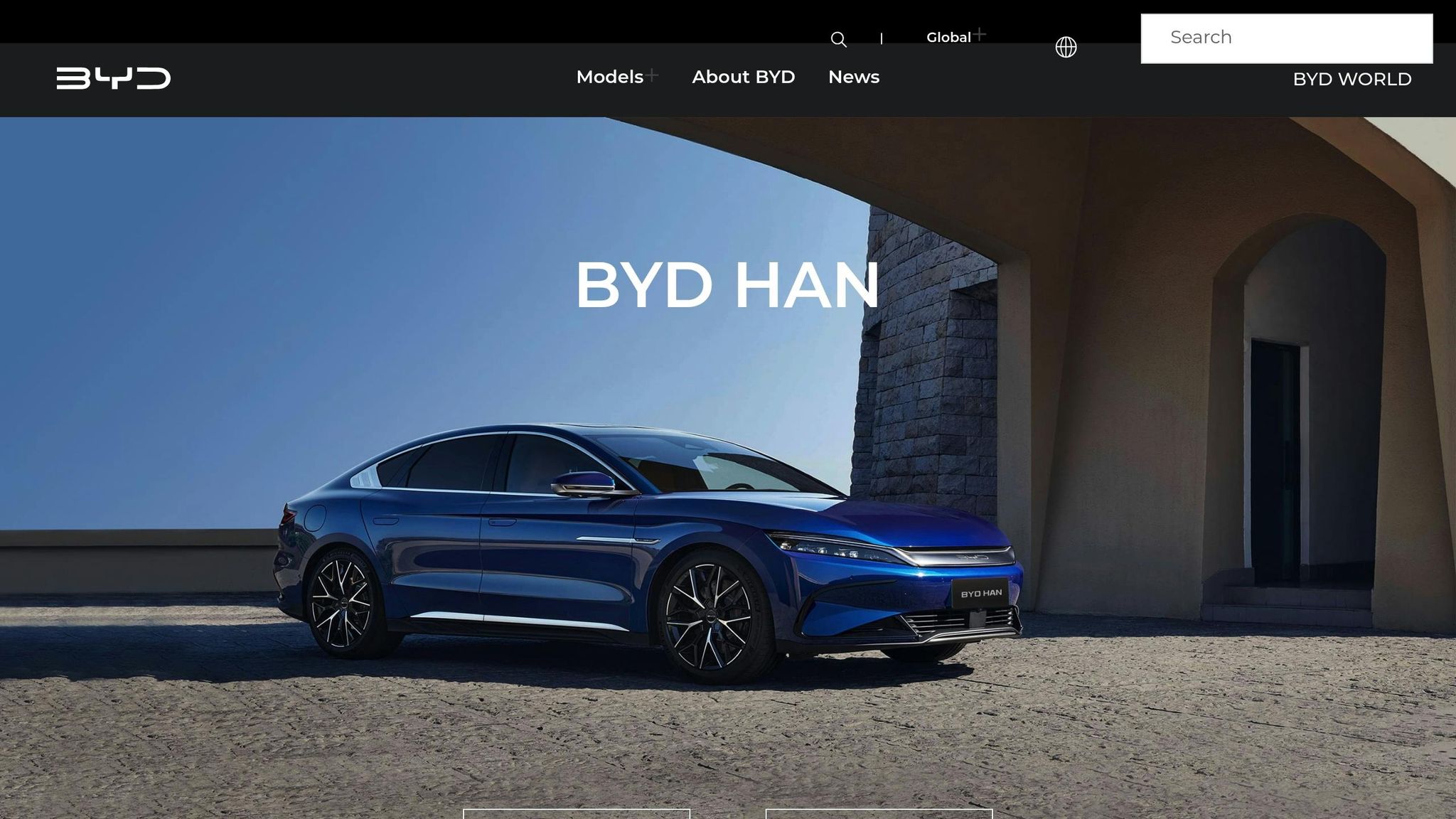
The BYD Dolphin Surf is set to make waves in African markets starting in 2026. Introduced by BYD South Africa, this hatchback is designed to tackle the affordability challenge that has kept many electric vehicles out of reach. Ming Xing, the Brand and Marketing Manager at BYD South Africa, summed it up perfectly:
"The BYD Dolphin Surf makes sustainable mobility accessible for everyday urban life."
Here’s a closer look at its pricing, range, and charging features.
Price (Under $25,000)
The Dolphin Surf comes in two trim levels, both comfortably priced below $25,000. The Comfort model starts at R339,000 (roughly $18,700), while the Dynamic is priced at R389,900 (about $21,500). This makes it the most affordable electric vehicle in South Africa. Both trims come equipped with BYD’s Blade Battery technology, celebrated for its durability and safety.
Real-world Range (miles)
The Comfort variant features a 30 kWh battery, delivering a range of approximately 144 miles under the WLTP standard. The Dynamic model, on the other hand, boasts a 38.8 kWh battery, extending its range to around 183 miles. These distances make the Dolphin Surf ideal for daily commutes, with the Dynamic offering extra versatility for longer trips.
Charging Practicality (AC/DC options)
Charging options are tailored for convenience. The Comfort trim supports DC fast charging up to 30 kW, while the Dynamic can handle up to 40 kW. These speeds allow for quick, practical recharges when needed. Both models also support standard AC charging, making overnight charging a hassle-free solution for most urban drivers.
2. Wuling Bingo / Wuling Mini EV–class city car
The Wuling Bingo and its Mini EV-class counterparts bring affordable electric driving to African cities. Designed specifically for navigating crowded urban areas, these compact cars are perfect for short trips and tight parking spaces. They address the unique transportation needs of African city dwellers, offering practical solutions for everyday mobility.
Price (Under $25,000)
With a price tag well below $25,000, the Wuling lineup stands out as one of the most affordable electric options available. While local pricing may vary, these vehicles remain an economical choice for budget-conscious buyers looking to switch to electric.
Real-world Range
Although exact range details aren’t specified, these cars are built with urban commuters in mind. They’re ideal for short daily drives, but longer journeys might require some extra planning to ensure access to charging points.
Ground Clearance and Suspension Suitability
Specifics on ground clearance and suspension haven’t been disclosed. However, these vehicles are clearly optimized for smooth city roads rather than rough or uneven terrains. Their primary focus is urban efficiency, not off-road performance.
Charging Practicality
Charging details are yet to be confirmed, but the vehicles are expected to support standard home charging and overnight urban charging setups, making them convenient for city living.
3. Dongfeng EX1 / Nammi Compact Crossover

The Dongfeng Nammi 01 offers flexibility with its two battery options. The smaller 31.7 kWh battery provides a range of approximately 143–155 miles (230–250 km), while the larger 42.3 kWh battery extends the driving range even further.
4. Leapmotor T03

The Leapmotor T03 is a small, five-door city car that packs a punch for its size. Available in South Africa and Morocco, thanks to its collaboration with Stellantis, this car is designed to balance affordability with features that meet the needs of urban drivers in African cities.
Price (Under $25,000)
With a starting price of just $12,000 FOB, the T03 is a budget-friendly option without compromising on quality. Despite its compact A-segment size – measuring 11.9 feet (3,620 mm) in length – the interior feels surprisingly spacious, rivaling the comfort of larger B-segment cars.
Real-World Range (Miles)
The T03 comes with two battery options: a 37.3 kWh or a 42 kWh pack. Depending on the variant, the WLTP range is around 165 miles, with some models offering an impressive range of up to 250 miles.
Ground Clearance and Suspension Suitability
Built for urban environments, the T03 features a basic MacPherson strut and torsion beam suspension setup, ideal for navigating paved city streets. Its compact wheelbase of 2,400 mm (about 7.9 feet) makes it highly maneuverable in tight spaces, perfect for crowded urban areas.
Charging Practicality (AC/DC Options)
The T03 supports 50 kW DC fast charging, allowing you to charge the battery from 30% to 80% in just 36 minutes. It also comes equipped with a 10.1-inch touchscreen that supports Android Auto and Apple CarPlay, along with over-the-air (OTA) software updates.
5. TAD Motors Kenyan EV (locally assembled)

TAD Motors is leading the way in Kenya by assembling electric vehicles (EVs) locally at the Naivasha Special Economic Zone. The company produces five models: three sedans – Taji, Makena, and Fahari – and two SUVs – Dhahabu and Amani. These vehicles are built using components sourced from over 30 Chinese OEMs, customized to meet the needs of the African market. The focus is on creating affordable, locally tailored EVs.
Price (Under $25,000)
The sedans are priced between $10,000 and $12,300, while the SUVs range from $15,400 to $20,000. TAD Motors’ owner, Tadesse Tessema, summed up their goal:
"Our idea is to make EVs affordable to ‘normal’ people."
With a $10 million investment in their Naivasha facility and a target to source 80% of components locally by September 2026, TAD Motors is positioning itself as a solution for Africa’s automotive needs.
Real-World Range (Miles)
The standard driving range for these EVs is 155 miles, but additional batteries can be installed to extend this range. As Tadesse Tessema explains:
"The range is extendable, if one wants more, we’ll be able to fit more batteries into the cars."
Ground Clearance and Suspension Suitability
Although specific suspension details haven’t been shared, the SUV models – Dhahabu and Amani – are designed to handle the rugged, unpaved roads commonly found in East Africa.
Charging Practicality (AC/DC Options)
All models come equipped with AC on-board chargers, allowing a full charge in up to 4 hours. However, there are no plans to include DC fast charging. These EVs are best suited for owners with reliable home charging setups, though long-distance trips may require careful planning.
6. BYD Dolphin Long Range / Higher Trim Variants
If you’re looking for a bit more range and faster charging, the BYD Dolphin Surf Dynamic might be the perfect fit. It’s designed to handle longer drives, especially when charging options might be less predictable.
Price (Under $30,000)
In South Africa, the Dolphin Surf Dynamic comes in at R389,900 (around $21,500), compared to the base Comfort trim, which is priced at R339,000. For the extra cost, you get a bigger battery and improved charging capabilities – offering a clear upgrade for those who value performance and convenience.
Real-World Range (Miles)
The Dynamic trim features a 38.8 kWh Blade Battery, delivering a WLTP range of 295 km (approximately 183 miles). That’s a solid 39-mile bump over the base model, giving you more freedom for longer drives or weekend getaways without constantly worrying about recharging.
Ground Clearance and Suspension Suitability
This trim isn’t built for rough terrain or off-road adventures. It’s best suited for smooth highways and urban roads, where it performs comfortably.
Charging Practicality (AC/DC Options)
One of the standout features of the Dynamic trim is its support for 40 kW DC fast charging, compared to the 30 kW offered by the base model. This means you’ll spend less time at charging stations. Both trims share the same 55 kW front-wheel motor and come with standard AC charging, making overnight home charging a breeze.
sbb-itb-99e19e3
7. BYD Shark or Similar Pickup / Crossover EV
The BYD Shark 6 is a plug-in hybrid (PHEV), with a fully electric version expected in the future. Currently priced at about $53,000, it sits well above the under-$30,000 target. However, more affordable options, including a cab-chassis variant, are projected to hit the market by 2025 or 2026, making it a more budget-friendly choice for African buyers.
Real-World Range
The Shark 6 offers an electric-only range of roughly 50 miles (80 km), while its hybrid system extends the range to about 342 miles (550 km) under typical driving conditions. Its dual-mode setup includes a 1.5L turbo engine that acts as a generator, which helps ease concerns about running out of charge in areas where charging stations are sparse.
Ground Clearance and Suspension
With a ground clearance of 11.1 inches (282 mm), reinforced underbody protection, and independent rear coil-spring suspension, the Shark is built to handle tough terrains while maintaining comfort on the road. It has proven its off-road mettle, successfully covering 1,118 miles (1,800 km) of challenging landscapes, earning praise for its rugged capabilities.
Charging Options and Flexibility
The Shark supports 40 kW DC fast charging, 7 kW AC charging, and a 6 kW Vehicle-to-Load (V2L) function. The V2L feature allows the vehicle to power tools, refrigerators, and camping gear directly from its battery. Additionally, the onboard petrol engine can recharge the battery while driving, reducing the need for external charging stations – an invaluable feature for long trips in remote areas.
8. BYD Yuan Plus / Atto Type Compact SUV
Continuing our look at affordable urban EVs, the BYD Yuan Plus, also called the Atto 3, is a compact SUV that blends practicality with modern features. As BYD gears up to expand its offerings in 2026, it’s clear the company is committed to delivering affordable options. For instance, the Atto 1 hatchback debuted at approximately $23,900 in select markets. This sets the stage for the Atto series to remain competitive in the under $30,000 price range. Let’s dive into what the Atto 3 brings to the table.
Price (Under $30,000)
The Atto 3 is expected to hover around the $30,000 mark, depending on the trim level and any applicable import duties. This pricing aligns with BYD’s strategy of offering budget-friendly EVs, making it a strong contender for buyers looking for value without breaking the bank.
Ground Clearance and Suspension Suitability
While specific details about ground clearance and suspension are not yet available, the design suggests it’s well-suited for city streets and light off-road conditions. However, its performance on rougher terrains remains to be confirmed.
9. Geely Geometry or Equivalent Compact Sedan/Hatch

Geely’s Geometry series focuses on delivering affordable electric sedans and hatchbacks. With Geely reporting an impressive 2,477,322 vehicle sales between January and October 2025 – a 44.33% increase from the previous year – the brand is clearly on an upward trajectory. The Geometry C is particularly appealing to African buyers seeking a practical sedan with a solid range and modern features, all at a reasonable price point. Let’s take a closer look at its pricing, range, and performance.
Price (Under $30,000)
The Geometry C is expected to fall within a price range of $25,000 to $30,000, depending on the trim level and applicable import duties.
Real-World Range (Miles)
This EV comes with two battery options: a 53-kWh pack offering approximately 217 miles of range and a 70-kWh pack that extends this to about 285 miles. The larger battery is ideal for intercity travel, while the smaller pack is a great fit for daily urban commutes.
Ground Clearance and Suspension Suitability
Designed for stability, the Geometry C features a low center of gravity that enhances handling on paved roads. According to Younes Rabeh from African EV Market News, many budget-friendly EVs aim to strike a balance between cost, range, and durability. While this model performs well in urban and highway settings, it’s not built for extremely rough terrain.
Performance and Features
Equipped with a 201-hp motor delivering 310 Nm of torque, the Geometry C doesn’t skimp on features. It includes practical additions like a 360° camera, parking sensors, and ventilated front seats. Inside, a 12.3-inch infotainment display and a Bose sound system elevate the driving experience. These features align with the growing demand for reliable, cost-effective EVs tailored for the African market.
10. Entry-level Toyota battery-electric model for South Africa

Toyota is stepping into the South African market with an entry-level electric vehicle that combines affordability and the brand’s well-known reliability. The 2023 bZ4X is designed to meet the needs of buyers looking for a trustworthy electric option, making it an appealing choice for those who value long-term dependability. With a price tag under $30,000, it offers an accessible entry point into electric mobility for South African consumers.
Price (Under $30,000)
The 2023 Toyota bZ4X is priced below $30,000, delivering Toyota’s renowned build quality at a budget-friendly cost.
Real-World Range (Miles)
Its range is tailored to handle daily commutes and moderate intercity travel with ease.
Comparison Table
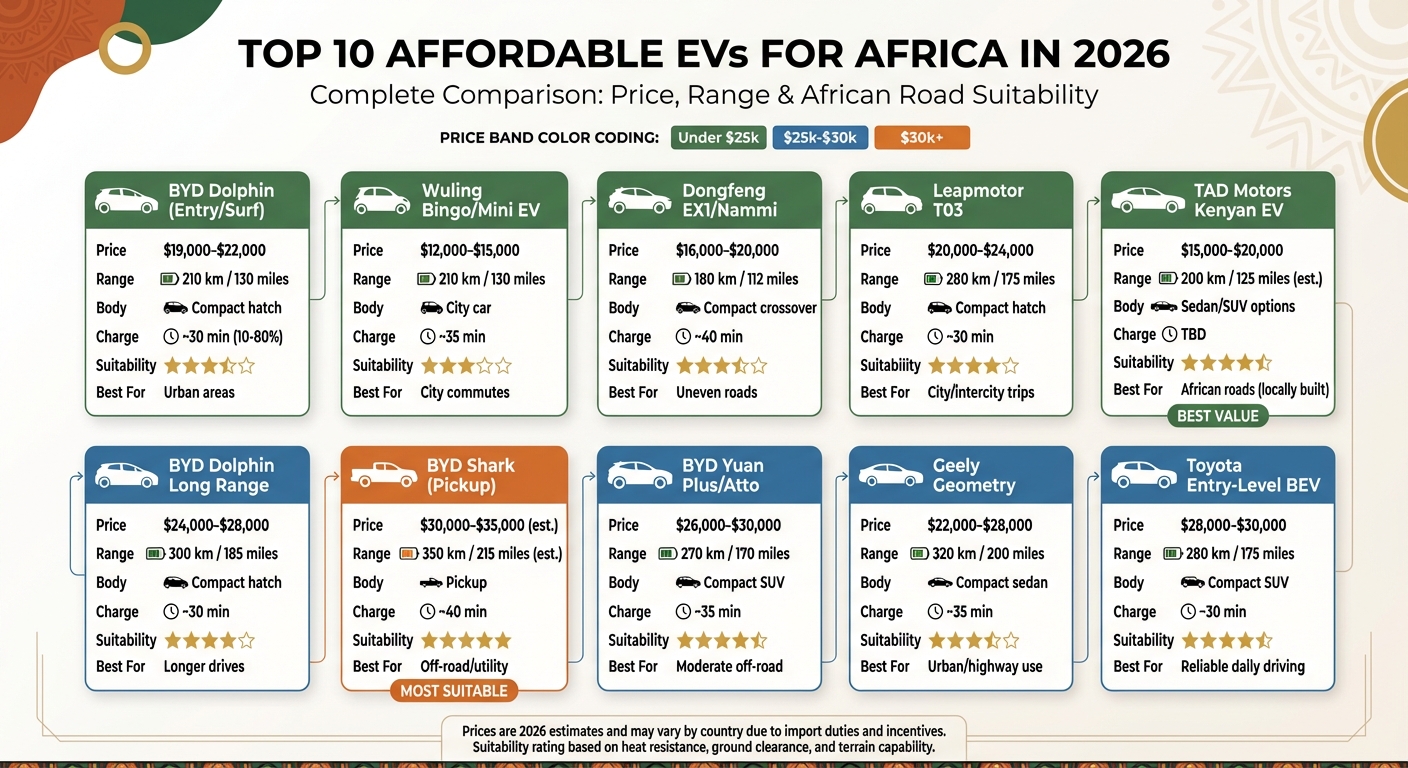
Here’s a detailed side-by-side look at ten affordable electric vehicles (EVs) expected to be available in Africa by 2026. The table highlights essential features like estimated prices (in U.S. dollars), battery capacity, real-world driving range (in kilometers and miles), body type, charging times, and suitability for Africa’s unique conditions. Keep in mind that prices are projections for 2026 and may vary based on factors like country-specific incentives, import duties, and local market dynamics.
| Model & Variant | Estimated 2026 Price | Price Band | Battery Size (kWh) | Real-World Range (km / miles) | Body Type | DC Fast-Charge Time (10–80%) | Suitability for African Conditions (1–5) |
|---|---|---|---|---|---|---|---|
| BYD Dolphin – Entry/Surf | $19,000–$22,000 | Under $25,000 | 30.7 LFP | 210 km / 130 mi | Compact hatch | ~30 min | 3.5/5 – Great for urban areas with heat-resistant design, but lacks off-road clearance. |
| Wuling Bingo / Mini EV–class | $12,000–$15,000 | Under $25,000 | 26.5 | 210 km / 130 mi | City car | ~35 min | 3/5 – Budget-friendly for city commutes; limited range and clearance suit dense urban environments. |
| Dongfeng EX1 / Nammi | $16,000–$20,000 | Under $25,000 | 26.8 | 180 km / 112 mi | Compact crossover | ~40 min | 3.5/5 – Elevated stance handles uneven roads; cooling system works for moderate climates. |
| Leapmotor T03 | $20,000–$24,000 | Under $25,000 | 41.3 | 280 km / 175 mi | Compact hatch | ~30 min | 4/5 – Balanced range and clearance make it versatile for city and short intercity trips; good heat management. |
| TAD Motors Kenyan EV | $15,000–$20,000 (projected) | Under $25,000 | ~30–35 (est.) | 200 km / 125 mi (est.) | Compact hatch | TBD | 4.5/5 – Locally built for African roads, designed to handle heat and unreliable charging infrastructure, with expected strong service support. |
| BYD Dolphin – Long Range / High Trim | $24,000–$28,000 | $25,000–$30,000 | 44.9 LFP | 300 km / 185 mi | Compact hatch | ~30 min | 4/5 – Extended range and heat-resistant battery, though ground clearance remains limited. |
| BYD Shark (Pickup/Crossover EV) | $30,000–$35,000 (est.) | $30,000–$35,000 | 60–80 (est.) | 350 km / 215 mi (est.) | Pickup | ~40 min | 5/5 – Rugged design, high clearance, and large battery capacity make it perfect for tough terrain and longer trips. |
| BYD Yuan Plus / Atto – Base | $26,000–$30,000 | $25,000–$30,000 | 49.9 LFP | 270 km / 170 mi | Compact SUV | ~35 min | 4.5/5 – Crossover design with solid cooling and growing support network, ideal for moderate off-road and hot climates. |
| Geely Geometry (Compact Sedan/Hatch) | $22,000–$28,000 | $25,000–$30,000 | 51.9–61.9 | 320 km / 200 mi | Compact sedan | ~35 min | 3.5/5 – Efficient with good range, but sedan design limits its ability to handle rough roads. |
| Toyota Entry-Level BEV (bZ4X–type) | $28,000–$30,000 | $25,000–$30,000 | ~50–60 (est.) | 280 km / 175 mi | Compact SUV | ~30 min | 4.5/5 – Trusted reliability and planned service network make it a strong contender, with a design balancing efficiency and usability. |
For those on a budget, city-focused microcars and compact hatches like the BYD Dolphin – Entry/Surf, Wuling Bingo, Dongfeng EX1, Leapmotor T03, and TAD Motors Kenyan EV offer great options under $25,000. Meanwhile, compact SUVs such as the BYD Dolphin – Long Range, BYD Yuan Plus, Geely Geometry, and Toyota BEV provide additional features in the $25,000–$30,000 range. For rugged conditions and demanding terrains, the BYD Shark stands out with its durable build and higher price point of $30,000–$35,000.
Conclusion
By 2026, Africa is set to experience a wave of affordable electric vehicles (EVs), with options ranging from Chinese imports and locally assembled models to global entries like Toyota – all priced within the $25,000–$30,000 range. These vehicles will cater to budget-conscious buyers looking for practical solutions for city commutes, family outings, and even light commercial use, moving beyond the premium-only EV market.
This growing variety ensures there’s something for every type of driver. Whether you need a compact city car, a versatile hatchback, a compact SUV, or a rugged pickup, these EVs are designed to handle real-world driving conditions across the continent. Locally assembled models, like the TAD Motors Kenyan EV, are built specifically for Africa’s unique challenges – unpredictable charging infrastructure, high temperatures, and rough roads – while also offering reliable service and durability.
When choosing an EV, focus on long-term savings, including reduced fuel costs, lower maintenance expenses, and available incentives, rather than just the upfront price. Select a model that fits your lifestyle: smaller vehicles are ideal for urban driving, while compact SUVs or crossovers provide better ground clearance and cargo space for mixed terrains. Additionally, ensure you check for local service availability, spare parts, and warranty terms to avoid future headaches.
The EV market in Africa is also being shaped by external factors. Affordable Asian imports, local manufacturing efforts, and shifting government policies are paving the way for cleaner and more affordable transportation. While challenges like high import duties, limited public charging infrastructure, and grid instability remain – particularly in countries like South Africa – progress is evident. More sub-$30,000 EVs are entering the market, early charging networks are being developed by manufacturers, and local assembly initiatives are gaining traction, all tailored to meet Africa’s unique needs for durability and practicality.
For many urban and suburban drivers, an affordable EV from this emerging lineup is already a realistic option as a primary or secondary vehicle.
Think of these EVs as tools to cut costs and reduce dependence on fuel. Keep an eye on release dates for your preferred models, explore home charging solutions, and stay informed about policy changes to ensure you get the best value.
FAQs
What should I look for in an affordable EV that’s suitable for African roads?
When picking an affordable electric vehicle (EV) for driving on African roads, it’s essential to focus on features that deliver reliability, good performance, and practicality. Cost and range should be top of mind – look for models priced under $30,000 that offer a range of 150–250 miles per charge. These specifications are perfect for daily commutes and shorter trips.
Durability is another key factor. Roads in many areas can be rough or unpaved, so prioritize EVs with at least 5.5 inches of ground clearance, reinforced suspension systems, and dust-resistant designs to handle tougher conditions.
Hot climates add another challenge, making battery resilience critical. EVs with lithium-iron-phosphate (LFP) batteries are a smart choice, as these batteries are better equipped to handle high temperatures, ensuring steady performance and a longer lifespan.
Lastly, consider charging flexibility. Vehicles with fast-charging capabilities, home charging times between 6–9 hours, and compatibility with developing public charging networks will make ownership much more convenient. By focusing on these features, you can find an EV that’s not only affordable but also ready to meet the unique demands of driving in Africa.
How does local EV assembly, like TAD Motors in Kenya, affect affordability and reliability?
Local assembly of electric vehicles (EVs), like the initiatives by TAD Motors in Kenya, has the potential to make EVs more affordable and reliable for consumers. By producing vehicles locally, companies can cut down on import taxes, shipping fees, and other related costs. This often leads to lower prices, making EVs a more viable option for a larger segment of the population in African markets.
Building vehicles locally also means manufacturers can better adapt to regional needs. For example, they can design EVs to handle rougher roads or withstand hotter climates. Plus, local production typically ensures quicker access to spare parts and maintenance services, which can improve the vehicles’ reliability over time. Although specific insights into TAD Motors’ contributions are limited, local assembly remains a promising approach to making EVs a practical and accessible choice in Africa.
What are the main challenges for EVs in Africa, like charging access and handling rough terrain?
Electric vehicles in Africa face a tough road ahead, largely due to a lack of charging infrastructure and the continent’s varied and often challenging road conditions. By 2025, Africa had just 903 public charging stations, and only 17% of countries could boast ten or more chargers. This leaves vast urban and rural areas without dependable fast-charging options. For those considering home charging, the costs can be steep – averaging around $826 per installation. To make matters worse, many national power grids are already under strain, making it difficult to meet the extra electricity demand. This combination fuels "range anxiety", discouraging potential EV buyers.
On top of that, Africa’s rugged terrain and unpaved roads create additional hurdles for affordable EVs, which are often designed with city driving in mind. These vehicles typically feature lower ground clearance – around 5.5 to 7 inches – and limited suspension travel, making them ill-suited for gravel roads, steep hills, or areas prone to flooding. While manufacturers like Hyundai and Citroën offer more durable models, such as the Hyundai Kona and Citroën ë-C3, the market still lacks a broader selection of EVs built to handle Africa’s demanding driving conditions.