
 Thabo Nkosi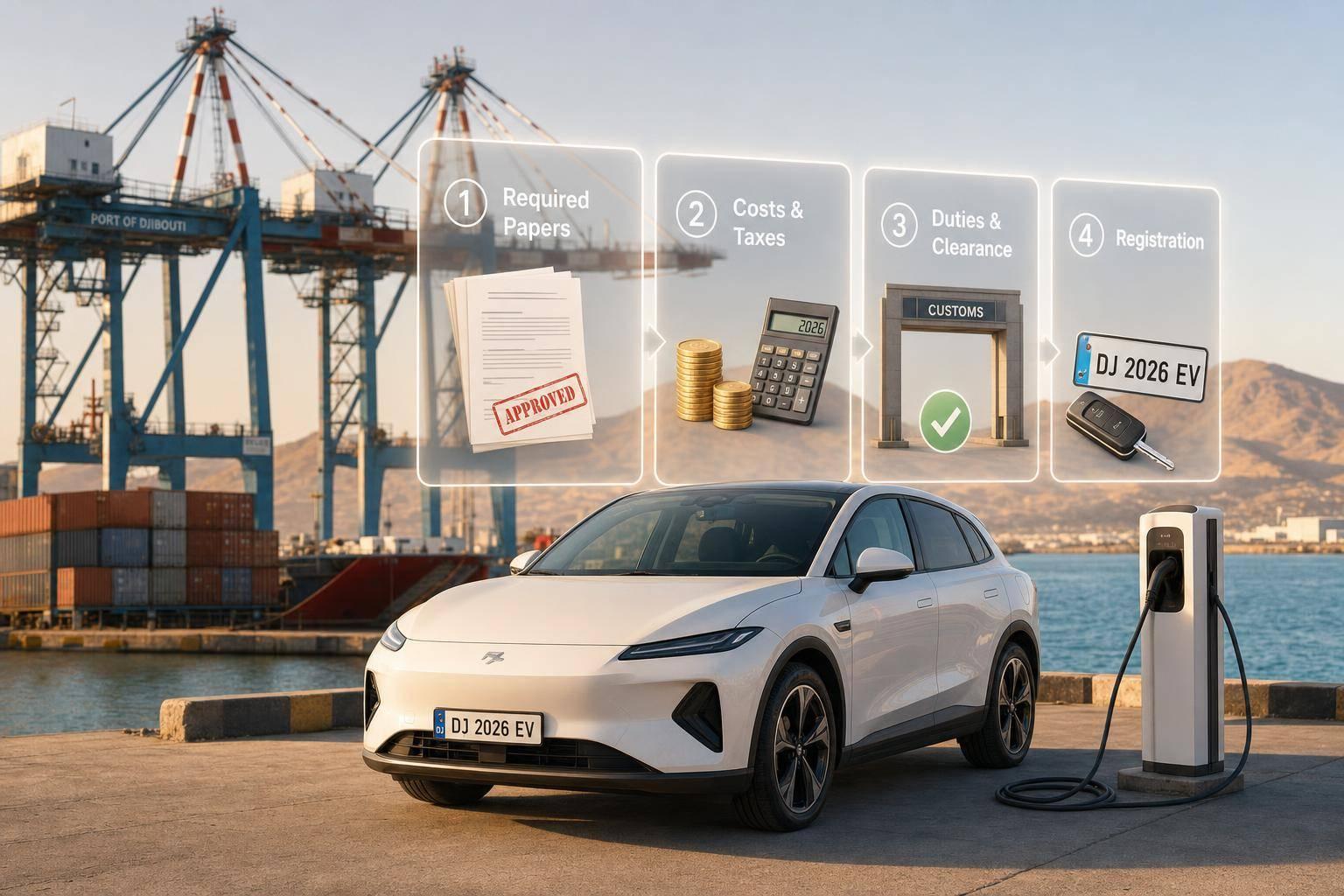
If I import an EV to Djibouti in 2026, I need to budget far beyond the sale price. My total cost usually includes the car, shipping, insurance, customs duty, 10% TIC, 10% VAT, port charges, clearing fees, registration, plates, and annual road tax.
Here’s the short version:
- I start with CIF: car price + freight + insurance
- Djibouti customs taxes the CIF amount, not just the car price
- Customs duty may range from about 5% to 25%, based on classification
- After duty, I also pay:
- 10% domestic consumption tax (TIC)
- 10% VAT
- Port costs can include handling, towing, transfer, and storage after 3 free days
- Used EVs need more paperwork than new ones
- Registration usually takes about 3 days to 1 week after a complete file
A simple example: if my EV costs $15,000, freight is $1,800, and insurance is $200, my CIF is $17,000. That CIF then feeds into the tax math. In the article’s sample case, a $20,000 CIF with 5% duty leads to $5,410 in import taxes before port, clearing, and registration costs.
What I’d check first:
- Vehicle documents: invoice, Bill of Lading, export papers, ID, ownership papers
- Used-car papers: Interpol clearance, non-pledge certificate, inspection papers
- Shipping method: RoRo or container, and whether the carrier accepts EV batteries
- Port timing: storage starts after the free period
- Registration costs: carte grise, plates, stamps, inspection, and vignette
This article walks through the cost chain from purchase to plates, so I can price the import before I commit.
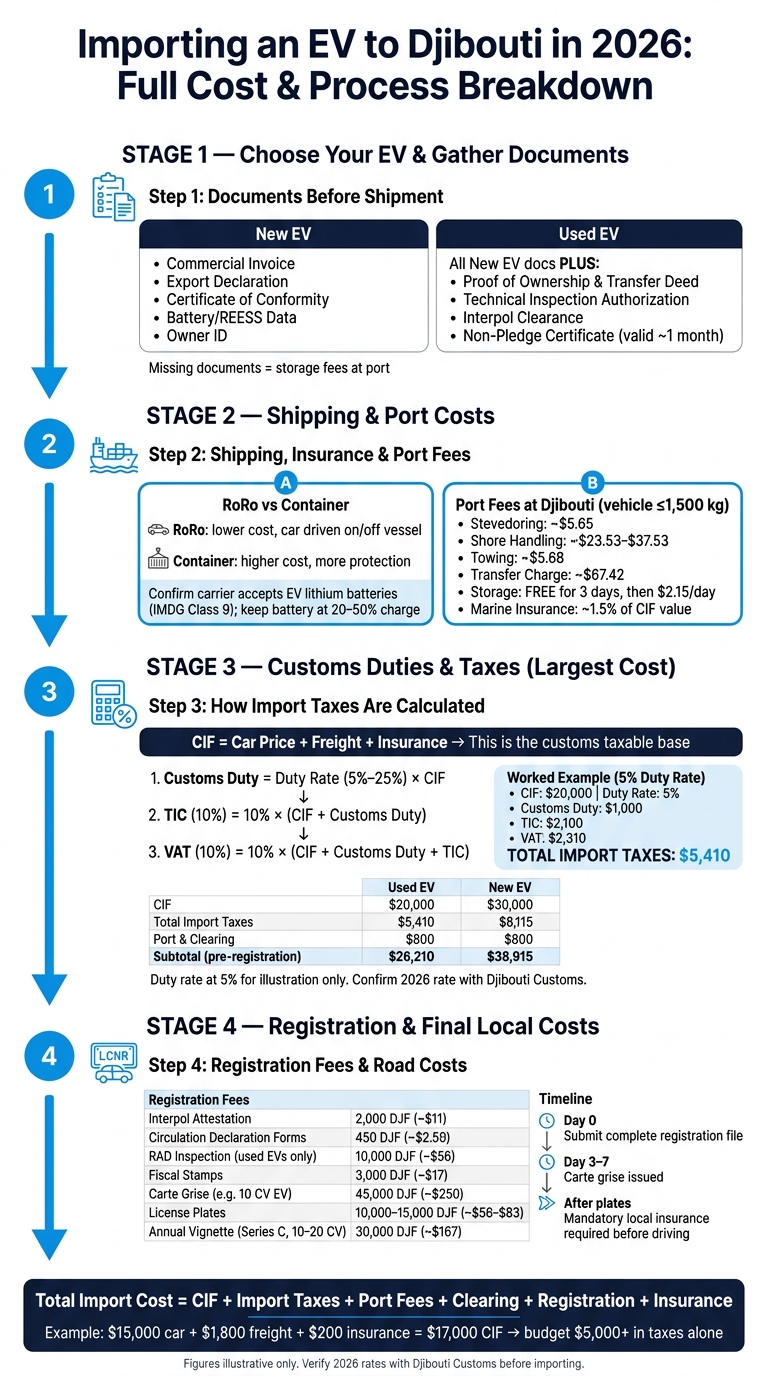
How to Import an Electric Car to Djibouti: Full Cost Breakdown (2026)
Step 1: Choose Your EV and Gather Export Documents
Before you ship, pin down the vehicle details and get the paperwork in order. Missing documents can hold up clearance and add storage fees in Djibouti. Check the exact model, trim, battery size, and VIN before the car leaves the export country.
Once the paperwork is set, the next big cost piece is shipping and port handling.
Documents to Collect Before Shipping
Djibouti requires complete original documents for used-vehicle imports under Decree n°2018-203. You should collect these before shipment:
- Commercial invoice – shows the vehicle price and the destination address in Djibouti
- Bill of Lading – the shipping document issued by the freight carrier
- Proof of ownership and transfer deed – registration certificate or deed of sale signed by the original owner, plus the legalized transfer deed confirming the ownership change
- Technical inspection authorization from an approved inspection center in the export country
- Interpol control document confirming the vehicle is not reported stolen
- Legalized copy of the export declaration from the country of origin
- Certificate of non-pledge proving no lender or third party has a claim on the vehicle; this is often valid for only one month
- Owner’s passport or government-issued ID
For EVs, customs may also ask for battery technical documents, such as a REESS sheet.
New vs. Used EV: Paperwork Differences
Used EVs need the full ownership trail. That usually means prior registration, transfer papers, Interpol clearance, and non-pledge proof.
New EVs usually need the commercial invoice, export declaration, and certificate of conformity. One small catch: if a new EV is moving on temporary transit plates, treat it like a used vehicle for paperwork purposes and include the ownership documents too.
Table: Import Document Checklist
| Document | Issued By | Timing | Used/New |
|---|---|---|---|
| Commercial invoice | Seller / dealer | Before shipment | Both |
| Bill of Lading | Freight carrier | At time of shipment | Both |
| Proof of ownership and transfer deed | Export country authority / notary | Before shipment | Used |
| Technical inspection authorization | Approved inspection center (export country) | Before shipment | Used |
| Interpol clearance | Police / authorized channel (export country) | Before shipment | Used |
| Export declaration | Customs authority (export country) | At time of export | Both |
| Non-pledge certificate | Vehicle registry or notary (export country) | Within about one month of shipment | Used |
| Owner ID or passport | Government-issued | Before shipment | Both |
| Battery technical data / REESS | Manufacturer | Before shipment | Both (EVs) |
| Certificate of conformity | Manufacturer / dealer | Before shipment | New |
With these documents ready, you can move on to freight, insurance, and port charges.
sbb-itb-99e19e3
Step 2: Estimate Shipping, Insurance, and Port Costs
Set aside money for freight, insurance, port fees, and possible storage delays. Start with the shipping method first, because that choice affects both the freight bill and whether the EV will be accepted for transport.
RoRo vs. Container Shipping to Djibouti
RoRo (roll-on/roll-off) is usually the lower-cost option for a drivable EV, though pricing depends on the origin, route, and vehicle size. The process is simple: the car is driven onto the vessel at the departure port and driven off in Djibouti. Less handling usually means a lower bill.
Container shipping costs more, but it gives the vehicle more protection from weather and handling damage. That can be worth it if you’re moving a higher-value EV or sending charging gear with the car.
There’s one more thing to check before you book. Lithium-ion EVs are Class 9 dangerous goods under the IMDG Code, but some RoRo carriers still accept them under Special Provision 961. Don’t assume it’s fine just because the car runs. Confirm with the carrier that your EV is accepted, and ask if they need advance approval or battery paperwork. Keep the battery charge between 20% and 50% for transport.
Once you’ve picked the shipping method, move on to insurance and the port bill in Djibouti.
Marine Insurance and Djibouti Port Fees
Marine insurance is part of CIF, which is the customs value used by customs. A typical all-risk marine policy for a vehicle is about 1.5% of the declared CIF value. In plain English, insure the car for the full invoice or replacement value, plus freight.
And freight isn’t the whole story. Port charges in Djibouti can slow down release if you’re not ready.
After the vehicle arrives, Djibouti applies charges for stevedoring, shore handling, towing, and a transfer fee before release. For a vehicle under 1,500 kg, expect:
- Stevedoring of about $5.65
- Shore handling of $23.53–$37.53
- Towing of about $5.68
- A transfer charge of about $67.42 per unit
Storage is free for the first 3 days after discharge. After that, charges start ticking. A vehicle under 1,500 kg costs $2.15 per day, while a vehicle in the 1,501–3,000 kg band costs $5.30 per day. That may not sound like much at first, but a few extra days can add up fast. Have your clearing agent lined up before the vessel arrives so the car doesn’t sit in the yard longer than needed.
Table: Shipping and Port Cost Components
| Cost Item | What It Covers | Included in CIF? | When You Pay |
|---|---|---|---|
| Ocean freight (RoRo or container) | Moving the vehicle from origin to Djibouti port | Yes (freight portion) | Before or at booking |
| Origin inland transport | Moving the car to the export port | No | Before shipment |
| Export paperwork fees | Export declaration, carrier paperwork | No | Before shipment |
| Marine insurance premium | All-risk coverage during transit (~1.5% of CIF value) | Yes (insurance portion) | Before or at shipment |
| Terminal handling charge (origin) | Loading and port processing at origin | No | At loading |
| Stevedoring (Djibouti, ≤1,500 kg) | Unloading from vessel | No | On arrival |
| Shore handling (Djibouti, ≤1,500 kg) | Moving vehicle within port terminal | No | On arrival |
| Towing (Djibouti, ≤1,500 kg) | Repositioning within port yard | No | On arrival |
| Transfer charge (Djibouti) | Vehicle transfer to storage or release area | No | On arrival |
| Port storage (after 3 free days, ≤1,500 kg) | Yard storage at $2.15/day per unit | No | Before vehicle release |
| Customs broker / clearing agent | Document handling and customs submission | No | Before or at clearance |
Step 3: Clear Customs and Calculate Duties and Taxes
How Customs Clearance Works After the EV Arrives
After port fees, customs duty and taxes are usually the biggest moving part in your import cost. Once the EV reaches the Port of Djibouti, begin customs clearance right away. It helps to appoint a licensed clearing agent before the vehicle arrives. That agent submits the electronic declaration through the automated customs system in the port community system (DPCS) using the correct HS code.
After filing, customs assigns a clearance channel. A documentary review channel usually means customs checks the paperwork only. An inspection channel may lead to a physical inspection at the port or in a bonded area. If that happens, an officer may check the VIN, the vehicle’s condition, and any optional equipment against your documents.
Once customs finishes the assessment, it issues the duty and tax calculation. You then pay through a designated bank or an approved electronic payment channel. After payment, you receive a customs payment receipt and release document. Keep both safe. You’ll need them later for vehicle registration.
One more thing: if customs thinks your CIF value looks too low, it can reject that figure and use a reference value instead. That pushes up every tax line. This is why the invoice, bill of lading, and proof of payment from Step 1 matter so much. If those documents don’t match, release can slow down.
How to Calculate Duty, Consumption Tax, and VAT from CIF
Djibouti’s 2025 budget law introduced a 10% domestic consumption tax (TIC) and 10% VAT for electric vehicles for domestic use in Djibouti.
Once you have your CIF value, use this sequence to estimate the tax bill. Before you lock in your budget, confirm the actual 2026 duty rate with Djibouti Customs or your clearing agent, since it may change by HS classification.
- Customs duty = applicable duty rate × CIF
- TIC = 10% × (CIF + customs duty)
- VAT = 10% × (CIF + customs duty + TIC)
Using a CIF of $20,000 and a sample 5% customs duty, the math looks like this:
- Customs duty: 5% × $20,000 = $1,000
- TIC: 10% × ($20,000 + $1,000) = $2,100
- VAT: 10% × ($20,000 + $1,000 + $2,100) = $2,310
- Total import taxes: $5,410
That total can shift a lot with the duty rate. So before you buy, run your budget at 0%, 5%, and 10% duty. It’s a simple stress test, and it can save you from a nasty surprise. After that, add port and clearing charges to get your landed cost.
Table: Landed Cost Breakdown Examples
The table below shows two sample cases, one used EV and one new EV, so you can see how the costs stack up before registration. Customs duty is shown at 5% just for illustration. Check the actual 2026 rate before using these numbers.
| Cost Component | Used EV (Hypothetical) | New EV (Hypothetical) |
|---|---|---|
| Vehicle purchase price | $17,000 | $27,000 |
| Shipping and marine insurance | $3,000 | $3,000 |
| CIF value | $20,000 | $30,000 |
| Customs duty (5% of CIF) | $1,000 | $1,500 |
| Domestic consumption tax / TIC (10% of CIF + duty) | $2,100 | $3,150 |
| VAT (10% of CIF + duty + TIC) | $2,310 | $3,465 |
| Total import taxes | $5,410 | $8,115 |
| Port, handling, and clearing fees (est.) | $800 | $800 |
| Subtotal before registration | $26,210 | $38,915 |
Figures are illustrative only. Actual costs depend on the specific vehicle, origin, shipping route, and the 2026 duty rate confirmed by Djibouti Customs.
After customs release, move to registration, plates, and inspection in Step 4.
Step 4: Register the EV in Djibouti and Account for Final Local Costs
Registration Documents and Approval Steps
Customs clearance gets your EV off the ship. Registration is what puts it on the road.
Start your registration file with the customs receipt from Step 3. After customs release, you move to local registration so the EV can be used legally on public roads. At this stage, the last main costs are registration, license plates, and the first-year road tax.
Registration is handled by the Direction des mines et de sécurité routière under the Préfecture de Djibouti. Once customs is cleared, you submit the full registration file with all supporting documents.
File the customs receipt, customs clearance attestation, and vehicle papers together.
| Document | New EV | Used EV |
|---|---|---|
| Customs attestation for vehicle registration (AIV) | ✓ | ✓ |
| Customs duty and tax payment receipt (quittance) | ✓ | ✓ |
| Interpol attestation | ✓ | ✓ |
| National ID card or passport | ✓ | ✓ |
| Vehicle circulation declaration forms | ✓ | ✓ |
| RAD inspection certificate | – | ✓ |
You should also add the vehicle’s foreign registration or deregistration papers, the purchase invoice, and the Bill of Lading. The Interpol attestation shows that the vehicle is not stolen. Police issue it using the VIN and the foreign registration. If you’re registering a used EV, you also need the technical inspection and the RAD inspection certificate before final registration.
Once the file is complete, the carte grise is usually issued in about 3 days to one week.
Registration Fees, Plates, and Other Local Charges
Set these local charges aside from customs duties and port fees. That’s where people often get tripped up.
| Cost Item | Estimated Amount |
|---|---|
| Interpol attestation fee | 2,000 DJF (~$11) |
| Vehicle circulation declaration forms | 450 DJF (~$2.50) |
| RAD technical inspection (used EVs only) | 10,000 DJF (~$56) |
| Fiscal stamps (3 × 1,000 DJF) | 3,000 DJF (~$17) |
| Carte grise – example for a 10 CV EV (4,500 DJF × 10 CV) | 45,000 DJF (~$250) |
| License plates (illustrative estimate) | 10,000–15,000 DJF (~$56–$83) |
| Annual vignette – Series C (10–20 CV) | 30,000 DJF (~$167) |
Conversions use 180 DJF = $1. Verify current rates before budgeting.
The carte grise costs 4,500 DJF per CV. For an EV, the fiscal horsepower equivalent depends on how the registration office converts motor output from kW to CV. So before you set your budget, check how your model will be classified. If the EV is rated at 10 CV, it falls under Series C (10–20 CV) and the annual vignette is 30,000 DJF.
After you get the carte grise and plates, there’s still one more box to check: mandatory local insurance. You can’t drive on public roads without it. The vignette also has to be renewed each year.
Conclusion: A Checklist to Avoid Surprise Costs
Before you wrap up the import, make sure both your paperwork and your budget are ready:
- Confirm your file is complete: AIV, customs receipt, Interpol attestation, owner ID, circulation declaration forms, and the vehicle’s foreign registration or deregistration papers.
- Add the extra step for used EVs: technical inspection and the RAD inspection certificate.
- Budget for the official registration charges: carte grise, plates, fiscal stamps, and Interpol and administrative fees.
- Plan for the annual vignette based on the EV’s CV band.
- Do not drive until local insurance is in place.
- Expect the registration certificate to take about 3 days to one week after a complete filing.
FAQs
How much cash should I have ready before my EV arrives in Djibouti?
Before your EV arrives, make sure you have enough cash to cover the total landed cost based on the CIF value: the vehicle purchase price, plus shipping and insurance.
You’ll also want to budget for:
- 10% domestic consumption tax
- 10% VAT
- Local fees, such as port handling, storage, clearing agent or broker charges, and vehicle registration and licensing costs
It’s not just about the sticker price. Once shipping, taxes, and port-related charges are added, the final amount can climb fast.
Can Djibouti Customs reject my declared EV value?
Yes. Djibouti customs can question or reject your declared EV value if it doesn’t match your shipping and commercial documents.
If the declared value, commercial invoice, bill of lading, and certificate of origin show different figures, clearance can slow down. Djibouti customs uses CIF (Cost, Insurance, and Freight) to calculate duties and taxes, so mismatched paperwork may trigger a review, inspection, or a dispute.
What most often delays EV registration in Djibouti?
Most delays come from document inconsistencies.
If the VIN, model year, owner details, or declared value don’t match exactly across the bill of lading, commercial invoice, customs declaration, and title, authorities may pause the process for manual review.
Another common issue is missing or incomplete paperwork. That can include battery health reports, import authorizations, or local insurance issued in the owner’s name before final registration.