
 Thabo Nkosi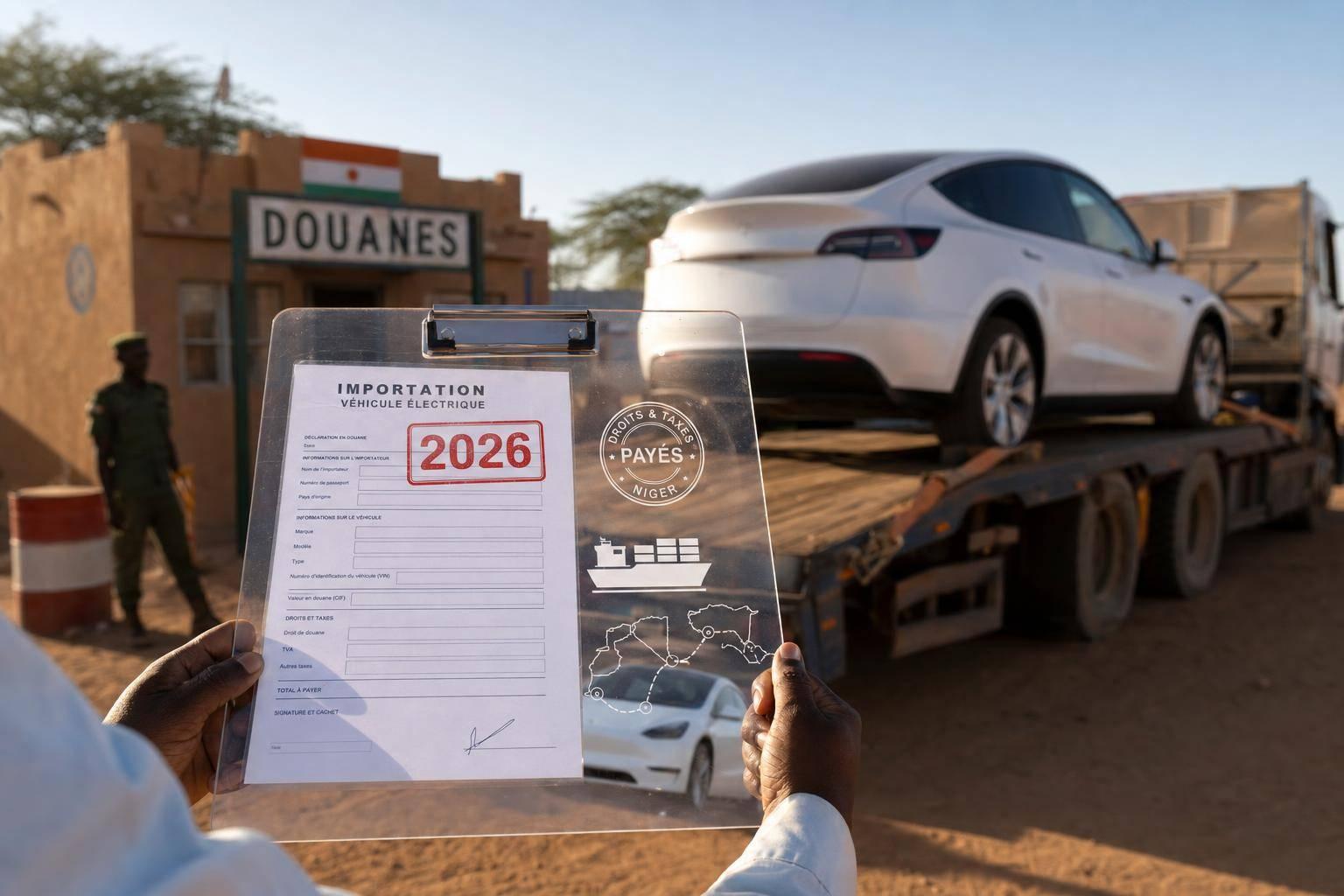
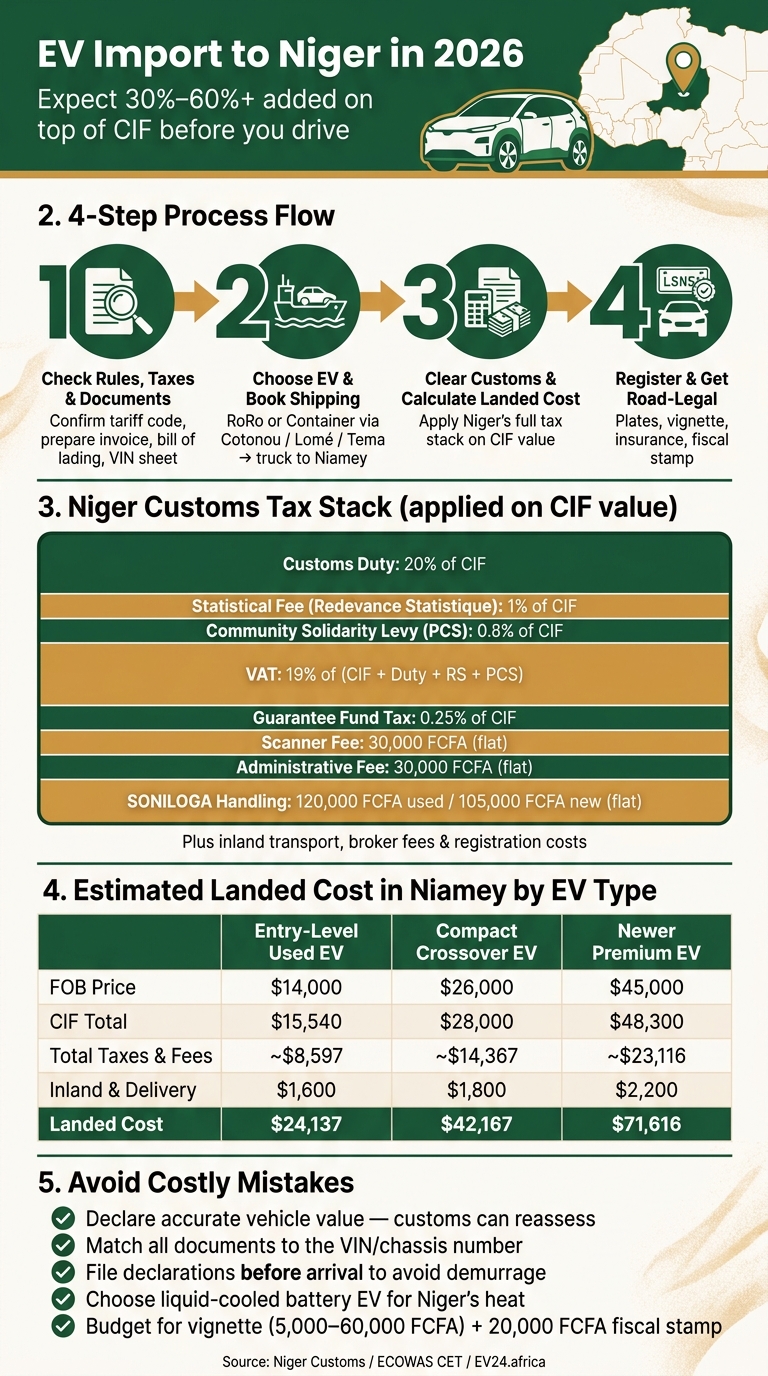
Importing an EV to Niger in 2026 can add 30% to 60%+ on top of the car’s CIF cost before registration. Since Niger is landlocked, I need to budget for sea freight to a West African port, overland transit to Niamey, customs charges, and local registration before I buy anything.
Here’s the short version:
- I usually route the car through Cotonou, Lomé, or Tema
- I may need a Preliminary Import Declaration if the vehicle value is CFA 1,000,000+ (about $1,700)
- I may need a COTECNA pre-shipment inspection if FOB value is CFA 2,000,000+ (about $3,400)
- I should expect a customs stack that often includes:
- 20% customs duty
- 1% statistical fee
- 0.8% PCS levy
- 19% VAT
- 0.25% guarantee fund tax
- flat port and handling fees
- I need to check the EV’s battery health, cooling system, ground clearance, and charging setup
- I should compare RoRo vs. container shipping
- I must match every document to the VIN/chassis number before shipping and registration
A simple example: if I buy an EV at $15,000 FOB, then add $1,500 freight and $300 insurance, the CIF becomes $16,800. Taxes and fees are then charged from that higher number, not just from the sale price.
How to Import an EV to Niger in 2026: Full Cost & Step-by-Step Process
Quick overview
| Item | What I need to know |
|---|---|
| Main route | Ship to a nearby port, then truck into Niger |
| Tax base | CIF = FOB + freight + insurance |
| Usual duty band | 20% for many passenger cars from outside ECOWAS |
| VAT | 19% |
| Extra fixed costs | Scanner, admin, SONILOGA, inland delivery, broker fees |
| Key risk | Delays from bad paperwork, low declared value, or missed inspections |
Bottom line: I should work out the full landed cost first, then decide whether the EV still fits my budget. The article walks through the rules, shipping path, customs math, and registration steps in the order I’d handle them.
sbb-itb-99e19e3
Step 1: Check Niger’s EV Import Rules, Taxes, and Required Documents
Niger does not use a separate customs category for EVs. In practice, imported EVs are cleared as motor vehicles under the ECOWAS Common External Tariff. That means customs treatment depends on the tariff code, declared value, origin, and paperwork – not on whether the car has a battery or an engine. For most passenger cars coming from outside ECOWAS, the customs duty usually falls in the 20% band.
So, don’t bank on an EV tax break. Before you send money to the seller, confirm the current tariff line and any possible incentive with Niger customs, a licensed customs broker, or SONILOGA. A small check up front can save a big headache later.
Know the Taxes and Fees Due on Arrival
Niger applies a stack of import charges that includes duty, levies, VAT, and fixed fees.
| Charge | Rate / Amount | Basis |
|---|---|---|
| Customs duty | 20% | CIF value |
| Statistical fee (Redevance Statistique) | 1% | CIF value |
| Community solidarity levy (PCS) | 0.8% | CIF value |
| VAT | 19% | CIF + duty + RS + PCS |
| Guarantee fund tax | 0.25% | CIF value |
| Scanner fee | 30,000 FCFA | Flat per vehicle |
| Administrative fee | 30,000 FCFA | Flat per vehicle |
| SONILOGA handling fee | 120,000 FCFA for used vehicles; 105,000 FCFA for new vehicles | Flat per vehicle |
This is the base of your landed-cost math before freight, inland transport, and registration are added.
It’s also worth separating taxes from logistics costs. Port and inland transit charges are not the same as Niger customs charges. For example, scanner fees at the Port of Cotonou – about 25,000 FCFA per vehicle – and convoy costs on the Cotonou–Niamey corridor are transport expenses, not Niger tax liabilities.
Prepare the Documents Customs Brokers Require
Once you’ve estimated the taxes, get the paperwork in order before the vehicle ships. Brokers and transit forwarders in Niger will usually ask for:
- Commercial invoice and bill of sale – showing the purchase price, seller details, transaction date, and exporter contact information
- Proof of payment – bank transfer records or payment confirmation that matches the invoice
- Foreign title or registration certificate – proof of legal ownership in the export country
- Bill of lading – issued by the shipping line to show the vehicle is on board
- Packing list – needed if the EV ships in a container
You should also include the EV’s technical sheet. It should show battery capacity, motor power, charging standard, VIN, curb weight, and whether the vehicle is new or used. Adding a photo of the VIN plate can help cut down inspection delays.
Once the tax stack and document file are sorted, you can move on to the EV model and shipping setup that make sense for Niger’s roads, climate, and inland route.
Step 2: Choose a Suitable EV and Book Shipping to Niger
Next, pick an EV that can handle Niger’s heat, rougher roads, and long inland trip. That choice doesn’t just affect day-to-day use. It also changes shipping risk and the customs bill you’ll work out next.
Pick an EV Model That Fits Niger’s Climate and Road Conditions
Niger isn’t the place to choose an EV based on brochure range alone. Heat, potholes, and limited fast charging should guide your decision.
Start with the battery setup. A liquid-cooled battery is a smart pick in hot weather because it helps manage heat better than simpler cooling systems. Ground clearance matters too. On roads with potholes and rough patches, a low sedan can be a headache. That’s why crossover and compact SUV EVs often make more sense. They usually give you better underbody protection, which can save you trouble once you’re outside the capital.
Charging setup is just as important. Look for a 7.2–11 kW onboard charger. DC fast charging is limited, so most charging will depend on 230V single-phase supply. In plain English: your EV needs to be comfortable living without a big fast-charging network.
Range also needs a reality check. In Niger’s heat, with the AC running, real-world range can drop 10–25% below the EPA or WLTP figure. So don’t get too hung up on the headline number in the sales sheet. Pay more attention to usable battery capacity and how well the battery handles heat.
Service is another piece people often skip, and then regret later. Go for models with parts that are easier to source and service manuals that technicians can actually use. That gives local mechanics a better shot at keeping the car on the road.
If you’re buying used, ask for:
- A battery State of Health (SoH) report
- A full VIN-based history showing any accident or flood records
- Service records for battery and charging system work
- Clear underbody photos
Try to avoid used EVs below about 80% SoH. Once battery health drops past that point, range and resale value tend to fall hard.
EV24.africa can help pre-screen listings for climate fit, arrange battery checks, and help you avoid models known for heat-related throttling or fast battery wear.
Compare RoRo and Container Shipping for Cost, Protection, and Transit Needs
The two main ways to ship a vehicle are Roll-on/Roll-off (RoRo) and container shipping.
RoRo is usually the lower-cost option. The vehicle is driven onto a carrier ship and parked on a protected deck. It’s a good fit for a standard EV that runs well and doesn’t need to travel with extra cargo.
Container shipping costs more, but your vehicle gets its own sealed unit. That added protection can make a lot of sense for a higher-value EV, a non-running unit, or a shipment that includes items like a home charger, spare wheels, or tools.
| Shipping Method | Cost Level | Protection Level | Best For |
|---|---|---|---|
| RoRo | Lower to moderate | Moderate (ship decks) | Standard, operational EVs where budget is critical and extra cargo is minimal |
| Container | Higher | High (sealed container) | Premium EVs, damaged or non-operational units, or shipments including valuable spares and chargers |
Use current freight quotes to compare both options based on the vehicle’s value, condition, and any extra cargo.
Route the Vehicle Through the Right West African Port
Your port choice affects inland trucking time, storage risk, and the paperwork you’ll deal with on the way in.
For Niger-bound EVs, Cotonou is the usual gateway, with road transit to Niamey through the Malanville–Gaya corridor under regional transit procedures. This route is well known, but it still needs people who know the process cold. The paperwork chain includes Beninese export formalities, transit bond requirements, and Nigerien import clearance. If any part of that sequence gets mishandled, the vehicle can end up stuck at the port or at the border.
A corridor agent with hands-on experience can help you avoid port storage fees and long heat exposure while the vehicle sits waiting. EV24.africa can work with corridor agents to line up shipping arrival dates, transit papers, and inland trucking so the vehicle keeps moving without avoidable delays or extra costs.
Step 3: Clear Customs in Niger and Calculate the Full Landed Cost
Once the EV moves into the inland corridor, customs becomes the next big cost driver. At that point, the sticker price matters a lot less than the landed total. That’s where many buyers get tripped up.
Calculate Customs Value from CIF and Apply Niger’s Tax Stack
Niger customs generally uses the CIF value as the base for import charges. CIF means the vehicle price (FOB) plus freight plus marine insurance. So if you buy a used EV for $15,000 FOB, pay $1,500 in freight, and $300 in marine insurance, your CIF comes to $16,800. Duties and taxes are then charged on that higher figure, not just the purchase price.
Duty depends on the tariff line customs assigns to the vehicle. On top of that, fixed fees apply, and if the invoice seems too low, customs can use its own reference valuation. In plain English: once customs sets the value, the rest of the bill follows a formula.
Use Example EV Budgets to Estimate a Realistic Import Total
These examples show how the landed cost builds from CIF all the way to final delivery in Niamey.
| Cost Component | Entry-Level Used EV | Compact Crossover EV | Newer Premium EV |
|---|---|---|---|
| Vehicle price (FOB) | $14,000 | $26,000 | $45,000 |
| Freight | $1,400 | $1,800 | $3,000 |
| Marine insurance | $140 | $200 | $300 |
| CIF total | $15,540 | $28,000 | $48,300 |
| Import duty | $3,108 | $5,600 | $9,660 |
| Guarantee fund (0.25%) | $39 | $70 | $121 |
| Scanner fee | $50 | $50 | $50 |
| Administrative fee | $50 | $50 | $50 |
| SONILOGA valuation fee | $200 | $200 | $200 |
| VAT | $3,550 | $6,397 | $11,035 |
| Inland transport, broker, and delivery | $1,600 | $1,800 | $2,200 |
| Estimated landed cost in Niamey | $24,137 | $42,167 | $71,616 |
The gap between CIF and final delivery can be big. In many cases, landed cost adds 30%–60% or more on top of CIF, depending on duty rates, VAT, corridor logistics, and the type of EV.
With customs cleared, the next costs shift to registration and local compliance.
Use Import Calculators and Freight Quote Tools Before You Commit
Before you send a deposit for any EV, build a simple line-by-line cost sheet. Start with CIF, then add duty, the guarantee fund, VAT, fixed fees, inland transit, and local delivery. It sounds a bit tedious, but it can save you from a nasty budget surprise later.
It also helps to get a current freight quote for your route and an insurance estimate before you commit. That way, your budget reflects the real landed cost, not just the seller’s asking price.
After customs release, the remaining costs are registration, plates, and local compliance.
Step 4: Register the EV in Niger and Reduce Avoidable Import Costs
Complete Registration, Plates, and Local Compliance After Customs Release
After customs releases the vehicle, registration is the last step before you can drive the EV legally. Gather the customs clearance certificate, duty and VAT receipts, and the inspection report. Check every document against the stamped chassis number. One wrong digit can hold up the whole process.
Next, submit the file for pre-registration inspection at the motor vehicle authority. Officials check the chassis number, confirm basic roadworthiness, and verify that customs duties were paid. Your file should include the sales invoice, national ID or company registration, customs validation certificate, insurance certificate, and completed registration forms.
Once approved, you receive the plates, registration book, and title certificate. Niger’s plate format uses a regional code, a letter series, and a registration number, such as 1A2345. In plain terms, a clean file helps you move through registration faster and keeps fee issues to a minimum.
You’ll also need to pay the vignette automobile, which is the annual road tax, at DGI offices during first registration. The amount depends on the tax band assigned by the registration office. Rates run from 5,000 CFA for the lowest band to 60,000 CFA for the highest. There is also a registration fiscal stamp of about 20,000 CFA.
Set aside money for these charges before the EV arrives. The vehicle is only road-legal after plates, insurance, and road tax are all in place.
Lower Your Total Import Bill Without Risking Penalties
Once the EV is legal on paper, the main way to save money is simple: avoid delay and penalty fees.
A big one is demurrage. To avoid it, make sure all documents are complete and error-free before the vehicle is loaded. That gives your clearing agent the chance to file declarations as soon as the car arrives and get it released within the free period.
Also, do not under-declare the vehicle’s value. Customs can reassess it, which may add duty, VAT, and extra delays.
Conclusion: How to Budget an EV Import into Niger in 2026
Importing an EV into Niger in 2026 is manageable if you plan the route, tax stack, and registration steps before you buy. Good prep at each stage is what keeps the process smooth and helps you avoid surprise costs and delays.
FAQs
Can I import a used EV with battery health below 80%?
Yes – Niger’s rules focus on the 10-year age limit, not a formal 80% battery health cutoff.
That said, importers should still provide a current battery health certificate and clear diagnostic reports that show capacity and error codes. Think of it as extra paperwork that can smooth things out at the border. It may help avoid delays, added inspections, or questions about the vehicle’s safety and roadworthiness during customs clearance.
How long does EV import clearance in Niger usually take?
There’s no set official timeline in the current records.
That said, you must file a Preliminary Import Declaration at least seven days before shipping.
To help avoid delays, make sure your paperwork is complete and accurate. Pay close attention to your proof of purchase and identification, since missing information is a common reason customs holds things up.
Which port is usually cheapest for shipping an EV to Niger?
There isn’t one cheapest port for every shipment. The total price depends on where the vehicle starts, the shipping lane, and how far it still needs to travel inland.
For Niger, the Port of Cotonou is a main entry point before overland delivery. Because Niger is landlocked, it makes more sense to compare the full route cost instead of looking at ocean freight alone. That means adding ocean shipping and inland transit together.
In many cases, RoRo shipping costs less than container shipping.